Trouble recovery
98
(2) Remove any weeds or debris from
around the jet intake, drive shaft, impel-
ler, jet pump housing, and jet thrust noz-
zle.
If debris is difficult to remove, consult a
Yamaha dealer.
EJU34641Jumping the battery
If the watercraft battery has run down, the en-
gine can be started using a 12-volt booster
battery and jumper cables.
EJU34663Connecting the jumper cables
WARNING
EWJ01250
To avoid battery explosion and serious
damage to the electrical system:
�Do not reverse the polarity of the jumper
cables when connecting to the batteries.
�Do not connect the negative (–) jumper
cable to the negative (–) terminal of the
watercraft battery.
�Do not touch the positive (+) jumper ca-
ble to the negative (–) jumper cable.
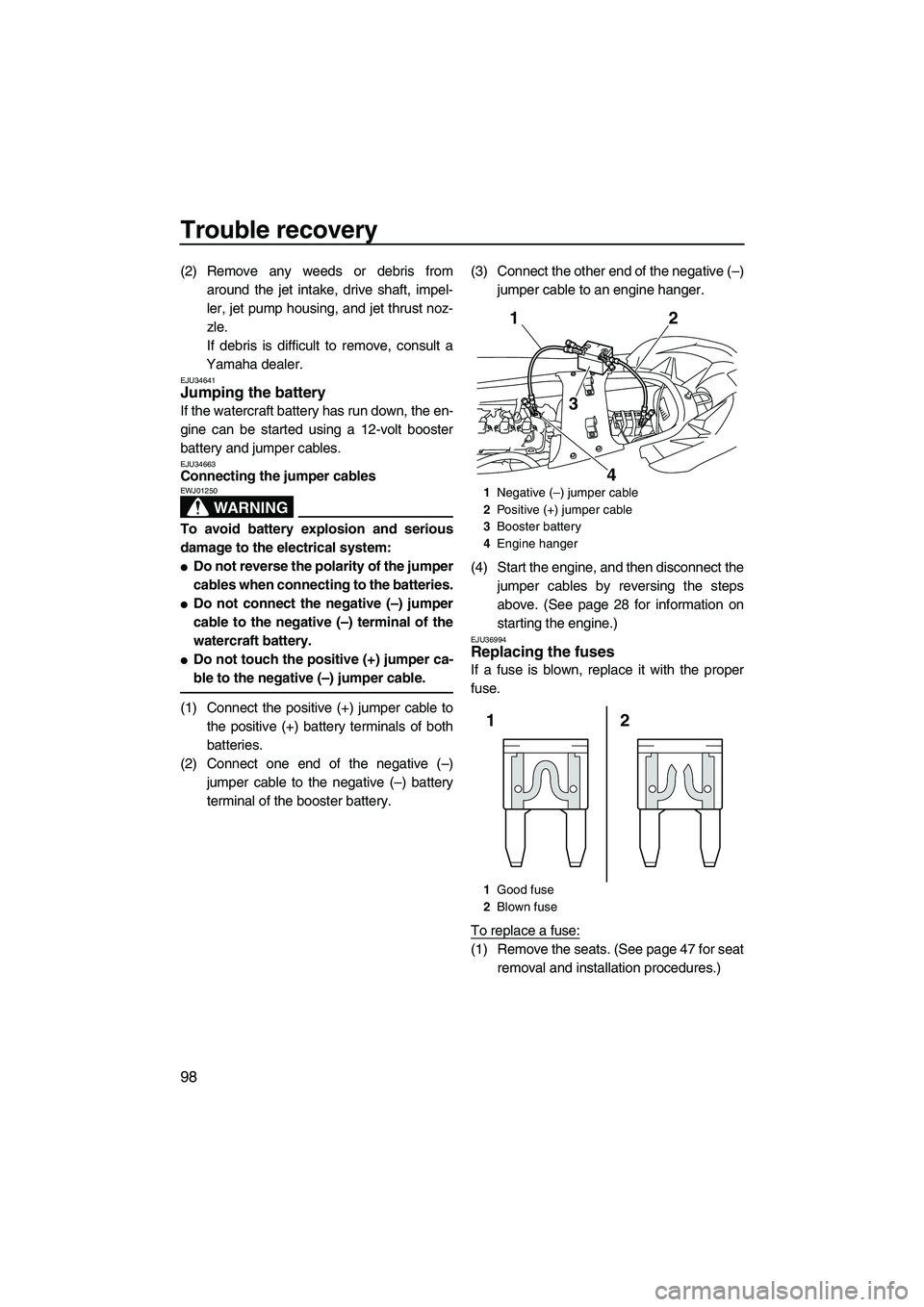
(1) Connect the positive (+) jumper cable to
the positive (+) battery terminals of both
batteries.
(2) Connect one end of the negative (–)
jumper cable to the negative (–) battery
terminal of the booster battery.(3) Connect the other end of the negative (–)
jumper cable to an engine hanger.
(4) Start the engine, and then disconnect the
jumper cables by reversing the steps
above. (See page 28 for information on
starting the engine.)
EJU36994Replacing the fuses
If a fuse is blown, replace it with the proper
fuse.
To replace a fuse:
(1) Remove the seats. (See page 47 for seat
removal and installation procedures.)
1Negative (–) jumper cable
2Positive (+) jumper cable
3Booster battery
4Engine hanger
1Good fuse
2Blown fuse
12
3
4
2 1
UF1W73E0.book Page 98 Monday, June 7, 2010 9:17 AM
Trouble recovery
100
(7) Securely install the seats in their original
positions.
If the fuse immediately blows again, the elec-
trical system may be defective. If this occurs,
have a Yamaha dealer service the watercraft.
EJU41820Replacing the bilge pump fuse
If the fuse is blown, replace it with the proper
fuse.
To replace the fuse:
(1) Remove the seats and engine cover.
(See page 47 for seat removal and instal-
lation procedures and page 89 for engine
cover removal and installation proce-
dures.)
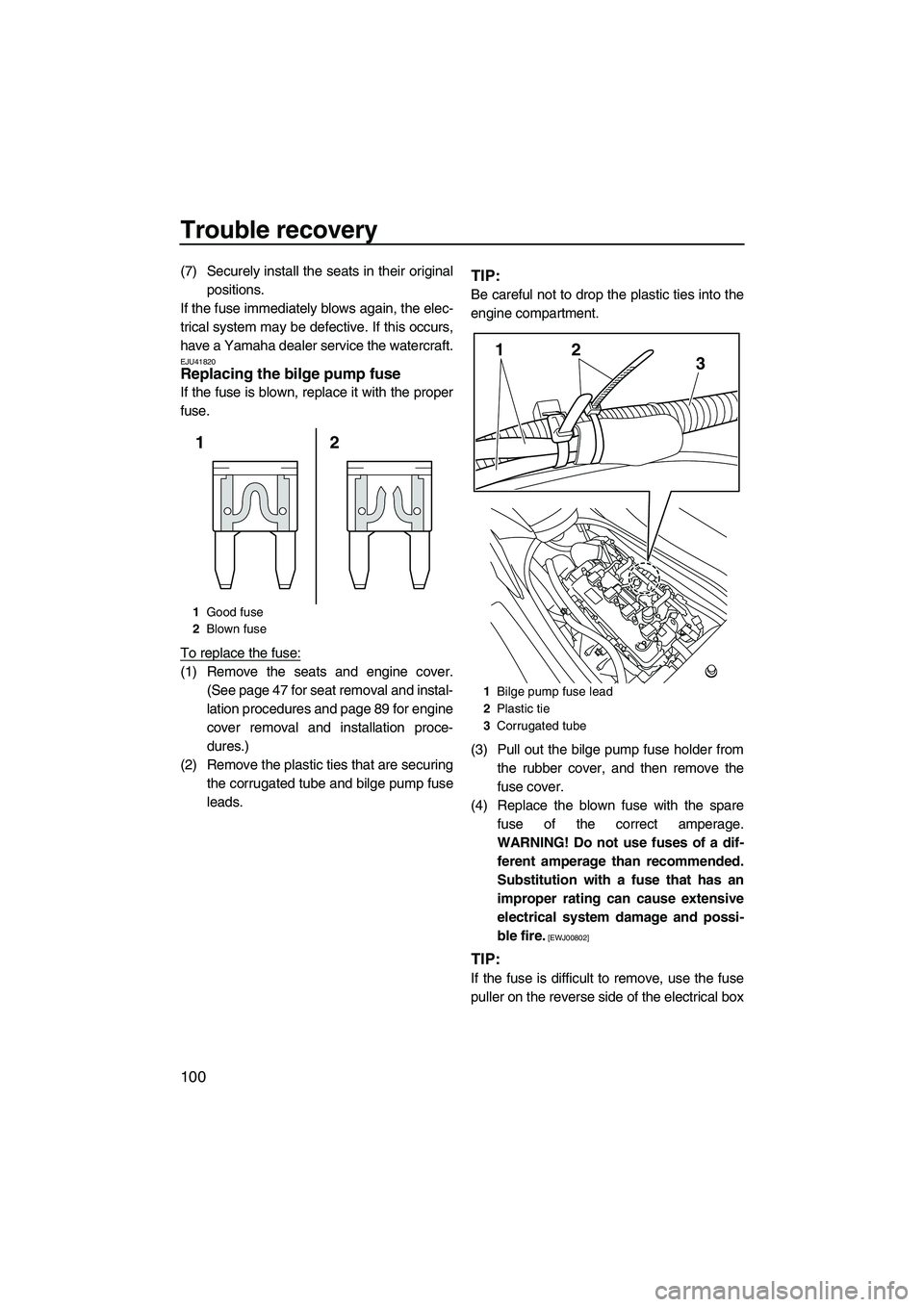
(2) Remove the plastic ties that are securing
the corrugated tube and bilge pump fuse
leads.
TIP:
Be careful not to drop the plastic ties into the
engine compartment.
(3) Pull out the bilge pump fuse holder from
the rubber cover, and then remove the
fuse cover.
(4) Replace the blown fuse with the spare
fuse of the correct amperage.
WARNING! Do not use fuses of a dif-
ferent amperage than recommended.
Substitution with a fuse that has an
improper rating can cause extensive
electrical system damage and possi-
ble fire.
[EWJ00802]
TIP:
If the fuse is difficult to remove, use the fuse
puller on the reverse side of the electrical box
1Good fuse
2Blown fuse
2 1
1Bilge pump fuse lead
2Plastic tie
3Corrugated tube
213
UF1W73E0.book Page 100 Monday, June 7, 2010 9:17 AM