warning YAMAHA T110C 2014 User Guide
[x] Cancel search | Manufacturer: YAMAHA, Model Year: 2014, Model line: T110C, Model: YAMAHA T110C 2014Pages: 82, PDF Size: 2.06 MB
Page 26 of 82
FOR YOUR SAFETY – PRE-OPERATION CHECKS
4-1
4
EAU15597
Inspect your vehicle each time you use it to make sure the vehicle is in safe operating condition. Always follow the inspection
and maintenance procedures and schedules described in the Owner’s Manual.
WARNING
EWA11151
Failure to inspect or maintain the vehicle properly increases the possibility of an accident or equipment damage.
Do not operate the vehicle if you find any problem. If a problem cannot be corrected by the procedures provided in
this manual, have the vehicle inspected by a Yamaha dealer.Before using this vehicle, check the following points:
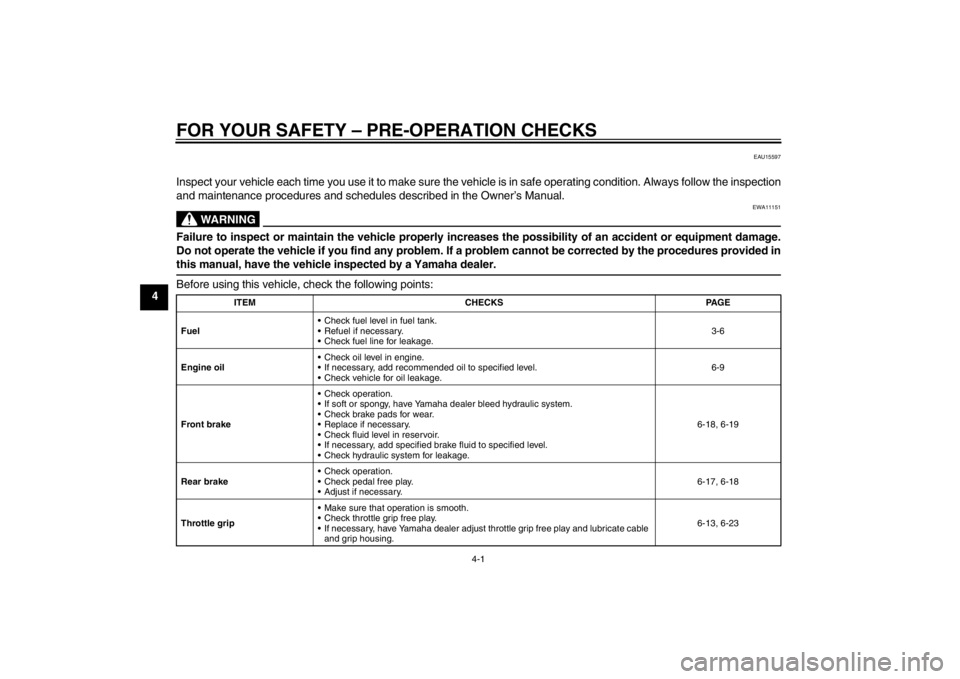
ITEM CHECKS PAGE
Fuel Check fuel level in fuel tank.
Refuel if necessary.
Check fuel line for leakage.3-6
Engine oil Check oil level in engine.
If necessary, add recommended oil to specified level.
Check vehicle for oil leakage.6-9
Front brake Check operation.
If soft or spongy, have Yamaha dealer bleed hydraulic system.
Check brake pads for wear.
Replace if necessary.
Check fluid level in reservoir.
If necessary, add specified brake fluid to specified level.
Check hydraulic system for leakage.6-18, 6-19
Rear brake Check operation.
Check pedal free play.
Adjust if necessary.6-17, 6-18
Throttle grip Make sure that operation is smooth.
Check throttle grip free play.
If necessary, have Yamaha dealer adjust throttle grip free play and lubricate cable
and grip housing.6-13, 6-23
U40BE2E0.book Page 1 Wednesday, October 10, 2012 8:01 AM
Page 28 of 82
OPERATION AND IMPORTANT RIDING POINTS
5-1
5
EAU15951
Read the Owner’s Manual carefully to
become familiar with all controls. If
there is a control or function you do not
understand, ask your Yamaha dealer.
WARNING
EWA10271
Failure to familiarize yourself with
the controls can lead to loss of con-
trol, which could cause an accident
or injury.
EAU47852
Starting and warming up a
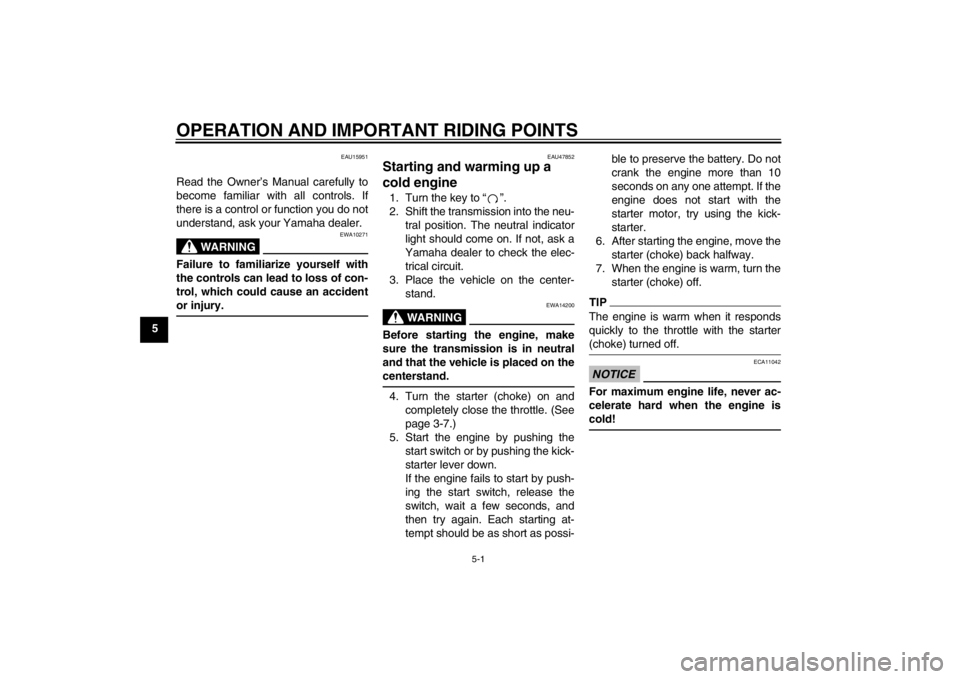
cold engine 1. Turn the key to “ ”.
2. Shift the transmission into the neu-
tral position. The neutral indicator
light should come on. If not, ask a
Yamaha dealer to check the elec-
trical circuit.
3. Place the vehicle on the center-
stand.
WARNING
EWA14200
Before starting the engine, make
sure the transmission is in neutral
and that the vehicle is placed on the
centerstand.4. Turn the starter (choke) on and
completely close the throttle. (See
page 3-7.)
5. Start the engine by pushing the
start switch or by pushing the kick-
starter lever down.
If the engine fails to start by push-
ing the start switch, release the
switch, wait a few seconds, and
then try again. Each starting at-
tempt should be as short as possi-ble to preserve the battery. Do not
crank the engine more than 10
seconds on any one attempt. If the
engine does not start with the
starter motor, try using the kick-
starter.
6. After starting the engine, move the
starter (choke) back halfway.
7. When the engine is warm, turn the
starter (choke) off.
TIPThe engine is warm when it responds
quickly to the throttle with the starter
(choke) turned off.NOTICE
ECA11042
For maximum engine life, never ac-
celerate hard when the engine is
cold!
U40BE2E0.book Page 1 Wednesday, October 10, 2012 8:01 AM
Page 31 of 82

OPERATION AND IMPORTANT RIDING POINTS
5-4
5
EAU17213
Parking When parking, stop the engine, and
then remove the key from the main
switch.
WARNING
EWA10311
●
Since the engine and exhaust
system can become very hot,
park in a place where pedestri-
ans or children are not likely to
touch them and be burned.
●
Do not park on a slope or on soft
ground, otherwise the vehicle
may overturn, increasing the
risk of a fuel leak and fire.
●
Do not park near grass or other
flammable materials which
might catch fire.
U40BE2E0.book Page 4 Wednesday, October 10, 2012 8:01 AM
Page 32 of 82

PERIODIC MAINTENANCE AND ADJUSTMENT
6-1
6
EAU17244
Periodic inspection, adjustment, and lu-
brication will keep your vehicle in the
safest and most efficient condition pos-
sible. Safety is an obligation of the vehi-
cle owner/operator. The most important
points of vehicle inspection, adjust-
ment, and lubrication are explained on
the following pages.
The intervals given in the periodic
maintenance charts should be simply
considered as a general guide under
normal riding conditions. However, de-
pending on the weather, terrain, geo-
graphical location, and individual use,
the maintenance intervals may need to
be shortened.
WARNING
EWA10321
Failure to properly maintain the ve-
hicle or performing maintenance ac-
tivities incorrectly may increase
your risk of injury or death during
service or while using the vehicle. If
you are not familiar with vehicle ser-
vice, have a Yamaha dealer perform
service.
WARNING
EWA15122
Turn off the engine when performing
maintenance unless otherwise
specified.●
A running engine has moving
parts that can catch on body
parts or clothing and electrical
parts that can cause shocks or
fires.
●
Running the engine while ser-
vicing can lead to eye injury,
burns, fire, or carbon monoxide
poisoning – possibly leading to
death. See page 1-3 for more in-
formation about carbon monox-
ide.WARNING
EWA15460
Brake discs, calipers, drums, and
linings can become very hot during
use. To avoid possible burns, let
brake components cool before
touching them.
EAU17302
Emission controls not only function to
ensure cleaner air, but are also vital to
proper engine operation and maximum
performance. In the following periodic
maintenance charts, the services relat-
ed to emissions control are grouped
separately. These services require
specialized data, knowledge, and
equipment. Maintenance, replacement,
or repair of the emission control devic-
es and systems may be performed by
any repair establishment or individual
that is certified (if applicable). Yamaha
dealers are trained and equipped to
perform these particular services.
U40BE2E0.book Page 1 Wednesday, October 10, 2012 8:01 AM
Page 45 of 82
PERIODIC MAINTENANCE AND ADJUSTMENT
6-14
6
EAU21576
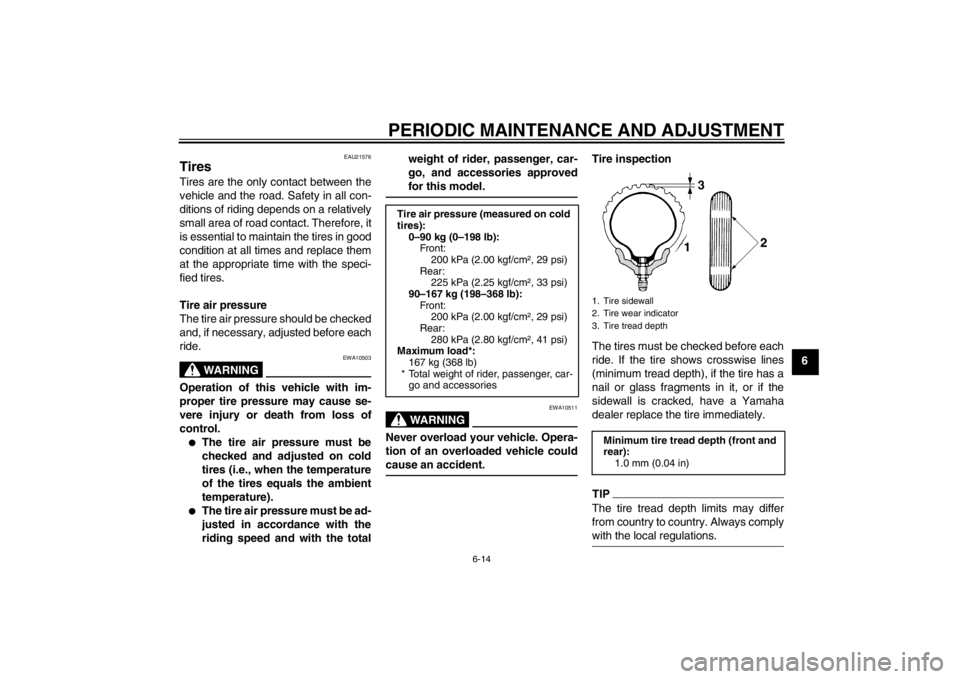
Tires Tires are the only contact between the
vehicle and the road. Safety in all con-
ditions of riding depends on a relatively
small area of road contact. Therefore, it
is essential to maintain the tires in good
condition at all times and replace them
at the appropriate time with the speci-
fied tires.
Tire air pressure
The tire air pressure should be checked
and, if necessary, adjusted before each
ride.
WARNING
EWA10503
Operation of this vehicle with im-
proper tire pressure may cause se-
vere injury or death from loss of
control.●
The tire air pressure must be
checked and adjusted on cold
tires (i.e., when the temperature
of the tires equals the ambient
temperature).
●
The tire air pressure must be ad-
justed in accordance with the
riding speed and with the totalweight of rider, passenger, car-
go, and accessories approved
for this model.
WARNING
EWA10511
Never overload your vehicle. Opera-
tion of an overloaded vehicle could
cause an accident.
Tire inspection
The tires must be checked before each
ride. If the tire shows crosswise lines
(minimum tread depth), if the tire has a
nail or glass fragments in it, or if the
sidewall is cracked, have a Yamaha
dealer replace the tire immediately.TIPThe tire tread depth limits may differ
from country to country. Always comply
with the local regulations.
Tire air pressure (measured on cold
tires):
0–90 kg (0–198 lb):
Fr o nt :
200 kPa (2.00 kgf/cm², 29 psi)
Rear:
225 kPa (2.25 kgf/cm², 33 psi)
90–167 kg (198–368 lb):
Fr o nt :
200 kPa (2.00 kgf/cm², 29 psi)
Rear:
280 kPa (2.80 kgf/cm², 41 psi)
Maximum load*:
167 kg (368 lb)
* Total weight of rider, passenger, car-
go and accessories
1. Tire sidewall
2. Tire wear indicator
3. Tire tread depth
Minimum tire tread depth (front and
rear):
1.0 mm (0.04 in)
U40BE2E0.book Page 14 Wednesday, October 10, 2012 8:01 AM
Page 46 of 82

PERIODIC MAINTENANCE AND ADJUSTMENT
6-15
6Tire information
This motorcycle is equipped with tube
tires.
Tires age, even if they have not been
used or have only been used occasion-
ally. Cracking of the tread and sidewall
rubber, sometimes accompanied by
carcass deformation, is an evidence of
ageing. Old and aged tires shall be
checked by tire specialists to ascertain
their suitability for further use.
WARNING
EWA10461
The front and rear tires should be of
the same make and design, other-
wise the handling characteristics of
the vehicle may be different, which
could lead to an accident.After extensive tests, only the tires list-
ed below have been approved for this
model by Yamaha Motor Co., Ltd.
WARNING
EWA10562
●
It is dangerous to ride with a
worn-out tire. When a tire tread
begins to show crosswise lines,
have a Yamaha dealer replace
the tire immediately.
●
The replacement of all wheel
and brake-related parts, includ-
ing the tires, should be left to a
Yamaha dealer, who has the
necessary professional knowl-
edge and experience.
●
It is not recommended to patch
a punctured tube. If unavoid-
able, however, patch the tubevery carefully and replace it as
soon as possible with a high-
quality product.
●
Ride at moderate speeds after
changing a tire since the tire
surface must first be “broken
in” for it to develop its optimal
characteristics.
Front tire:
Size:
70/90-17M/C 38P
Manufacturer/model:
DURO/HF314A
DUNLOP/D104FM (KOR)
Rear tire:
Size:
80/90-17M/C 50P
Manufacturer/model:
DURO/HF314A
DUNLOP/T900AL (KOR)
U40BE2E0.book Page 15 Wednesday, October 10, 2012 8:01 AM
Page 47 of 82
PERIODIC MAINTENANCE AND ADJUSTMENT
6-16
6
EAU22003
Cast wheels
WARNING
EWA10610
The wheels on this model are not de-
signed for use with tubeless tires.
Do not attempt to use tubeless tires
on this model.To maximize the performance, durabil-
ity, and safe operation of your vehicle,
note the following points regarding the
specified wheels.●
The wheel rims should be checked
for cracks, bends, warpage or oth-
er damage before each ride. If any
damage is found, have a Yamaha
dealer replace the wheel. Do not
attempt even the smallest repair to
the wheel. A deformed or cracked
wheel must be replaced.
●
The wheel should be balanced
whenever either the tire or wheel
has been changed or replaced. An
unbalanced wheel can result in
poor performance, adverse han-
dling characteristics, and a short-
ened tire life.
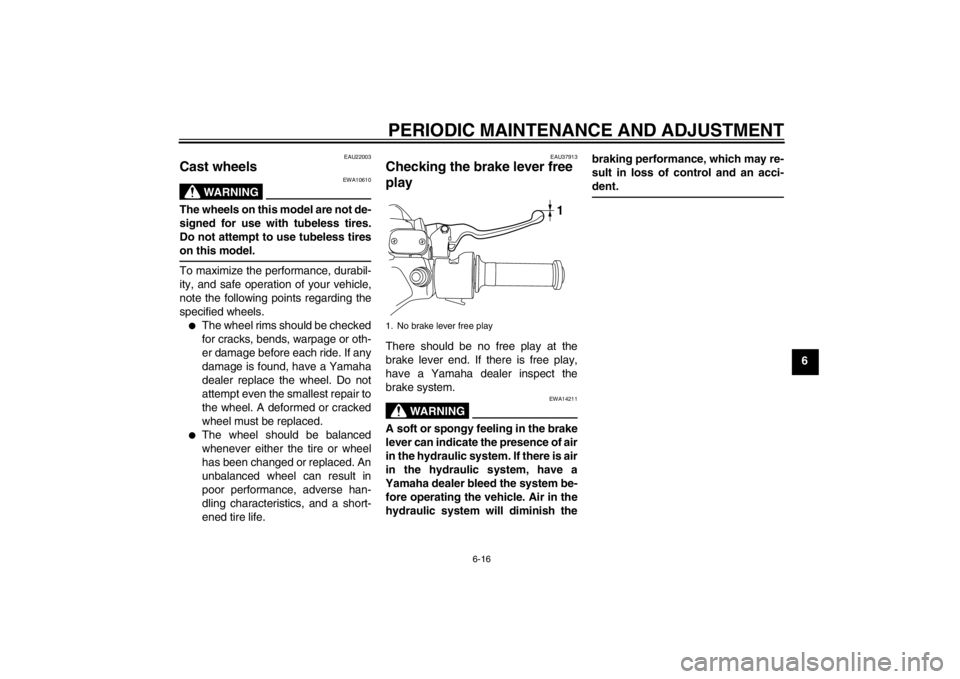
EAU37913
Checking the brake lever free
play There should be no free play at the
brake lever end. If there is free play,
have a Yamaha dealer inspect the
brake system.
WARNING
EWA14211
A soft or spongy feeling in the brake
lever can indicate the presence of air
in the hydraulic system. If there is air
in the hydraulic system, have a
Yamaha dealer bleed the system be-
fore operating the vehicle. Air in the
hydraulic system will diminish thebraking performance, which may re-
sult in loss of control and an acci-
dent.1. No brake lever free play
1
U40BE2E0.book Page 16 Wednesday, October 10, 2012 8:01 AM
Page 48 of 82
PERIODIC MAINTENANCE AND ADJUSTMENT
6-17
6
EAU39813
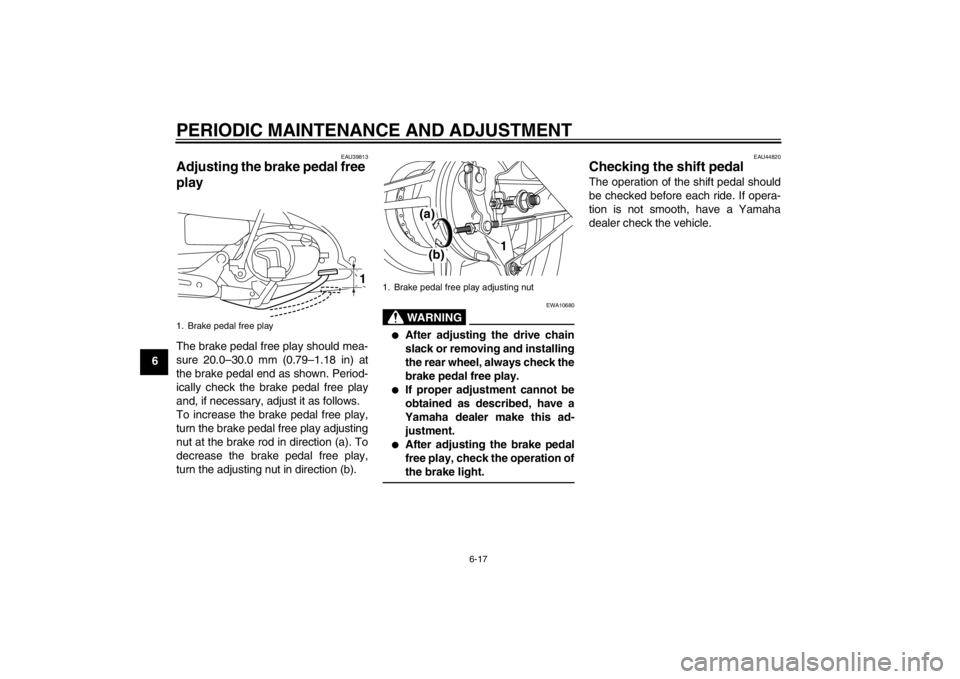
Adjusting the brake pedal free
play The brake pedal free play should mea-
sure 20.0–30.0 mm (0.79–1.18 in) at
the brake pedal end as shown. Period-
ically check the brake pedal free play
and, if necessary, adjust it as follows.
To increase the brake pedal free play,
turn the brake pedal free play adjusting
nut at the brake rod in direction (a). To
decrease the brake pedal free play,
turn the adjusting nut in direction (b).
WARNING
EWA10680
●
After adjusting the drive chain
slack or removing and installing
the rear wheel, always check the
brake pedal free play.
●
If proper adjustment cannot be
obtained as described, have a
Yamaha dealer make this ad-
justment.
●
After adjusting the brake pedal
free play, check the operation of
the brake light.
EAU44820
Checking the shift pedal The operation of the shift pedal should
be checked before each ride. If opera-
tion is not smooth, have a Yamaha
dealer check the vehicle.
1. Brake pedal free play
1
1. Brake pedal free play adjusting nut
(a)(b)
1
U40BE2E0.book Page 17 Wednesday, October 10, 2012 8:01 AM
Page 50 of 82
PERIODIC MAINTENANCE AND ADJUSTMENT
6-19
6indicator grooves have almost disap-
peared, have a Yamaha dealer replace
the brake pads as a set.
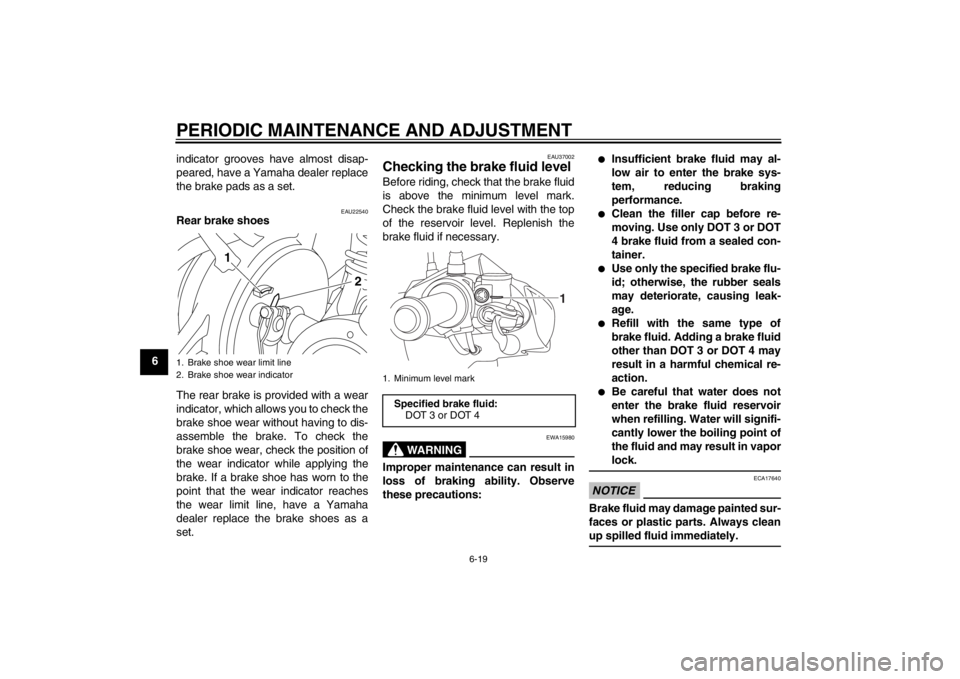
EAU22540
Rear brake shoes
The rear brake is provided with a wear
indicator, which allows you to check the
brake shoe wear without having to dis-
assemble the brake. To check the
brake shoe wear, check the position of
the wear indicator while applying the
brake. If a brake shoe has worn to the
point that the wear indicator reaches
the wear limit line, have a Yamaha
dealer replace the brake shoes as a
set.
EAU37002
Checking the brake fluid level Before riding, check that the brake fluid
is above the minimum level mark.
Check the brake fluid level with the top
of the reservoir level. Replenish the
brake fluid if necessary.
WARNING
EWA15980
Improper maintenance can result in
loss of braking ability. Observe
these precautions:
●
Insufficient brake fluid may al-
low air to enter the brake sys-
tem, reducing braking
performance.
●
Clean the filler cap before re-
moving. Use only DOT 3 or DOT
4 brake fluid from a sealed con-
tainer.
●
Use only the specified brake flu-
id; otherwise, the rubber seals
may deteriorate, causing leak-
age.
●
Refill with the same type of
brake fluid. Adding a brake fluid
other than DOT 3 or DOT 4 may
result in a harmful chemical re-
action.
●
Be careful that water does not
enter the brake fluid reservoir
when refilling. Water will signifi-
cantly lower the boiling point of
the fluid and may result in vapor
lock.
NOTICE
ECA17640
Brake fluid may damage painted sur-
faces or plastic parts. Always clean
up spilled fluid immediately.
1. Brake shoe wear limit line
2. Brake shoe wear indicator
2 1
1. Minimum level markSpecified brake fluid:
DOT 3 or DOT 4
1
U40BE2E0.book Page 19 Wednesday, October 10, 2012 8:01 AM
Page 53 of 82

PERIODIC MAINTENANCE AND ADJUSTMENT
6-22
6 5. Tighten both locknuts, and then
tighten the axle nut and brake
torque rod nut to their specified
torques.
TIPWhen tightening the axle nut, hold the
wheel axle with a wrench to keep it from
turning.6. Adjust the brake pedal free play.
(See page 6-17.) WARNING! Af-
ter adjusting the brake pedal
free play, check the operation of
the brake light.
[EWA16080]
7. Make sure that the drive chain pull-
ers are in the same position, the
drive chain slack is correct, and
the drive chain moves smoothly.
EAU23016
Cleaning and lubricating the
drive chain The drive chain must be cleaned and
lubricated at the intervals specified in
the periodic maintenance and lubrica-
tion chart, otherwise it will quickly wear
out, especially when riding in dusty or
wet areas. Service the drive chain as
follows.NOTICE
ECA10583
The drive chain must be lubricated
after washing the motorcycle, riding
in the rain or riding in wet areas.1. Remove all dirt and mud from the
drive chain with a brush or cloth.TIPFor a thorough cleaning, have a
Yamaha dealer remove the drive chain
and soak it in solvent.2. Spray Yamaha Chain and Cable
Lube or a high-quality spray-type
drive chain lubricant on the entire
chain, making sure that all side
plates and rollers have been suffi-
ciently oiled.
1. Alignment marks
2. Drive chain slack adjusting nut
3. Drive chain pullerTightening torques:
Locknut:
7 Nm (0.7 m·kgf, 5.1 ft·lbf)
Axle nut:
60 Nm (6.0 m·kgf, 43 ft·lbf)
Brake torque rod nut:
19 Nm (1.9 m·kgf, 14 ft·lbf)13
2
(a)
(b)
U40BE2E0.book Page 22 Wednesday, October 10, 2012 8:01 AM