lock YAMAHA TDM 850 2000 User Guide
[x] Cancel search | Manufacturer: YAMAHA, Model Year: 2000, Model line: TDM 850, Model: YAMAHA TDM 850 2000Pages: 99, PDF Size: 10.69 MB
Page 29 of 99

INSTRUMENT AND CONTROL FUNCTIONS
3-15
3
EAU01768*
Rear shock absorber
adjustmentThis shock absorber is equipped with
two spring preload adjusters and one
damping force adjuster.
Spring preload
Coarse adjustment (top)Use the special tool in the owner’s tool
kit to turn the lever to “S” when riding
solo and to “H” when riding with a pas-
senger.Fine adjustment (bottom)
Proceed as follows to suit road condi-
tions and the rider’s preference.
1. Loosen the locknut.
2. Turn the adjusting nut in direction
a
to increase spring preload and in di-
rection
b to decrease spring pre-
load.
1. Adjusting lever
1. Locknut
2. Adjusting nut
a. Distance “A”
Spring preload:
Minimum (soft):
Distance “A” = 59 mm
Standard:
Distance “A” = 61 mm
Maximum (hard):
Distance “A” = 63 mm
E_4tx_Functions.fm Page 15 Saturday, October 16, 1999 9:36 AM
Page 30 of 99

INSTRUMENT AND CONTROL FUNCTIONS
3-16
3 3. Tighten the locknut to the speci-
fied torque.
EC000018
CAUTION:@ Always tighten the locknut against
the spring adjusting nut and tighten
the locknut to the specified torque. @
Damping force adjustment
Turn the adjusting knob in direction
a
to increase damping force and in direc-
tion
b to decrease damping force.CI-29E
EC000015CAUTION:@ Never attempt to turn an adjuster
beyond the maximum or minimum
setting. @
EAU00315
WARNING
@ This shock absorber contains high-
ly pressurized nitrogen gas. Read
and understand the following infor-
mation before handling the shock
absorber. The manufacturer cannot
be held responsible for property
damage or personal injury that may
result from improper handling.l
Do not tamper with or attempt to
open the cylinder assembly.
l
Do not subject the shock ab-
sorber to an open flame or other
high heat source. This may
cause the unit to explode due to
excessive gas pressure.
l
Do not deform or damage the
cylinder in any way. Cylinder
damage will result in poor
damping performance.
l
Take your shock absorber to a
Yamaha dealer for any service.
@
Tightening torque:
Locknut:
70 Nm (7.0 m·kg)
1. Adjusting knobMinimum (soft) 20 clicks out*
Standard 10 clicks out*
Maximum (hard) 0 click out*
* From the fully turned-in position
E_4tx_Functions.fm Page 16 Saturday, October 16, 1999 9:36 AM
Page 31 of 99

INSTRUMENT AND CONTROL FUNCTIONS
3-17
3
EAU00324
Luggage strap holdersThere are four luggage strap holders
below the passenger seat, two of which
can be turned outward for easier ac-
cess.
EAU00330
SidestandThis model is equipped with an ignition
circuit cut-off system. The motorcycle
must not be ridden when the sidestand
is down. The sidestand is located on
the left side of the frame. (Refer to
page 5-1 for an explanation of this sys-
tem.)
EW000044
WARNING
@ This motorcycle must not be operat-
ed with the sidestand in the down
position. If the stand is not properly
retracted, it could contact the
ground and distract the operator, re-
sulting in a possible loss of control.
Yamaha has designed into this
motorcycle a lockout system to as-
sist the operator in fulfilling the re-
sponsibility of retracting the
sidestand. Please check carefully
the operating instructions listed be-
low and if there is any indication of a
malfunction, return the motorcycle
to a Yamaha dealer immediately for
repair. @
EAU00331
Sidestand/clutch switch
operation checkCheck the operation of the sidestand
switch and clutch switch against the in-
formation below.CD-11E
1. Luggage strap holder (´ 4)
TURN THE MAIN SWITCH TO “ON”
AND THE ENGINE STOP SWITCH TO
“”.TRANSMISSION IS IN GEAR AND
SIDESTAND IS UP.PULL IN CLUTCH LEVER AND
PUSH THE START SWITCH.ENGINE WILL START.CLUTCH SWITCH IS OK.
E_4tx_Functions.fm Page 17 Saturday, October 16, 1999 9:36 AM
Page 65 of 99
PERIODIC MAINTENANCE AND MINOR REPAIR
6-19
6
CE-10E
CE-12EEAU00684
WARNING
@ This motorcycle is fitted with super
high-speed running tires. The fol-
lowing points must be observed in
order for you to make fully effective
use of these tires.l
Never fail to use the specified
tires in tire replacement. Other
tires may have a danger of
bursting at super high-speeds.
l
New tires have a relatively low
grip on the road surface until
they have been slightly worn.
Therefore, approximately 100 km
should be traveled at normal
speed before any high-speed
riding is done.
l
Before any high-speed runs, the
tires should be warmed-up suf-
ficiently.
l
Always inflate to the correct tire
pressure according to the oper-
ating conditions.
@
EAU00692
Clutch lever free play
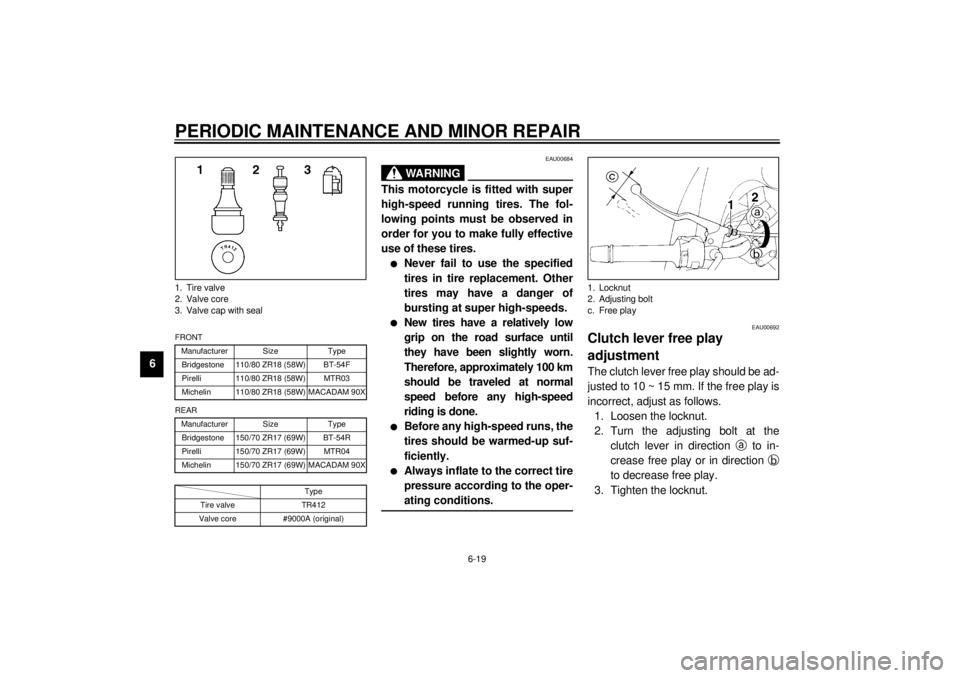
adjustmentThe clutch lever free play should be ad-
justed to 10 ~ 15 mm. If the free play is
incorrect, adjust as follows.
1. Loosen the locknut.
2. Turn the adjusting bolt at the
clutch lever in direction
a to in-
crease free play or in direction
b
to decrease free play.
3. Tighten the locknut.
1. Tire valve
2. Valve core
3. Valve cap with sealFRONT
Manufacturer Size Type
Bridgestone 110/80 ZR18 (58W) BT-54F
Pirelli 110/80 ZR18 (58W) MTR03
Michelin 110/80 ZR18 (58W) MACADAM 90X
REAR
Manufacturer Size Type
Bridgestone 150/70 ZR17 (69W) BT-54R
Pirelli 150/70 ZR17 (69W) MTR04
Michelin 150/70 ZR17 (69W) MACADAM 90X
Type
Tire valve TR412
Valve core #9000A (original)
1. Locknut
2. Adjusting bolt
c. Free play
E_4tx_Periodic.fm Page 19 Saturday, October 16, 1999 9:37 AM
Page 68 of 99
PERIODIC MAINTENANCE AND MINOR REPAIR
6-22
6
EAU00731
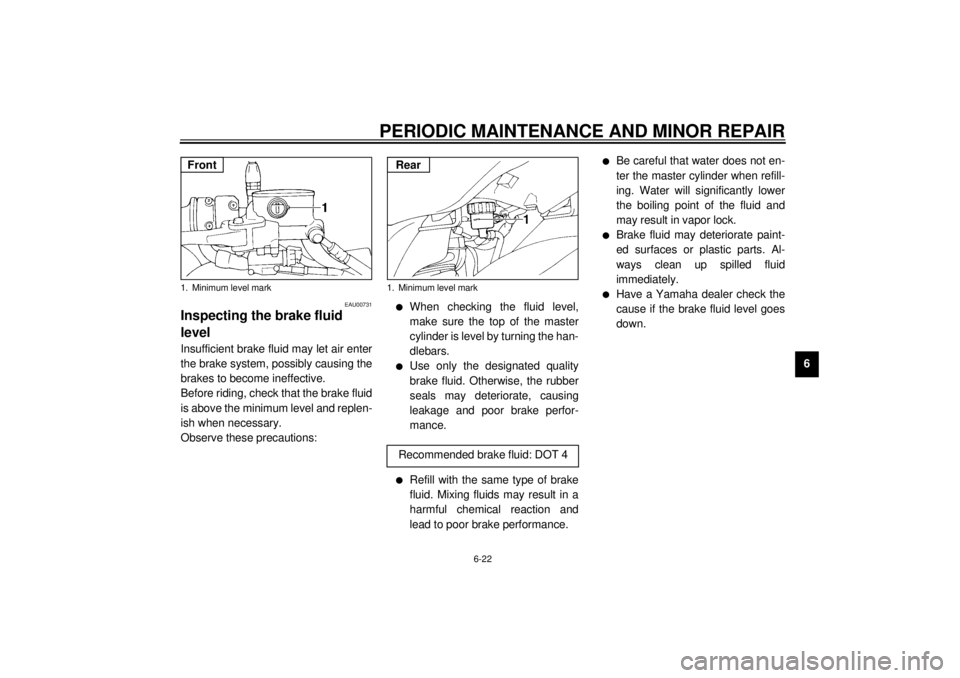
Inspecting the brake fluid
levelInsufficient brake fluid may let air enter
the brake system, possibly causing the
brakes to become ineffective.
Before riding, check that the brake fluid
is above the minimum level and replen-
ish when necessary.
Observe these precautions:
l
When checking the fluid level,
make sure the top of the master
cylinder is level by turning the han-
dlebars.
l
Use only the designated quality
brake fluid. Otherwise, the rubber
seals may deteriorate, causing
leakage and poor brake perfor-
mance.
l
Refill with the same type of brake
fluid. Mixing fluids may result in a
harmful chemical reaction and
lead to poor brake performance.
l
Be careful that water does not en-
ter the master cylinder when refill-
ing. Water will significantly lower
the boiling point of the fluid and
may result in vapor lock.
l
Brake fluid may deteriorate paint-
ed surfaces or plastic parts. Al-
ways clean up spilled fluid
immediately.
l
Have a Yamaha dealer check the
cause if the brake fluid level goes
down.
1. Minimum level markFront
1. Minimum level markRecommended brake fluid: DOT 4Rear
E_4tx_Periodic.fm Page 22 Saturday, October 16, 1999 9:37 AM
Page 69 of 99
PERIODIC MAINTENANCE AND MINOR REPAIR
6-23
6
EAU00742
Brake fluid replacementThe brake fluid should be replaced only
by trained Yamaha service personnel.
Have the Yamaha dealer replace the
following components during periodic
maintenance or when they are dam-
aged or leaking:l
oil seals (every two years)
l
brake hoses (every four years)
EAU00744
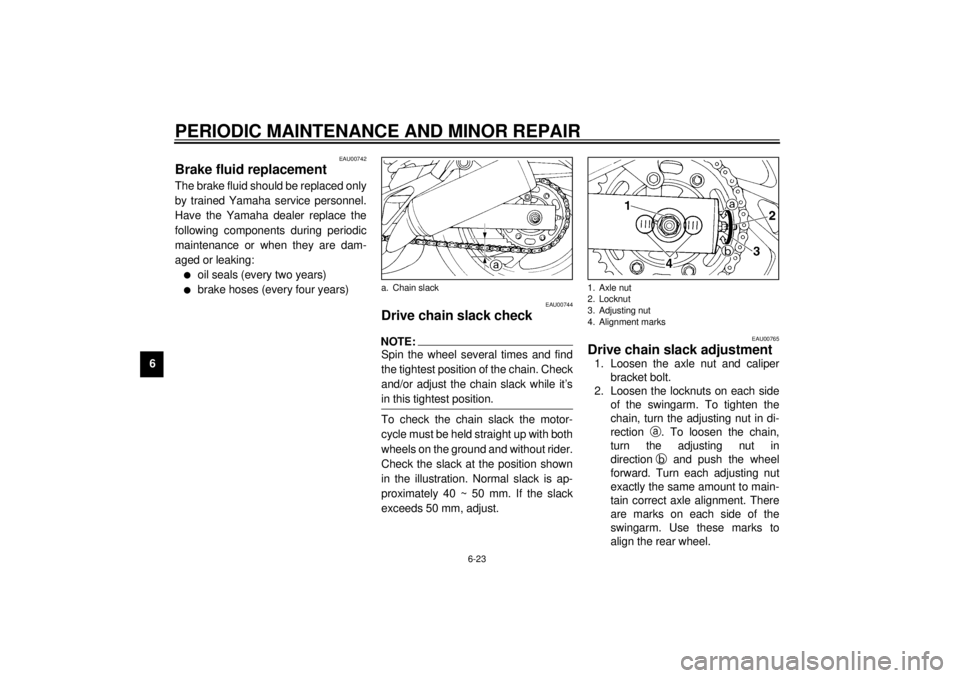
Drive chain slack checkNOTE:@ Spin the wheel several times and find
the tightest position of the chain. Check
and/or adjust the chain slack while it’s
in this tightest position. @To check the chain slack the motor-
cycle must be held straight up with both
wheels on the ground and without rider.
Check the slack at the position shown
in the illustration. Normal slack is ap-
proximately 40 ~ 50 mm. If the slack
exceeds 50 mm, adjust.
EAU00765
Drive chain slack adjustment1. Loosen the axle nut and caliper
bracket bolt.
2. Loosen the locknuts on each side
of the swingarm. To tighten the
chain, turn the adjusting nut in di-
rection
a. To loosen the chain,
turn the adjusting nut in
direction
b and push the wheel
forward. Turn each adjusting nut
exactly the same amount to main-
tain correct axle alignment. There
are marks on each side of the
swingarm. Use these marks to
align the rear wheel.
a. Chain slack
1. Axle nut
2. Locknut
3. Adjusting nut
4. Alignment marks
E_4tx_Periodic.fm Page 23 Saturday, October 16, 1999 9:37 AM
Page 77 of 99
PERIODIC MAINTENANCE AND MINOR REPAIR
6-31
64. Install the bulb holder cover and
reconnect the headlight connec-
tors. If the headlight beam adjust-
ment is necessary, ask a Yamaha
dealer to make that adjustment.
EAU01623*
Tail/brake light bulb
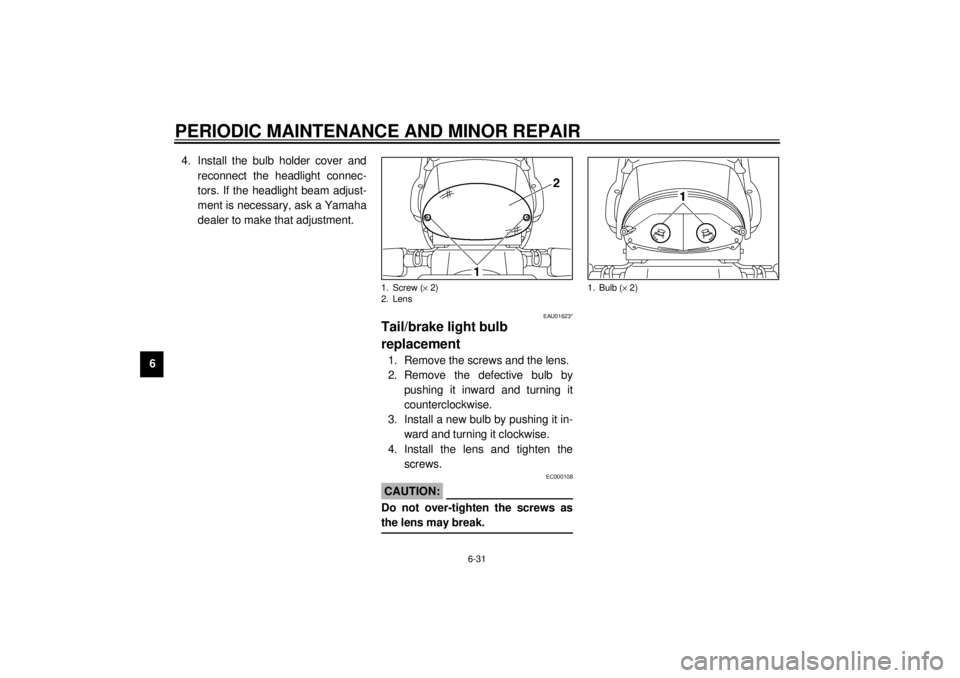
replacement1. Remove the screws and the lens.
2. Remove the defective bulb by
pushing it inward and turning it
counterclockwise.
3. Install a new bulb by pushing it in-
ward and turning it clockwise.
4. Install the lens and tighten the
screws.
EC000108
CAUTION:@ Do not over-tighten the screws as
the lens may break. @1. Screw (´ 2)
2. Lens
1. Bulb (´ 2)
E_4tx_Periodic.fm Page 31 Saturday, October 16, 1999 9:37 AM
Page 78 of 99
PERIODIC MAINTENANCE AND MINOR REPAIR
6-32
6
EAU01095
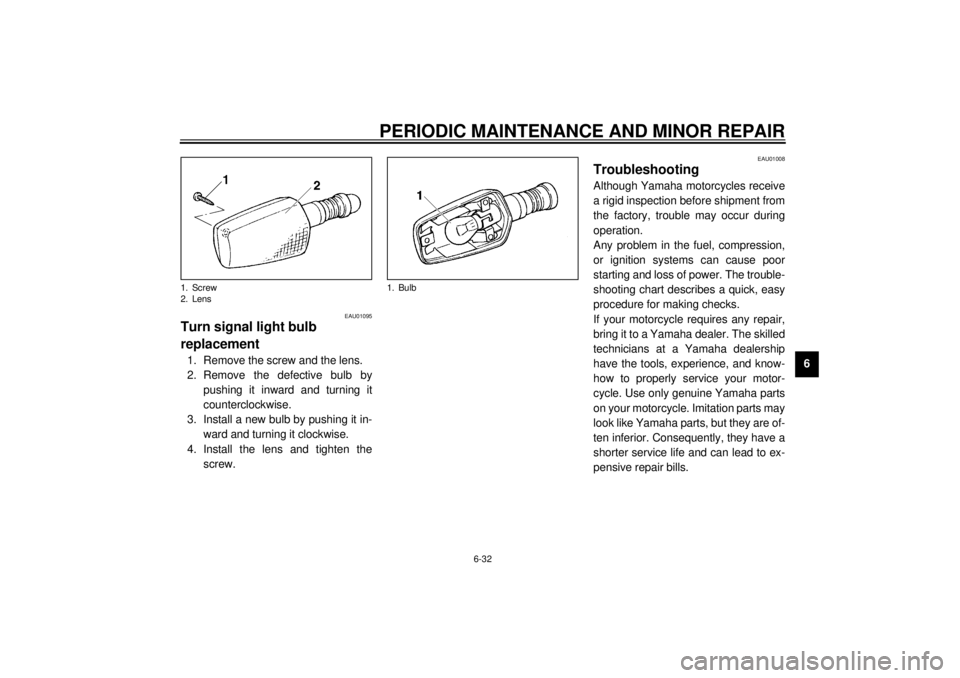
Turn signal light bulb
replacement1. Remove the screw and the lens.
2. Remove the defective bulb by
pushing it inward and turning it
counterclockwise.
3. Install a new bulb by pushing it in-
ward and turning it clockwise.
4. Install the lens and tighten the
screw.
EAU01008
TroubleshootingAlthough Yamaha motorcycles receive
a rigid inspection before shipment from
the factory, trouble may occur during
operation.
Any problem in the fuel, compression,
or ignition systems can cause poor
starting and loss of power. The trouble-
shooting chart describes a quick, easy
procedure for making checks.
If your motorcycle requires any repair,
bring it to a Yamaha dealer. The skilled
technicians at a Yamaha dealership
have the tools, experience, and know-
how to properly service your motor-
cycle. Use only genuine Yamaha parts
on your motorcycle. Imitation parts may
look like Yamaha parts, but they are of-
ten inferior. Consequently, they have a
shorter service life and can lead to ex-
pensive repair bills.
1. Screw
2. Lens
1. Bulb
E_4tx_Periodic.fm Page 32 Saturday, October 16, 1999 9:37 AM
Page 80 of 99
PERIODIC MAINTENANCE AND MINOR REPAIR
6-34
6
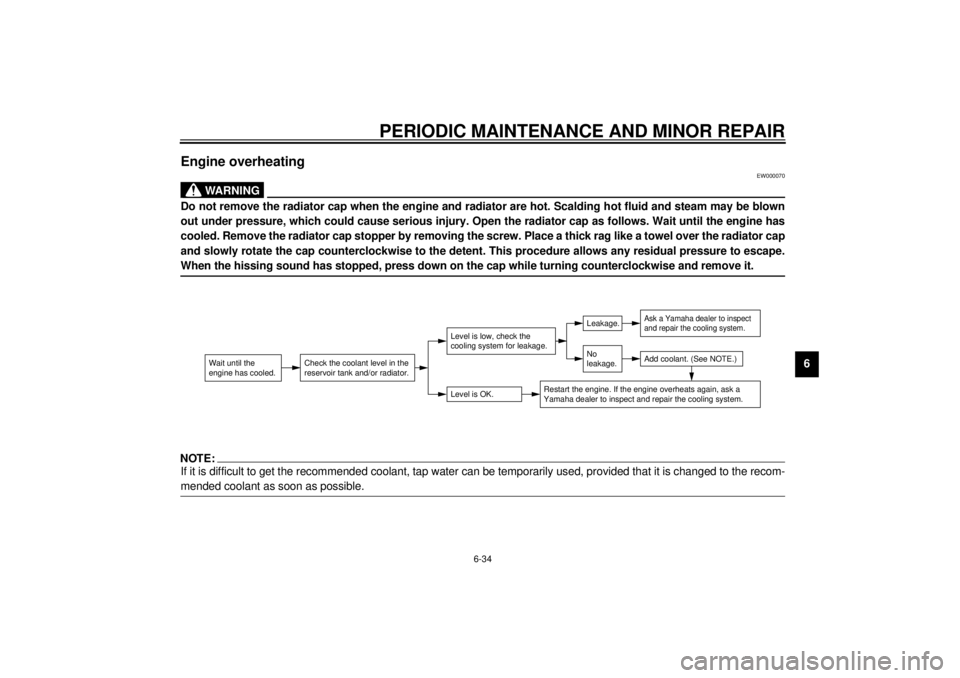
Engine overheating
EW000070
WARNING
@ Do not remove the radiator cap when the engine and radiator are hot. Scalding hot fluid and steam may be blown
out under pressure, which could cause serious injury. Open the radiator cap as follows. Wait until the engine has
cooled. Remove the radiator cap stopper by removing the screw. Place a thick rag like a towel over the radiator cap
and slowly rotate the cap counterclockwise to the detent. This procedure allows any residual pressure to escape.
When the hissing sound has stopped, press down on the cap while turning counterclockwise and remove it. @NOTE:@ If it is difficult to get the recommended coolant, tap water can be temporarily used, provided that it is changed to the recom-
mended coolant as soon as possible. @
Wait until the
engine has cooled.
Check the coolant level in the
reservoir tank and/or radiator.
Level is OK.Level is low, check the
cooling system for leakage.
No
leakage.Leakage.
Ask a Yamaha dealer to inspect
and repair the cooling system.Add coolant. (See NOTE.)
Restart the engine. If the engine overheats again, ask a
Yamaha dealer to inspect and repair the cooling system.
E_4tx_Periodic.fm Page 34 Saturday, October 16, 1999 9:37 AM
Page 97 of 99

10-INDEXAAir filter .................................................. 6-13
Antitheft alarm (optional) ..........................3-5BBattery ................................................... 6-28
Brake and clutch lever lubrication........... 6-25
Brake and shift pedal lubrication ............ 6-25
Brake fluid replacement ......................... 6-23
Brake light switch adjustment ................. 6-21CCable inspection and lubrication ............ 6-24
Carburetor adjustment ........................... 6-15
Care.........................................................7-1
Changing the coolant ............................. 6-11
Checking the front and
rear brake pads ................................... 6-21
Clutch lever ..............................................3-8
Clutch lever free play adjustment ........... 6-19
Controls/Instruments ................................2-3
Coolant temperature indicator light...........3-2
Cooling system ...................................... 6-10
Cowling and panel removal and
installation .............................................6-5
Cowlings A and B ....................................6-5DDiagnosis device......................................3-5
Dimmer switch .........................................3-6
Drive chain lubrication ............................ 6-24
Drive chain slack adjustment.................. 6-23
Drive chain slack check.......................... 6-23
EEngine break-in ....................................... 5-5
Engine oil ................................................ 6-8
Engine overheating ................................. 6-34
Engine stop switch................................... 3-7FFront brake lever ..................................... 3-9
Front fork adjustment............................. 3-14
Front fork inspection .............................. 6-27
Fuel ....................................................... 3-11
Fuel gauge .............................................. 3-5
Fuel indicator light ................................... 3-3
Fuel tank breather hose
(for Germany only) .............................. 3-12
Fuel tank cap ......................................... 3-10
Fuse replacement.................................. 6-29GGive safety the right of way ..................... 1-1HHandlebar switches ................................. 3-6
Dimmer switch ................................... 3-6
Engine stop switch ............................. 3-7
Hazard switch .................................... 3-6
Horn switch ........................................ 3-6
Lights switch ...................................... 3-7
Pass switch ........................................ 3-6
Start switch ........................................ 3-7
Turn signal switch .............................. 3-6
Hazard switch .......................................... 3-6
Headlight bulb replacement ................... 6-30
Helmet holder ........................................ 3-13
High beam indicator light ..........................3-2
Horn switch ..............................................3-6IIdentification number records ...................9-1
Idle speed adjustment ............................6-15
Indicator lights ..........................................3-2
Coolant temperature indicator light .....3-2
Fuel indicator light...............................3-3
High beam indicator light ....................3-2
Neutral indicator light ..........................3-2
Turn indicator lights ............................3-2
Inspecting the brake fluid level ...............6-22KKey identification number .........................9-1LLeft view...................................................2-1
Lights switch ............................................3-7
Luggage strap holders ...........................3-17MMain switch/steering lock .........................3-1
Model label ..............................................9-2NNeutral indicator light ...............................3-2PPanels A and B ........................................6-6
Parking.....................................................5-6
Pass switch ..............................................3-6
Periodic maintenance and lubrication .......6-2
Pre-operation check list ............................4-1
E_4txIX.fm Page 1 Saturday, October 16, 1999 9:38 AM