fuel YAMAHA TDR 125 2002 User Guide
[x] Cancel search | Manufacturer: YAMAHA, Model Year: 2002, Model line: TDR 125, Model: YAMAHA TDR 125 2002Pages: 94, PDF Size: 2.43 MB
Page 32 of 94

5-1
EAU00372
OPERATION AND IMPORTANT RIDING POINTS
5
EAU00373
w8Become thoroughly familiar
with all operating controls and
their functions before riding.
Consult a Yamaha dealer
regarding any control or func-
tion that you do not thorough-
ly understand.
8Never start the engine or oper-
ate it in a closed area for any
length of time. Exhaust fumes
are poisonous, and inhaling
them can cause loss of con-
sciousness and death within a
short time. Always make sure
that there is adequate ventila-
tion.
8Before starting out, make sure
that the sidestand is up. If the
sidestand is not raised com-
pletely, it could contact the
ground and distract the opera-
tor, resulting in a possible loss
of control.
EAU04271
Starting a cold engineIn order for the ignition circuit cut-off
system to enable starting, one of the
following conditions must be met:
8The transmission is in the neutral
position.
8The transmission is in gear with
the clutch lever pulled and the
sidestand up.
EW000054
w8Before starting the engine,
check the function of the igni-
tion circuit cut-off system
according to the procedure
described on page 3-17.
8Never ride with the sidestand
down.1. Turn the fuel cock lever to “ON”.
2. Turn the key to “ON” and make
sure that the engine stop switch
is set to “#”.3. Shift the transmission into the
neutral position.
NOTE:
When the transmission is in the neu-
tral position, the neutral indicator light
should be on, otherwise have a
Yamaha dealer check the electrical
circuit.4. Turn the starter (choke) on and
completely close the throttle.
(See page 3-12 for starter
(choke) operation.)
5. Start the engine by pushing the
start switch.NOTE:
If the engine fails to start, release the
start switch, wait a few seconds, and
then try again. Each starting attempt
should be as short as possible to pre-
serve the battery. Do not crank the
engine more than 10 seconds on any
one attempt.
5AE-28199-E5 honbun 7/6/01 10:18 AM Page 31
Page 35 of 94
5-4
OPERATION AND IMPORTANT RIDING POINTS
5
EAU00424
Tips for reducing fuel
consumptionFuel consumption depends largely on
your riding style. Consider the follow-
ing tips to reduce fuel consumption:
8Thoroughly warm up the engine.
8Turn the starter (choke) off as
soon as possible.
8Shift up swiftly, and avoid high
engine speeds during accelera-
tion.
8Do not rev the engine while shift-
ing down, and avoid high engine
speeds with no load on the
engine.
8Turn the engine off instead of let-
ting it idle for an extended length
of time (e.g., in traffic jams, at
traffic lights or at railroad cross-
ings).
EAU00436
Engine break-inThere is never a more important peri-
od in the life of your engine than the
period between 0 and 1,000 km. For
this reason, you should read the fol-
lowing material carefully.
Since the engine is brand new, do
not put an excessive load on it for the
first 1,000 km. The various parts in
the engine wear and polish them-
selves to the correct operating clear-
ances. During this period, prolonged
full-throttle operation or any condition
that might result in engine overheat-
ing must be avoided.
EAU00453
0–500 km
8Avoid prolonged operation above
6,000 r/min.
8After every hour of operation,
stop the engine, and then let it
cool for five to ten minutes.
8Vary the engine speed from time
to time. Do not operate the
engine at one set throttle posi-
tion.
500–1,000 km
8Avoid prolonged operation
above 7,000 r/min.
8Rev the engine freely through
the gears, but do not use full
throttle at any time.
EC000060
cCAfter 1,000 km of operation, the
transmission oil must be changed.
5AE-28199-E5 honbun 7/6/01 10:18 AM Page 34
Page 36 of 94
5-5
OPERATION AND IMPORTANT RIDING POINTS
5 1,000 km and beyond
The vehicle can now be operated
normally.
EC000053
cC8Keep the engine speed out of
the tachometer red zone.
8If any engine trouble should
occur during the engine break-
in period, immediately have a
Yamaha dealer check the vehi-
cle.
EAU00458
ParkingWhen parking, stop the engine,
remove the key from the main switch,
and then turn the fuel cock lever to
“OFF”.
EW000058
w8Since the engine and exhaust
system can become very hot,
park in a place where pedestri-
ans or children are not likely
to touch them.
8Do not park on a slope or on
soft ground, otherwise the
motorcycle may overturn.
EC000062
cCNever park in an area where there
are fire hazards such as grass or
other flammable materials.
5AE-28199-E5 honbun 7/6/01 10:18 AM Page 35
Page 38 of 94

6-2
PERIODIC MAINTENANCE AND MINOR REPAIR
6
EAU03686
Periodic maintenance and lubrication chart
NOTE:
8
The annual checks must be performed every year, except if a kilometer-based maintenance is performed instead.
8From 30,000 km, repeat the maintenance intervals starting from 6,000 km.
8Items marked with an asterisk should be performed by a Yamaha dealer as they require special tools, data and
technical skills.NO. ITEM CHECK OR MAINTENANCE JOBODOMETER READING (× 1,000 km)
ANNUAL
CHECK
1 6 12 18 24
1
*Fuel line•Check fuel hoses for cracks or damage.√√√√ √
2 Spark plug•Replace.√√√√ √
3 Air filter element•Clean.√√
•Replace.√√
4 Clutch•Check operation.
•Adjust.√√√√√
5*Front brake•Check operation, fluid level and vehicle for fluid leakage.
(See NOTE on page 6-4.)√√√√√ √
•Replace brake pads.Whenever worn to the limit
6*Rear brake•Check operation, fluid level and vehicle for fluid leakage.
(See NOTE on page 6-4.)√√√√√ √
•Replace brake pads.Whenever worn to the limit
7*Brake hoses•Check for cracks or damage.√√√√ √
•Replace. (See NOTE on page 6-4.)Every 4 years
8*Wheels•Check runout and for damage.√√√√
5AE-28199-E5 honbun 7/6/01 10:18 AM Page 37
Page 49 of 94
6-13
PERIODIC MAINTENANCE AND MINOR REPAIR
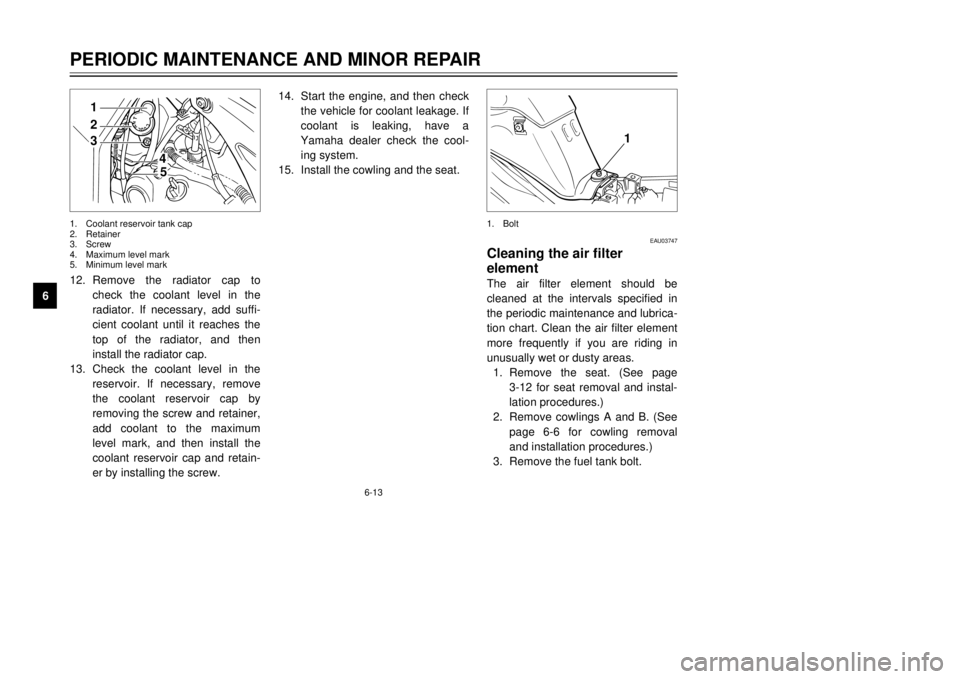
612. Remove the radiator cap to
check the coolant level in the
radiator. If necessary, add suffi-
cient coolant until it reaches the
top of the radiator, and then
install the radiator cap.
13. Check the coolant level in the
reservoir. If necessary, remove
the coolant reservoir cap by
removing the screw and retainer,
add coolant to the maximum
level mark, and then install the
coolant reservoir cap and retain-
er by installing the screw.14. Start the engine, and then check
the vehicle for coolant leakage. If
coolant is leaking, have a
Yamaha dealer check the cool-
ing system.
15. Install the cowling and the seat.
EAU03747
Cleaning the air filter
elementThe air filter element should be
cleaned at the intervals specified in
the periodic maintenance and lubrica-
tion chart. Clean the air filter element
more frequently if you are riding in
unusually wet or dusty areas.
1. Remove the seat. (See page
3-12 for seat removal and instal-
lation procedures.)
2. Remove cowlings A and B. (See
page 6-6 for cowling removal
and installation procedures.)
3. Remove the fuel tank bolt.
21
4
5
3
1
1. Coolant reservoir tank cap
2. Retainer
3. Screw
4. Maximum level mark
5. Minimum level mark1. Bolt
5AE-28199-E5 honbun 7/6/01 10:18 AM Page 48
Page 50 of 94
6-14
PERIODIC MAINTENANCE AND MINOR REPAIR
6 4. Lift the front of the fuel tank to
position the fuel tank away from
the air filter case. (Do not discon-
nect the fuel hoses!)
EW000071
w8Make sure that the fuel tank is
well supported.
8Do not tilt or pull the fuel tank
too much, otherwise the fuel
hoses may come loose, which
could cause fuel leakage.
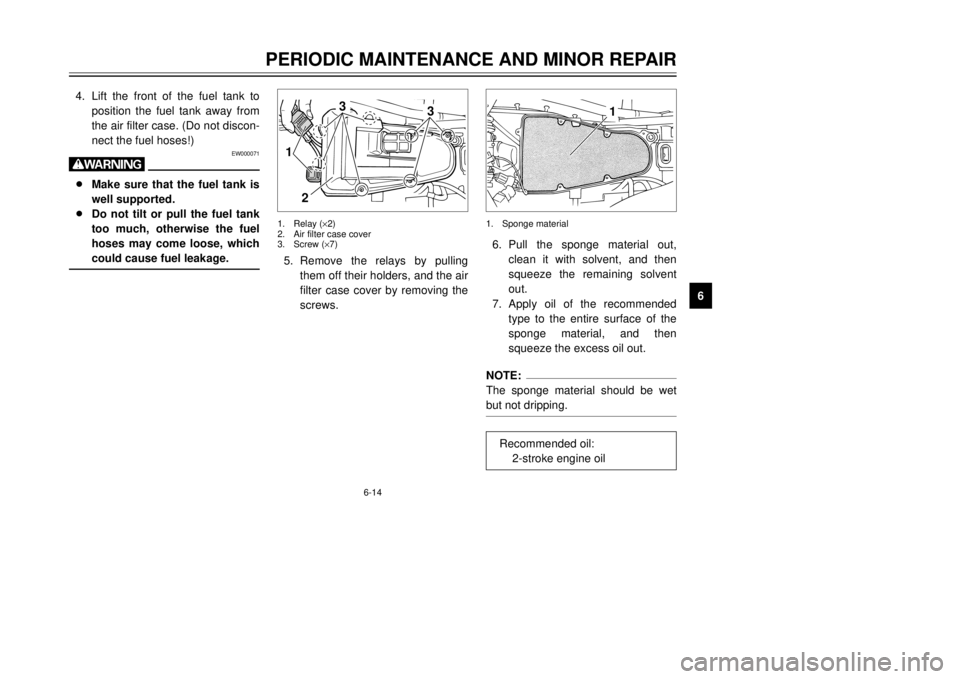
5. Remove the relays by pulling
them off their holders, and the air
filter case cover by removing the
screws.6. Pull the sponge material out,
clean it with solvent, and then
squeeze the remaining solvent
out.
7. Apply oil of the recommended
type to the entire surface of the
sponge material, and then
squeeze the excess oil out.
NOTE:
The sponge material should be wet
but not dripping.
1
3
3
2
1
1. Relay (×2)
2. Air filter case cover
3. Screw (×7)1. Sponge material
Recommended oil:
2-stroke engine oil
5AE-28199-E5 honbun 7/6/01 10:18 AM Page 49
Page 51 of 94
6-15
PERIODIC MAINTENANCE AND MINOR REPAIR
68. Insert the sponge material into
the air filter case.
EC000082
cC8Make sure that the air filter ele-
ment is properly seated in the
air filter case.
8The engine should never be
operated without the air filter
element installed, otherwise
the piston and/or cylinder may
become excessively worn.9. Install the air filter case cover by
installing the screws, and then
install the relays.
10. Place the fuel tank in the original
position, and then install the bolt.
EW000131
wMake sure that the fuel hoses and
vacuum hose are properly con-
nected and routed, and not
pinched. Replace any damaged
hoses.11. Install the seat and the cowlings.
EAU00629
Adjusting the carburetorThe carburetor is an important part of
the engine and requires very sophisti-
cated adjustment. Therefore, most
carburetor adjustments should be left
to a Yamaha dealer, who has the
necessary professional knowledge
and experience. The adjustment
described in the following section,
however, may be serviced by the
owner as part of routine mainte-
nance.
EC000094
cCThe carburetor has been set and
extensively tested at the Yamaha
factory. Changing these settings
without sufficient technical knowl-
edge may result in poor perfor-
mance of or damage to the engine.
5AE-28199-E5 honbun 7/6/01 10:18 AM Page 50
Page 77 of 94

6-41
PERIODIC MAINTENANCE AND MINOR REPAIR
6
EAU03087
TroubleshootingAlthough Yamaha motorcycles
receive a thorough inspection before
shipment from the factory, trouble
may occur during operation. Any
problem in the fuel, compression, or
ignition systems, for example, can
cause poor starting and loss of
power.
The following troubleshooting charts
represent quick and easy procedures
for checking these vital systems your-
self. However, should your motorcy-
cle require any repair, take it to a
Yamaha dealer, whose skilled techni-
cians have the necessary tools,
experience, and know-how to service
the motorcycle properly.
Use only genuine Yamaha replace-
ment parts. Imitation parts may look
like Yamaha parts, but they are often
inferior, have a shorter service life
and can lead to expensive repair
bills.
5AE-28199-E5 honbun 7/6/01 10:18 AM Page 76
Page 78 of 94
6-42
PERIODIC MAINTENANCE AND MINOR REPAIR
6
EAU01581
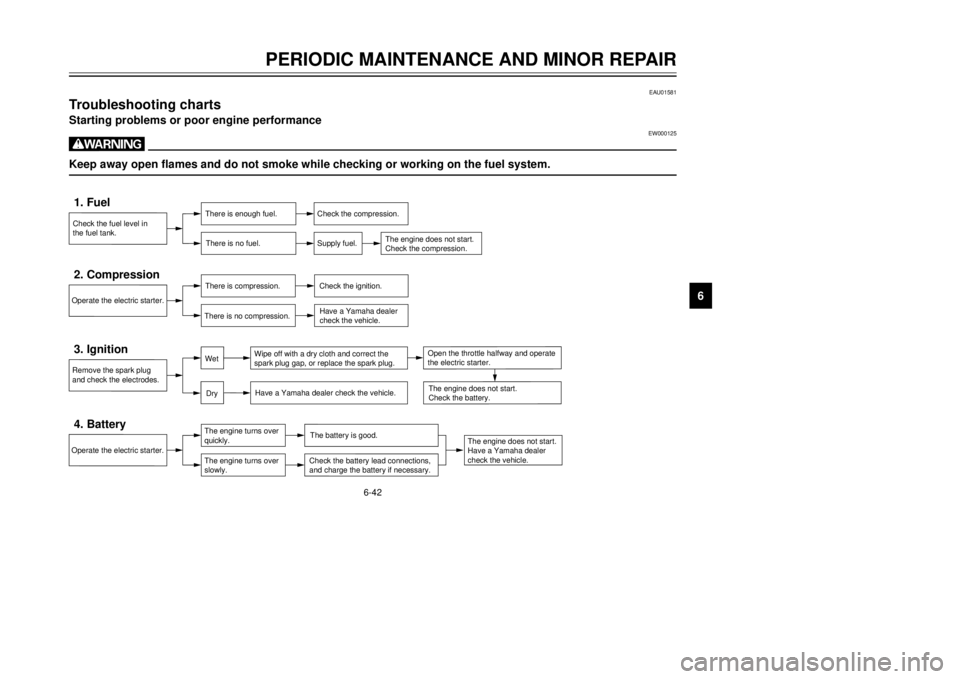
Troubleshooting chartsStarting problems or poor engine performance
EW000125
wKeep away open flames and do not smoke while checking or working on the fuel system.Check the fuel level in
the fuel tank.1. Fuel
There is enough fuel.
There is no fuel.
Check the compression.
Supply fuel.
The engine does not start.
Check the compression.
Operate the electric starter.2. Compression
There is compression.
There is no compression.
Check the ignition.
Have a Yamaha dealer
check the vehicle.
Remove the spark plug
and check the electrodes.3. Ignition
Wipe off with a dry cloth and correct the
spark plug gap, or replace the spark plug.
Have a Yamaha dealer check the vehicle.
The engine does not start.
Have a Yamaha dealer
check the vehicle.
The engine does not start.
Check the battery.
Operate the electric starter.4. Battery
The engine turns over
quickly.
The engine turns over
slowly.
The battery is good.Check the battery lead connections,
and charge the battery if necessary.
DryWet
Open the throttle halfway and operate
the electric starter.
5AE-28199-E5 honbun 7/6/01 10:18 AM Page 77
Page 81 of 94
7-2
MOTORCYCLE CARE AND STORAGE
78Do not use any harsh chemical
products on plastic parts. Be
sure to avoid using cloths or
sponges which have been in
contact with strong or abra-
sive cleaning products, sol-
vent or thinner, fuel (gasoline),
rust removers or inhibitors,
brake fluid, antifreeze or elec-
trolyte.
8Do not use high-pressure
washers or steam-jet cleaners
since they cause water seep-
age and deterioration in the
following areas: seals (of
wheel and swingarm bearings,
fork and brakes), electric com-
ponents (couplers, connec-
tors, instruments, switches
and lights), breather hoses
and vents.8For motorcycles equipped
with a windshield: Do not use
strong cleaners or hard
sponges as they will cause
dulling or scratching. Some
cleaning compounds for plas-
tic may leave scratches on the
windshield. Test the product
on a small hidden part of the
windshield to make sure that it
does not leave any marks. If
the windshield is scratched,
use a quality plastic polishing
compound after washing.
After normal useRemove dirt with warm water, a mild
detergent, and a soft, clean sponge,
and then rinse thoroughly with clean
water. Use a toothbrush or bottle-
brush for hard-to-reach areas.
Stubborn dirt and insects will come
off more easily if the area is covered
with a wet cloth for a few minutes
before cleaning.After riding in the rain, near the sea
or on salt-sprayed roadsSince sea salt or salt sprayed on
roads during winter are extremely
corrosive in combination with water,
carry out the following steps after
each ride in the rain, near the sea or
on salt-sprayed roads.NOTE:
Salt sprayed on roads in the winter
may remain well into spring.1. Clean the motorcycle with cold
water and a mild detergent, after
the engine has cooled down.
ECA00012
cCDo not use warm water since it
increases the corrosive action of
the salt.2. Apply a corrosion protection
spray on all metal, including
chrome- and nickel-plated, sur-
faces to prevent corrosion.
5AE-28199-E5 honbun 7/6/01 10:18 AM Page 80