warning light YAMAHA TENERE 700 2020 User Guide
[x] Cancel search | Manufacturer: YAMAHA, Model Year: 2020, Model line: TENERE 700, Model: YAMAHA TENERE 700 2020Pages: 102, PDF Size: 10.31 MB
Page 83 of 102
Periodic maintenance and adjustment
6-32
6
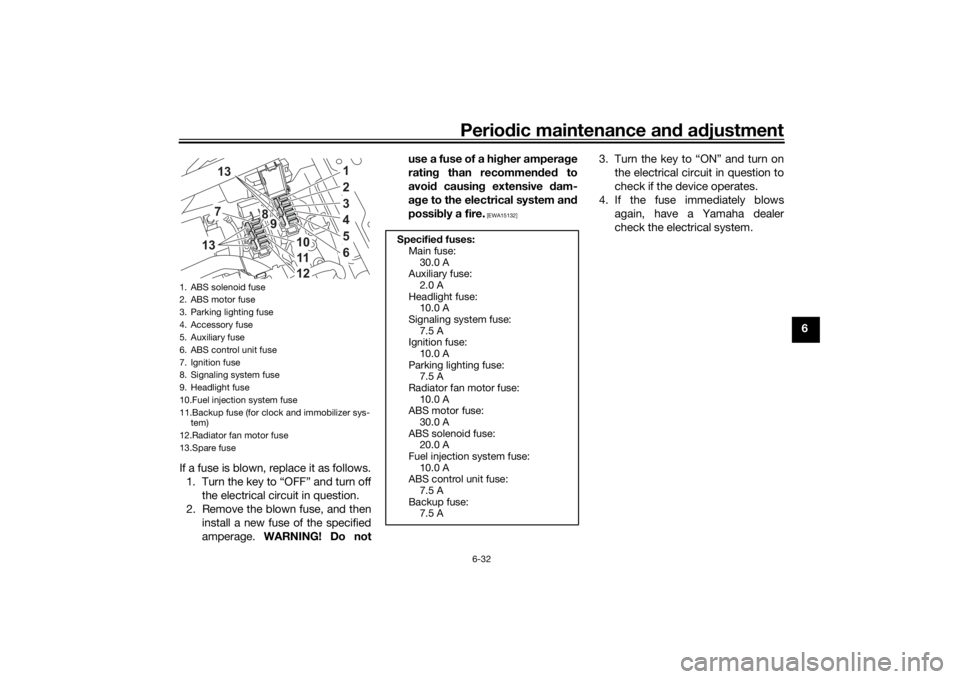
If a fuse is blown, replace it as follows.
1. Turn the key to “OFF” and turn off
the electrical circuit in question.
2. Remove the blown fuse, and then
install a new fuse of the specified
amperage. WARNING! Do notuse a fuse of a higher amperage
rating than recommended to
avoid causing extensive dam-
age to the electrical system and
possibly a fire.
[EWA15132]
3. Turn the key to “ON” and turn on
the electrical circuit in question to
check if the device operates.
4. If the fuse immediately blows
again, have a Yamaha dealer
check the electrical system.
1. ABS solenoid fuse
2. ABS motor fuse
3. Parking lighting fuse
4. Accessory fuse
5. Auxiliary fuse
6. ABS control unit fuse
7. Ignition fuse
8. Signaling system fuse
9. Headlight fuse
10.Fuel injection system fuse
11.Backup fuse (for clock and immobilizer sys-
tem)
12.Radiator fan motor fuse
13.Spare fuse
89
7
123456
101112 13
13
Specified fuses:
Main fuse:
30.0 A
Auxiliary fuse:
2.0 A
Headlight fuse:
10.0 A
Signaling system fuse:
7.5 A
Ignition fuse:
10.0 A
Parking lighting fuse:
7.5 A
Radiator fan motor fuse:
10.0 A
ABS motor fuse:
30.0 A
ABS solenoid fuse:
20.0 A
Fuel injection system fuse:
10.0 A
ABS control unit fuse:
7.5 A
Backup fuse:
7.5 A
UBW3E0E0.book Page 32 Friday, May 24, 2019 11:01 AM
Page 86 of 102
![YAMAHA TENERE 700 2020 User Guide Periodic maintenance and adjustment
6-35
6cle from under the skid plate or
by the frame sub-members.
[ECAM1190]
3. Confirm that the vehicle is in a sta-
ble and level position before start-
ing any ma](/img/51/51774/w960_51774-85.png "YAMAHA TENERE 700 2020 User Guide Periodic maintenance and adjustment
6-35
6cle from under the skid plate or
by the frame sub-members.
[ECAM1190]
3. Confirm that the vehicle is in a sta-
ble and level position before start-
ing any ma")
Periodic maintenance and adjustment
6-35
6cle from under the skid plate or
by the frame sub-members.
[ECAM1190]
3. Confirm that the vehicle is in a sta-
ble and level position before start-
ing any maintenance.
EAU25872
TroubleshootingAlthough Yamaha motorcycles receive
a thorough inspection before shipment
from the factory, trouble may occur
during operation. Any problem in the
fuel, compression, or ignition systems,
for example, can cause poor starting
and loss of power.
The following troubleshooting charts
represent quick and easy procedures
for checking these vital systems your-
self. However, should your motorcycle
require any repair, take it to a Yamaha
dealer, whose skilled technicians have
the necessary tools, experience, and
know-how to service the motorcycle
properly.
Use only genuine Yamaha replace-
ment parts. Imitation parts may look
like Yamaha parts, but they are often
inferior, have a shorter service life and
can lead to expensive repair bills.
WARNING
EWA15142
When checking the fuel system, do
not smoke, and make sure there are
no open flames or sparks in the ar-
ea, including pilot lights from waterheaters or furnaces. Gasoline or
gasoline vapors can ignite or ex-
plode, causing severe injury or prop-
erty damage.
UBW3E0E0.book Page 35 Friday, May 24, 2019 11:01 AM
Page 90 of 102

Motorcycle care and storage
7-2
7chemicals such as, solvents,
gasoline, rust removers, brake
fluid, or antifreeze, etc.
Before washing
1. Park the vehicle out of direct sun-
light and allow it to cool. This will
help avoid water spots.
2. Make sure all caps, covers, elec-
trical couplers and connectors are
tightly installed.
3. Cover the muffler end with a plas-
tic bag and a strong rubber band.
4. Pre-soak stubborn stains like in-
sects or bird droppings with a wet
towel for a few minutes.
5. Remove road grime and oil stains
with a quality degreasing agent
and a plastic-bristle brush or
sponge. NOTICE: Do not use
degreasing agent on areas re-
quiring lubrication such as
seals, gaskets, and wheel axles.
Follow product instructions.
[ECA26290]
Washing
1. Rinse off any degreaser and spray
down the vehicle with a garden
hose. Use only enough pressure
to do the job. Avoid spraying wa-
ter directly into the muffler, instru-
ment panel, air inlet, or other inner
areas such as underseat storage
compartments.
2. Wash the vehicle with a quality au-
tomotive-type detergent mixed
with cool water and a soft, clean
towel or sponge. Use an old tooth-
brush or plastic-bristle brush for
hard-to-reach places. NOTICE:
Use cold water if the vehicle has
been exposed to salt. Warm wa-
ter will increase salt’s corrosive
properties.
[ECA26301]
3. For windshield-equipped vehicles:
Clean the windshield with a soft
towel or sponge dampened with
water and a pH neutral detergent.
If necessary, use a high-quality
windshield cleaner or polish for
motorcycles. NOTICE: Never use
any strong chemicals to clean
the windshield. Additionally,
some cleaning compounds forplastic may scratch the wind-
shield, so be sure to test all
cleaning products before gen-
eral application.
[ECA26310]
4. Rinse off thoroughly with clean
water. Be sure to remove all deter-
gent residues, as they can be
harmful to plastic parts.
After washing
1. Dry the vehicle with a chamois or
absorbent towel, preferably mi-
crofiber terrycloth.
2. For drive chain-equipped models:
Dry and then lubricate the drive
chain to prevent rust.
3. Use a chrome polish to shine
chrome, aluminum, and stainless
steel parts. Often the thermally in-
duced discoloring of stainless
steel exhaust systems can be re-
moved through polishing.
4. Apply a corrosion protection spray
on all metal parts including
chrome or nickel-plated surfaces.
WARNING! Do not apply sili-
cone or oil spray to seats, hand
grips, rubber foot pegs or tire
treads. Otherwise these parts
UBW3E0E0.book Page 2 Friday, May 24, 2019 11:01 AM
Page 91 of 102
![YAMAHA TENERE 700 2020 User Guide Motorcycle care and storage
7-3
7 will become slippery, which
could cause loss of control.
Thoroughly clean the surfaces
of these parts before operating
the vehicle.
[EWA20650]
5. Treat rubber, vinyl](/img/51/51774/w960_51774-90.png "YAMAHA TENERE 700 2020 User Guide Motorcycle care and storage
7-3
7 will become slippery, which
could cause loss of control.
Thoroughly clean the surfaces
of these parts before operating
the vehicle.
[EWA20650]
5. Treat rubber, vinyl")
Motorcycle care and storage
7-3
7 will become slippery, which
could cause loss of control.
Thoroughly clean the surfaces
of these parts before operating
the vehicle.
[EWA20650]
5. Treat rubber, vinyl, and unpainted
plastic parts with a suitable care
product.
6. Touch up minor paint damage
caused by stones, etc.
7. Wax all painted surfaces using a
non-abrasive wax or use a detail
spray for motorcycles.
8. When finished cleaning, start the
engine and let it idle for several
minutes to help dry any remaining
moisture.
9. If the headlight lens has fogged
up, start the engine and turn on
the headlight to help remove the
moisture.
10. Let the vehicle dry completely be-
fore storing or covering it.NOTICE
ECA26320
Do not apply wax to rubber or
unpainted plastic parts.Do not use abrasive polishing
compounds as they will wear
away the paint.
Apply sprays and wax sparingly.
Wipe off excess afterwards.
WARNING
EWA20660
Contaminants left on the brakes or
tires can cause loss of control.
Make sure there is no lubricant
or wax on the brakes or tires.
If necessary, wash the tires with
warm water and a mild deter-
gent.
If necessary, clean the brake
discs and pads with brake
cleaner or acetone.
Before riding at higher speeds,
test the vehicle’s braking per-
formance and cornering behav-
ior.
EAU83472
StorageAlways store the vehicle in a cool, dry
place. If necessary, protect it against
dust with a porous cover. Be sure the
engine and the exhaust system are
cool before covering the vehicle. If the
vehicle often sits for weeks at a time
between uses, the use of a quality fuel
stabilizer is recommended after each
fill-up.NOTICE
ECA21170
Storing the vehicle in a poorly
ventilated room or covering it
with a tarp, while it is still wet,
will allow water and humidity to
seep in and cause rust.
To prevent corrosion, avoid
damp cellars, stables (because
of the presence of ammonia)
and areas where strong chemi-
cals are stored.Long term storage
Before storing the vehicle long term (60
days or more):
UBW3E0E0.book Page 3 Friday, May 24, 2019 11:01 AM
Page 98 of 102

10-1
10
IndexAABS ....................................................... 3-15
ABS off warning light .............................. 3-4
ABS warning light ................................... 3-4
Air filter element and check hose,
replacing and cleaning ....................... 6-15BBattery .................................................. 6-30
Brake and clutch levers, checking and
lubricating ........................................... 6-27
Brake and shift pedals, checking and
lubricating ........................................... 6-26
Brake fluid, changing ............................ 6-23
Brake fluid level, checking .................... 6-22
Brake lever ............................................ 3-15
Brake lever free play, checking............. 6-20
Brake light switches.............................. 6-21
Brake pedal........................................... 3-15CCables, checking and lubricating ......... 6-26
Canister................................................. 6-10
Care ........................................................ 7-1
Catalytic converter ................................ 3-19
Clutch lever ........................................... 3-14
Clutch lever free play, adjusting ........... 6-19
Coolant ................................................. 6-14
Coolant temperature warning light ......... 3-4
Cowlings, removing and installing .......... 6-9DData recording, vehicle ........................... 9-2
DC power outlets .................................. 3-26
Diagnostic connector.............................. 9-2
Dimmer switch ...................................... 3-13
Drive chain, cleaning and lubricating .... 6-25Drive chain slack .................................. 6-23
EEngine break-in ...................................... 5-1
Engine oil and oil filter cartridge ........... 6-11
Engine overheating ............................... 6-37
Engine serial number .............................. 9-1
Engine stop switch ............................... 3-13
Engine trouble warning light ................... 3-4FFront and rear brake pads, checking ... 6-21
Front fender .......................................... 3-26
Front fork, adjusting ............................. 3-21
Front fork, bleeding .............................. 3-23
Front fork, checking ............................. 6-29
Fuel ....................................................... 3-17
Fuel consumption, tips for reducing ...... 5-4
Fuel tank cap ........................................ 3-16
Fuel tank overflow hose ....................... 3-19
Fuses, replacing ................................... 6-31HHandlebar switches .............................. 3-12
Hazard switch....................................... 3-13
Headlight beams, adjusting.................. 3-21
High beam indicator light ....................... 3-3
Horn switch .......................................... 3-13IIdentification numbers ............................ 9-1
Ignition circuit cut-off system ............... 3-28
Immobilizer system ................................ 3-1
Immobilizer system indicator light .......... 3-5
Indicator lights and warning lights ......... 3-3LLicense plate light ................................ 6-34
Luggage strap holders ......................... 3-25
MMain switch/steering lock .......................3-2
Maintenance and lubrication, periodic....6-5
Maintenance, emission control
system ..................................................6-3
Matte color, caution ................................7-1
Model label .............................................9-1
Multi-function meter unit .........................3-5NNeutral indicator light ..............................3-3OOil pressure warning light .......................3-3PParking ....................................................5-4
Part locations ..........................................2-1
Pass switch ...........................................3-13RRear suspension, lubricating ................6-28SSafety information ...................................1-1
Seats .....................................................3-19
SELECT switch .....................................3-13
Shifting ....................................................5-3
Shift pedal .............................................3-14
Shock absorber assembly, adjusting ....3-23
Sidestand ..............................................3-27
Sidestand, checking and lubricating.....6-28
Spark plugs, checking ............................6-9
Specifications .........................................8-1
Starting the engine ..................................5-2
Start switch ...........................................3-13
Steering, checking ................................6-29
Storage ...................................................7-3
Supporting the motorcycle ...................6-34
UBW3E0E0.book Page 1 Friday, May 24, 2019 11:01 AM