engine YAMAHA TENERE 700 2020 Service Manual
[x] Cancel search | Manufacturer: YAMAHA, Model Year: 2020, Model line: TENERE 700, Model: YAMAHA TENERE 700 2020Pages: 102, PDF Size: 10.31 MB
Page 85 of 102
Periodic maintenance and adjustment
6-34
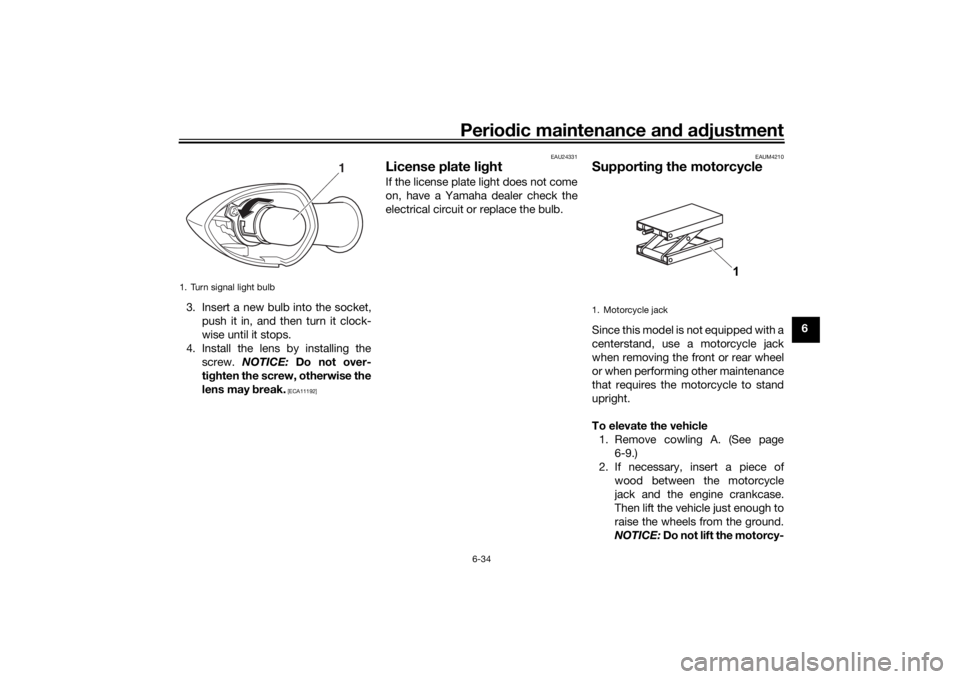
6 3. Insert a new bulb into the socket,
push it in, and then turn it clock-
wise until it stops.
4. Install the lens by installing the
screw. NOTICE: Do not over-
tighten the screw, otherwise the
lens may break.
[ECA11192]EAU24331
License plate lightIf the license plate light does not come
on, have a Yamaha dealer check the
electrical circuit or replace the bulb.
EAUM4210
Supporting the motorcycleSince this model is not equipped with a
centerstand, use a motorcycle jack
when removing the front or rear wheel
or when performing other maintenance
that requires the motorcycle to stand
upright.
To elevate the vehicle
1. Remove cowling A. (See page
6-9.)
2. If necessary, insert a piece of
wood between the motorcycle
jack and the engine crankcase.
Then lift the vehicle just enough to
raise the wheels from the ground.
NOTICE: Do not lift the motorcy-
1. Turn signal light bulb
1
1. Motorcycle jack
1
UBW3E0E0.book Page 34 Friday, May 24, 2019 11:01 AM
Page 87 of 102
Periodic maintenance and adjustment
6-36
6
EAU86350
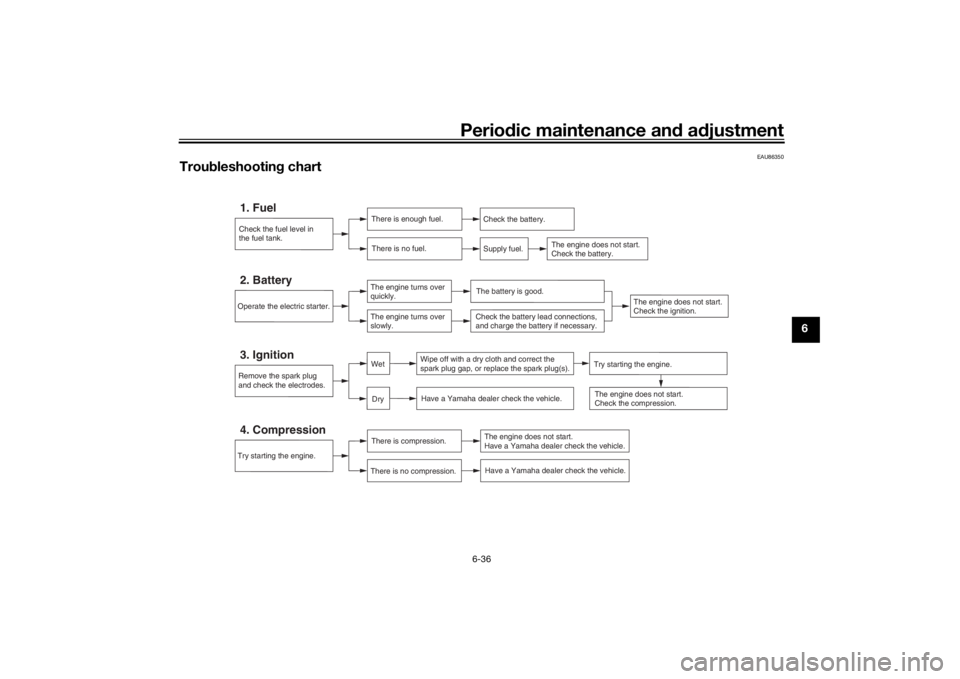
Troubleshooting chart
Check the fuel level in
the fuel tank.1. Fuel
There is enough fuel.
There is no fuel.
Check the battery.
Supply fuel.
The engine does not start.
Check the battery.
Try starting the engine.4. Compression
There is compression.
There is no compression.
The engine does not start.
Have a Yamaha dealer check the vehicle.Have a Yamaha dealer check the vehicle.
Remove the spark plug
and check the electrodes.3. Ignition
Wipe off with a dry cloth and correct the
spark plug gap, or replace the spark plug(s).
Have a Yamaha dealer check the vehicle.
The engine does not start.
Check the compression.
Operate the electric starter.2. Battery
The engine turns over
quickly.
The engine turns over
slowly.
The battery is good.
DryWet
Try starting the engine. Check the battery lead connections,
and charge the battery if necessary.
The engine does not start.
Check the ignition.
UBW3E0E0.book Page 36 Friday, May 24, 2019 11:01 AM
Page 88 of 102
Periodic maintenance and adjustment
6-37
6
EAU86420
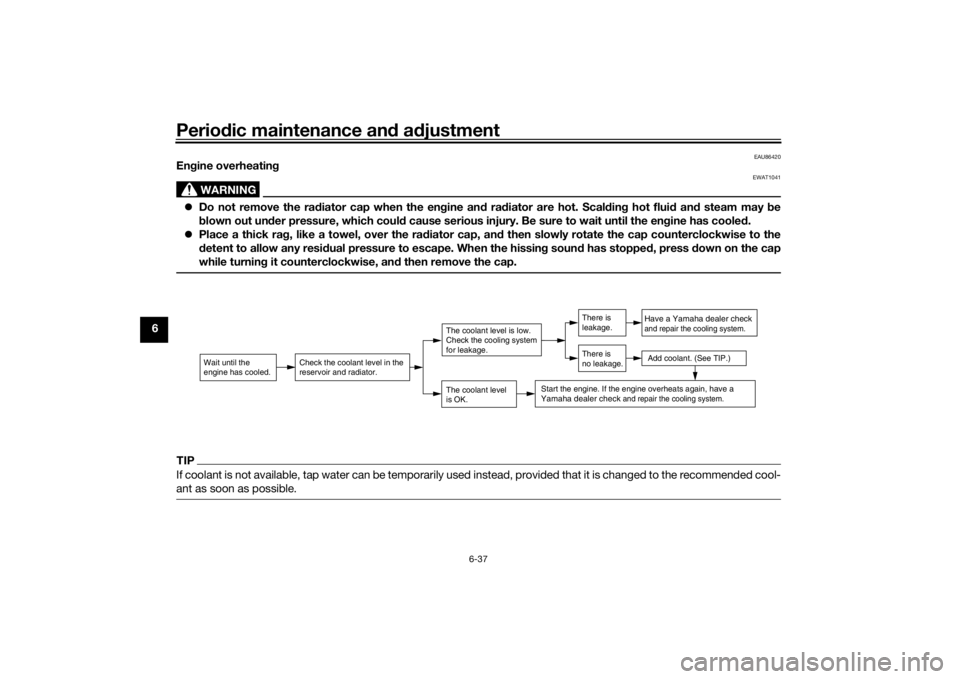
Engine overheating
WARNING
EWAT1041
Do not remove the radiator cap when the engine and radiator are hot. Scalding hot fluid and steam may be
blown out under pressure, which could cause serious injury. Be sure to wait until the engine has cooled.
Place a thick rag, like a towel, over the radiator cap, and then slowly rotate the cap counterclockwise to the
detent to allow any residual pressure to escape. When the hissing sound has stopped, press down on the cap
while turning it counterclockwise, and then remove the cap.TIPIf coolant is not available, tap water can be temporarily used instead, provided that it is changed to the recommended cool-
ant as soon as possible.
Wait until the
engine has cooled.
Check the coolant level in the
reservoir and radiator.
The coolant level
is OK.The coolant level is low.
Check the cooling system
for leakage.
Have a Yamaha dealer checkand repair the cooling system.Add coolant. (See TIP.)
Start the engine. If the engine overheats again,
have a
Yamaha dealer check
and repair the cooling system.
There is
leakage.
There is
no leakage.
UBW3E0E0.book Page 37 Friday, May 24, 2019 11:01 AM
Page 91 of 102
![YAMAHA TENERE 700 2020 Service Manual Motorcycle care and storage
7-3
7 will become slippery, which
could cause loss of control.
Thoroughly clean the surfaces
of these parts before operating
the vehicle.
[EWA20650]
5. Treat rubber, vinyl](/img/51/51774/w960_51774-90.png "YAMAHA TENERE 700 2020 Service Manual Motorcycle care and storage
7-3
7 will become slippery, which
could cause loss of control.
Thoroughly clean the surfaces
of these parts before operating
the vehicle.
[EWA20650]
5. Treat rubber, vinyl")
Motorcycle care and storage
7-3
7 will become slippery, which
could cause loss of control.
Thoroughly clean the surfaces
of these parts before operating
the vehicle.
[EWA20650]
5. Treat rubber, vinyl, and unpainted
plastic parts with a suitable care
product.
6. Touch up minor paint damage
caused by stones, etc.
7. Wax all painted surfaces using a
non-abrasive wax or use a detail
spray for motorcycles.
8. When finished cleaning, start the
engine and let it idle for several
minutes to help dry any remaining
moisture.
9. If the headlight lens has fogged
up, start the engine and turn on
the headlight to help remove the
moisture.
10. Let the vehicle dry completely be-
fore storing or covering it.NOTICE
ECA26320
Do not apply wax to rubber or
unpainted plastic parts.Do not use abrasive polishing
compounds as they will wear
away the paint.
Apply sprays and wax sparingly.
Wipe off excess afterwards.
WARNING
EWA20660
Contaminants left on the brakes or
tires can cause loss of control.
Make sure there is no lubricant
or wax on the brakes or tires.
If necessary, wash the tires with
warm water and a mild deter-
gent.
If necessary, clean the brake
discs and pads with brake
cleaner or acetone.
Before riding at higher speeds,
test the vehicle’s braking per-
formance and cornering behav-
ior.
EAU83472
StorageAlways store the vehicle in a cool, dry
place. If necessary, protect it against
dust with a porous cover. Be sure the
engine and the exhaust system are
cool before covering the vehicle. If the
vehicle often sits for weeks at a time
between uses, the use of a quality fuel
stabilizer is recommended after each
fill-up.NOTICE
ECA21170
Storing the vehicle in a poorly
ventilated room or covering it
with a tarp, while it is still wet,
will allow water and humidity to
seep in and cause rust.
To prevent corrosion, avoid
damp cellars, stables (because
of the presence of ammonia)
and areas where strong chemi-
cals are stored.Long term storage
Before storing the vehicle long term (60
days or more):
UBW3E0E0.book Page 3 Friday, May 24, 2019 11:01 AM
Page 92 of 102

Motorcycle care and storage
7-4
71. Make all necessary repairs and
perform any outstanding mainte-
nance.
2. Follow all instructions in the Care
section of this chapter.
3. Fill up the fuel tank, adding fuel
stabilizer according to product in-
structions. Run the engine for 5
minutes to distribute treated fuel
through the fuel system.
4. For vehicles equipped with a fuel
cock: Turn the fuel cock lever to
the off position.
5. For vehicles with a carburetor: To
prevent fuel deposits from build-
ing up, drain the fuel in the carbu-
retor float chamber into a clean
container. Retighten the drain bolt
and pour the fuel back into the fuel
tank.
6. Use a quality engine fogging oil
according to product instructions
to protect internal engine compo-
nents from corrosion. If engine
fogging oil is not available, per-
form the following steps for each
cylinder:
a. Remove the spark plug cap
and spark plug.b. Pour a teaspoonful of engine
oil into the spark plug bore.
c. Install the spark plug cap onto
the spark plug, and then place
the spark plug on the cylinder
head so that the electrodes are
grounded. (This will limit spark-
ing during the next step.)
d. Turn the engine over several
times with the starter. (This will
coat the cylinder wall with oil.)
WARNING! To prevent dam-
age or injury from sparking,
make sure to ground the
spark plug electrodes while
turning the engine over.
[EWA10952]
e. Remove the spark plug cap
from the spark plug, and then
install the spark plug and the
spark plug cap.
7. Lubricate all control cables, piv-
ots, levers and pedals, as well as
the sidestand and centerstand (if
equipped).
8. Check and correct the tire air
pressure, and then lift the vehicle
so that all wheels are off the
ground. Otherwise, turn thewheels a little once a month in or-
der to prevent the tires from be-
coming degraded in one spot.
9. Cover the muffler outlet with a
plastic bag to prevent moisture
from entering it.
10. Remove the battery and fully
charge it, or attach a maintenance
charger to keep the battery opti-
mally charged. NOTICE: Confirm
that the battery and its charger
are compatible. Do not charge a
VRLA battery with a convention-
al charger.
[ECA26330]
TIPIf the battery will be removed,
charge it once a month and store
it in a temperate location between
0-30 °C (32-90 °F).
See page 6-30 for more informa-
tion on charging and storing the
battery.
UBW3E0E0.book Page 4 Friday, May 24, 2019 11:01 AM
Page 93 of 102
Specifications
8-1
8
Dimensions:Overall length:
2370 mm (93.3 in)
Overall width:
905 mm (35.6 in)
Overall height:
1455 mm (57.3 in)
Seat height:
875 mm (34.4 in)
Wheelbase:
1595 mm (62.8 in)
Ground clearance:
240 mm (9.45 in)
Minimum turning radius:
2.8 m (9.47 ft)Weight:Curb weight:
204 kg (450 lb)Engine:Combustion cycle:
4-stroke
Cooling system:
Liquid cooled
Valve train:
DOHC
Cylinder arrangement:
Inline
Number of cylinders:
2-cylinder
Displacement:
689 cm³
Bore × stroke:
80.0 × 68.6 mm (3.15 × 2.70 in)Starting system:
Electric starter
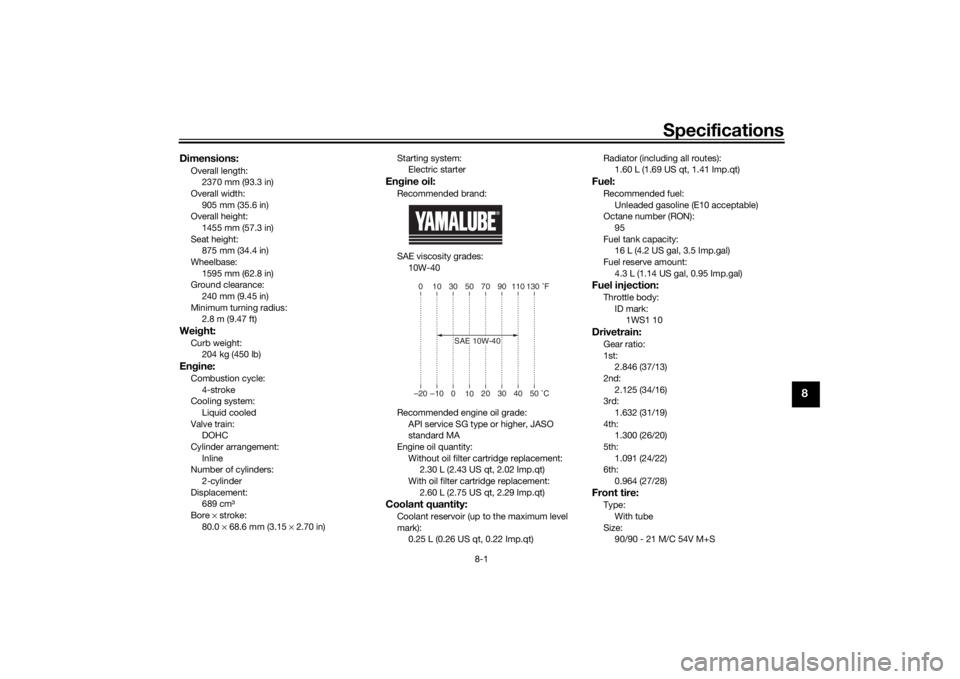
Engine oil:Recommended brand:
SAE viscosity grades:
10W-40
Recommended engine oil grade:
API service SG type or higher, JASO
standard MA
Engine oil quantity:
Without oil filter cartridge replacement:
2.30 L (2.43 US qt, 2.02 Imp.qt)
With oil filter cartridge replacement:
2.60 L (2.75 US qt, 2.29 Imp.qt)Coolant quantity:Coolant reservoir (up to the maximum level
mark):
0.25 L (0.26 US qt, 0.22 Imp.qt)Radiator (including all routes):
1.60 L (1.69 US qt, 1.41 Imp.qt)
Fuel:Recommended fuel:
Unleaded gasoline (E10 acceptable)
Octane number (RON):
95
Fuel tank capacity:
16 L (4.2 US gal, 3.5 Imp.gal)
Fuel reserve amount:
4.3 L (1.14 US gal, 0.95 Imp.gal)Fuel injection:Throttle body:
ID mark:
1WS1 10Drivetrain:Gear ratio:
1st:
2.846 (37/13)
2nd:
2.125 (34/16)
3rd:
1.632 (31/19)
4th:
1.300 (26/20)
5th:
1.091 (24/22)
6th:
0.964 (27/28)Front tire:Type:
With tube
Size:
90/90 - 21 M/C 54V M+S
–20 –10 0
1020 30 40 50 C 10 30 50 70 90 110 0 130 F
SAE 10W-40
UBW3E0E0.book Page 1 Friday, May 24, 2019 11:01 AM
Page 95 of 102
Consumer information
9-1
9
EAU53562
Identification numbersRecord the vehicle identification num-
ber, engine serial number, and the
model label information in the spaces
provided below. These identification
numbers are needed when registering
the vehicle with the authorities in your
area and when ordering spare parts
from a Yamaha dealer.
VEHICLE IDENTIFICATION NUMBER:
ENGINE SERIAL NUMBER:
MODEL LABEL INFORMATION:
EAU26401
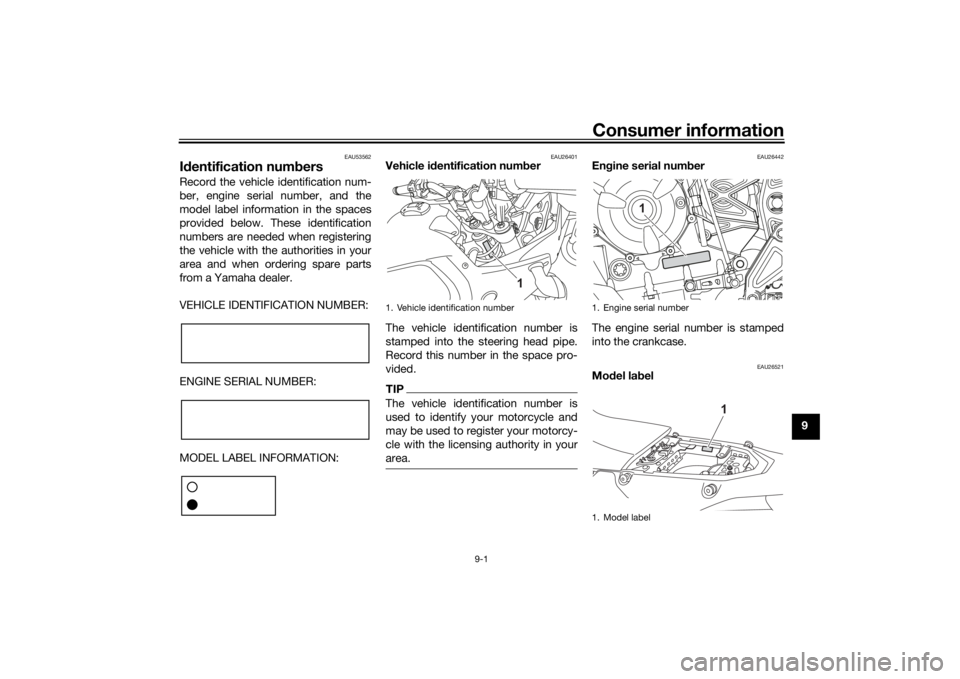
Vehicle identification number
The vehicle identification number is
stamped into the steering head pipe.
Record this number in the space pro-
vided.TIPThe vehicle identification number is
used to identify your motorcycle and
may be used to register your motorcy-
cle with the licensing authority in your
area.
EAU26442
Engine serial number
The engine serial number is stamped
into the crankcase.
EAU26521
Model label
1. Vehicle identification number
1
1. Engine serial number
1. Model label
1
1
UBW3E0E0.book Page 1 Friday, May 24, 2019 11:01 AM
Page 96 of 102
Consumer information
9-2
9The model label is affixed to the frame
under the passenger seat. (See page
3-19.) Record the information on this
label in the space provided. This infor-
mation will be needed when ordering
spare parts from a Yamaha dealer.
EAU69910
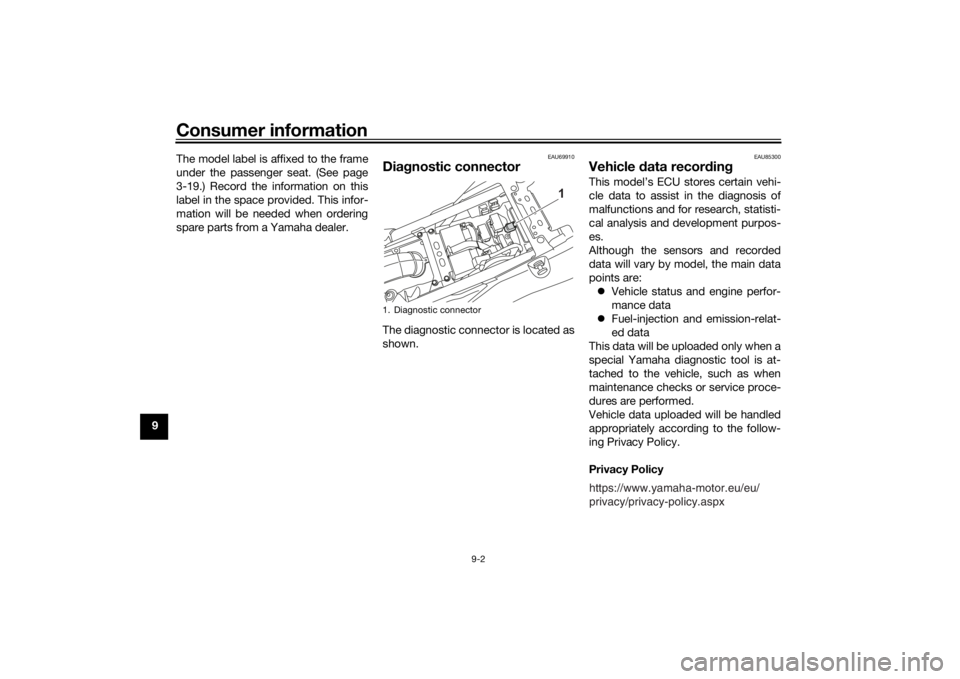
Diagnostic connectorThe diagnostic connector is located as
shown.
EAU85300
Vehicle data recordingThis model’s ECU stores certain vehi-
cle data to assist in the diagnosis of
malfunctions and for research, statisti-
cal analysis and development purpos-
es.
Although the sensors and recorded
data will vary by model, the main data
points are:
Vehicle status and engine perfor-
mance data
Fuel-injection and emission-relat-
ed data
This data will be uploaded only when a
special Yamaha diagnostic tool is at-
tached to the vehicle, such as when
maintenance checks or service proce-
dures are performed.
Vehicle data uploaded will be handled
appropriately according to the follow-
ing Privacy Policy.
Privacy Policy
1. Diagnostic connector
1
https://www.yamaha-motor.eu/eu/
privacy/privacy-policy.aspx
UBW3E0E0.book Page 2 Friday, May 24, 2019 11:01 AM
Page 98 of 102

10-1
10
IndexAABS ....................................................... 3-15
ABS off warning light .............................. 3-4
ABS warning light ................................... 3-4
Air filter element and check hose,
replacing and cleaning ....................... 6-15BBattery .................................................. 6-30
Brake and clutch levers, checking and
lubricating ........................................... 6-27
Brake and shift pedals, checking and
lubricating ........................................... 6-26
Brake fluid, changing ............................ 6-23
Brake fluid level, checking .................... 6-22
Brake lever ............................................ 3-15
Brake lever free play, checking............. 6-20
Brake light switches.............................. 6-21
Brake pedal........................................... 3-15CCables, checking and lubricating ......... 6-26
Canister................................................. 6-10
Care ........................................................ 7-1
Catalytic converter ................................ 3-19
Clutch lever ........................................... 3-14
Clutch lever free play, adjusting ........... 6-19
Coolant ................................................. 6-14
Coolant temperature warning light ......... 3-4
Cowlings, removing and installing .......... 6-9DData recording, vehicle ........................... 9-2
DC power outlets .................................. 3-26
Diagnostic connector.............................. 9-2
Dimmer switch ...................................... 3-13
Drive chain, cleaning and lubricating .... 6-25Drive chain slack .................................. 6-23
EEngine break-in ...................................... 5-1
Engine oil and oil filter cartridge ........... 6-11
Engine overheating ............................... 6-37
Engine serial number .............................. 9-1
Engine stop switch ............................... 3-13
Engine trouble warning light ................... 3-4FFront and rear brake pads, checking ... 6-21
Front fender .......................................... 3-26
Front fork, adjusting ............................. 3-21
Front fork, bleeding .............................. 3-23
Front fork, checking ............................. 6-29
Fuel ....................................................... 3-17
Fuel consumption, tips for reducing ...... 5-4
Fuel tank cap ........................................ 3-16
Fuel tank overflow hose ....................... 3-19
Fuses, replacing ................................... 6-31HHandlebar switches .............................. 3-12
Hazard switch....................................... 3-13
Headlight beams, adjusting.................. 3-21
High beam indicator light ....................... 3-3
Horn switch .......................................... 3-13IIdentification numbers ............................ 9-1
Ignition circuit cut-off system ............... 3-28
Immobilizer system ................................ 3-1
Immobilizer system indicator light .......... 3-5
Indicator lights and warning lights ......... 3-3LLicense plate light ................................ 6-34
Luggage strap holders ......................... 3-25
MMain switch/steering lock .......................3-2
Maintenance and lubrication, periodic....6-5
Maintenance, emission control
system ..................................................6-3
Matte color, caution ................................7-1
Model label .............................................9-1
Multi-function meter unit .........................3-5NNeutral indicator light ..............................3-3OOil pressure warning light .......................3-3PParking ....................................................5-4
Part locations ..........................................2-1
Pass switch ...........................................3-13RRear suspension, lubricating ................6-28SSafety information ...................................1-1
Seats .....................................................3-19
SELECT switch .....................................3-13
Shifting ....................................................5-3
Shift pedal .............................................3-14
Shock absorber assembly, adjusting ....3-23
Sidestand ..............................................3-27
Sidestand, checking and lubricating.....6-28
Spark plugs, checking ............................6-9
Specifications .........................................8-1
Starting the engine ..................................5-2
Start switch ...........................................3-13
Steering, checking ................................6-29
Storage ...................................................7-3
Supporting the motorcycle ...................6-34
UBW3E0E0.book Page 1 Friday, May 24, 2019 11:01 AM