brake YAMAHA TMAX 2003 Owner's Manual
[x] Cancel search | Manufacturer: YAMAHA, Model Year: 2003, Model line: TMAX, Model: YAMAHA TMAX 2003Pages: 104, PDF Size: 1.67 MB
Page 73 of 104
6-28
PERIODIC MAINTENANCE AND MINOR REPAIR
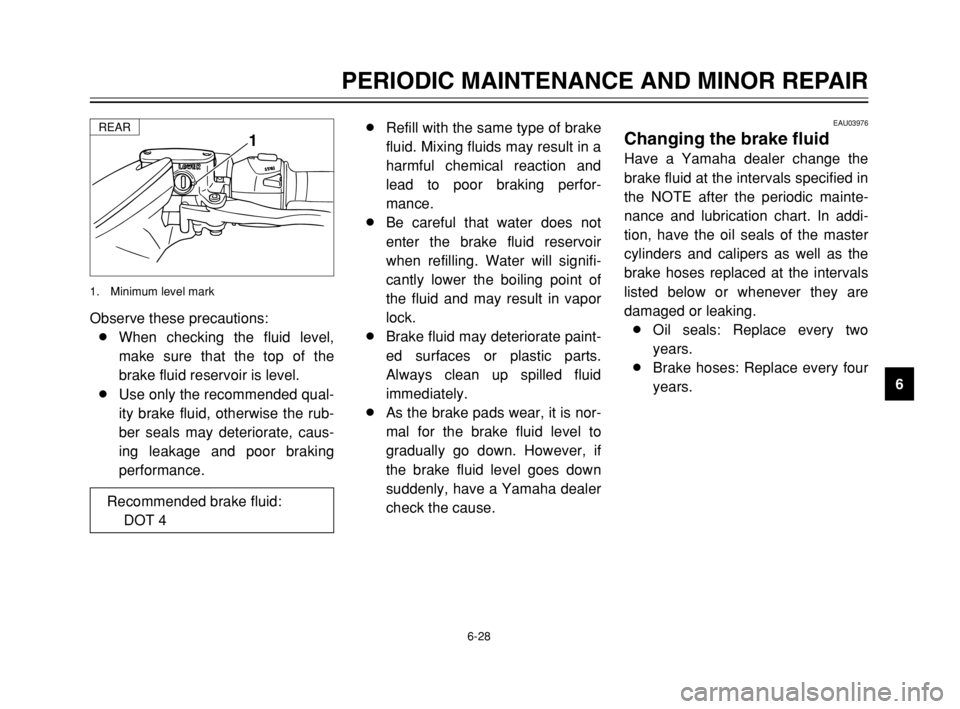
6 Observe these precautions:
8When checking the fluid level,
make sure that the top of the
brake fluid reservoir is level.
8Use only the recommended qual-
ity brake fluid, otherwise the rub-
ber seals may deteriorate, caus-
ing leakage and poor braking
performance.
1
1. Minimum level mark
EAU03976
Changing the brake fluidBrake fluid, changing
Have a Yamaha dealer change the
brake fluid at the intervals specified in
the NOTE after the periodic mainte-
nance and lubrication chart. In addi-
tion, have the oil seals of the master
cylinders and calipers as well as the
brake hoses replaced at the intervals
listed below or whenever they are
damaged or leaking.
8Oil seals: Replace every two
years.
8Brake hoses: Replace every four
years. 8Refill with the same type of brake
fluid. Mixing fluids may result in a
harmful chemical reaction and
lead to poor braking perfor-
mance.
8Be careful that water does not
enter the brake fluid reservoir
when refilling. Water will signifi-
cantly lower the boiling point of
the fluid and may result in vapor
lock.
8Brake fluid may deteriorate paint-
ed surfaces or plastic parts.
Always clean up spilled fluid
immediately.
8As the brake pads wear, it is nor-
mal for the brake fluid level to
gradually go down. However, if
the brake fluid level goes down
suddenly, have a Yamaha dealer
check the cause.
REAR
Recommended brake fluid:
DOT 4
5GJ-28199-E2 9/9/02 9:15 AM Page 71
Page 74 of 104
6-29
PERIODIC MAINTENANCE AND MINOR REPAIR
6
EAU04034
Checking and lubricating the
throttle grip and cable
Throttle grip and cable, checking and lubricating
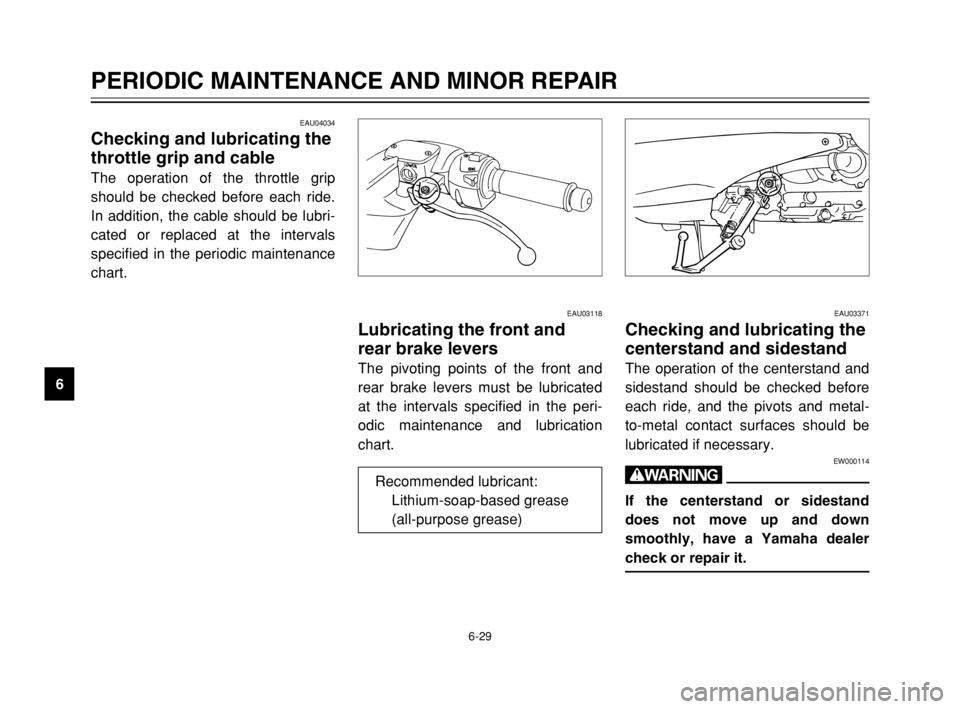
The operation of the throttle grip
should be checked before each ride.
In addition, the cable should be lubri-
cated or replaced at the intervals
specified in the periodic maintenance
chart.
EAU03371
Checking and lubricating the
centerstand and sidestand
Centerstand and sidestand, checking and lubricating
The operation of the centerstand and
sidestand should be checked before
each ride, and the pivots and metal-
to-metal contact surfaces should be
lubricated if necessary.
EW000114
w
If the centerstand or sidestand
does not move up and down
smoothly, have a Yamaha dealer
check or repair it.
EAU03118
Lubricating the front and
rear brake levers
Brake levers, lubricating
The pivoting points of the front and
rear brake levers must be lubricated
at the intervals specified in the peri-
odic maintenance and lubrication
chart.
Recommended lubricant:
Lithium-soap-based grease
(all-purpose grease)
5GJ-28199-E2 9/9/02 9:15 AM Page 72
Page 75 of 104
6-30
PERIODIC MAINTENANCE AND MINOR REPAIR
6
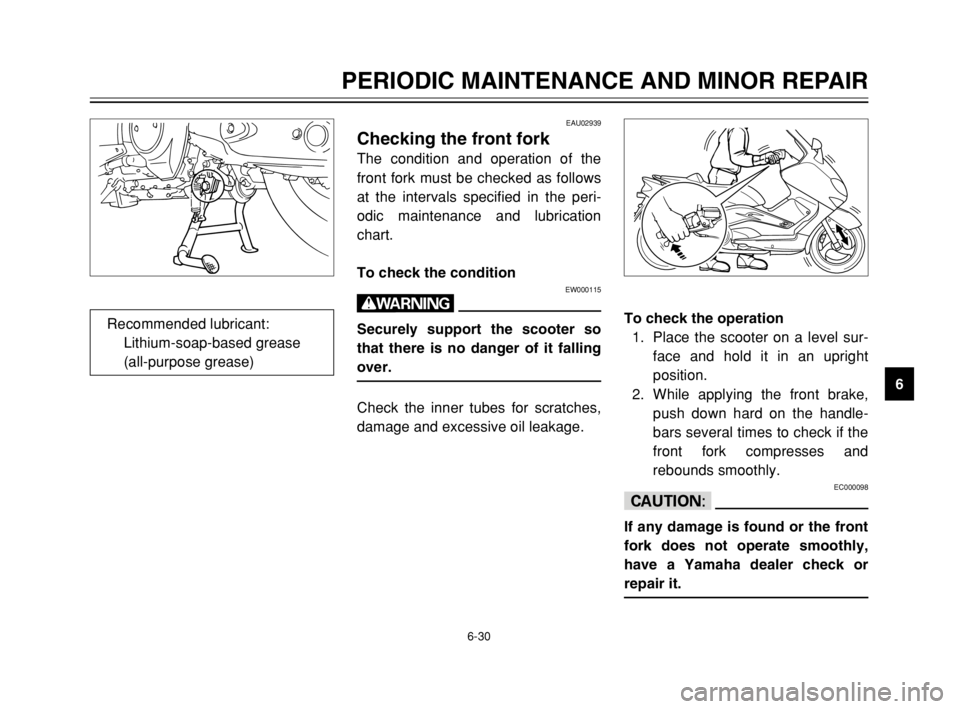
To check the operation
1. Place the scooter on a level sur-
face and hold it in an upright
position.
2. While applying the front brake,
push down hard on the handle-
bars several times to check if the
front fork compresses and
rebounds smoothly.
EC000098
cC
If any damage is found or the front
fork does not operate smoothly,
have a Yamaha dealer check or
repair it.
EAU02939
Checking the front forkFront fork, checking
The condition and operation of the
front fork must be checked as follows
at the intervals specified in the peri-
odic maintenance and lubrication
chart.
To check the condition
EW000115
w
Securely support the scooter so
that there is no danger of it falling
over.
Check the inner tubes for scratches,
damage and excessive oil leakage. Recommended lubricant:
Lithium-soap-based grease
(all-purpose grease)
5GJ-28199-E2 9/9/02 9:15 AM Page 73
Page 87 of 104
7-2
SCOOTER CARE AND STORAGE
7 8 8
Do not use any harsh chemical
products on plastic parts. Be
sure to avoid using cloths or
sponges which have been in
contact with strong or abra-
sive cleaning products, sol-
vent or thinner, fuel (gasoline),
rust removers or inhibitors,
brake fluid, antifreeze or elec-
trolyte.
8 8
Do not use high-pressure
washers or steam-jet cleaners
since they cause water seep-
age and deterioration in the
following areas: seals (of
wheel and swingarm bearings,
fork and brakes), electric com-
ponents (couplers, connec-
tors, instruments, switches
and lights), breather hoses
and vents.8 8
For scooters equipped with a
windshield: Do not use strong
cleaners or hard sponges as
they will cause dulling or
scratching. Some cleaning
compounds for plastic may
leave scratches on the wind-
shield. Test the product on a
small hidden part of the wind-
shield to make sure that it
does not leave any marks. If
the windshield is scratched,
use a quality plastic polishing
compound after washing.After normal use
Remove dirt with warm water, a mild
detergent, and a soft, clean sponge,
and then rinse thoroughly with clean
water. Use a toothbrush or bottle-
brush for hard-to-reach areas.
Stubborn dirt and insects will come
off more easily if the area is covered
with a wet cloth for a few minutes
before cleaning.After riding in the rain, near the sea
or on salt-sprayed roads
Since sea salt or salt sprayed on
roads during winter are extremely
corrosive in combination with water,
carry out the following steps after
each ride in the rain, near the sea or
on salt-sprayed roads.
NOTE:
Salt sprayed on roads in the winter
may remain well into spring.
1. Clean the scooter with cold water
and a mild detergent after the
engine has cooled down.
ECA00012
cC
Do not use warm water since it
increases the corrosive action of
the salt.
2. Apply a corrosion protection
spray on all metal, including
chrome- and nickel-plated, sur-
faces to prevent corrosion.
5GJ-28199-E2 9/9/02 9:15 AM Page 85
Page 88 of 104

7-3
SCOOTER CARE AND STORAGE
7After cleaning
1. Dry the scooter with a chamois
or an absorbing cloth.
2. Use a chrome polish to shine
chrome, aluminum and stainless-
steel parts, including the exhaust
system. (Even the thermally
induced discoloring of stainless-
steel exhaust systems can be
removed through polishing.)
3. To prevent corrosion, it is recom-
mended to apply a corrosion pro-
tection spray on all metal, includ-
ing chrome- and nickel-plated,
surfaces.
4. Use spray oil as a universal
cleaner to remove any remaining
dirt.
5. Touch up minor paint damage
caused by stones, etc.6. Wax all painted surfaces.
7. Let the scooter dry completely
before storing or covering it.
EWA00002
w
8 8
Make sure that there is no oil
or wax on the brakes or tires.
If necessary, clean the brake
discs and brake linings with a
regular brake disc cleaner or
acetone, and wash the tires
with warm water and a mild
detergent.
8 8
Before operating the scooter
test its braking performance
and cornering behavior.
ECA00013
cC
8
8
Apply spray oil and wax spar-
ingly and make sure to wipe
off any excess.
8 8
Never apply oil or wax to any
rubber and plastic parts, but
treat them with a suitable care
product.
8 8
Avoid using abrasive polish-
ing compounds as they will
wear away the paint.
NOTE:
Consult a Yamaha dealer for advice
on what products to use.
5GJ-28199-E2 9/9/02 9:15 AM Page 86
Page 94 of 104

8-3
SPECIFICATIONS
8
Wheels
Front
Type Cast wheel
Size 14 M/C ×MT3.50
Rear
Type Cast wheel
Size 14 M/C ×MT4.50
Brakes
Front
Type Single disc brake
Operation Right hand
Fluid DOT 4
Rear
Type Single disc brake
Operation Left hand
Fluid DOT 4Suspension
Front Telescopic fork
Rear Swingarm
Spring/shock absorbers
Front Coil spring/oil damper
Rear Coil spring/gas-oil damper
Wheel travel
Front 120 mm
Rear 120 mm
Electrical
Ignition system Transistorized coil ignition
(digital)
Charging system
Type A.C. magneto
Standard output 14 V, 310W @ 5,000 r/min
Battery
Type GT9B-4
Voltage, capacity 12 V, 8 Ah
Headlight bulb typeHalogen
Bulb voltage, wattage ×quantity
Headlight 12 V, 60/55 W ×1
12 V, 55 W ×1
5GJ-28199-E2 9/9/02 9:15 AM Page 92
Page 95 of 104

8-4
SPECIFICATIONS
8
Tail/brake light 12 V, 5/21 W ×2
Front turn signal light 12 V, 5/21 W ×2
Rear turn signal light 12 V, 21 W ×2
Auxiliary light 12 V, 5 W ×2
License plate light 12 V, 5 W ×1
Meter lighting 12 V, 1.7 W ×3
High beam indicator light 12 V, 1.7 W ×1
Oil change indicator light 12 V, 1.7 W ×1
Turn indicator light 12 V, 3.4 W ×2
V-belt replacement
indicator light 12 V, 1.7 W ×1
Fuses
Main fuse 30 A
Signaling system fuse 15 A
Headlight fuse 15 A
Ignition fuse 10 A
Radiator fan fuse 15 A
Hazard fuse 10 A
Clock fuse (backup fuse) 10 A
5GJ-28199-E2 9/9/02 9:15 AM Page 93
Page 100 of 104

INDEX
F
Front and rear brake levers ..................6-25
Front and rear brake pads, checking ....6-26
Front fork, checking ..............................6-30
Fuel ......................................................3-10
Fuel consumption, tips for reducing .......5-3
Fuel gauge .............................................3-4
Fuel tank cap ..........................................3-9
Fuses, replacing ...................................6-34
H
Handlebar switches ................................3-6
Dimmer switch .....................................3-6
Engine stop switch ...............................3-7
Hazard switch ......................................3-7
Horn switch ..........................................3-7
Pass switch ..........................................3-6
Start switch ..........................................3-7
Turn signal switch ................................3-7
Headlight bulb, replacing ......................6-35
Headlight variations ................................3-8
Helmet holder .......................................3-13
I
Identification numbers ............................9-1
Ignition circuit cut-off system ................3-15
Indicator lights ........................................3-2
High beam indicator light .....................3-3
Oil change indicator light .....................3-2
Turn signal indicator lights ...................3-3
V-belt replacement indicator light ........3-3K
Key identification number .......................9-1
M
Main switch/steering lock .......................3-1
Model label .............................................9-2
P
Parking ...................................................5-4
Part locations ..........................................2-1
Periodic maintenance and lubrication
chart .....................................................6-3
Pre-operation check list ..........................4-1
R
Rider backrest, adjusting ......................3-12
S
Safe-riding points ...................................1-2
Seat ......................................................3-11
Self-diagnosis device .............................3-6
Sidestand .............................................3-14
Spark plugs, checking ............................6-9
Specifications .........................................8-1
Speedometer unit ...................................3-4
Starting off ..............................................5-2
Starting the engine .................................5-1
Steering, checking ................................6-31
Storage ...................................................7-4
Storage compartments .........................3-14A
Acceleration and deceleration ................5-2
Air filter element, cleaning ....................6-19
Anti-theft alarm (optional) .......................3-6
B
Battery ..................................................6-32
Brake fluid level, checking ....................6-27
Brake fluid, changing ............................6-28
Brake lever, front ....................................3-9
Brake lever, rear .....................................3-9
Brake levers, lubricating .......................6-29
Braking ...................................................5-3
C
Carburetors, adjusting ..........................6-21
Care ........................................................7-1
Centerstand and sidestand, checking and
lubricating ..........................................6-29
Chain drive oil .......................................6-15
Clock ......................................................3-5
Conversion table ....................................8-5
Coolant ..................................................6-17
Coolant temperature gauge ....................3-5
Cowlings and panels, removing and
installing ...............................................6-6
E
Engine break-in ......................................5-4
Engine idling speed ..............................6-21
Engine oil and oil filter cartridge ...........6-12
5GJ-28199-E2 9/9/02 9:15 AM Page 98