lock YAMAHA TMAX 2013 User Guide
[x] Cancel search | Manufacturer: YAMAHA, Model Year: 2013, Model line: TMAX, Model: YAMAHA TMAX 2013Pages: 100, PDF Size: 2.95 MB
Page 35 of 100
INSTRUMENT AND CONTROL FUNCTIONS
3-20
234
5
6
7
8
9
EAU13932
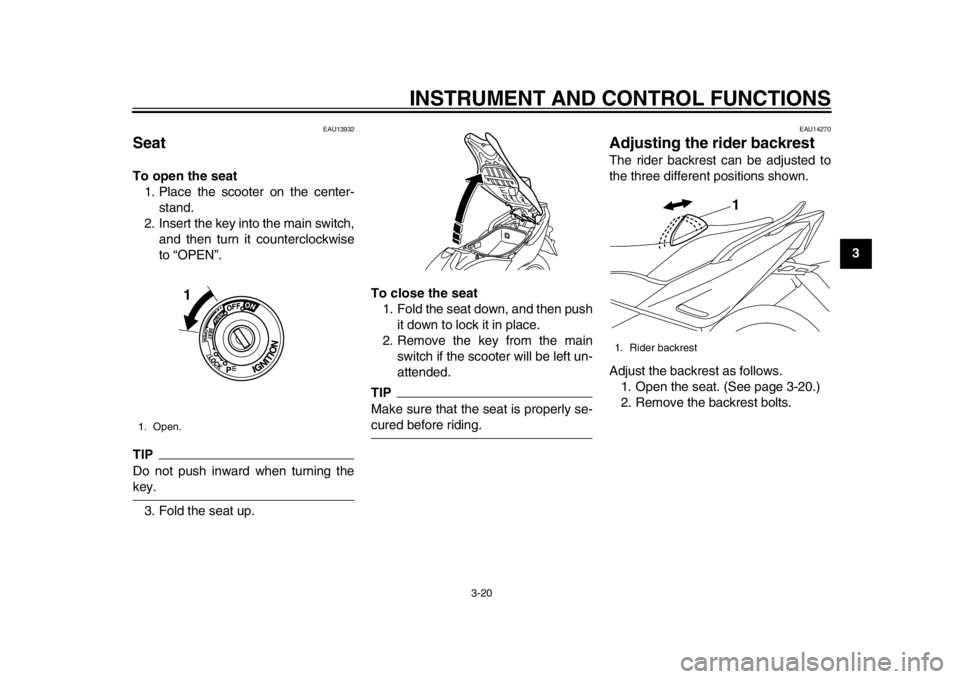
Seat To open the seat1. Place the scooter on the center- stand.
2. Insert the key into the main switch, and then turn it counterclockwise
to “OPEN”.TIPDo not push inward when turning thekey.
3. Fold the seat up. To close the seat
1. Fold the seat down, and then push it down to lock it in place.
2. Remove the key from the main switch if the scooter will be left un-
attended.
TIPMake sure that the seat is properly se-cured before riding.
EAU14270
Adjusting the rider backrest The rider backrest can be adjusted to
the three different positions shown.
Adjust the backrest as follows.1. Open the seat. (See page 3-20.)
2. Remove the backrest bolts.
1. Open.
1
1. Rider backrest
1
59C-9-E1.book 20 ページ 2012年6月26日 火曜日 午前11時33分
Page 37 of 100
INSTRUMENT AND CONTROL FUNCTIONS
3-22
234
5
6
7
8
9
EAU52221
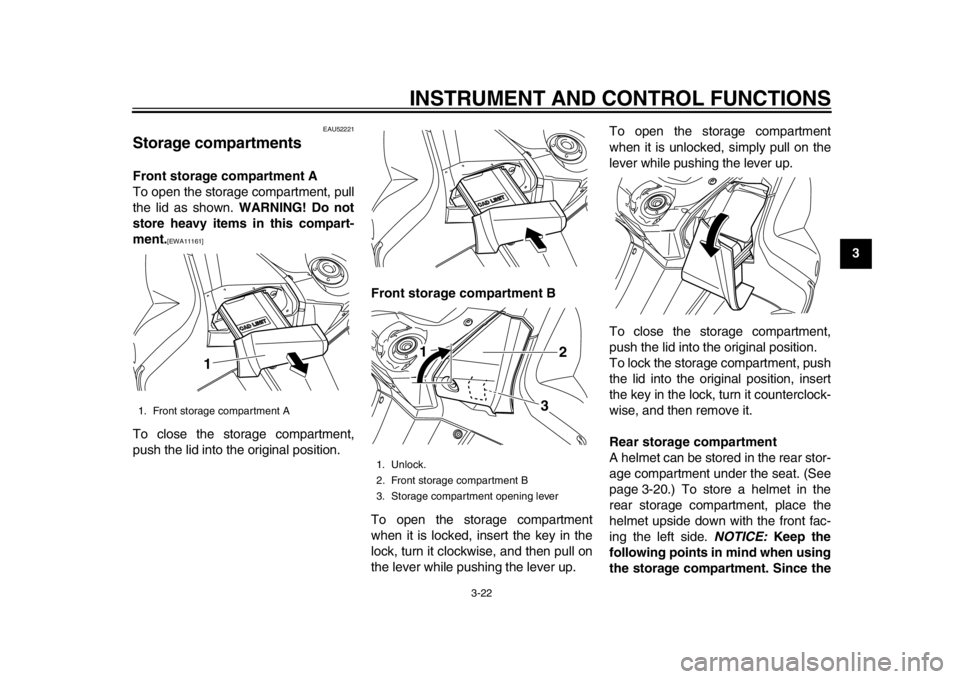
Storage compartments Front storage compartment A
To open the storage compartment, pull
the lid as shown. WARNING! Do not
store heavy items in this compart-
ment.
[EWA11161]
To close the storage compartment,
push the lid into the original position. Front storage compartment B
To open the storage compartment
when it is locked, insert the key in the
lock, turn it clockwise, and then pull on
the lever while pushing the lever up.To open the storage compartment
when it is unlocked, simply pull on the
lever while pushing the lever up.
To close the storage compartment,
push the lid into the original position.
To lock the storage compartment, push
the lid into the original position, insert
the key in the lock, turn it counterclock-
wise, and then remove it.
Rear storage compartment
A helmet can be stored in the rear stor-
age compartment under the seat. (See
page 3-20.) To store a helmet in the
rear storage compartment, place the
helmet upside down with the front fac-
ing the left side.
NOTICE: Keep the
following points in mind when using
the storage compartment. Since the
1. Front storage compartment A
1
1. Unlock.
2. Front storage compartment B
3. Storage compartment opening lever
1 2
3
59C-9-E1.book 22 ページ 2012年6月26日 火曜日 午前11時33分
Page 54 of 100
PERIODIC MAINTENANCE AND ADJUSTMENT
6-4
1
2
3
4
56
7
8
9
EAU1770E
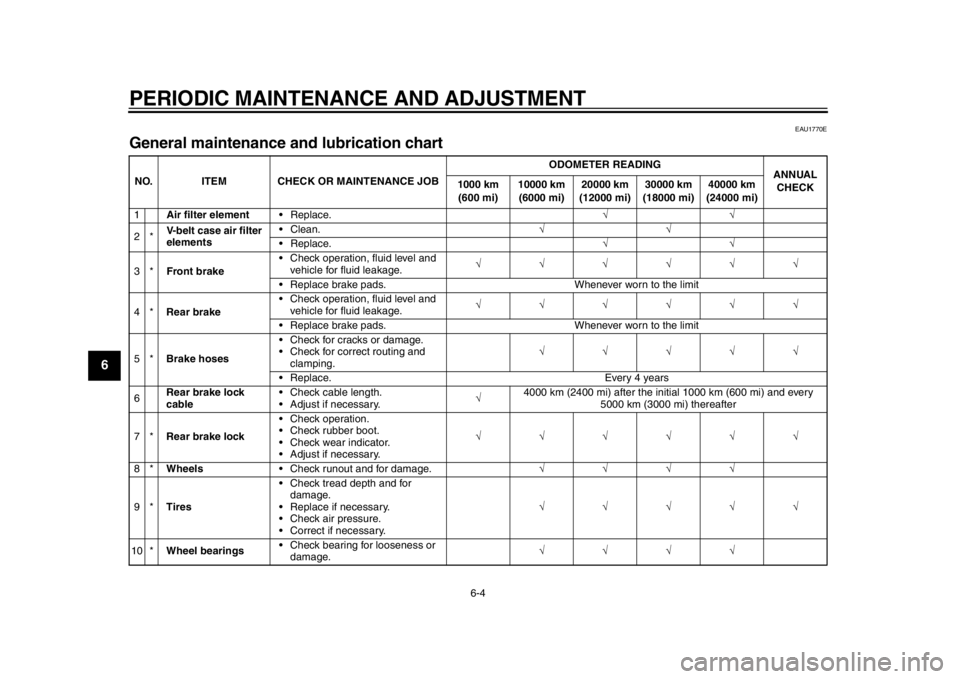
General maintenance and lubrication chart NO. ITEM CHECK OR MAINTENANCE JOB ODOMETER READING
ANNUAL
CHECK
1000 km
(600 mi) 10000 km
(6000 mi) 20000 km
(12000 mi) 30000 km
(18000 mi) 40000 km
(24000 mi)
1 Air filter element Replace.
2* V-belt case air filter
elements Clean.
Replace.
3* Front brake Check operation, fluid level and
vehicle for fluid leakage.
Replace brake pads. Whenever worn to the limit
4* Rear brake Check operation, fluid level and
vehicle for fluid leakage.
Replace brake pads. Whenever worn to the limit
5* Brake hoses Check for cracks or damage.
Check for correct routing and
clamping.
Replace. Every 4 years
6 Rear brake lock
cable Check cable length.
Adjust if necessary.
4000 km (2400 mi) after the initial 1000 km (600 mi) and every
5000 km (3000 mi) thereafter
7* Rear brake lock Check operation.
Check rubber boot.
Check wear indicator.
Adjust if necessary.
8* Wheels Check runout and for damage.
9* Tires Check tread depth and for
damage.
Replace if necessary.
Check air pressure.
Correct if necessary.
10 * Wheel bearings Check bearing for looseness or
damage.
59C-9-E1.book 4 ページ 2012年6月26日 火曜日 午前11時33分
Page 69 of 100
PERIODIC MAINTENANCE AND ADJUSTMENT
6-19
2
3
4
567
8
9
ageing. Old and aged tires shall be
checked by tire spec
ialists to ascertain
their suitability for further use.
WARNING
EWA16100
The front and rear tires should
be of the same make and de-
sign, otherwise the handling
characteristics of the vehicle
may be different, which could
lead to an accident.
Always make sure that the valve
caps are securely installed to
prevent air pressure leakage.
Use only the tire valves and
valve cores listed below toavoid tire deflation during a ride.
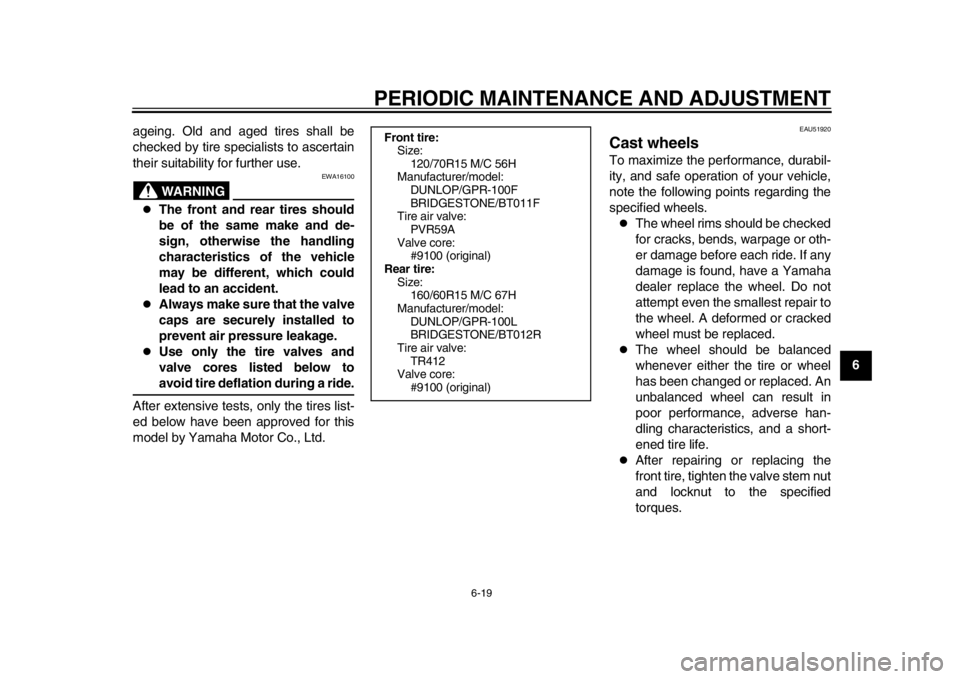
After extensive tests, only the tires list-
ed below have been approved for this
model by Yamaha Motor Co., Ltd.
EAU51920
Cast wheels To maximize the performance, durabil-
ity, and safe operation of your vehicle,
note the following points regarding the
specified wheels.
The wheel rims should be checked
for cracks, bends, warpage or oth-
er damage before each ride. If any
damage is found, have a Yamaha
dealer replace the wheel. Do not
attempt even the smallest repair to
the wheel. A deformed or cracked
wheel must be replaced.
The wheel should be balanced
whenever either the tire or wheel
has been changed or replaced. An
unbalanced wheel can result in
poor performance, adverse han-
dling characteristics, and a short-
ened tire life.
After repairing or replacing the
front tire, tighten the valve stem nut
and locknut to the specified
torques.
Front tire: Size:120/70R15 M/C 56H
Manufacturer/model:
DUNLOP/GPR-100F
BRIDGESTONE/BT011F
Tire air valve:
PVR59A
Valve core: #9100 (original)
Rear tire: Size:160/60R15 M/C 67H
Manufacturer/model: DUNLOP/GPR-100L
BRIDGESTONE/BT012R
Tire air valve: TR412
Valve core:
#9100 (original)
59C-9-E1.book 19 ページ 2012年6月26日 火曜日 午前11時33分
Page 70 of 100
PERIODIC MAINTENANCE AND ADJUSTMENT
6-20
1
2
3
4
56
7
8
9
EAU50860
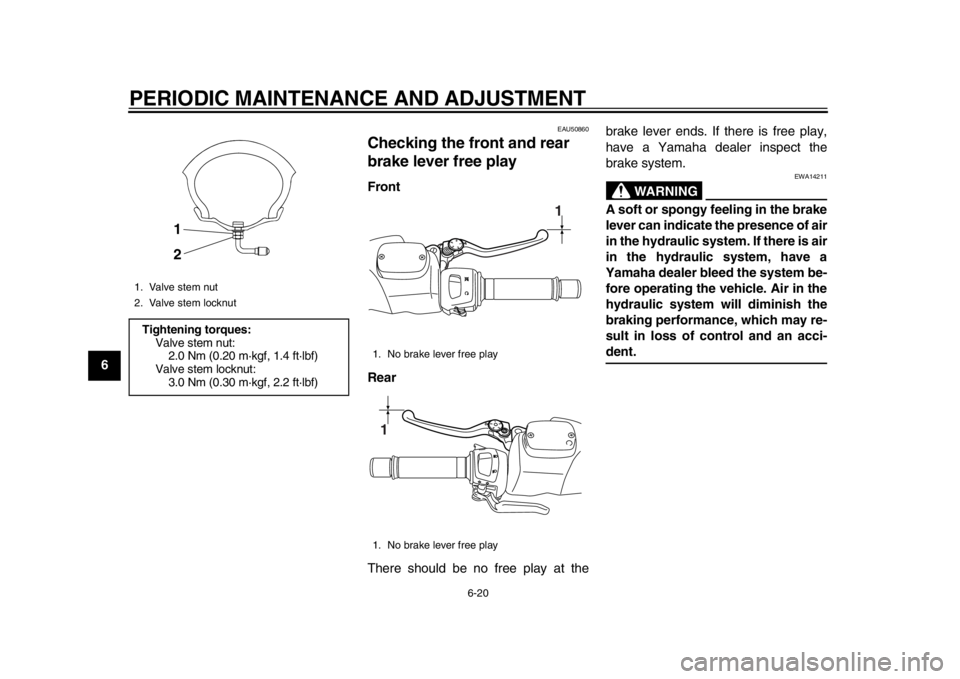
Checking the front and rear
brake lever free play Front
Rear
There should be no free play at thebrake lever ends. If there is free play,
have a Yamaha dealer inspect the
brake system.
WARNING
EWA14211
A soft or spongy feeling in the brake
lever can indicate the presence of air
in the hydraulic system. If there is air
in the hydraulic system, have a
Yamaha dealer bleed the system be-
fore operating the vehicle. Air in the
hydraulic system will diminish the
braking performance, which may re-
sult in loss of control and an acci-dent.
1. Valve stem nut
2. Valve stem locknutTightening torques:
Valve stem nut:
2.0 Nm (0.20 m·kgf, 1.4 ft·lbf)
Valve stem locknut: 3.0 Nm (0.30 m·kgf, 2.2 ft·lbf)
1
2
1. No brake lever free play
1. No brake lever free play
1
1
59C-9-E1.book 20 ページ 2012年6月26日 火曜日 午前11時33分
Page 71 of 100
PERIODIC MAINTENANCE AND ADJUSTMENT
6-21
2
3
4
567
8
9
EAU53031
Adjusting the rear brake lock
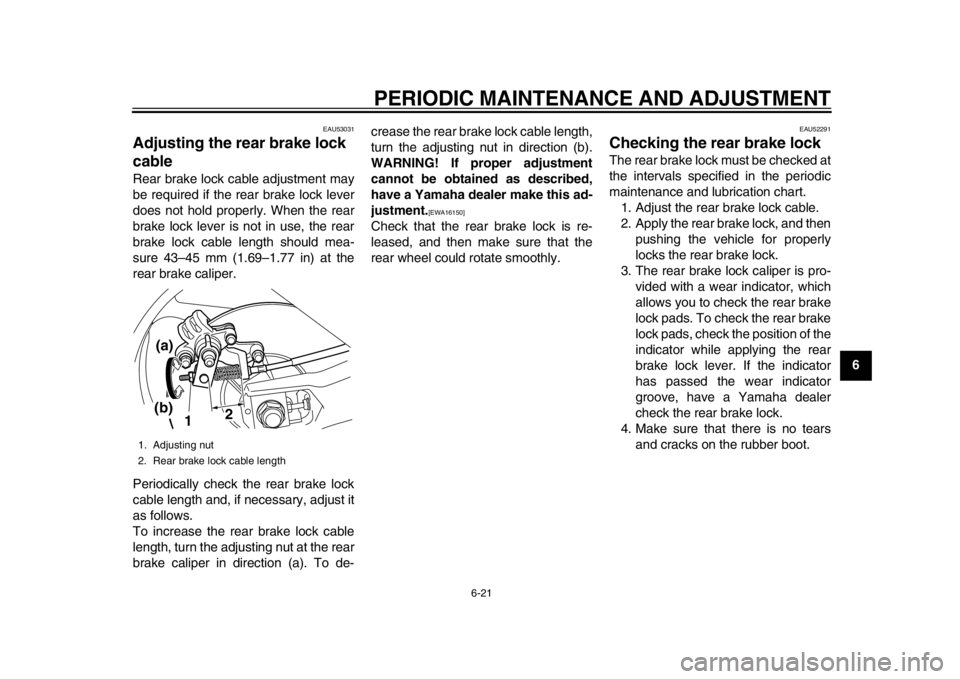
cable Rear brake lock cable adjustment may
be required if the rear brake lock lever
does not hold properly. When the rear
brake lock lever is not in use, the rear
brake lock cable length should mea-
sure 43–45 mm (1.69–1.77 in) at the
rear brake caliper.
Periodically check the rear brake lock
cable length and, if necessary, adjust it
as follows.
To increase the rear brake lock cable
length, turn the adjusting nut at the rear
brake caliper in direction (a). To de-crease the rear brake lock cable length,
turn the adjusting nut in direction (b).
WARNING! If proper adjustment
cannot be obtained as described,
have a Yamaha dealer make this ad-
justment.
[EWA16150]
Check that the rear brake lock is re-
leased, and then make sure that the
rear wheel could rotate smoothly.
EAU52291
Checking the rear brake lock The rear brake lock must be checked at
the intervals specified in the periodic
maintenance and lubrication chart. 1. Adjust the rear brake lock cable.
2. Apply the rear brake lock, and then pushing the vehicle for properly
locks the rear brake lock.
3. The rear brake lock caliper is pro- vided with a wear indicator, which
allows you to check the rear brake
lock pads. To check the rear brake
lock pads, check the position of the
indicator while applying the rear
brake lock lever. If the indicator
has passed the wear indicator
groove, have a Yamaha dealer
check the rear brake lock.
4. Make sure that there is no tears and cracks on the rubber boot.
1. Adjusting nut
2. Rear brake lock cable length
2
1
(a)
(b)
59C-9-E1.book 21 ページ 2012年6月26日 火曜日 午前11時33分
Page 73 of 100
PERIODIC MAINTENANCE AND ADJUSTMENT
6-23
2
3
4
567
8
9
EAU22581
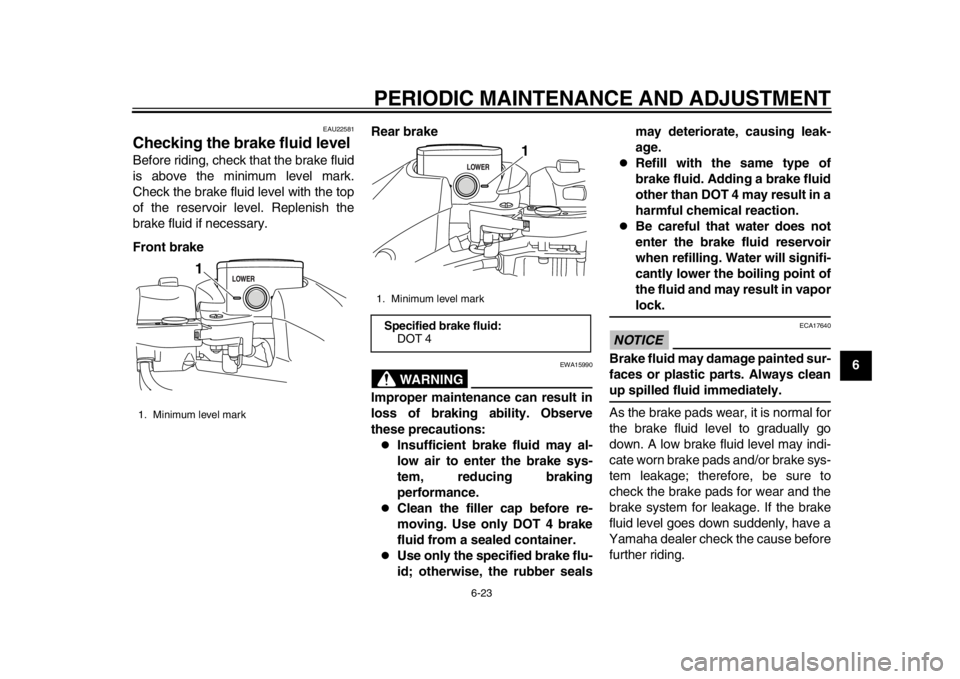
Checking the brake fluid level Before riding, check that the brake fluid
is above the minimum level mark.
Check the brake fluid level with the top
of the reservoir level. Replenish the
brake fluid if necessary.
Front brakeRear brake
WARNING
EWA15990
Improper maintenance can result in
loss of braking ability. Observe
these precautions:
Insufficient brake fluid may al-
low air to enter the brake sys-
tem, reducing braking
performance.
Clean the filler cap before re-
moving. Use only DOT 4 brake
fluid from a sealed container.
Use only the specified brake flu-
id; otherwise, the rubber sealsmay deteriorate, causing leak-
age.
Refill with the same type of
brake fluid. Adding a brake fluid
other than DOT 4 may result in a
harmful chemical reaction.
Be careful that water does not
enter the brake fluid reservoir
when refilling. Water will signifi-
cantly lower the boiling point of
the fluid and may result in vaporlock.
NOTICE
ECA17640
Brake fluid may damage painted sur-
faces or plastic parts. Always cleanup spilled fluid immediately.
As the brake pads wear, it is normal for
the brake fluid level to gradually go
down. A low brake fluid level may indi-
cate worn brake pads and/or brake sys-
tem leakage; therefore, be sure to
check the brake pads for wear and the
brake system for leakage. If the brake
fluid level goes down suddenly, have a
Yamaha dealer check the cause before
further riding.
1. Minimum level mark
1
1. Minimum level markSpecified brake fluid:
DOT 4
1
59C-9-E1.book 23 ページ 2012年6月26日 火曜日 午前11時33分
Page 82 of 100
PERIODIC MAINTENANCE AND ADJUSTMENT
6-32
1
2
3
4
56
7
8
9
EAU52231
Replacing the headlight bulb This model is equipped with a halogen
bulb headlights. If the headlight bulb
burns out, replace it as follows.NOTICE
ECA10650
Take care not to damage the follow-
ing parts:
Headlight bulb
Do not touch the glass part of
the headlight bulb to keep it free
from oil, otherwise the transpar-
ency of the glass, the luminosity
of the bulb, and the bulb life will
be adversely affected. Thor-
oughly clean off any dirt and fin-
gerprints on the headlight bulb
using a cloth moistened with al-
cohol or thinner.
Headlight lens
Do not affix any type of tinted
film or stickers to the headlight
lens.
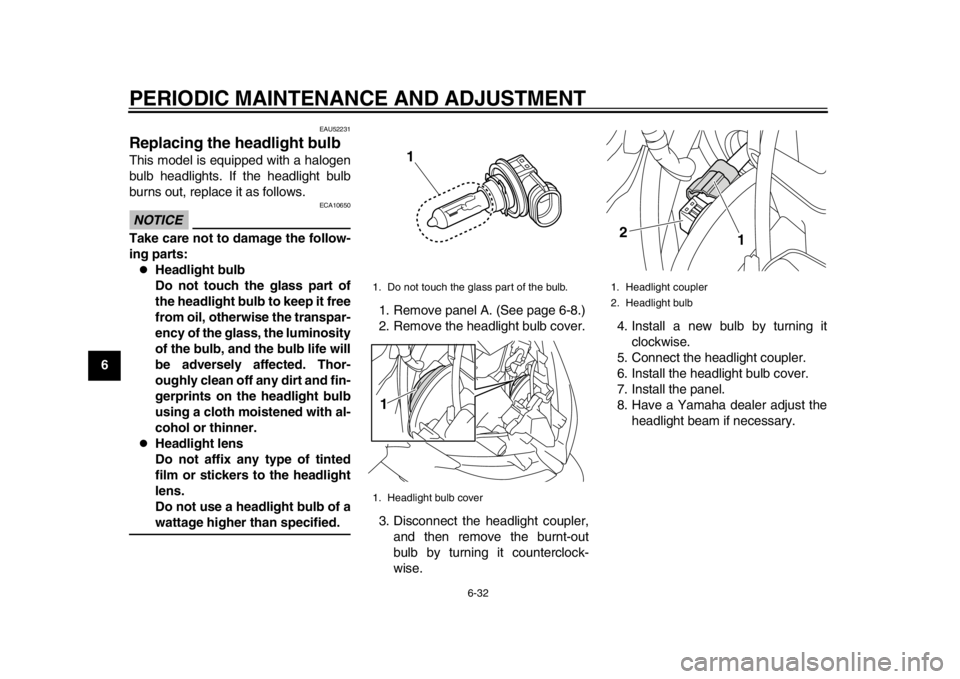
Do not use a headlight bulb of awattage higher than specified. 1. Remove panel A. (See page 6-8.)
2. Remove the headlight bulb cover.
3. Disconnect the headlight coupler,
and then remove the burnt-out
bulb by turning it counterclock-
wise. 4. Install a new bulb by turning it
clockwise.
5. Connect the headlight coupler.
6. Install the headlight bulb cover.
7. Install the panel.
8. Have a Yamaha dealer adjust the headlight beam if necessary.
1. Do not touch the glass part of the bulb.
1. Headlight bulb cover
1
1
1. Headlight coupler
2. Headlight bulb
1
2
59C-9-E1.book 32 ページ 2012年6月26日 火曜日 午前11時33分
Page 83 of 100
PERIODIC MAINTENANCE AND ADJUSTMENT
6-33
2
3
4
567
8
9
EAU24181
Tail/brake light This model is equipped with an
LED-type tail/brake light.
If the tail/brake light does not come on,
have a Yamaha dealer check it.
EAU52320
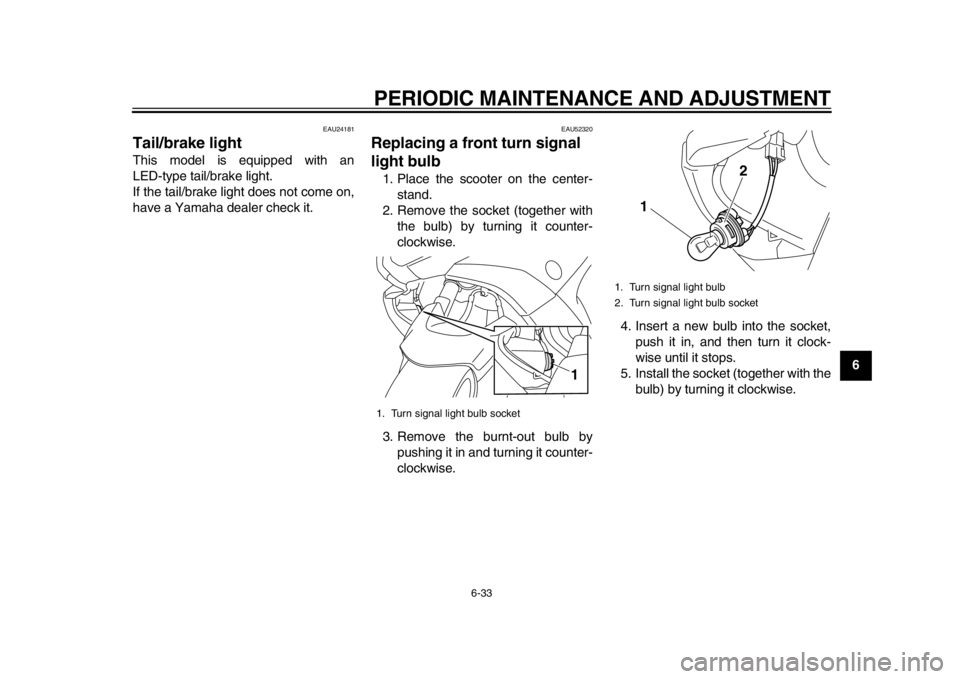
Replacing a front turn signal
light bulb 1. Place the scooter on the center-
stand.
2. Remove the socket (together with the bulb) by turning it counter-
clockwise.
3. Remove the burnt-out bulb by pushing it in and turning it counter-
clockwise. 4. Insert a new bulb into the socket,
push it in, and then turn it clock-
wise until it stops.
5. Install the socket (together with the bulb) by turning it clockwise.1. Turn signal light bulb socket
1
1. Turn signal light bulb
2. Turn signal light bulb socket
1 2
59C-9-E1.book 33 ページ 2012年6月26日 火曜日 午前11時33分
Page 88 of 100
PERIODIC MAINTENANCE AND ADJUSTMENT
6-38
1
2
3
4
56
7
8
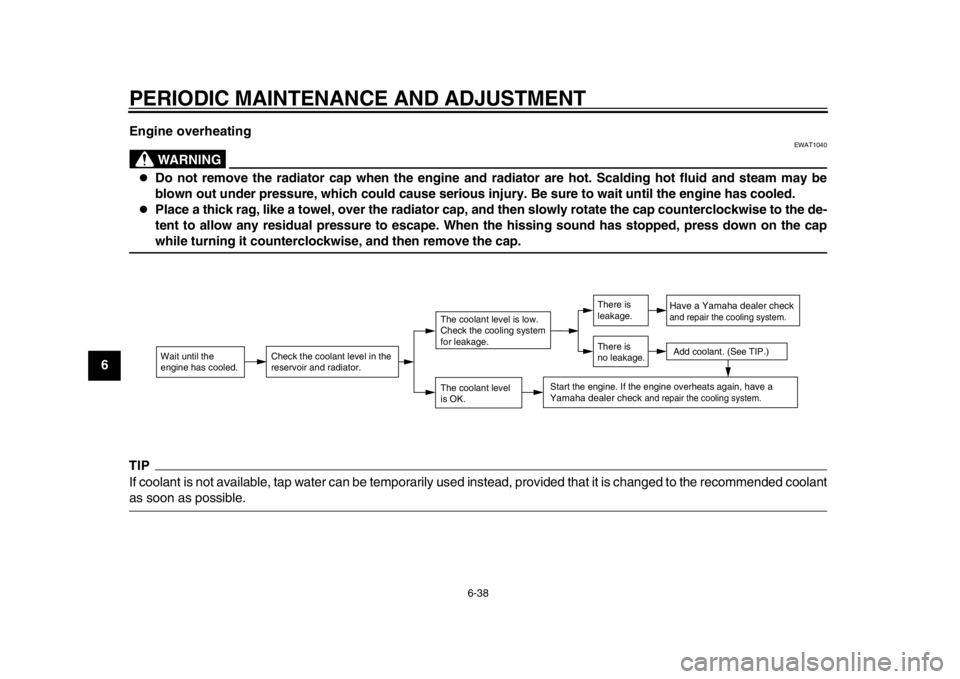
9Engine overheating
WARNING
EWAT1040
Do not remove the radiator cap when the engine and radiator are hot. Scalding hot fluid and steam may be
blown out under pressure, which could cause serious injury. Be sure to wait until the engine has cooled.
Place a thick rag, like a towel, over the radiator cap, and then slowly rotate the cap counterclockwise to the de-
tent to allow any residual pressure to escape. When the hissing sound has stopped, press down on the capwhile turning it counterclockwise, and then remove the cap.
TIPIf coolant is not available, tap water can be temporarily us
ed instead, provided that it is changed to the recommended coolantas soon as possible.
Wait until the
engine has cooled.
Check the coolant level in the
reservoir and radiator.
The coolant level
is OK.The coolant level is low.
Check the cooling system
for leakage.
Have a Yamaha dealer checkand repair the cooling system.Add coolant. (See TIP.)
Start the engine. If the engine overheats again,
have a
Yamaha dealer check
and repair the cooling system.
There is
leakage.
There is
no leakage.
59C-9-E1.book 38 ページ 2012年6月26日 火曜日 午前11時33分