brake YAMAHA TRACER 900 2015 Owners Manual
[x] Cancel search | Manufacturer: YAMAHA, Model Year: 2015, Model line: TRACER 900, Model: YAMAHA TRACER 900 2015Pages: 114, PDF Size: 3.26 MB
Page 6 of 114

TABLE OF CONTENTSSAFETY INFORMATION.................. 1-1
DESCRIPTION .................................. 2-1
Left view ......................................... 2-1
Right view ....................................... 2-2
Controls and instruments ............... 2-3
INSTRUMENT AND CONTROL
FUNCTIONS ...................................... 3-1
Immobilizer system......................... 3-1
Main switch/steering lock............... 3-2
Indicator lights and warning lights............................................ 3-3
Multi-function meter unit ................ 3-6
D-mode (drive mode).................... 3-18
Handlebar switches ...................... 3-18
Clutch lever .................................. 3-20
Shift pedal .................................... 3-21
Brake lever.................................... 3-21
Brake pedal .................................. 3-21
ABS .............................................. 3-22
Traction control system ................ 3-23
Fuel tank cap ................................ 3-24
Fuel ............................................... 3-25
Fuel tank breather hose and overflow hose ............................ 3-26
Catalytic converter ....................... 3-27
Seats ............................................ 3-27
Adjusting the rider seat height...... 3-29
Helmet holder ............................... 3-31
Storage compartment .................. 3-31 Windshield .................................... 3-32
Adjusting the front fork ................. 3-33
Adjusting the shock absorber
assembly.................................... 3-34
Luggage strap holders .................. 3-36
Sidestand ...................................... 3-36
Ignition circuit cut-off system ....... 3-37
Auxiliary DC jack ........................... 3-39
FOR YOUR SAFETY –
PRE-OPERATION CHECKS ............. 4-1
OPERATION AND IMPORTANT
RIDING POINTS ................................ 5-1
Starting the engine .......................... 5-1
Shifting ............................................ 5-2
Tips for reducing fuel consumption ................................ 5-4
Engine break-in ............................... 5-4
Parking ............................................ 5-5
PERIODIC MAINTENANCE AND
ADJUSTMENT ................................... 6-1
Owner’s tool kit ............................... 6-2
Periodic maintenance chart for the emission control system .............. 6-3
General maintenance and lubrication chart ........................... 6-4
Removing and installing the
panel ............................................ 6-8
Checking the spark plugs ............... 6-9 Engine oil and oil filter cartridge ... 6-10
Coolant ......................................... 6-12
Air filter element ............................ 6-15
Checking the engine idling
speed ........................................ 6-16
Checking the throttle grip free play ............................................ 6-16
Valve clearance............................. 6-16
Tires .............................................. 6-17
Cast wheels .................................. 6-19
Adjusting the clutch lever free
play ............................................ 6-19
Checking the brake lever free play ............................................ 6-20
Brake light switches ..................... 6-21
Checking the front and rear brake pads ................................ 6-21
Checking the brake fluid level ...... 6-22
Changing the brake fluid .............. 6-23
Drive chain slack........................... 6-23
Cleaning and lubricating the drive chain ................................. 6-25
Checking and lubricating the
cables ........................................ 6-26
Checking and lubricating the throttle grip and cable ............... 6-26
Checking and lubricating the brake and shift pedals............... 6-26
Checking and lubricating the
brake and clutch levers ............. 6-27U2PPE0E0.book Page 1 Monday, July 14, 2014 3:25 PM
Page 7 of 114

TABLE OF CONTENTS
Checking and lubricating the centerstand and sidestand ........6-28
Lubricating the swingarm pivots ...6-28
Checking the front fork..................6-29
Checking the steering ...................6-29
Checking the wheel bearings ........6-30
Battery ...........................................6-30
Replacing the fuses .......................6-31
Headlight .......................................6-34
Auxiliary light .................................6-34
Tail/brake light ...............................6-34
Replacing a turn signal light bulb ............................................6-35
Replacing the license plate light
bulb ............................................6-35
Troubleshooting ............................6-36
Troubleshooting charts .................6-37
MOTORCYCLE CARE AND
STORAGE ..........................................7-1
Matte color caution .........................7-1
Care .................................................7-1
Storage ............................................7-4
SPECIFICATIONS ..............................8-1
CONSUMER INFORMATION ............9-1
Identification numbers .....................9-1
INDEX ...............................................10-1
U2PPE0E0.book Page 2 Monday, July 14, 2014 3:25 PM
Page 14 of 114
DESCRIPTION
2-2
2
EAU10421
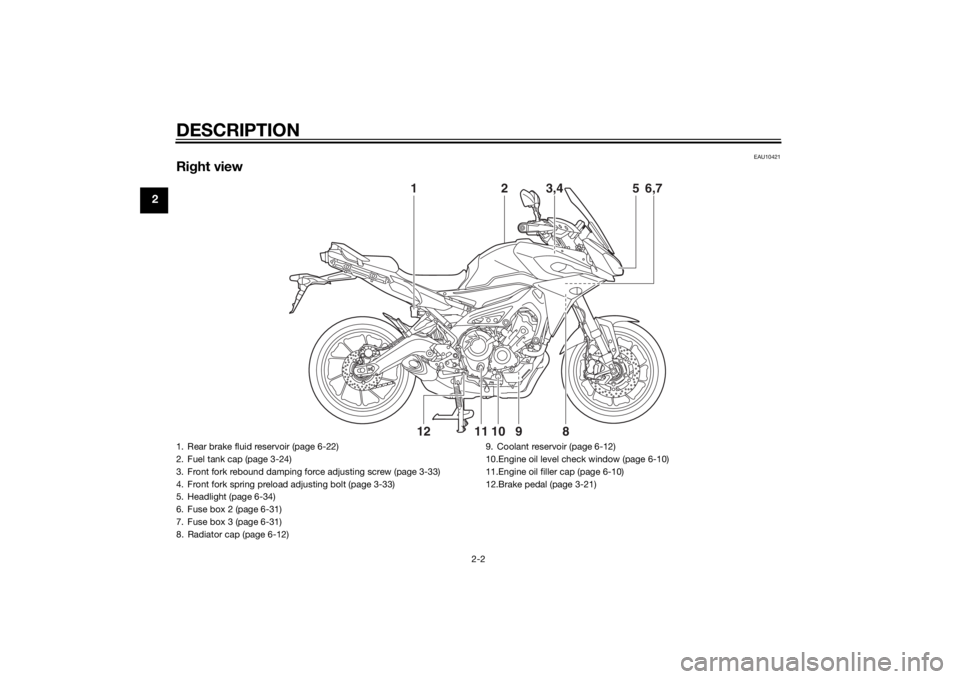
Right view
1
5
6,7
2
8
9
10
11
12
3,4
1. Rear brake fluid reservoir (page 6-22)
2. Fuel tank cap (page 3-24)
3. Front fork rebound damping force adjusting screw (page 3-33)
4. Front fork spring preload adjusting bolt (page 3-33)
5. Headlight (page 6-34)
6. Fuse box 2 (page 6-31)
7. Fuse box 3 (page 6-31)
8. Radiator cap (page 6-12) 9. Coolant reservoir (page 6-12)
10.Engine oil level check window (page 6-10)
11.Engine oil filler cap (page 6-10)
12.Brake pedal (page 3-21)U2PPE0E0.book Page 2 Monday, July 14, 2014 3:25 PM
Page 15 of 114
DESCRIPTION
2-3
2
EAU10431
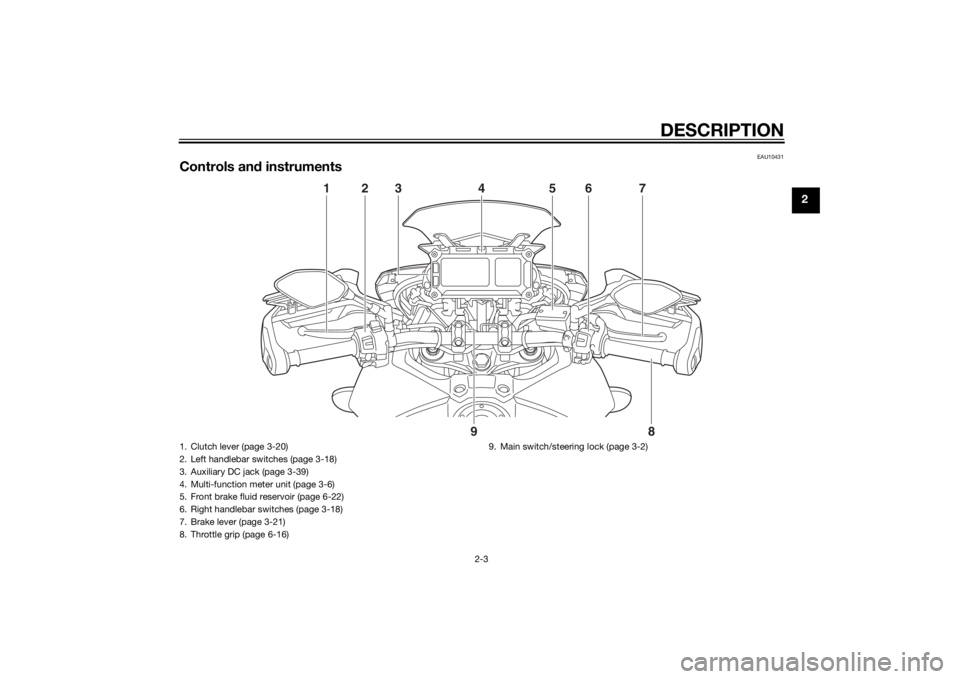
Controls and instruments
12 56 7
4
3
8
9
1. Clutch lever (page 3-20)
2. Left handlebar switches (page 3-18)
3. Auxiliary DC jack (page 3-39)
4. Multi-function meter unit (page 3-6)
5. Front brake fluid reservoir (page 6-22)
6. Right handlebar switches (page 3-18)
7. Brake lever (page 3-21)
8. Throttle grip (page 6-16) 9. Main switch/steering lock (page 3-2)
U2PPE0E0.book Page 3 Monday, July 14, 2014 3:25 PM
Page 18 of 114
INSTRUMENT AND CONTROL FUNCTIONS
3-3
3
EAU10685
LOCK
The steering is locked, and all electrical
systems are off. The key can be re-
moved.
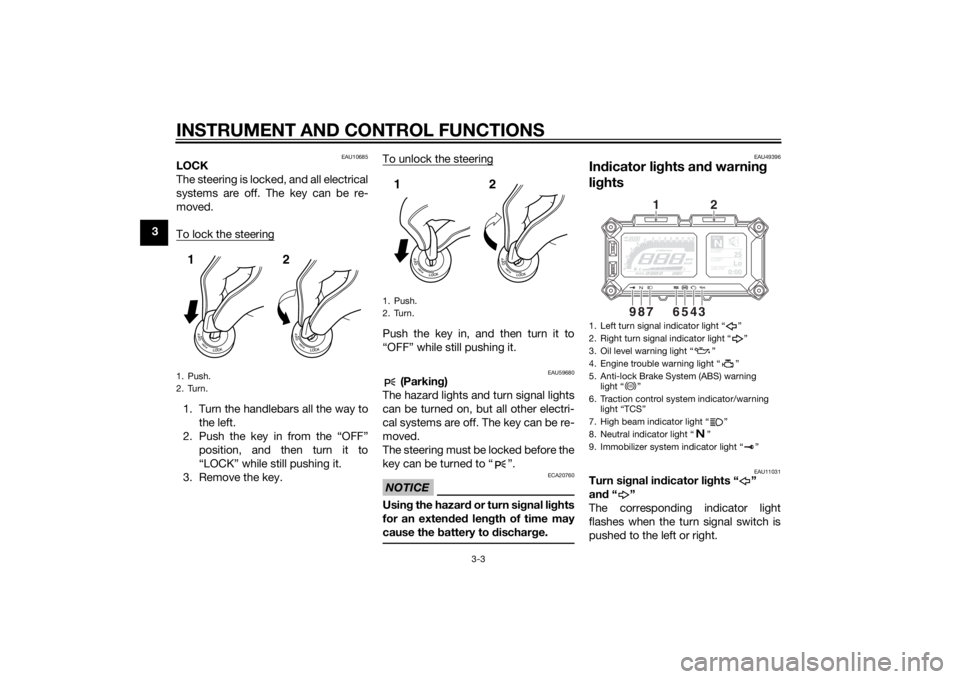
To lock the steering1. Turn the handlebars all the way tothe left.
2. Push the key in from the “OFF” position, and then turn it to
“LOCK” while still pushing it.
3. Remove the key. To unlock the steering
Push the key in, and then turn it to
“OFF” while still pushing it.
EAU59680
(Parkin
g)
The hazard lights and turn signal lights
can be turned on, but all other electri-
cal systems are off. The key can be re-
moved.
The steering must be locked before the
key can be turned to “ ”.
NOTICE
ECA20760
Usin g the hazar d o r t ur n s i gnal li ghts
for an exten ded len gth of time may
cause the battery to d ischarge.
EAU49396
In dicator li ghts and warning
li g hts
EAU11031
Turn si gnal in dicator li ghts “ ”
an d“”
The corresponding indicator light
flashes when the turn signal switch is
pushed to the left or right.
1. Push.
2. Turn.12
1. Push.
2. Turn.12
1. Left turn signal indicator light “ ”
2. Right turn signal indicator light “ ”
3. Oil level warning light “ ”
4. Engine trouble warning light “ ”
5. Anti-lock Brake System (ABS) warning light “ ”
6. Traction control system indicator/warning light “TCS”
7. High beam indicator light “ ”
8. Neutral indicator light “ ”
9. Immobilizer system indicator light “ ”
GEARN
25
A.TEMP ˚C
Lo
C.TEMP˚C
0:00
TIME TRIP
3456
789
1
2
ABS
U2PPE0E0.book Page 3 Monday, July 14, 2014 3:25 PM
Page 20 of 114
INSTRUMENT AND CONTROL FUNCTIONS
3-5
3The ABS may not work correctly. If any
of the above occurs, have a Yamaha
dealer check the system as soon as
possible. (See page 3-22 for an expla-
nation of the ABS.)
WARNING
EWA16041
If the ABS warnin
g li ght does not go
off after travelin g at a speed of 10
km/h (6 mi/h) or hi gher, or if the
warnin g li ght comes on or flashes
while ri din g, the b rake system re-
verts to conventional brakin g. If ei-
ther of the ab ove occurs, or if the
warnin g li ght does not come on at
all, use extra caution to avoi d possi-
b le wheel lock during emer gency
b rakin g. Have a Yamaha d ealer
check the brake system an d electri-
cal circuits as soon as possi ble.TIPThe ABS warning light will also come
on while the start switch is pushed, but
this does not indicate a malfunction.
EAU54261
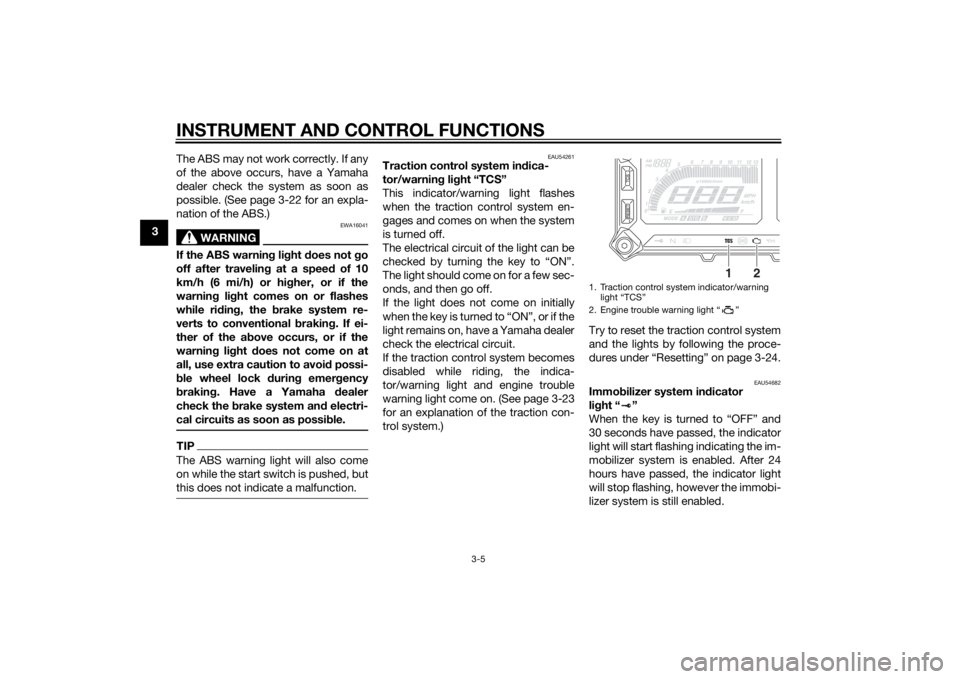
Traction control system in dica-
tor/warnin g li ght “TCS”
This indicator/warning light flashes
when the traction control system en-
gages and comes on when the system
is turned off.
The electrical circuit of the light can be
checked by turning the key to “ON”.
The light should come on for a few sec-
onds, and then go off.
If the light does not come on initially
when the key is turned to “ON”, or if the
light remains on, have a Yamaha dealer
check the electrical circuit.
If the traction control system becomes
disabled while riding, the indica-
tor/warning light and engine trouble
warning light come on. (See page 3-23
for an explanation of the traction con-
trol system.) Try to reset the traction control system
and the lights by following the proce-
dures under “Resetting” on page 3-24.
EAU54682
Immo
bilizer system in dicator
li g ht “ ”
When the key is turned to “OFF” and
30 seconds have passed, the indicator
light will start flashing indicating the im-
mobilizer system is enabled. After 24
hours have passed, the indicator light
will stop flashing, however the immobi-
lizer system is still enabled.1. Traction control system indicator/warning light “TCS”
2. Engine trouble warning light “ ”
1
2
U2PPE0E0.book Page 5 Monday, July 14, 2014 3:25 PM
Page 36 of 114
INSTRUMENT AND CONTROL FUNCTIONS
3-21
3
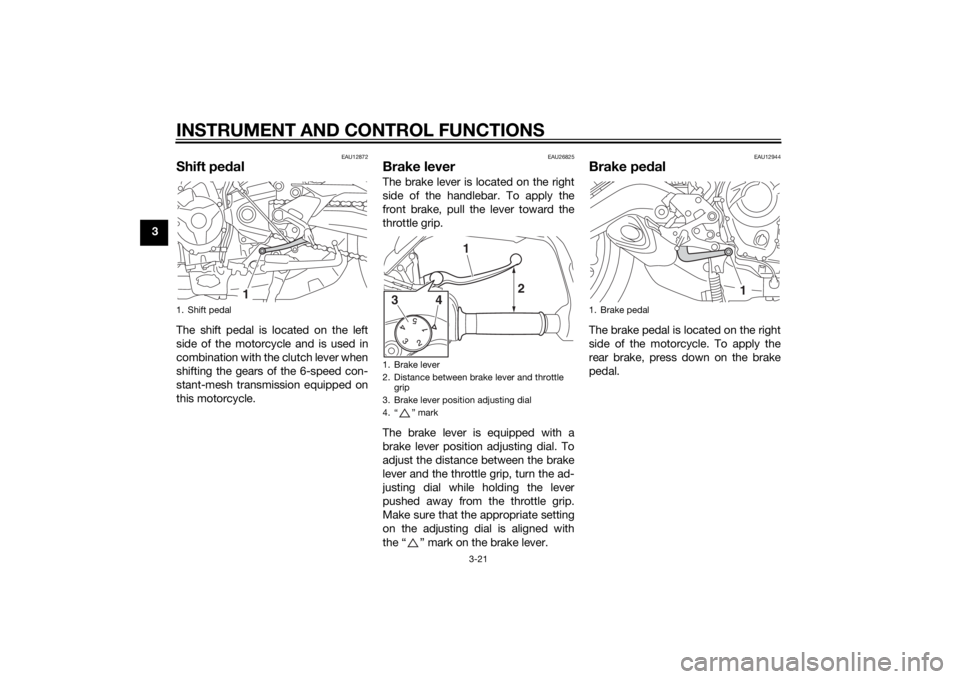
EAU12872
Shift pedalThe shift pedal is located on the left
side of the motorcycle and is used in
combination with the clutch lever when
shifting the gears of the 6-speed con-
stant-mesh transmission equipped on
this motorcycle.
EAU26825
Brake leverThe brake lever is located on the right
side of the handlebar. To apply the
front brake, pull the lever toward the
throttle grip.
The brake lever is equipped with a
brake lever position adjusting dial. To
adjust the distance between the brake
lever and the throttle grip, turn the ad-
justing dial while holding the lever
pushed away from the throttle grip.
Make sure that the appropriate setting
on the adjusting dial is aligned with
the “ ” mark on the brake lever.
EAU12944
Brake ped alThe brake pedal is located on the right
side of the motorcycle. To apply the
rear brake, press down on the brake
pedal.
1. Shift pedal
1
1. Brake lever
2. Distance between brake lever and throttle
grip
3. Brake lever position adjusting dial
4. “ ” mark
2
3
4
1
1. Brake pedal
1
U2PPE0E0.book Page 21 Monday, July 14, 2014 3:25 PM
Page 37 of 114
INSTRUMENT AND CONTROL FUNCTIONS
3-22
3
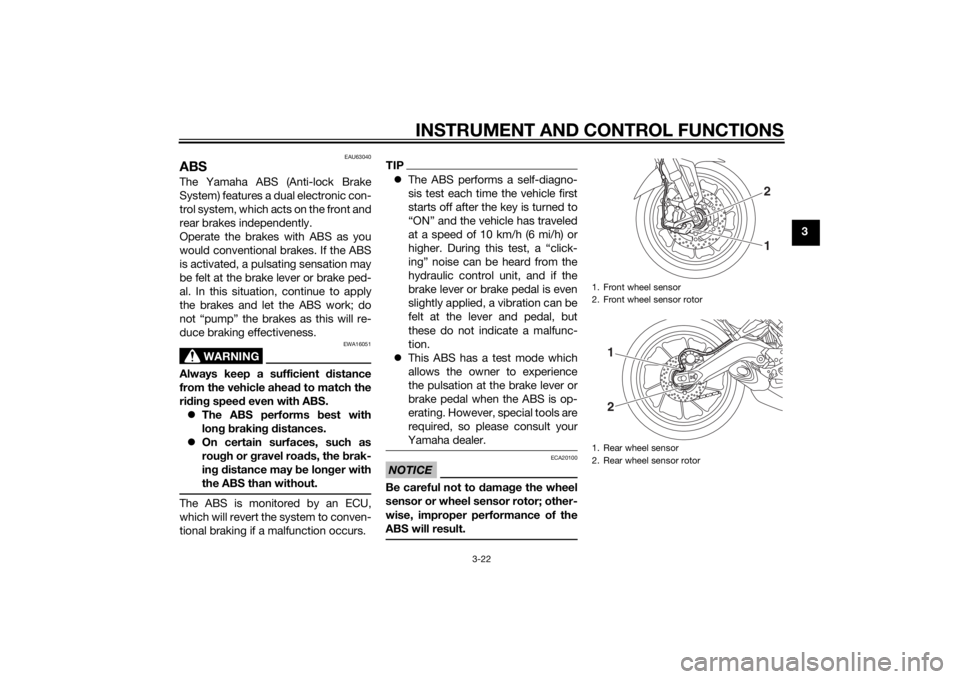
EAU63040
ABSThe Yamaha ABS (Anti-lock Brake
System) features a dual electronic con-
trol system, which acts on the front and
rear brakes independently.
Operate the brakes with ABS as you
would conventional brakes. If the ABS
is activated, a pulsating sensation may
be felt at the brake lever or brake ped-
al. In this situation, continue to apply
the brakes and let the ABS work; do
not “pump” the brakes as this will re-
duce braking effectiveness.
WARNING
EWA16051
Always keep a sufficient distance
from the vehicle ahea d to match the
ri din g speed even with ABS.
The ABS performs best with
lon g b rakin g d istances.
On certain surfaces, such as
rou gh or g ravel roa ds, the b rak-
in g d istance may be lon ger with
the ABS than without.The ABS is monitored by an ECU,
which will revert the system to conven-
tional braking if a malfunction occurs.
TIP The ABS performs a self-diagno-
sis test each time the vehicle first
starts off after the key is turned to
“ON” and the vehicle has traveled
at a speed of 10 km/h (6 mi/h) or
higher. During this test, a “click-
ing” noise can be heard from the
hydraulic control unit, and if the
brake lever or brake pedal is even
slightly applied, a vibration can be
felt at the lever and pedal, but
these do not indicate a malfunc-
tion.
This ABS has a test mode which
allows the owner to experience
the pulsation at the brake lever or
brake pedal when the ABS is op-
erating. However, special tools are
required, so please consult your
Yamaha dealer.NOTICE
ECA20100
Be careful not to d amage the wheel
sensor or wheel sensor rotor; other-
wise, improper performance of the
ABS will result.
1. Front wheel sensor
2. Front wheel sensor rotor
1. Rear wheel sensor
2. Rear wheel sensor rotor
21
12
U2PPE0E0.book Page 22 Monday, July 14, 2014 3:25 PM
Page 55 of 114
FOR YOUR SAFETY – PRE-OPERATION CHECKS
4-1
4
EAU15598
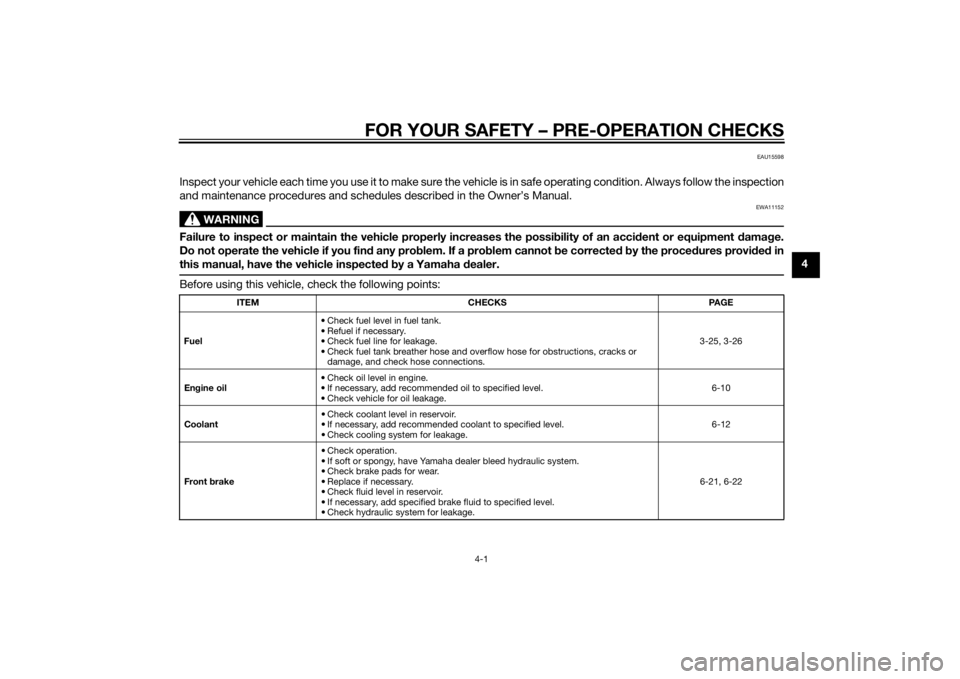
Inspect your vehicle each time you use it to make sure the vehicle is in safe operating condition. Always follow the inspection
and maintenance procedures and schedules described in the Owner’s Manual.
WARNING
EWA11152
Failure to inspect or maintain the vehicle properly increases the possibility of an accident or equipment d amage.
Do not operate the vehicle if you fin d any pro blem. If a pro blem cannot b e corrected b y the proce dures provi ded in
this manual, have the vehicle inspecte d b y a Yamaha dealer.Before using this vehicle, check the following points:
ITEM CHECKS PAGE
Fuel • Check fuel level in fuel tank.
• Refuel if necessary.
• Check fuel line for leakage.
• Check fuel tank breather hose and overflow hose for obstructions, cracks or
damage, and check hose connections. 3-25, 3-26
En gine oil • Check oil level in engine.
• If necessary, add recommended oil to specified level.
• Check vehicle for oil leakage. 6-10
Coolant • Check coolant level in reservoir.
• If necessary, add recommended coolant to specified level.
• Check cooling system for leakage. 6-12
Front brake • Check operation.
• If soft or spongy, have Yamaha dealer bleed hydraulic system.
• Check brake pads for wear.
• Replace if necessary.
• Check fluid level in reservoir.
• If necessary, add specified brake fluid to specified level.
• Check hydraulic system for leakage. 6-21, 6-22
U2PPE0E0.book Page 1 Monday, July 14, 2014 3:25 PM
Page 56 of 114

FOR YOUR SAFETY – PRE-OPERATION CHECKS
4-2
4
Rear brake • Check operation.
• If soft or spongy, have Yamaha dealer bleed hydraulic system.
• Check brake pads for wear.
• Replace if necessary.
• Check fluid level in reservoir.
• If necessary, add specified brake fluid to specified level.
• Check hydraulic system for leakage. 6-21, 6-22
Clutch • Check operation.
• Lubricate cable if necessary.
• Check lever free play.
• Adjust if necessary.
6-19
Throttle g rip • Make sure that operation is smooth.
• Check throttle grip free play.
• If necessary, have Yamaha dealer adjust throttle grip free play and lubricate ca-
ble and grip housing. 6-16, 6-26
Control ca bles • Make sure that operation is smooth.
• Lubricate if necessary. 6-26
Drive chain • Check chain slack.
• Adjust if necessary.
• Check chain condition.
• Lubricate if necessary.
6-23, 6-25
Wheels an d tires •Check for damage.
• Check tire condition and tread depth.
• Check air pressure.
• Correct if necessary.
6-17, 6-19
Brake an d shift pe dals • Make sure that operation is smooth.
• Lubricate pedal pivoting points if necessary. 6-26
Brake an d clutch levers • Make sure that operation is smooth.
• Lubricate lever pivoting points if necessary.
6-27
Centerstan d, si destan d • Make sure that operation is smooth.
• Lubricate pivots if necessary.
6-28
ITEM
CHECKS PAGE
U2PPE0E0.book Page 2 Monday, July 14, 2014 3:25 PM