warning light YAMAHA TRACER 900 2021 User Guide
[x] Cancel search | Manufacturer: YAMAHA, Model Year: 2021, Model line: TRACER 900, Model: YAMAHA TRACER 900 2021Pages: 118, PDF Size: 4.38 MB
Page 35 of 118

Instrument and control functions
4-13
4
Displays how much fuel has been con-
sumed since the trip meter was last re-
set.
TIPThe instantaneous fuel consumption
function should be used for general
reference only. Do not use this figure to
estimate the distance that can be trav-
eled on the current tank of fuel.Trip time:Displays engine running time.
Cruise control speed setting:Displays the selected speed setting for
the cruise control system. To adjust
this speed setting, see page 3-1 for an
explanation of the cruise control sys-
tem. To reset information display items (if
able):1. Rotate the wheel switch to high-
light one of the six vehicle informa-
tion displays.
2. Press the wheel switch inward to select the information display.
3. Rotate the wheel switch to select the desired information display
item.
4. Press and hold the wheel switch inward until the display item is re-
set.
Transmission gear display
This shows which gear the transmis-
sion is in. This model has 6 gears and a
neutral position. The neutral position is
indicated by the neutral indicator
light “ ” and by the transmission gear
display “ ”. MODE
display
This display shows the currently se-
lected “D-MODE” and “TCS-MODE”
settings. The mode that is enlarged
and displayed on the right can be ad-
justed using the MODE up/down
switches. Use the “MODE” switch to
toggle left-right between “TCS-MODE”
and “D-MODE”.
See page 3-3 for information on “D-
MODE” and “TCS-MODE” settings.
TIP When the malfunction indicator
light “ ”, the auxiliary system
warning “ ”, or the coolant tem-
perature warning “ ” are on, “D-
MODE” and “TCS-MODE” cannot
be adjusted.
UB5UE0E0.book Page 13 Wednesday, December 23, 2020 11:03 AM
Page 38 of 118
Instrument and control functions
4-16
4
TIP The engine must be running to
start the lap timer.
The headlight will flash when the
dimmer/pass switch is pressed.
Whenever the lap timer is paused,
it can be resumed using the dim-
mer/pass switch.Brake control icon “BC”
This icon is replaced by the auxiliary
system warning and coolant tempera-
ture warning indicators when they are
activated.
For more information on the BC sys-
tem see “BC” on page 3-6.
Error mo de warnin g “Err”
When an internal error occurs (e.g.,
communication with a system control-
ler has been cut off), the error mode
warning will appear as follows.
“Err” and “ ” indicator light indicates
an ECU error.
“Err” only indicates an ABS ECU error.
TIPDepending on the nature of the error,
the display may not function properly
and the TCS settings may be impossi-
ble to change. Additionally, the ABS
may not function properly. Use extra
care when braking and have a Yamaha
dealer check the vehicle immediately.Auxiliary system warnin g“”
This icon appears if a problem is de-
tected in a non-engine-related system.
Coolant temperature warnin g“”
This icon appears if the coolant tem-
perature reaches 116 °C (241 °F) or
higher. Stop the vehicle and turn off the
engine. Allow the engine to cool.NOTICE
ECA10022
Do not continue to operate the en-
g ine if it is overheatin g.Oil pressure warnin g“”
This icon appears when the engine oil
pressure is low. When the vehicle is
first turned on, engine oil pressure has yet to build, so this icon will come on
and stay on until the engine has been
started.
TIPIf a malfunction is detected, the oil
pressure warning icon will flash repeat-
edly.NOTICE
ECA26410
Do not continue to operate the en-
g
ine if the oil pressure is low.
UB5UE0E0.book Page 16 Wednesday, December 23, 2020 11:03 AM
Page 46 of 118
Instrument and control functions
4-24
4
EAU13077
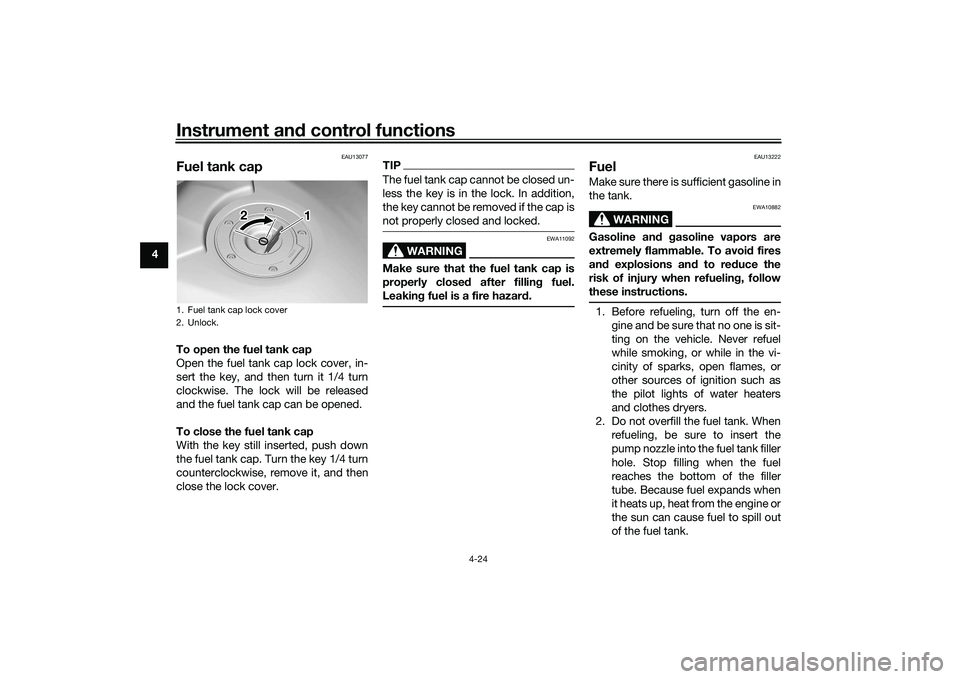
Fuel tank capTo open the fuel tank cap
Open the fuel tank cap lock cover, in-
sert the key, and then turn it 1/4 turn
clockwise. The lock will be released
and the fuel tank cap can be opened.
To close the fuel tank cap
With the key still inserted, push down
the fuel tank cap. Turn the key 1/4 turn
counterclockwise, remove it, and then
close the lock cover.
TIPThe fuel tank cap cannot be closed un-
less the key is in the lock. In addition,
the key cannot be removed if the cap is
not properly closed and locked.
WARNING
EWA11092
Make sure that the fuel tank cap is
properly close d after fillin g fuel.
Leakin g fuel is a fire hazar d.
EAU13222
FuelMake sure there is sufficient gasoline in
the tank.
WARNING
EWA10882
Gasoline an d g asoline vapors are
extremely flammab le. To avoid fires
an d explosions an d to re duce the
risk of injury when refuelin g, follow
these instructions.1. Before refueling, turn off the en- gine and be sure that no one is sit-
ting on the vehicle. Never refuel
while smoking, or while in the vi-
cinity of sparks, open flames, or
other sources of ignition such as
the pilot lights of water heaters
and clothes dryers.
2. Do not overfill the fuel tank. When refueling, be sure to insert the
pump nozzle into the fuel tank filler
hole. Stop filling when the fuel
reaches the bottom of the filler
tube. Because fuel expands when
it heats up, heat from the engine or
the sun can cause fuel to spill out
of the fuel tank.
1. Fuel tank cap lock cover
2. Unlock.
1
2
UB5UE0E0.book Page 24 Wednesday, December 23, 2020 11:03 AM
Page 65 of 118
Operation and important ri din g points
6-2
6
EAU91411
Startin g the en gineThe ignition circuit cut-off system will
enable starting when:
the transmission is in the neutral
position or
the transmission is in gear, the
sidestand is up, and the clutch le-
ver is pulled.
To start the engine1. Turn the main switch on and set the engine stop switch to the run
position.
2. Confirm the indicator and warning light(s) come on for a few sec-
onds, and then go off. (See page
4-6.)TIPDo not start the engine if the mal-
function indicator light remains on.
The oil pressure and coolant tem-
perature warning light should
come on and stay on until the en-
gine is started.
The ABS warning light should
come on and stay on until the ve-
hicle reaches a speed of 5 km/h (3
mi/h).
NOTICE
ECA24110
If a warnin g or in dicator li ght does
not work as d escribed a bove, have a
Yamaha dealer check the vehicle.3. Shift the transmission into the
neutral position.
4. Start the engine by pushing the start switch.
5. Release the start switch when the engine starts, or after 5 seconds.
Wait 10 seconds before pressing
the switch again to allow battery
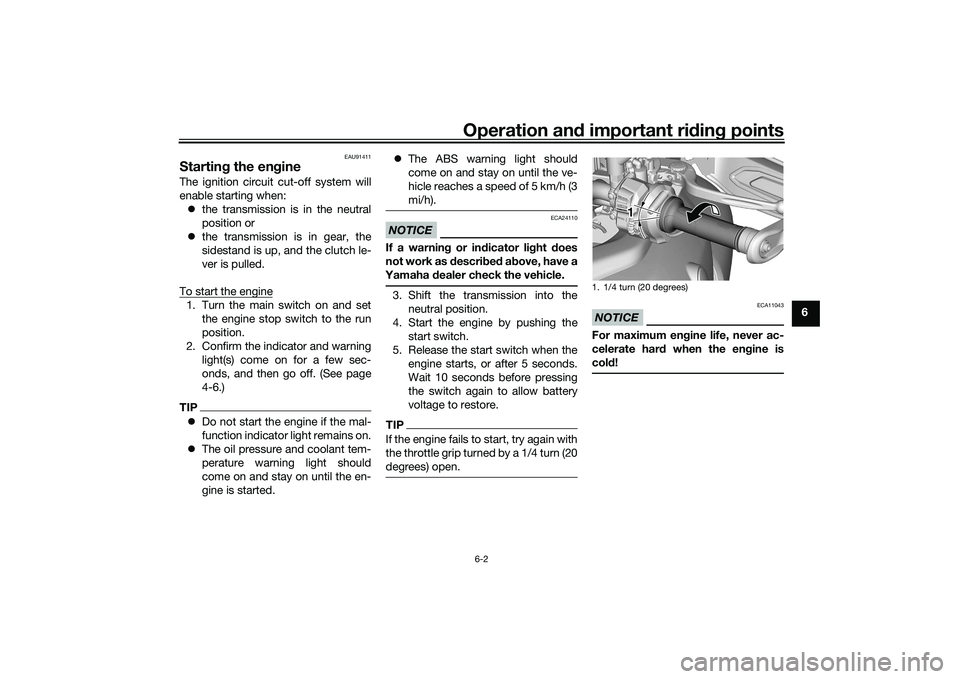
voltage to restore.TIPIf the engine fails to start, try again with
the throttle grip turned by a 1/4 turn (20
degrees) open.
NOTICE
ECA11043
For maximum en gine life, never ac-
celerate har d when the en gine is
col d!1. 1/4 turn (20 degrees)
1 1 1
UB5UE0E0.book Page 2 Wednesday, December 23, 2020 11:03 AM
Page 67 of 118
Operation and important ri din g points
6-4
6
4. After starting out, close the throt-
tle, and at the same time, quickly
pull the clutch lever in.
5. Shift the transmission into second gear. (Make sure not to shift the
transmission into the neutral posi-
tion.)
6. Open the throttle part way and gradually release the clutch lever.
7. Follow the same procedure when shifting to the next higher gear.
EAU85380
To decelerate
1. Release the throttle and apply both the front and the rear brakes
smoothly to slow the motorcycle.
2. As the vehicle decelerates, shift to a lower gear.
3. When the engine is about to stall or runs roughly, pull the clutch le-
ver in, use the brakes to slow the
motorcycle, and continue to
downshift as necessary.
4. Once the motorcycle has stopped, the transmission can be
shifted into the neutral position. The neutral indicator light should
come on and then the clutch lever
can be released.
WARNING
EWA17380
Improper brakin g can cause
loss of control or traction. Al-
ways use b oth brakes an d apply
them smoothly.
Make sure that the motorcycle
and the en gine have sufficiently
slowe d b efore shiftin g to a low-
er gear. En gag in g a lower gear
when the vehicle or en gine
spee d is too hi gh coul d make
the rear wheel lose traction or
the en gine to over-rev. This
coul d cause loss of control, an
acci dent an d injury. It coul d also
cause en gine or d rive train d am-
a g e.
EAU16811
Tips for re ducin g fuel con-
sumptionFuel consumption depends largely on
your riding style. Consider the follow-
ing tips to reduce fuel consumption:
Shift up swiftly, and avoid high en-
gine speeds during acceleration.
Do not rev the engine while shift-
ing down, and avoid high engine
speeds with no load on the en-
gine.
Turn the engine off instead of let-
ting it idle for an extended length
of time (e.g., in traffic jams, at traf-
fic lights or at railroad crossings).
UB5UE0E0.book Page 4 Wednesday, December 23, 2020 11:03 AM
Page 99 of 118
Periodic maintenance an d a djustment
7-31
7
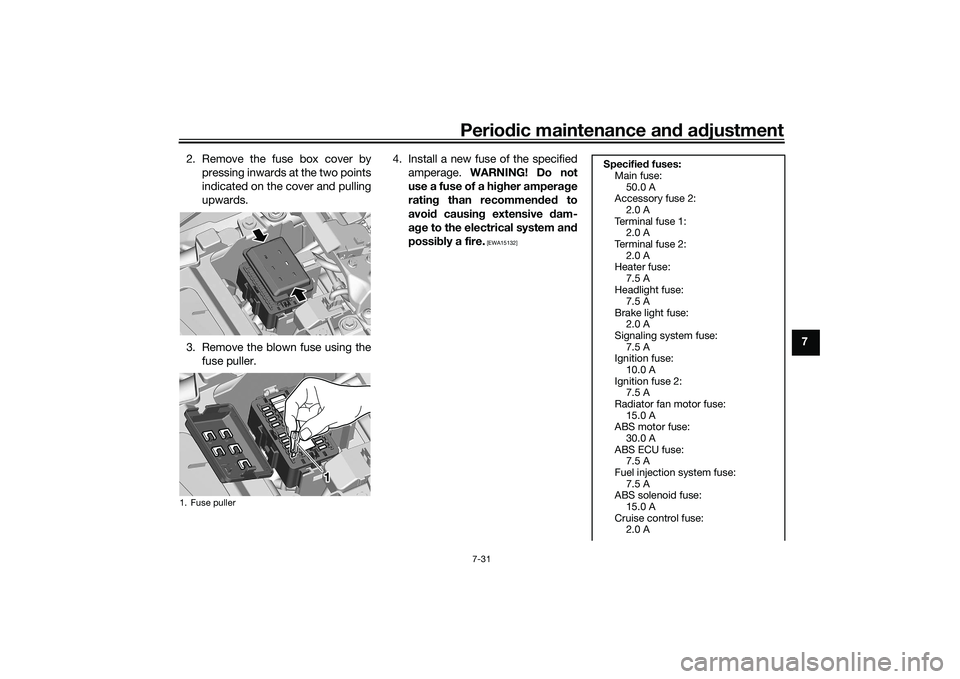
2. Remove the fuse box cover by
pressing inwards at the two points
indicated on the cover and pulling
upwards.
3. Remove the blown fuse using the fuse puller. 4. Install a new fuse of the specified
amperage. WARNING! Do not
use a fuse of a hi gher ampera ge
ratin g than recommen ded to
avoi d causin g extensive dam-
a g e to the electrical system an d
possi bly a fire.
[EWA15132]
1. Fuse puller
1 1 1
Specified fuses:
Main fuse:
50.0 A
Accessory fuse 2:
2.0 A
Terminal fuse 1: 2.0 A
Terminal fuse 2: 2.0 A
Heater fuse:
7.5 A
Headlight fuse: 7.5 A
Brake light fuse: 2.0 A
Signaling system fuse:
7.5 A
Ignition fuse: 10.0 A
Ignition fuse 2: 7.5 A
Radiator fan motor fuse:
15.0 A
ABS motor fuse: 30.0 A
ABS ECU fuse: 7.5 A
Fuel injection system fuse:
7.5 A
ABS solenoid fuse: 15.0 A
Cruise control fuse: 2.0 A
UB5UE0E0.book Page 31 Wednesday, December 23, 2020 11:03 AM
Page 101 of 118

Periodic maintenance an d a djustment
7-33
7
3. Remove the license plate light
bulb socket (together with the
bulb) by turning it counterclock-
wise, and then pulling it out.
4. Remove the burnt-out bulb by pulling it out.
5. Insert a new bulb into the socket.
6. Install the socket (together with the bulb) by pushing it in, and then
turning it clockwise until it stops.
7. Install the license plate unit onto the rear fender.
8. Install the bolts and tighten to the specified torque.
EAU25872
Trou bleshootin gAlthough Yamaha motorcycles receive
a thorough inspection before shipment
from the factory, trouble may occur
during operation. Any problem in the
fuel, compression, or ignition systems,
for example, can cause poor starting
and loss of power.
The following troubleshooting charts
represent quick and easy procedures
for checking these vital systems your-
self. However, should your motorcycle
require any repair, take it to a Yamaha
dealer, whose skilled technicians have
the necessary tools, experience, and
know-how to service the motorcycle
properly.
Use only genuine Yamaha replace-
ment parts. Imitation parts may look
like Yamaha parts, but they are often
inferior, have a shorter service life and
can lead to expensive repair bills.
WARNING
EWA15142
When checkin g the fuel system, d o
not smoke, an d make sure there are
no open flames or sparks in the ar-
ea, inclu din g pilot li ghts from water
1. Collar
2. License plate light bulb
3. License plate light unit
3
2
1 1 1
Ti
ghtenin g torque:
License plate light unit bolt:
4.0 N·m (0.40 kgf·m, 3.0 lb·ft)
UB5UE0E0.book Page 33 Wednesday, December 23, 2020 11:03 AM
Page 106 of 118
Motorcycle care and stora ge
8-2
8 chemicals such as, solvents,
g
asoline, rust removers, b rake
flui d, or antifreeze, etc.
Before washin g
1. Park the vehicle out of direct sun- light and allow it to cool. This will
help avoid water spots.
2. Make sure all caps, covers, elec- trical couplers and connectors are
tightly installed.
3. Cover the muffler end with a plas- tic bag and a strong rubber band.
4. Pre-soak stubborn stains like in- sects or bird droppings with a wet
towel for a few minutes.
5. Remove road grime and oil stains with a quality degreasing agent
and a plastic-bristle brush or
sponge. NOTICE: Do not use
d eg reasin g a gent on areas re-
quirin g lu brication such as
seals, gaskets, an d wheel axles.
Follow prod uct instructions.
[ECA26290]
Washing
1. Rinse off any degreaser and spray down the vehicle with a garden
hose. Use only enough pressure
to do the job. Avoid spraying wa-
ter directly into the muffler, instru-
ment panel, air inlet, or other inner
areas such as underseat storage
compartments.
2. Wash the vehicle with a quality au- tomotive-type detergent mixed
with cool water and a soft, clean
towel or sponge. Use an old tooth-
brush or plastic-bristle brush for
hard-to-reach places. NOTICE:
Use col d water if the vehicle has
b een exposed to salt. Warm wa-
ter will increase salt’s corrosive
properties.
[ECA26301]
3. For windshield-equipped vehicles: Clean the windshield with a soft
towel or sponge dampened with
water and a pH neutral detergent.
If necessary, use a high-quality
windshield cleaner or polish for
motorcycles. NOTICE: Never use
any stron g chemicals to clean
the win dshiel d. A dditionally,
some cleanin g compoun ds for plastic may scratch the win
d-
shiel d, so b e sure to test all
cleanin g prod ucts before gen-
eral application.
[ECA26310]
4. Rinse off thoroughly with clean water. Be sure to remove all deter-
gent residues, as they can be
harmful to plastic parts.
After washin g
1. Dry the vehicle with a chamois or absorbent towel, preferably mi-
crofiber terrycloth.
2. For drive chain-equipped models: Dry and then lubricate the drive
chain to prevent rust.
3. Use a chrome polish to shine chrome, aluminum, and stainless
steel parts. Often the thermally in-
duced discoloring of stainless
steel exhaust systems can be re-
moved through polishing.
4. Apply a corrosion protection spray on all metal parts including
chrome or nickel-plated surfaces.
WARNING! Do not apply sili-
cone or oil spray to seats, han d
g rips, ru bber foot peg s or tire
trea ds. Otherwise these parts
UB5UE0E0.book Page 2 Wednesday, December 23, 2020 11:03 AM
Page 107 of 118
![YAMAHA TRACER 900 2021 User Guide Motorcycle care and stora ge
8-3
8
will
become slippery, which
coul d cause loss of control.
Thorou ghly clean the surfaces
of these parts before operatin g
the vehicle.
[EWA20650]
5. Treat rubber,](/img/51/51814/w960_51814-106.png "YAMAHA TRACER 900 2021 User Guide Motorcycle care and stora ge
8-3
8
will
become slippery, which
coul d cause loss of control.
Thorou ghly clean the surfaces
of these parts before operatin g
the vehicle.
[EWA20650]
5. Treat rubber,")
Motorcycle care and stora ge
8-3
8
will
become slippery, which
coul d cause loss of control.
Thorou ghly clean the surfaces
of these parts before operatin g
the vehicle.
[EWA20650]
5. Treat rubber, vinyl, and unpainted plastic parts with a suitable care
product.
6. Touch up minor paint damage caused by stones, etc.
7. Wax all painted surfaces using a non-abrasive wax or use a detail
spray for motorcycles.
8. When finished cleaning, start the engine and let it idle for several mi-
nutes to help dry any remaining
moisture.
9. If the headlight lens has fogged up, start the engine and turn on
the headlight to help remove the
moisture.
10. Let the vehicle dry completely be- fore storing or covering it.NOTICE
ECA26320
Do not apply wax to ru bber or
unpainte d plastic parts.
Do not use a brasive polishin g
compoun ds as they will wear
away the paint.
Apply sprays an d wax sparin gly.
Wipe off excess afterwar ds.
WARNING
EWA20660
Contaminants left on the brakes or
tires can cause loss of control. Make sure there is no lu bricant
or wax on the brakes or tires.
If necessary, wash the tires with
warm water an d a mil d d eter-
g ent.
If necessary, clean the b rake
d iscs an d pad s with b rake
cleaner or acetone.
Before ri din g at hi gher spee ds,
test the vehicle’s brakin g per-
formance an d cornerin g b ehav-
ior.
EAU83472
Stora geAlways store the vehicle in a cool, dry
place. If necessary, protect it against
dust with a porous cover. Be sure the
engine and the exhaust system are
cool before covering the vehicle. If the
vehicle often sits for weeks at a time
between uses, the use of a quality fuel
stabilizer is recommended after each
fill-up.NOTICE
ECA21170
Storin g the vehicle in a poorly
ventilate d room or coverin g it
with a tarp, while it is still wet,
will allow water an d humi dity to
seep in an d cause rust.
To prevent corrosion, avoi d
d amp cellars, stab les (because
of the presence of ammonia)
an d areas where stron g chemi-
cals are stored .Long term stora ge
Before storing the vehicle long term (60
days or more):
UB5UE0E0.book Page 3 Wednesday, December 23, 2020 11:03 AM
Page 114 of 118

11-1
11
IndexAABS warning light ................................... 4-7
Air filter element .................................... 7-14
Auxiliary DC connectors ....................... 4-36
Auxiliary DC jack ................................... 4-36
Auxiliary system warning light ................ 4-9BBattery .................................................. 7-28
BC ........................................................... 3-6
Brake and clutch levers, checking and
lubricating ........................................... 7-25
Brake and shift pedals, checking and
lubricating ........................................... 7-25
Brake control system (BC) .................... 4-22
Brake fluid, changing ............................ 7-21
Brake fluid level, checking .................... 7-20
Brake lever ............................................ 4-22
Brake lever free play, checking............. 7-18
Brake light switches.............................. 7-19
Brake pedal........................................... 4-22CCables, checking and lubricating ......... 7-24
Canister................................................. 7-10
Care ........................................................ 8-1
Catalytic converter ................................ 4-27
Centerstand and sidestand, checking
and lubricating .................................... 7-26
Clutch lever ........................................... 4-21
Clutch lever free play, adjusting ........... 7-18
Coolant ................................................. 7-13
Cruise control indicator lights ................. 4-6
Cruise control switches .......................... 4-4
Cruise control system ............................. 3-1
DData recording, vehicle ........................ 10-2
Diagnostic connector ........................... 10-2
Dimmer/Pass switch .............................. 4-3
Display, menu screen ........................... 4-17
Displays .................................................. 4-9
D-MODE ................................................. 3-3
Drive chain, cleaning and lubricating ... 7-23
Drive chain slack .................................. 7-22EEngine break-in ...................................... 6-1
Engine idling speed, checking ............. 7-14
Engine oil .............................................. 7-10
Engine overheating ............................... 7-36
Engine serial number ............................ 10-1FFront and rear brake pads, checking ... 7-19
Front fork, adjusting ............................. 4-32
Front fork, checking ............................. 7-27
Fuel ....................................................... 4-24
Fuel consumption, tips for reducing ...... 6-4
Fuel level warning light ........................... 4-6
Fuel tank cap ........................................ 4-24
Fuel tank overflow hose ....................... 4-26
Fuses, replacing ................................... 7-30HHandlebar position, adjusting .............. 4-32
Handlebar switches ................................ 4-3
Hazard switch......................................... 4-4
High beam indicator light ....................... 4-6
Horn switch ............................................ 4-4IIdentification numbers .......................... 10-1
Ignition circuit cut-off system ............... 4-37 Immobilizer system .................................4-1
Immobilizer system indi
cator light ..........4-8
Indicator lights and warning lights ..........4-6
LLicense plate light bulb, replacing ........7-32
Luggage strap holders ..........................4-35MMain switch/steering lock .......................4-2
Maintenance and lubrication, periodic....7-5
Maintenance, emission control system ..................................................7-3
Malfunction indicator light (MIL)..............4-7
Matte color, caution ................................8-1
Model label ...........................................10-1NNeutral indicator light ..............................4-6OOil pressure and Coolant temperature warning light .........................................4-8PParking ....................................................6-5
Part locations ..........................................2-1QQSS (if equipped) ....................................3-6RRider footrest position, adjusting ..........4-31
Rider seat height, adjusting ..................4-28SSafety information ...................................1-1
Seats .....................................................4-27
Shifting ....................................................6-3
Shift pedal .............................................4-21
Shock absorber assembly, adjusting ....4-34
Sidestand ..............................................4-37
UB5UE0E0.book Page 1 Wednesday, December 23, 2020 11:03 AM