ABS YAMAHA TRICITY 2015 Owners Manual
[x] Cancel search | Manufacturer: YAMAHA, Model Year: 2015, Model line: TRICITY, Model: YAMAHA TRICITY 2015Pages: 86, PDF Size: 2.6 MB
Page 6 of 86

TABLE OF CONTENTSSAFETY INFORMATION.................. 1-1
Further safe-riding points ............... 1-5
DESCRIPTION .................................. 2-1
Left view ......................................... 2-1
Right view ....................................... 2-2
Controls and instruments ............... 2-3
INSTRUMENT AND CONTROL
FUNCTIONS ...................................... 3-1
Main switch/steering lock............... 3-1
Keyhole shutter .............................. 3-2
Indicator lights and warning lights............................................ 3-2
Self-diagnosis device .................... 3-4
Multi-function meter unit ................ 3-4
Handlebar switches ........................ 3-8
Front brake lever ............................ 3-9
Rear brake lever ............................. 3-9
ABS .............................................. 3-10
Fuel tank cap ................................ 3-11
Fuel ............................................... 3-12
Catalytic converter ....................... 3-13
Seat .............................................. 3-14
Passenger footrest ....................... 3-14
Storage compartment .................. 3-15
Luggage hook............................... 3-16
Sidestand ..................................... 3-16
Ignition circuit cut-off system ....... 3-17
Auxiliary DC connector ................. 3-19 FOR YOUR SAFETY –
PRE-OPERATION CHECKS
............. 4-1
OPERATION AND IMPORTANT
RIDING POINTS ................................ 5-1
Starting the engine .......................... 5-1
Starting off ...................................... 5-2
Acceleration and deceleration ........ 5-2
Braking ............................................ 5-3
Tips for reducing fuel consumption ................................ 5-3
Engine break-in ............................... 5-3
Parking ............................................ 5-4
PERIODIC MAINTENANCE AND
ADJUSTMENT ................................... 6-1
Owner’s tool kit ............................... 6-2
Periodic maintenance chart for
the emission control system ........ 6-3
General maintenance and
lubrication chart ........................... 6-4
Removing and installing the panel ............................................ 6-8
Checking the spark plug ................. 6-8
Engine oil and oil strainer .............. 6-10
Final transmission oil..................... 6-12
Coolant.......................................... 6-13
Air filter and V-belt case air filter elements .................................... 6-14
Checking the throttle grip free play ..................................... 6-16 Valve clearance............................. 6-16
Tires .............................................. 6-17
Cast wheels .................................. 6-18
Checking the front brake lever
free play..................................... 6-19
Checking the rear brake lever free play..................................... 6-19
Checking the front and rear
brake pads ................................ 6-20
Checking the brake fluid level ...... 6-20
Changing the brake fluid .............. 6-22
Checking and lubricating the cables ........................................ 6-22
Checking and lubricating the
throttle grip and cable ............... 6-22
Lubricating the front and rear brake levers ............................... 6-23
Checking and lubricating the centerstand and sidestand........ 6-23
Checking the front fork ................. 6-24
Checking the steering................... 6-25
Checking the wheel bearings ....... 6-25
Checking the steering tie rod ....... 6-25
Checking the leaning system ....... 6-26
Battery .......................................... 6-26
Replacing the fuses ...................... 6-27
Replacing the headlight bulb ........ 6-29
Auxiliary light ................................ 6-30
Tail/brake light .............................. 6-30
Turn signal light bulb .................... 6-30
Troubleshooting............................ 6-31U2CME1E0.book Page 1 Tuesday, December 9, 2014 4:12 PM
Page 18 of 86
INSTRUMENT AND CONTROL FUNCTIONS
3-2
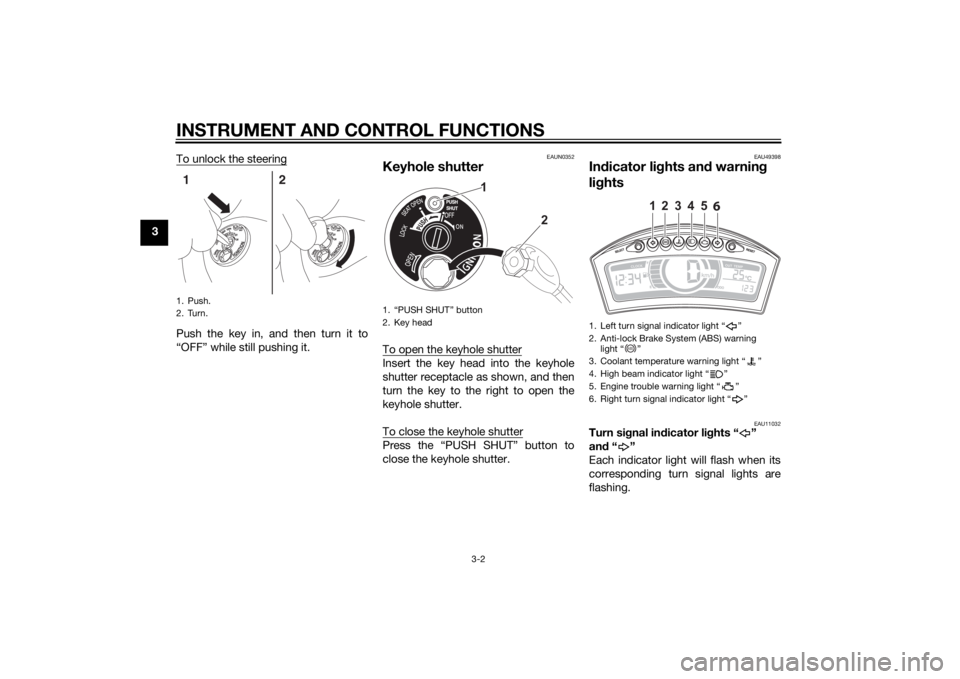
3To unlock the steering
Push the key in, and then turn it to
“OFF” while still pushing it.
EAUN0352
Keyhole shutterTo open the keyhole shutterInsert the key head into the keyhole
shutter receptacle as shown, and then
turn the key to the right to open the
keyhole shutter.
To close the keyhole shutterPress the “PUSH SHUT” button to
close the keyhole shutter.
EAU49398
In
dicator li ghts and warning
li g hts
EAU11032
Turn si gnal in dicator li ghts “ ”
an d“”
Each indicator light will flash when its
corresponding turn signal lights are
flashing.
1. Push.
2. Turn.12
1. “PUSH SHUT” button
2. Key head
1
2
1. Left turn signal indicator light “ ”
2. Anti-lock Brake System (ABS) warning light “ ”
3. Coolant temperature warning light “ ”
4. High beam indicator light “ ”
5. Engine trouble warning light “ ”
6. Right turn signal indicator light “ ”
1
2
3
4
5
6
ABS
U2CME1E0.book Page 2 Tuesday, December 9, 2014 4:12 PM
Page 19 of 86
INSTRUMENT AND CONTROL FUNCTIONS
3-3
3
EAU11081
High beam in dicator li ght “ ”
This indicator light comes on when the
high beam of the headlight is switched
on.
EAU11447
Coolant temperature warnin g
lig ht “ ”
This warning light comes on if the en-
gine overheats. If this occurs, stop the
engine immediately and allow the en-
gine to cool.
The electrical circuit of the warning
light can be checked by turning the key
to “ON”. The warning light should
come on for a few seconds, and then
go off.
If the warning light does not come on
initially when the key is turned to “ON”,
or if the warning light remains on, have
a Yamaha dealer check the electrical
circuit.NOTICE
ECA10022
Do not continue to operate the en-
g ine if it is overheatin g.
TIP For radiator-fan-equipped vehi-
cles, the radiator fan(s) automati-
cally switch on or off according to
the coolant temperature in the ra-
diator.
If the engine overheats, see page
6-33 for further instructions.
EAU11506
Engine trou ble warnin g li ght “ ”
This warning light comes on or flashes
if a problem is detected in the electrical
circuit monitoring the engine. If this oc-
curs, have a Yamaha dealer check the
self-diagnosis system. (See page 3-4
for an explanation of the self-diagnosis
device.)
The electrical circuit of the warning
light can be checked by turning the key
to “ON”. The warning light should
come on for a few seconds, and then
go off.
If the warning light does not come on
initially when the key is turned to “ON”,
or if the warning light remains on, have
a Yamaha dealer check the electrical
circuit.
EAUU1810
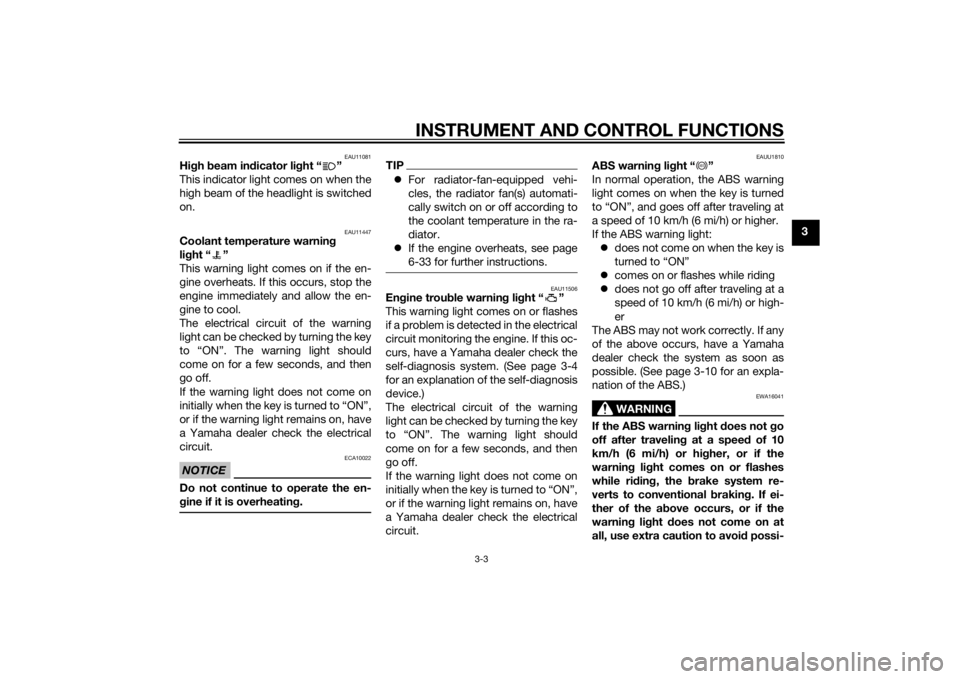
ABS warnin g lig ht “ ”
In normal operation, the ABS warning
light comes on when the key is turned
to “ON”, and goes off after traveling at
a speed of 10 km/h (6 mi/h) or higher.
If the ABS warning light: does not come on when the key is
turned to “ON”
comes on or flashes while riding
does not go off after traveling at a
speed of 10 km/h (6 mi/h) or high-
er
The ABS may not work correctly. If any
of the above occurs, have a Yamaha
dealer check the system as soon as
possible. (See page 3-10 for an expla-
nation of the ABS.)
WARNING
EWA16041
If the ABS warning light does not go
off after travelin g at a speed of 10
km/h (6 mi/h) or hi gher, or if the
warnin g lig ht comes on or flashes
while ri din g, the b rake system re-
verts to conventional brakin g. If ei-
ther of the a bove occurs, or if the
warnin g lig ht does not come on at
all, use extra caution to avoi d possi-
ABS
U2CME1E0.book Page 3 Tuesday, December 9, 2014 4:12 PM
Page 20 of 86
INSTRUMENT AND CONTROL FUNCTIONS
3-4
3b
le wheel lock during emer gency
b rakin g. Have a Yamaha d ealer
check the brake system an d electri-
cal circuits as soon as possi ble.
TIPThe ABS warning light may come on
while accelerating the engine with the
vehicle on its centerstand, but this
does not indicate a malfunction.
EAU12096
Self- dia gnosis device This model is equipped with a self-di-
agnosis device for various electrical
circuits.
If a problem is detected in any of those
circuits, the engine trouble warning
light will come on or flash. If this oc-
curs, have a Yamaha dealer check the
vehicle.NOTICE
ECA11171
To prevent en gine damag e, be sure
to consult a Yamaha d ealer as soon
as possi ble if this occurs.
EAUU1730
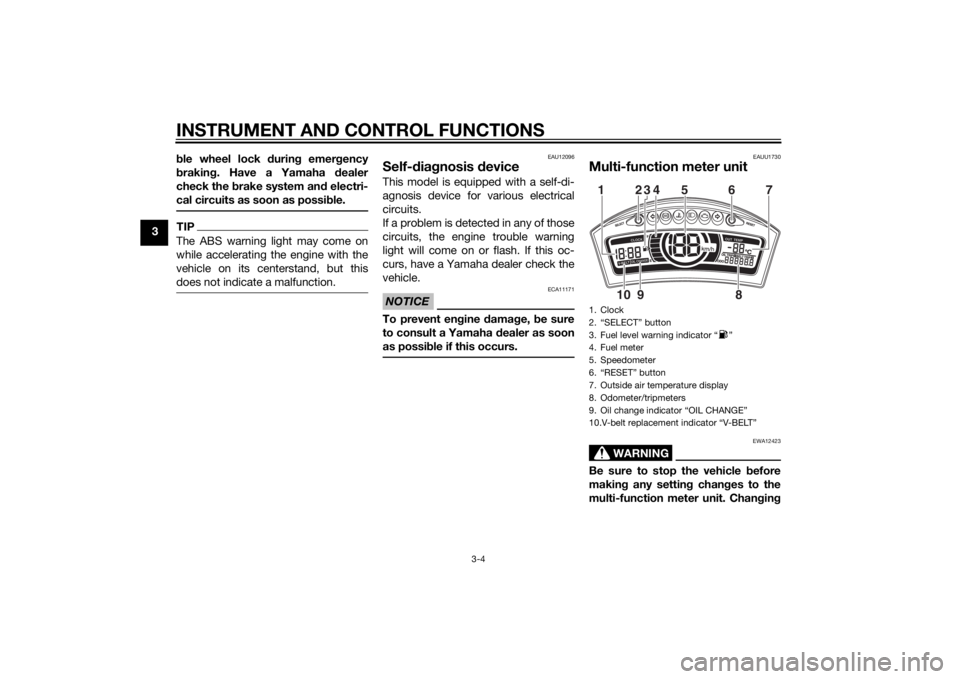
Multi-function meter unit
WARNING
EWA12423
Be sure to stop the vehicle before
makin g any settin g chan ges to the
multi-function meter unit. Chan gin g1. Clock
2. “SELECT” button
3. Fuel level warning indicator “ ”
4. Fuel meter
5. Speedometer
6. “RESET” button
7. Outside air temperature display
8. Odometer/tripmeters
9. Oil change indicator “OIL CHANGE”
10.V-belt replacement indicator “V-BELT”12345 6
8
910 7
U2CME1E0.book Page 4 Tuesday, December 9, 2014 4:12 PM
Page 26 of 86
INSTRUMENT AND CONTROL FUNCTIONS
3-10
3
TIPAs the unified brake system is me-
chanical, additional free play can
be felt in the front brake lever
when the rear brake lever is being
pulled.
The unified brake system does not
function when the front brake is
applied alone.
EAUU1840
ABSYour leaning multi-wheel vehicle’s ABS
(Anti-lock Brake System) features an
electronic control system, which acts
on each of the front and rear brakes in-
dependently.
Operate the brakes with ABS as you
would conventional brakes. If the ABS
is activated, a pulsating sensation may
be felt at the brake levers. In this situa-
tion, continue to apply the brakes and
let the ABS work; do not “pump” the
brakes as this will reduce braking ef-
fectiveness.
WARNING
EWA16051
Always keep a sufficient d istance
from the vehicle ahea d to match the
ri din g spee d even with ABS.
The ABS performs best with
lon g b rakin g d istances.
On certain surfaces, such as
rou gh or g ravel roa ds, the b rak-
in g d istance may b e longer with
the ABS than without.The ABS is monitored by an ECU,
which will revert the system to conven-
tional braking if a malfunction occurs.
TIP The ABS performs a self-diagno-
sis test each time the vehicle first
starts off after the key is turned to
“ON” and the vehicle has traveled
at a speed of 10 km/h (6 mi/h) or
higher. During this test, a “click-
ing” noise can be heard from the
front of the vehicle, and if either
brake lever is even slightly ap-
plied, a vibration can be felt at the
lever, but these do not indicate a
malfunction.
This ABS has a test mode which
allows the owner to experience
the pulsation at the brake levers
when the ABS is operating. How-
ever, special tools are required, so
please consult your Yamaha deal-
er.NOTICE
ECA20100
Be careful not to d amage the wheel
sensor or wheel sensor rotor; other-
wise, improper performance of the
ABS will result.
U2CME1E0.book Page 10 Tuesday, December 9, 2014 4:12 PM
Page 39 of 86
OPERATION AND IMPORTANT RIDING POINTS
5-2
5
The ABS warning light should
come on when the main switch is
turned to “ON” and then go off af-
ter traveling at a speed of 10 km/h
(6 mi/h) or higher.
NOTICE
ECA17682
If the ABS warnin
g li ght does not
come on an d then go off as ex-
plaine d a bove, see pa ge 3-2 for the
warnin g li ght circuit check.2. Close the throttle completely.
3. Start the engine by pushing the
start switch while applying the
front or rear brake.
If the engine fails to start, release
the start switch, wait a few sec-
onds, and then try again. Each
starting attempt should be as
short as possible to preserve the
battery. Do not crank the engine
more than 10 seconds on any one
attempt.NOTICE
ECA11043
For maximum en gine life, never ac-
celerate har d when the en gine is
col d!
EAU60640
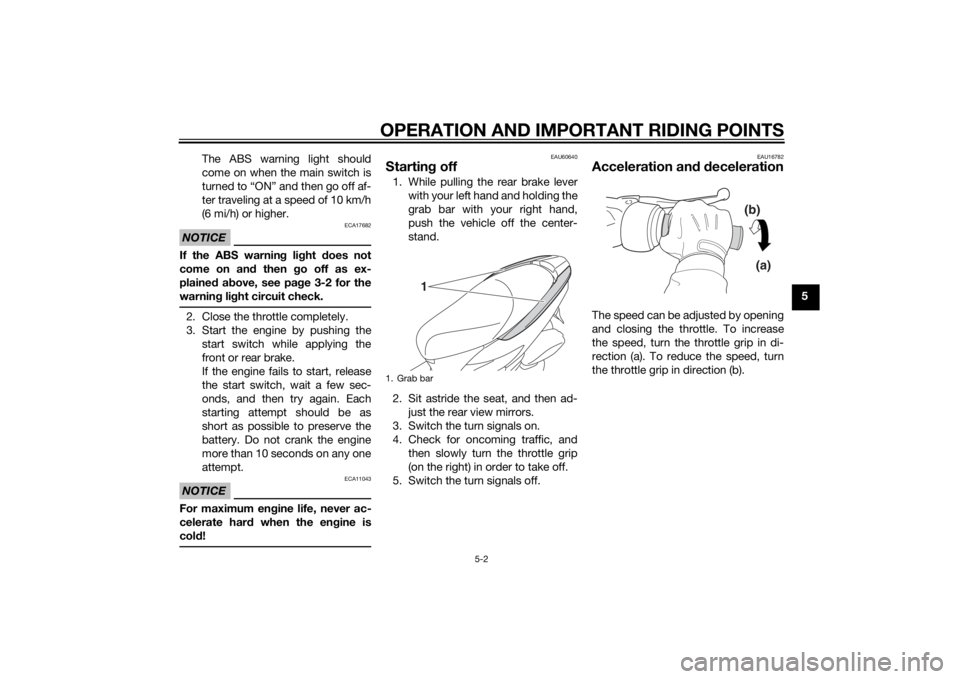
Startin g off1. While pulling the rear brake lever
with your left hand and holding the
grab bar with your right hand,
push the vehicle off the center-
stand.
2. Sit astride the seat, and then ad- just the rear view mirrors.
3. Switch the turn signals on.
4. Check for oncoming traffic, and then slowly turn the throttle grip
(on the right) in order to take off.
5. Switch the turn signals off.
EAU16782
Acceleration an d d ecelerationThe speed can be adjusted by opening
and closing the throttle. To increase
the speed, turn the throttle grip in di-
rection (a). To reduce the speed, turn
the throttle grip in direction (b).
1. Grab bar
1
(b)
(a)
U2CME1E0.book Page 2 Tuesday, December 9, 2014 4:12 PM
Page 62 of 86
PERIODIC MAINTENANCE AND ADJUSTMENT
6-21
6Rear
brake
WARNING
EWA16011
Improper maintenance can result in
loss of brakin g a bility. O bserve
these precautions: Insufficient brake flui d may al-
low air to enter the b rake sys-
tem, re ducin g brakin g
performance.
Clean the filler cap before re-
moving . Use only DOT 4 b rake
flui d from a seale d container.
Use only the specified b rake flu-
i d ; otherwise, the ru bber seals
may deteriorate, causin g leak-
a g e.
Refill with the same type of
brake flui d. A ddin g a brake flui d
other than DOT 4 may result in a
harmful chemical reaction.
Be careful that water or dust
d oes not enter the brake flui d
reservoir when refillin g. Water
will si gnificantly lower the boil-
in g point of the flui d an d may re-
sult in vapor lock, an d d ir t may
clo g
the ABS hy draulic unit
valves.
NOTICE
ECA17641
Brake fluid may damag e painted
surfaces or plastic parts. Always
clean up spille d flui d imme diately.As the brake pads wear, it is normal for
the brake fluid level to gradually go
down. A low brake fluid level may indi-
cate worn brake pads and/or brake
system leakage; therefore, be sure to
check the brake pads for wear and the
brake system for leakage. If the brake fluid level goes down suddenly, have a
Yamaha dealer check the cause before further riding.
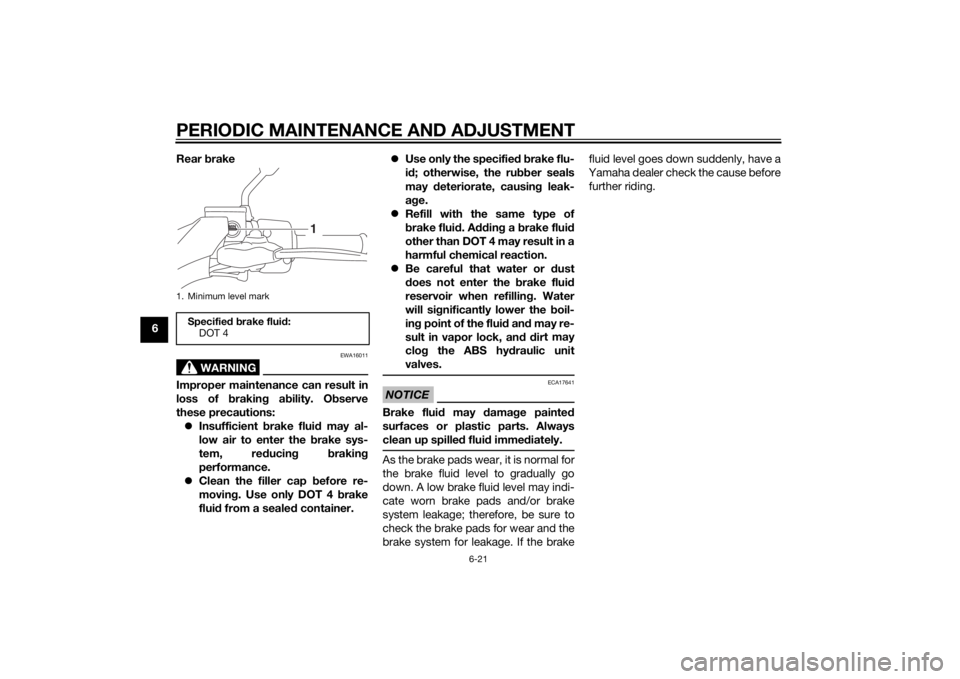
1. Minimum level markSpecifie d b rake flui d:
DOT 4
1
U2CME1E0.book Page 21 Tuesday, December 9, 2014 4:12 PM
Page 69 of 86
PERIODIC MAINTENANCE AND ADJUSTMENT
6-28
6
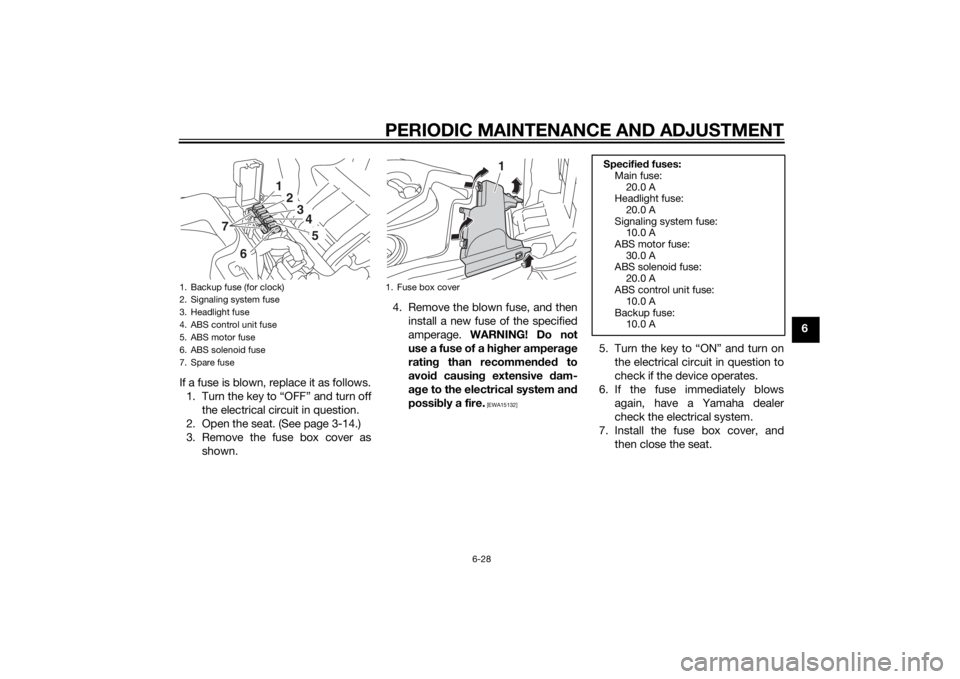
If a fuse is blown, replace it as follows. 1. Turn the key to “OFF” and turn off the electrical circuit in question.
2. Open the seat. (See page 3-14.)
3. Remove the fuse box cover as shown. 4. Remove the blown fuse, and then
install a new fuse of the specified
amperage. WARNING! Do not
use a fuse of a hi gher ampera ge
ratin g than recommen ded to
avoi d causin g extensive dam-
a g e to the electrical system an d
possi bly a fire.
[EWA15132]
5. Turn the key to “ON” and turn on
the electrical circuit in question to
check if the device operates.
6. If the fuse immediately blows again, have a Yamaha dealer
check the electrical system.
7. Install the fuse box cover, and then close the seat.
1. Backup fuse (for clock)
2. Signaling system fuse
3. Headlight fuse
4. ABS control unit fuse
5. ABS motor fuse
6. ABS solenoid fuse
7. Spare fuse
12345
6
7
1. Fuse box cover
1
Specified fuses:
Main fuse:
20.0 A
Headlight fuse:
20.0 A
Signaling system fuse: 10.0 A
ABS motor fuse: 30.0 A
ABS solenoid fuse:
20.0 A
ABS control unit fuse: 10.0 A
Backup fuse: 10.0 A
U2CME1E0.book Page 28 Tuesday, December 9, 2014 4:12 PM
Page 77 of 86
VEHICLE CARE AND STORAGE
7-3
7
thoroughly with water. For additional
cleaning, use Yamaha Windshield
Cleaner or another high-quality wind-
shield cleaner. Some cleaning com-
pounds for plastics may leave
scratches on the windshield. Before
using such cleaners, test an area of the
windshield which does not affect your
visibility and which cannot be easily
recognized.
After cleanin
g
1. Dry the vehicle with a chamois or an absorbing cloth.
2. Use a chrome polish to shine chrome, aluminum, and stainless-
steel parts, including the exhaust
system. (Even the thermally in-
duced discoloring of stainless-
steel exhaust systems can be re-
moved through polishing.)
3. To prevent corrosion, it is recom- mended to apply a corrosion pro-
tection spray on all metal,
including chrome- and nickel-plat-
ed surfaces.
4. Use spray oil as a universal clean- er to remove any remaining dirt. 5. Touch up minor paint damage
caused by stones, etc.
6. Wax all painted surfaces.
7. Let the vehicle dry completely be- fore storing or covering it.
WARNING
EWA17830
Contaminants on the b rakes or tires
can cause loss of control. Make sure that there is no oil or
wax on the b rakes or tires. If
necessary, clean the brake
d iscs an d b rake linin gs with a
re gular brake disc cleaner or
acetone, an d wash the tires with
warm water an d a mil d d eter-
g ent.
Before operatin g the vehicle
test its brakin g performance
an d cornerin g b ehavior.NOTICE
ECAU0022
Apply spray oil an d wax spar-
in gly an d make sure to wipe off
any excess.
Never apply oil or wax to any
rubber parts, plastic parts or
hea dlig ht, tailli ght and meter
lenses, but treat them with a
suita ble care pro duct.
Avoi d using abrasive polishin g
compoun ds as they will wear
away the paint.
TIP Consult a Yamaha dealer for ad-
vice on what products to use.
Washing, rainy weather or humid
climates can cause the headlight
lens to fog. Turning the headlight
on for a short period of time will
help remove the moisture from the
lens.
U2CME1E0.book Page 3 Tuesday, December 9, 2014 4:12 PM
Page 80 of 86

SPECIFICATIONS
8-2
8
Trail:68 mm (2.7 in)
Track: 385 mm (15.2 in)Front tire:Type:Tubeless
Size: 90/80-14M/C 43P
Manufacturer/model:
CHENG SHIN/M6231Rear tire:Type:Tubeless
Size:
110/90-12 64P
Manufacturer/model: CHENG SHIN/M6232Loa din g:Maximum load:
169 kg (373 lb)
(Total weight of rider, passenger, cargo
and accessories)Tire air pressure (measure d on col d
tires):
Front:
175 kPa (1.75 kgf/cm2, 25 psi)
Rear: 225 kPa (2.25 kgf/cm2, 33 psi)
Front wheel:Wheel type:Cast wheel
Rim size: 14M/C x MT2.15
Rear wheel:Wheel type:Cast wheel
Rim size:
12 x MT2.15Unifie d b rake system:Operation:
Activated by rear brakeFront brake:Type:
Disc brake
Operation: Right hand operation
Specified brake fluid:
DOT 4Rear brake:Type:
Disc brake
Operation:
Left hand operation
Specified brake fluid: DOT 4Front suspension:Type:
Telescopic fork
Spring/shock absorber type: Coil spring/oil damper
Wheel travel: 90 mm (3.5 in)Rear suspension:Type:Unit swing
Spring/shock absorber type: Coil spring/oil damper Wheel travel:
89 mm (3.5 in)
Electrical system:Ignition system:
TCI
Charging system: AC magnetoBattery:Model:
YTZ7V
Voltage, capacity: 12 V, 6.0 AhHea dlig ht:Bulb type:
Halogen bulbBul b volta ge, watta ge × quantity:Headlight:
12 V, 60.0 W/55.0 W × 1
Tail/brake light:
LED
Front turn signal light: 12 V, 10.0 W × 2
Rear turn signal light: 12 V, 10.0 W × 2
Auxiliary light:
LED
Meter lighting: LED
High beam indicator light: LED
Turn signal indicator light:
LED
Coolant temperature warning light: LED
U2CME1E0.book Page 2 Tuesday, December 9, 2014 4:12 PM