battery YAMAHA TRICITY 2015 Owners Manual
[x] Cancel search | Manufacturer: YAMAHA, Model Year: 2015, Model line: TRICITY, Model: YAMAHA TRICITY 2015Pages: 86, PDF Size: 2.6 MB
Page 6 of 86

TABLE OF CONTENTSSAFETY INFORMATION.................. 1-1
Further safe-riding points ............... 1-5
DESCRIPTION .................................. 2-1
Left view ......................................... 2-1
Right view ....................................... 2-2
Controls and instruments ............... 2-3
INSTRUMENT AND CONTROL
FUNCTIONS ...................................... 3-1
Main switch/steering lock............... 3-1
Keyhole shutter .............................. 3-2
Indicator lights and warning lights............................................ 3-2
Self-diagnosis device .................... 3-4
Multi-function meter unit ................ 3-4
Handlebar switches ........................ 3-8
Front brake lever ............................ 3-9
Rear brake lever ............................. 3-9
ABS .............................................. 3-10
Fuel tank cap ................................ 3-11
Fuel ............................................... 3-12
Catalytic converter ....................... 3-13
Seat .............................................. 3-14
Passenger footrest ....................... 3-14
Storage compartment .................. 3-15
Luggage hook............................... 3-16
Sidestand ..................................... 3-16
Ignition circuit cut-off system ....... 3-17
Auxiliary DC connector ................. 3-19 FOR YOUR SAFETY –
PRE-OPERATION CHECKS
............. 4-1
OPERATION AND IMPORTANT
RIDING POINTS ................................ 5-1
Starting the engine .......................... 5-1
Starting off ...................................... 5-2
Acceleration and deceleration ........ 5-2
Braking ............................................ 5-3
Tips for reducing fuel consumption ................................ 5-3
Engine break-in ............................... 5-3
Parking ............................................ 5-4
PERIODIC MAINTENANCE AND
ADJUSTMENT ................................... 6-1
Owner’s tool kit ............................... 6-2
Periodic maintenance chart for
the emission control system ........ 6-3
General maintenance and
lubrication chart ........................... 6-4
Removing and installing the panel ............................................ 6-8
Checking the spark plug ................. 6-8
Engine oil and oil strainer .............. 6-10
Final transmission oil..................... 6-12
Coolant.......................................... 6-13
Air filter and V-belt case air filter elements .................................... 6-14
Checking the throttle grip free play ..................................... 6-16 Valve clearance............................. 6-16
Tires .............................................. 6-17
Cast wheels .................................. 6-18
Checking the front brake lever
free play..................................... 6-19
Checking the rear brake lever free play..................................... 6-19
Checking the front and rear
brake pads ................................ 6-20
Checking the brake fluid level ...... 6-20
Changing the brake fluid .............. 6-22
Checking and lubricating the cables ........................................ 6-22
Checking and lubricating the
throttle grip and cable ............... 6-22
Lubricating the front and rear brake levers ............................... 6-23
Checking and lubricating the centerstand and sidestand........ 6-23
Checking the front fork ................. 6-24
Checking the steering................... 6-25
Checking the wheel bearings ....... 6-25
Checking the steering tie rod ....... 6-25
Checking the leaning system ....... 6-26
Battery .......................................... 6-26
Replacing the fuses ...................... 6-27
Replacing the headlight bulb ........ 6-29
Auxiliary light ................................ 6-30
Tail/brake light .............................. 6-30
Turn signal light bulb .................... 6-30
Troubleshooting............................ 6-31U2CME1E0.book Page 1 Tuesday, December 9, 2014 4:12 PM
Page 15 of 86
DESCRIPTION
2-2
2
EAU10421
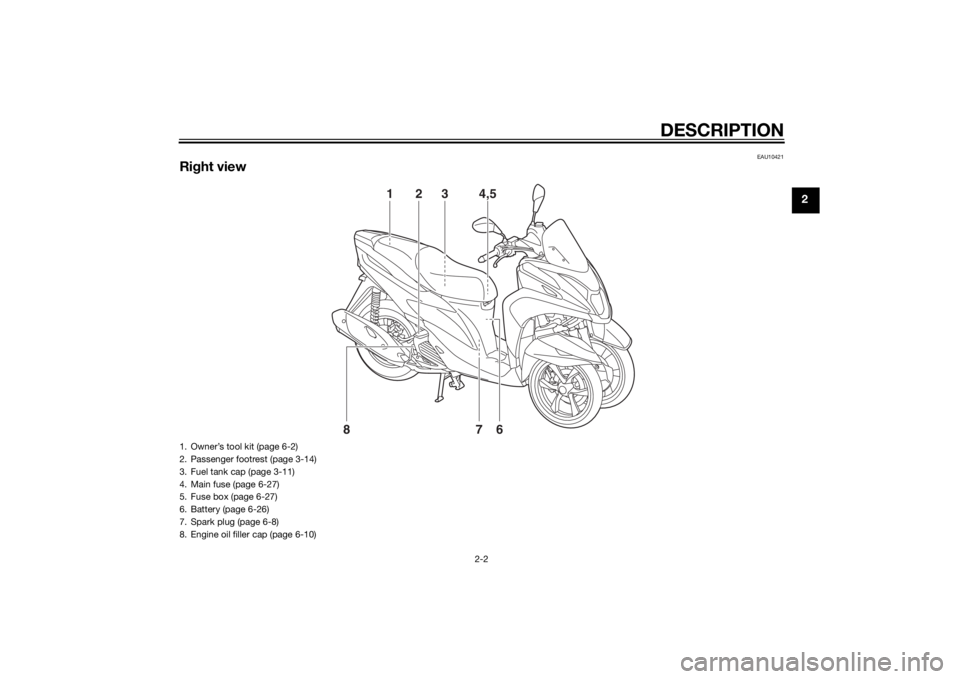
Right view
1
3
4,5
6
2
8
7
1. Owner’s tool kit (page 6-2)
2. Passenger footrest (page 3-14)
3. Fuel tank cap (page 3-11)
4. Main fuse (page 6-27)
5. Fuse box (page 6-27)
6. Battery (page 6-26)
7. Spark plug (page 6-8)
8. Engine oil filler cap (page 6-10)
U2CME1E0.book Page 2 Tuesday, December 9, 2014 4:12 PM
Page 21 of 86
INSTRUMENT AND CONTROL FUNCTIONS
3-5
3
settin
gs while ri din g can distract the
operator an d increase the risk of an
acci dent.
The multi-function meter unit is
equipped with the following:
a speedometer
a fuel meter
a clock
an outside air temperature display
an odometer
two tripmeters
a fuel reserve tripmeter
an oil change tripmeter
a V-belt replacement tripmeter
an oil change indicator
a V-belt replacement indicatorTIPBe sure to turn the key to “ON” be-
fore using the “SELECT” and “RE-
SET” buttons.
For the UK only: To switch the
speedometer and odometer/trip-
meter displays between kilome-
ters and miles, press the
“SELECT” button for at least one
second.
If the coolant temperature warning
light and engine trouble warning
light remain on during the initial
display mode, have the battery
charged by a Yamaha dealer.
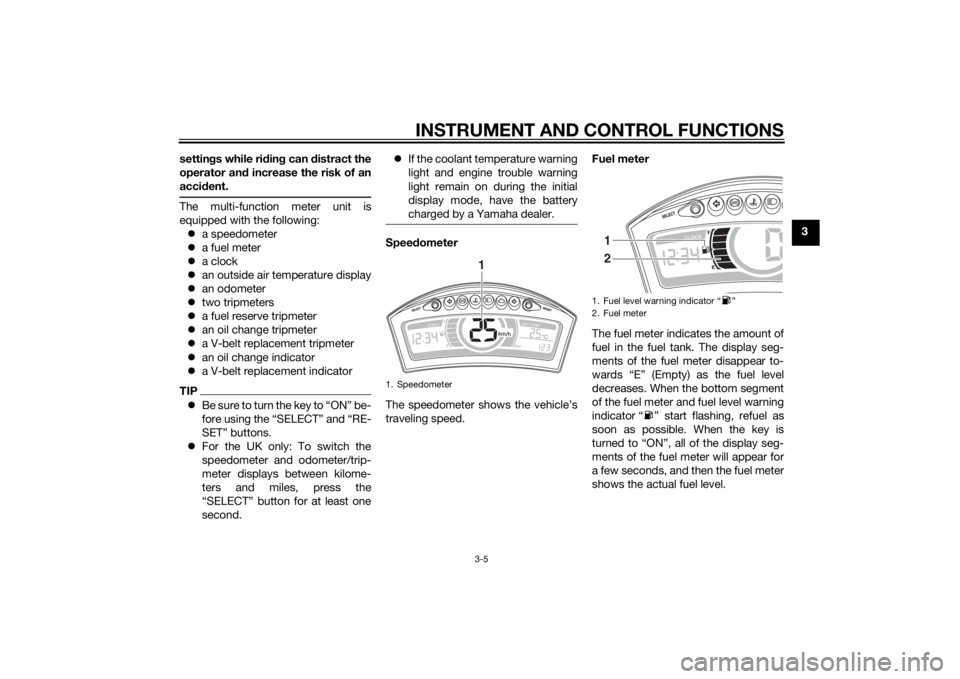
Speed ometer
The speedometer shows the vehicle’s
traveling speed. Fuel meter
The fuel meter indicates the amount of
fuel in the fuel tank. The display seg-
ments of the fuel meter disappear to-
wards “E” (Empty) as the fuel level
decreases. When the bottom segment
of the fuel meter and fuel level warning
indicator “ ” start flashing, refuel as
soon as possible. When the key is
turned to “ON”, all of the display seg-
ments of the fuel meter will appear for
a few seconds, and then the fuel meter
shows the actual fuel level.1. Speedometer
1
1. Fuel level warning indicator “ ”
2. Fuel meter
1
2
U2CME1E0.book Page 5 Tuesday, December 9, 2014 4:12 PM
Page 35 of 86
INSTRUMENT AND CONTROL FUNCTIONS
3-19
3
EAU61140
Auxiliary DC connectorNOTICE
ECA21160
The accessory connected to the
auxiliary DC connector shoul d not
b e used with the en gine turne d off,
an d the loa d must never excee d 120
W (10 A), otherwise the fuse may
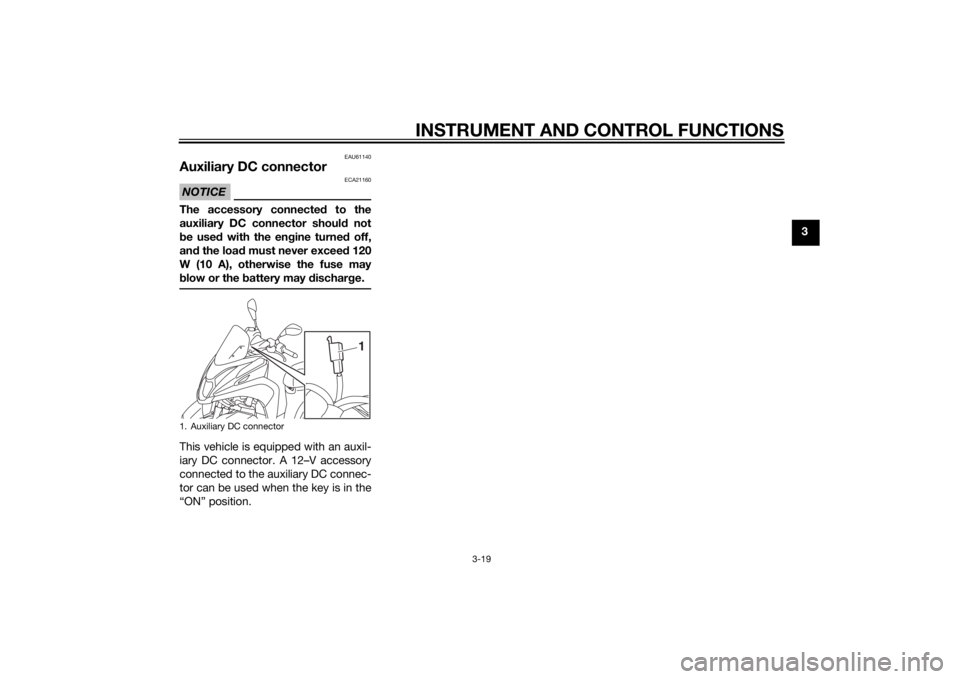
b low or the battery may d ischarge.This vehicle is equipped with an auxil-
iary DC connector. A 12–V accessory
connected to the auxiliary DC connec-
tor can be used when the key is in the
“ON” position.1. Auxiliary DC connector
1
U2CME1E0.book Page 19 Tuesday, December 9, 2014 4:12 PM
Page 39 of 86
OPERATION AND IMPORTANT RIDING POINTS
5-2
5
The ABS warning light should
come on when the main switch is
turned to “ON” and then go off af-
ter traveling at a speed of 10 km/h
(6 mi/h) or higher.
NOTICE
ECA17682
If the ABS warnin
g li ght does not
come on an d then go off as ex-
plaine d a bove, see pa ge 3-2 for the
warnin g li ght circuit check.2. Close the throttle completely.
3. Start the engine by pushing the
start switch while applying the
front or rear brake.
If the engine fails to start, release
the start switch, wait a few sec-
onds, and then try again. Each
starting attempt should be as
short as possible to preserve the
battery. Do not crank the engine
more than 10 seconds on any one
attempt.NOTICE
ECA11043
For maximum en gine life, never ac-
celerate har d when the en gine is
col d!
EAU60640
Startin g off1. While pulling the rear brake lever
with your left hand and holding the
grab bar with your right hand,
push the vehicle off the center-
stand.
2. Sit astride the seat, and then ad- just the rear view mirrors.
3. Switch the turn signals on.
4. Check for oncoming traffic, and then slowly turn the throttle grip
(on the right) in order to take off.
5. Switch the turn signals off.
EAU16782
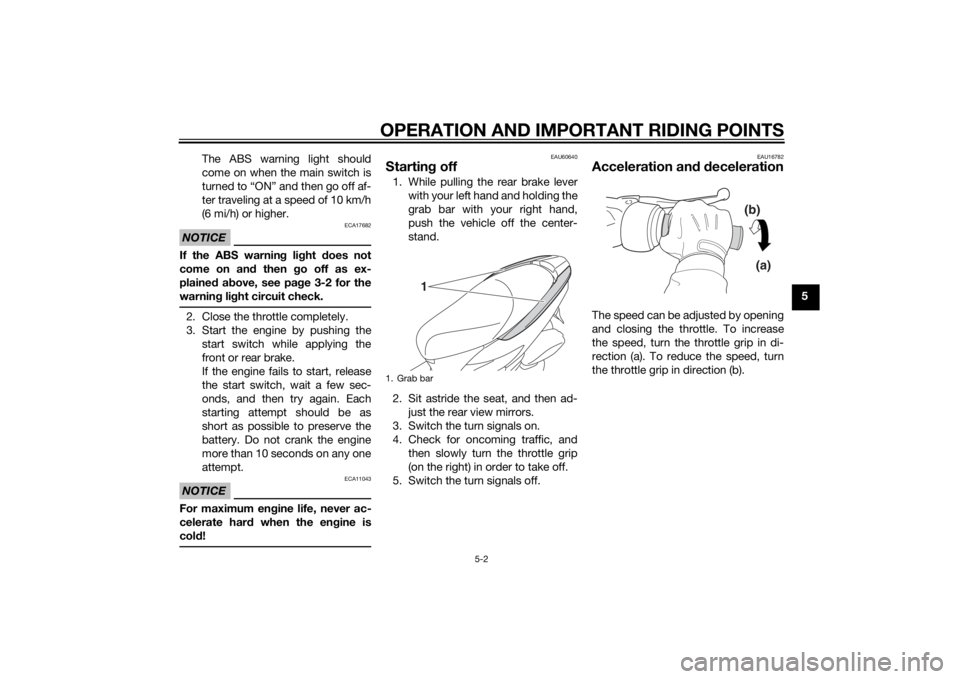
Acceleration an d d ecelerationThe speed can be adjusted by opening
and closing the throttle. To increase
the speed, turn the throttle grip in di-
rection (a). To reduce the speed, turn
the throttle grip in direction (b).
1. Grab bar
1
(b)
(a)
U2CME1E0.book Page 2 Tuesday, December 9, 2014 4:12 PM
Page 67 of 86
PERIODIC MAINTENANCE AND ADJUSTMENT
6-26
6
EAU61390
Checking the leanin g systemThe leaning system must be checked
by a Yamaha dealer at the intervals
specified in the periodic maintenance
and lubrication chart.
EAU60690
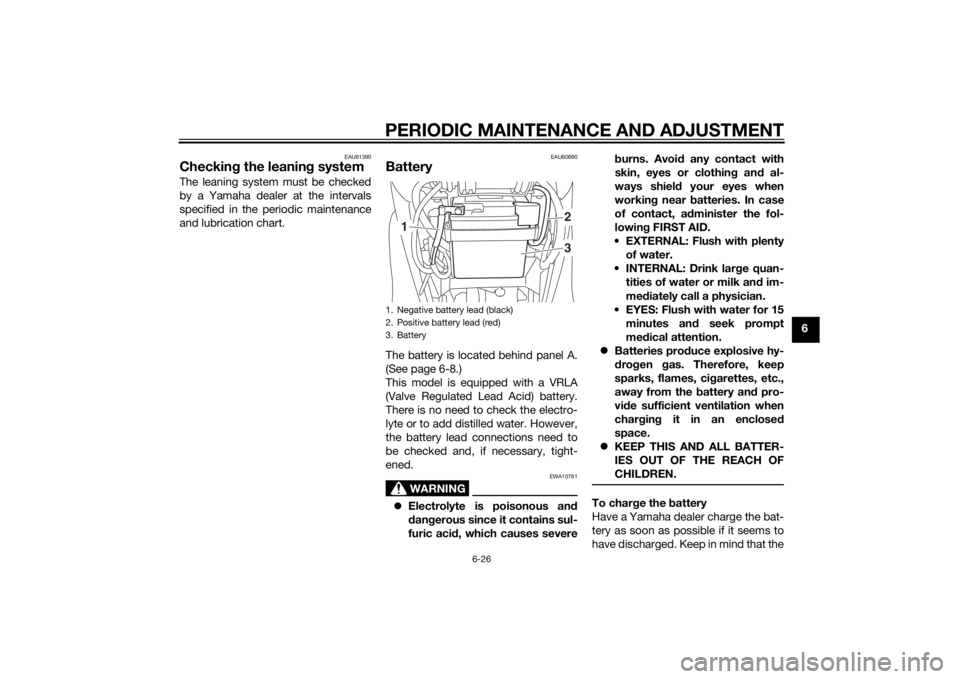
BatteryThe battery is located behind panel A.
(See page 6-8.)
This model is equipped with a VRLA
(Valve Regulated Lead Acid) battery.
There is no need to check the electro-
lyte or to add distilled water. However,
the battery lead connections need to
be checked and, if necessary, tight-
ened.
WARNING
EWA10761
Electrolyte is poisonous an d
d an gerous since it contains sul-
furic aci d, which causes severe b
urns. Avoi d any contact with
skin, eyes or clothin g an d al-
ways shiel d your eyes when
workin g near b atteries. In case
of contact, ad minister the fol-
lowin g FIRST AID.
EXTERNAL: Flush with plenty of water.
INTERNAL: Drink lar ge quan-
tities of water or milk an d im-
me diately call a physician.
EYES: Flush with water for 15 minutes an d seek prompt
me dical attention.
Batteries pro duce explosive hy-
d ro gen gas. Therefore, keep
sparks, flames, ci garettes, etc.,
away from the battery an d pro-
vi de sufficient ventilation when
char gin g it in an enclose d
space.
KEEP THIS AND ALL BATTER-
IES OUT OF THE REACH OF
CHILDREN.
To char ge the b attery
Have a Yamaha dealer charge the bat-
tery as soon as possible if it seems to
have discharged. Keep in mind that the
1. Negative battery lead (black)
2. Positive battery lead (red)
3. Battery
1
23
U2CME1E0.book Page 26 Tuesday, December 9, 2014 4:12 PM
Page 68 of 86
PERIODIC MAINTENANCE AND ADJUSTMENT
6-27
6battery tends to discharge more quick-
ly if the vehicle is equipped with op-
tional electrical accessories.
NOTICE
ECA16522
To char
ge a VRLA (Valve Re gulate d
Lea d Aci d) battery, a special (con-
stant-voltag e) battery char ger is re-
quired . Using a conventional b attery
char ger will damag e the b attery.To store the b attery
1. If the vehicle will not be used for more than one month, remove the
battery, fully charge it, and then
place it in a cool, dry place.
NOTICE: When removin g the
b attery, be sure the key is
turne d to “OFF”, then d iscon-
nect the neg ative lead b efore
d isconnectin g the positive lea d.
[ECA16303]
2. If the battery will be stored for
more than two months, check it at
least once a month and fully
charge it if necessary.
3. Fully charge the battery before in- stallation. NOTICE: When install-
in g the b attery, be sure the key is turned
to “OFF”, then connect
the positive lead before con-
nectin g the ne gative lea d.
[ECA16841]
4. After installation, make sure that
the battery leads are properly con-
nected to the battery terminals.NOTICE
ECA16531
Always keep the b attery charged .
Storin g a d ischar ged battery can
cause permanent battery damag e.
EAU60983
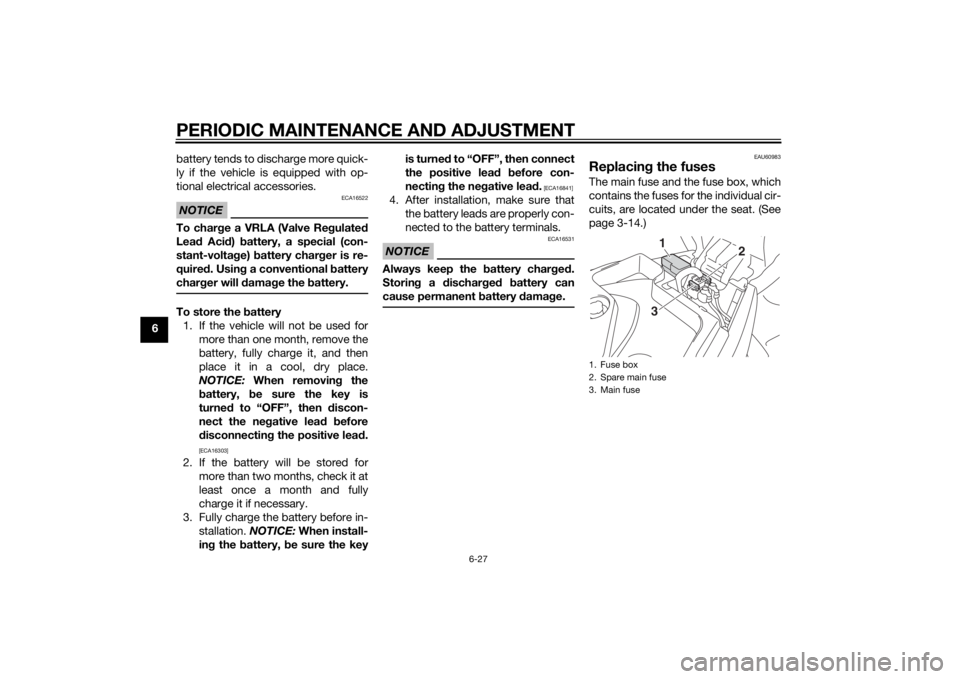
Replacin g the fusesThe main fuse and the fuse box, which
contains the fuses for the individual cir-
cuits, are located under the seat. (See
page 3-14.)1. Fuse box
2. Spare main fuse
3. Main fuse
1
2
3
U2CME1E0.book Page 27 Tuesday, December 9, 2014 4:12 PM
Page 73 of 86
PERIODIC MAINTENANCE AND ADJUSTMENT
6-32
6
EAU61350
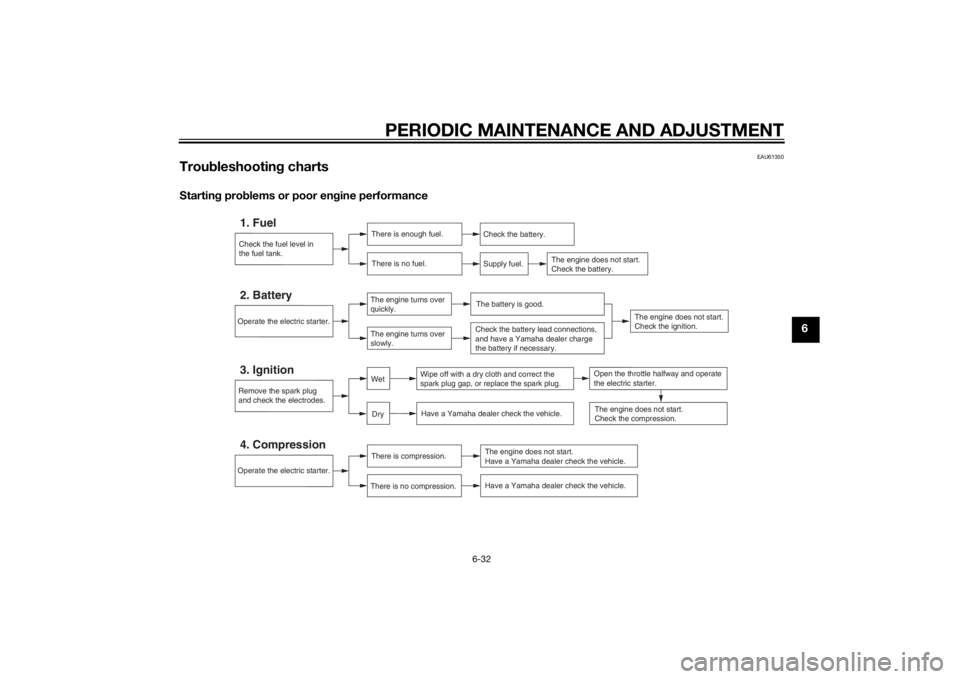
Troubleshootin g chartsStartin g prob lems or poor en gine performance
Check the fuel level in
the fuel tank.1. Fuel
There is enough fuel.
There is no fuel.
Check the battery.
Supply fuel.
The engine does not start.
Check the battery.
The engine does not start.
Have a Yamaha dealer check the vehicle.
Operate the electric starter.4. Compression
There is compression.
There is no compression.
Remove the spark plug
and check the electrodes.3. Ignition
Wipe off with a dry cloth and correct the
spark plug gap, or replace the spark plug. Have a Yamaha dealer check the vehicle.
Have a Yamaha dealer check the vehicle.
The engine does not start.
Check the compression.
The engine does not start.
Check the ignition.
Operate the electric starter.2. Battery
The engine turns over
quickly.
The engine turns over
slowly.
The battery is good.Check the battery lead connections,
and have a Yamaha dealer charge
the battery if necessary.
DryWet
Open the throttle halfway and operate
the electric starter.
U2CME1E0.book Page 32 Tuesday, December 9, 2014 4:12 PM
Page 78 of 86
VEHICLE CARE AND STORAGE
7-4
7
EAU60721
StorageShort-term
Always store your vehicle in a cool, dry
place and, if necessary, protect it
against dust with a porous cover. Be
sure the engine and the exhaust sys-
tem are cool before covering the vehi-
cle.NOTICE
ECA21170
Storin g the vehicle in a poorly
ventilate d room or coverin g it
with a tarp, while it is still wet,
will allow water an d humi dity to
seep in an d cause rust.
To prevent corrosion, avoi d
d amp cellars, sta bles ( because
of the presence of ammonia)
an d areas where stron g chemi-
cals are stored .Long-term
Before storing your vehicle for several
months: 1. Follow all the instructions in the “Care” section of this chapter. 2. Fill up the fuel tank and add fuel
stabilizer (if available) to prevent
the fuel tank from rusting and the
fuel from deteriorating.
3. Perform the following steps to protect the cylinder, piston rings,
etc. from corrosion.a. Remove the spark plug cap and spark plug.
b. Pour a teaspoonful of engine oil into the spark plug bore.
c. Install the spark plug cap onto the spark plug, and then place
the spark plug on the cylinder
head so that the electrodes are
grounded. (This will limit spark-
ing during the next step.)
d. Turn the engine over several times with the starter. (This will
coat the cylinder wall with oil.)
e. Remove the spark plug cap from the spark plug, and then
install the spark plug and the
spark plug cap. WARNING! To
prevent dama ge or injury
from sparkin g, make sure to
g roun d the spark plu g elec-
tro des while turning the en-
g ine over.
[EWA10952]
4. Lubricate all control cables and
the pivoting points of all levers and
pedals as well as of the side-
stand/centerstand.
5. Check and, if necessary, correct the tire air pressure, and then lift
the vehicle so that both of its
wheels are off the ground. Alterna-
tively, turn the wheels a little every
month in order to prevent the tires
from becoming degraded in one
spot.
6. Cover the muffler outlet with a plastic bag to prevent moisture
from entering it.
7. Remove the battery and fully charge it. Store it in a cool, dry
place and charge it once a month.
Do not store the battery in an ex-
cessively cold or warm place [less
than 0 °C (30 °F) or more than 30
°C (90 °F)]. For more information
on storing the battery, see page
6-26.TIPMake any necessary repairs before
storing the vehicle.
U2CME1E0.book Page 4 Tuesday, December 9, 2014 4:12 PM
Page 80 of 86

SPECIFICATIONS
8-2
8
Trail:68 mm (2.7 in)
Track: 385 mm (15.2 in)Front tire:Type:Tubeless
Size: 90/80-14M/C 43P
Manufacturer/model:
CHENG SHIN/M6231Rear tire:Type:Tubeless
Size:
110/90-12 64P
Manufacturer/model: CHENG SHIN/M6232Loa din g:Maximum load:
169 kg (373 lb)
(Total weight of rider, passenger, cargo
and accessories)Tire air pressure (measure d on col d
tires):
Front:
175 kPa (1.75 kgf/cm2, 25 psi)
Rear: 225 kPa (2.25 kgf/cm2, 33 psi)
Front wheel:Wheel type:Cast wheel
Rim size: 14M/C x MT2.15
Rear wheel:Wheel type:Cast wheel
Rim size:
12 x MT2.15Unifie d b rake system:Operation:
Activated by rear brakeFront brake:Type:
Disc brake
Operation: Right hand operation
Specified brake fluid:
DOT 4Rear brake:Type:
Disc brake
Operation:
Left hand operation
Specified brake fluid: DOT 4Front suspension:Type:
Telescopic fork
Spring/shock absorber type: Coil spring/oil damper
Wheel travel: 90 mm (3.5 in)Rear suspension:Type:Unit swing
Spring/shock absorber type: Coil spring/oil damper Wheel travel:
89 mm (3.5 in)
Electrical system:Ignition system:
TCI
Charging system: AC magnetoBattery:Model:
YTZ7V
Voltage, capacity: 12 V, 6.0 AhHea dlig ht:Bulb type:
Halogen bulbBul b volta ge, watta ge × quantity:Headlight:
12 V, 60.0 W/55.0 W × 1
Tail/brake light:
LED
Front turn signal light: 12 V, 10.0 W × 2
Rear turn signal light: 12 V, 10.0 W × 2
Auxiliary light:
LED
Meter lighting: LED
High beam indicator light: LED
Turn signal indicator light:
LED
Coolant temperature warning light: LED
U2CME1E0.book Page 2 Tuesday, December 9, 2014 4:12 PM