fuel cap YAMAHA TRICITY 2016 Owners Manual
[x] Cancel search | Manufacturer: YAMAHA, Model Year: 2016, Model line: TRICITY, Model: YAMAHA TRICITY 2016Pages: 87, PDF Size: 2.59 MB
Page 6 of 87

Table of contentsSafety information ............................ 1-1
Further safe-riding points ............... 1-5
Description ....................................... 2-1
Left view ......................................... 2-1
Right view ....................................... 2-2
Controls and instruments ............... 2-3
Instrument an d control functions ... 3-1
Main switch/steering lock............... 3-1
Keyhole shutter .............................. 3-3
Indicator lights and warning lights............................................ 3-3
Self-diagnosis device .................... 3-5
Multi-function meter unit ................ 3-5
Handlebar switches ........................ 3-9
Front brake lever .......................... 3-10
Rear brake lever ........................... 3-10
ABS (for ABS models) .................. 3-11
Fuel tank cap ................................ 3-12
Fuel ............................................... 3-13
Catalytic converter ....................... 3-14
Seat .............................................. 3-15
Passenger footrest ....................... 3-15
Storage compartment .................. 3-16
Luggage hook............................... 3-17
Sidestand ..................................... 3-17
Ignition circuit cut-off system ....... 3-18
Auxiliary DC connector ................. 3-20 For your safety – pre-operation
checks
............................................... 4-1
Operation an d important ri din g
points ................................................. 5-1
Starting the engine .......................... 5-1
Starting off ...................................... 5-2
Acceleration and deceleration ........ 5-3
Braking ............................................ 5-3
Tips for reducing fuel consumption ................................ 5-3
Engine break-in ............................... 5-4
Parking ............................................ 5-4
Perio dic maintenance an d
a d justment ........................................ 6-1
Owner’s tool kit ............................... 6-2
Periodic maintenance chart for
the emission control system ........ 6-3
General maintenance and
lubrication chart ........................... 6-4
Removing and installing the panel ............................................ 6-8
Checking the spark plug ................. 6-8
Engine oil and oil strainer .............. 6-10
Final transmission oil..................... 6-12
Coolant.......................................... 6-13
Air filter and V-belt case air filter elements .................................... 6-14
Checking the throttle grip free play ..................................... 6-16 Valve clearance............................. 6-16
Tires .............................................. 6-17
Cast wheels .................................. 6-18
Checking the front brake lever
free play..................................... 6-19
Checking the rear brake lever free play..................................... 6-19
Checking the front and rear
brake pads ................................ 6-20
Checking the brake fluid level ...... 6-20
Changing the brake fluid .............. 6-22
Checking and lubricating the cables ........................................ 6-22
Checking and lubricating the
throttle grip and cable ............... 6-22
Lubricating the front and rear brake levers ............................... 6-23
Checking and lubricating the centerstand and sidestand........ 6-23
Checking the front fork ................. 6-24
Checking the steering................... 6-25
Checking the wheel bearings ....... 6-25
Checking the steering tie rod ....... 6-25
Checking the leaning system ....... 6-26
Battery .......................................... 6-26
Replacing the fuses ...................... 6-27
Replacing the headlight bulb ........ 6-29
Auxiliary lights............................... 6-30
Tail/brake light .............................. 6-30
Turn signal light bulb .................... 6-31
Troubleshooting............................ 6-31U2CME2E0.book Page 1 Friday, August 21, 2015 9:16 AM
Page 15 of 87
Description
2-2
2
EAU10421
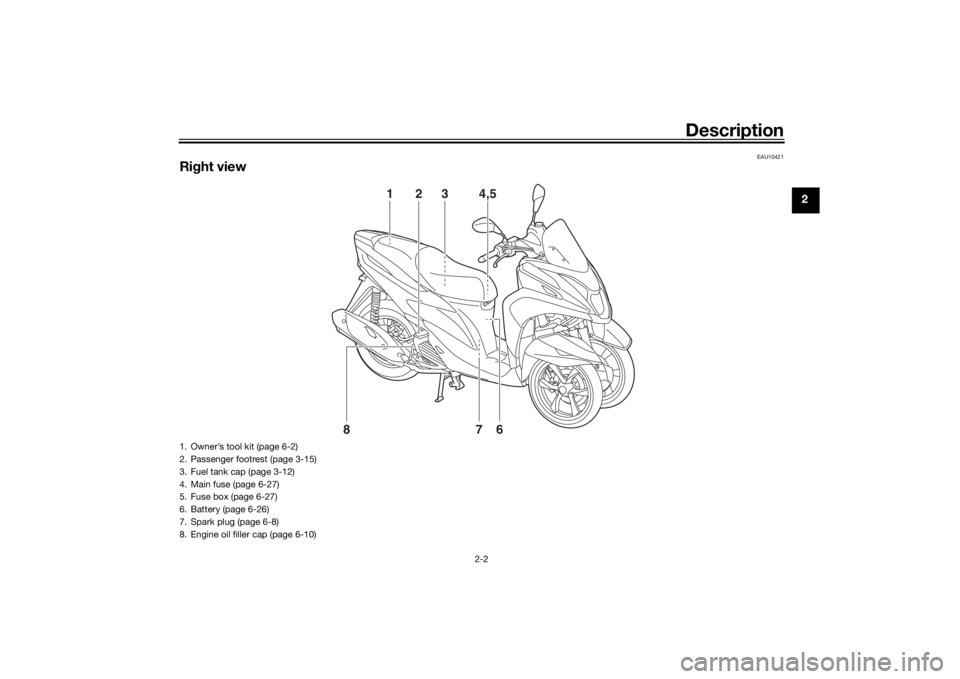
Right view
1
3
4,5
6
2
8
7
1. Owner’s tool kit (page 6-2)
2. Passenger footrest (page 3-15)
3. Fuel tank cap (page 3-12)
4. Main fuse (page 6-27)
5. Fuse box (page 6-27)
6. Battery (page 6-26)
7. Spark plug (page 6-8)
8. Engine oil filler cap (page 6-10)
U2CME2E0.book Page 2 Friday, August 21, 2015 9:16 AM
Page 28 of 87
Instrument and control functions
3-12
3
EAU37473
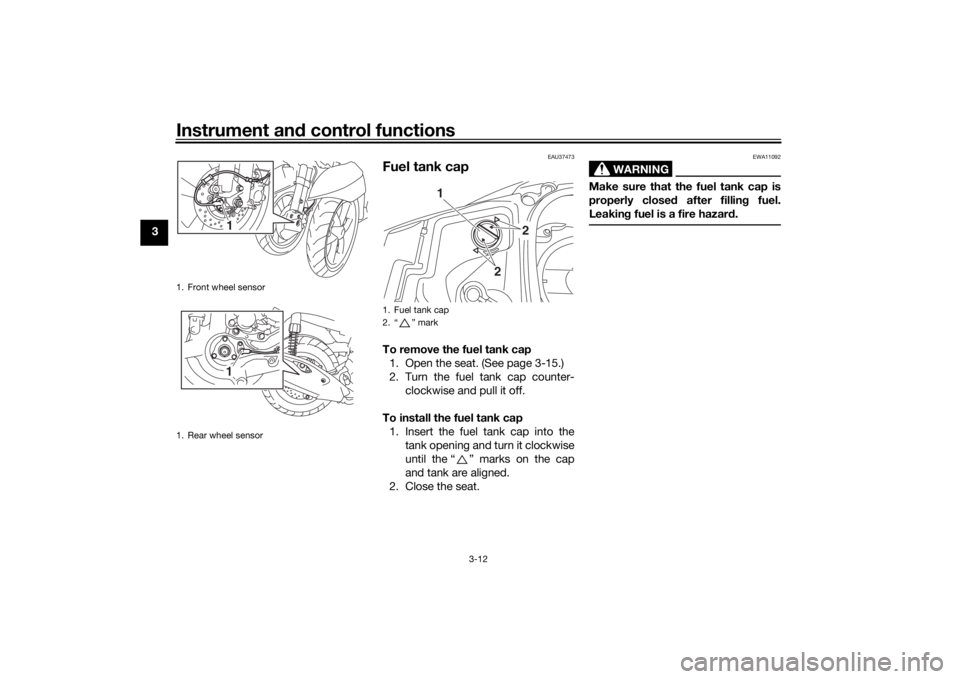
Fuel tank capTo remove the fuel tank cap
1. Open the seat. (See page 3-15.)
2. Turn the fuel tank cap counter- clockwise and pull it off.
To install the fuel tank cap 1. Insert the fuel tank cap into the tank opening and turn it clockwise
until the “ ” marks on the cap
and tank are aligned.
2. Close the seat.
WARNING
EWA11092
Make sure that the fuel tank cap is
properly close d after fillin g fuel.
Leakin g fuel is a fire hazar d.
1. Front wheel sensor
1. Rear wheel sensor
11
1. Fuel tank cap
2. “ ” mark
2
2
1
U2CME2E0.book Page 12 Friday, August 21, 2015 9:16 AM
Page 29 of 87
Instrument and control functions
3-13
3
EAU13222
FuelMake sure there is sufficient gasoline in
the tank.
WARNING
EWA10882
Gasoline an d gasoline vapors are
extremely flammab le. To avoid fires
an d explosions an d to re duce the
risk of injury when refueling , follow
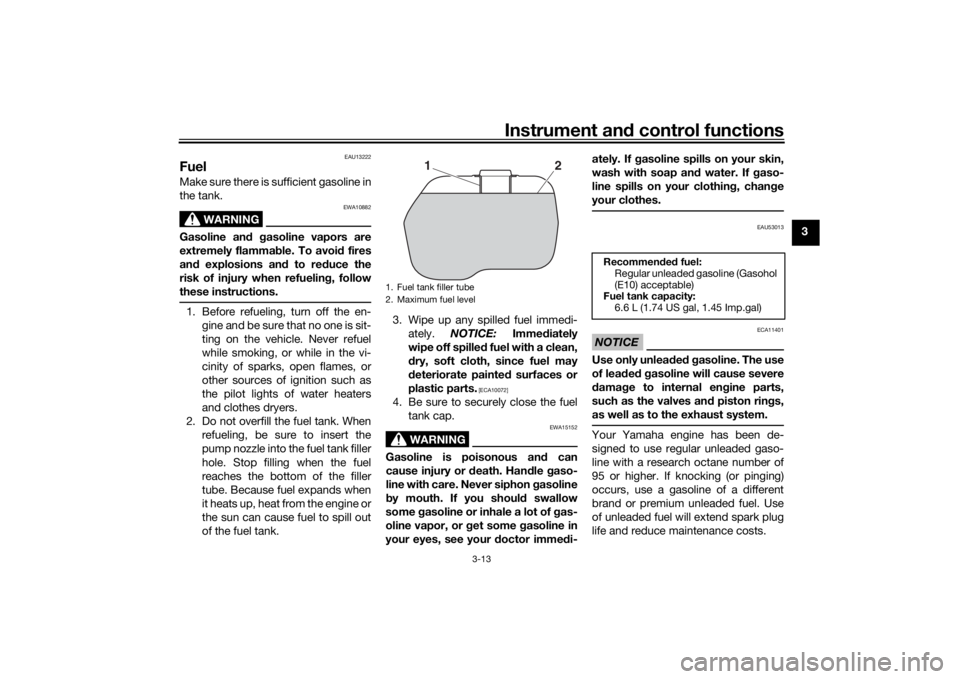
these instructions.1. Before refueling, turn off the en- gine and be sure that no one is sit-
ting on the vehicle. Never refuel
while smoking, or while in the vi-
cinity of sparks, open flames, or
other sources of ignition such as
the pilot lights of water heaters
and clothes dryers.
2. Do not overfill the fuel tank. When refueling, be sure to insert the
pump nozzle into the fuel tank filler
hole. Stop filling when the fuel
reaches the bottom of the filler
tube. Because fuel expands when
it heats up, heat from the engine or
the sun can cause fuel to spill out
of the fuel tank. 3. Wipe up any spilled fuel immedi-
ately. NOTICE: Immediately
wipe off spille d fuel with a clean,
d ry, soft cloth, since fuel may
d eteriorate painte d surfaces or
plastic parts.
[ECA10072]
4. Be sure to securely close the fuel tank cap.
WARNING
EWA15152
Gasoline is poisonous an d can
cause injury or d eath. Handle gaso-
line with care. Never siphon gasoline
b y mouth. If you shoul d swallow
some gasoline or inhale a lot of gas-
oline vapor, or g et some gasoline in
your eyes, see your doctor imme di- ately. If g
asoline spills on your skin,
wash with soap an d water. If gaso-
line spills on your clothin g, chan ge
your clothes.
EAU53013
NOTICE
ECA11401
Use only unlea ded g asoline. The use
of lead ed g asoline will cause severe
d amag e to internal en gine parts,
such as the valves an d piston rin gs,
as well as to the exhaust system.Your Yamaha engine has been de-
signed to use regular unleaded gaso-
line with a research octane number of
95 or higher. If knocking (or pinging)
occurs, use a gasoline of a different
brand or premium unleaded fuel. Use
of unleaded fuel will extend spark plug
life and reduce maintenance costs.
1. Fuel tank filler tube
2. Maximum fuel level
1
2
Recommen ded fuel:
Regular unleaded gasoline (Gasohol
(E10) acceptable)
Fuel tank capacity:
6.6 L (1.74 US gal, 1.45 Imp.gal)
U2CME2E0.book Page 13 Friday, August 21, 2015 9:16 AM
Page 79 of 87
Vehicle care and stora ge
7-4
7
EAU60721
Stora geShort-term
Always store your vehicle in a cool, dry
place and, if necessary, protect it
against dust with a porous cover. Be
sure the engine and the exhaust sys-
tem are cool before covering the vehi-
cle.NOTICE
ECA21170
Storin g the vehicle in a poorly
ventilate d room or coverin g it
with a tarp, while it is still wet,
will allow water an d humi dity to
seep in an d cause rust.
To prevent corrosion, avoi d
d amp cellars, sta bles ( because
of the presence of ammonia)
an d areas where stron g chemi-
cals are stored .Long-term
Before storing your vehicle for several
months: 1. Follow all the instructions in the “Care” section of this chapter. 2. Fill up the fuel tank and add fuel
stabilizer (if available) to prevent
the fuel tank from rusting and the
fuel from deteriorating.
3. Perform the following steps to protect the cylinder, piston rings,
etc. from corrosion.a. Remove the spark plug cap and spark plug.
b. Pour a teaspoonful of engine oil into the spark plug bore.
c. Install the spark plug cap onto the spark plug, and then place
the spark plug on the cylinder
head so that the electrodes are
grounded. (This will limit spark-
ing during the next step.)
d. Turn the engine over several times with the starter. (This will
coat the cylinder wall with oil.)
e. Remove the spark plug cap from the spark plug, and then
install the spark plug and the
spark plug cap. WARNING! To
prevent damag e or injury
from sparkin g, make sure to
g roun d the spark plu g elec-
tro des while turnin g the en-
g ine over.
[EWA10952]
4. Lubricate all control cables and
the pivoting points of all levers and
pedals as well as of the side-
stand/centerstand.
5. Check and, if necessary, correct the tire air pressure, and then lift
the vehicle so that both of its
wheels are off the ground. Alterna-
tively, turn the wheels a little every
month in order to prevent the tires
from becoming degraded in one
spot.
6. Cover the muffler outlet with a plastic bag to prevent moisture
from entering it.
7. Remove the battery and fully charge it. Store it in a cool, dry
place and charge it once a month.
Do not store the battery in an ex-
cessively cold or warm place [less
than 0 °C (30 °F) or more than 30
°C (90 °F)]. For more information
on storing the battery, see page
6-26.TIPMake any necessary repairs before
storing the vehicle.
U2CME2E0.book Page 4 Friday, August 21, 2015 9:16 AM
Page 80 of 87
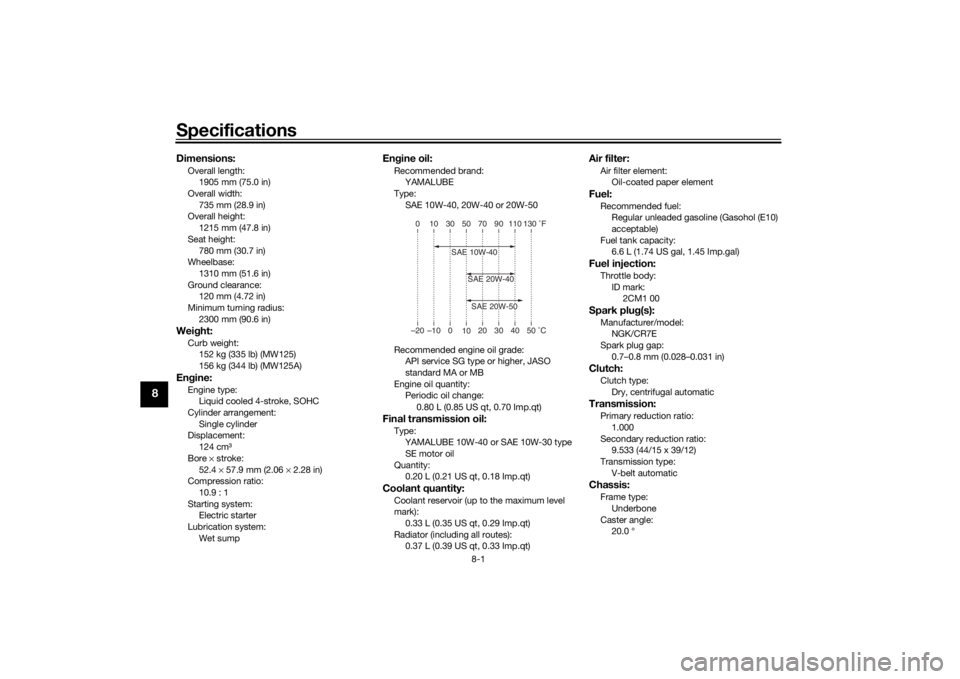
Specifications
8-1
8
Dimensions:Overall length:1905 mm (75.0 in)
Overall width:
735 mm (28.9 in)
Overall height: 1215 mm (47.8 in)
Seat height: 780 mm (30.7 in)
Wheelbase:
1310 mm (51.6 in)
Ground clearance: 120 mm (4.72 in)
Minimum turning radius: 2300 mm (90.6 in)Wei ght:Curb weight:
152 kg (335 lb) (MW125)
156 kg (344 lb) (MW125A)Engine:Engine type:
Liquid cooled 4-stroke, SOHC
Cylinder arrangement:
Single cylinder
Displacement: 124 cm3
Bore × stroke:
52.4 × 57.9 mm (2.06 × 2.28 in)
Compression ratio:
10.9 : 1
Starting system: Electric starter
Lubrication system: Wet sump
Engine oil:Recommended brand:
YAMALUBE
Type:
SAE 10W-40, 20W-40 or 20W-50
Recommended engine oil grade: API service SG type or higher, JASO
standard MA or MB
Engine oil quantity: Periodic oil change:
0.80 L (0.85 US qt, 0.70 Imp.qt)Final transmission oil:Type:YAMALUBE 10W-40 or SAE 10W-30 type
SE motor oil
Quantity: 0.20 L (0.21 US qt, 0.18 Imp.qt)Coolant quantity:Coolant reservoir (up to the maximum level
mark):
0.33 L (0.35 US qt, 0.29 Imp.qt)
Radiator (including all routes): 0.37 L (0.39 US qt, 0.33 Imp.qt)
Air filter:Air filter element:Oil-coated paper elementFuel:Recommended fuel:Regular unleaded gasoline (Gasohol (E10)
acceptable)
Fuel tank capacity: 6.6 L (1.74 US gal, 1.45 Imp.gal)Fuel injection:Throttle body:
ID mark: 2CM1 00Spark plu g(s):Manufacturer/model:
NGK/CR7E
Spark plug gap: 0.7–0.8 mm (0.028–0.031 in)Clutch:Clutch type:Dry, centrifugal automaticTransmission:Primary reduction ratio:
1.000
Secondary reduction ratio: 9.533 (44/15 x 39/12)
Transmission type: V-belt automaticChassis:Frame type:Underbone
Caster angle: 20.0 °
–20 –10 0 1020 30 40 50 C
10 30 50 70 90 110
0 130 F
SAE 20W-50SAE 20W-40
SAE 10W-40
U2CME2E0.book Page 1 Friday, August 21, 2015 9:16 AM
Page 85 of 87

10-1
10
Index
AABS (for ABS models) .......................... 3-11
ABS warning light (for ABS models) ....... 3-4
Acceleration and deceleration ................ 5-3
Air filter and V-belt case air filter
elements ............................................. 6-14
Auxiliary DC connector ......................... 3-20
Auxiliary lights....................................... 6-30BBattery .................................................. 6-26
Brake fluid, changing............................ 6-22
Brake fluid level, checking.................... 6-20
Brake lever, front .................................. 3-10
Brake lever, rear ................................... 3-10
Brake levers, lubricating ....................... 6-23
Braking ................................................... 5-3CCables, checking and lubricating ......... 6-22
Care ........................................................ 7-1
Catalytic converter ............................... 3-14
Centerstand and sidestand, checking and lubricating .................... 6-23
Coolant ................................................. 6-13
Coolant temperature warning light ......... 3-4DDimmer switch...................................... 3-10EEngine break-in ...................................... 5-4
Engine oil and oil strainer ..................... 6-10
Engine serial number .............................. 9-1
Engine trouble warning light ................... 3-4FFinal transmission oil ............................ 6-12
Front and rear brake pads, checking ... 6-20 Front brake lever free play, checking ... 6-19
Front fork, checking ............................. 6-24
Fuel ...................................................... 3-13
Fuel consumption, tips for reducing ...... 5-3
Fuel tank cap........................................ 3-12
Fuses, replacing ................................... 6-27
HHandlebar switches ............................... 3-9
Headlight bulb, replacing ..................... 6-29
High beam indicator light ....................... 3-4
Horn switch .......................................... 3-10IIdentification numbers ........................... 9-1
Ignition circuit cut-off system .............. 3-18
Indicator lights and warning lights ......... 3-3KKeyhole shutter ...................................... 3-3LLeaning system, checking ................... 6-26
Luggage hook ...................................... 3-17MMain switch/steering lock ...................... 3-1
Maintenance and lubrication, periodic... 6-4
Maintenance, emission control
system ................................................. 6-3
Matte color, caution ............................... 7-1
Model label............................................. 9-1
Multi-function meter unit ........................ 3-5PPanel, removing and installing ............... 6-8
Parking ................................................... 5-4
Part locations ......................................... 2-1
Passenger footrest ............................... 3-15
RRear brake lever free play, checking .... 6-19SSafe-riding points ................................... 1-5
Safety information................................... 1-1
Seat....................................................... 3-15
Self-diagnosis device ............................. 3-5
Sidestand.............................................. 3-17
Spark plug, checking .............................. 6-8
Specifications ......................................... 8-1
Starting off .............................................. 5-2
Starting the engine ................................. 5-1
Start switch ........................................... 3-10
Steering, checking ................................ 6-25
Steering tie rod, checking..................... 6-25
Storage ................................................... 7-4
Storage compartment........................... 3-16TTail/brake light ...................................... 6-30
Throttle grip and cable,
checking and lubricating .................... 6-22
Throttle grip free play, checking ........... 6-16
Tires ...................................................... 6-17
Tool kit .................................................... 6-2
Troubleshooting .................................... 6-31
Troubleshooting charts ......................... 6-32
Turn signal indicator lights...................... 3-3
Turn signal light bulb ............................ 6-31
Turn signal switch ................................. 3-10VValve clearance..................................... 6-16
Vehicle identification number ................. 9-1
U2CME2E0.book Page 1 Friday, August 21, 2015 9:16 AM