brake YAMAHA TT-R110E 2020 Owner's Manual
[x] Cancel search | Manufacturer: YAMAHA, Model Year: 2020, Model line: TT-R110E, Model: YAMAHA TT-R110E 2020Pages: 88, PDF Size: 2.26 MB
Page 73 of 88
Periodic maintenance an d a djustment
7-31
7
3. Insert the wheel axle from the right
side, and then install the washer
and the axle nut.
4. Lower the front wheel so that it is on the ground, and then put the
sidestand down.
5. Tighten the axle nut to the speci- fied torque.
6. Adjust the brake lever free play. (See page 7-18.)
7. While applying the front brake, push down hard on the handlebar
several times to check for proper
fork operation.
EAU25081
Rear wheel
EAU56801
To remove the rear wheel
WARNING
EWA10822
To avoi d injury, securely support the
vehicle so there is no dan ger of it
fallin g over.
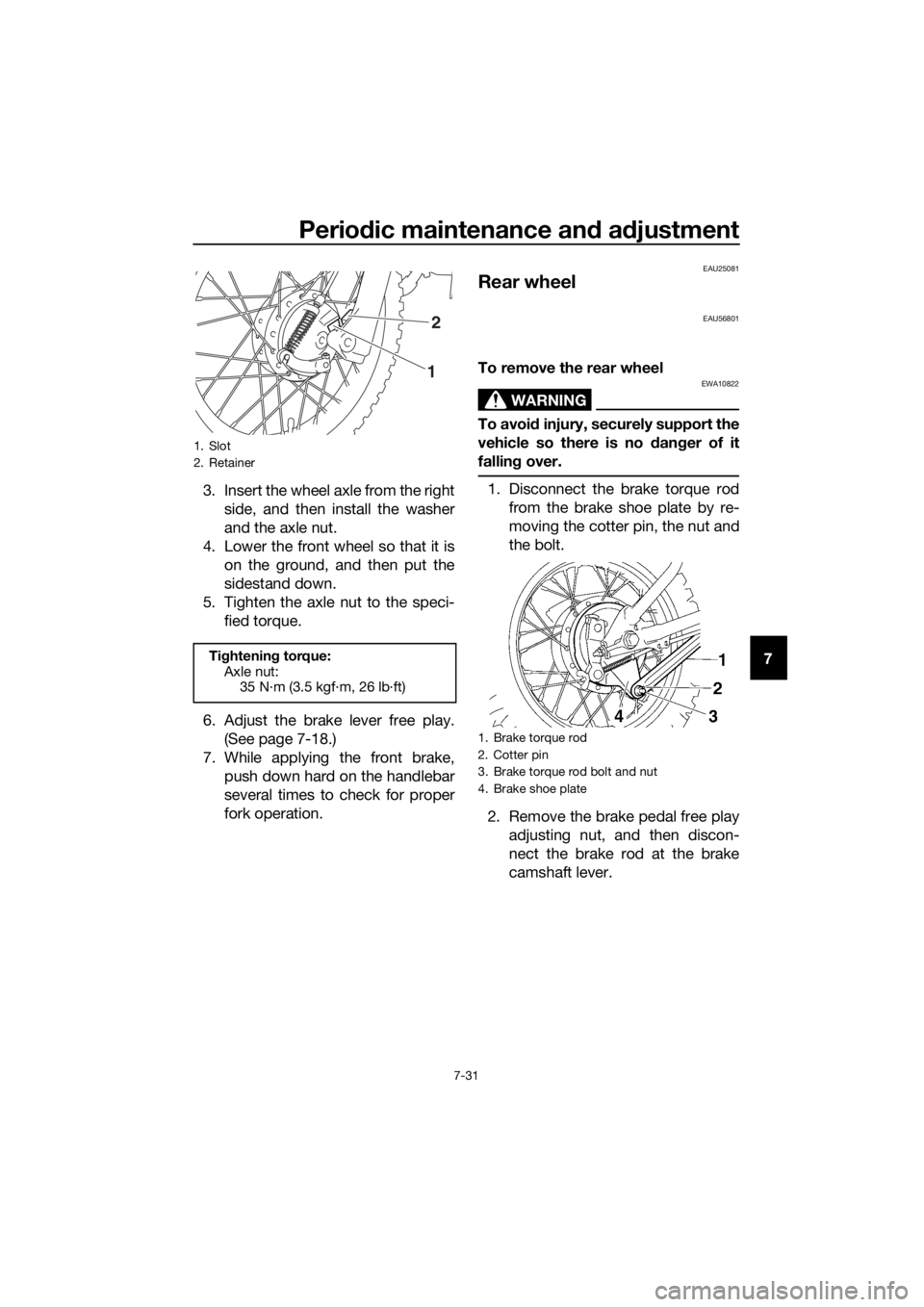
1. Disconnect the brake torque rod
from the brake shoe plate by re-
moving the cotter pin, the nut and
the bolt.
2. Remove the brake pedal free play adjusting nut, and then discon-
nect the brake rod at the brake
camshaft lever.
1. Slot
2. Retainer
Tightening torque:
Axle nut: 35 N·m (3.5 kgf·m, 26 lb·ft)
2
1
1. Brake torque rod
2. Cotter pin
3. Brake torque rod bolt and nut
4. Brake shoe plate
UB5185E0.book Page 31 Monday, June 17, 2019 9:04 AM
Page 74 of 88
Periodic maintenance an d a djustment
7-32
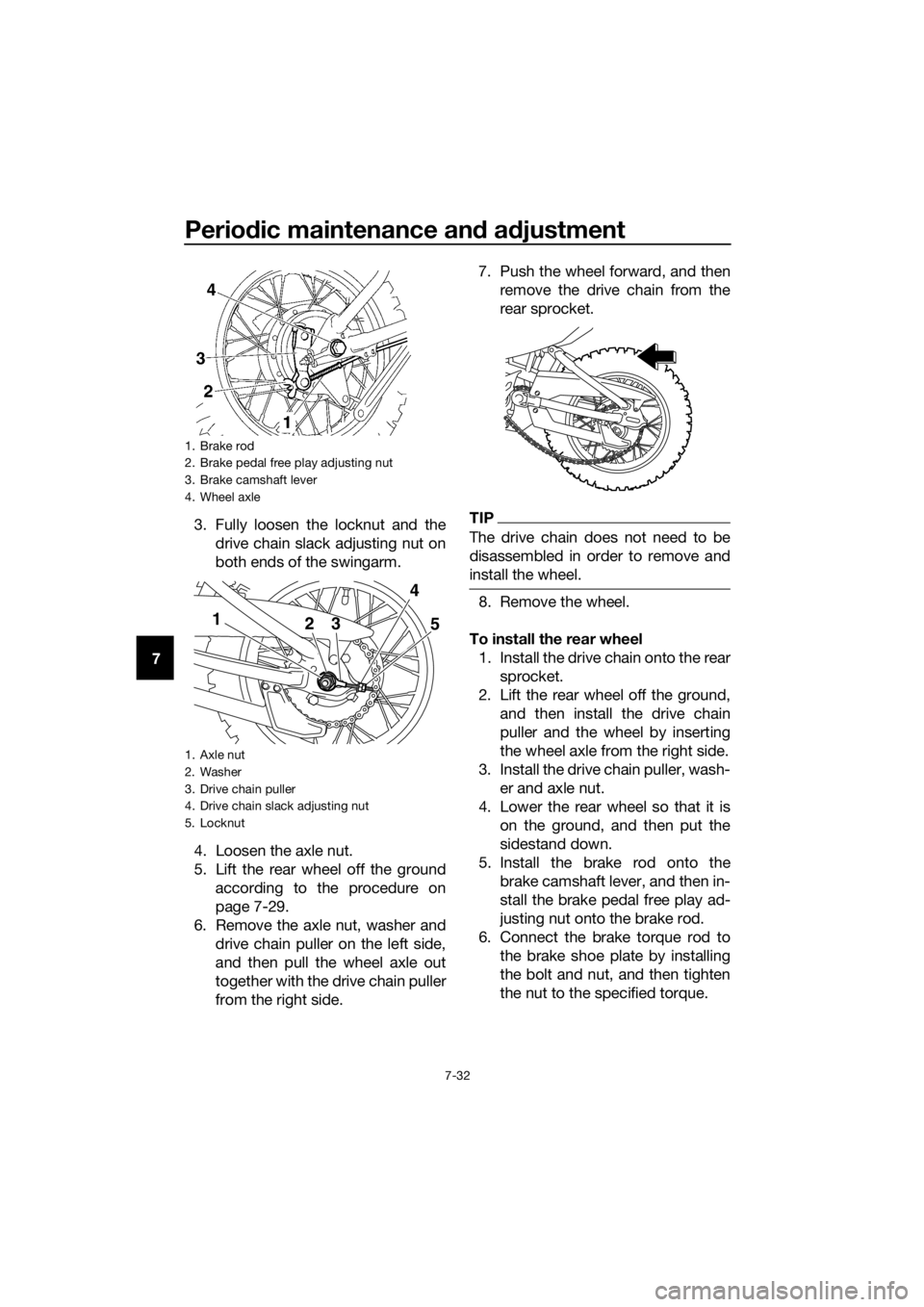
7 3. Fully loosen the locknut and the
drive chain slack adjusting nut on
both ends of the swingarm.
4. Loosen the axle nut.
5. Lift the rear wheel off the ground according to the procedure on
page 7-29.
6. Remove the axle nut, washer and drive chain puller on the left side,
and then pull the wheel axle out
together with the drive chain puller
from the right side. 7. Push the wheel forward, and then
remove the drive chain from the
rear sprocket.
TIP
The drive chain does not need to be
disassembled in order to remove and
install the wheel.
8. Remove the wheel.
To install the rear wheel 1. Install the drive chain onto the rear sprocket.
2. Lift the rear wheel off the ground, and then install the drive chain
puller and the wheel by inserting
the wheel axle from the right side.
3. Install the drive chain puller, wash- er and axle nut.
4. Lower the rear wheel so that it is on the ground, and then put the
sidestand down.
5. Install the brake rod onto the brake camshaft lever, and then in-
stall the brake pedal free play ad-
justing nut onto the brake rod.
6. Connect the brake torque rod to the brake shoe plate by installing
the bolt and nut, and then tighten
the nut to the specified torque.
1. Brake rod
2. Brake pedal free play adjusting nut
3. Brake camshaft lever
4. Wheel axle
1. Axle nut
2. Washer
3. Drive chain puller
4. Drive chain slack adjusting nut
5. Locknut
1 23 5
4
UB5185E0.book Page 32 Monday, June 17, 2019 9:04 AM
Page 75 of 88
Periodic maintenance an d a djustment
7-33
7
7. Insert a new cotter pin.
8. Adjust the drive chain slack. (See
page 7-21.)
9. Tighten the axle nut and both locknuts to the specified torque.
10. Adjust the brake pedal free play. (See page 7-19.)
EAU25853
Trou bleshootin g
Although Yamaha motorcycles receive
a thorough inspection before shipment
from the factory, trouble may occur
during operation. Any problem in the
fuel, compression, or ignition systems,
for example, can cause poor starting
and loss of power.
The following troubleshooting chart
represents a quick and easy procedure
for checking these vital systems your-
self. However, should your motorcycle
require any repair, take it to a Yamaha
dealer, whose skilled technicians have
the necessary tools, experience, and
know-how to service the motorcycle
properly.
Use only genuine Yamaha replace-
ment parts. Imitation parts may look
like Yamaha parts, but they are often
inferior, have a shorter service life and
can lead to expensive repair bills.
WARNING
EWA15142
When checkin g the fuel system, do
not smoke, an d make sure there are
no open flames or sparks in the ar-
ea, inclu din g pilot li ghts from water
heaters or furnaces. Gasoline or
g asoline vapors can i gnite or ex-
plo de, causin g severe injury or prop-
erty damag e.
Tightening torque:
Brake torque rod nut: 26 N·m (2.6 kgf·m, 19 lb·ft)
Ti ghtening torque:
Axle nut: 60 N·m (6.0 kgf·m, 44 lb·ft)
Locknut: 7 N·m (0.7 kgf·m, 5.2 lb·ft)
UB5185E0.book Page 33 Monday, June 17, 2019 9:04 AM
Page 78 of 88

Motorcycle care and stora ge
8-2
8 fected
area any lon ger than in-
structe d. Also, thorou ghly rinse
the area off with water, imme di-
ately dry it, an d then apply a cor-
rosion protection spray.
Improper cleanin g can d amage
plastic parts (such as cowlin gs,
panels, win dshield s, hea dlig ht
lenses, meter lenses, etc.) an d
the mufflers. Use only a soft,
clean cloth or spon ge with wa-
ter to clean plastic. However, if
the plastic parts cannot be thor-
ou ghly cleaned with water, di-
lute d mil d d eter gent with water
may be used . Be sure to rinse
off any d etergent resi due usin g
plenty of water, as it is harmful
to plastic parts.
Do not use any harsh chemical
prod ucts on plastic parts. Be
sure to avoi d using cloths or
spon ges which have been in
contact with stron g or a brasive
cleanin g pro ducts, solvent or
thinner, fuel (g asoline), rust re-
movers or inhi bitors, brake flui d,
antifreeze or electrolyte.
Do not use hi gh-pressure wash-
ers or steam-jet cleaners since
they cause water seepa ge an d
d eterioration in the followin g ar-
eas: seals (of wheel an d swin g-
arm bearin gs, fork an d b rakes),
electric components (couplers,
connectors, instruments,
switches an d lig hts), breather
hoses an d vents.
For motorcycles equippe d with
a win dshield : Do not use stron g
cleaners or har d spon ges as
they will cause dullin g or scratching
. Some cleanin g
compoun ds for plastic may
leave scratches on the win d-
shield . Test the pro duct on a
small hi dden part of the win d-
shield to make sure that it d oes
not leave any marks. If the win d-
shield is scratche d, use a quality
plast
ic polishin g compoun d af-
ter washin g.
After normal use
Remove dirt with warm water, a mild
detergent, and a soft, clean sponge,
and then rinse thoroughly with clean
water. Use a toothbrush or bottlebrush
for hard-to-reach areas. Stubborn dirt
and insects will come off more easily if
the area is covered with a wet cloth for
a few minutes before cleaning.
After riding in the rain or near the sea
Since sea salt is extremely corrosive,
carry out the following steps after each
ride in the rain or near the sea.
1. Clean the motorcycle with cold water and a mild detergent, after
the engine has cooled down.
NOTICE: Do not use warm wa-
ter since it increases the corro-
sive action of the salt.
[ECA10792]
2. Apply a corrosion protection spray on all metal, including chrome-
and nickel-plated, surfaces to pre-
vent corrosion.
After cleaning 1. Dry the motorcycle with a chamois or an absorbing cloth.
2. Immediately dry the drive chain and lubricate it to prevent it from
rusting.
UB5185E0.book Page 2 Monday, June 17, 2019 9:04 AM
Page 79 of 88
Motorcycle care and stora ge
8-3
8
3. Use a chrome polish to shine
chrome, aluminum and stainless-
steel parts, including the exhaust
system. (Even the thermally in-
duced discoloring of stainless-
steel exhaust systems can be re-
moved through polishing.)
4. To prevent corrosion, it is recom- mended to apply a corrosion pro-
tection spray on all metal,
including chrome- and nickel-plat-
ed, surfaces.
5. Use spray oil as a universal clean- er to remove any remaining dirt.
6. Touch up minor paint damage caused by stones, etc.
7. Wax all painted surfaces.
8. Let the motorcycle dry completely before storing or covering it.
WARNING
EWA14502
Contaminants on the brakes or tires
can cause loss of control. Make sure that there is no oil or
wax on the tires.
If necessary, wash the tires with
warm water an d a mil d d eter-
g ent. Before ri din g at hi gher
speed s, test the motorcycle’s
b rakin g performance an d cor-
nering b ehavior.
NOTICE
ECA10801
Apply spray oil an d wax spar-
in gly an d make sure to wipe off
any excess.
Never apply oil or wax to any
rubber an d plastic parts, but
treat them with a suitab le care
prod uct.
Avoi d using abrasive polishin g
compoun ds as they will wear
away the paint.
TIP
Consult a Yamaha dealer for advice on
what products to use.
UB5185E0.book Page 3 Monday, June 17, 2019 9:04 AM
Page 83 of 88

Specifications
9-2
9
Spark plug(s):
Manufacturer/model:
NGK/CR6HSA
Spark plug gap:
0.6–0.7 mm (0.024–0.028 in)
Clutch:
Clutch type:Wet, centrifugal, shoe + multiple-disc
Drivetrain:
Primary reduction ratio:3.722 (67/18)
Final drive: Chain
Secondary reduction ratio:
2.500 (35/14)
Transmission type:
Constant mesh 4-speed
Gear ratio: 1st:
3.167 (38/12)
2nd: 1.941 (33/17)
3rd: 1.381 (29/21)
4th:
1.095 (23/21)
Chassis:
Frame type:Backbone
Caster angle:
26.0 °
Trail: 60 mm (2.4 in)
Front tire:
Type:
With tube
Size: 2.50-14 4PR
Manufacturer/model: CHENG SHIN/C-803
Speed rating:
120 km/h (75 mph)
Rear tire:
Type:With tube
Size:
3.00-12 4PR
Manufacturer/model: CHENG SHIN/C-803 Speed rating:
120 km/h (75 mph)
Tire air pressure (measure d on col d
tires):
Front:
100 kPa (1.00 kgf/cm², 15 psi)
Rear: 100 kPa (1.00 kgf/cm², 15 psi)
Front wheel:
Wheel type: Spoke wheel
Rim size: 14 x 1.40
Rear wheel:
Wheel type:
Spoke wheel
Rim size: 12 x 1.60
Front brake:
Type:
Mechanical leading trailing drum brake
Rear brake:
Type:
Mechanical leading trailing drum brake
Front suspension:
Type:Telescopic fork
Spring: Coil spring
Shock absorber:
Hydraulic damper
Wheel travel: 115 mm (4.5 in)
Rear suspension:
Type:
Swingarm
Spring: Coil spring
Shock absorber: Gas-hydraulic damper
Wheel travel:
110 mm (4.3 in)
Electrical system:
System voltage:12 V
Ignition system:
CDI
Charging system: AC magneto
UB5185E0.book Page 2 Monday, June 17, 2019 9:04 AM
Page 87 of 88

11-1
11
Index
A
Air filter element, cleaning .................... 7-10
B
Battery .................................................. 7-27
Brake lever ............................................. 4-2
Brake lever, checking and
lubricating .......................................... 7-24
Brake lever free play, adjusting ............ 7-18
Brake pedal ............................................ 4-3
Brake pedal, checking and lubricating .......................................... 7-24
Brake pedal free play, adjusting........... 7-19
Brake shoes, checking ......................... 7-20
C
Cables, checking and lubricating ......... 7-23
Carburetor, adjusting ........................... 7-13
Care ........................................................ 8-1
Clutch free play, adjusting ................... 7-18
D
Drive chain, cleaning and lubricating ... 7-22
Drive chain slack .................................. 7-21
E
Engine break-in ...................................... 6-3
Engine idling speed .............................. 7-14
Engine oil ................................................ 7-8
Engine serial number............................ 10-1
Engine, starting a warm ......................... 6-2
Engine stop switch ................................. 4-1
F
Front fork, checking ............................. 7-26
Fuel......................................................... 4-4
Fuel cock ................................................ 4-6
Fuel tank breather hose ......................... 4-5
Fuel tank cap.......................................... 4-3
Fuse, replacing ..................................... 7-29
H
Handlebar switches................................ 4-1
I
Identification numbers.......................... 10-1
K
Kickstarter .............................................. 4-7
L
Labels, location ...................................... 1-1
M
Main switch ............................................ 4-1
Maintenance and lubrication, periodic ... 7-4
Maintenance, emission control
system.................................................. 7-3
Matte color, caution ............................... 8-1
Model label ........................................... 10-1
P
Panels, removing and installing .............. 7-6
Parking .................................................... 6-4
Part locations .......................................... 3-1
S
Safety information................................... 2-1
Seat......................................................... 4-8
Shifting .................................................... 6-2
Shift pedal............................................... 4-2
Shift pedal, checking ............................ 7-20
Shock absorber assembly ...................... 4-8
Sidestand ................................................ 4-9
Sidestand, checking and lubricating .... 7-25
Spark arrester, cleaning ........................ 7-12
Spark plug, checking .............................. 7-7
Specifications ......................................... 9-1
Starter (choke) lever ................................ 4-7
Starting and warming up a cold engine ................................................... 6-1
Starting circuit cut-off system ................ 4-9
Start switch ............................................. 4-1
Steering, checking ................................ 7-26
Storage ................................................... 8-4
Supporting the motorcycle ................... 7-29
Swingarm pivots, lubricating ................ 7-25
T
Throttle grip and cable, checking and lubricating ........................................... 7-23
Throttle grip free play, checking ........... 7-15
Tires ...................................................... 7-16
Tool kit .................................................... 7-2
Troubleshooting .................................... 7-33
Troubleshooting chart........................... 7-34
V
Valve clearance..................................... 7-15
Vehicle Emission Control Information label (For Canada) .............................. 10-2
Vehicle identification number ............... 10-1
W
Wheel bearings, checking..................... 7-27
Wheel (front).......................................... 7-30
Wheel (rear) ........................................... 7-31
Wheels .................................................. 7-17
UB5185E0.book Page 1 Monday, June 17, 2019 9:04 AM