fuel cap YAMAHA TTR110 2010 Owners Manual
[x] Cancel search | Manufacturer: YAMAHA, Model Year: 2010, Model line: TTR110, Model: YAMAHA TTR110 2010Pages: 84, PDF Size: 2.59 MB
Page 9 of 84
TABLE OF CONTENTS
LOCATION OF IMPORTANT
LABELS ............................................1-1
SAFETY INFORMATION .................. 2-1
DESCRIPTION .................................. 3-1
Left view .......................................... 3-1
Right view ........................................ 3-2
Controls and instruments ................3-3
INSTRUMENT AND CONTROL
FUNCTIONS....................................... 4-1
Main switch ..................................... 4-1
Handlebar switches ........................ 4-1
Shift pedal ......................................4-2
Brake lever ..................................... 4-2
Brake pedal .................................... 4-3
Fuel tank cap .................................. 4-3
Fuel ................................................ 4-3
Fuel tank breather hose ................. 4-5
Fuel cock ........................................ 4-5
Starter (choke) lever ....................... 4-6
Kickstarter ......................................4-7
Seat ................................................ 4-7
Shock absorber assembly .............. 4-8
Sidestand ....................................... 4-8
Starting circuit cut-off system ......... 4-8FOR YOUR SAFETY –
PRE-OPERATION CHECKS............. 5-1
OPERATION AND IMPORTANT
RIDING POINTS................................ 6-1
Starting and warming up
a cold engine .............................. 6-1
Starting a warm engine .................. 6-2
Shifting ........................................... 6-2
Engine break-in .............................. 6-3
Parking ........................................... 6-4
PERIODIC MAINTENANCE AND
ADJUSTMENT................................... 7-1
Owner’s tool kit .............................. 7-2
Periodic maintenance chart for
the emission control system ....... 7-3
General maintenance and
lubrication chart .......................... 7-4
Removing and installing panels ..... 7-7
Checking the spark plug ................ 7-8
Engine oil ....................................... 7-9
Cleaning the air filter element ...... 7-11
Cleaning the spark arrester ......... 7-13
Adjusting the carburetor ............... 7-14
Adjusting the engine idling
speed ........................................ 7-14
Checking the throttle cable
free play .................................... 7-15
Valve clearance ........................... 7-15
Tires ............................................. 7-15Spoke wheels ............................... 7-17
Adjusting the clutch free play ....... 7-17
Adjusting the brake lever free
play ........................................... 7-18
Adjusting the brake pedal free
play ........................................... 7-19
Checking the shift pedal ............... 7-20
Checking the front and
rear brake shoes ....................... 7-20
Drive chain slack .......................... 7-21
Cleaning and lubricating
the drive chain .......................... 7-22
Checking and lubricating
the cables ................................. 7-23
Checking and lubricating
the throttle grip and cable ......... 7-23
Checking and lubricating
the brake lever .......................... 7-23
Checking and lubricating
the brake pedal ......................... 7-24
Checking and lubricating
the sidestand ............................ 7-24
Lubricating the swingarm pivots ... 7-24
Checking the front fork ................. 7-25
Checking the steering .................. 7-25
Checking the wheel bearings ....... 7-26
Battery .......................................... 7-26
Replacing the fuse ....................... 7-27
Supporting the motorcycle ........... 7-28
Front wheel .................................. 7-29
Rear wheel ................................... 7-30
U5B682E0.book Page 1 Tuesday, June 9, 2009 2:04 PM
Page 24 of 84
DESCRIPTION
3-2
3
EAU10420
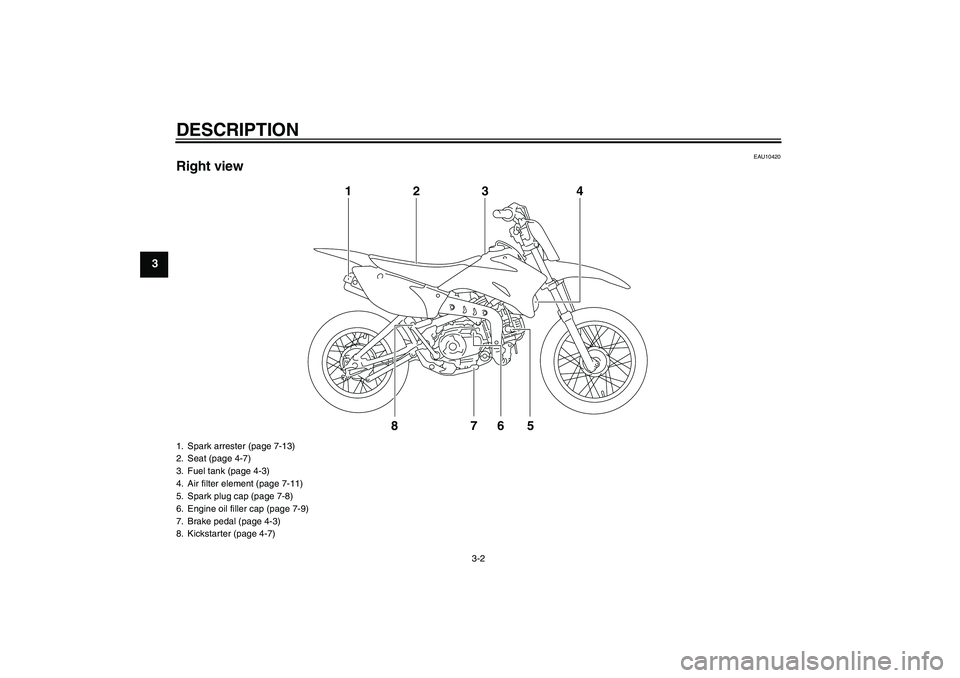
Right view
12 3 4
857
6
1. Spark arrester (page 7-13)
2. Seat (page 4-7)
3. Fuel tank (page 4-3)
4. Air filter element (page 7-11)
5. Spark plug cap (page 7-8)
6. Engine oil filler cap (page 7-9)
7. Brake pedal (page 4-3)
8. Kickstarter (page 4-7)U5B682E0.book Page 2 Tuesday, June 9, 2009 2:04 PM
Page 25 of 84
DESCRIPTION
3-3
3
EAU10430
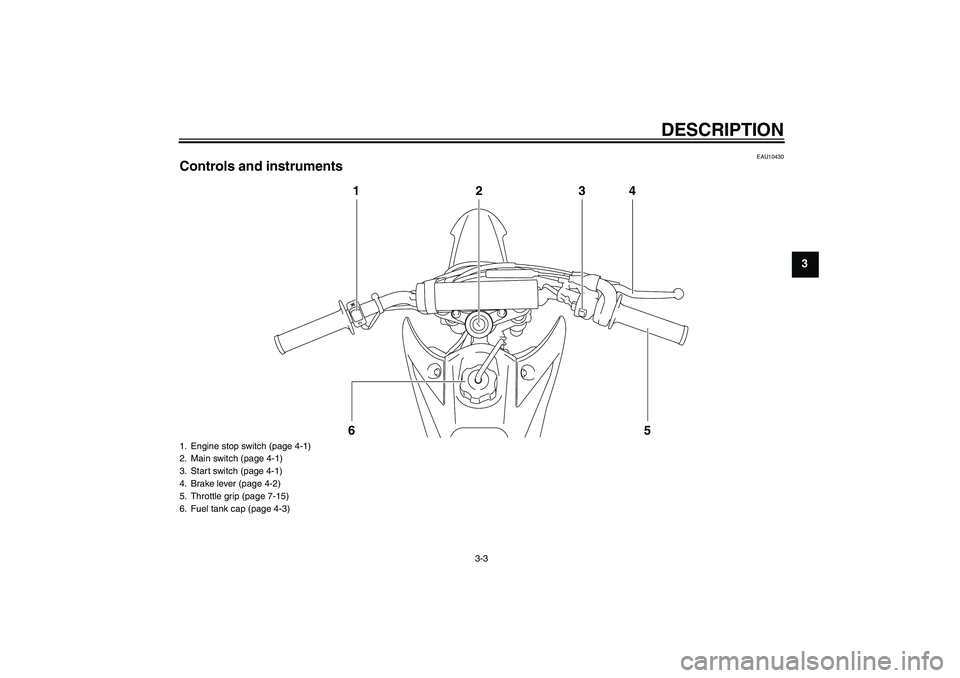
Controls and instruments
1234
5 6
1. Engine stop switch (page 4-1)
2. Main switch (page 4-1)
3. Start switch (page 4-1)
4. Brake lever (page 4-2)
5. Throttle grip (page 7-15)
6. Fuel tank cap (page 4-3)
U5B682E0.book Page 3 Tuesday, June 9, 2009 2:04 PM
Page 28 of 84
INSTRUMENT AND CONTROL FUNCTIONS
4-3
4
EAU12941
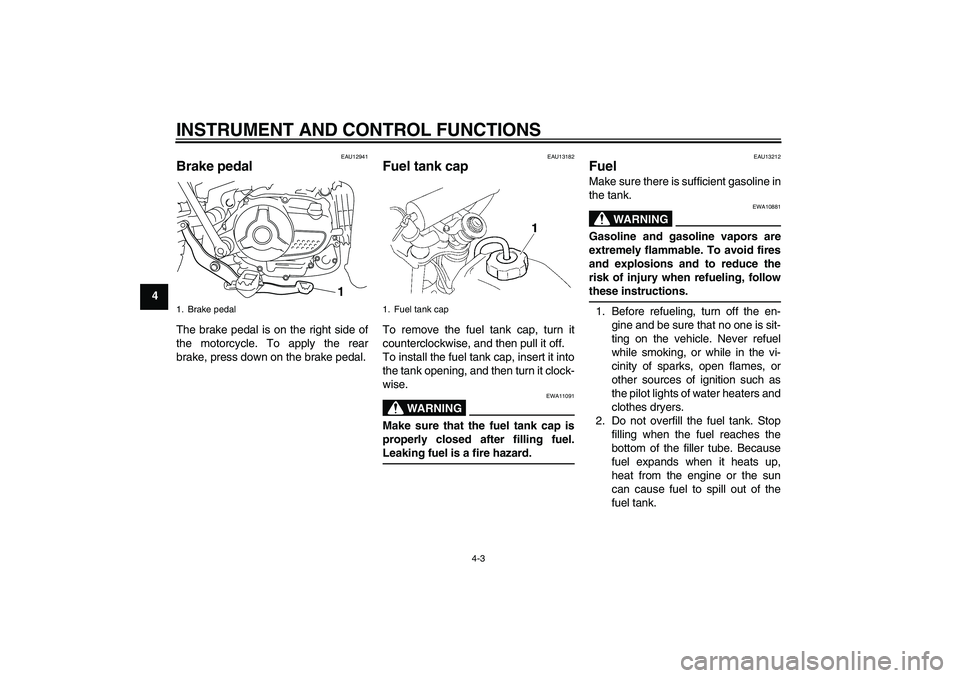
Brake pedal The brake pedal is on the right side of
the motorcycle. To apply the rear
brake, press down on the brake pedal.
EAU13182
Fuel tank cap To remove the fuel tank cap, turn it
counterclockwise, and then pull it off.
To install the fuel tank cap, insert it into
the tank opening, and then turn it clock-
wise.
WARNING
EWA11091
Make sure that the fuel tank cap is
properly closed after filling fuel.
Leaking fuel is a fire hazard.
EAU13212
Fuel Make sure there is sufficient gasoline in
the tank.
WARNING
EWA10881
Gasoline and gasoline vapors are
extremely flammable. To avoid fires
and explosions and to reduce the
risk of injury when refueling, follow
these instructions.1. Before refueling, turn off the en-
gine and be sure that no one is sit-
ting on the vehicle. Never refuel
while smoking, or while in the vi-
cinity of sparks, open flames, or
other sources of ignition such as
the pilot lights of water heaters and
clothes dryers.
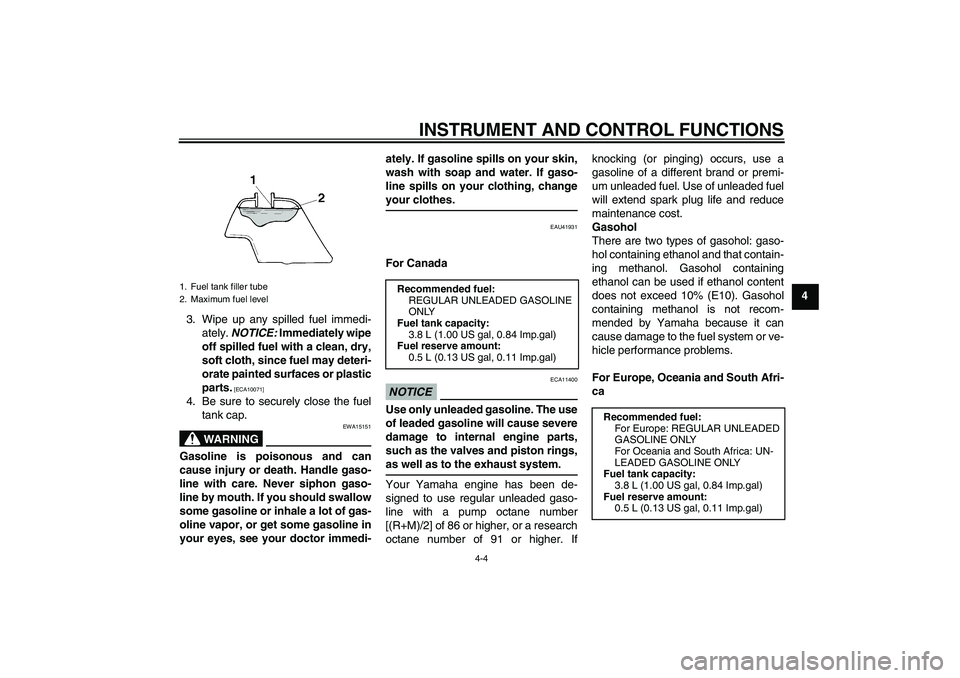
2. Do not overfill the fuel tank. Stop
filling when the fuel reaches the
bottom of the filler tube. Because
fuel expands when it heats up,
heat from the engine or the sun
can cause fuel to spill out of the
fuel tank.
1. Brake pedal
1
1. Fuel tank cap
U5B682E0.book Page 3 Tuesday, June 9, 2009 2:04 PM
Page 29 of 84
INSTRUMENT AND CONTROL FUNCTIONS
4-4
4
3. Wipe up any spilled fuel immedi-
ately. NOTICE: Immediately wipe
off spilled fuel with a clean, dry,
soft cloth, since fuel may deteri-
orate painted surfaces or plastic
parts.
[ECA10071]
4. Be sure to securely close the fuel
tank cap.
WARNING
EWA15151
Gasoline is poisonous and can
cause injury or death. Handle gaso-
line with care. Never siphon gaso-
line by mouth. If you should swallow
some gasoline or inhale a lot of gas-
oline vapor, or get some gasoline in
your eyes, see your doctor immedi-ately. If gasoline spills on your skin,
wash with soap and water. If gaso-
line spills on your clothing, change
your clothes.
EAU41931
For CanadaNOTICE
ECA11400
Use only unleaded gasoline. The use
of leaded gasoline will cause severe
damage to internal engine parts,
such as the valves and piston rings,
as well as to the exhaust system.Your Yamaha engine has been de-
signed to use regular unleaded gaso-
line with a pump octane number
[(R+M)/2] of 86 or higher, or a research
octane number of 91 or higher. Ifknocking (or pinging) occurs, use a
gasoline of a different brand or premi-
um unleaded fuel. Use of unleaded fuel
will extend spark plug life and reduce
maintenance cost.
Gasohol
There are two types of gasohol: gaso-
hol containing ethanol and that contain-
ing methanol. Gasohol containing
ethanol can be used if ethanol content
does not exceed 10% (E10). Gasohol
containing methanol is not recom-
mended by Yamaha because it can
cause damage to the fuel system or ve-
hicle performance problems.
For Europe, Oceania and South Afri-
ca
1. Fuel tank filler tube
2. Maximum fuel level
Recommended fuel:
REGULAR UNLEADED GASOLINE
ONLY
Fuel tank capacity:
3.8 L (1.00 US gal, 0.84 Imp.gal)
Fuel reserve amount:
0.5 L (0.13 US gal, 0.11 Imp.gal)
Recommended fuel:
For Europe: REGULAR UNLEADED
GASOLINE ONLY
For Oceania and South Africa: UN-
LEADED GASOLINE ONLY
Fuel tank capacity:
3.8 L (1.00 US gal, 0.84 Imp.gal)
Fuel reserve amount:
0.5 L (0.13 US gal, 0.11 Imp.gal)
U5B682E0.book Page 4 Tuesday, June 9, 2009 2:04 PM
Page 77 of 84
MOTORCYCLE CARE AND STORAGE
8-4
8 3. Drain the carburetor float chamber
by loosening the drain bolt; this will
prevent fuel deposits from building
up. Pour the drained fuel into the
fuel tank.
4. Fill up the fuel tank and add fuel
stabilizer (if available) to prevent
the fuel tank from rusting and the
fuel from deteriorating.
5. Perform the following steps to pro-
tect the cylinder, piston rings, etc.
from corrosion.
a. Remove the spark plug cap
and spark plug.
b. Pour a teaspoonful of engine oil
into the spark plug bore.
c. Install the spark plug cap onto
the spark plug, and then place
the spark plug on the cylinder
head so that the electrodes are
grounded. (This will limit spark-
ing during the next step.)
d. Turn the engine over several
times with the starter. (This will
coat the cylinder wall with oil.)
WARNING! To prevent dam-
age or injury from sparking,
make sure to ground thespark plug electrodes while
turning the engine over.
[EWA10951]
e. Remove the spark plug cap
from the spark plug, and then
install the spark plug and the
spark plug cap.
6. Lubricate all control cables and the
pivoting points of all levers and
pedals as well as of the side-
stand/centerstand.
7. Check and, if necessary, correct
the tire air pressure, and then lift
the motorcycle so that both of its
wheels are off the ground. Alterna-
tively, turn the wheels a little every
month in order to prevent the tires
from becoming degraded in one
spot.
8. Cover the muffler outlet with a
plastic bag to prevent moisture
from entering it.
9. Remove the battery and fully
charge it. Store it in a cool, dry
place and charge it once a month.
Do not store the battery in an ex-
cessively cold or warm place [less
than 0 °C (30 °F) or more than 30°C (90 °F)]. For more information
on storing the battery, see page
7-26.
TIPMake any necessary repairs before
storing the motorcycle.
U5B682E0.book Page 4 Tuesday, June 9, 2009 2:04 PM
Page 78 of 84
SPECIFICATIONS
9-1
9
Dimensions:Overall length:
1565 mm (61.6 in)
Overall width:
680 mm (26.8 in)
Overall height:
923 mm (36.3 in)
Seat height:
670 mm (26.4 in)
Wheelbase:
1080 mm (42.5 in)
Ground clearance:
180 mm (7.09 in)
Minimum turning radius:
1660 mm (65.4 in)Weight:With oil and fuel:
72.0 kg (159 lb)Noise and vibration level:Noise level (77/311/EEC):
TT-R110E 78.9 dB(A)
Vibration on seat (EN1032, ISO5008):
TT-R110E Will not exceed 0.5 m/s²
Vibration on handlebar (EN1032, ISO5008):
TT-R110E Will not exceed 2.5 m/s²Engine:Engine type:
Air cooled 4-stroke, SOHC
Cylinder arrangement:
Forward-inclined single cylinder
Displacement:
110 cm³
Bore × stroke:
51.0 × 54.0 mm (2.01 × 2.13 in)Compression ratio:
9.30 :1
Starting system:
Electric starter and kickstarter
Lubrication system:
Wet sump
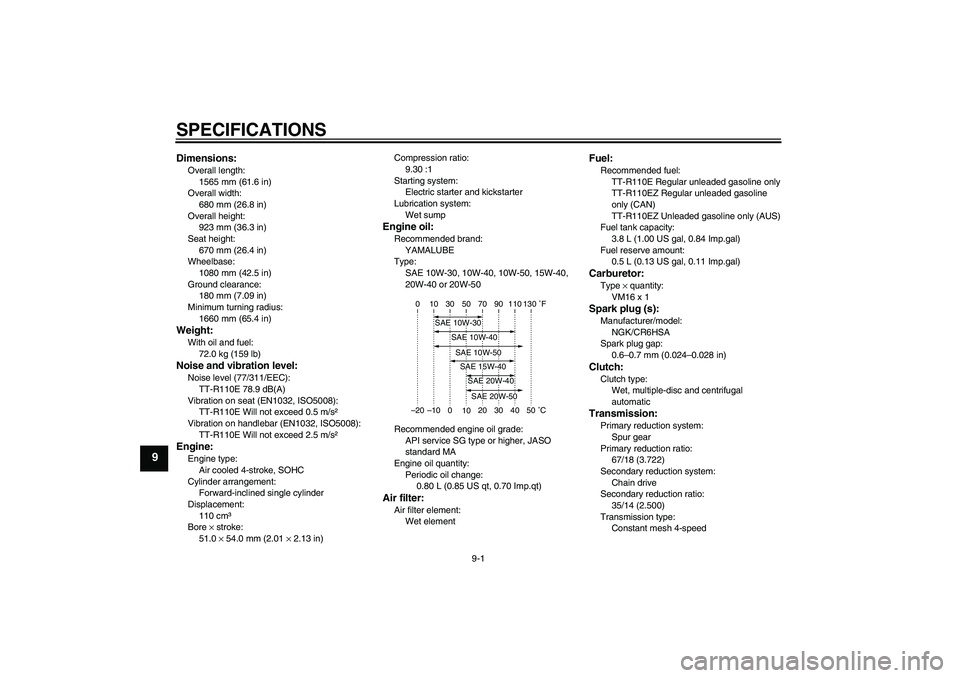
Engine oil:Recommended brand:
YAMALUBE
Type:
SAE 10W-30, 10W-40, 10W-50, 15W-40,
20W-40 or 20W-50
Recommended engine oil grade:
API service SG type or higher, JASO
standard MA
Engine oil quantity:
Periodic oil change:
0.80 L (0.85 US qt, 0.70 Imp.qt)Air filter:Air filter element:
Wet element
Fuel:Recommended fuel:
TT-R110E Regular unleaded gasoline only
TT-R110EZ Regular unleaded gasoline
only (CAN)
TT-R110EZ Unleaded gasoline only (AUS)
Fuel tank capacity:
3.8 L (1.00 US gal, 0.84 Imp.gal)
Fuel reserve amount:
0.5 L (0.13 US gal, 0.11 Imp.gal)Carburetor:Type × quantity:
VM16 x 1Spark plug (s):Manufacturer/model:
NGK/CR6HSA
Spark plug gap:
0.6–0.7 mm (0.024–0.028 in)Clutch:Clutch type:
Wet, multiple-disc and centrifugal
automaticTransmission:Primary reduction system:
Spur gear
Primary reduction ratio:
67/18 (3.722)
Secondary reduction system:
Chain drive
Secondary reduction ratio:
35/14 (2.500)
Transmission type:
Constant mesh 4-speed
–20–10 0
1020 30 40 50 ˚C
SAE 10W-30
SAE 15W-40SAE 20W-40SAE 20W-50
SAE 10W-40SAE 10W-50
10 30 50 70 90 110 0 130 ˚F
U5B682E0.book Page 1 Tuesday, June 9, 2009 2:04 PM
Page 82 of 84
INDEXAAir filter element, cleaning..................... 7-11BBattery................................................... 7-26
Brake lever .............................................. 4-2
Brake lever, checking and lubricating ... 7-23
Brake lever free play, adjusting............. 7-18
Brake pedal ............................................. 4-3
Brake pedal, checking and
lubricating ........................................... 7-24
Brake pedal free play, adjusting............ 7-19
Brake shoes, checking .......................... 7-20CCables, checking and lubricating .......... 7-23
Carburetor, adjusting ............................ 7-14
Care ........................................................ 8-1
Clutch free play, adjusting..................... 7-17DDrive chain, cleaning and lubricating .... 7-22
Drive chain slack ................................... 7-21EEngine break-in ....................................... 6-3
Engine idling speed............................... 7-14
Engine oil ................................................ 7-9
Engine, starting a warm .......................... 6-2
Engine stop switch .................................. 4-2FFront fork, checking .............................. 7-25
Fuel ......................................................... 4-3
Fuel cock................................................. 4-5
Fuel tank breather hose .......................... 4-5
Fuel tank cap .......................................... 4-3
Fuse, replacing ..................................... 7-27
HHandlebar switches ................................ 4-1IIdentification numbers .......................... 10-1KKey identification number ..................... 10-1
Kickstarter............................................... 4-7LLabels, location....................................... 1-1MMain switch ............................................. 4-1
Maintenance and lubrication, periodic .... 7-4
Maintenance, emission control
system .................................................. 7-3
Matte color, caution ................................ 8-1
Model label ........................................... 10-2PPanels, removing and installing .............. 7-7
Parking ................................................... 6-4
Part locations .......................................... 3-1SSafety information................................... 2-1
Seat ........................................................ 4-7
Shifting.................................................... 6-2
Shift pedal............................................... 4-2
Shift pedal, checking ............................ 7-20
Shock absorber assembly ...................... 4-8
Sidestand................................................ 4-8
Sidestand, checking and lubricating ..... 7-24
Spark arrester, cleaning ....................... 7-13
Spark plug, checking .............................. 7-8
Specifications ......................................... 9-1
Starter (choke) lever ............................... 4-6Starting and warming up
a cold engine ........................................ 6-1
Starting circuit cut-off system .................. 4-8
Start switch.............................................. 4-2
Steering, checking................................. 7-25
Storage.................................................... 8-3
Supporting the motorcycle .................... 7-28
Swingarm pivots, lubricating ................. 7-24
TThrottle cable free play, checking ......... 7-15
Throttle grip and cable, checking and
lubricating ........................................... 7-23
Tires ...................................................... 7-15
Tool kit..................................................... 7-2
Troubleshooting .................................... 7-32
Troubleshooting chart ........................... 7-33VValve clearance..................................... 7-15
Vehicle Emission Control Information
label (For Canada) .............................. 10-2
Vehicle identification number ................ 10-1WWheel bearings, checking ..................... 7-26
Wheel (front) ......................................... 7-29
Wheel (rear) .......................................... 7-30
Wheels .................................................. 7-17
U5B682E0.book Page 1 Tuesday, June 9, 2009 2:04 PM