light YAMAHA TTR50 2006 User Guide
[x] Cancel search | Manufacturer: YAMAHA, Model Year: 2006, Model line: TTR50, Model: YAMAHA TTR50 2006Pages: 390, PDF Size: 9.69 MB
Page 166 of 390
3 - 22
INSPADJ
LUBRICATION
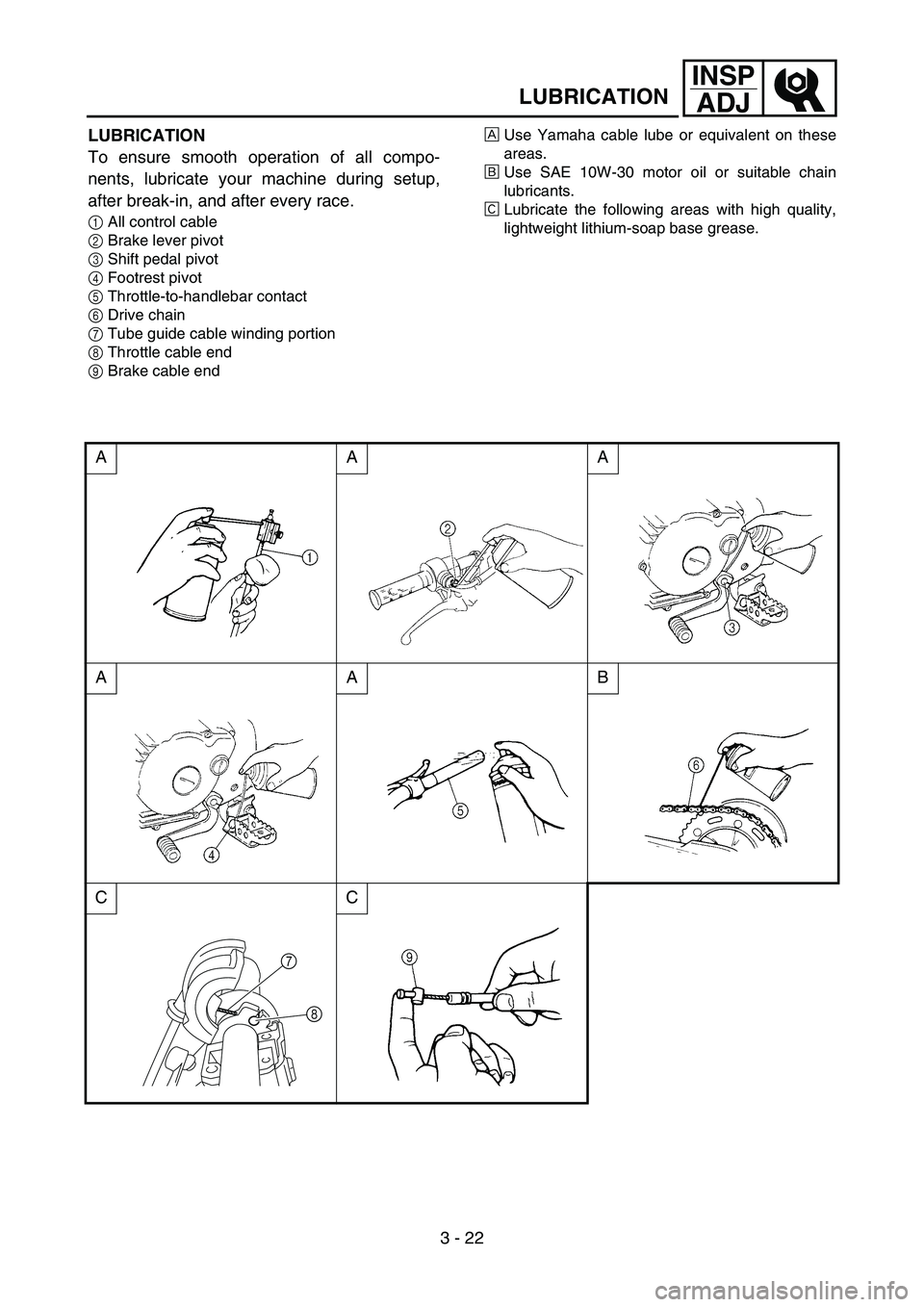
LUBRICATION
To ensure smooth operation of all compo-
nents, lubricate your machine during setup,
after break-in, and after every race.
1 All control cable
2 Brake lever pivot
3 Shift pedal pivot
4 Footrest pivot
5 Throttle-to-handlebar contact
6 Drive chain
7 Tube guide cable winding portion
8 Throttle cable end
9 Brake cable end È
Use Yamaha cable lube or equivalent on these
areas.
É Use SAE 10W-30 motor oil or suitable chain
lubricants.
Ê Lubricate the following areas with high quality,
lightweight lithium-soap base grease.
AAA
AAB
CC
7 8
Page 168 of 390
3 - 23
INSPADJ
ELECTRICAL/SPARK PLUG INSPECTION
EC370000
ELECTRICAL
EC371001
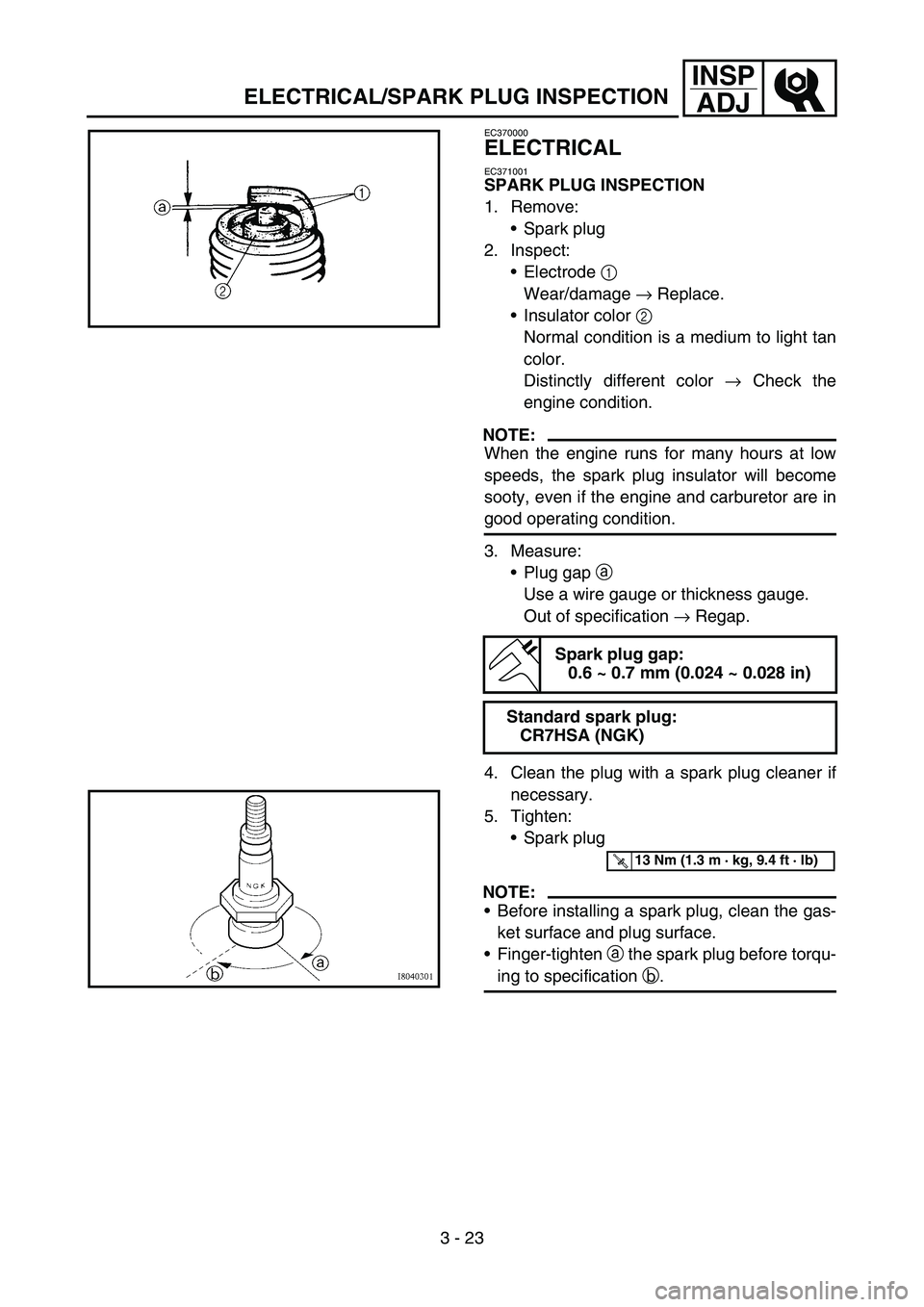
SPARK PLUG INSPECTION
1. Remove:
Spark plug
2. Inspect: Electrode 1
Wear/damage → Replace.
Insulator color 2
Normal condition is a medium to light tan
color.
Distinctly different color → Check the
engine condition.
NOTE:
When the engine runs for many hours at low
speeds, the spark plug insulator will become
sooty, even if the engine and carburetor are in
good operating condition.
3. Measure: Plug gap a
Use a wire gauge or thickness gauge.
Out of specification → Regap.
4. Clean the plug with a spark plug cleaner if necessary.
5. Tighten: Spark plug
NOTE:
Before installing a spark plug, clean the gas-
ket surface and plug surface.
Finger-tighten a the spark plug before torqu-
ing to specification b.
Spark plug gap:
0.6 ~ 0.7 mm (0.024 ~ 0.028 in)
Standard spark plug: CR7HSA (NGK)
T R..13 Nm (1.3 m · kg, 9.4 ft · lb)
Page 170 of 390
3 - 24
INSPADJ
BATTERY INSPECTION AND CHARGING
WARNING
Batteries generate explosive hydrogen gas
and contain electrolyte which is made of
poisonous and highly caustic sulfuric acid.
Therefore, always follow these preventive
measures:
Wear protective eye gear when handling
or working near batteries.
Charge batteries in a well-ventilated area.
Keep batteries away from fire, sparks or
open flames (e.g., welding equipment,
lighted cigarettes).
DO NOT SMOKE when charging or han-
dling batteries.
KEEP BATTERIES AND ELECTROLYTE
OUT OF REACH OF CHILDREN.
Avoid bodily contact with electrolyte as it
can cause severe burns or permanent eye
injury.
FIRST AID IN CASE OF BODILY CONTACT:
EXTERNAL
Skin — Wash with water.
Eyes — Flush with water for 15 minutes
and get immediate medical attention.
INTERNAL
Drink large quantities of water or milk fol-
lowed with milk of magnesia, beaten egg
or vegetable oil. Get immediate medical
attention.
CAUTION:
Charging time, charging amperage and
charging voltage for an MF battery are dif-
ferent from those of conventional batteries.
The MF battery should be charged as
explained in the charging method illustra-
tions. If the battery is overcharged, the
electrolyte level will drop considerably.
Therefore, take special care when charging
the battery.
BATTERY INSPECTION AND CHARGING
Page 228 of 390

4 - 21
ENGVALVES AND VALVE SPRINGS
2. Lap:Valve face
Valve seat
NOTE:
After refacing the valve seat or replacing the
valve and valve guide, the valve seat and
valve face should be lapped.
Lapping steps:
Apply a coarse lapping compound to the
valve face.
CAUTION:
Do not let the compound enter the gap
between the valve stem and the guide.
Apply molybdenum disulfide oil to the
valve stem.
Install the valve into the cylinder head.
Turn the valve until the valve face and
valve seat are evenly polished, then clean
off all of the compound.
NOTE:
For best lapping results, lightly tap the valve
seat while rotating the valve back and forth
between your hands.
Apply a fine lapping compound to the
valve face and repeat the above steps.
NOTE:
After every lapping operation be sure to
clean off all of the compound from the valve
face and valve seat.
Apply Mechanic ’s blueing dye (Dykem) to
the valve face.
Install the valve into the cylinder head.
Press the valve through the valve guide
and onto the valve seat to make a clear
pattern.
Measure the valve seat width again. If the
valve seat width is out of specification,
reface and relap the valve seat.
Page 230 of 390
4 - 22
ENGVALVES AND VALVE SPRINGS
ASSEMBLY AND INSTALLATION
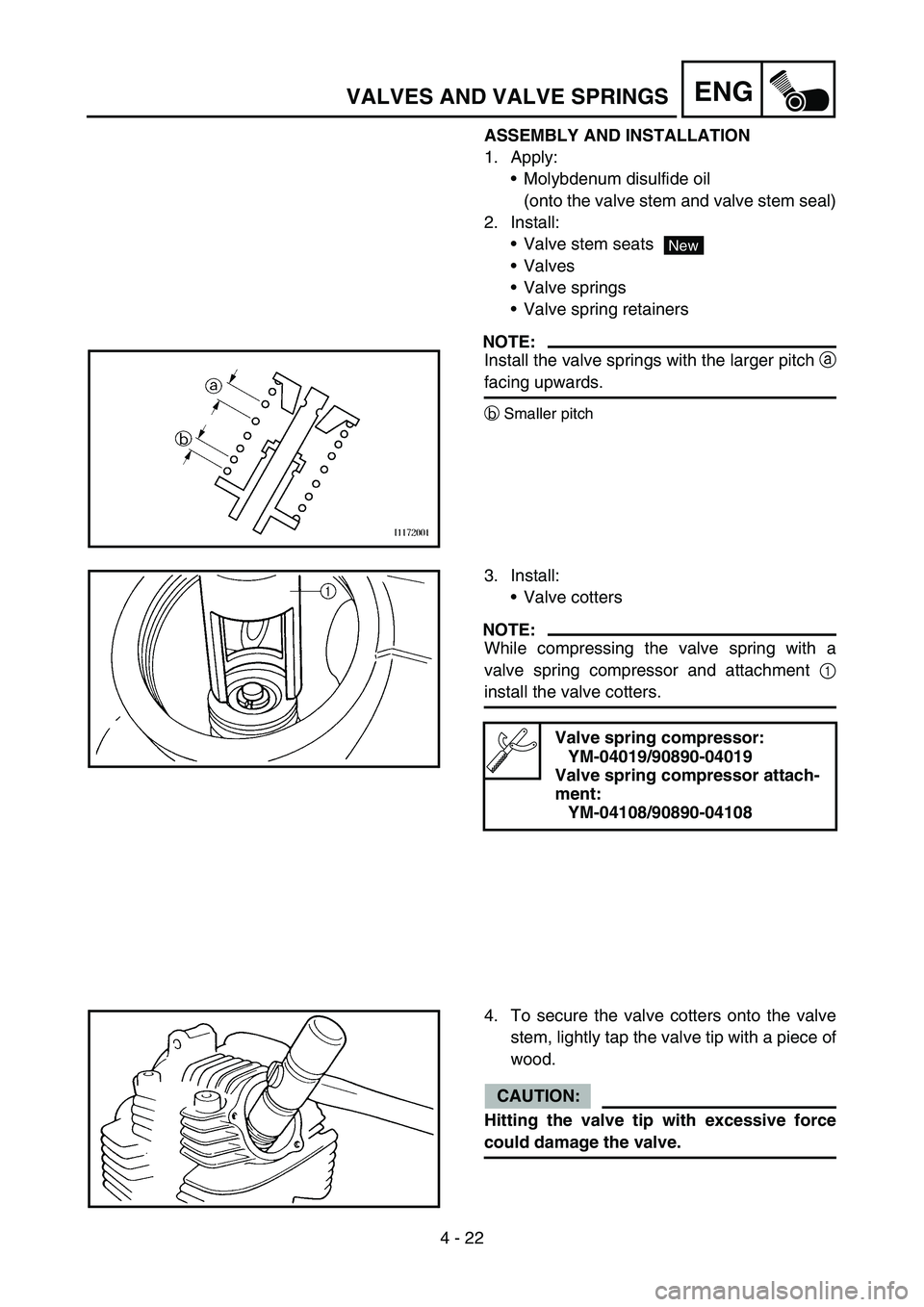
1. Apply:Molybdenum disulfide oil
(onto the valve stem and valve stem seal)
2. Install: Valve stem seats
Valves
Valve springs
Valve spring retainers
NOTE:
Install the valve springs with the larger pitch a
facing upwards.
bSmaller pitch
New
3. Install:
Valve cotters
NOTE:
While compressing the valve spring with a
valve spring compressor and attachment 1
install the valve cotters.
Valve spring compressor:
YM-04019/90890-04019
Valve spring compressor attach-
ment: YM-04108/90890-04108
4. To secure the valve cotters onto the valve
stem, lightly tap the valve tip with a piece of
wood.
CAUTION:
Hitting the valve tip with excessive force
could damage the valve.
Page 258 of 390

4 - 36
ENG
Clutch free play adjustment
1. Adjust:Clutch free play
Adjustment steps:
Loosen the locknut 1.
Turn the clutch adjuster 2 counterclock-
wise until it becomes slightly difficult to
turn.
Turn the clutch adjuster 2 clockwise 1/8
turn.
Hold the clutch adjuster 2 and tighten the
locknut 1.
T R..
Locknut:
6 Nm (0.6 m kg, 4.3 ft lb)
1
2
CLUTCH
Page 274 of 390
4 - 44
ENGAC MAGNETO AND STARTER CLUTCH
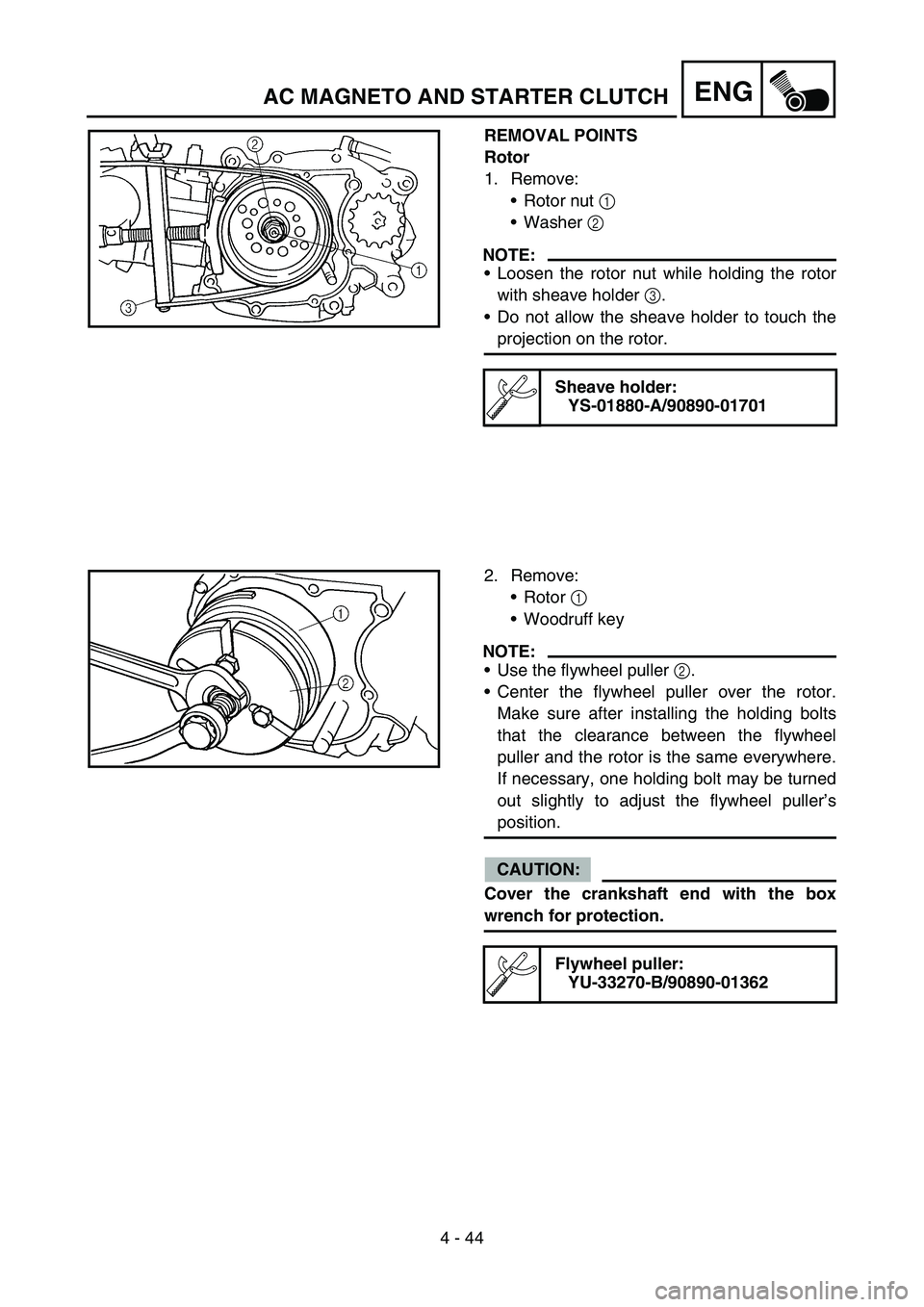
REMOVAL POINTS
Rotor
1. Remove:Rotor nut 1
Washer 2
NOTE:
Loosen the rotor nut while holding the rotor
with sheave holder 3.
Do not allow the sheave holder to touch the
projection on the rotor.
Sheave holder:
YS-01880-A/90890-01701
2. Remove:
Rotor 1
Woodruff key
NOTE:
Use the flywheel puller 2.
Center the flywheel puller over the rotor.
Make sure after installing the holding bolts
that the clearance between the flywheel
puller and the rotor is the same everywhere.
If necessary, one holding bolt may be turned
out slightly to adjust the flywheel puller ’s
position.
CAUTION:
Cover the crankshaft end with the box
wrench for protection.
Flywheel puller: YU-33270-B/90890-01362
Page 298 of 390
4 - 56
ENGSHIFT FORK, SHIFT CAM AND TRANSMISSION
EC4H3000
REMOVAL POINTS
Shift fork, shift cam and transmission
1. Remove:Shift forks
Shift cam
Drive axle assembly
Main axle assembly
NOTE:
Remove the main axle, drive axle, shift cam
and shift forks all together by tapping lightly
on the transmission main axle and shift cam
with a soft hammer to remove.
Remove assembly carefully. Note the posi-
tion of each part. Pay particular attention to
the location and direction of shift forks.
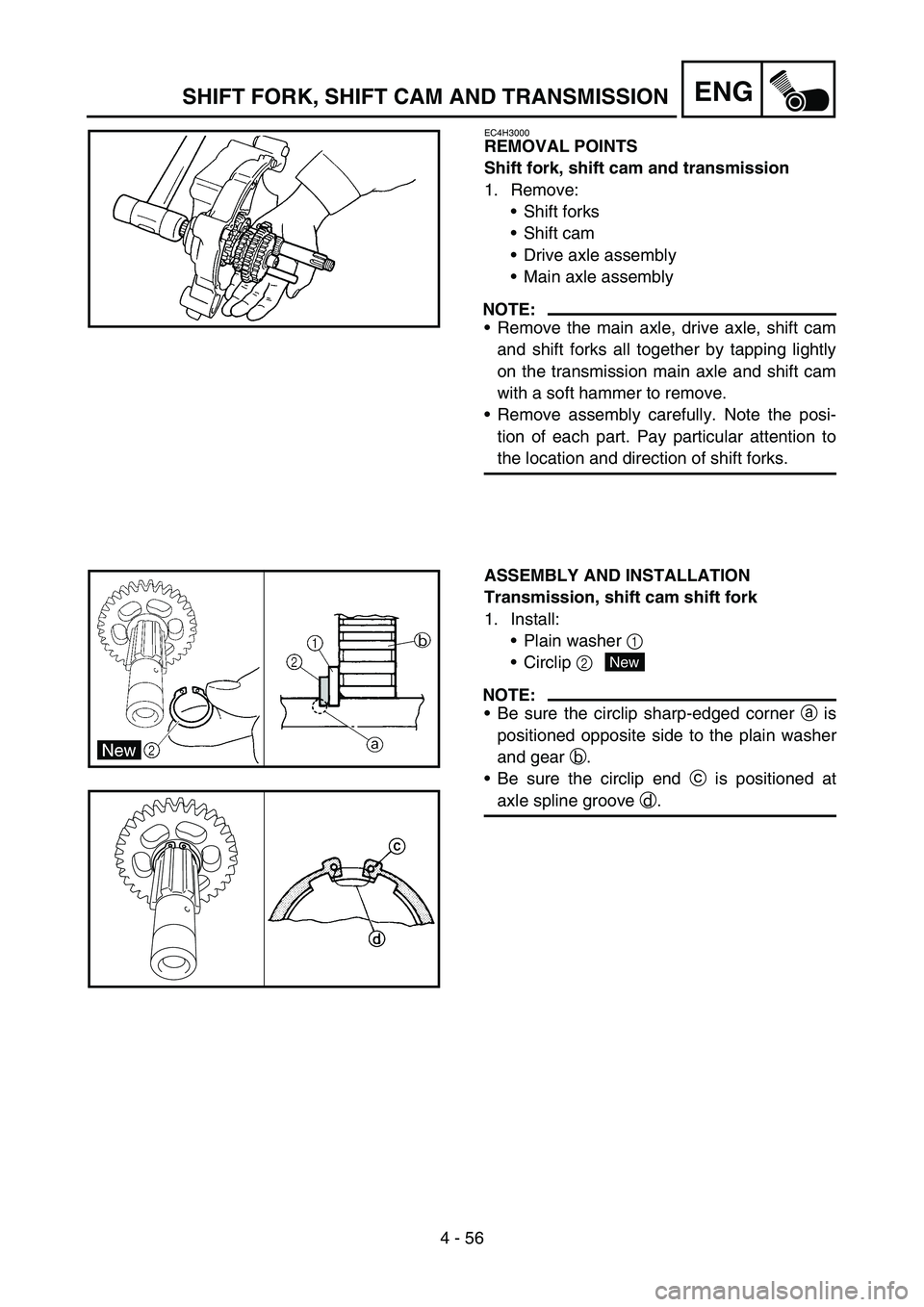
ASSEMBLY AND INSTALLATION
Transmission, shift cam shift fork
1. Install:
Plain washer 1
Circlip 2
NOTE:
Be sure the circlip sharp-edged corner a is
positioned opposite side to the plain washer
and gear b.
Be sure the circlip end c is positioned at
axle spline groove d.
New
Page 368 of 390
6 - 13
–+ELEC
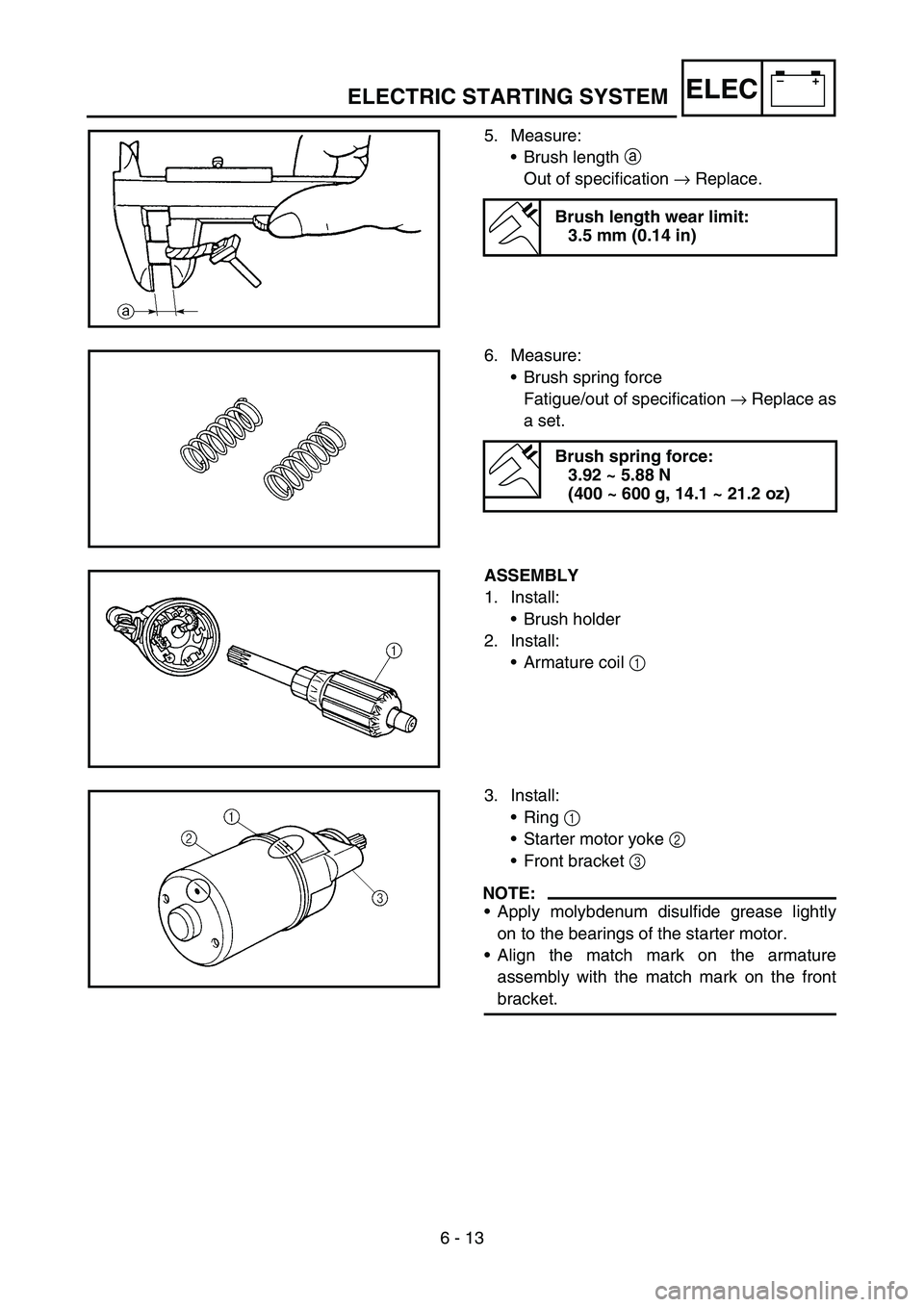
5. Measure:
Brush length a
Out of specification → Replace.
Brush length wear limit:
3.5 mm (0.14 in)
6. Measure:
Brush spring force
Fatigue/out of specification → Replace as
a set.
Brush spring force: 3.92 ~ 5.88 N
(400 ~ 600 g, 14.1 ~ 21.2 oz)
ASSEMBLY
1. Install:
Brush holder
2. Install:
Armature coil 1
3. Install:
Ring 1
Starter motor yoke 2
Front bracket 3
NOTE:
Apply molybdenum disulfide grease lightly
on to the bearings of the starter motor.
Align the match mark on the armature
assembly with the match mark on the front
bracket.
ELECTRIC STARTING SYSTEM
Page 376 of 390
–+ELEC
6 - 16
CARBURETOR HEATING SYSTEM
CARBURETOR HEATING SYSTEM
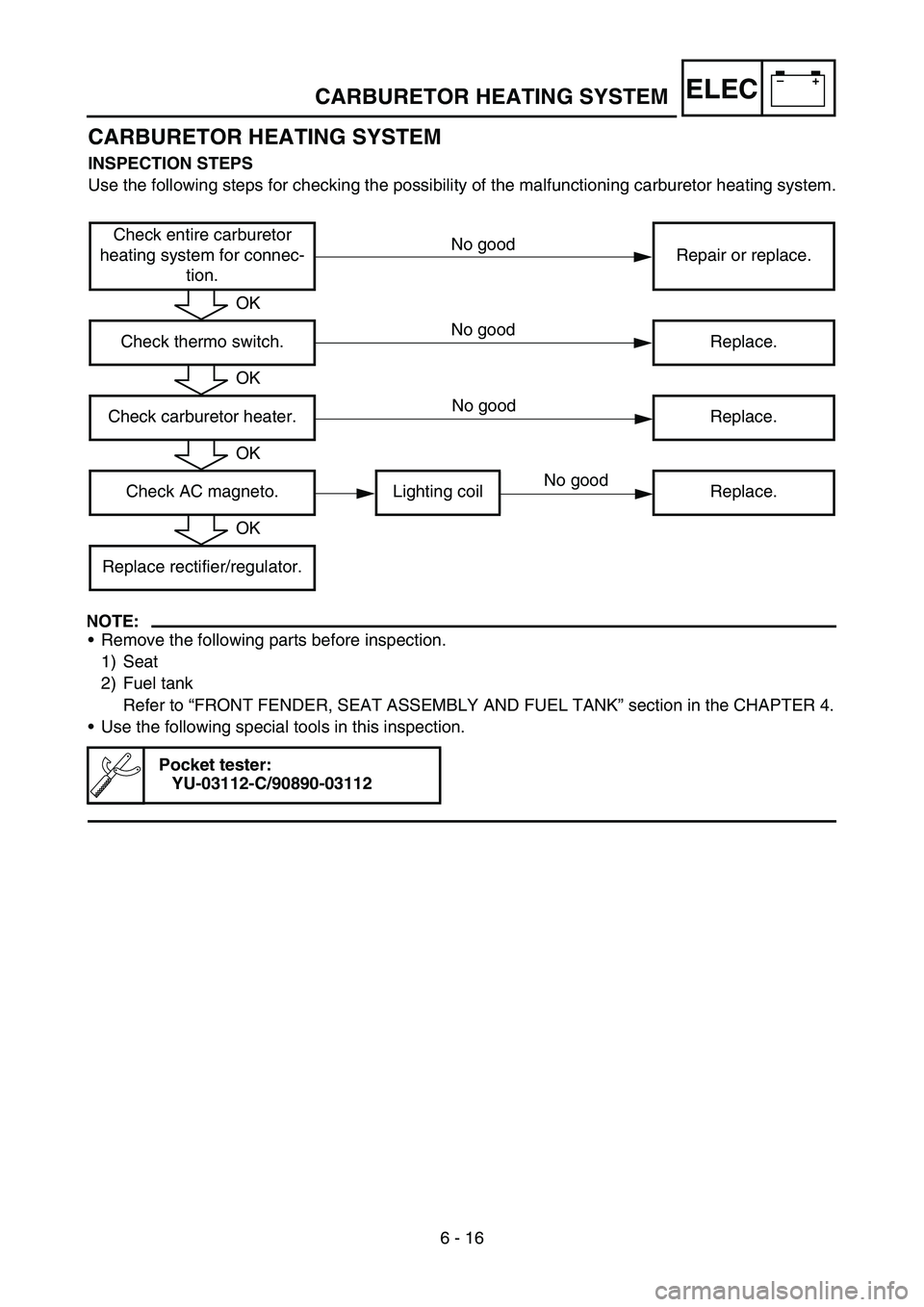
INSPECTION STEPS
Use the following steps for checking the possibility of the malfunctioning carburetor heating system.
NOTE:
Remove the following parts before inspection.
1) Seat
2) Fuel tank
Refer to “FRONT FENDER, SEAT ASSEMBLY AND FUEL TANK ” section in the CHAPTER 4.
Use the following special tools in this inspection.
Pocket tester:
YU-03112-C/90890-03112
Check entire carburetor
heating system for connec- tion. Repair or replace.
Check thermo switch. Replace.
Check carburetor heater. Replace. Check AC magneto. Lighting coil Replace.
Replace rectifier/regulator.
OK
OK
OK
OK
No good
No good
No good
No good