wheel YAMAHA TTR50 2006 User Guide
[x] Cancel search | Manufacturer: YAMAHA, Model Year: 2006, Model line: TTR50, Model: YAMAHA TTR50 2006Pages: 390, PDF Size: 9.69 MB
Page 156 of 390
3 - 17
INSPADJ
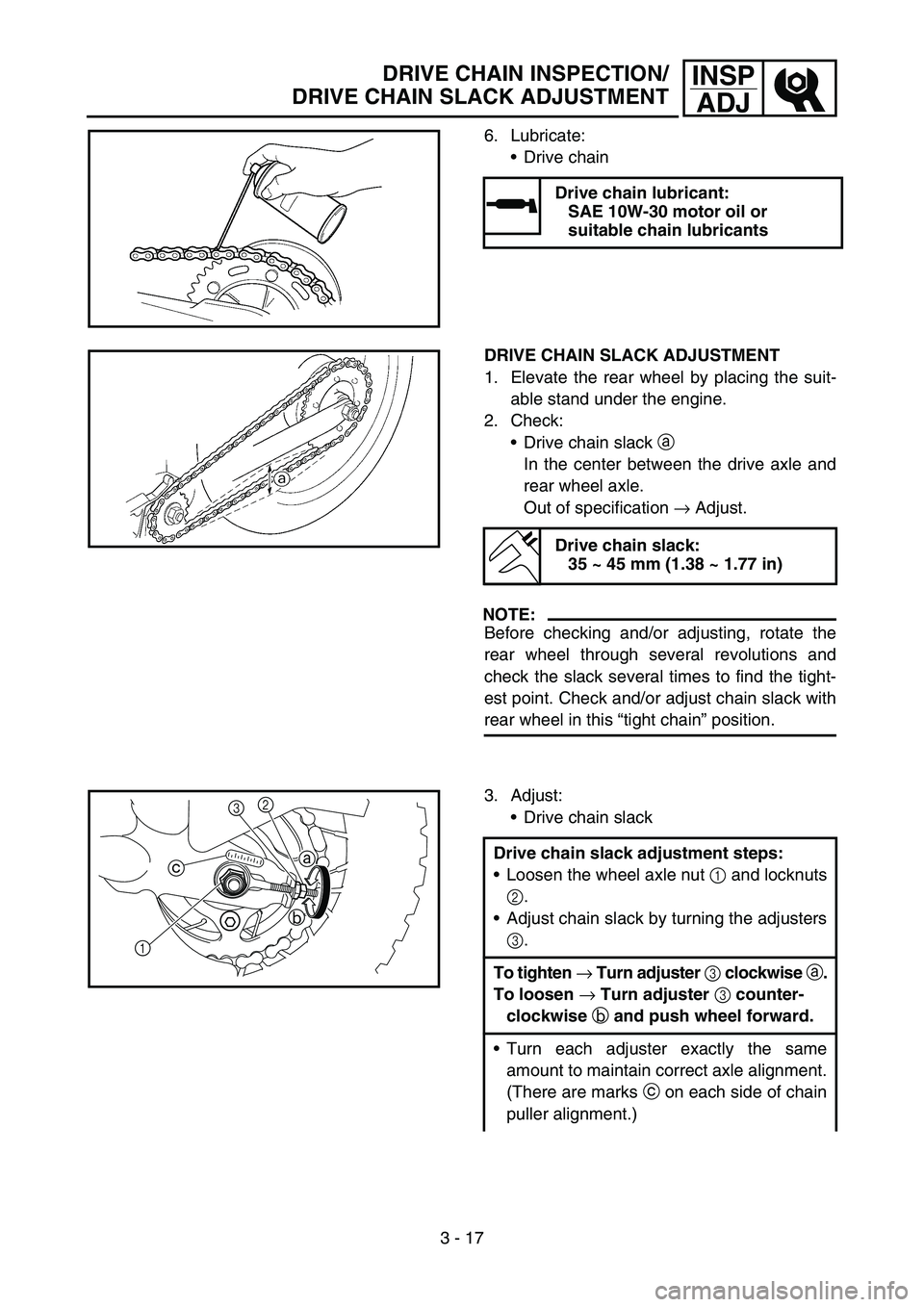
6. Lubricate:
Drive chain
Drive chain lubricant:
SAE 10W-30 motor oil or
suitable chain lubricants
DRIVE CHAIN SLACK ADJUSTMENT
1. Elevate the rear wheel by placing the suit-
able stand under the engine.
2. Check: Drive chain slack a
In the center between the drive axle and
rear wheel axle.
Out of specification → Adjust.
NOTE:
Before checking and/or adjusting, rotate the
rear wheel through several revolutions and
check the slack several times to find the tight-
est point. Check and/or adjust chain slack with
rear wheel in this “tight chain ” position.
Drive chain slack:
35 ~ 45 mm (1.38 ~ 1.77 in)
3. Adjust:
Drive chain slack
Drive chain slack adjustment steps:
Loosen the wheel axle nut 1 and locknuts
2 .
Adjust chain slack by turning the adjusters
3 .
To tighten → Turn adjuster 3 clockwise a.
To loosen → Turn adjuster 3 counter-
clockwise b and push wheel forward.
Turn each adjuster exactly the same
amount to maintain correct axle alignment.
(There are marks c on each side of chain
puller alignment.)
1 b
c
a
23
DRIVE CHAIN INSPECTION/
DRIVE CHAIN SLACK ADJUSTMENT
Page 158 of 390
3 - 18
INSPADJDRIVE CHAIN SLACK ADJUSTMENT/
FRONT FORK INSPECTION/REAR SHOCK ABSORBER INSPECTION
NOTE:
Turn the adjuster so that the chain is in line
with the sprocket, as viewed from the rear.
CAUTION:
Too small chain slack will overload the
engine and other vital parts; keep the
slack within the specified limits.
Tighten the wheel axle nut while pushing
down the drive chain.
T R..
Axle nut:
60 Nm (6.0 m kg, 43 ft lb)
Tighten the locknuts.
T R..
Locknut:
7 Nm (0.7 m kg, 5.1 ft lb)
EC36C000
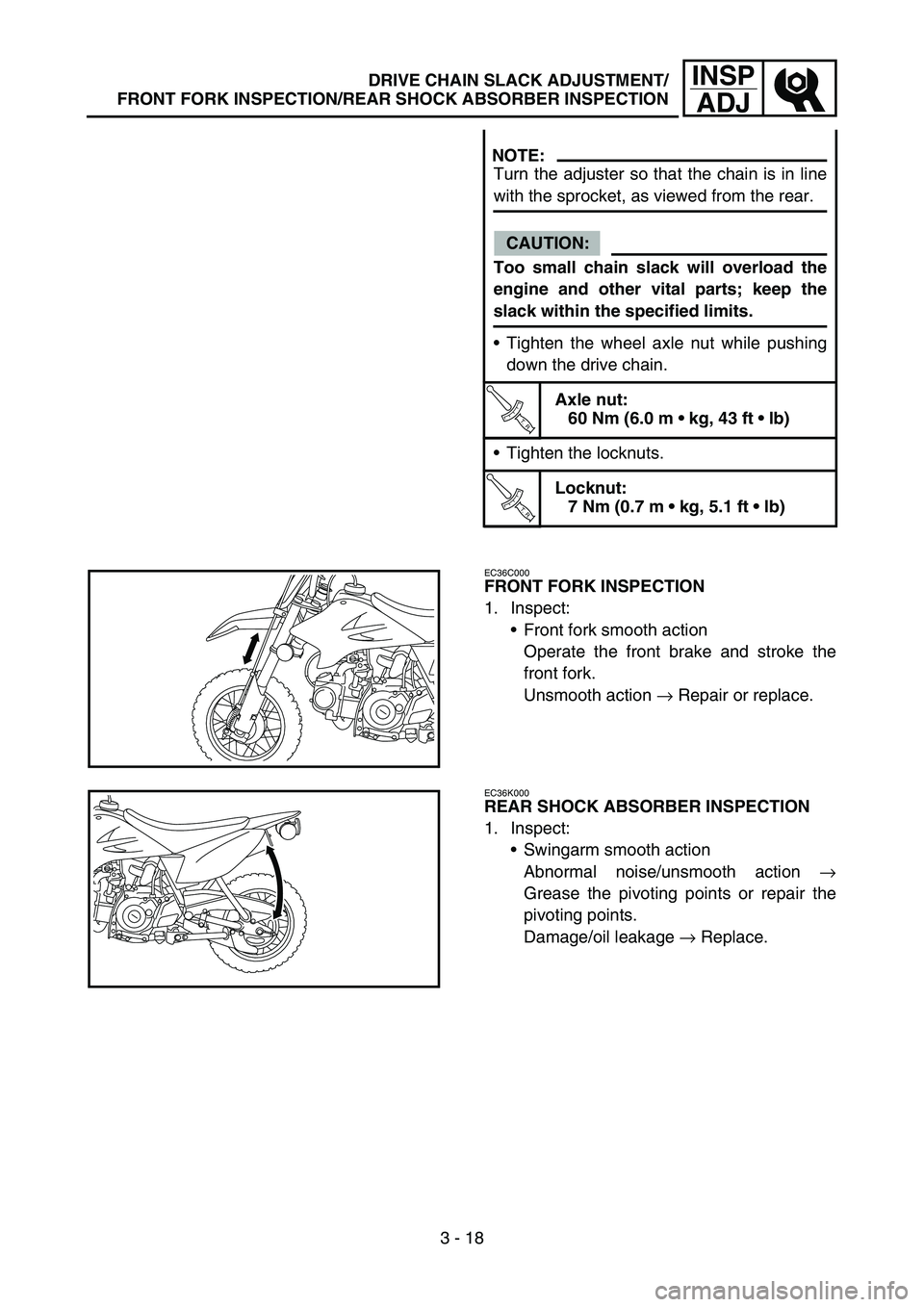
FRONT FORK INSPECTION
1. Inspect:
Front fork smooth action
Operate the front brake and stroke the
front fork.
Unsmooth action → Repair or replace.
EC36K000
REAR SHOCK ABSORBER INSPECTION
1. Inspect:
Swingarm smooth action
Abnormal noise/unsmooth action →
Grease the pivoting points or repair the
pivoting points.
Damage/oil leakage → Replace.
Page 160 of 390
3 - 19
INSPADJ
EC36Q000
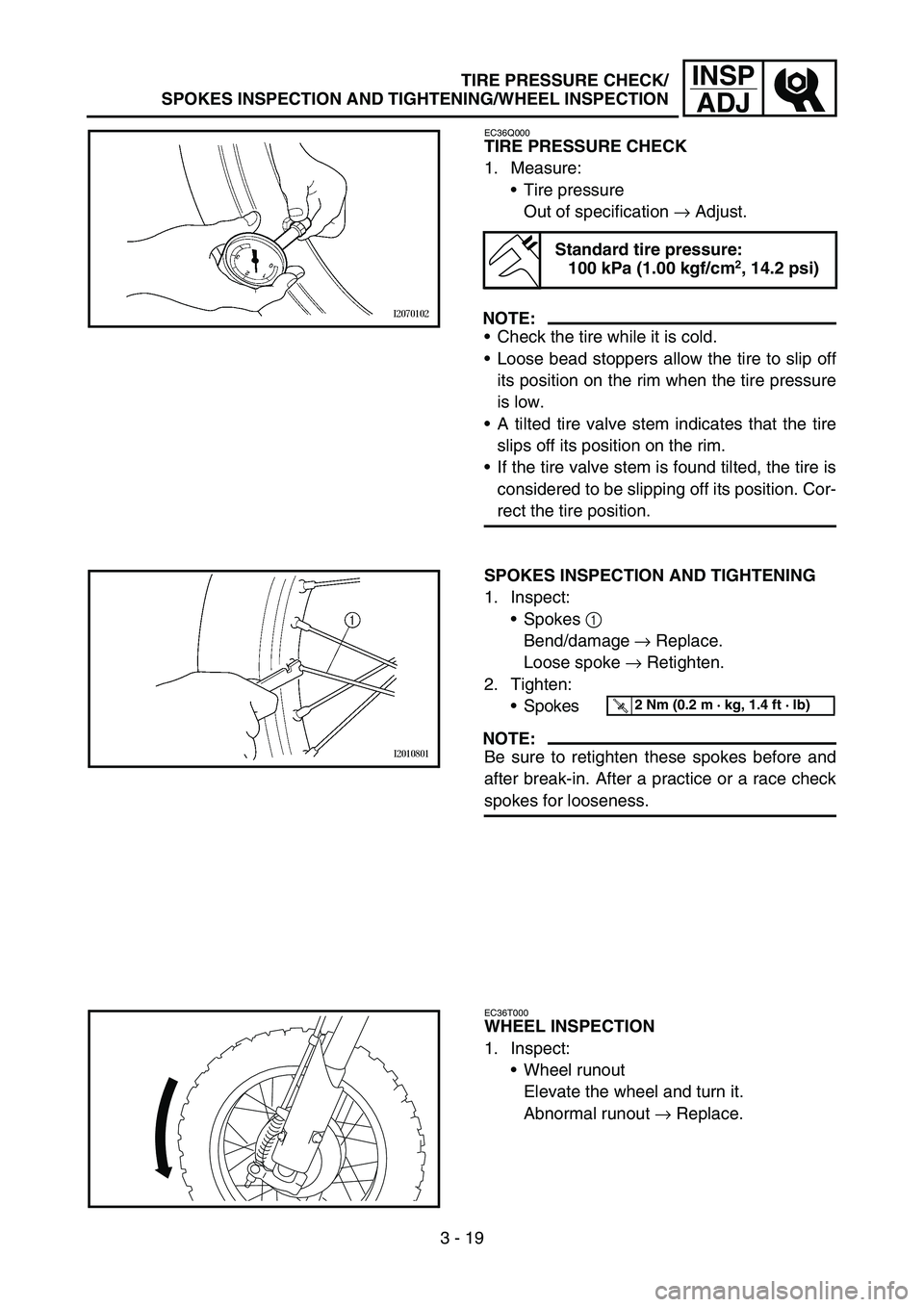
TIRE PRESSURE CHECK
1. Measure:
Tire pressure
Out of specification → Adjust.
NOTE:
Check the tire while it is cold.
Loose bead stoppers allow the tire to slip off
its position on the rim when the tire pressure
is low.
A tilted tire valve stem indicates that the tire
slips off its position on the rim.
If the tire valve stem is found tilted, the tire is
considered to be slipping off its position. Cor-
rect the tire position.
Standard tire pressure:
100 kPa (1.00 kgf/cm2, 14.2 psi)
SPOKES INSPECTION AND TIGHTENING
1. Inspect:
Spokes 1
Bend/damage → Replace.
Loose spoke → Retighten.
2. Tighten: Spokes
NOTE:
Be sure to retighten these spokes before and
after break-in. After a practice or a race check
spokes for looseness.
T R..2 Nm (0.2 m · kg, 1.4 ft · lb)
EC36T000
WHEEL INSPECTION
1. Inspect:
Wheel runout
Elevate the wheel and turn it.
Abnormal runout → Replace.
TIRE PRESSURE CHECK/
SPOKES INSPECTION AND TIGHTENING/WHEEL INSPECTION
Page 162 of 390
3 - 20
INSPADJWHEEL INSPECTION/
STEERING HEAD INSPECTION AND ADJUSTMENT
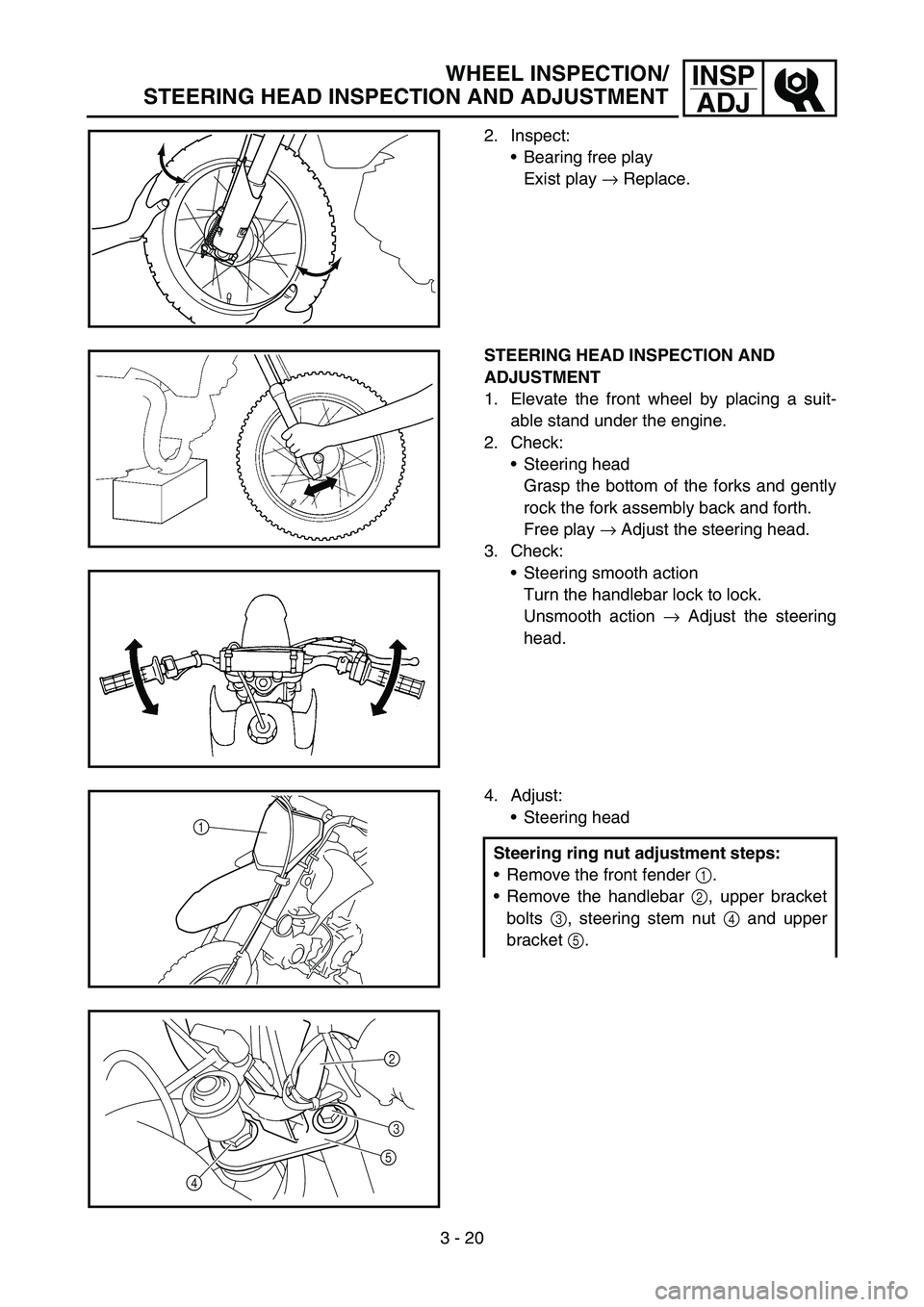
2. Inspect:
Bearing free play
Exist play → Replace.
STEERING HEAD INSPECTION AND
ADJUSTMENT
1. Elevate the front wheel by placing a suit-
able stand under the engine.
2. Check:
Steering head
Grasp the bottom of the forks and gently
rock the fork assembly back and forth.
Free play → Adjust the steering head.
3. Check: Steering smooth action
Turn the handlebar lock to lock.
Unsmooth action → Adjust the steering
head.
4. Adjust:
Steering head
Steering ring nut adjustment steps:
Remove the front fender 1.
Remove the handlebar 2, upper bracket
bolts 3, steering stem nut 4 and upper
bracket 5.
1
4
3
52
Page 206 of 390
4 - 10
ENGCYLINDER HEAD
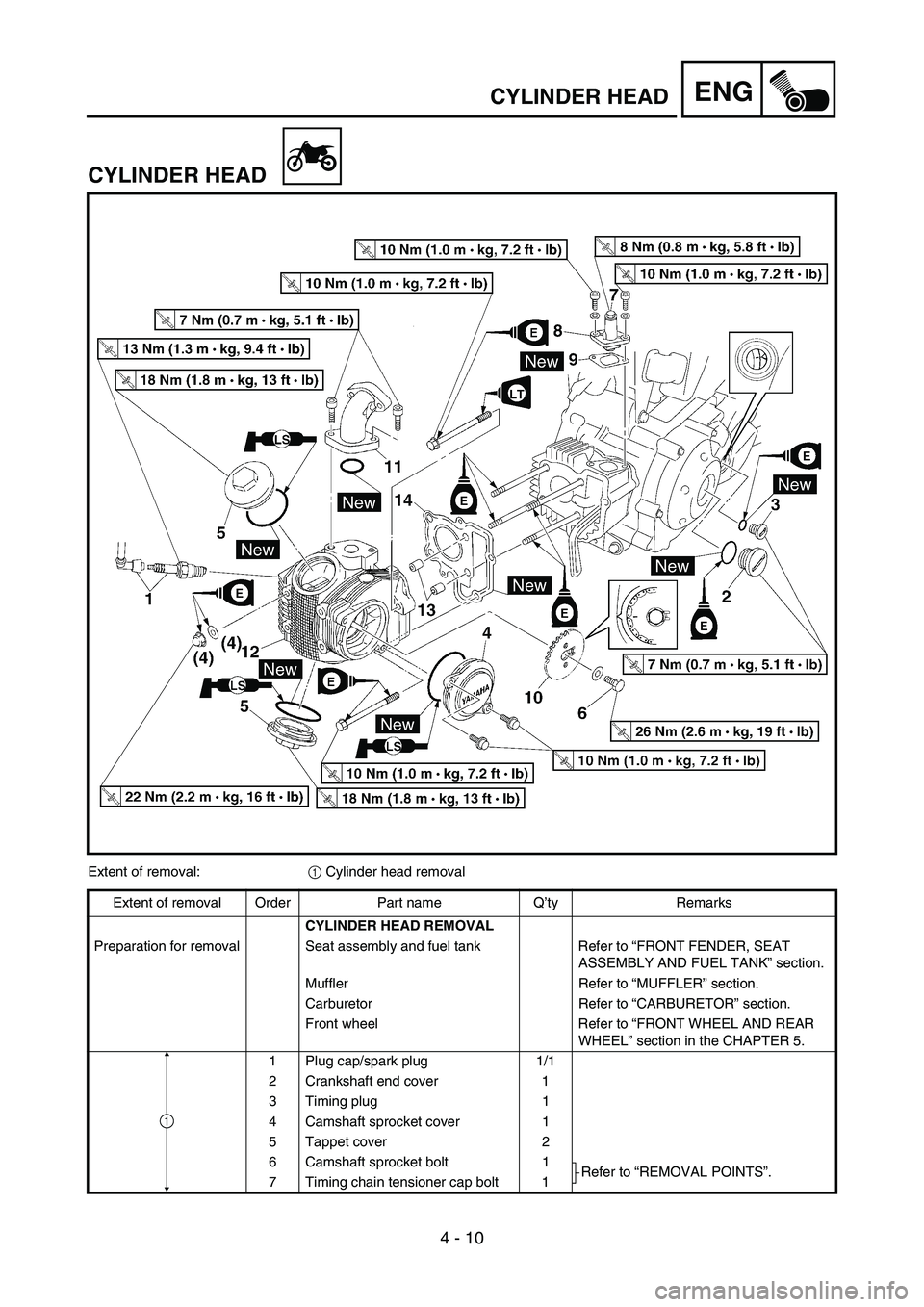
CYLINDER HEAD
Extent of removal: 1 Cylinder head removal
Extent of removal Order Part name Q ’ty Remarks
CYLINDER HEAD REMOVAL
Preparation for removal Seat assembly and fuel tank Refer to “FRONT FENDER, SEAT
ASSEMBLY AND FUEL TANK ” section.
Muffler Refer to “MUFFLER ” section.
Carburetor Refer to “CARBURETOR ” section.
Front wheel Refer to “FRONT WHEEL AND REAR
WHEEL ” section in the CHAPTER 5.
1 Plug cap/spark plug 1/1
2 Crankshaft end cover 1
3 Timing plug 1
4 Camshaft sprocket cover 1
5 Tappet cover 2
6 Camshaft sprocket bolt 1 Refer to “REMOVAL POINTS ”.
7 Timing chain tensioner cap bolt 1
1
Page 270 of 390
4 - 42
ENGAC MAGNETO AND STARTER CLUTCH
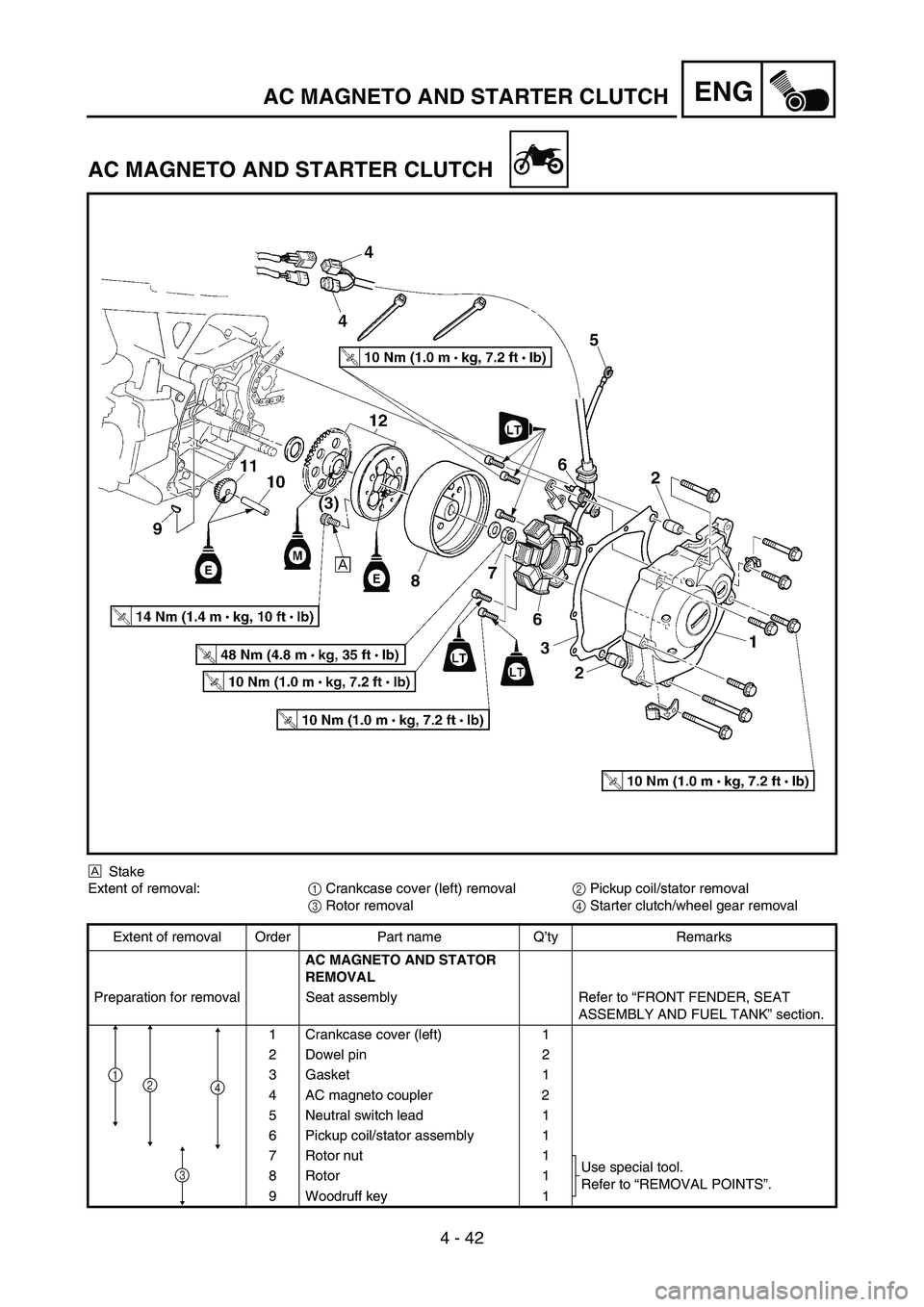
AC MAGNETO AND STARTER CLUTCH
È Stake
Extent of removal: 1 Crankcase cover (left) removal
2 Pickup coil/stator removal
3 Rotor removal
4 Starter clutch/wheel gear removal
Extent of removal Order Part name Q ’ty Remarks
AC MAGNETO AND STATOR
REMOVAL
Preparation for removal Seat assembly Refer to “FRONT FENDER, SEAT
ASSEMBLY AND FUEL TANK ” section.
1 Crankcase cover (left) 1
2 Dowel pin 2
3 Gasket 1
4 AC magneto coupler 2
5 Neutral switch lead 1
6 Pickup coil/stator assembly 1
7 Rotor nut 1 Use special tool.
Refer to “REMOVAL POINTS ”.
8 Rotor 1
9 Woodruff key 1
21
3
4
Page 272 of 390
4 - 43
ENGAC MAGNETO AND STARTER CLUTCH
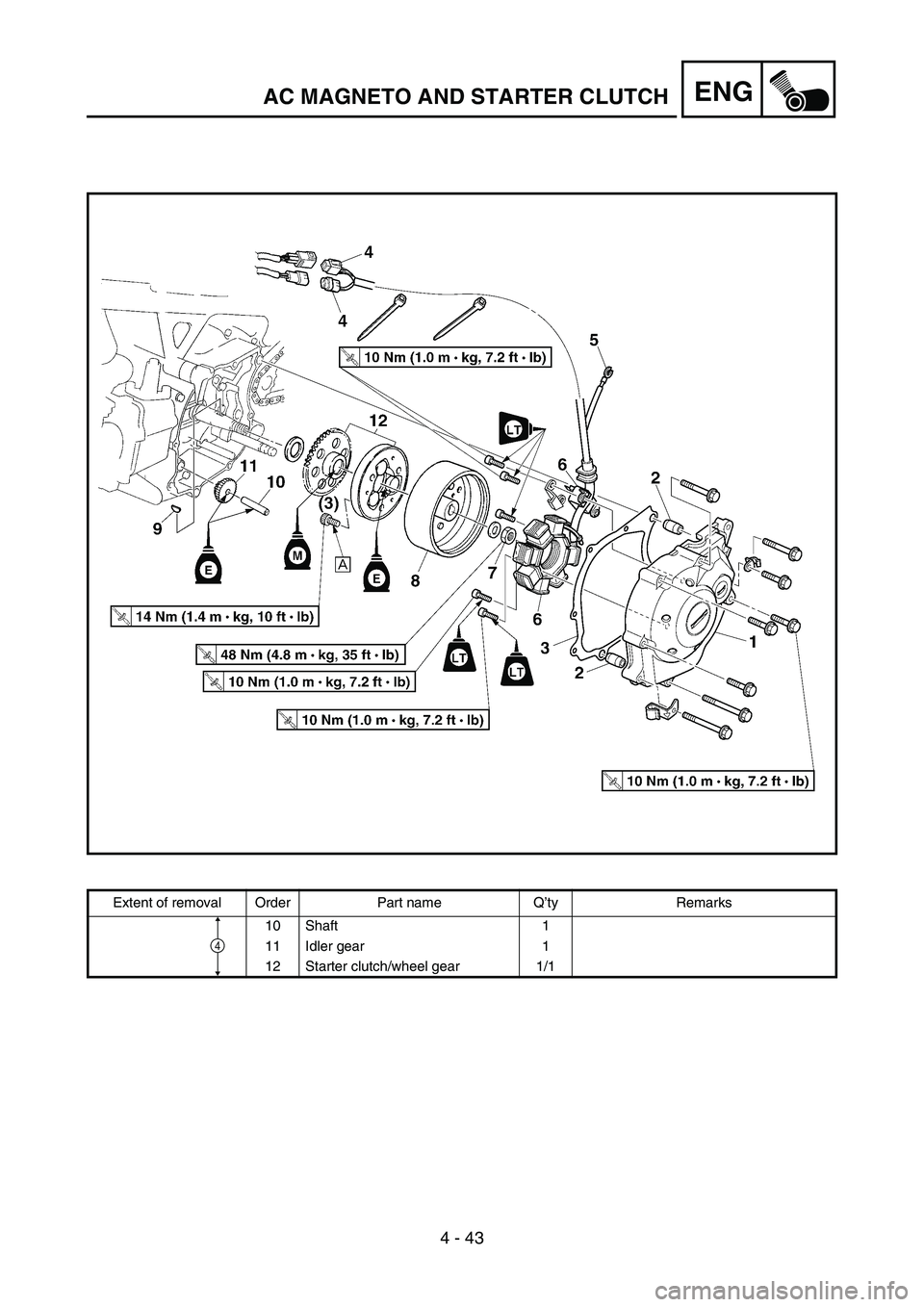
Extent of removal Order Part name Q’ty Remarks
10 Shaft 1
11 Idler gear 1
12 Starter clutch/wheel gear 1/1
4
Page 274 of 390
4 - 44
ENGAC MAGNETO AND STARTER CLUTCH
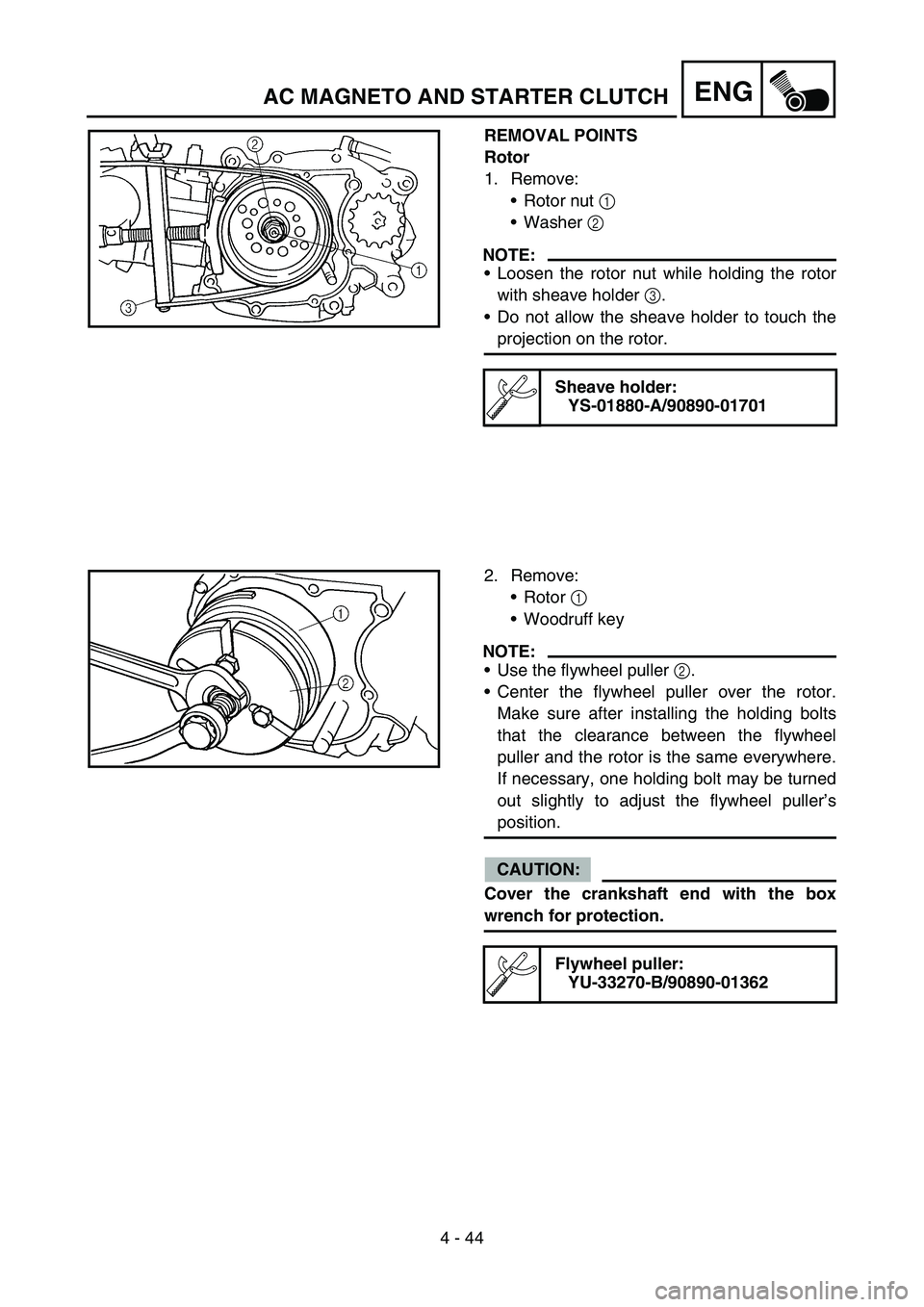
REMOVAL POINTS
Rotor
1. Remove:Rotor nut 1
Washer 2
NOTE:
Loosen the rotor nut while holding the rotor
with sheave holder 3.
Do not allow the sheave holder to touch the
projection on the rotor.
Sheave holder:
YS-01880-A/90890-01701
2. Remove:
Rotor 1
Woodruff key
NOTE:
Use the flywheel puller 2.
Center the flywheel puller over the rotor.
Make sure after installing the holding bolts
that the clearance between the flywheel
puller and the rotor is the same everywhere.
If necessary, one holding bolt may be turned
out slightly to adjust the flywheel puller ’s
position.
CAUTION:
Cover the crankshaft end with the box
wrench for protection.
Flywheel puller: YU-33270-B/90890-01362
Page 276 of 390

4 - 45
ENG
INSPECTION
Starter clutch
1. Inspect:Starter idle gear teeth a
Starter drive gear teeth b
Starter wheel gear teeth c
Burrs/chips/roughness/wear → Replace.
2. Check:
Starter clutch operation.
Checking steps:
Install the starter wheel gear onto the
starter clutch and hold the starter clutch.
When turning the starter wheel gear clock-
wise È, the starter clutch and the starter
wheel gear should be engage, otherwise
the starter clutch is faulty and must be
replaced.
When turning the starter wheel gear coun-
terclockwise É, it should turn freely, other-
wise the starter clutch is faulty and must
be replaced.
É
È
ASSEMBLY AND INSTALLATION
Starter clutch
1. Install:Starter clutch 1
1T R..14 Nm (1.4 m · kg, 10 ft · lb)
2. Unloosen the starter clutch assembly by
using the center punch.
AC MAGNETO AND STARTER CLUTCH
Page 278 of 390
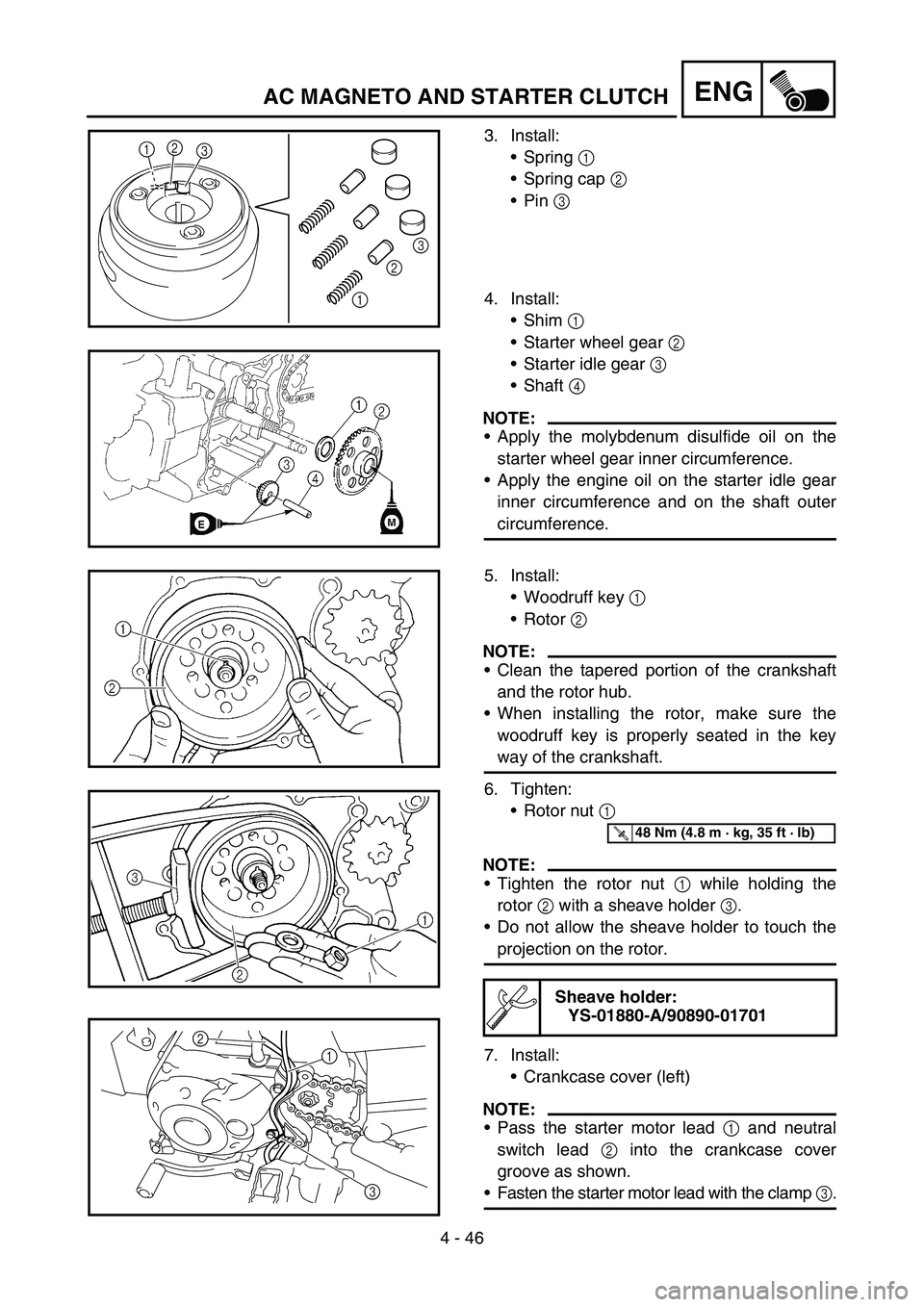
4 - 46
ENGAC MAGNETO AND STARTER CLUTCH
3. Install:Spring 1
Spring cap 2
Pin 3
4. Install: Shim 1
Starter wheel gear 2
Starter idle gear 3
Shaft 4
NOTE:
Apply the molybdenum disulfide oil on the
starter wheel gear inner circumference.
Apply the engine oil on the starter idle gear
inner circumference and on the shaft outer
circumference.
1 2
3
12
3
5. Install:
Woodruff key 1
Rotor 2
NOTE:
Clean the tapered portion of the crankshaft
and the rotor hub.
When installing the rotor, make sure the
woodruff key is properly seated in the key
way of the crankshaft.
6. Tighten: Rotor nut 1
NOTE:
Tighten the rotor nut 1 while holding the
rotor 2 with a sheave holder 3.
Do not allow the sheave holder to touch the
projection on the rotor.
7. Install: Crankcase cover (left)
NOTE:
Pass the starter motor lead 1 and neutral
switch lead 2 into the crankcase cover
groove as shown.
Fasten the starter motor lead with the clamp 3.
Sheave holder:
YS-01880-A/90890-01701
T R..48 Nm (4.8 m · kg, 35 ft · lb)
3
1
2