warning YAMAHA TTR50 2013 User Guide
[x] Cancel search | Manufacturer: YAMAHA, Model Year: 2013, Model line: TTR50, Model: YAMAHA TTR50 2013Pages: 86, PDF Size: 1.8 MB
Page 40 of 86

OPERATION AND IMPORTANT RIDING POINTS
6-1
6
EAU15951
Read the Owner’s Manual carefully to
become familiar with all controls. If
there is a control or function you do not
understand, ask your Yamaha dealer.
WARNING
EWA10271
Failure to familiarize yourself with
the controls can lead to loss of con-
trol, which could cause an accident
or injury.
EAU40098
Starting and warming up a
cold engine 1. Turn the fuel cock lever to “ON”.
2. Turn the key to “ON” and makesure that the engine stop switch is
set to “ ”.
3. Shift the transmission into the neu- tral position.
WARNING
EWA14410
●
Be sure to shift the transmis-
sion into neutral before starting
the engine.
●
Never ride with the sidestand
down.
4. Turn the starter (choke) on andcompletely close the throttle.
5. Start the engine by pushing the start switch.
6. When the engine is warm, turn the starter (choke) off.TIPThe engine is warm when it responds
quickly to the throttle with the starter
(choke) turned off.
NOTICE
ECA11042
For maximum engine life, never ac-
celerate hard when the engine is
cold!
U2CJ80E0.book Page 1 Tuesday, June 12, 2012 11:15 AM
Page 43 of 86
OPERATION AND IMPORTANT RIDING POINTS
6-4
6
EAU17171
Parking When parking, stop the engine, remove
the key from the main switch, and then
turn the fuel cock lever to “OFF”.
WARNING
EWA10311
●
Since the engine and exhaust
system can become very hot,
park in a place where pedestri-
ans or children are not likely to
touch them and be burned.
●
Do not park on a slope or on soft
ground, otherwise the vehicle
may overturn, increasing the
risk of a fuel leak and fire.
●
Do not park near grass or other
flammable materials which
might catch fire.
U2CJ80E0.book Page 4 Tuesday, June 12, 2012 11:15 AM
Page 44 of 86
PERIODIC MAINTENANCE AND ADJUSTMENT
7-1
7
EAU17244
Periodic inspection, adjustment, and lu-
brication will keep your vehicle in the
safest and most efficient condition pos-
sible. Safety is an obligation of the vehi-
cle owner/operator. The most important
points of vehicle inspection, adjust-
ment, and lubrication are explained on
the following pages.
The intervals given in the periodic
maintenance charts should be simply
considered as a general guide under
normal riding conditions. However, de-
pending on the weather, terrain, geo-
graphical location, and individual use,
the maintenance intervals may need to
be shortened.
WARNING
EWA10321
Failure to properly maintain the ve-
hicle or performing maintenance ac-
tivities incorrectly may increase
your risk of injury or death during
service or while using the vehicle. If
you are not familiar with vehicle ser-
vice, have a Yamaha dealer perform
service.
WARNING
EWA15122
Turn off the engine when performing
maintenance unless otherwise
specified.●
A running engine has moving
parts that can catch on body
parts or clothing and electrical
parts that can cause shocks or
fires.
●
Running the engine while ser-
vicing can lead to eye injury,
burns, fire, or carbon monoxide
poisoning – possibly leading to
death. See page 2-2 for more in-
formation about carbon monox-
ide.WARNING
EWA15460
Brake discs, calipers, drums, and
linings can become very hot during
use. To avoid possible burns, let
brake components cool before
touching them.
EAU17302
Emission controls not only function to
ensure cleaner air, but are also vital to
proper engine operation and maximum
performance. In the following periodic
maintenance charts, the services relat-
ed to emissions control are grouped
separately. These services require
specialized data, knowledge, and
equipment. Maintenance, replacement,
or repair of the emission control devic-
es and systems may be performed by
any repair establishment or individual
that is certified (if applicable). Yamaha
dealers are trained and equipped to
perform these particular services.
U2CJ80E0.book Page 1 Tuesday, June 12, 2012 11:15 AM
Page 52 of 86
PERIODIC MAINTENANCE AND ADJUSTMENT
7-9
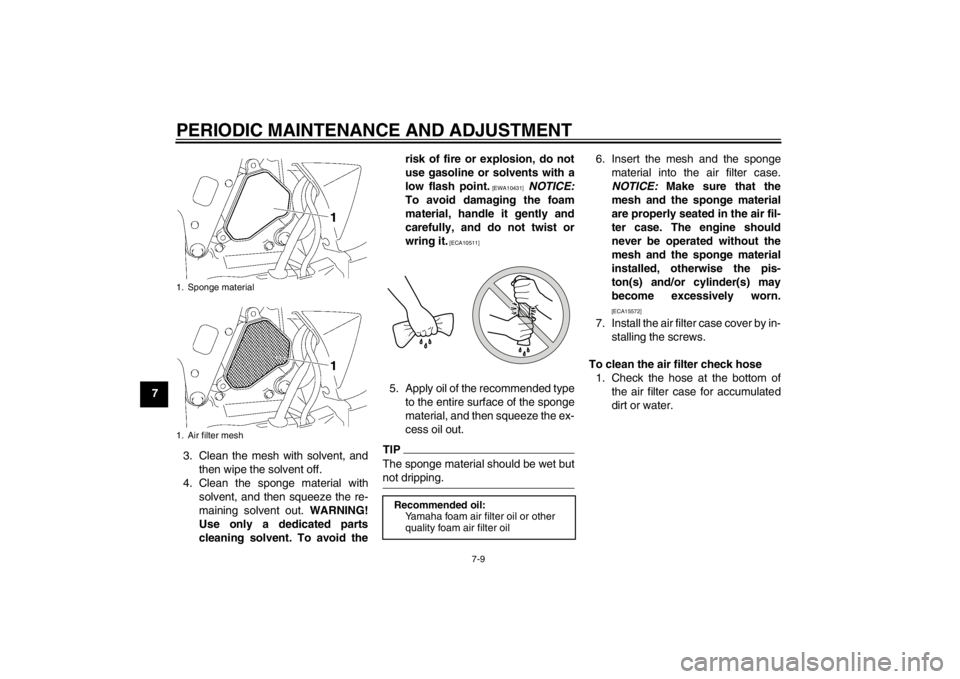
73. Clean the mesh with solvent, andthen wipe the solvent off.
4. Clean the sponge material with solvent, and then squeeze the re-
maining solvent out. WARNING!
Use only a dedicated parts
cleaning solvent. To avoid the risk of fire or explosion, do not
use gasoline or solvents with a
low flash point.
[EWA10431]
NOTICE:
To avoid damaging the foam
material, handle it gently and
carefully, and do not twist or
wring it.
[ECA10511]
5. Apply oil of the recommended type to the entire surface of the sponge
material, and then squeeze the ex-
cess oil out.TIPThe sponge material should be wet but
not dripping.
6. Insert the mesh and the spongematerial into the air filter case.
NOTICE: Make sure that the
mesh and the sponge material
are properly seated in the air fil-
ter case. The engine should
never be operated without the
mesh and the sponge material
installed, otherwise the pis-
ton(s) and/or cylinder(s) may
become excessively worn.
[ECA15572]
7. Install the air filter case cover by in- stalling the screws.
To clean the air filter check hose 1. Check the hose at the bottom of the air filter case for accumulated
dirt or water.
1. Sponge material
1. Air filter mesh
Recommended oil:Yamaha foam air filter oil or other
quality foam air filter oil
U2CJ80E0.book Page 9 Tuesday, June 12, 2012 11:15 AM
Page 53 of 86
PERIODIC MAINTENANCE AND ADJUSTMENT
7-10
7
2. If dirt or water is visible, remove
the hose, clean it, and then install
it.
EAU40421
Cleaning the spark arrester The spark arrester should be cleaned
at the intervals specified in the periodic
maintenance and lubrication chart.
WARNING
EWA10980
●
Always let the exhaust system
cool prior to touching exhaust
components.
●
Do not start the engine when
cleaning the exhaust system.
TIPMake sure to select a well-ventilated
area free of combustible materials to
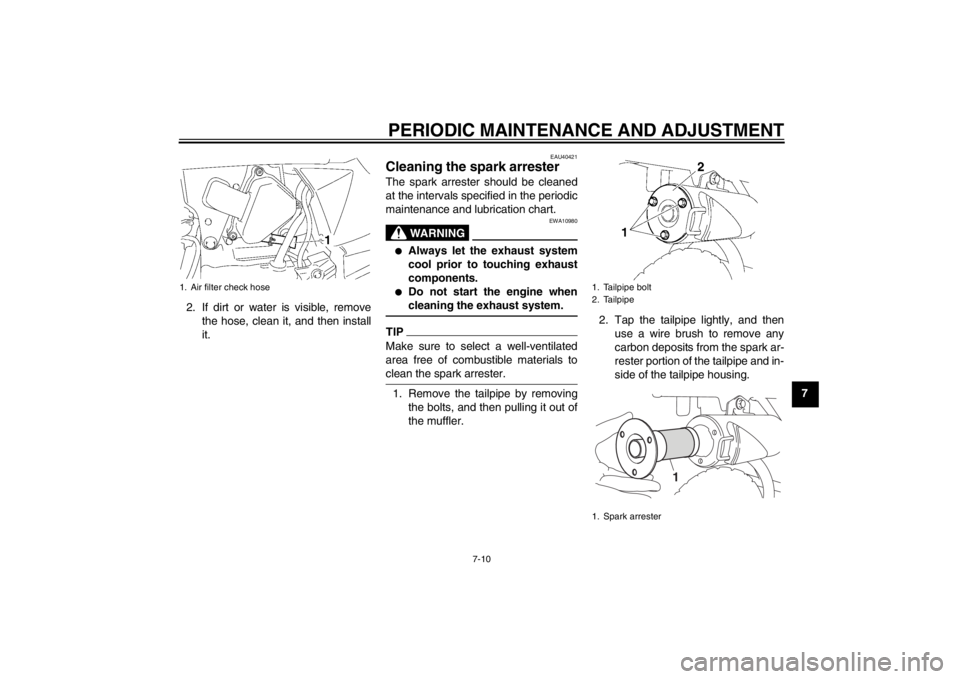
clean the spark arrester.1. Remove the tailpipe by removingthe bolts, and then pulling it out of
the muffler. 2. Tap the tailpipe lightly, and then
use a wire brush to remove any
carbon deposits from the spark ar-
rester portion of the tailpipe and in-
side of the tailpipe housing.
1. Air filter check hose
1. Tailpipe bolt
2. Tailpipe
1. Spark arrester
1
U2CJ80E0.book Page 10 Tuesday, June 12, 2012 11:15 AM
Page 56 of 86
PERIODIC MAINTENANCE AND ADJUSTMENT
7-13
7
EAU39825
Tires Tires are the only contact between the
vehicle and the road. Safety in all con-
ditions of riding depends on a relatively
small area of road contact. Therefore, it
is essential to maintain the tires in good
condition at all times and replace them
at the appropriate time with the speci-
fied tires.
Tire air pressure
The tire air pressure should be checked
and, if necessary, adjusted before each
ride.
WARNING
EWA15370
Operation of this vehicle with im-
proper tire pressure may cause se-
vere injury or death from loss of
control.
The tire air pressure must be
checked and adjusted on cold tires
(i.e., when the temperature of the
tires equals the ambient tempera-
ture).
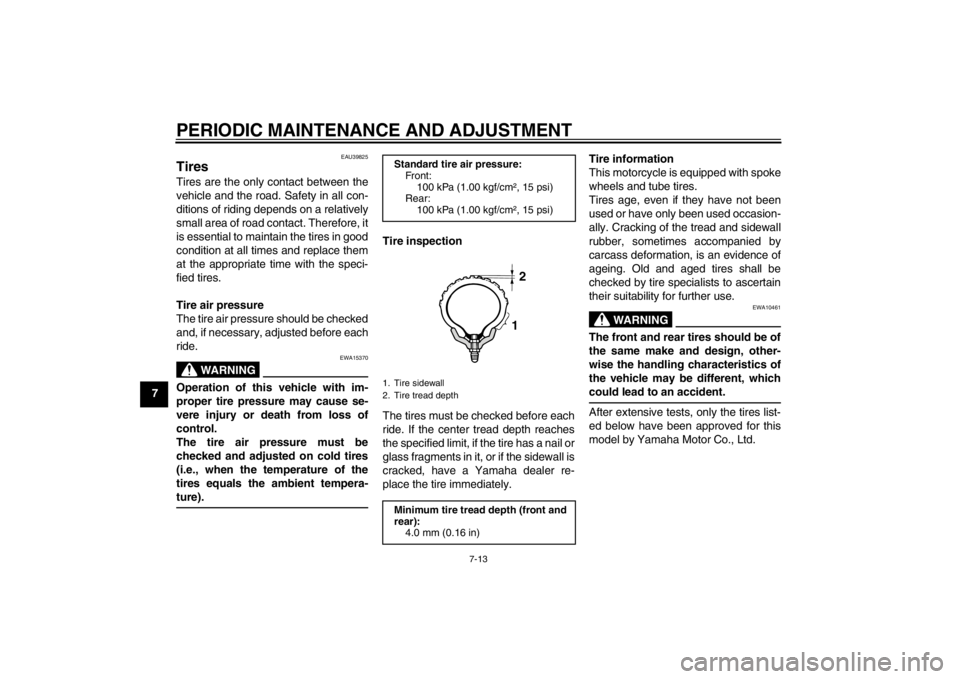
Tire inspection
The tires must be checked before each
ride. If the center tread depth reaches
the specified limit, if the tire has a nail or
glass fragments in it, or if the sidewall is
cracked, have a Yamaha dealer re-
place the tire immediately.Tire information
This motorcycle is equipped with spoke
wheels and tube tires.
Tires age, even if they have not been
used or have only been used occasion-
ally. Cracking of the tread and sidewall
rubber, sometimes accompanied by
carcass deformation, is an evidence of
ageing. Old and aged tires shall be
checked by tire specialists to ascertain
their suitability for further use.
WARNING
EWA10461
The front and rear tires should be of
the same make and design, other-
wise the handling characteristics of
the vehicle may be different, which
could lead to an accident.After extensive tests, only the tires list-
ed below have been approved for this
model by Yamaha Motor Co., Ltd.
Standard tire air pressure:
Fr o nt :
100 kPa (1.00 kgf/cm², 15 psi)
Rear:
100 kPa (1.00 kgf/cm², 15 psi)1. Tire sidewall
2. Tire tread depthMinimum tire tread depth (front and
rear):4.0 mm (0.16 in)
12
U2CJ80E0.book Page 13 Tuesday, June 12, 2012 11:15 AM
Page 57 of 86

PERIODIC MAINTENANCE AND ADJUSTMENT
7-14
7
WARNING
EWA15541
●
Have a Yamaha dealer replace
excessively worn tires. Operat-
ing the motorcycle with exces-
sively worn tires decreases
riding stability and can lead to
loss of control.
●
The replacement of all wheel-
and brake-related parts, includ-
ing the tires, should be left to a
Yamaha dealer, who has the necessary professional knowl-
edge and experience.
●
It is not recommended to patch
a punctured tube. If unavoid-
able, however, patch the tube very carefully and replace it as
soon as possible with a high-
quality product.
●
Ride conservatively after
changing a tire since the tire
must seat itself on the rim prop-
erly. Failure to allow proper
seating may cause tire failure,
which may result in damage to
the motorcycle and injury to the
rider.
EAU21943
Spoke wheels
WARNING
EWA10610
The wheels on this model are not de-
signed for use with tubeless tires.
Do not attempt to use tubeless tires
on this model.To maximize the performance, durabil-
ity, and safe operation of your motorcy-
cle, note the following points regarding
the specified wheels.●
The wheel rims should be checked
for cracks, bends, warpage or oth-
er damage, and the spokes for
looseness or damage before each
ride. If any damage is found, have
a Yamaha dealer replace the
wheel. Do not attempt even the
smallest repair to the wheel. A de-
formed or cracked wheel must be
replaced.
●
The wheel should be balanced
whenever either the tire or wheel
has been changed or replaced. An
unbalanced wheel can result in
poor performance, adverse han-
dling characteristics, and a short-
ened tire life.
Front tire:
Size:
2.50-10 4PR
Manufacturer/model:
CHENG SHIN/C183A
Rear tire: Size:
2.50-10 4PR
Manufacturer/model: CHENG SHIN/C183A
U2CJ80E0.book Page 14 Tuesday, June 12, 2012 11:15 AM
Page 59 of 86
PERIODIC MAINTENANCE AND ADJUSTMENT
7-16
7
WARNING
EWA10650
If proper adjustment cannot be ob-
tained as described, have a Yamaha
dealer make this adjustment.
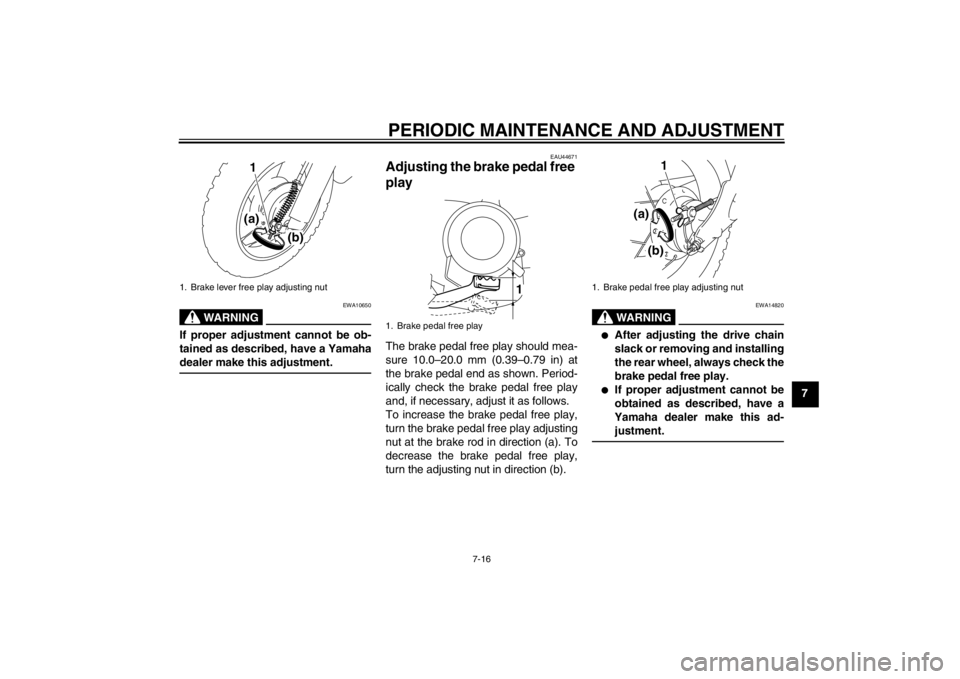
EAU44671
Adjusting the brake pedal free
play The brake pedal free play should mea-
sure 10.0–20.0 mm (0.39–0.79 in) at
the brake pedal end as shown. Period-
ically check the brake pedal free play
and, if necessary, adjust it as follows.
To increase the brake pedal free play,
turn the brake pedal free play adjusting
nut at the brake rod in direction (a). To
decrease the brake pedal free play,
turn the adjusting nut in direction (b).
WARNING
EWA14820
●
After adjusting the drive chain
slack or removing and installing
the rear wheel, always check the
brake pedal free play.
●
If proper adjustment cannot be
obtained as described, have a
Yamaha dealer make this ad- justment.
1. Brake lever free play adjusting nut
1
(a) (b)
1. Brake pedal free play
1
1. Brake pedal free play adjusting nut
(b)
(a)
1
U2CJ80E0.book Page 16 Tuesday, June 12, 2012 11:15 AM
Page 63 of 86
PERIODIC MAINTENANCE AND ADJUSTMENT
7-20
7
EAU23095
Checking and lubricating the
cables The operation of all control cables and
the condition of the cables should be
checked before each ride, and the ca-
bles and cable ends should be lubricat-
ed if necessary. If a cable is damaged
or does not move smoothly, have a
Yamaha dealer check or replace it.
WARNING! Damage to the outer housing of cables may result in in-
ternal rusting and cause interfer-
ence with cable movement. Replace
damaged cables as soon as possi-
ble to prevent unsafe conditions.[EWA10711] EAU23114
Checking and lubricating the
throttle grip and cable The operation of the throttle grip should
be checked before each ride. In addi-
tion, the cable should be lubricated by a
Yamaha dealer at the intervals speci-
fied in the periodic maintenance chart.
The throttle cable is equipped with a
rubber cover. Make sure that the cover
is securely installed. Even though the
cover is installed correctly, it does not
completely protect the cable from water
entry. Therefore, use care not to pour
water directly onto the cover or cable
when washing the vehicle. If the cable
or cover becomes dirty, wipe clean with
a moist cloth.
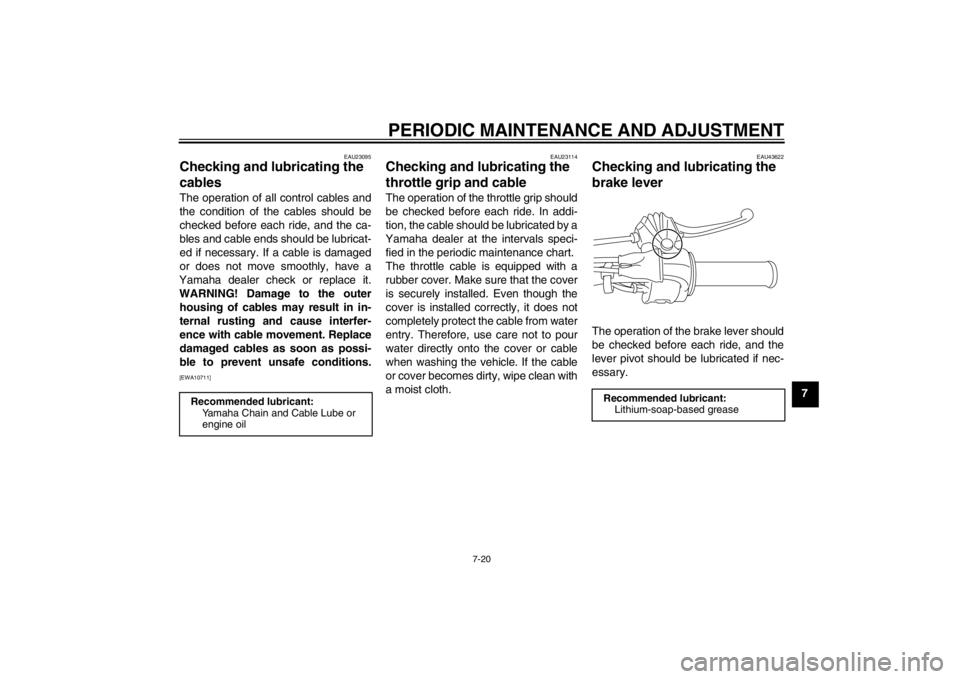
EAU43622
Checking and lubricating the
brake lever The operation of the brake lever should
be checked before each ride, and the
lever pivot should be lubricated if nec-
essary.
Recommended lubricant:
Yamaha Chain and Cable Lube or
engine oil
Recommended lubricant:Lithium-soap-based grease
U2CJ80E0.book Page 20 Tuesday, June 12, 2012 11:15 AM
Page 64 of 86
PERIODIC MAINTENANCE AND ADJUSTMENT
7-21
7
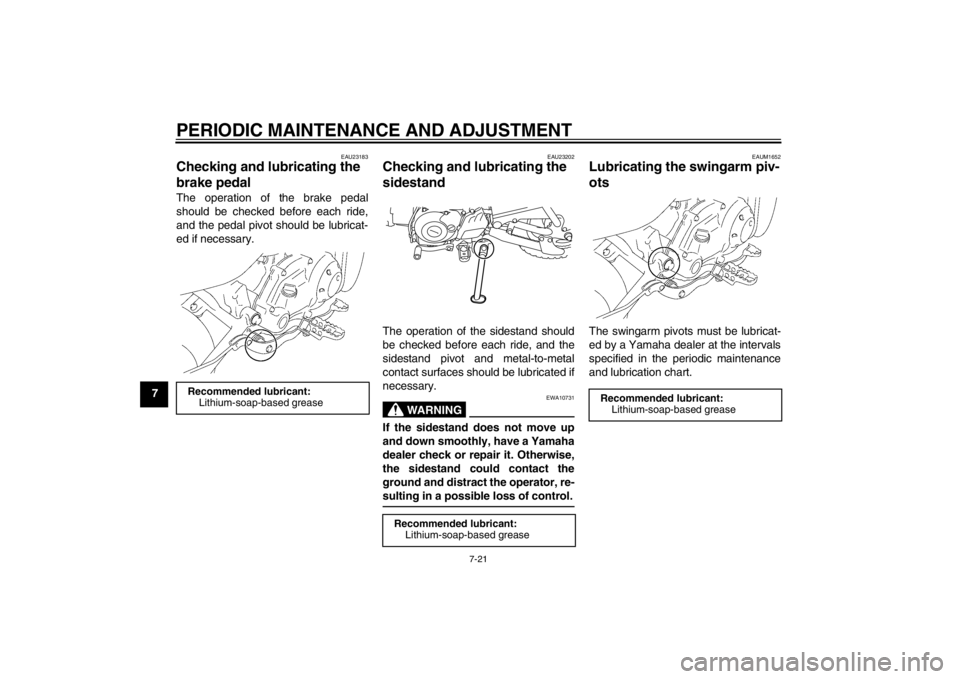
EAU23183
Checking and lubricating the
brake pedal The operation of the brake pedal
should be checked before each ride,
and the pedal pivot should be lubricat-
ed if necessary.
EAU23202
Checking and lubricating the
sidestand The operation of the sidestand should
be checked before each ride, and the
sidestand pivot and metal-to-metal
contact surfaces should be lubricated if
necessary.
WARNING
EWA10731
If the sidestand does not move up
and down smoothly, have a Yamaha
dealer check or repair it. Otherwise,
the sidestand could contact the
ground and distract the operator, re-
sulting in a possible loss of control.
EAUM1652
Lubricating the swingarm piv-
ots The swingarm pivots must be lubricat-
ed by a Yamaha dealer at the intervals
specified in the periodic maintenance
and lubrication chart.
Recommended lubricant:Lithium-soap-based grease
Recommended lubricant:Lithium-soap-based grease
Recommended lubricant:Lithium-soap-based grease
U2CJ80E0.book Page 21 Tuesday, June 12, 2012 11:15 AM