maintenance YAMAHA TTR50 2013 Owner's Guide
[x] Cancel search | Manufacturer: YAMAHA, Model Year: 2013, Model line: TTR50, Model: YAMAHA TTR50 2013Pages: 86, PDF Size: 1.8 MB
Page 67 of 86

PERIODIC MAINTENANCE AND ADJUSTMENT
7-24
7
battery tends to discharge more quickly
if the vehicle is equipped with optional
electrical accessories.
NOTICE
ECA16521
To charge a VRLA (Valve Regulated
Lead Acid) battery, a special (con-
stant-voltage) battery charger is re-
quired. Using a conventional battery
charger will damage the battery.To store the battery
1. If the vehicle will not be used for more than one month, remove the
battery, fully charge it, and then
place it in a cool, dry place.
NOTICE: When removing the
battery, be sure the key is
turned to “OFF” before discon-
necting the coupler.
[ECA16322]
2. If the battery will be stored for more than two months, check it at least
once a month and fully charge it if
necessary.
3. Fully charge the battery before in- stallation. NOTICE: When install-
ing the battery, be sure the key
is turned to “OFF” before con-
necting the coupler.
[ECA16930]
NOTICE
ECA16530
Always keep the battery charged.
Storing a discharged battery can
cause permanent battery damage.
EAU42024
Replacing the fuse The fuse is located inside the battery
coupler.
If the fuse is blown, replace it as fol-
lows. 1. Turn the key to “OFF” and turn off all electrical circuits.
2. Remove the seat. (See page 4-8.)
3. Remove the battery cover by re- moving the bolts.1. Battery coupler
2. Spare fuse
3. Fuse
32
1
U2CJ80E0.book Page 24 Tuesday, June 12, 2012 11:15 AM
Page 68 of 86
PERIODIC MAINTENANCE AND ADJUSTMENT
7-25
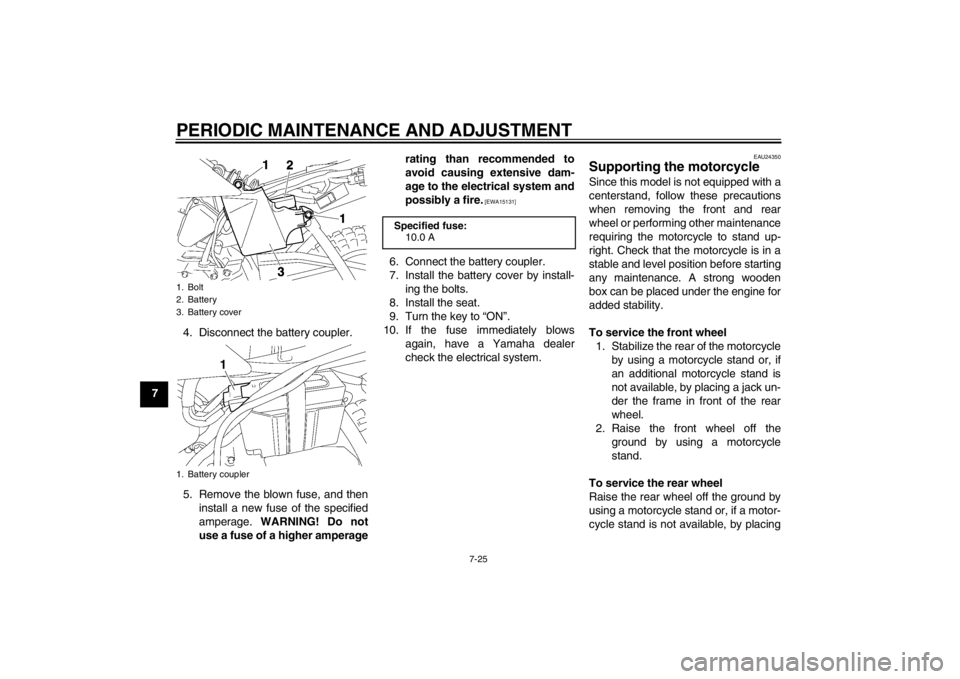
74. Disconnect the battery coupler.
5. Remove the blown fuse, and then
install a new fuse of the specified
amperage. WARNING! Do not
use a fuse of a higher amperage rating than recommended to
avoid causing extensive dam-
age to the electrical system and
possibly a fire.
[EWA15131]
6. Connect the battery coupler.
7. Install the battery cover by install-
ing the bolts.
8. Install the seat.
9. Turn the key to “ON”.
10. If the fuse immediately blows again, have a Yamaha dealer
check the electrical system.
EAU24350
Supporting the motorcycle Since this model is not equipped with a
centerstand, follow these precautions
when removing the front and rear
wheel or performing other maintenance
requiring the motorcycle to stand up-
right. Check that the motorcycle is in a
stable and level position before starting
any maintenance. A strong wooden
box can be placed under the engine for
added stability.
To service the front wheel1. Stabilize the rear of the motorcycle by using a motorcycle stand or, if
an additional motorcycle stand is
not available, by placing a jack un-
der the frame in front of the rear
wheel.
2. Raise the front wheel off the ground by using a motorcycle
stand.
To service the rear wheel
Raise the rear wheel off the ground by
using a motorcycle stand or, if a motor-
cycle stand is not available, by placing
1. Bolt
2. Battery
3. Battery cover
1. Battery coupler
1
Specified fuse: 10.0 A
U2CJ80E0.book Page 25 Tuesday, June 12, 2012 11:15 AM
Page 69 of 86
PERIODIC MAINTENANCE AND ADJUSTMENT
7-26
7
a jack either under each side of the
frame in front of the rear wheel or under
each side of the swingarm.
EAU24360
Front wheel
EAU39793
To remove the front wheel
WARNING
EWA10821
To avoid injury, securely support the
vehicle so there is no danger of it
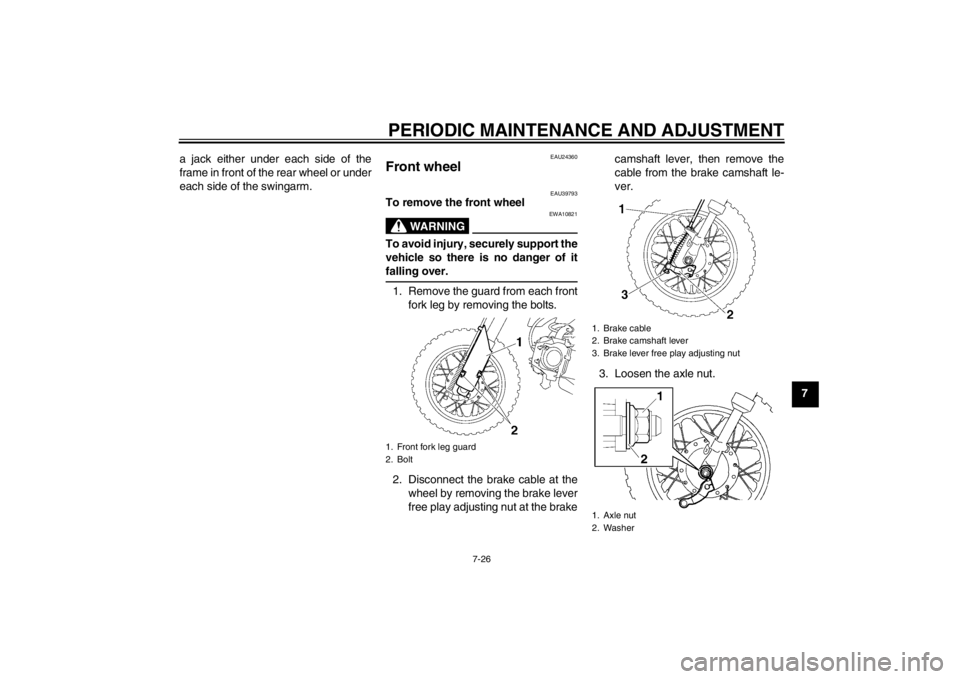
falling over.1. Remove the guard from each front
fork leg by removing the bolts.
2. Disconnect the brake cable at the wheel by removing the brake lever
free play adjusting nut at the brake camshaft lever, then remove the
cable from the brake camshaft le-
ver.
3. Loosen the axle nut.1. Front fork leg guard
2. Bolt
1. Brake cable
2. Brake camshaft lever
3. Brake lever free play adjusting nut
1. Axle nut
2. Washer
U2CJ80E0.book Page 26 Tuesday, June 12, 2012 11:15 AM
Page 70 of 86
PERIODIC MAINTENANCE AND ADJUSTMENT
7-27
74. Lift the front wheel off the ground
according to the procedure in the
previous section “Supporting the
motorcycle”.
5. Remove the axle nut and washer.
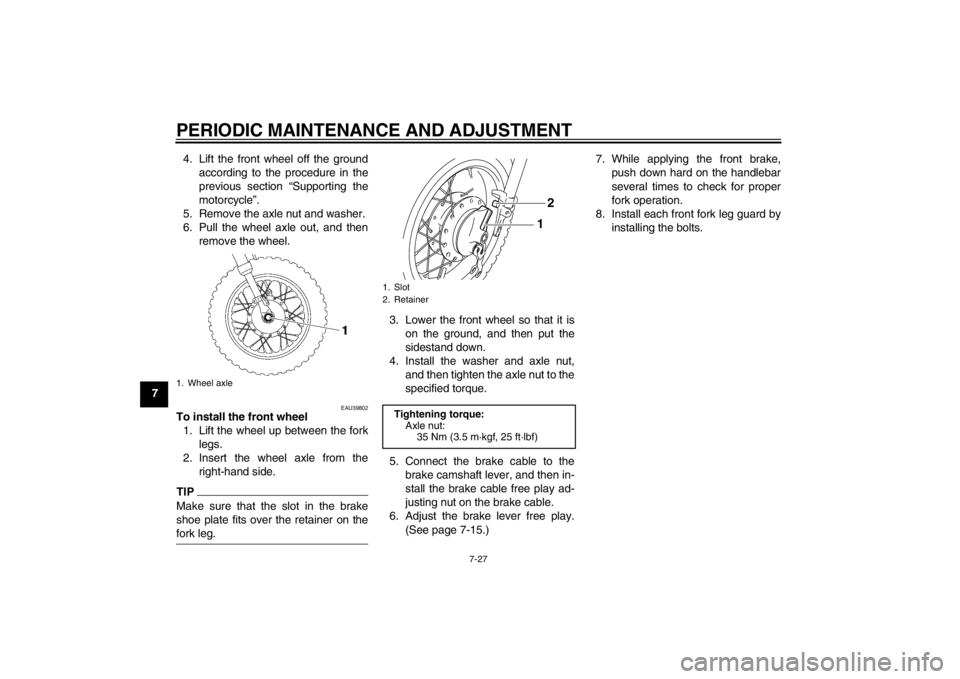
6. Pull the wheel axle out, and then remove the wheel.
EAU39802
To install the front wheel1. Lift the wheel up between the fork legs.
2. Insert the wheel axle from the right-hand side.TIPMake sure that the slot in the brake
shoe plate fits over the retainer on the
fork leg.
3. Lower the front wheel so that it ison the ground, and then put the
sidestand down.
4. Install the washer and axle nut, and then tighten the axle nut to the
specified torque.
5. Connect the brake cable to the brake camshaft lever, and then in-
stall the brake cable free play ad-
justing nut on the brake cable.
6. Adjust the brake lever free play. (See page 7-15.) 7. While applying the front brake,
push down hard on the handlebar
several times to check for proper
fork operation.
8. Install each front fork leg guard by installing the bolts.
1. Wheel axle
1. Slot
2. RetainerTightening torque:Axle nut:35 Nm (3.5 m·kgf, 25 ft·lbf)
2
1
U2CJ80E0.book Page 27 Tuesday, June 12, 2012 11:15 AM
Page 71 of 86
PERIODIC MAINTENANCE AND ADJUSTMENT
7-28
7
EAU25080
Rear wheel
EAU39774
To remove the rear wheel
WARNING
EWA10821
To avoid injury, securely support the
vehicle so there is no danger of it
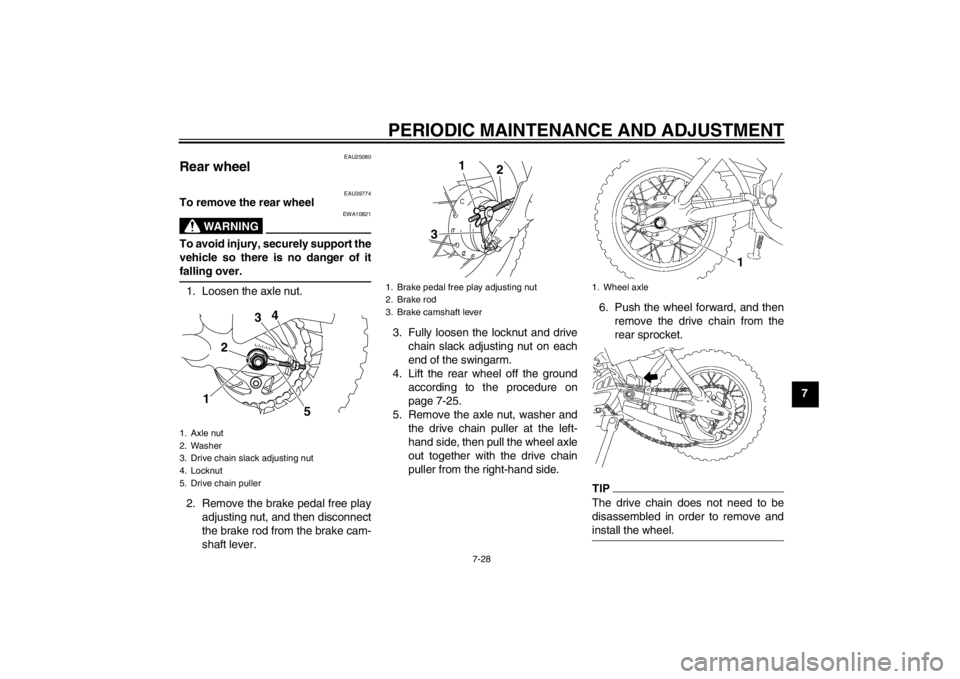
falling over.1. Loosen the axle nut.
2. Remove the brake pedal free playadjusting nut, and then disconnect
the brake rod from the brake cam-
shaft lever. 3. Fully loosen the locknut and drive
chain slack adjusting nut on each
end of the swingarm.
4. Lift the rear wheel off the ground according to the procedure on
page 7-25.
5. Remove the axle nut, washer and the drive chain puller at the left-
hand side, then pull the wheel axle
out together with the drive chain
puller from the right-hand side. 6. Push the wheel forward, and then
remove the drive chain from the
rear sprocket.
TIPThe drive chain does not need to be
disassembled in order to remove and
install the wheel.
1. Axle nut
2. Washer
3. Drive chain slack adjusting nut
4. Locknut
5. Drive chain puller
1
5
4
3
2
1. Brake pedal free play adjusting nut
2. Brake rod
3. Brake camshaft lever
1
2
3
1. Wheel axle
U2CJ80E0.book Page 28 Tuesday, June 12, 2012 11:15 AM
Page 72 of 86
PERIODIC MAINTENANCE AND ADJUSTMENT
7-29
77. Remove the wheel.
EAU39783
To install the rear wheel
1. Install the drive chain onto the rear sprocket, lift the rear wheel off the
ground, and then install the drive
chain puller and the wheel by in-
serting the wheel axle from the
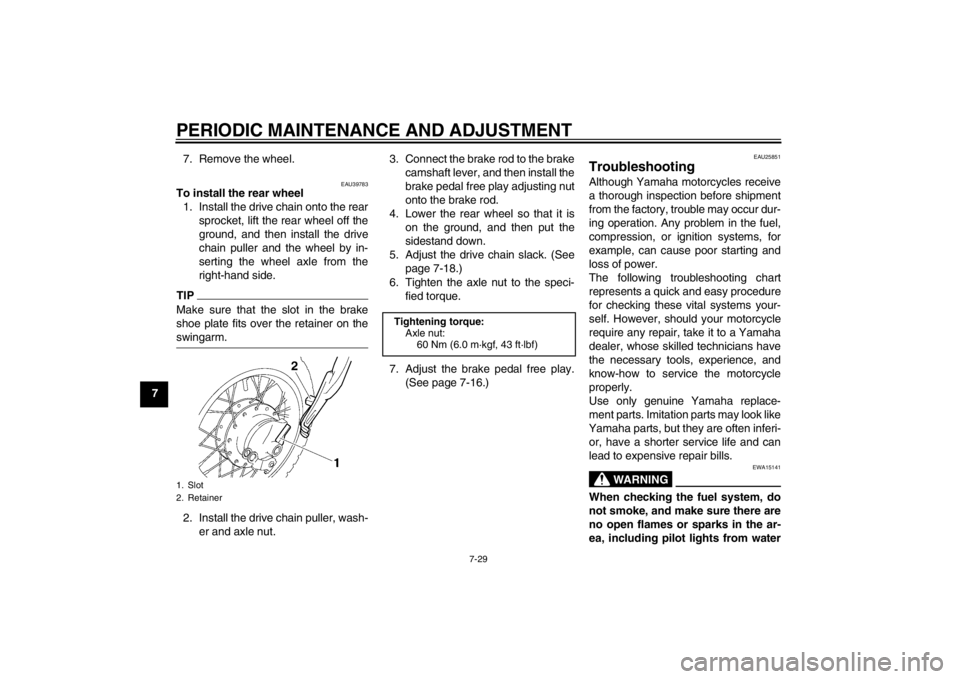
right-hand side.TIPMake sure that the slot in the brake
shoe plate fits over the retainer on the
swingarm.2. Install the drive chain puller, wash-er and axle nut. 3. Connect the brake rod to the brake
camshaft lever, and then install the
brake pedal free play adjusting nut
onto the brake rod.
4. Lower the rear wheel so that it is on the ground, and then put the
sidestand down.
5. Adjust the drive chain slack. (See page 7-18.)
6. Tighten the axle nut to the speci- fied torque.
7. Adjust the brake pedal free play. (See page 7-16.)
EAU25851
Troubleshooting Although Yamaha motorcycles receive
a thorough inspection before shipment
from the factory, trouble may occur dur-
ing operation. Any problem in the fuel,
compression, or ignition systems, for
example, can cause poor starting and
loss of power.
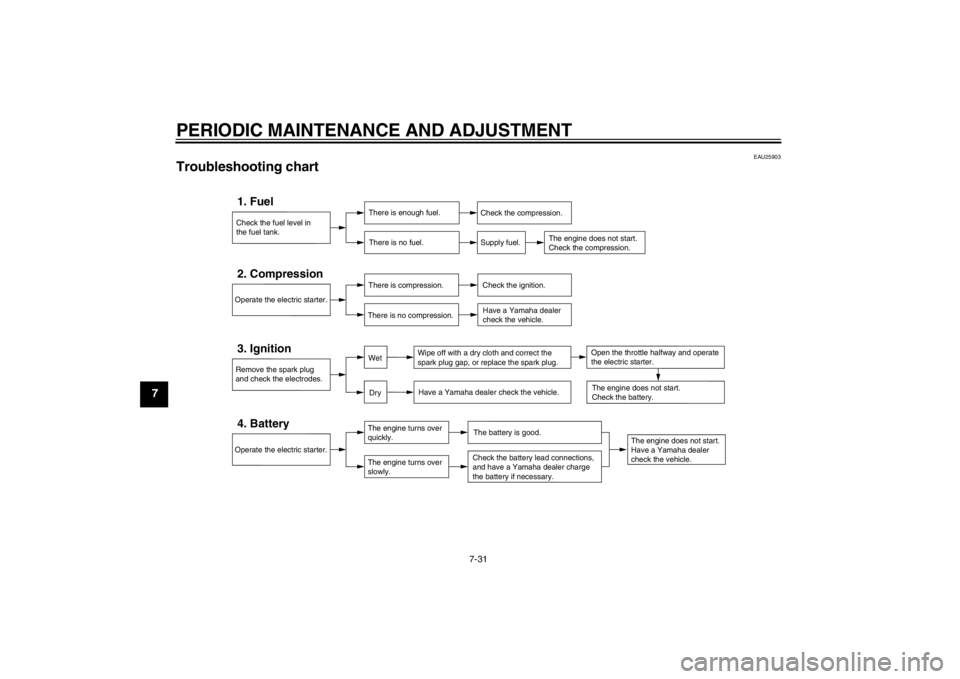
The following troubleshooting chart
represents a quick and easy procedure
for checking these vital systems your-
self. However, should your motorcycle
require any repair, take it to a Yamaha
dealer, whose skilled technicians have
the necessary tools, experience, and
know-how to service the motorcycle
properly.
Use only genuine Yamaha replace-
ment parts. Imitation parts may look like
Yamaha parts, but they are often inferi- or, have a shorter service life and can
lead to expensive repair bills.
WARNING
EWA15141
When checking the fuel system, do
not smoke, and make sure there are
no open flames or sparks in the ar-
ea, including pilot lights from water
1. Slot
2. Retainer
Tightening torque: Axle nut:60 Nm (6.0 m·kgf, 43 ft·lbf)
U2CJ80E0.book Page 29 Tuesday, June 12, 2012 11:15 AM
Page 73 of 86
PERIODIC MAINTENANCE AND ADJUSTMENT
7-30
7
heaters or furnaces. Gasoline or
gasoline vapors can ignite or ex-
plode, causing severe injury or
property damage.
U2CJ80E0.book Page 30 Tuesday, June 12, 2012 11:15 AM
Page 74 of 86
PERIODIC MAINTENANCE AND ADJUSTMENT
7-31
7
EAU25903
Troubleshooting chart
Check the fuel level in
the fuel tank.1. Fuel
There is enough fuel.There is no fuel.
Check the compression.
Supply fuel.
The engine does not start.
Check the compression.
Operate the electric starter.2. Compression
There is compression.
There is no compression.
Check the ignition. Have a Yamaha dealer
check the vehicle.
Remove the spark plug
and check the electrodes.3. Ignition
Wipe off with a dry cloth and correct the
spark plug gap, or replace the spark plug.
Have a Yamaha dealer check the vehicle.
The engine does not start.
Have a Yamaha dealer
check the vehicle.
The engine does not start.
Check the battery.
Operate the electric starter.4. Battery
The engine turns over
quickly.
The engine turns over
slowly.
The battery is good.Check the battery lead connections,
and have a Yamaha dealer charge
the battery if necessary.
DryWet
Open the throttle halfway and operate
the electric starter.
U2CJ80E0.book Page 31 Tuesday, June 12, 2012 11:15 AM
Page 84 of 86

INDEXAAir filter element, cleaning....................... 7-8BBattery................................................... 7-23
Brake lever .............................................. 4-3
Brake lever, checking and lubricating ... 7-20
Brake lever free play, adjusting............. 7-15
Brake pedal ............................................. 4-3
Brake pedal, checking and lubricating ........................................... 7-21
Brake pedal free play, adjusting............ 7-16
Brake shoes, checking .......................... 7-17CCables, checking and lubricating .......... 7-20
Carburetor, adjusting ............................ 7-11
Care ........................................................ 8-1
Clutch free play, adjusting..................... 7-15DDrive chain, cleaning and lubricating .... 7-19
Drive chain slack ................................... 7-18EEngine break-in ....................................... 6-3
Engine idling speed............................... 7-11
Engine oil ................................................ 7-7
Engine, starting a warm .......................... 6-2
Engine stop switch .................................. 4-2FFront fork, checking .............................. 7-22
Fuel ......................................................... 4-4
Fuel cock................................................. 4-7
Fuel tank breather hose .......................... 4-7
Fuel tank cap .......................................... 4-4
Fuse, replacing ..................................... 7-24
HHandlebar switches ................................ 4-1IIdentification numbers .......................... 10-1LLabels, location....................................... 1-1MMain switch ............................................. 4-1
Maintenance and lubrication, periodic .... 7-3
Maintenance, emission control system... 7-2
Matte color, caution ................................ 8-1
Model label ........................................... 10-1PParking ................................................... 6-4
Part locations .......................................... 3-1SSafety information................................... 2-1
Seat ........................................................ 4-8
Shifting.................................................... 6-2
Shift pedal............................................... 4-3
Shift pedal, checking ............................ 7-17
Sidestand................................................ 4-9
Sidestand, checking and lubricating ..... 7-21
Spark arrester, cleaning ....................... 7-10
Spark plug, checking .............................. 7-6
Specifications ......................................... 9-1
Speed limiter........................................... 4-2
Starter (choke) lever ............................... 4-8
Starting and warming up a cold
engine .................................................. 6-1
Starting circuit cut-off system ................. 4-9
Start switch ............................................. 4-2
Steering, checking ................................ 7-22
Storage ................................................... 8-3 Supporting the motorcycle .................... 7-25
Swingarm pivots, lubricating ................. 7-21
TThrottle grip and cable, checking and
lubricating ........................................... 7-20
Throttle grip free play, checking ............ 7-12
Tires ...................................................... 7-13
Troubleshooting .................................... 7-29
Troubleshooting chart ........................... 7-31VValve clearance..................................... 7-12
Vehicle Emission Control Information
label (For Canada) .............................. 10-2
Vehicle identification number ................ 10-1WWheel bearings, checking ..................... 7-23
Wheel (front) ......................................... 7-26
Wheel (rear) .......................................... 7-28
Wheels .................................................. 7-14
U2CJ80E0.book Page 1 Tuesday, June 12, 2012 11:15 AM