brake YAMAHA TW200 2003 User Guide
[x] Cancel search | Manufacturer: YAMAHA, Model Year: 2003, Model line: TW200, Model: YAMAHA TW200 2003Pages: 74, PDF Size: 1.57 MB
Page 50 of 74
6-20
PERIODIC MAINTENANCE AND MINOR REPAIR
1
2
3
4
5
6
7
8
9
b1
2a
EAU00713
Brake light switch
adjustment
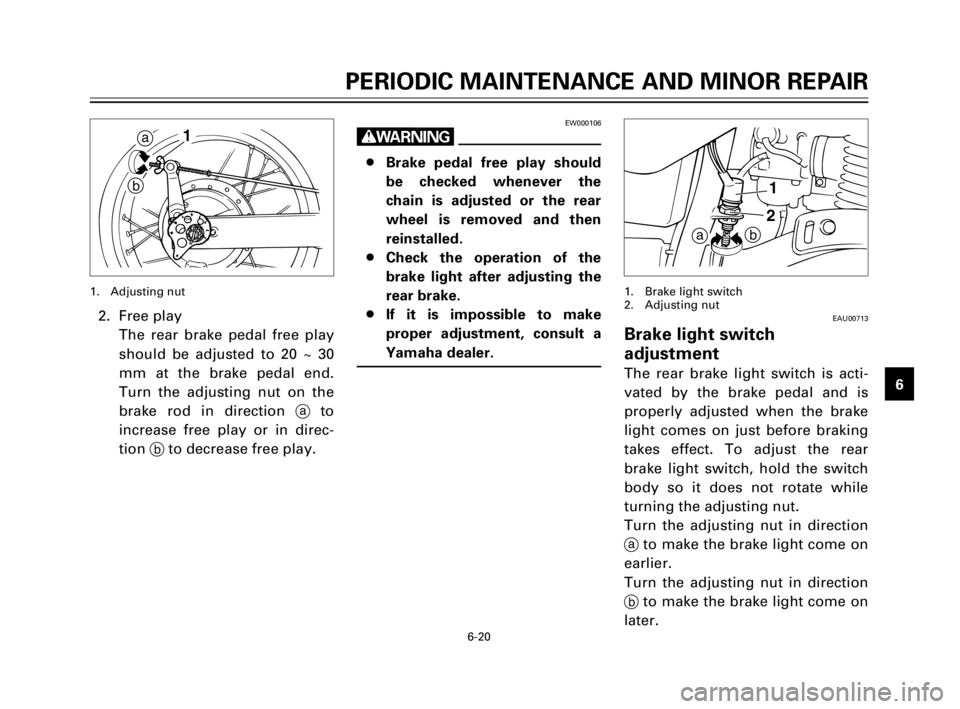
The rear brake light switch is acti-
vated by the brake pedal and is
properly adjusted when the brake
light comes on just before braking
takes effect. To adjust the rear
brake light switch, hold the switch
body so it does not rotate while
turning the adjusting nut.
Turn the adjusting nut in direction
ato make the brake light come on
earlier.
Turn the adjusting nut in direction
bto make the brake light come on
later.
1. Brake light switch
2. Adjusting nut
EW000106
w
8Brake pedal free play should
be checked whenever the
chain is adjusted or the rear
wheel is removed and then
reinstalled.
8Check the operation of the
brake light after adjusting the
rear brake.
8If it is impossible to make
proper adjustment, consult a
Yamaha dealer.
2. Free play
The rear brake pedal free play
should be adjusted to 20 ~ 30
mm at the brake pedal end.
Turn the adjusting nut on the
brake rod in direction ato
increase free play or in direc-
tion bto decrease free play.
a
b1
1. Adjusting nut
5FY-9-E0 (TW200) 7/29/02 10:54 AM Page 49
Page 51 of 74
6-21
PERIODIC MAINTENANCE AND MINOR REPAIR
1
2
3
4
5
6
7
8
9
EAU00744Drive chain slack check
NOTE:
Spin the wheel several times and
find the tightest position of the
chain. Check and/or adjust the
chain slack while it’s in this tightest
position.
EAU00719
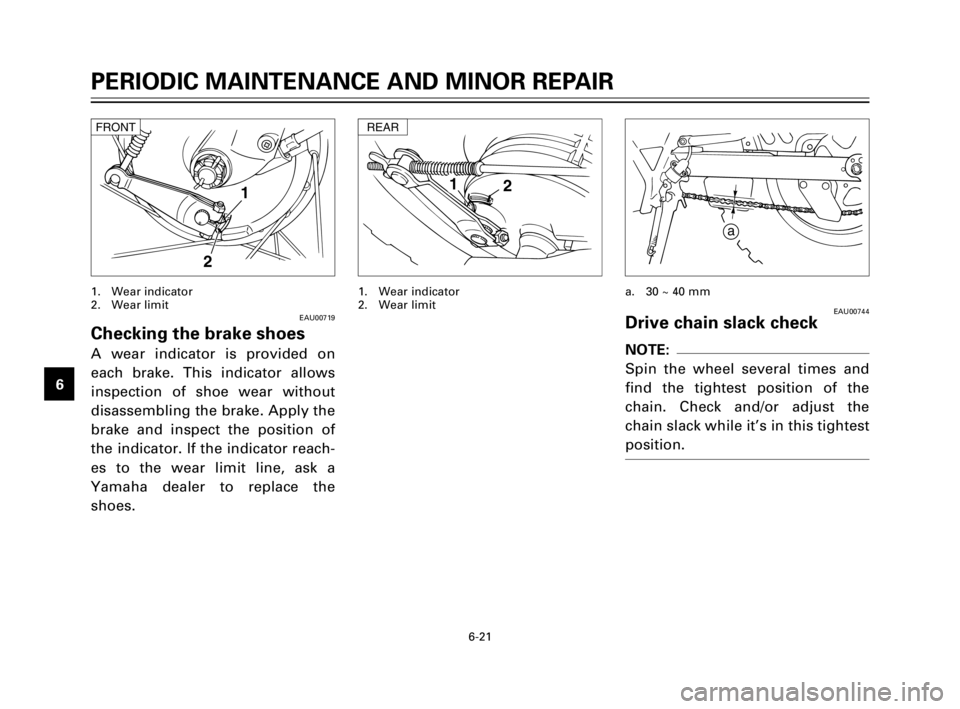
Checking the brake shoes
A wear indicator is provided on
each brake. This indicator allows
inspection of shoe wear without
disassembling the brake. Apply the
brake and inspect the position of
the indicator. If the indicator reach-
es to the wear limit line, ask a
Yamaha dealer to replace the
shoes.
1
2
1. Wear indicator
2. Wear limit
FRONT
21
1. Wear indicator
2. Wear limit
REAR
a
a. 30 ~ 40 mm
5FY-9-E0 (TW200) 7/29/02 10:54 AM Page 50
Page 52 of 74

6-22
PERIODIC MAINTENANCE AND MINOR REPAIR
1
2
3
4
5
6
7
8
9 To check the chain slack the motor-
cycle must be held straight up with
both wheels on the ground and
without rider. Check the slack at
the position shown in the illustra-
tion. Normal slack is approximately
30 ~ 40 mm. If the slack exceeds 40
mm, adjust.
EAU01302
Drive chain slack adjustment
1. Loosen the rear brake adjust-
ing nut.
2. Remove the cotter pin from
the axle nut.
3. Loosen the axle nut.
4. Turn both left and right chain
adjusting plates the same
amount. Make sure that they
are in the same position for
proper wheel alignment.
1
2
3 4
1. Adjusting nut
2. Axle nut
3. Cotter pin
4. Chain adjusting plate
EC000096
cC
Too little chain slack will overload
the engine and other vital parts.
Keep the slack within the specified
limits.
5. After adjusting, be sure to
tighten the axle nut to the
specified torque.
Tightening torque:
Axle nut:
90 Nm (9.0 m0kg)
5FY-9-E0 (TW200) 7/29/02 10:54 AM Page 51
Page 53 of 74

6-23
PERIODIC MAINTENANCE AND MINOR REPAIR
1
2
3
4
5
6
7
8
9
1
6. Insert a new cotter pin into the
axle nut and bend the end of
the cotter pin as shown in the
illustration. If the notch in the
nut and cotter pin hole do not
match, tighten the nut slightly
to align them.
EW000110
w
Always use a new cotter pin on
the axle nut.
1. Cotter pin
7. Adjust the free play in the
brake pedal.
EW000103
w
Check the operation of the brake
light after adjusting the rear brake.
EAU01106Drive chain lubrication
The chain consists of many parts
which work with each other. If the
chain is not maintained properly, it
will wear out quickly. Therefore,
the chain must be serviced regular-
ly. This service is especially neces-
sary when riding in dusty areas.
1. The drive chain should be
lubricated every 500 km. First,
remove all dirt and mud from
the chain with a brush or cloth.
Then, spray any of the many
brands of spray-type chain
lubricant between both rows
of side plates and on all center
rollers.
2. To clean the chain thoroughly,
remove it from the motorcycle,
dip it in solvent, and clean out
as much dirt as possible. Then,
take the chain out of the sol-
vent to dry it, and immediately
lubricate it to prevent it from
rusting.
5FY-9-E0 (TW200) 7/29/02 10:54 AM Page 52
Page 54 of 74

6-24
PERIODIC MAINTENANCE AND MINOR REPAIR
1
2
3
4
5
6
7
8
9
EAU00772
Cable inspection and
lubrication
EW000112
w
Damage to the outer housing of
cables may lead to internal rusting
and interfere with the cable move-
ment. Replace damaged cables as
soon as possible to prevent unsafe
conditions.
Lubricate the cables and cable
ends. If a cable does not operate
smoothly, ask a Yamaha dealer to
replace it.
Recommended lubricant:
Same as engine oil
EAU00773
Throttle cable and grip
lubrication
The throttle twist grip assembly
should be greased at the time that
the cable is lubricated, since the
grip must be removed to get at the
end of the throttle cable. After
removing the screws, hold the end
of the cable up in the air and put in
several drops of lubricant. With the
throttle grip disassembled, coat the
metal surface of the grip assembly
with a suitable all-purpose grease.
EAU00776
Brake and shift pedal
lubrication
Lubricate the pivoting parts.
Recommended lubricant:
Same as engine oil
5FY-9-E0 (TW200) 7/29/02 10:54 AM Page 53
Page 55 of 74

6-25
PERIODIC MAINTENANCE AND MINOR REPAIR
1
2
3
4
5
6
7
8
9
EAU00778
Brake and clutch lever
lubrication
Lubricate the pivoting parts.
EAU00785
Sidestand lubrication
Lubricate the sidestand pivoting
point and metal-to-metal contact
surfaces. Check that the sidestand
moves up and down smoothly.
EW000113
w
If the sidestand does not move
smoothly, consult a Yamaha deal-
er.
Recommended lubricant:
Same as engine oil
Recommended lubricant:
Same as engine oil
EAU00791
Rear suspension lubrication
Lubricate the pivoting parts.
Recommended lubricant:
Lithium soap base grease
5FY-9-E0 (TW200) 7/29/02 10:54 AM Page 54
Page 56 of 74
6-26
PERIODIC MAINTENANCE AND MINOR REPAIR
1
2
3
4
5
6
7
8
9
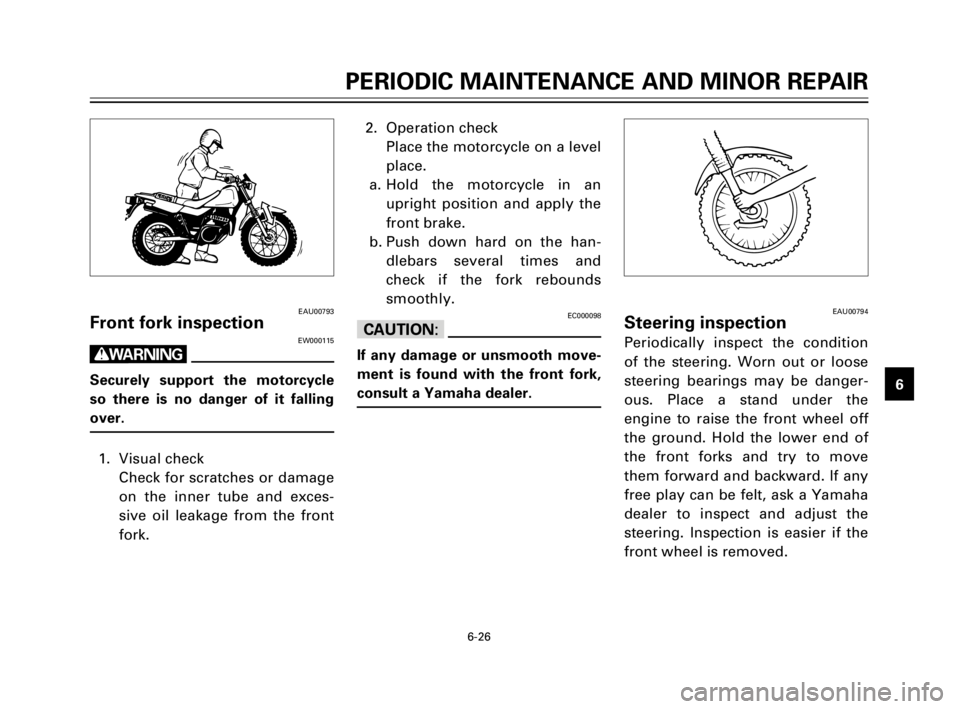
EAU00793Front fork inspection
EW000115
w
Securely support the motorcycle
so there is no danger of it falling
over.
1. Visual check
Check for scratches or damage
on the inner tube and exces-
sive oil leakage from the front
fork.2. Operation check
Place the motorcycle on a level
place.
a. Hold the motorcycle in an
upright position and apply the
front brake.
b. Push down hard on the han-
dlebars several times and
check if the fork rebounds
smoothly.
EC000098
cC
If any damage or unsmooth move-
ment is found with the front fork,
consult a Yamaha dealer.
EAU00794Steering inspection
Periodically inspect the condition
of the steering. Worn out or loose
steering bearings may be danger-
ous. Place a stand under the
engine to raise the front wheel off
the ground. Hold the lower end of
the front forks and try to move
them forward and backward. If any
free play can be felt, ask a Yamaha
dealer to inspect and adjust the
steering. Inspection is easier if the
front wheel is removed.
5FY-9-E0 (TW200) 7/29/02 10:54 AM Page 55
Page 62 of 74

6-32
PERIODIC MAINTENANCE AND MINOR REPAIR
1
2
3
4
5
6
7
8
9 2. Loosen the brake cable free
play adjusting nuts. Remove
the brake cable from the han-
dlebar lever holder and then
from the front wheel hub.
3. Remove the cotter pin and
loosen the axle nut.
4. Elevate the front wheel by
placing a suitable stand under
the engine.
5. Remove the axle nut and
wheel axle.3. Make sure the axle nut is prop-
erly torqued, and a new cotter
pin is installed.
EW000124
w
Always use a new cotter pin.
4. Adjust the free play in the
brake lever. Axle holder nut torque:
90 Nm (9.0 m0kg)EAU00927
Front wheel installation
When installing the front wheel,
reverse the removal procedure.
Pay attention to the following
points:
1. Make sure the wheel hub and
the brake shoe plate assembly
are installed with the projec-
tions meshed into the slots.
2. Make sure the slot in the brake
shoe plate fits over the stopper
on the front fork outer tube.
5FY-9-E0 (TW200) 7/29/02 10:54 AM Page 61
Page 63 of 74

6-33
PERIODIC MAINTENANCE AND MINOR REPAIR
1
2
3
4
5
6
7
8
9
EAU01304
Rear wheel removalEW000122
w
8It is advisable to have a
Yamaha dealer service the
wheel.
8Securely support the motorcy-
cle so there is no danger of it
falling over.
1. Remove the brake adjusting
nut and brake rod from the
brake cam lever.
1
2
3
4 5
1. Adjusting nut
2. Brake rod
3. Axle nut
4. Cotter pin
5. Chain adjusting plate
2. Remove the axle nut cotter pin
and loosen the axle nut.
3. Elevate the rear wheel by plac-
ing a suitable stand under the
engine.
4. Remove the axle nut.
5. Push the wheel forward and
remove the drive chain.
6. Pull out the axle and remove
the rear wheel assembly by
pulling it backwards.EAU01308
Rear wheel installation
1. Install the wheel assembly and
insert the axle from the left-
hand side. Be sure that the
chain adjusting plates are
installed with the punched side
outward and the slot in the
brake shoe plate is fit over the
stopper on the swingarm.
2. Install and adjust the drive
chain. (See page 6-22 for
details about adjusting the
drive chain slack.)
3. Install the axle nut and let the
motorcycle down.
4. Tighten the axle nut to the
specified torque and install the
axle nut cotter pin.
Tightening torque:
Axle nut:
90 Nm (9.0 m0kg)
5FY-9-E0 (TW200) 7/29/02 10:54 AM Page 62
Page 64 of 74

6-34
PERIODIC MAINTENANCE AND MINOR REPAIR
1
2
3
4
5
6
7
8
9
EW000110
w
Always use a new cotter pin on
the axle nut.
5. Insert the brake rod into the
brake cam lever and install the
brake pedal free play adjusting
nut.
6. Adjust the rear brake pedal
free play. (See page 6-19.)
EW000103
w
Check the operation of the brake
light after adjusting the rear brake.
EAU01008Troubleshooting
Although Yamaha motorcycles
receive a rigid inspection before
shipment from the factory, trouble
may occur during operation.
Any problem in the fuel, compres-
sion, or ignition systems can cause
poor starting and loss of power.
The troubleshooting chart
describes a quick, easy procedure
for making checks.
If your motorcycle requires any
repair, bring it to a Yamaha dealer.
The skilled technicians at a
Yamaha dealership have the tools,
experience, and know-how to
properly service your motorcycle.
Use only genuine Yamaha parts on
your motorcycle. Imitation parts
may look like Yamaha parts, but
they are often inferior.
Consequently, they have a shorter
service life and can lead to expen-
sive repair bills.
5FY-9-E0 (TW200) 7/29/02 10:54 AM Page 63