light YAMAHA TZR50 2010 User Guide
[x] Cancel search | Manufacturer: YAMAHA, Model Year: 2010, Model line: TZR50, Model: YAMAHA TZR50 2010Pages: 88, PDF Size: 1.83 MB
Page 34 of 88
EAU16640
Starting a warm engine
Follow the same procedure as for
starting a cold engine with the excep-
tion that the starter (choke) is not
required when the engine is warm.
EAU16671
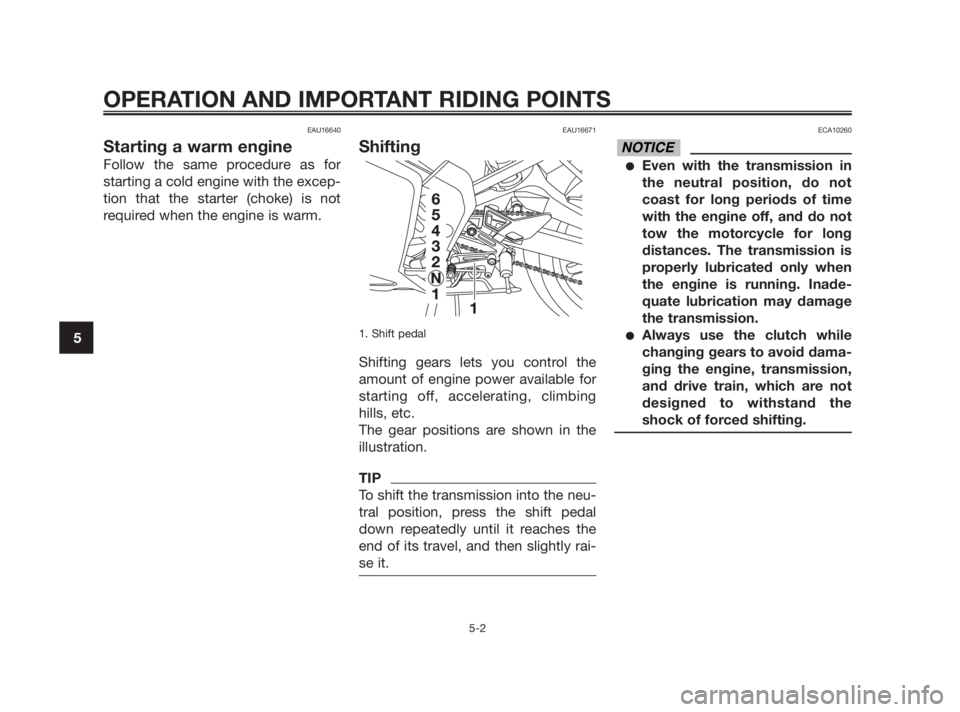
Shifting
1. Shift pedal
Shifting gears lets you control the
amount of engine power available for
starting off, accelerating, climbing
hills, etc.
The gear positions are shown in the
illustration.
TIP
To shift the transmission into the neu-
tral position, press the shift pedal
down repeatedly until it reaches the
end of its travel, and then slightly rai-
se it.
ECA10260
●Even with the transmission in
the neutral position, do not
coast for long periods of time
with the engine off, and do not
tow the motorcycle for long
distances. The transmission is
properly lubricated only when
the engine is running. Inade-
quate lubrication may damage
the transmission.
●Always use the clutch while
changing gears to avoid dama-
ging the engine, transmission,
and drive train, which are not
designed to withstand the
shock of forced shifting.
NOTICE
OPERATION AND IMPORTANT RIDING POINTS
5-2
5
5WX-F8199-E3 7/11/08 16:50 Página 34
Page 35 of 88
EAU16800
Tips for reducing fuel con-
sumption
Fuel consumption depends largely on
your riding style. Consider the follo-
wing tips to reduce fuel consumption:
●Turn the starter (choke) off as
soon as possible.
●Shift up swiftly, and avoid high
engine speeds during accelera-
tion.
●Do not rev the engine while shif-
ting down, and avoid high engine
speeds with no load on the engi-
ne.
●Turn the engine off instead of let-
ting it idle for an extended length
of time (e.g., in traffic jams, at
traffic lights or at railroad cros-
sings).
EAU16830
Engine break-in
There is never a more important
period in the life of your engine than
the period between 0 and 1000 km
(600 mi). For this reason, you should
read the following material carefully.
Since the engine is brand new, do not
put an excessive load on it for the first
1000 km (600 mi). The various parts in
the engine wear and polish themsel-
ves to the correct operating clearan-
ces. During this period, prolonged
full-throttle operation or any condition
that might result in engine overhea-
ting must be avoided.
EAUS1560
0–500 km (0–300 mi)
●Avoid prolonged operation above
4000 r/min.
●After every hour of operation,
stop the engine, and then let it
cool for five to ten minutes.
●Vary the engine speed from time
to time. Do not operate the engi-
ne at one set throttle position.500–1000 km (300–600 mi)
●Avoid prolonged operation above
6000 r/min.
●Rev the engine freely through the
gears, but do not use full throttle
at any time. NOTICE:After 1000
km (600 mi) of operation, the
transmission oil must be chan-
ged.
[ECA10370]
1000 km (600 mi) and beyond
●The vehicle can now be operated
normally.
ECA10310
●Keep the engine speed out of
the tachometer red zone.
●If any engine trouble should
occur during the engine break-
in period, immediately have a
Yamaha dealer check the vehi-
cle.
NOTICE
OPERATION AND IMPORTANT RIDING POINTS
5-3
5
5WX-F8199-E3 7/11/08 16:50 Página 35
Page 42 of 88
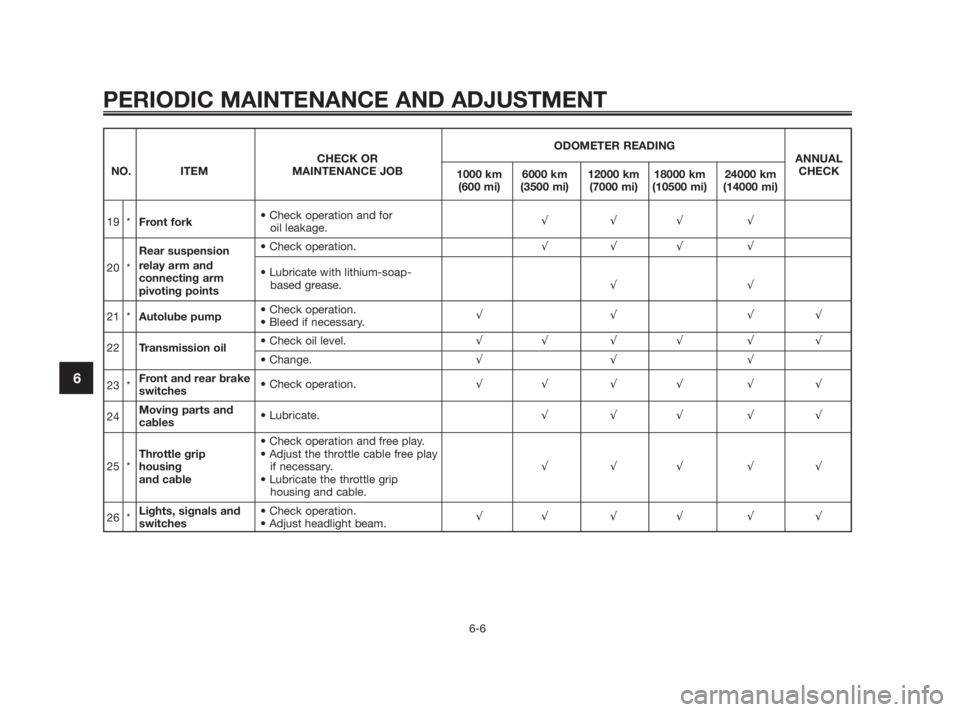
ODOMETER READING
CHECK OR ANNUAL
NO. ITEM MAINTENANCE JOB 1000 km 6000 km 12000 km 18000 km 24000 kmCHECK
(600 mi) (3500 mi) (7000 mi) (10500 mi) (14000 mi)
19 * Front fork • Check operation and for
oil leakage. √√√ √
20 *Rear suspension
• Check operation.
√√√ √
relay arm and • Lubricate with lithium-soap-
connecting arm
based grease. √√
pivoting points
21 * Autolube pump • Check operation.
• Bleed if necessary. √√ √√
22
Transmission oil • Check oil level.
√√ √ √ √ √• Change.√√ √
23 * Front and rear brake
switches • Check operation.
√√ √ √ √ √
24 Moving parts and
cables • Lubricate.
√√√ √√
• Check operation and free play.
Throttle grip • Adjust the throttle cable free play
25 * housing if necessary. √√√ √√
and cable • Lubricate the throttle grip
housing and cable.
26 * Lights, signals and
• Check operation.
switches • Adjust headlight beam. √√ √ √ √ √
PERIODIC MAINTENANCE AND ADJUSTMENT
6-6
6
5WX-F819D-E3 24/11/08 20:10 Página 42
Page 46 of 88
EAU19210
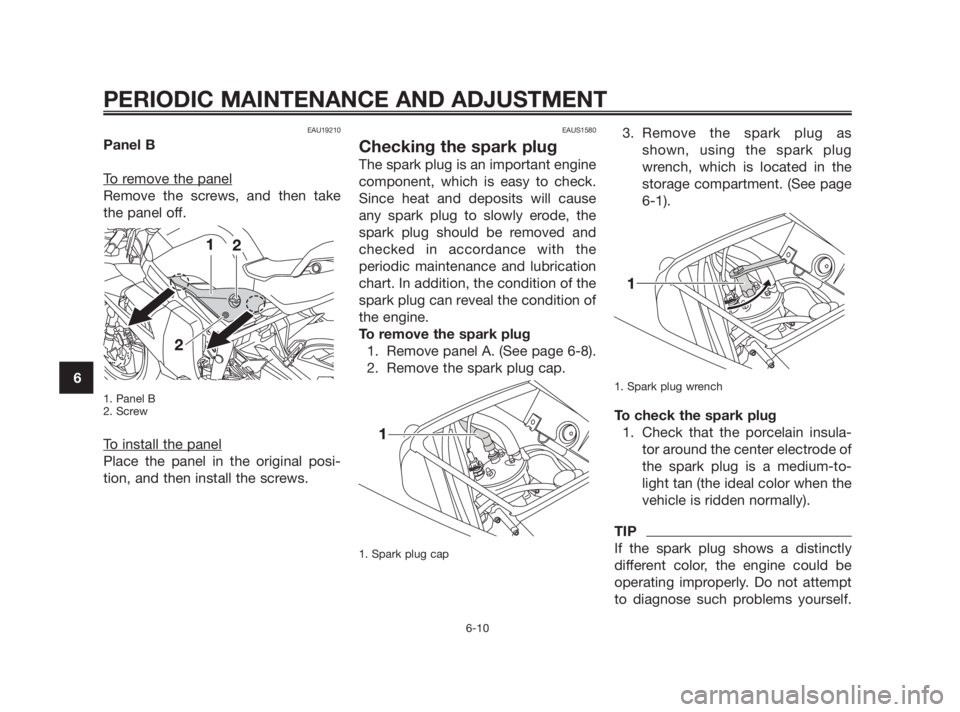
Panel B
T
o remove the panel
Remove the screws, and then take
the panel off.
1. Panel B
2. Screw
To install the panel
Place the panel in the original posi-
tion, and then install the screws.
EAUS1580
Checking the spark plug
The spark plug is an important engine
component, which is easy to check.
Since heat and deposits will cause
any spark plug to slowly erode, the
spark plug should be removed and
checked in accordance with the
periodic maintenance and lubrication
chart. In addition, the condition of the
spark plug can reveal the condition of
the engine.
To remove the spark plug
1. Remove panel A. (See page 6-8).
2. Remove the spark plug cap.
1. Spark plug cap
3. Remove the spark plug as
shown, using the spark plug
wrench, which is located in the
storage compartment. (See page
6-1).
1. Spark plug wrench
To check the spark plug
1. Check that the porcelain insula-
tor around the center electrode of
the spark plug is a medium-to-
light tan (the ideal color when the
vehicle is ridden normally).
TIP
If the spark plug shows a distinctly
different color, the engine could be
operating improperly. Do not attempt
to diagnose such problems yourself.
PERIODIC MAINTENANCE AND ADJUSTMENT
6-10
6
5WX-F8199-E3 7/11/08 16:51 Página 46
Page 48 of 88
TIP
Make sure that the vehicle is positio-
ned straight up when checking the oil
level. A slight tilt to the side can result
in a false reading.
3. Remove the oil check bolt, and
then check the oil level.
TIP
The oil should be at the brim of the
check hole.
4. If the oil is below the brim of the
check hole, remove the oil filler
cap, add sufficient oil of the
recommended type to raise it to
the correct level, and then install
the oil filler cap.
5. Install the oil check bolt, and then
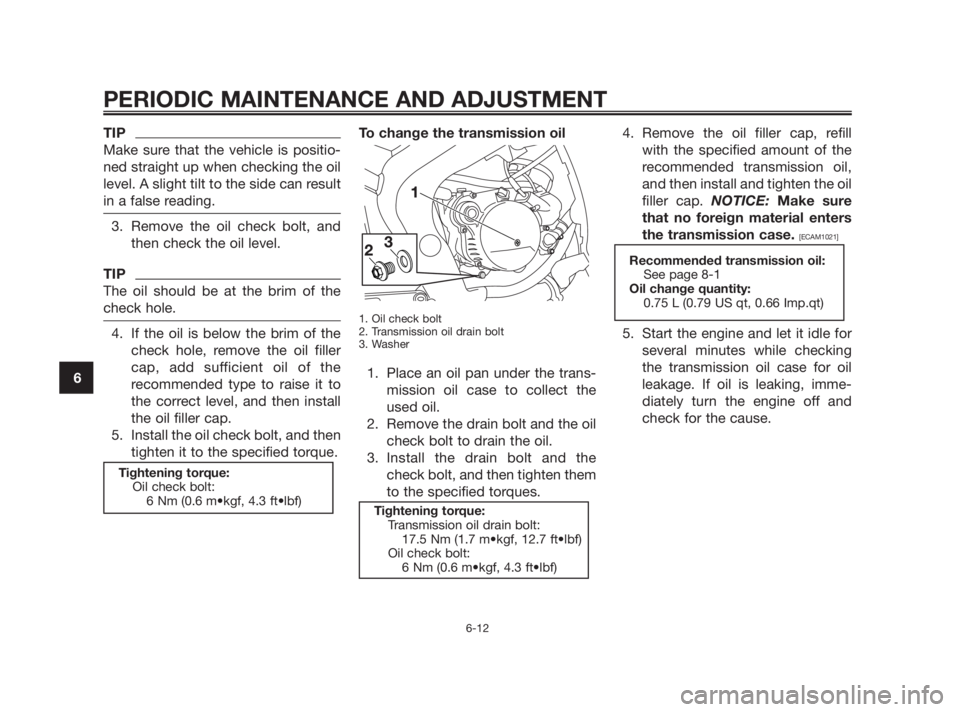
tighten it to the specified torque.To change the transmission oil
1. Oil check bolt
2. Transmission oil drain bolt
3. Washer
1. Place an oil pan under the trans-
mission oil case to collect the
used oil.
2. Remove the drain bolt and the oil
check bolt to drain the oil.
3. Install the drain bolt and the
check bolt, and then tighten them
to the specified torques.4. Remove the oil filler cap, refill
with the specified amount of the
recommended transmission oil,
and then install and tighten the oil
filler cap. NOTICE: Make sure
that no foreign material enters
the transmission case.
[ECAM1021]
5. Start the engine and let it idle for
several minutes while checking
the transmission oil case for oil
leakage. If oil is leaking, imme-
diately turn the engine off and
check for the cause.
Recommended transmission oil:
See page 8-1
Oil change quantity:
0.75 L (0.79 US qt, 0.66 Imp.qt)
Tightening torque:
Transmission oil drain bolt:
17.5 Nm (1.7 m•kgf, 12.7 ft•lbf)
Oil check bolt:
6 Nm (0.6 m•kgf, 4.3 ft•lbf)
Tightening torque:
Oil check bolt:
6 Nm (0.6 m•kgf, 4.3 ft•lbf)
PERIODIC MAINTENANCE AND ADJUSTMENT
6-12
6
5WX-F8199-E3 7/11/08 16:51 Página 48
Page 49 of 88
EAU20070
Coolant
The coolant level should be checked
before each ride. In addition, the coo-
lant must be changed at the intervals
specified in the periodic maintenance
and lubrication chart.
EAU39086
To check the coolant level
1. Place the vehicle on a level surfa-
ce and hold it in an upright posi-
tion.
TIP
●The coolant level must be chec-
ked on a cold engine since the
level varies with engine tempera-
ture.
●Make sure that the vehicle is
positioned straight up when
checking the coolant level. A
slight tilt to the side can result in
a false reading.
2. Check the coolant level in the
coolant reservoir.
TIP
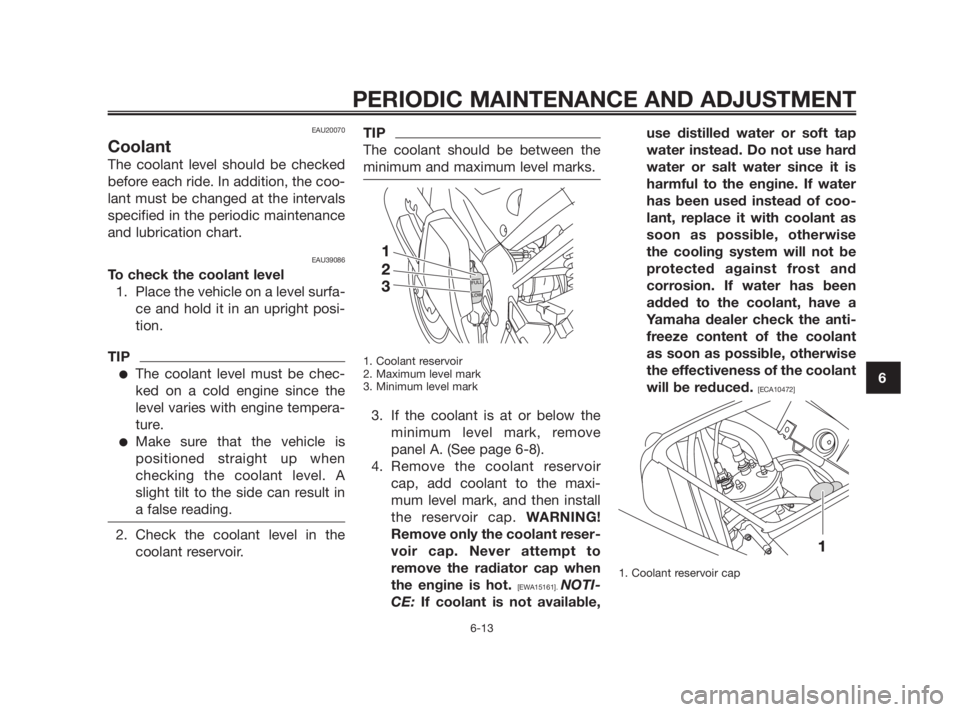
The coolant should be between the
minimum and maximum level marks.
1. Coolant reservoir
2. Maximum level mark
3. Minimum level mark
3. If the coolant is at or below the
minimum level mark, remove
panel A. (See page 6-8).
4. Remove the coolant reservoir
cap, add coolant to the maxi-
mum level mark, and then install
the reservoir cap. WARNING!
Remove only the coolant reser-
voir cap. Never attempt to
remove the radiator cap when
the engine is hot.
[EWA15161]. NOTI-
CE: If coolant is not available,use distilled water or soft tap
water instead. Do not use hard
water or salt water since it is
harmful to the engine. If water
has been used instead of coo-
lant, replace it with coolant as
soon as possible, otherwise
the cooling system will not be
protected against frost and
corrosion. If water has been
added to the coolant, have a
Yamaha dealer check the anti-
freeze content of the coolant
as soon as possible, otherwise
the effectiveness of the coolant
will be reduced.
[ECA10472]
1. Coolant reservoir cap
PERIODIC MAINTENANCE AND ADJUSTMENT
6-13
6
5WX-F8199-E3 7/11/08 16:51 Página 49
Page 57 of 88
EAUB1100
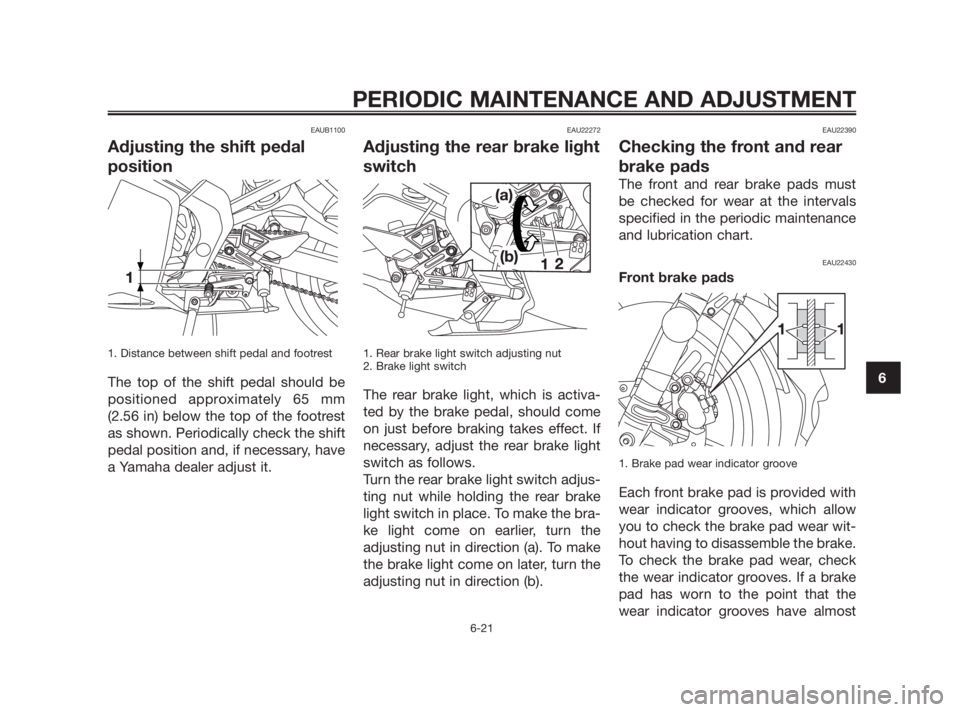
Adjusting the shift pedal
position
1. Distance between shift pedal and footrest
The top of the shift pedal should be
positioned approximately 65 mm
(2.56 in) below the top of the footrest
as shown. Periodically check the shift
pedal position and, if necessary, have
a Yamaha dealer adjust it.
EAU22272
Adjusting the rear brake light
switch
1. Rear brake light switch adjusting nut
2. Brake light switch
The rear brake light, which is activa-
ted by the brake pedal, should come
on just before braking takes effect. If
necessary, adjust the rear brake light
switch as follows.
Turn the rear brake light switch adjus-
ting nut while holding the rear brake
light switch in place. To make the bra-
ke light come on earlier, turn the
adjusting nut in direction (a). To make
the brake light come on later, turn the
adjusting nut in direction (b).
EAU22390
Checking the front and rear
brake pads
The front and rear brake pads must
be checked for wear at the intervals
specified in the periodic maintenance
and lubrication chart.
EAU22430
Front brake pads
1. Brake pad wear indicator groove
Each front brake pad is provided with
wear indicator grooves, which allow
you to check the brake pad wear wit-
hout having to disassemble the brake.
To check the brake pad wear, check
the wear indicator grooves. If a brake
pad has worn to the point that the
wear indicator grooves have almost
PERIODIC MAINTENANCE AND ADJUSTMENT
6-21
6
5WX-F8199-E3 7/11/08 16:51 Página 57
Page 68 of 88
3. Turn the key to “ ” and turn on
the electrical circuits to check if
the devices operate.
4. If the fuse immediately blows
again, have a Yamaha dealer
check the electrical system.
EAU23801
Replacing the headlight bulb
This model is equipped with a quartz
bulb headlight. If the headlight bulb
burns out, replace it as follows.
ECA10660
Do not touch the glass part of the
headlight bulb to keep it free from
oil, otherwise the transparency of
the glass, the luminosity of the
bulb, and the bulb life will be adver-
sely affected. Thoroughly clean off
any dirt and fingerprints on the
headlight bulb using a cloth mois-
tened with alcohol or thinner.
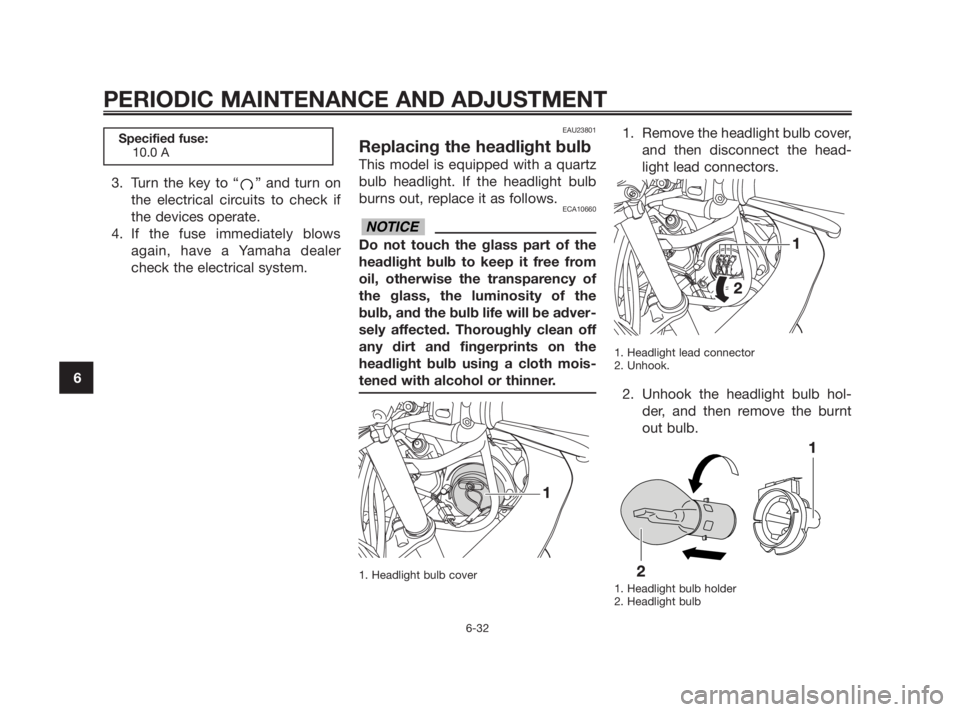
1. Headlight bulb cover
1. Remove the headlight bulb cover,
and then disconnect the head-
light lead connectors.
1. Headlight lead connector
2. Unhook.
2. Unhook the headlight bulb hol-
der, and then remove the burnt
out bulb.
1. Headlight bulb holder
2. Headlight bulb
NOTICE
Specified fuse:
10.0 A
PERIODIC MAINTENANCE AND ADJUSTMENT
6-32
6
5WX-F8199-E3 7/11/08 16:51 Página 68
Page 69 of 88
3. Place a new headlight bulb into
position, and then secure it with
the bulb holder.
4. Connect the headlight lead con-
nectors, and then install the bulb
cover.
5. Have a Yamaha dealer adjust the
headlight beam if necessary.EAU24133
Replacing the tail/brake light
bulb
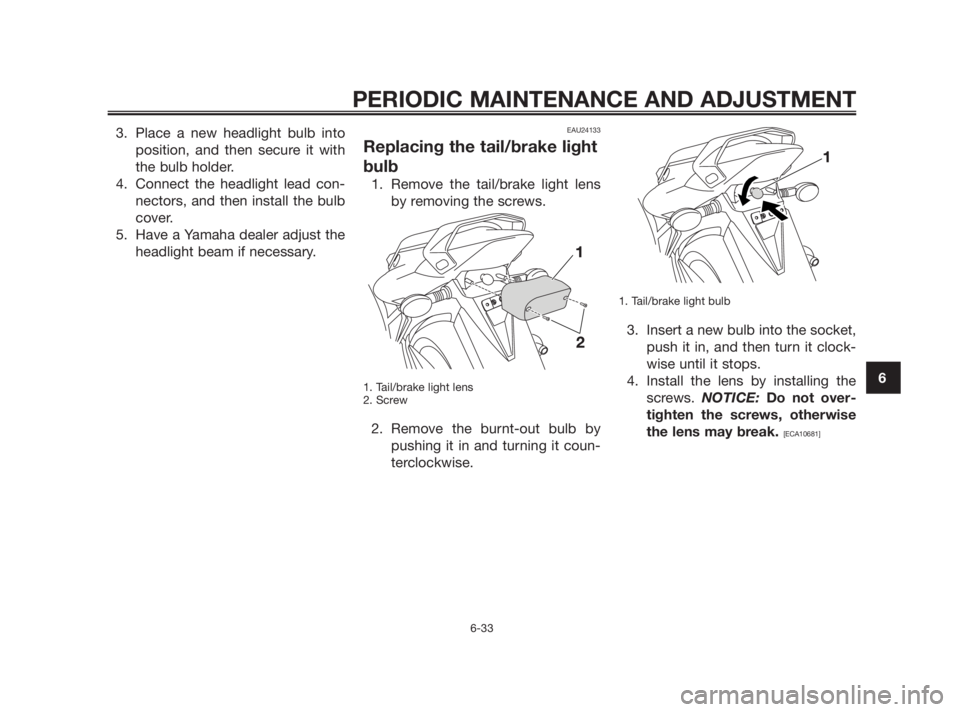
1. Remove the tail/brake light lens
by removing the screws.
1. Tail/brake light lens
2. Screw
2. Remove the burnt-out bulb by
pushing it in and turning it coun-
terclockwise.
1. Tail/brake light bulb
3. Insert a new bulb into the socket,
push it in, and then turn it clock-
wise until it stops.
4. Install the lens by installing the
screws. NOTICE: Do not over-
tighten the screws, otherwise
the lens may break.
[ECA10681]
PERIODIC MAINTENANCE AND ADJUSTMENT
6-33
6
5WX-F8199-E3 7/11/08 16:51 Página 69
Page 70 of 88
EAUS1352
Replacing a front turn signal
light bulb
ECA10670
It is advisable to have a Yamaha
dealer perform this job.
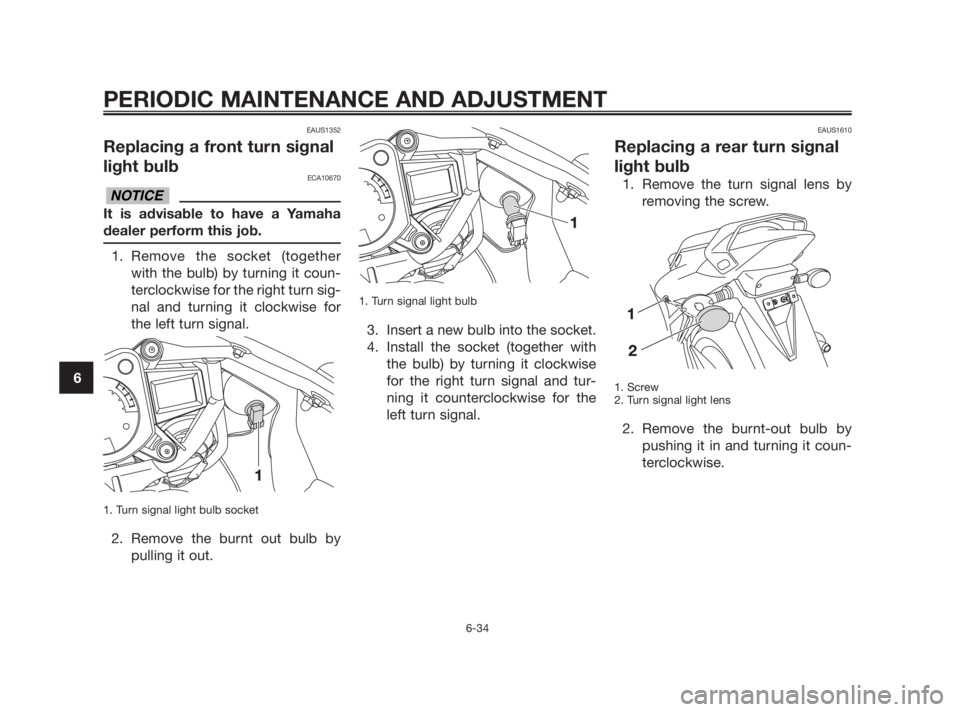
1. Remove the socket (together
with the bulb) by turning it coun-
terclockwise for the right turn sig-
nal and turning it clockwise for
the left turn signal.
1. Turn signal light bulb socket
2. Remove the burnt out bulb by
pulling it out.
1. Turn signal light bulb
3. Insert a new bulb into the socket.
4. Install the socket (together with
the bulb) by turning it clockwise
for the right turn signal and tur-
ning it counterclockwise for the
left turn signal.
EAUS1610
Replacing a rear turn signal
light bulb
1. Remove the turn signal lens by
removing the screw.
1. Screw
2. Turn signal light lens
2. Remove the burnt-out bulb by
pushing it in and turning it coun-
terclockwise.
NOTICE
PERIODIC MAINTENANCE AND ADJUSTMENT
6-34
6
5WX-F8199-E3 7/11/08 16:51 Página 70