ECU YAMAHA V1 2015 User Guide
[x] Cancel search | Manufacturer: YAMAHA, Model Year: 2015, Model line: V1, Model: YAMAHA V1 2015Pages: 94, PDF Size: 3.01 MB
Page 53 of 94

Pre-operation checks
47
EJU31982
WARNING
EWJ00412
Failure to inspect or maintain the watercraft properly increases the possibility of an ac-
cident or damage to the watercraft. Do not operate the watercraft if you find any prob-
lem. If a problem cannot be corrected by the procedures provided in this manual, have
the watercraft inspected by a Yamaha dealer.
EJU41234Pre-operation checklist
Before using this watercraft, be sure to perform the checks in the following checklist.
ITEM ROUTINE PAGE
PRE-LAUNCH CHECKS
Engine compartmentVentilate the engine compartment.
Check inside the engine compartment for damage.49
Fuel systemCheck the fuel system for leakage.
Check the fuel level in the fuel tank.49
Water separatorCheck the water separator for water. 49
Engine unitCheck the exterior of the engine unit for damage. 49
Engine oil levelCheck the engine oil level. 49
Bilge waterCheck the engine compartment for bilge water. 50
BatteryCheck the battery connections and electrolyte level. 50
Steering systemCheck the steering system for proper operation. 50
Reverse system (V1 Sport)Check the reverse system for proper operation. 51
Throttle leverCheck the throttle lever for proper operation.
Check the throttle lever free play.52
Engine shut-off cord (lan-
yard)Check the engine shut-off cord (lanyard) for dam-
age.52
SwitchesCheck the start switch, engine stop switch, and en-
gine shut-off switch for proper operation.53
Storage compartmentsCheck the storage compartments for damage and
water.53
Fire extinguisher holder,
cover, and bandCheck the fire extinguisher holder, cover, and band
for damage.53
Fire extinguisherCheck the condition of the fire extinguisher. 53
Safety equipmentCheck that safety equipment meeting the applica-
ble regulations is on board.54
Hull and deckCheck the hull and deck for damage. 54
Jet intakeCheck the jet intake for damage and clogging. 54
Stern drain plugsCheck the stern drain plugs for damage and foreign
material and check that they are securely installed.54
HoodCheck that the hood is securely closed. 54
SeatCheck that the seat is securely installed. 34
UF2P72E0.book Page 47 Tuesday, August 26, 2014 10:08 AM
Page 55 of 94
Pre-operation checks
49
EJU32282
Pre-operation check pointsEJU40546Pre-launch checks
Perform the pre-launch checks in the pre-op-
eration checklist while the watercraft is on
land.
To perform the pre-launch checks:
(1) Remove the seat. (See page 34 for seat
removal and installation procedures.)
(2) Perform the checks and make sure that
there are no malfunctioning items or oth-
er problems.
(3) After completing these checks, securely
install the seat in its original position.
EJU32334Engine compartment check
WARNING
EWJ00462
Failure to ventilate the engine compart-
ment could result in a fire or explosion. Do
not start the engine if there is a fuel leak.
Ventilate the engine compartment. Leave the
engine compartment open for a few minutes
to allow any fuel vapors to escape.
Make sure that there is no damage inside the
engine compartment.
EJU34215Fuel system checks
WARNING
EWJ00382
Leaking fuel can result in fire or explosion.
Check for fuel leakage regularly.
If any fuel leakage is found, the fuel sys-
tem must be repaired by a qualified me-
chanic. Improper repairs can make the
watercraft unsafe to operate.
Make sure that there is no damage, leakage,
or other problem in the fuel system.
Check:
Fuel filler cap and seal for damage
Fuel tank for damage and leakage
Fuel hoses and joints for damage and leak-
age
Fuel tank breather hose for damage and
leakage
EJU36875Fuel level check
Check the fuel level in the fuel tank.
Add fuel if necessary. (See page 40 for infor-
mation on filling the fuel tank.)
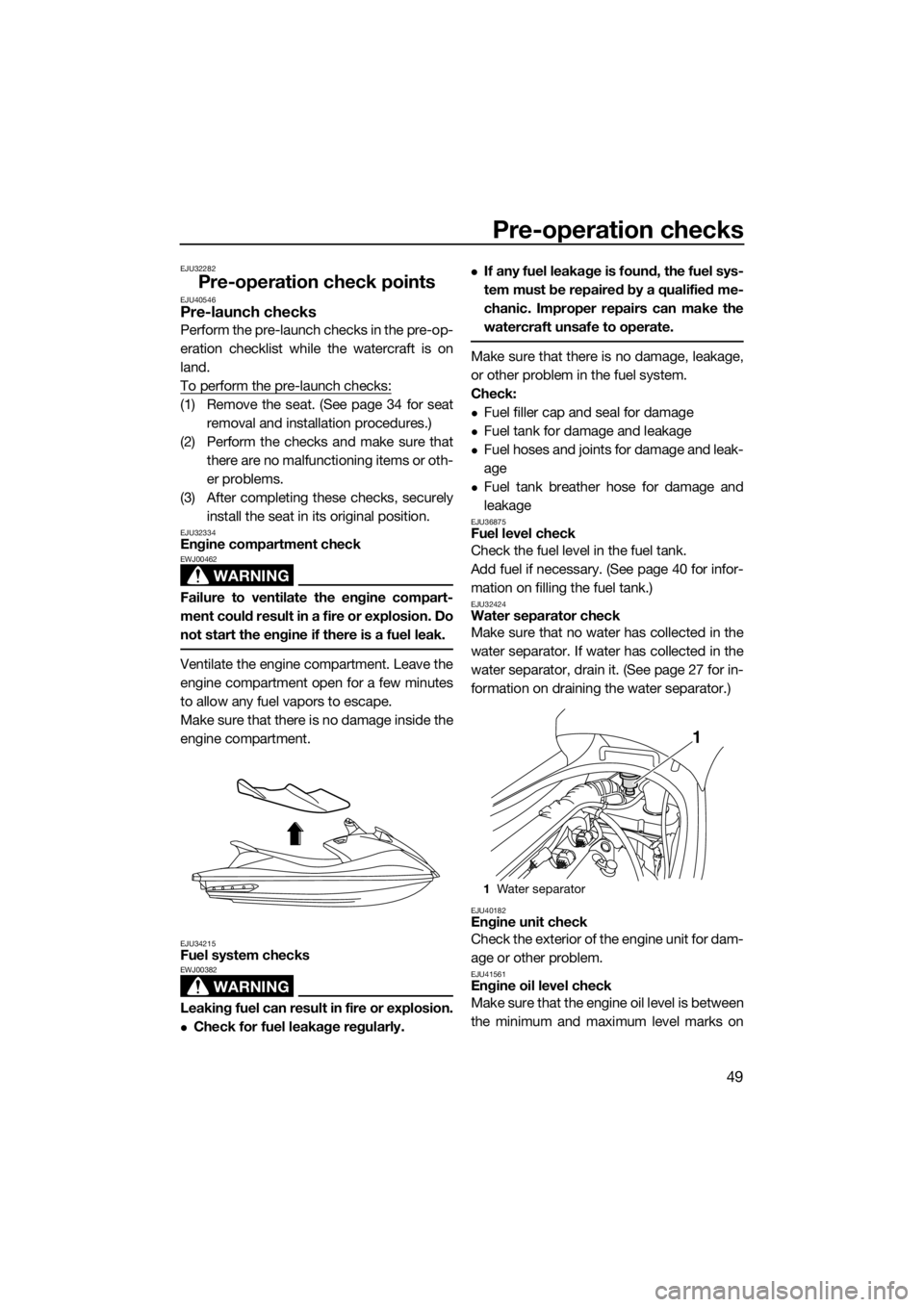
EJU32424Water separator check
Make sure that no water has collected in the
water separator. If water has collected in the
water separator, drain it. (See page 27 for in-
formation on draining the water separator.)
EJU40182Engine unit check
Check the exterior of the engine unit for dam-
age or other problem.
EJU41561Engine oil level check
Make sure that the engine oil level is between
the minimum and maximum level marks on
1Water separator
1
UF2P72E0.book Page 49 Tuesday, August 26, 2014 10:08 AM
Page 56 of 94
Pre-operation checks
50
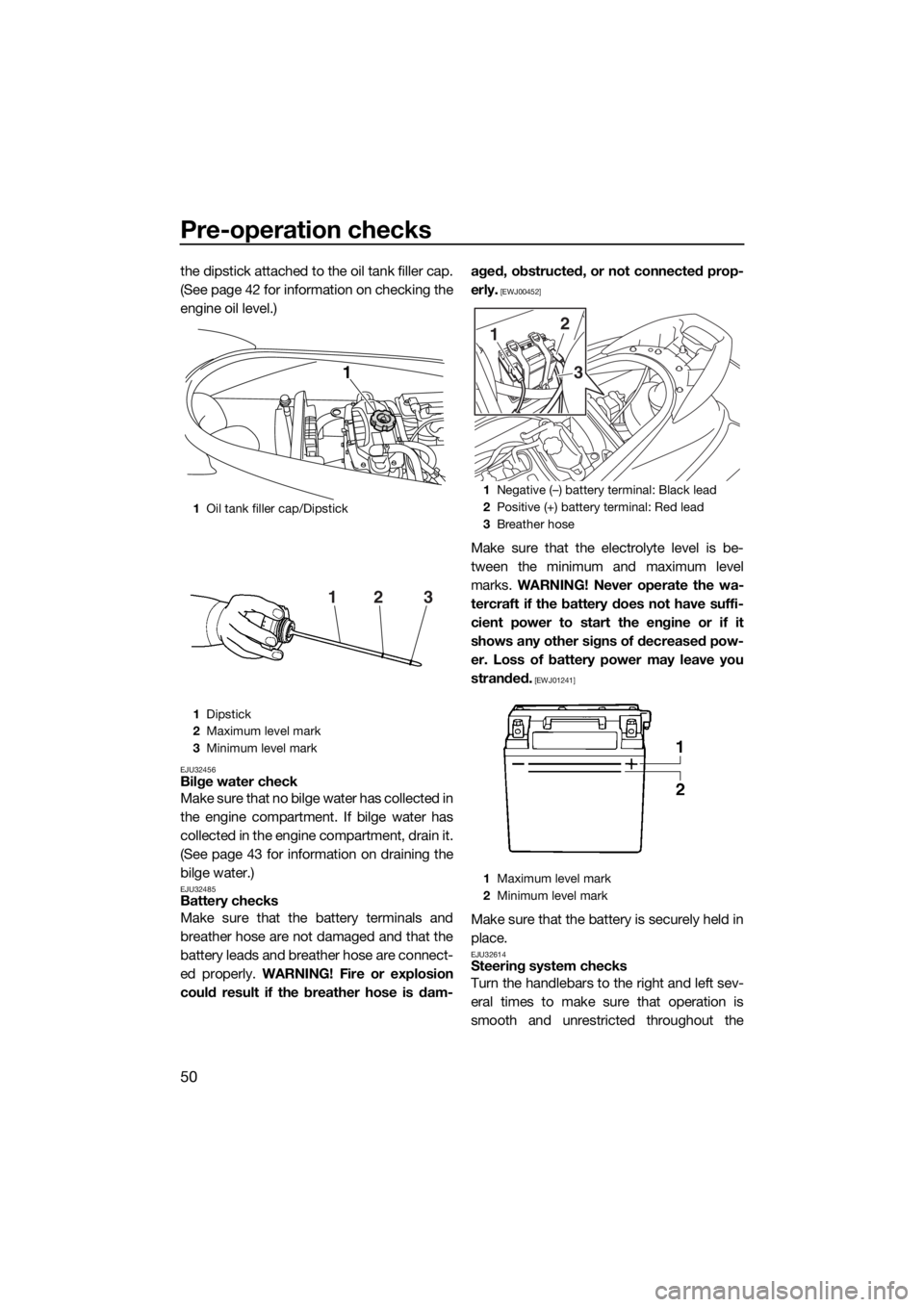
the dipstick attached to the oil tank filler cap.
(See page 42 for information on checking the
engine oil level.)
EJU32456Bilge water check
Make sure that no bilge water has collected in
the engine compartment. If bilge water has
collected in the engine compartment, drain it.
(See page 43 for information on draining the
bilge water.)
EJU32485Battery checks
Make sure that the battery terminals and
breather hose are not damaged and that the
battery leads and breather hose are connect-
ed properly. WARNING! Fire or explosion
could result if the breather hose is dam-aged, obstructed, or not connected prop-
erly.
[EWJ00452]
Make sure that the electrolyte level is be-
tween the minimum and maximum level
marks. WARNING! Never operate the wa-
tercraft if the battery does not have suffi-
cient power to start the engine or if it
shows any other signs of decreased pow-
er. Loss of battery power may leave you
stranded.
[EWJ01241]
Make sure that the battery is securely held in
place.
EJU32614Steering system checks
Turn the handlebars to the right and left sev-
eral times to make sure that operation is
smooth and unrestricted throughout the
1Oil tank filler cap/Dipstick
1Dipstick
2Maximum level mark
3Minimum level mark
1
213
1Negative (–) battery terminal: Black lead
2Positive (+) battery terminal: Red lead
3Breather hose
1Maximum level mark
2Minimum level mark
12
3
UF2P72E0.book Page 50 Tuesday, August 26, 2014 10:08 AM
Page 59 of 94
![YAMAHA V1 2015 User Guide Pre-operation checks
53
falls off, allowing the watercraft to contin-
ue to run and cause an accident.
[EWJ01221]
EJU40692
Switch checks
NOTICE
ECJ01311
Do not run the engine over 4000 r/min on
land.](/img/51/51943/w960_51943-58.png "YAMAHA V1 2015 User Guide Pre-operation checks
53
falls off, allowing the watercraft to contin-
ue to run and cause an accident.
[EWJ01221]
EJU40692
Switch checks
NOTICE
ECJ01311
Do not run the engine over 4000 r/min on
land.")
Pre-operation checks
53
falls off, allowing the watercraft to contin-
ue to run and cause an accident.
[EWJ01221]
EJU40692
Switch checks
NOTICE
ECJ01311
Do not run the engine over 4000 r/min on
land. Also, do not run the engine for more
than 15 seconds without supplying water,
otherwise the engine could overheat.
Check the start switch, the engine stop
switch, and the engine shut-off switch for
proper operation. (See pages 25 to 25 for in-
formation on operating each switch.)
To check the operation of the switches:
(1) Push the start switch to make sure that
the engine starts.(2) As soon as the engine starts running,
push the engine stop switch to make
sure that the engine stops immediately.
(3) Restart the engine, and then pull the en-
gine shut-off cord (lanyard) to remove
the clip from the engine shut-off switch
to make sure that the engine stops im-
mediately.
EJU40102Storage compartment checks
Make sure that the storage compartments
are not damaged and that water has not col-
lected in the compartments. (See page 36 for
information on the storage compartments.)
EJU41082Fire extinguisher holder, cover, and band
checks
Make sure that the fire extinguisher holder,
cover, and band are not damaged and that
the cover is securely held in place using the
band. (See page 38 for information on the fire
extinguisher holder, cover, and band.)
EJU32544Fire extinguisher check
Check that there is a full fire extinguisher on
board.
To check the fire extinguisher, see the in-
structions supplied by the fire extinguisher
manufacturer. Always keep the fire extin-
guisher secured in the holder with its cover in
place.
Always carry a fire extinguisher on board. A
fire extinguisher is not standard equipment
1Engine shut-off switch
2Clip
3Start switch
4Engine stop switch
5Engine shut-off cord (lanyard)
123
4
5
UF2P72E0.book Page 53 Tuesday, August 26, 2014 10:08 AM
Page 60 of 94
Pre-operation checks
54
with this watercraft. If you do not have one,
contact a Yamaha dealer or a fire extinguish-
er dealer to obtain one meeting the proper
specifications.
EJU40122Safety equipment check
Check that safety equipment meeting the ap-
plicable regulations is on board.
EJU32353Hull and deck check
Check the hull and deck for damage or other
problem.
EJU32657Jet intake checks
Make sure that the jet intake is not damaged
or clogged with weeds or debris. If the jet in-
take is clogged, clean it. (See page 82 for in-
formation on the jet intake.)
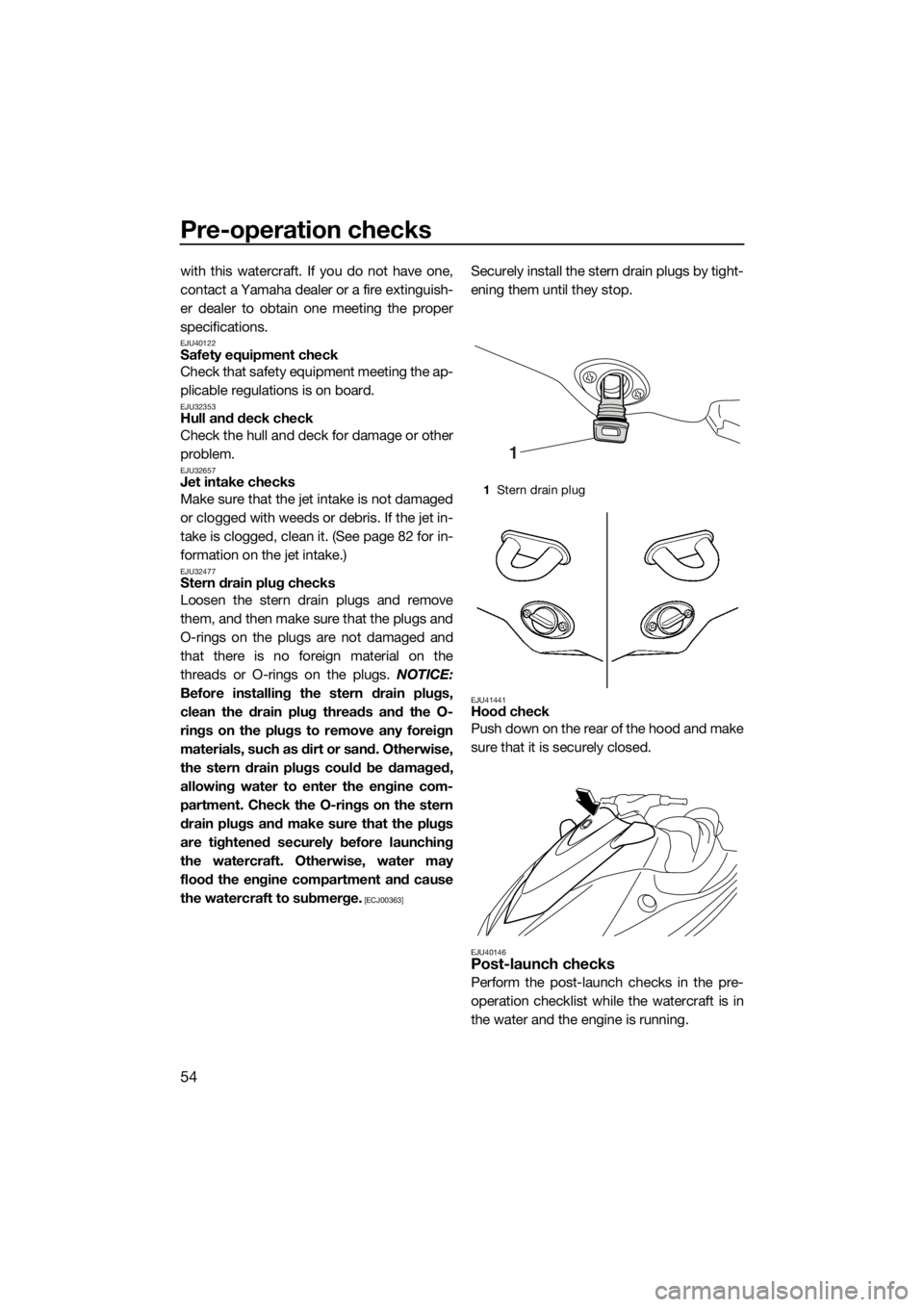
EJU32477Stern drain plug checks
Loosen the stern drain plugs and remove
them, and then make sure that the plugs and
O-rings on the plugs are not damaged and
that there is no foreign material on the
threads or O-rings on the plugs. NOTICE:
Before installing the stern drain plugs,
clean the drain plug threads and the O-
rings on the plugs to remove any foreign
materials, such as dirt or sand. Otherwise,
the stern drain plugs could be damaged,
allowing water to enter the engine com-
partment. Check the O-rings on the stern
drain plugs and make sure that the plugs
are tightened securely before launching
the watercraft. Otherwise, water may
flood the engine compartment and cause
the watercraft to submerge.
[ECJ00363]
Securely install the stern drain plugs by tight-
ening them until they stop.
EJU41441Hood check
Push down on the rear of the hood and make
sure that it is securely closed.
EJU40146Post-launch checks
Perform the post-launch checks in the pre-
operation checklist while the watercraft is in
the water and the engine is running.
1Stern drain plug
1
UF2P72E0.book Page 54 Tuesday, August 26, 2014 10:08 AM
Page 69 of 94

Operation
63
(4) Grip the handlebars with both hands and
place both feet on the floor of the foot-
well.
(5) Look in all directions, start the engine,
and then start off slowly.
EJU3316ABoarding with passenger(s)
WARNING
EWJ00661
Severe internal injuries can occur if water
is forced into body cavities as a result of
being near the jet thrust nozzle. Do not ap-
ply throttle until the passengers are seat-
ed with their feet on the floor of the
footwell and are securely holding on to the
person in front of them or to the handgrip
provided.
The heavier the total weight of the operator
and passenger(s), the more difficult it will be
to balance the watercraft. Do not operate the
watercraft when the total weight exceeds 240
kg (530 lb) including any cargo.To board at a standstill:
(1) Board as noted in the previous section
“Boarding alone”.
(2) Attach the engine shut-off cord (lanyard)
to your left wrist, and then attach the clip
to the engine shut-off switch.
(3) Grip the handlebars with both hands and
place both feet on the floor of the foot-
well.
(4) Have the first passenger move to the rear
of the watercraft.
(5) Have the first passenger board using the
same procedure as the operator, place
UF2P72E0.book Page 63 Tuesday, August 26, 2014 10:08 AM
Page 70 of 94

Operation
64
their feet on the floor of the footwell, and
securely hold on to the operator.
(6) Have the second passenger follow the
same procedure. When the second pas-
senger is boarding, try to balance the
watercraft together with the first passen-
ger.
(7) Make sure that the passenger(s) have
their feet on the floor of the footwell and
are securely holding on to the person in
front of them or to the handgrip provided.(8) Look in all directions, start the engine,
and then start off slowly.
To board when it is difficult to balance at a
standstill:
(1) Have the passenger(s) steady the water-
craft, and then board as noted in the pre-
vious section “Boarding alone”.
(2) Grip the handlebars with both hands,
place both feet on the floor of the foot-
well, and balance there.
(3) Have the first passenger board using the
same procedure as the operator, place
their feet on the floor of the footwell, se-
curely hold on to the operator, and bal-
ance there.
(4) Attach the engine shut-off cord (lanyard)
to your left wrist, and then attach the clip
to the engine shut-off switch.
(5) Look in all directions, and then start the
engine and operate at trolling speed.
(6) Have the second passenger pull them-
selves up onto the boarding platform into
a kneeling position and balance there.
Look in all directions, and then gradually
accelerate. Then, have the second pas-
UF2P72E0.book Page 64 Tuesday, August 26, 2014 10:08 AM
Page 71 of 94
Operation
65
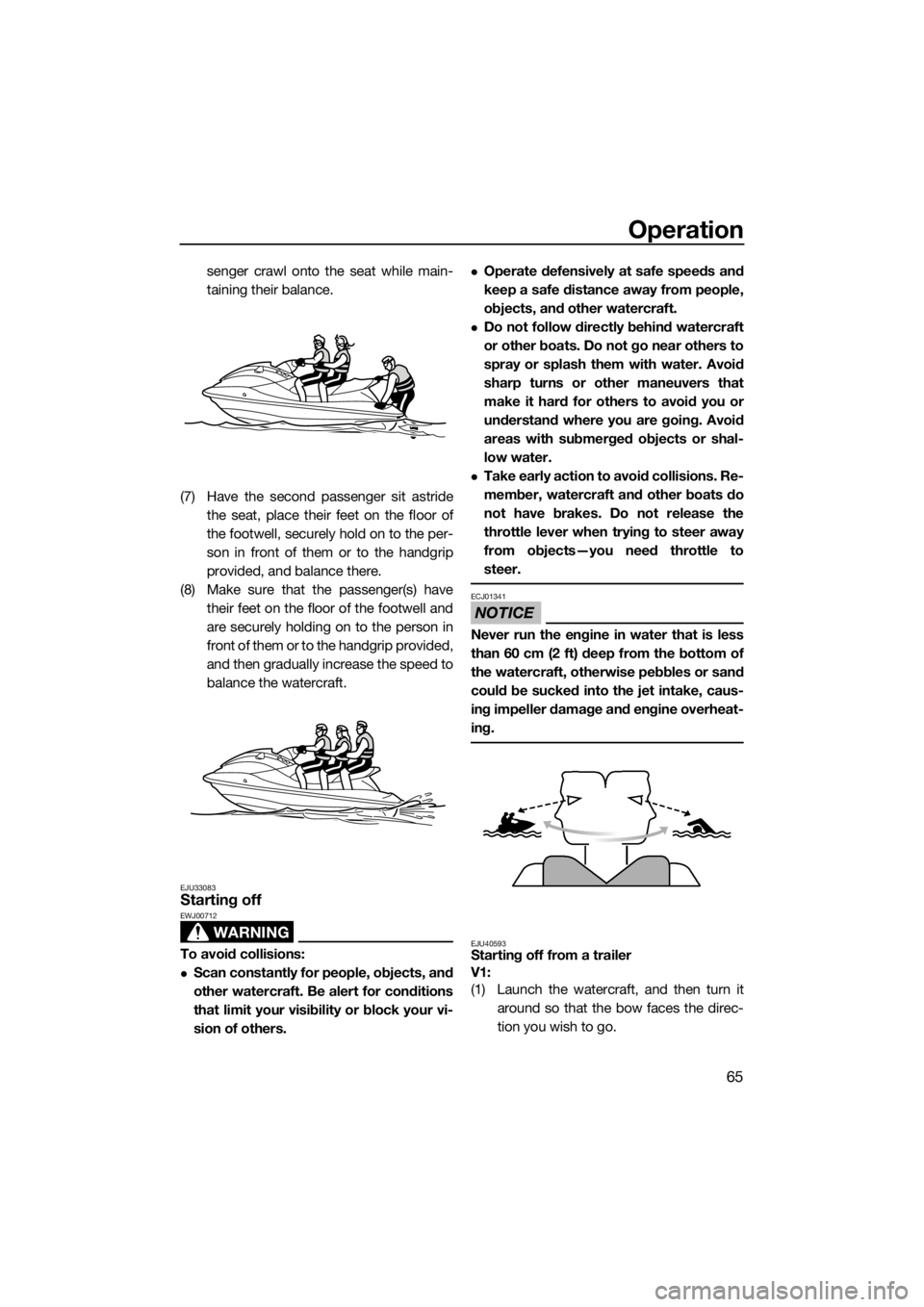
senger crawl onto the seat while main-
taining their balance.
(7) Have the second passenger sit astride
the seat, place their feet on the floor of
the footwell, securely hold on to the per-
son in front of them or to the handgrip
provided, and balance there.
(8) Make sure that the passenger(s) have
their feet on the floor of the footwell and
are securely holding on to the person in
front of them or to the handgrip provided,
and then gradually increase the speed to
balance the watercraft.
EJU33083Starting off
WARNING
EWJ00712
To avoid collisions:
Scan constantly for people, objects, and
other watercraft. Be alert for conditions
that limit your visibility or block your vi-
sion of others.
Operate defensively at safe speeds and
keep a safe distance away from people,
objects, and other watercraft.
Do not follow directly behind watercraft
or other boats. Do not go near others to
spray or splash them with water. Avoid
sharp turns or other maneuvers that
make it hard for others to avoid you or
understand where you are going. Avoid
areas with submerged objects or shal-
low water.
Take early action to avoid collisions. Re-
member, watercraft and other boats do
not have brakes. Do not release the
throttle lever when trying to steer away
from objects—you need throttle to
steer.
NOTICE
ECJ01341
Never run the engine in water that is less
than 60 cm (2 ft) deep from the bottom of
the watercraft, otherwise pebbles or sand
could be sucked into the jet intake, caus-
ing impeller damage and engine overheat-
ing.
EJU40593Starting off from a trailer
V1:
(1) Launch the watercraft, and then turn it
around so that the bow faces the direc-
tion you wish to go.
UF2P72E0.book Page 65 Tuesday, August 26, 2014 10:08 AM
Page 75 of 94
Care and storage
69
EJU37146
Post-operation care
WARNING
EWJ00331
Always place the watercraft upright in a
horizontal position when storing it, other-
wise fuel could leak out into the engine or
engine compartment, which could create
a fire hazard.
After using the watercraft, always take it out
of the water, clean it, and store it. Leaving the
watercraft in the water for extended periods
will accelerate the rate of normal deteriora-
tion of the jet pump and hull. Marine organ-
isms and corrosion are some of the
conditions that can shorten the life of many
watercraft components.
EJU33548Flushing the cooling water passages
NOTICE
ECJ01311
Do not run the engine over 4000 r/min on
land. Also, do not run the engine for more
than 15 seconds without supplying water,
otherwise the engine could overheat.
Flush the cooling water passages to prevent
them from clogging with salt, sand, or dirt.
(1) Place the watercraft in a horizontal posi-
tion.
(2) Remove the seat. (See page 34 for seat
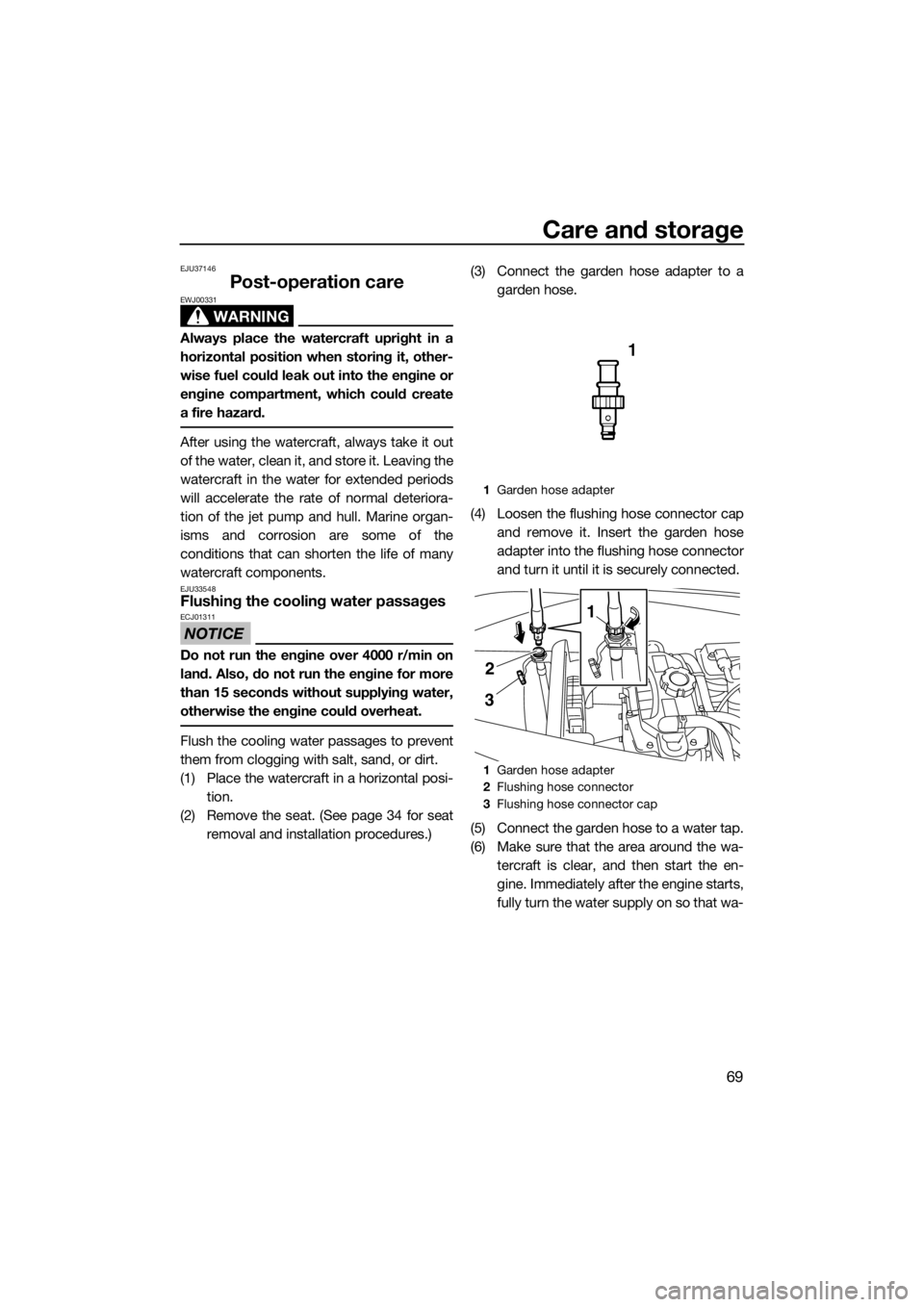
removal and installation procedures.)(3) Connect the garden hose adapter to a
garden hose.
(4) Loosen the flushing hose connector cap
and remove it. Insert the garden hose
adapter into the flushing hose connector
and turn it until it is securely connected.
(5) Connect the garden hose to a water tap.
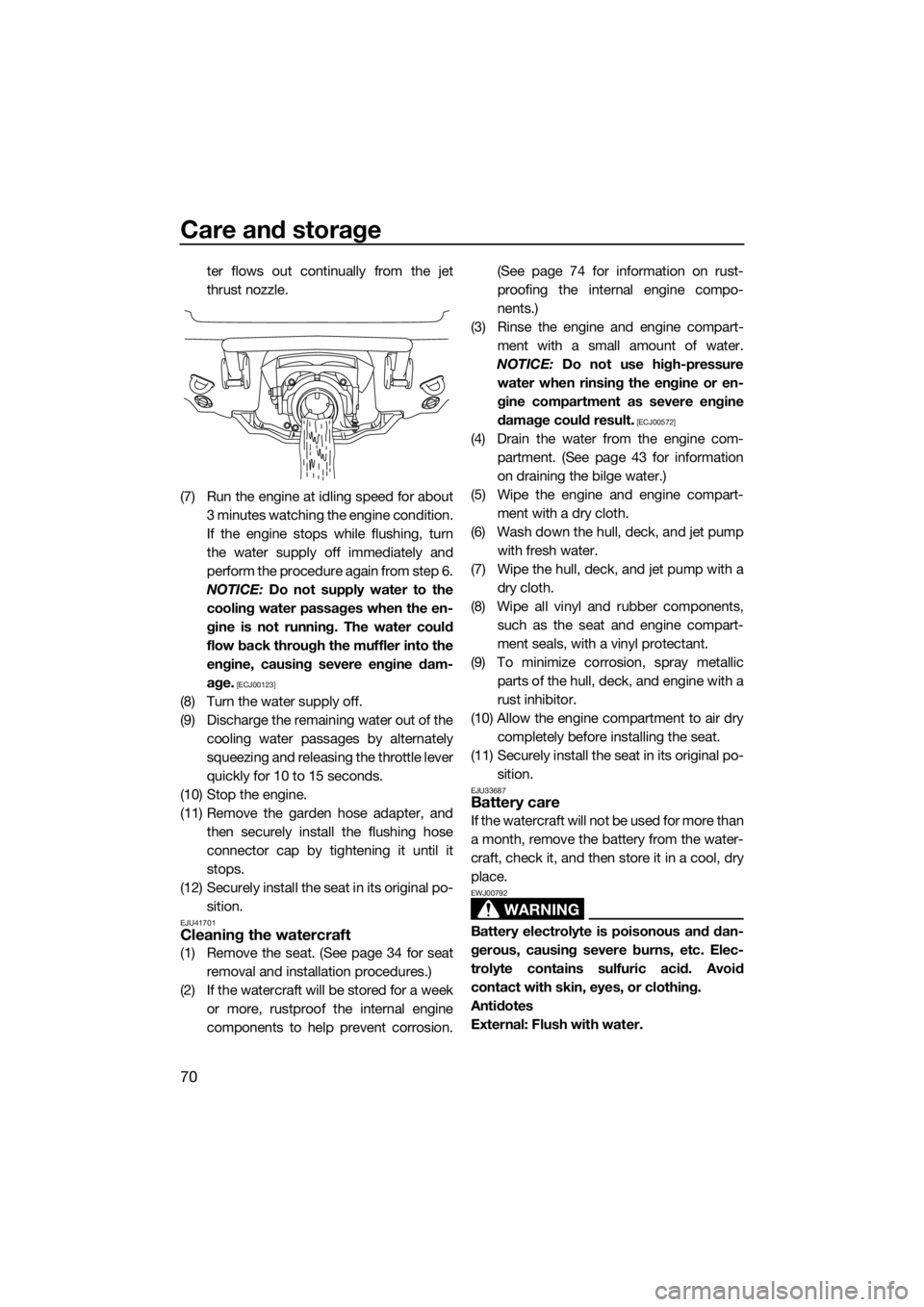
(6) Make sure that the area around the wa-
tercraft is clear, and then start the en-
gine. Immediately after the engine starts,
fully turn the water supply on so that wa-
1Garden hose adapter
1Garden hose adapter
2Flushing hose connector
3Flushing hose connector cap
321
UF2P72E0.book Page 69 Tuesday, August 26, 2014 10:08 AM
Page 76 of 94
Care and storage
70
ter flows out continually from the jet
thrust nozzle.
(7) Run the engine at idling speed for about
3 minutes watching the engine condition.
If the engine stops while flushing, turn
the water supply off immediately and
perform the procedure again from step 6.
NOTICE: Do not supply water to the
cooling water passages when the en-
gine is not running. The water could
flow back through the muffler into the
engine, causing severe engine dam-
age.
[ECJ00123]
(8) Turn the water supply off.
(9) Discharge the remaining water out of the
cooling water passages by alternately
squeezing and releasing the throttle lever
quickly for 10 to 15 seconds.
(10) Stop the engine.
(11) Remove the garden hose adapter, and
then securely install the flushing hose
connector cap by tightening it until it
stops.
(12) Securely install the seat in its original po-
sition.
EJU41701Cleaning the watercraft
(1) Remove the seat. (See page 34 for seat
removal and installation procedures.)
(2) If the watercraft will be stored for a week
or more, rustproof the internal engine
components to help prevent corrosion.(See page 74 for information on rust-
proofing the internal engine compo-
nents.)
(3) Rinse the engine and engine compart-
ment with a small amount of water.
NOTICE: Do not use high-pressure
water when rinsing the engine or en-
gine compartment as severe engine
damage could result.
[ECJ00572]
(4) Drain the water from the engine com-
partment. (See page 43 for information
on draining the bilge water.)
(5) Wipe the engine and engine compart-
ment with a dry cloth.
(6) Wash down the hull, deck, and jet pump
with fresh water.
(7) Wipe the hull, deck, and jet pump with a
dry cloth.
(8) Wipe all vinyl and rubber components,
such as the seat and engine compart-
ment seals, with a vinyl protectant.
(9) To minimize corrosion, spray metallic
parts of the hull, deck, and engine with a
rust inhibitor.
(10) Allow the engine compartment to air dry
completely before installing the seat.
(11) Securely install the seat in its original po-
sition.
EJU33687Battery care
If the watercraft will not be used for more than
a month, remove the battery from the water-
craft, check it, and then store it in a cool, dry
place.
WARNING
EWJ00792
Battery electrolyte is poisonous and dan-
gerous, causing severe burns, etc. Elec-
trolyte contains sulfuric acid. Avoid
contact with skin, eyes, or clothing.
Antidotes
External: Flush with water.
UF2P72E0.book Page 70 Tuesday, August 26, 2014 10:08 AM