light YAMAHA VERSITY 300 2004 User Guide
[x] Cancel search | Manufacturer: YAMAHA, Model Year: 2004, Model line: VERSITY 300, Model: YAMAHA VERSITY 300 2004Pages: 104, PDF Size: 2.82 MB
Page 39 of 104
4
PRE-OPERATION CHECKS
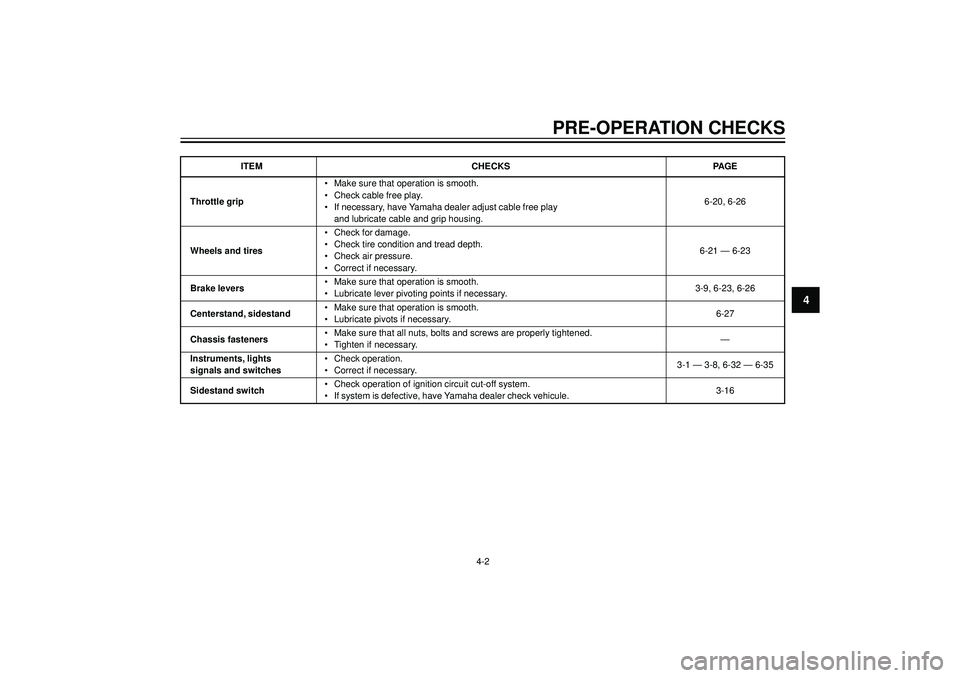
ITEM CHECKS PAGE
•Make sure that operation is smooth.
Throttle grip•Check cable free play.
6-20, 6-26
•If necessary, have Yamaha dealer adjust cable free play
and lubricate cable and grip housing.
•Check for damage.
Wheels and tires•Check tire condition and tread depth.
6-21 — 6-23
•Check air pressure.
•Correct if necessary.
Brake levers•Make sure that operation is smooth.
3-9, 6-23, 6-26
•Lubricate lever pivoting points if necessary.
Centerstand, sidestand•Make sure that operation is smooth.
6-27
•Lubricate pivots if necessary.
Chassis fasteners•Make sure that all nuts, bolts and screws are properly tightened.
—
•Tighten if necessary.
Instruments, lights•Check operation.
3-1 — 3-8, 6-32 — 6-35
signals and switches•Correct if necessary.
Sidestand switch•Check operation of ignition circuit cut-off system.
3-16
•If system is defective, have Yamaha dealer check vehicule.
4-2
Page 45 of 104
OPERATION AND IMPORTANT RIDING POINTS
5
EAU04755
Tips for reducing fuel
consumption
Fuel consumption depends largely on
your riding style. Consider the following
tips to reduce fuel consumption:
•Avoid high engine speeds during
acceleration.
•Avoid high engine speeds with no
load on the engine.
•Turn the engine off instead of
letting it idle for an extended
length of time (e.g., in traffic jams,
at traffic lights or at railroad
crossings).
EAU01128
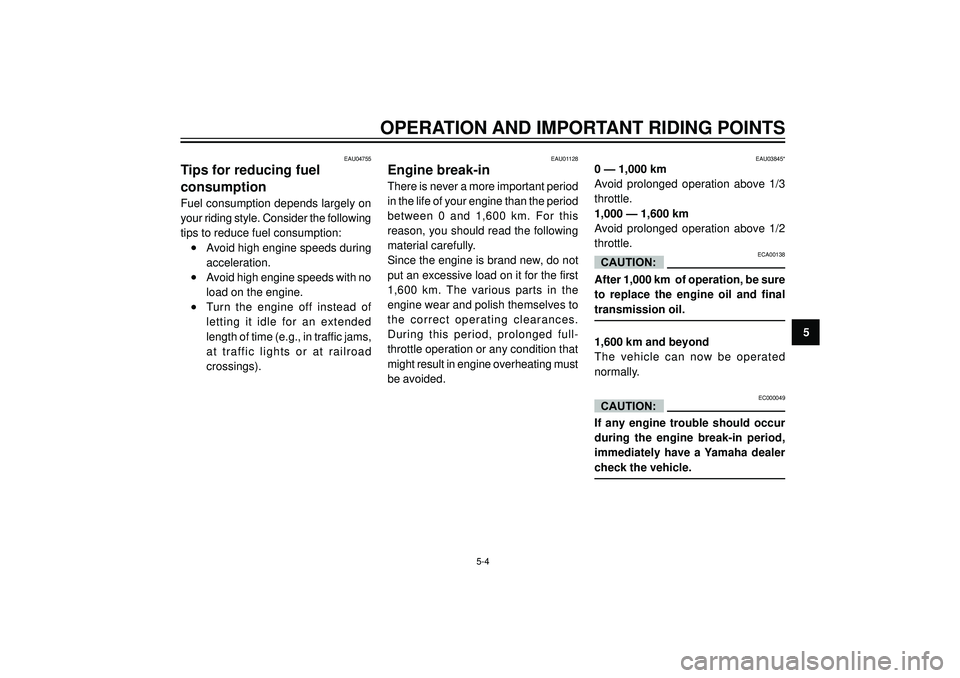
Engine break-in
There is never a more important period
in the life of your engine than the period
between 0 and 1,600 km. For this
reason, you should read the following
material carefully.
Since the engine is brand new, do not
put an excessive load on it for the first
1,600 km. The various parts in the
engine wear and polish themselves to
the correct operating clearances.
During this period, prolonged full-
throttle operation or any condition that
might result in engine overheating must
be avoided.
EAU03845*
0 — 1,000 km
Avoid prolonged operation above 1/3
throttle.
1,000 — 1,600 km
Avoid prolonged operation above 1/2
throttle.
ECA00138
After 1,000 km of operation, be sure
to replace the engine oil and final
transmission oil.
1,600 km and beyond
The vehicle can now be operated
normally.
EC000049
If any engine trouble should occur
during the engine break-in period,
immediately have a Yamaha dealer
check the vehicle.
CAUTION:
CAUTION:
5-4
Page 47 of 104
EAU00462
PERIODIC MAINTENANCE AND MINOR REPAIR
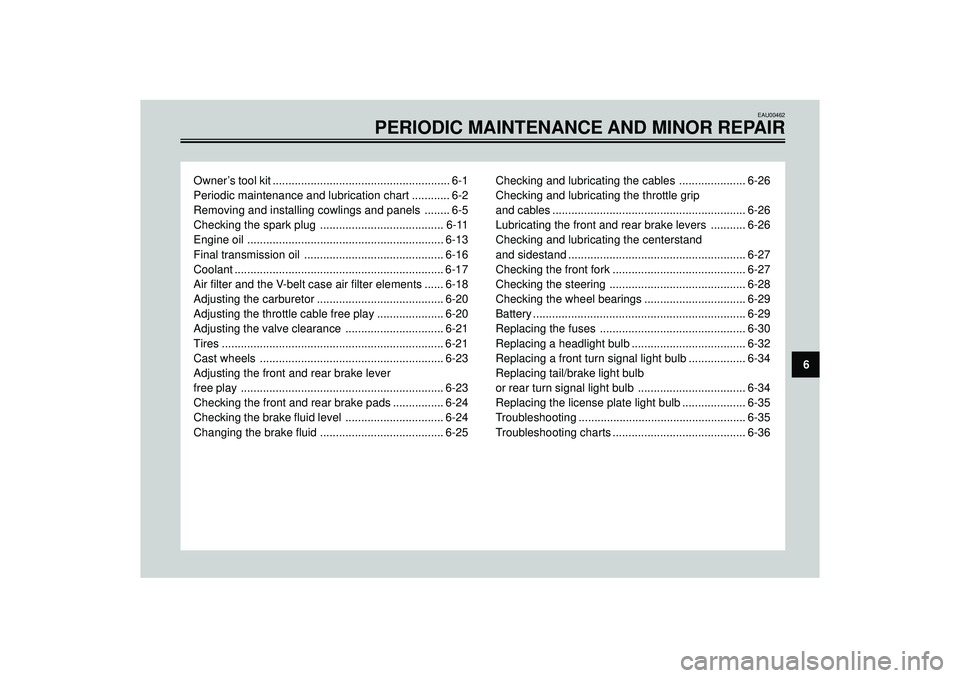
Owner’s tool kit ........................................................ 6-1
Periodic maintenance and lubrication chart ............ 6-2
Removing and installing cowlings and panels ........ 6-5
Checking the spark plug ....................................... 6-11
Engine oil .............................................................. 6-13
Final transmission oil ............................................ 6-16
Coolant .................................................................. 6-17
Air filter and the V-belt case air filter elements ...... 6-18
Adjusting the carburetor ........................................ 6-20
Adjusting the throttle cable free play ..................... 6-20
Adjusting the valve clearance ............................... 6-21
Tires ...................................................................... 6-21
Cast wheels .......................................................... 6-23
Adjusting the front and rear brake lever
free play ................................................................ 6-23
Checking the front and rear brake pads ................ 6-24
Checking the brake fluid level ............................... 6-24
Changing the brake fluid ....................................... 6-25Checking and lubricating the cables ..................... 6-26
Checking and lubricating the throttle grip
and cables ............................................................. 6-26
Lubricating the front and rear brake levers ........... 6-26
Checking and lubricating the centerstand
and sidestand ........................................................ 6-27
Checking the front fork .......................................... 6-27
Checking the steering ........................................... 6-28
Checking the wheel bearings ................................ 6-29
Battery ................................................................... 6-29
Replacing the fuses .............................................. 6-30
Replacing a headlight bulb .................................... 6-32
Replacing a front turn signal light bulb .................. 6-34
Replacing tail/brake light bulb
or rear turn signal light bulb .................................. 6-34
Replacing the license plate light bulb .................... 6-35
Troubleshooting ..................................................... 6-35
Troubleshooting charts .......................................... 6-36
6
Page 51 of 104
PERIODIC MAINTENANCE AND MINOR REPAIR
6
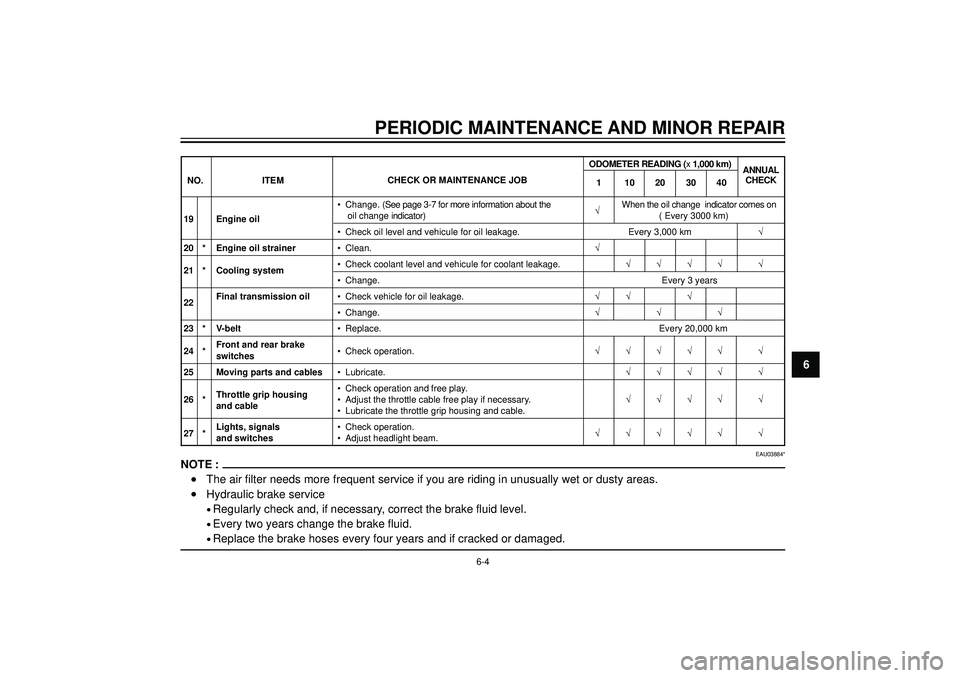
•Change. (See page 3-7 for more information about the√When the oil change indicator comes on19 Engine oil oil change indicator)( Every 3000 km)
•Check oil level and vehicule for oil leakage. Every 3,000 km√
20 * Engine oil strainer•Clean.√
21 * Cooling system•Check coolant level and vehicule for coolant leakage.√√√√ √•Change. Every 3 years
22Final transmission oil•Check vehicle for oil leakage.√√ √•Change.√√√
23 * V-belt•Replace. Every 20,000 km
24 *Front and rear brake
•Check operation.√√√√√ √
switches
25 Moving parts and cables•Lubricate.√√√√ √
Throttle grip housing•Check operation and free play.
26 *
and cable•Adjust the throttle cable free play if necessary.√√√√ √
•Lubricate the throttle grip housing and cable.
27 *Lights, signals•Check operation.
√√√√√ √
and switches•Adjust headlight beam.
ODOMETER READING (x 1,000 km)
NO. ITEMCHECK OR MAINTENANCE JOB
1
ANNUAL
CHECK
10 20 30 40
EAU03884*
NOTE :
•The air filter needs more frequent service if you are riding in unusually wet or dusty areas.
•Hydraulic brake service
•Regularly check and, if necessary, correct the brake fluid level.
•Every two years change the brake fluid.
•Replace the brake hoses every four years and if cracked or damaged.
6-4
Page 54 of 104
PERIODIC MAINTENANCE AND MINOR REPAIR
6
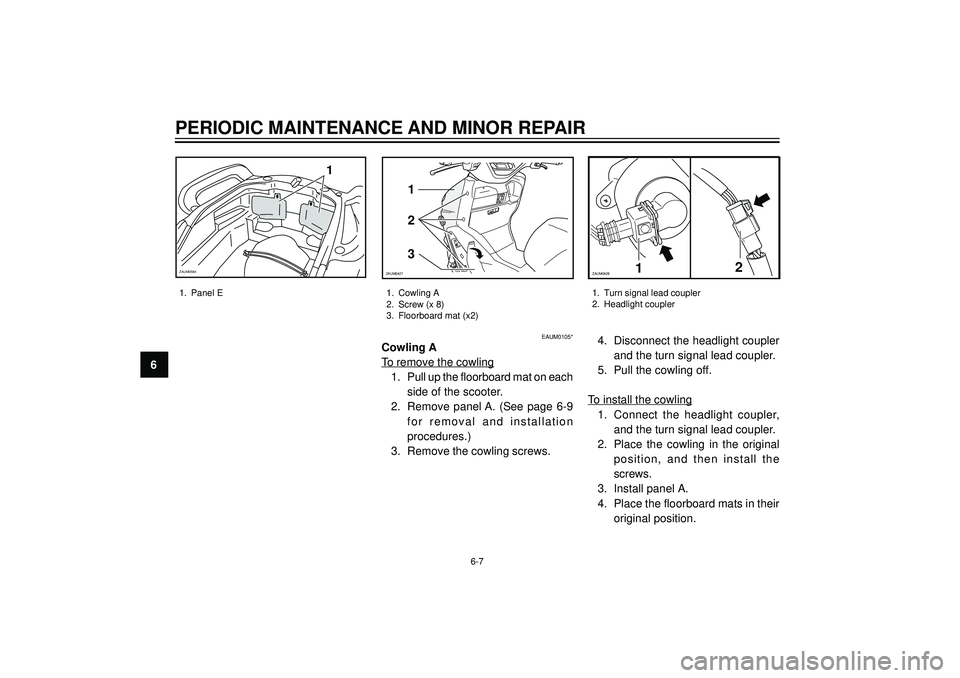
1. Cowling A
2. Screw (x 8)
3. Floorboard mat (x2)1. Turn signal lead coupler
2. Headlight coupler
6-7
3 2 1
ZAUM042712ZAUM0428
EAUM0105*
Cowling A
To remove the cowling
1. Pull up the floorboard mat on each
side of the scooter.
2. Remove panel A. (See page 6-9
for removal and installation
procedures.)
3. Remove the cowling screws.4. Disconnect the headlight coupler
and the turn signal lead coupler.
5. Pull the cowling off.
To install the cowling
1. Connect the headlight coupler,
and the turn signal lead coupler.
2. Place the cowling in the original
position, and then install the
screws.
3. Install panel A.
4. Place the floorboard mats in their
original position.
1
ZAUM0584
1. Panel E
Page 59 of 104
PERIODIC MAINTENANCE AND MINOR REPAIR
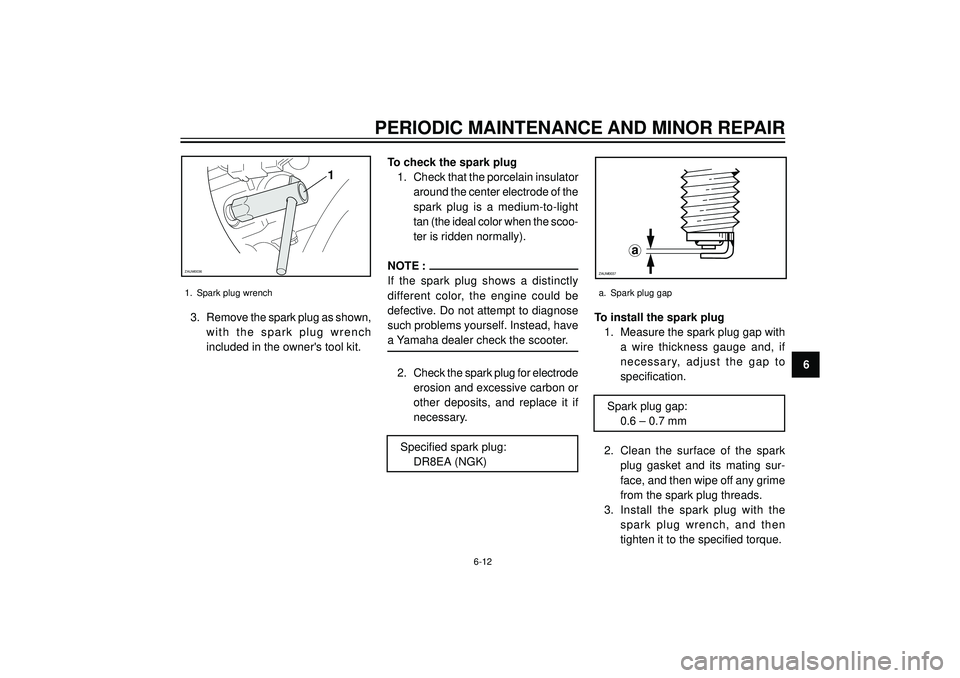
6 3. Remove the spark plug as shown,
with the spark plug wrench
included in the owner's tool kit.To check the spark plug
1. Check that the porcelain insulator
around the center electrode of the
spark plug is a medium-to-light
tan (the ideal color when the scoo-
ter is ridden normally).
NOTE :
If the spark plug shows a distinctly
different color, the engine could be
defective. Do not attempt to diagnose
such problems yourself. Instead, have
a Yamaha dealer check the scooter.
2. Check the spark plug for electrode
erosion and excessive carbon or
other deposits, and replace it if
necessary.
Specified spark plug:
DR8EA (NGK)To install the spark plug
1. Measure the spark plug gap with
a wire thickness gauge and, if
necessary, adjust the gap to
specification.
Spark plug gap:
0.6 – 0.7 mm
2. Clean the surface of the spark
plug gasket and its mating sur-
face, and then wipe off any grime
from the spark plug threads.
3. Install the spark plug with the
spark plug wrench, and then
tighten it to the specified torque.
1. Spark plug wrencha. Spark plug gap
6-12
1
ZAUM0036
a
ZAUM0037
Page 60 of 104
PERIODIC MAINTENANCE AND MINOR REPAIR
6Tightening torque:
Spark plug:
17.5 Nm (1.75 m
•kg)
NOTE :
If a torque wrench is not available when
installing a spark plug, a good estimate
of the correct torque is 1/4 – 1/2 turn
past finger tight. However, the spark
plug should be tightened to the
specified torque as soon as possible.
4. Install the spark plug cap.
5. Install the cowling.
6-13
EAUM0103*
Engine oil
The engine oil level should be checked
before each ride. In addition, the oil
must be changed at the intervals
specified in the periodic maintenance
and lubrication chart and when the oil
change indicator comes on.To check the engine oil level
1. Place the scooter on the
centerstand.
NOTE :
Make sure that the scooter is positioned
straight up when checking the oil level.
A slight tilt to the side can result in a
false reading.
2. Start the engine, warm it up for
several minutes, and then turn it
off.
Page 64 of 104
PERIODIC MAINTENANCE AND MINOR REPAIR
6
EAU04591*
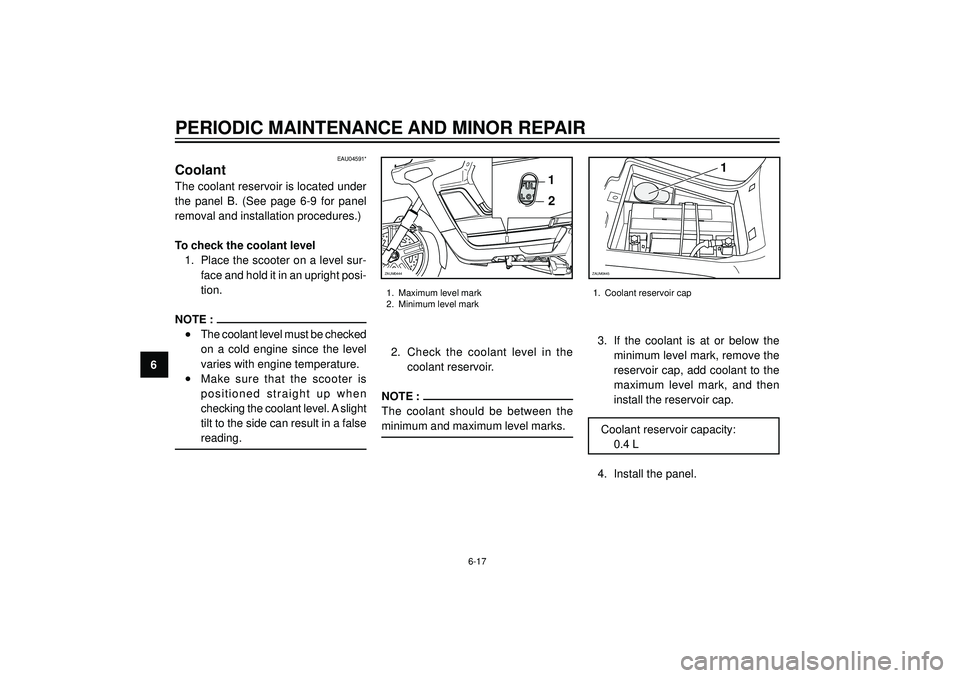
Coolant
The coolant reservoir is located under
the panel B. (See page 6-9 for panel
removal and installation procedures.)
To check the coolant level
1. Place the scooter on a level sur-
face and hold it in an upright posi-
tion.
NOTE :
•The coolant level must be checked
on a cold engine since the level
varies with engine temperature.
•Make sure that the scooter is
positioned straight up when
checking the coolant level. A slight
tilt to the side can result in a false
reading.2. Check the coolant level in the
coolant reservoir.
NOTE :
The coolant should be between the
minimum and maximum level marks.
1. Maximum level mark
2. Minimum level mark
3. If the coolant is at or below the
minimum level mark, remove the
reservoir cap, add coolant to the
maximum level mark, and then
install the reservoir cap.
Coolant reservoir capacity:
0.4 L
4. Install the panel.
1. Coolant reservoir cap
6-17
1
2
ZAUM0444
1
ZAUM0445
Page 78 of 104
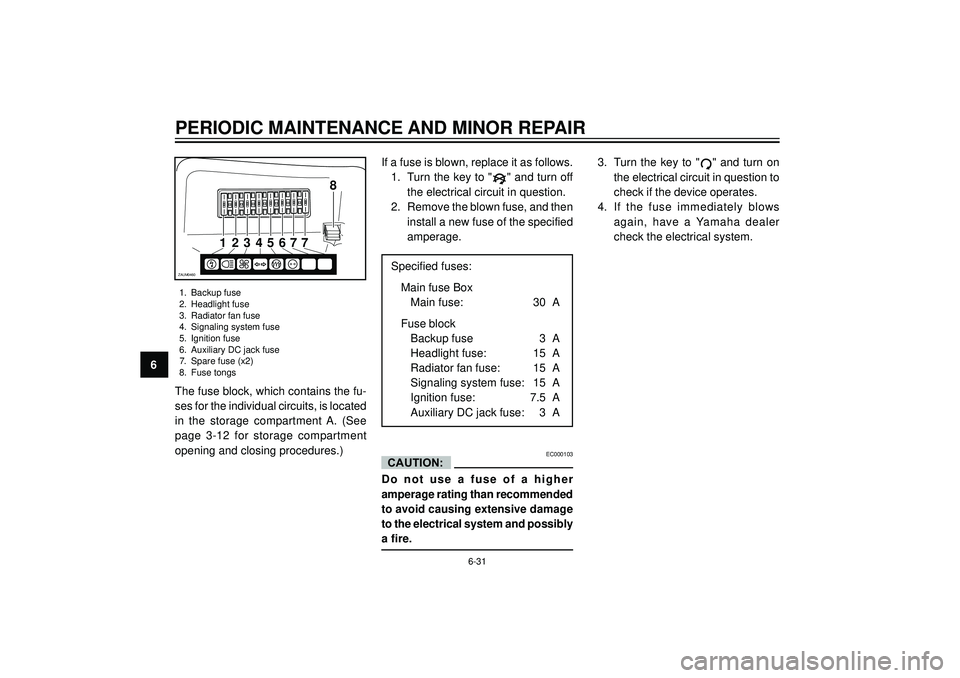
PERIODIC MAINTENANCE AND MINOR REPAIR
6
1. Backup fuse
2. Headlight fuse
3. Radiator fan fuse
4. Signaling system fuse
5. Ignition fuse
6. Auxiliary DC jack fuse
7. Spare fuse (x2)
8. Fuse tongs
CAUTION:
6-31
12345 776
8
ZAUM0460
The fuse block, which contains the fu-
ses for the individual circuits, is located
in the storage compartment A. (See
page 3-12 for storage compartment
opening and closing procedures.)If a fuse is blown, replace it as follows.
1. Turn the key to "
" and turn off
the electrical circuit in question.
2. Remove the blown fuse, and then
install a new fuse of the specified
amperage.
Specified fuses:
Main fuse Box
Main fuse: 30 A
Fuse block
Backup fuse 3 A
Headlight fuse: 15 A
Radiator fan fuse: 15 A
Signaling system fuse: 15 A
Ignition fuse: 7.5 A
Auxiliary DC jack fuse: 3 A3. Turn the key to "
" and turn on
the electrical circuit in question to
check if the device operates.
4. If the fuse immediately blows
again, have a Yamaha dealer
check the electrical system.
EC000103
Do not use a fuse of a higher
amperage rating than recommended
to avoid causing extensive damage
to the electrical system and possibly
a fire.
Page 79 of 104

PERIODIC MAINTENANCE AND MINOR REPAIR
6
EAU04285
Replacing the headlight bulb
This scooter is equipped with a quartz
bulb headlight. If the headlight bulb
burns out, replace it as follows.
1. Remove cowling A together with
the headlight unit. (See page 6-7
for cowling removal and installa-
tion procedures.)
WARNING
1. Bulb cover
2. Headlight coupler
3. Remove the headlight bulb holder
by pushing it inward and turning
it counterclockwise, and then
remove the defective bulb.
EW000119
Headlight bulbs get very hot.
Therefore, keep flammable products
away from a lit headlight bulb, and
do not touch the bulb until it has
cooled down. 2. Disconnect the headlight coupler,
and then remove the bulb cover.
6-32
2 1ZAUM0461
1
ZAUM0462
1. Headlight bulb holder