fuel YAMAHA VIKING 2014 User Guide
[x] Cancel search | Manufacturer: YAMAHA, Model Year: 2014, Model line: VIKING, Model: YAMAHA VIKING 2014Pages: 180, PDF Size: 3.78 MB
Page 63 of 180
5-1
1
2
3
45
6
7
8
9
10
11
12
13
14
EVU01200
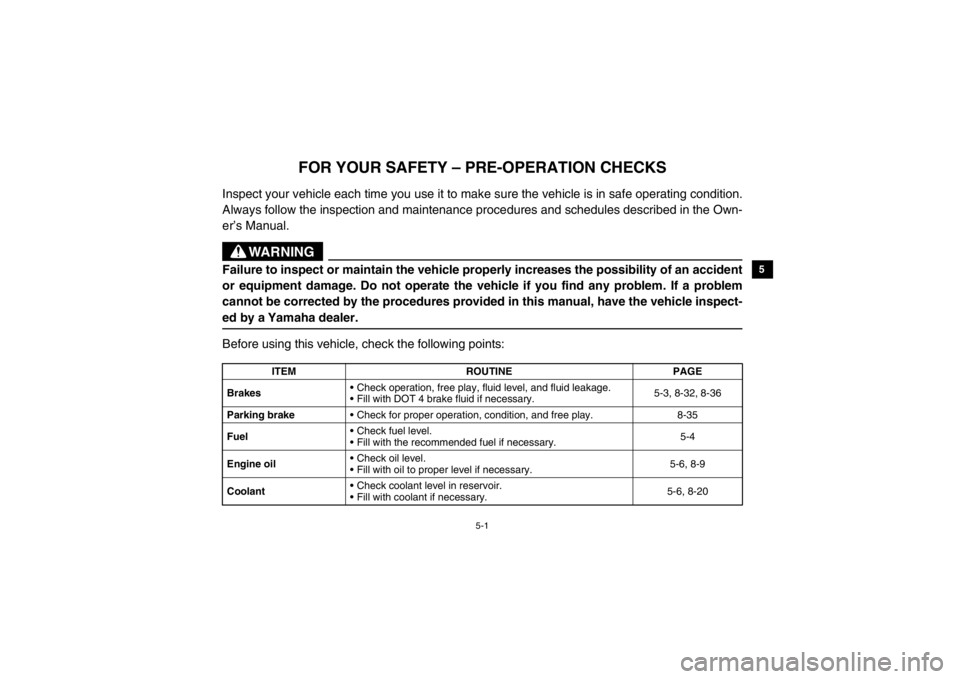
1-FOR YOUR SAFETY – PRE-OPERATION CHECKS
Inspect your vehicle each time you use it to make sure the vehicle is in safe operating condition.
Always follow the inspection and maintenance procedures and schedules described in the Own-
er’s Manual.
WARNING
Failure to inspect or maintain the vehicle properly increases the possibility of an accident
or equipment damage. Do not operate the vehicle if you find any problem. If a problem
cannot be corrected by the procedures provided in this manual, have the vehicle inspect-
ed by a Yamaha dealer.Before using this vehicle, check the following points:
ITEMROUTINE PAGE
Brakes Check operation, free play, fluid level, and fluid leakage.
Fill with DOT 4 brake fluid if necessary. 5-3, 8-32, 8-36
Parking brake Check for proper operation, condition, and free play. 8-35
Fuel Check fuel level.
Fill with the recommended fuel if necessary. 5-4
Engine oil Check oil level.
Fill with oil to proper level if necessary. 5-6, 8-9
Coolant Check coolant level in reservoir.
Fill with coolant if necessary. 5-6, 8-20
1XP7B_EE.book Page 1 Tuesday, February 4, 2014 3:40 PM
Page 66 of 180
5-4
5
6
7
8
9
10
11
12
13
14
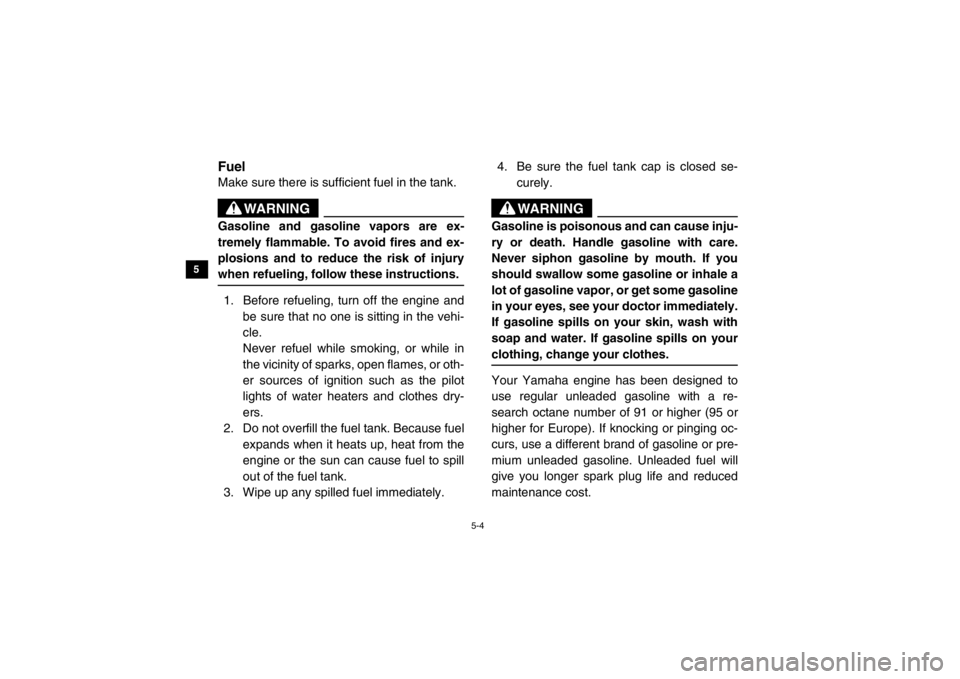
EVU00400FuelMake sure there is sufficient fuel in the tank.
WARNING
Gasoline and gasoline vapors are ex-
tremely flammable. To avoid fires and ex-
plosions and to reduce the risk of injury
when refueling, follow these instructions.1. Before refueling, turn off the engine and be sure that no one is sitting in the vehi-
cle.
Never refuel while smoking, or while in
the vicinity of sparks, open flames, or oth-
er sources of ignition such as the pilot
lights of water heaters and clothes dry-
ers.
2. Do not overfill the fuel tank. Because fuel
expands when it heats up, heat from the
engine or the sun can cause fuel to spill
out of the fuel tank.
3. Wipe up any spilled fuel immediately. 4. Be sure the fuel tank cap is closed se-
curely.
WARNING
Gasoline is poisonous and can cause inju-
ry or death. Handle gasoline with care.
Never siphon gasoline by mouth. If you
should swallow some gasoline or inhale a
lot of gasoline vapor, or get some gasoline
in your eyes, see your doctor immediately.
If gasoline spills on your skin, wash with
soap and water. If gasoline spills on your
clothing, change your clothes.Your Yamaha engine has been designed to
use regular unleaded gasoline with a re-
search octane number of 91 or higher (95 or
higher for Europe). If knocking or pinging oc-
curs, use a different brand of gasoline or pre-
mium unleaded gasoline. Unleaded fuel will
give you longer spark plug life and reduced
maintenance cost.
1XP7B_EE.book Page 4 Tuesday, February 4, 2014 3:40 PM
Page 67 of 180

5-5
1
2
3
45
6
7
8
9
10
11
12
13
14
Portable fuel containers
If you carry a portable fuel container in the bed
of your Yamaha Viking, be sure to secure it
with the cap tightened before driving the vehi-
cle.
Always place a portable fuel container on the
ground before filling it. Before removing the
container cap, touch the container with the
fuel dispenser nozzle. Keep fuel dispenser
nozzle in contact with container inlet when fill-
ing. WARNING! Never refill a fuel container
in the bed of any vehicle. Fire may result
from a build-up of static electricity. The
discharge of this build-up while refueling
can cause a spark and ignite the gasoline.
Recommended fuel:
Regular unleaded gasoline only
For Europe:
Regular unleaded gasoline only with a re-
search octane number of 95 or higher
Fuel tank capacity: 36.7 L (9.70 US gal, 8.07 Imp.gal)
1XP7B_EE.book Page 5 Tuesday, February 4, 2014 3:40 PM
Page 114 of 180
8-4
8
9
10
11
12
13
14
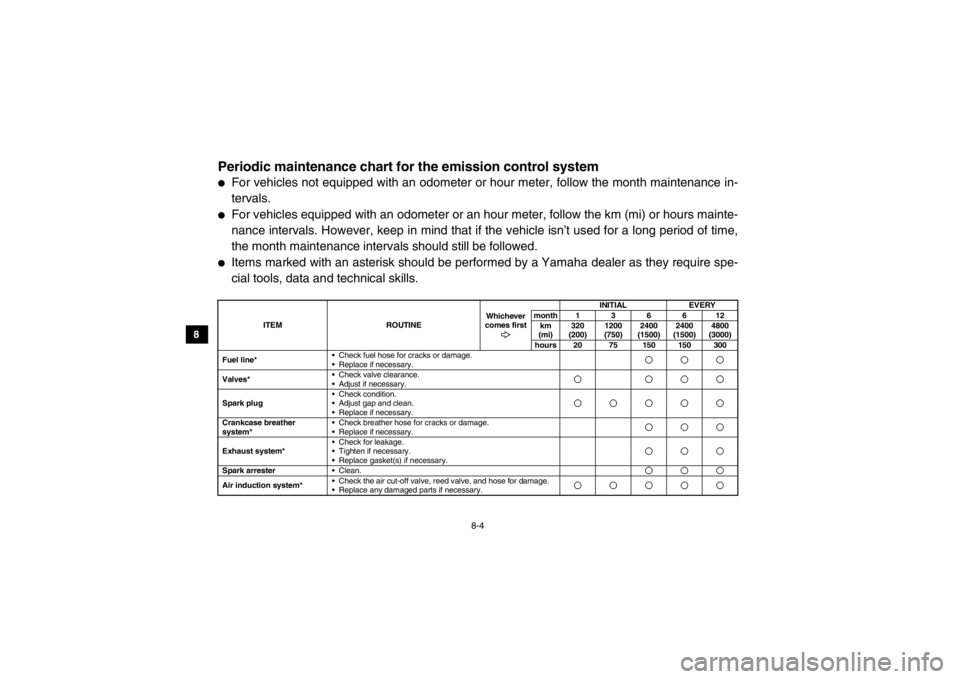
EVU01640Periodic maintenance chart for the emission control system●
For vehicles not equipped with an odometer or hour meter, follow the month maintenance in-
tervals.
●
For vehicles equipped with an odometer or an hour meter, follow the km (mi) or hours mainte-
nance intervals. However, keep in mind that if the vehicle isn’t used for a long period of time,
the month maintenance intervals should still be followed.
●
Items marked with an asterisk should be performed by a Yamaha dealer as they require spe-
cial tools, data and technical skills.
ITEM ROUTINEWhichever
comes first INITIAL
EVERY
month136612 km
(mi) 320
(200) 1200
(750) 2400
(1500) 2400
(1500) 4800
(3000)
hours 20 75 150 150 300
Fuel line* Check fuel hose for cracks or damage.
Replace if necessary.
Valves*
Check valve clearance.
Adjust if necessary.Spark plug Check condition.
Adjust gap and clean.
Replace if necessary.Crankcase breather
system* Check breather hose for cracks or damage.
Replace if necessary.Exhaust system*
Check for leakage.
Tighten if necessary.
Replace gasket(s) if necessary.Spark arrester
Clean.Air induction system* Check the air cut-off valve, reed valve, and hose for damage.
Replace any damaged parts if necessary.1XP7B_EE.book Page 4 Tuesday, February 4, 2014 4:19 PM
Page 135 of 180
8-25
1
2
3
4
5
6
78
9
10
11
12
13
14
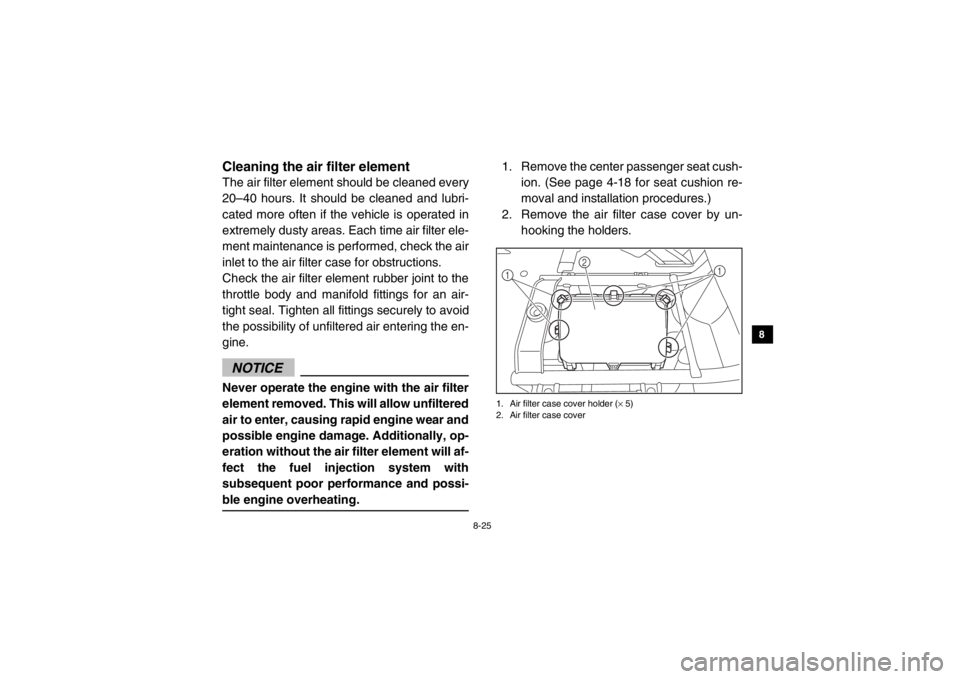
5B410016Cleaning the air filter elementThe air filter element should be cleaned every
20–40 hours. It should be cleaned and lubri-
cated more often if the vehicle is operated in
extremely dusty areas. Each time air filter ele-
ment maintenance is performed, check the air
inlet to the air filter case for obstructions.
Check the air filter element rubber joint to the
throttle body and manifold fittings for an air-
tight seal. Tighten all fittings securely to avoid
the possibility of unfiltered air entering the en-
gine.NOTICENever operate the engine with the air filter
element removed. This will allow unfiltered
air to enter, causing rapid engine wear and
possible engine damage. Additionally, op-
eration without the air filter element will af-
fect the fuel injection system with
subsequent poor performance and possi-
ble engine overheating.
1. Remove the center passenger seat cush-
ion. (See page 4-18 for seat cushion re-
moval and installation procedures.)
2. Remove the air filter case cover by un- hooking the holders.1. Air filter case cover holder ( × 5)
2. Air filter case cover
2
1 1
1XP7B_EE.book Page 25 Tuesday, February 4, 2014 3:40 PM
Page 141 of 180
8-31
1
2
3
4
5
6
78
9
10
11
12
13
14
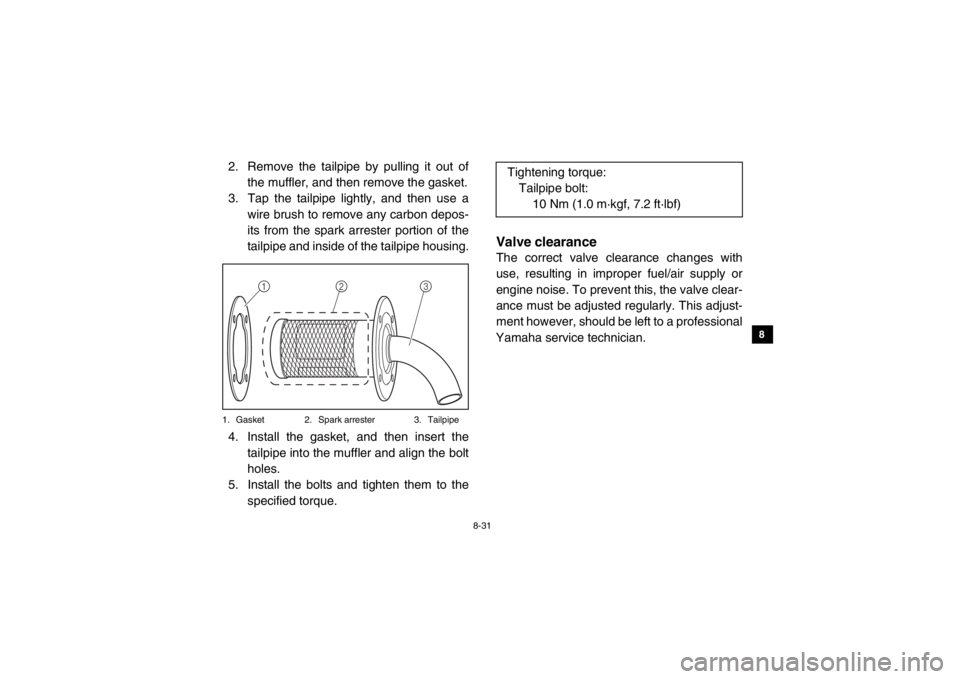
2. Remove the tailpipe by pulling it out ofthe muffler, and then remove the gasket.
3. Tap the tailpipe lightly, and then use a
wire brush to remove any carbon depos-
its from the spark arrester portion of the
tailpipe and inside of the tailpipe housing.1. Gasket 2. Spark arrester 3. Tailpipe4. Install the gasket, and then insert thetailpipe into the muffler and align the bolt
holes.
5. Install the bolts and tighten them to the specified torque.
Valve clearanceThe correct valve clearance changes with
use, resulting in improper fuel/air supply or
engine noise. To prevent this, the valve clear-
ance must be adjusted regularly. This adjust-
ment however, should be left to a professional
Yamaha service technician.
3
2
1
Tightening torque:
Tailpipe bolt:
10 Nm (1.0 m·kgf, 7.2 ft·lbf)
1XP7B_EE.book Page 31 Tuesday, February 4, 2014 3:40 PM
Page 157 of 180
8-47
1
2
3
4
5
6
78
9
10
11
12
13
14
1. Jumper cable negative lead5. Start the engine. (Refer to “Starting theengine” on page 6-2.)
6. After the engine starts, disconnect the negative lead of the jumper cable from
the frame and charged battery, and then
disconnect the positive lead of the jumper
cable from the charged battery and the
battery in the vehicle.
7. Install the hood.
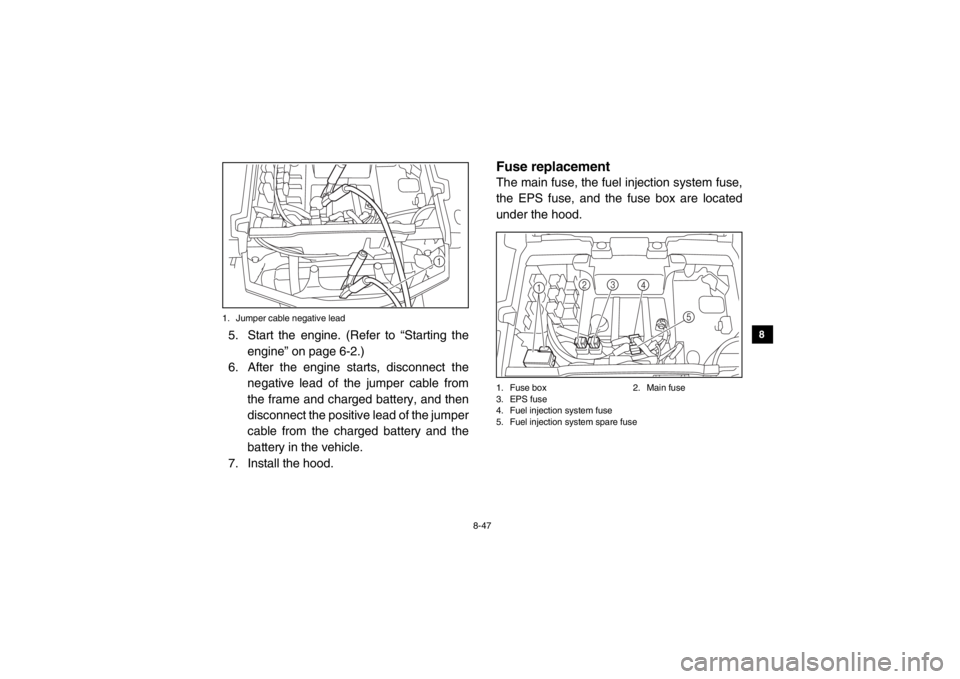
5B410023Fuse replacementThe main fuse, the fuel injection system fuse,
the EPS fuse, and the fuse box are located
under the hood.1. Fuse box 2. Main fuse
3. EPS fuse
4. Fuel injection system fuse
5. Fuel injection system spare fuse
1
1 3
2
4
5
1XP7B_EE.book Page 47 Tuesday, February 4, 2014 3:40 PM
Page 159 of 180
8-49
1
2
3
4
5
6
78
9
10
11
12
13
14
4. Turn the key to “ ” (on) and turn on theelectrical circuit in question to check if the
device operates. If the fuse blows again
immediately, have a Yamaha dealer
check the electrical system.
5. Install the hood.
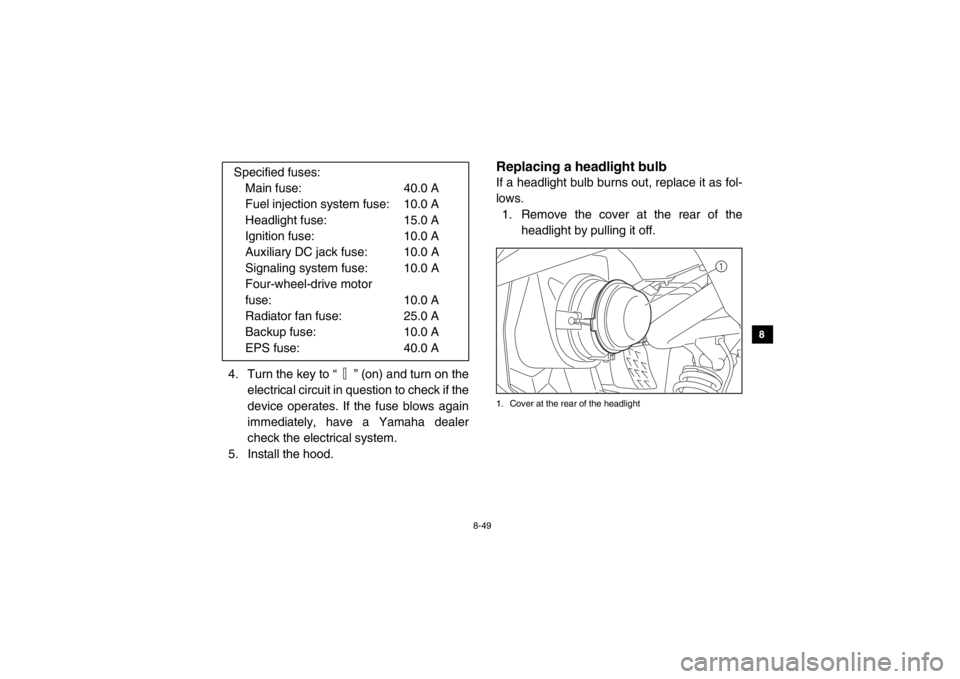
EVU01670Replacing a headlight bulbIf a headlight bulb burns out, replace it as fol-
lows. 1. Remove the cover at the rear of the headlight by pulling it off.1. Cover at the rear of the headlight
Specified fuses:Main fuse: 40.0 A
Fuel injection system fuse: 10.0 A
Headlight fuse: 15.0 A
Ignition fuse: 10.0 A
Auxiliary DC jack fuse: 10.0 A
Signaling system fuse: 10.0 A
Four-wheel-drive motor
fuse: 10.0 A
Radiator fan fuse: 25.0 A
Backup fuse: 10.0 A
EPS fuse: 40.0 A
1
1XP7B_EE.book Page 49 Tuesday, February 4, 2014 3:40 PM
Page 165 of 180
8-55
1
2
3
4
5
6
78
9
10
11
12
13
14
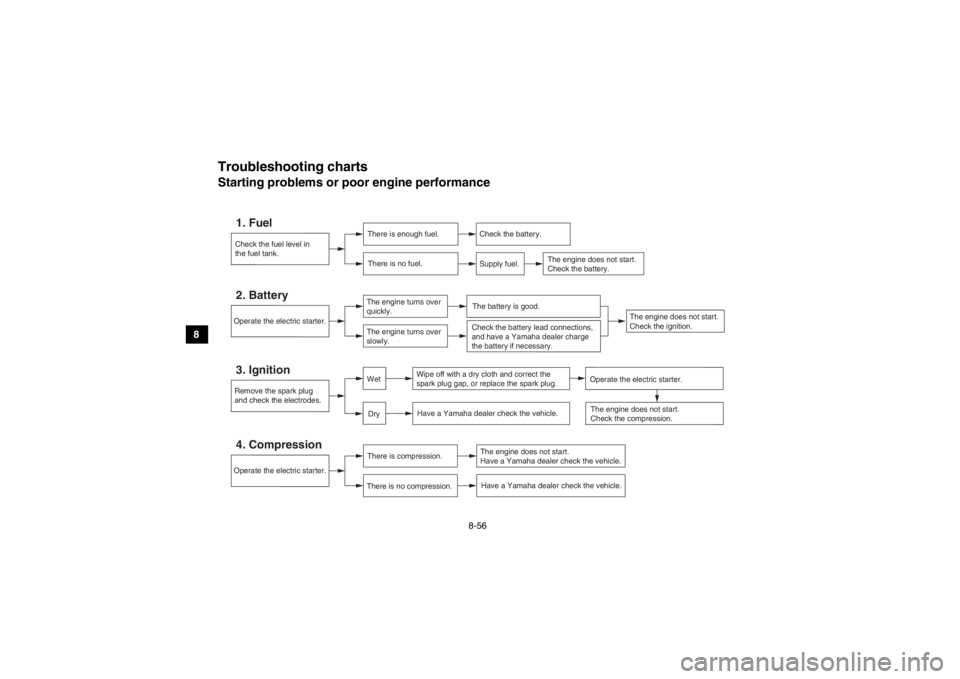
EVU01010TroubleshootingAlthough Yamaha vehicles receive an inspec-
tion before shipment from the factory, trouble
may occur during operation. Any problem in
the fuel, compression, or ignition systems can
cause poor starting and loss of power. The
troubleshooting chart describes a quick, easy
procedure for making checks. If your vehicle
requires any repair, take it to a Yamaha deal-
er.
The skilled technicians at a Yamaha dealer-
ship have the tools, experience, and know-
how to properly service your vehicle. Use only
genuine Yamaha parts on your vehicle. Imita-
tion parts may look like Yamaha parts, but
they are often inferior. Consequently, they
have a shorter service life and can lead to ex-
pensive repair bills.
WARNING
When checking the fuel system, do not
smoke and make sure there are no open
flames or sparks in the area, including pi-
lot lights from water heaters or furnaces.
Gasoline or gasoline vapors can ignite or
explode, causing severe injury or property
damage.
1XP7B_EE.book Page 55 Tuesday, February 4, 2014 3:40 PM
Page 166 of 180
8-56
8
9
10
11
12
13
14
5B410024Troubleshooting chartsStarting problems or poor engine performance
Check the fuel level in
the fuel tank.1. Fuel
There is enough fuel.
There is no fuel.
Check the battery.
Supply fuel.
The engine does not start.
Check the battery.
Operate the electric starter.4. Compression
There is compression.
There is no compression.
The engine does not start.
Have a Yamaha dealer check the vehicle.Have a Yamaha dealer check the vehicle.
Remove the spark plug
and check the electrodes.3. Ignition
Wipe off with a dry cloth and correct the
spark plug gap, or replace the spark plug. Have a Yamaha dealer check the vehicle.
The engine does not start.
Check the compression.
Operate the electric starter.2. Battery
The engine turns over
quickly.
The engine turns over
slowly.
The battery is good.
DryWet
Operate the electric starter.
Check the battery lead connections,
and have a Yamaha dealer charge
the battery if necessary.
The engine does not start.
Check the ignition.
1XP7B_EE.book Page 56 Tuesday, February 4, 2014 3:40 PM