light YAMAHA VIKING 2014 Owner's Manual
[x] Cancel search | Manufacturer: YAMAHA, Model Year: 2014, Model line: VIKING, Model: YAMAHA VIKING 2014Pages: 180, PDF Size: 3.78 MB
Page 75 of 180
6-2
1
2
3
4
56
7
8
9
10
11
12
13
14
Each full-throttle acceleration sequence
should be followed with a substantial rest pe-
riod for the engine, by cruising at lower r/min
so the engine can rid itself of the temporary
build-up of heat. If any abnormality is noticed
during this period, consult a Yamaha dealer.
0–10 hours:
Avoid continuous operation above 1/2-throt-
tle. Allow a cooling-off period of 5 to 10 min-
utes after every hour of operation. Vary the
speed of the vehicle from time to time. Do not
operate it at one set throttle position.
10–20 hours:
Avoid prolonged operation above three-quar-
ter throttle.
After break-in:
The vehicle may now be operated normally.
5B410007Starting the engine1. Turn the key to “ ” (on).NOTICEThe coolant temperature warning light and
engine trouble warning light should come
on, then go off.
The EPS warning light should come on,
then go off when the engine is started.
If a warning light does not go off, see page
4-2 for the corresponding warning light
circuit check.2. Apply the brake pedal.
3. Shift the drive select lever into the neutralposition.
●
When the drive select lever is in the
neutral position, the neutral indicator
light should come on. If the neutral in-
dicator light does not come on, ask a
Yamaha dealer to inspect the electric circuit.
1XP7B_EE.book Page 2 Tuesday, February 4, 2014 3:40 PM
Page 78 of 180
6-5
6
7
8
9
10
11
12
13
14
Shifting: neutral to reverse
WARNING
Before you shift into reverse, make sure
there are no obstacles or people behind
you. When it is safe to proceed, go slowly.
Hitting an obstacle or person could result
in serious injury or death.1. Stop the vehicle, take your foot off the ac- celerator pedal, and check behind you.
2. Apply the brake pedal.
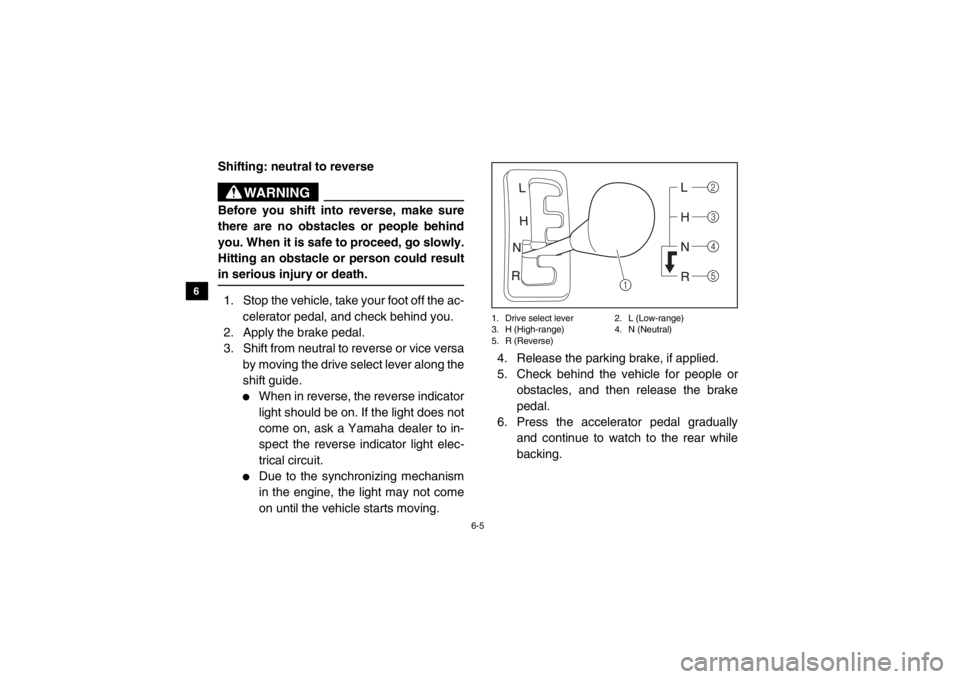
3. Shift from neutral to reverse or vice versa
by moving the drive select lever along the
shift guide.
●
When in reverse, the reverse indicator
light should be on. If the light does not
come on, ask a Yamaha dealer to in-
spect the reverse indicator light elec-
trical circuit.
●
Due to the synchronizing mechanism
in the engine, the light may not come
on until the vehicle starts moving.
1. Drive select lever 2. L (Low-range)
3. H (High-range) 4. N (Neutral)
5. R (Reverse)4. Release the parking brake, if applied.
5. Check behind the vehicle for people or obstacles, and then release the brake
pedal.
6. Press the accelerator pedal gradually and continue to watch to the rear while
backing.
1
2
5 4
3
1XP7B_EE.book Page 5 Tuesday, February 4, 2014 3:40 PM
Page 79 of 180
6-6
1
2
3
4
56
7
8
9
10
11
12
13
14
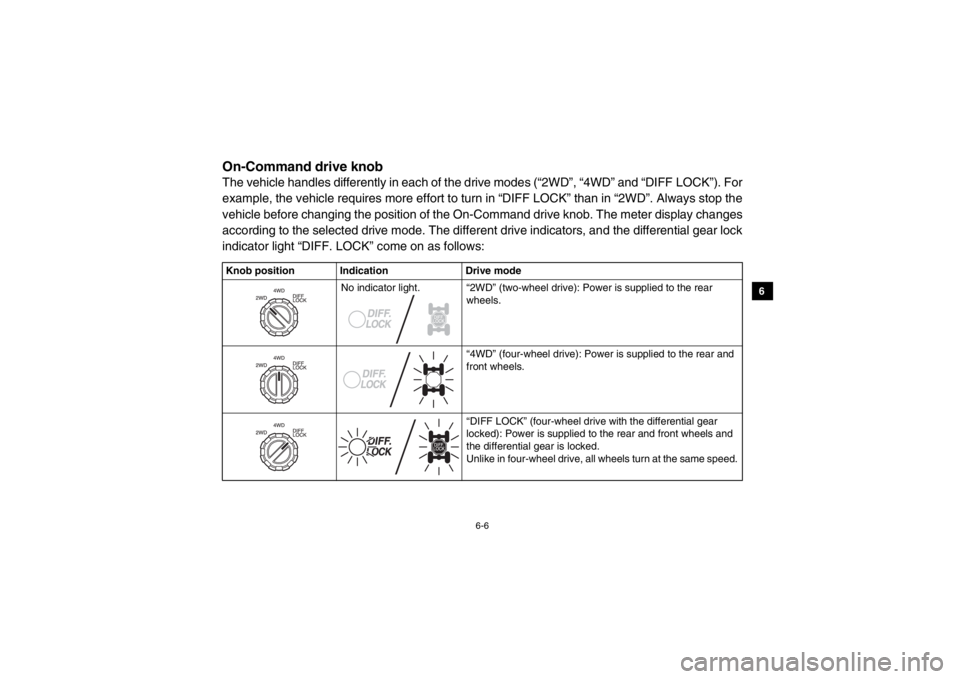
5B410009On-Command drive knobThe vehicle handles differently in each of the drive modes (“2WD”, “4WD” and “DIFF LOCK”). For
example, the vehicle requires more effort to turn in “DIFF LOCK” than in “2WD”. Always stop the
vehicle before changing the position of the On-Command drive knob. The meter display changes
according to the selected drive mode. The different drive indicators, and the differential gear lock
indicator light “DIFF. LOCK” come on as follows:Knob position Indication Drive mode
No indicator light. “2WD” (two-wheel drive): Power is supplied to the rear wheels.
“4WD” (four-wheel drive): Power is supplied to the rear and
front wheels.
“DIFF LOCK” (four-wheel drive with the differential gear
locked): Power is supplied to the rear and front wheels and
the differential gear is locked.
Unlike in four-wheel drive, all wheels turn at the same speed.
1XP7B_EE.book Page 6 Tuesday, February 4, 2014 3:40 PM
Page 80 of 180

6-7
6
7
8
9
10
11
12
13
14
TIP●
When the knob is set to “DIFF LOCK” or “4WD”, the differential gear lock indicator and indi-
cator light will flash until the differential gear is completely locked or unlocked.
●
When the indicator and indicator light are flashing, turning the steering wheel back and forth
will help the differential gear lock to engage or disengage.
●
Riding before the differential gear is properly engaged or disengaged (e.g., when the indica-
tor and indicator light are flashing) will cause the vehicle speed to be limited until the differ-
ential gear is completely engaged or disengaged.
1XP7B_EE.book Page 7 Tuesday, February 4, 2014 3:40 PM
Page 122 of 180
8-12
8
9
10
11
12
13
14
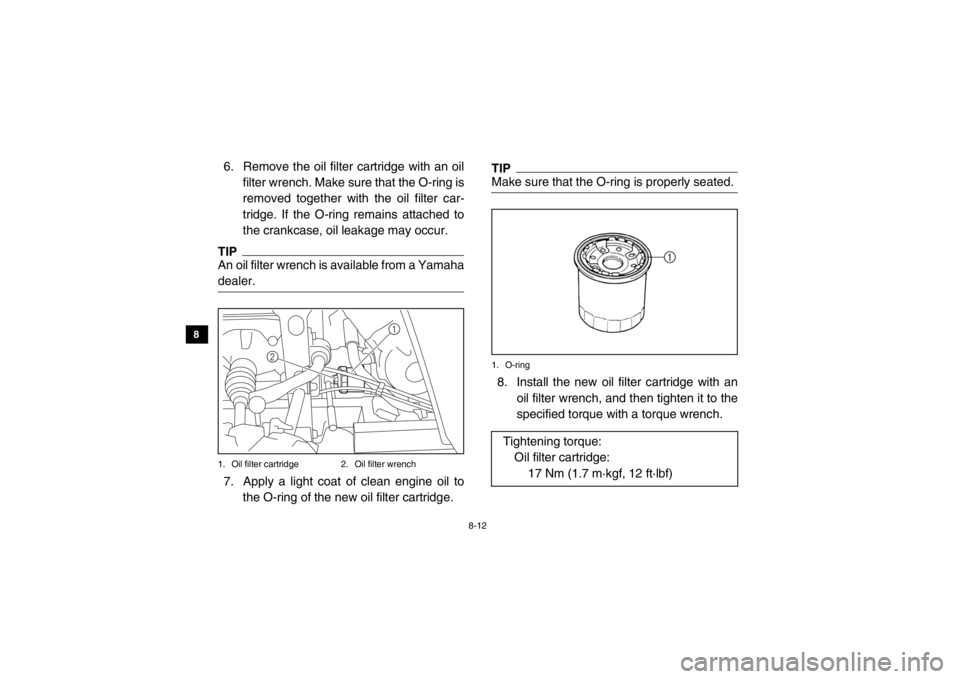
6. Remove the oil filter cartridge with an oil filter wrench. Make sure that the O-ring is
removed together with the oil filter car-
tridge. If the O-ring remains attached to
the crankcase, oil leakage may occur.TIPAn oil filter wrench is available from a Yamaha
dealer. 1. Oil filter cartridge 2. Oil filter wrench7. Apply a light coat of clean engine oil tothe O-ring of the new oil filter cartridge.
TIPMake sure that the O-ring is properly seated.1. O-ring8. Install the new oil filter cartridge with an oil filter wrench, and then tighten it to the
specified torque with a torque wrench.
2
1
Tightening torque:Oil filter cartridge: 17 Nm (1.7 m·kgf, 12 ft·lbf)
1XP7B_EE.book Page 12 Tuesday, February 4, 2014 3:40 PM
Page 133 of 180
8-23
1
2
3
4
5
6
78
9
10
11
12
13
14
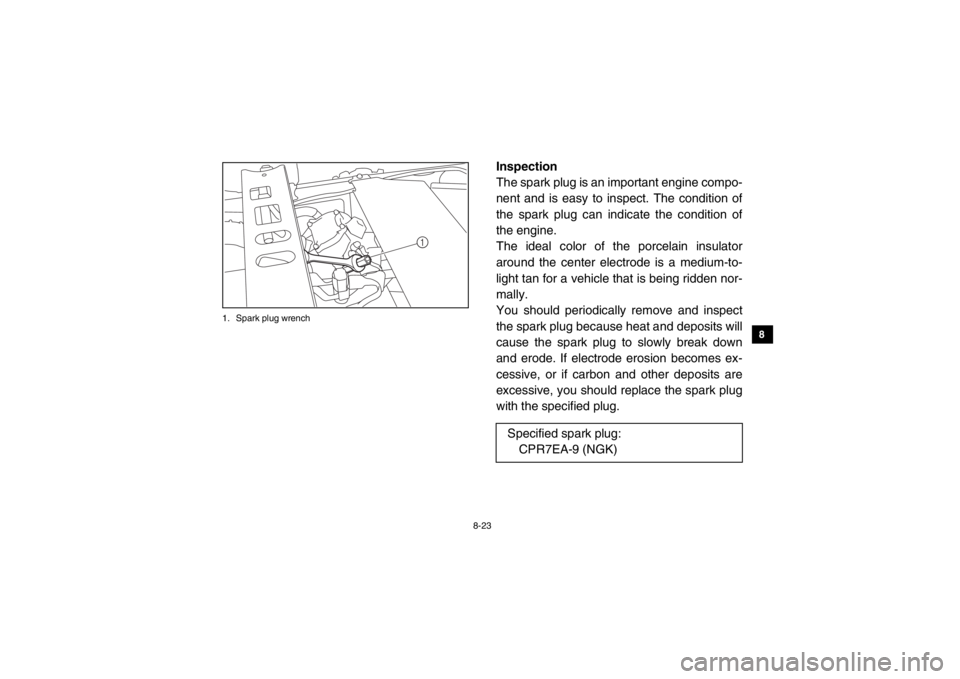
1. Spark plug wrench
Inspection
The spark plug is an important engine compo-
nent and is easy to inspect. The condition of
the spark plug can indicate the condition of
the engine.
The ideal color of the porcelain insulator
around the center electrode is a medium-to-
light tan for a vehicle that is being ridden nor-
mally.
You should periodically remove and inspect
the spark plug because heat and deposits will
cause the spark plug to slowly break down
and erode. If electrode erosion becomes ex-
cessive, or if carbon and other deposits are
excessive, you should replace the spark plug
with the specified plug.
1
Specified spark plug:CPR7EA-9 (NGK)
1XP7B_EE.book Page 23 Tuesday, February 4, 2014 3:40 PM
Page 141 of 180
8-31
1
2
3
4
5
6
78
9
10
11
12
13
14
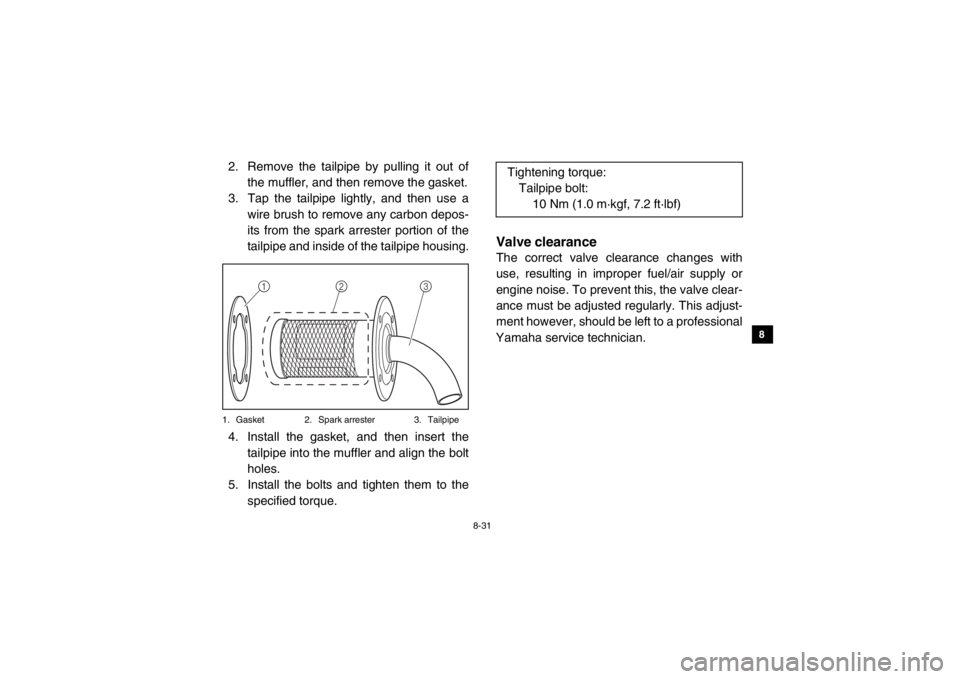
2. Remove the tailpipe by pulling it out ofthe muffler, and then remove the gasket.
3. Tap the tailpipe lightly, and then use a
wire brush to remove any carbon depos-
its from the spark arrester portion of the
tailpipe and inside of the tailpipe housing.1. Gasket 2. Spark arrester 3. Tailpipe4. Install the gasket, and then insert thetailpipe into the muffler and align the bolt
holes.
5. Install the bolts and tighten them to the specified torque.
Valve clearanceThe correct valve clearance changes with
use, resulting in improper fuel/air supply or
engine noise. To prevent this, the valve clear-
ance must be adjusted regularly. This adjust-
ment however, should be left to a professional
Yamaha service technician.
3
2
1
Tightening torque:
Tailpipe bolt:
10 Nm (1.0 m·kgf, 7.2 ft·lbf)
1XP7B_EE.book Page 31 Tuesday, February 4, 2014 3:40 PM
Page 146 of 180
8-36
8
9
10
11
12
13
14
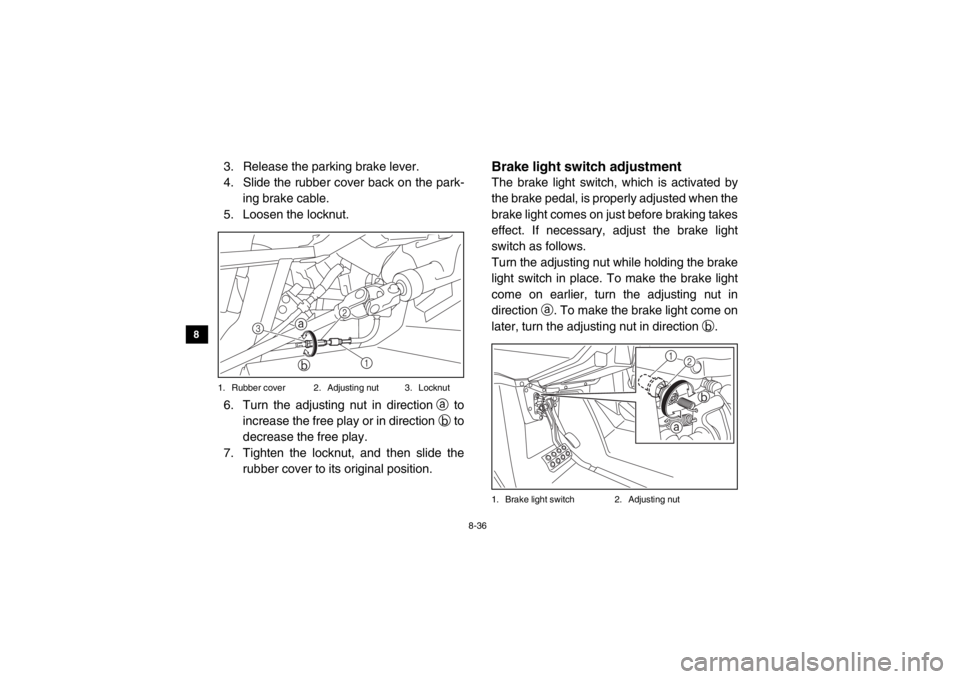
3. Release the parking brake lever.
4. Slide the rubber cover back on the park- ing brake cable.
5. Loosen the locknut.1. Rubber cover 2. Adjusting nut 3. Locknut6. Turn the adjusting nut in direction a to
increase the free play or in direction b to
decrease the free play.
7. Tighten the locknut, and then slide the rubber cover to its original position.
EVU00880Brake light switch adjustmentThe brake light switch, which is activated by
the brake pedal, is properly adjusted when the
brake light comes on just before braking takes
effect. If necessary, adjust the brake light
switch as follows.
Turn the adjusting nut while holding the brake
light switch in place. To make the brake light
come on earlier, turn the adjusting nut in
direction a. To make the brake light come on
later, turn the adjusting nut in direction b.1. Brake light switch 2. Adjusting nut
1
ab
2
3
1a
b
2
1XP7B_EE.book Page 36 Tuesday, February 4, 2014 3:40 PM
Page 158 of 180
8-48
8
9
10
11
12
13
14
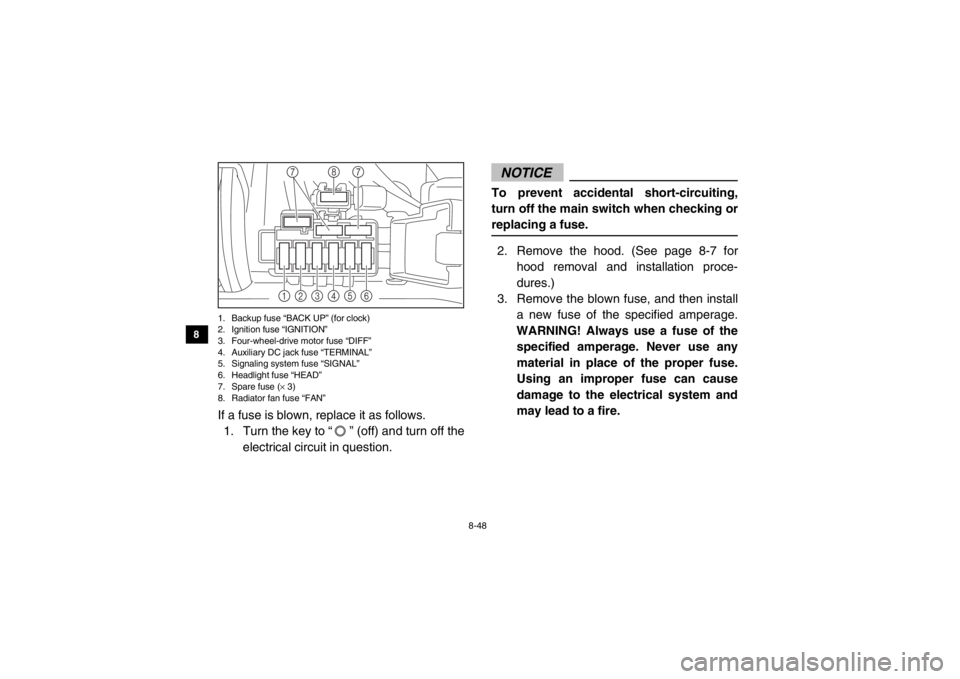
1. Backup fuse “BACK UP” (for clock)
2. Ignition fuse “IGNITION”
3. Four-wheel-drive motor fuse “DIFF”
4. Auxiliary DC jack fuse “TERMINAL”
5. Signaling system fuse “SIGNAL”
6. Headlight fuse “HEAD”
7. Spare fuse ( × 3)
8. Radiator fan fuse “FAN”If a fuse is blown, replace it as follows.
1. Turn the key to “ ” (off) and turn off the
electrical circuit in question.
NOTICETo prevent accidental short-circuiting,
turn off the main switch when checking or
replacing a fuse.2. Remove the hood. (See page 8-7 for hood removal and installation proce-
dures.)
3. Remove the blown fuse, and then install a new fuse of the specified amperage.
WARNING! Always use a fuse of the specified amperage. Never use any
material in place of the proper fuse.
Using an improper fuse can cause
damage to the electrical system and
may lead to a fire.
1
2
3
4
5
6
8
7
7
1XP7B_EE.book Page 48 Tuesday, February 4, 2014 3:40 PM
Page 159 of 180
8-49
1
2
3
4
5
6
78
9
10
11
12
13
14
4. Turn the key to “ ” (on) and turn on theelectrical circuit in question to check if the
device operates. If the fuse blows again
immediately, have a Yamaha dealer
check the electrical system.
5. Install the hood.
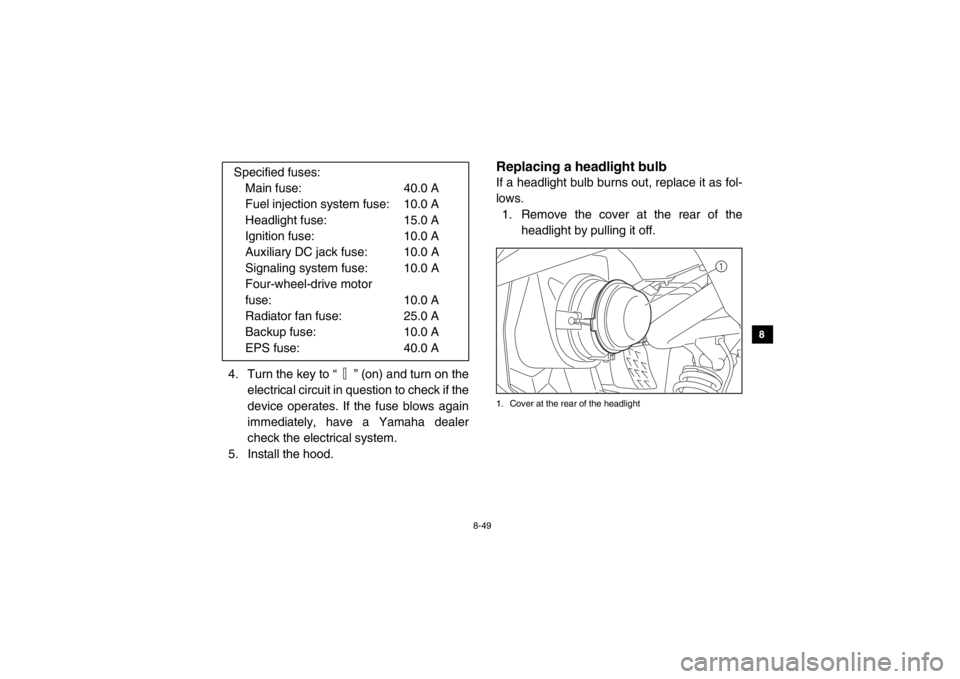
EVU01670Replacing a headlight bulbIf a headlight bulb burns out, replace it as fol-
lows. 1. Remove the cover at the rear of the headlight by pulling it off.1. Cover at the rear of the headlight
Specified fuses:Main fuse: 40.0 A
Fuel injection system fuse: 10.0 A
Headlight fuse: 15.0 A
Ignition fuse: 10.0 A
Auxiliary DC jack fuse: 10.0 A
Signaling system fuse: 10.0 A
Four-wheel-drive motor
fuse: 10.0 A
Radiator fan fuse: 25.0 A
Backup fuse: 10.0 A
EPS fuse: 40.0 A
1
1XP7B_EE.book Page 49 Tuesday, February 4, 2014 3:40 PM