engine YAMAHA VIKING 2014 Owner's Guide
[x] Cancel search | Manufacturer: YAMAHA, Model Year: 2014, Model line: VIKING, Model: YAMAHA VIKING 2014Pages: 180, PDF Size: 3.78 MB
Page 107 of 180

7-23
1
2
3
4
5
67
8
9
10
11
12
13
14
Downhill
Check the terrain carefully before going
downhill. When possible, choose a path that
lets you drive your vehicle straight downhill.
Choose your path carefully and drive slowly
enough to be able to react to obstacles that
you encounter.
For more traction and control, before going
down steeper and/or rougher slopes, shift into
low gear and select “4WD” or “DIFF LOCK”.
Engine braking will help you go downhill slow-
ly. Go as slowly as possible. If you begin to go
too fast, apply the brakes gently. Avoid hard
application of the brakes, which could cause
the vehicle to slide.If you are sliding or skidding, try to steer in the
direction the vehicle is sliding, to regain con-
trol. For example, if you feel the back of the
vehicle start to slide to your right, steer to the
right.
If you must turn on the hill to avoid an obsta-
cle, do so slowly and carefully. If the vehicle
starts to tip, immediately steer in the downhill
direction if there are no obstacles in your path.
As you regain proper balance, gradually steer
again in the direction you want to go.1XP7B_EE.book Page 23 Tuesday, February 4, 2014 3:40 PM
Page 110 of 180

7-26
7
8
9
10
11
12
13
14
Brush or wooded areas
When operating in areas with brush or trees,
watch carefully on both sides and above the
vehicle for obstacles such as branches that
the vehicle might hit, causing an accident.
Watch for brush that might enter the vehicle
as you pass and strike you or the passengers.
Never hold onto the cage/frame. The passen-
gers should always hold onto the passenger
handhold with both hands.
The muffler and other engine parts become
extremely hot during operation and remain
hot after the engine has stopped. To reduce
the risk of fire during operation or after leaving
the vehicle, do not let brush, grass and other
materials collect under the vehicle, near the
muffler or exhaust pipe, or next to other hot
parts. Check under the vehicle after operating
in areas where combustible materials may
have collected. Do not idle or park the vehicle
in long dry grass or other dry ground cover. Encountering obstacles
If you cannot go around an obstacle, such as
a fallen tree or a ditch, stop the vehicle where
it is safe to do so. Set the parking brake and
get out to inspect the area thoroughly. Look
from both your approach side and exit side. If
you believe you can continue safely, choose
the path that will allow you to get over the ob-
stacle and at as close to a right angle as pos-
sible to minimize vehicle tipping. Go only fast
enough to maintain your momentum but still
give yourself plenty of time to react to chang-
es in conditions.
If there is any question about your ability to
maneuver safely over the obstacle, you
should turn around if the ground is flat and you
have the room or back up until you find a less
difficult path.1XP7B_EE.book Page 26 Tuesday, February 4, 2014 3:40 PM
Page 111 of 180
8-1
1
2
3
4
5
6
78
9
10
11
12
13
14
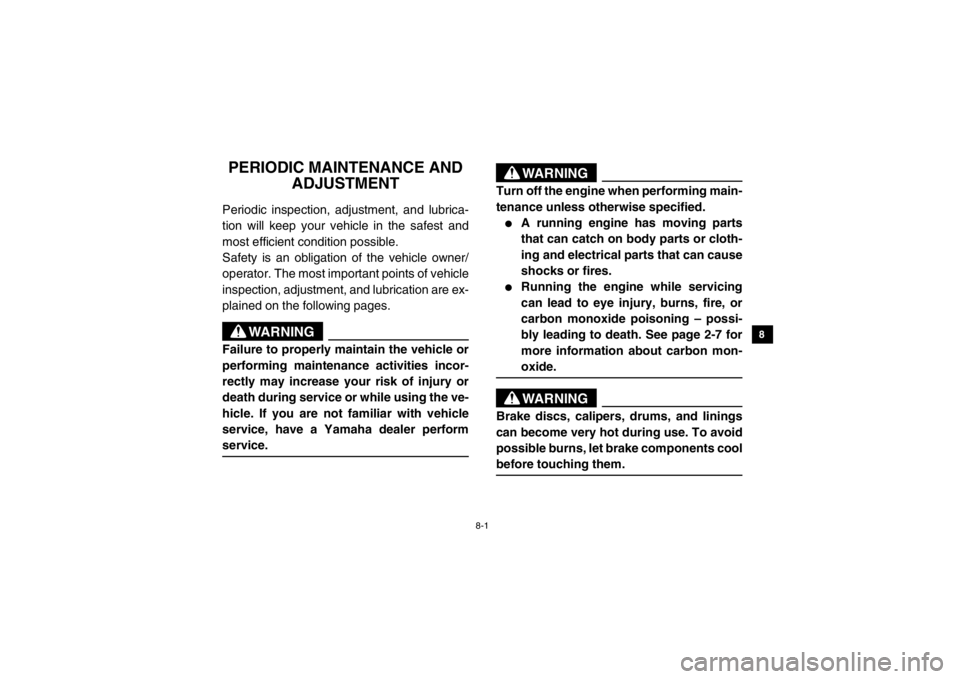
EVU006501-PERIODIC MAINTENANCE AND ADJUSTMENTPeriodic inspection, adjustment, and lubrica-
tion will keep your vehicle in the safest and
most efficient condition possible.
Safety is an obligation of the vehicle owner/
operator. The most important points of vehicle
inspection, adjustment, and lubrication are ex-
plained on the following pages.
WARNING
Failure to properly maintain the vehicle or
performing maintenance activities incor-
rectly may increase your risk of injury or
death during service or while using the ve-
hicle. If you are not familiar with vehicle
service, have a Yamaha dealer perform
service.
WARNING
Turn off the engine when performing main-
tenance unless otherwise specified.●
A running engine has moving parts
that can catch on body parts or cloth-
ing and electrical parts that can cause
shocks or fires.
●
Running the engine while servicing
can lead to eye injury, burns, fire, or
carbon monoxide poisoning – possi-
bly leading to death. See page 2-7 for
more information about carbon mon-
oxide.WARNING
Brake discs, calipers, drums, and linings
can become very hot during use. To avoid
possible burns, let brake components cool
before touching them.
1XP7B_EE.book Page 1 Tuesday, February 4, 2014 3:40 PM
Page 115 of 180
8-5
1
2
3
4
5
6
78
9
10
11
12
13
14
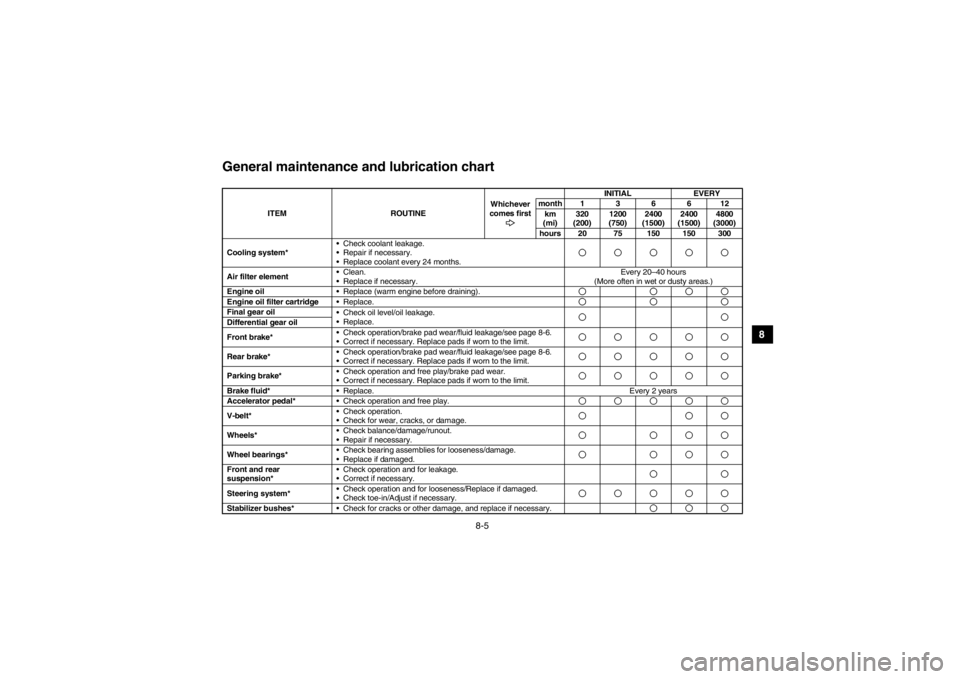
EVU01650General maintenance and lubrication chart
ITEM ROUTINEWhichever
comes first INITIAL
EVERY
month136612 km
(mi) 320
(200) 1200
(750) 2400
(1500) 2400
(1500) 4800
(3000)
hours 20 75 150 150 300
Cooling system* Check coolant leakage.
Repair if necessary.
Replace coolant every 24 months.
Air filter element
Clean.
Replace if necessary. Every 20–40 hours
(More often in wet or dusty areas.)
Engine oil Replace (warm engine before draining).Engine oil filter cartridge Replace.Final gear oil
Check oil level/oil leakage.
Replace.Differential gear oil
Front brake* Check operation/brake pad wear/fluid leakage/see page 8-6.
Correct if necessary. Replace pads if worn to the limit.Rear brake* Check operation/brake pad wear/fluid leakage/see page 8-6.
Correct if necessary. Replace pads if worn to the limit.Parking brake*
Check operation and free play/brake pad wear.
Correct if necessary. Replace pads if worn to the limit.Brake fluid*
Replace. Every 2 years
Accelerator pedal* Check operation and free play.V-belt* Check operation.
Check for wear, cracks, or damage.Wheels* Check balance/damage/runout.
Repair if necessary.Wheel bearings*
Check bearing assemblies for looseness/damage.
Replace if damaged.Front and rear
suspension* Check operation and for leakage.
Correct if necessary.Steering system*
Check operation and for looseness/Replace if damaged.
Check toe-in/Adjust if necessary.Stabilizer bushes*
Check for cracks or other damage, and replace if necessary.
1XP7B_EE.book Page 5 Tuesday, February 4, 2014 4:19 PM
Page 116 of 180
8-6
8
9
10
11
12
13
14
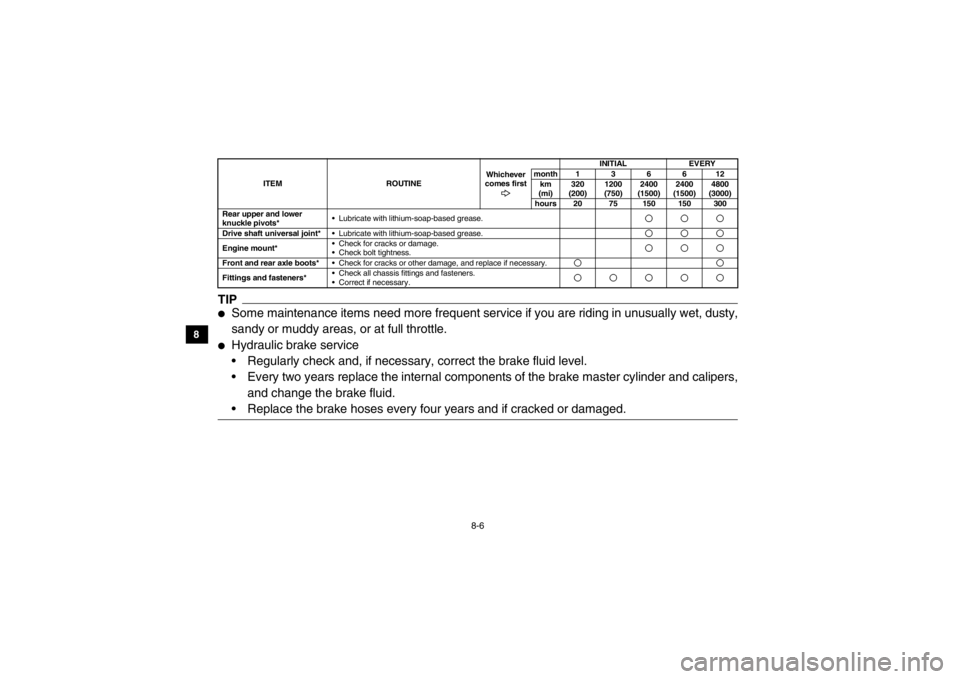
TIP●
Some maintenance items need more frequent service if you are riding in unusually wet, dusty,
sandy or muddy areas, or at full throttle.
●
Hydraulic brake service
Regularly check and, if necessary, correct the brake fluid level.
Every two years replace the internal components of the brake master cylinder and calipers, and change the brake fluid.
Replace the brake hoses every four years and if cracked or damaged.Rear upper and lower
knuckle pivots* Lubricate with lithium-soap-based grease.Drive shaft universal joint*
Lubricate with lithium-soap-based grease.Engine mount* Check for cracks or damage.
Check bolt tightness.Front and rear axle boots*
Check for cracks or other damage, and replace if necessary.Fittings and fasteners* Check all chassis fittings and fasteners.
Correct if necessary.
ITEM
ROUTINEWhichever
comes first INITIAL
EVERY
month136612 km
(mi) 320
(200) 1200
(750) 2400
(1500) 2400
(1500) 4800
(3000)
hours 20 75 150 150 300
1XP7B_EE.book Page 6 Tuesday, February 4, 2014 4:19 PM
Page 119 of 180
8-9
1
2
3
4
5
6
78
9
10
11
12
13
14
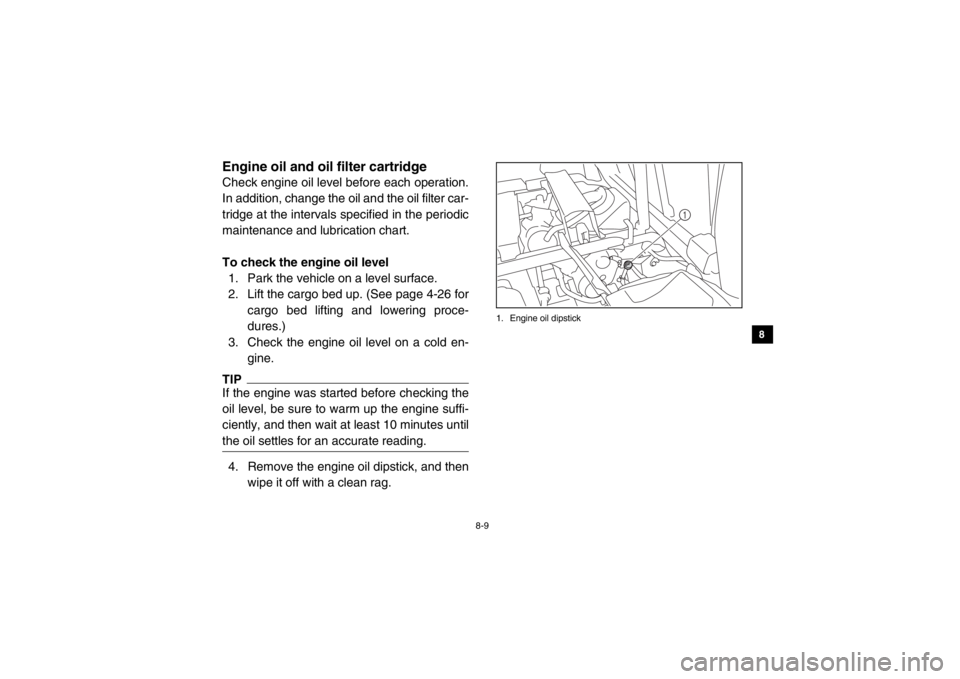
5B410012Engine oil and oil filter cartridgeCheck engine oil level before each operation.
In addition, change the oil and the oil filter car-
tridge at the intervals specified in the periodic
maintenance and lubrication chart.
To check the engine oil level1. Park the vehicle on a level surface.
2. Lift the cargo bed up. (See page 4-26 for cargo bed lifting and lowering proce-
dures.)
3. Check the engine oil level on a cold en-
gine. TIPIf the engine was started before checking the
oil level, be sure to warm up the engine suffi-
ciently, and then wait at least 10 minutes until
the oil settles for an accurate reading.4. Remove the engine oil dipstick, and thenwipe it off with a clean rag.
1. Engine oil dipstick
1
1XP7B_EE.book Page 9 Tuesday, February 4, 2014 3:40 PM
Page 120 of 180
8-10
8
9
10
11
12
13
14
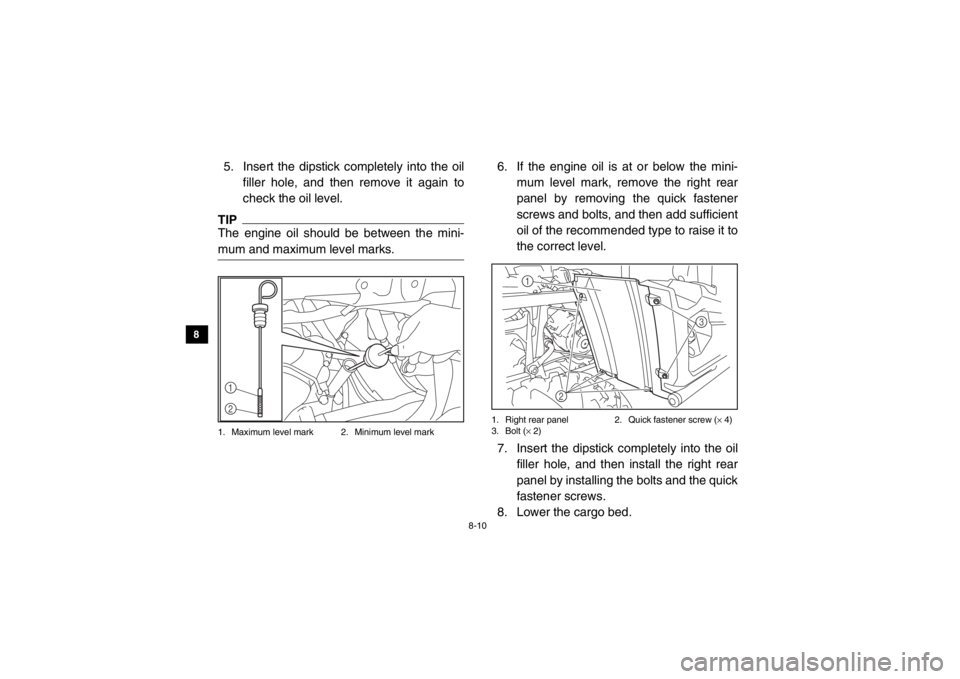
5. Insert the dipstick completely into the oil filler hole, and then remove it again to
check the oil level. TIPThe engine oil should be between the mini-
mum and maximum level marks.1. Maximum level mark 2. Minimum level mark
6. If the engine oil is at or below the mini- mum level mark, remove the right rear
panel by removing the quick fastener
screws and bolts, and then add sufficient
oil of the recommended type to raise it to
the correct level.1. Right rear panel 2. Quick fastener screw (× 4)
3. Bolt ( × 2)7. Insert the dipstick completely into the oil
filler hole, and then install the right rear
panel by installing the bolts and the quick
fastener screws.
8. Lower the cargo bed.
1
2
1
2
3
1XP7B_EE.book Page 10 Tuesday, February 4, 2014 3:40 PM
Page 121 of 180
8-11
1
2
3
4
5
6
78
9
10
11
12
13
14
To change the engine oil (with or without
oil filter cartridge replacement)1. Park the vehicle on a level surface.
2. Lift the cargo bed up. (See page 4-26 for
cargo bed lifting and lowering proce-
dures.)
3. Start the engine, warm it up for several minutes, and then turn it off.
4. Place an oil pan under the engine to col-
lect the used oil, and then remove the
dipstick.
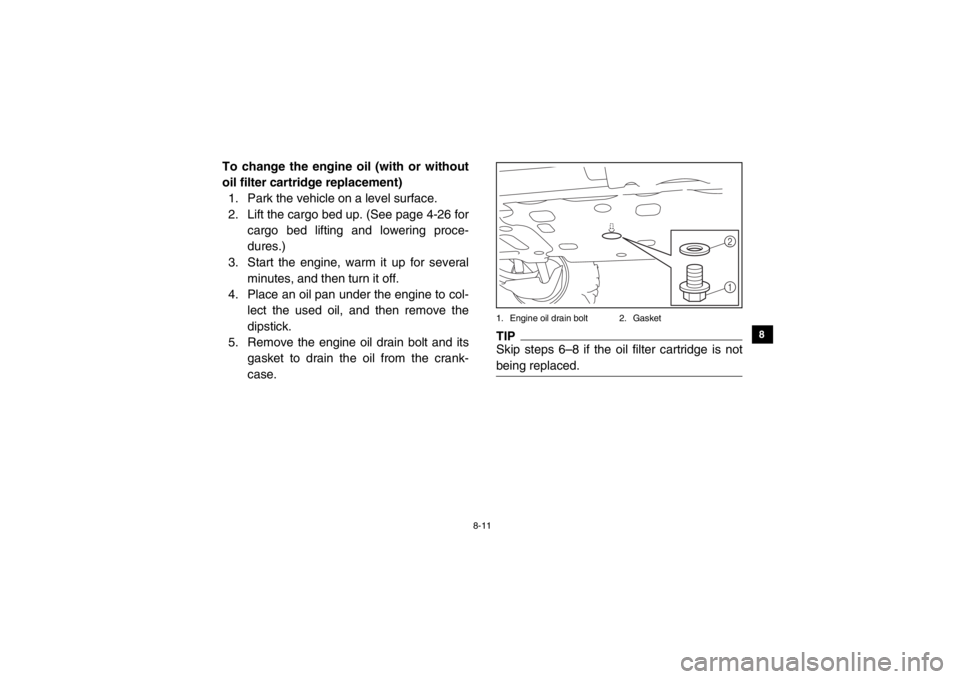
5. Remove the engine oil drain bolt and its
gasket to drain the oil from the crank-
case.
1. Engine oil drain bolt 2. GasketTIPSkip steps 6–8 if the oil filter cartridge is not
being replaced.
1 2
1XP7B_EE.book Page 11 Tuesday, February 4, 2014 3:40 PM
Page 122 of 180
8-12
8
9
10
11
12
13
14
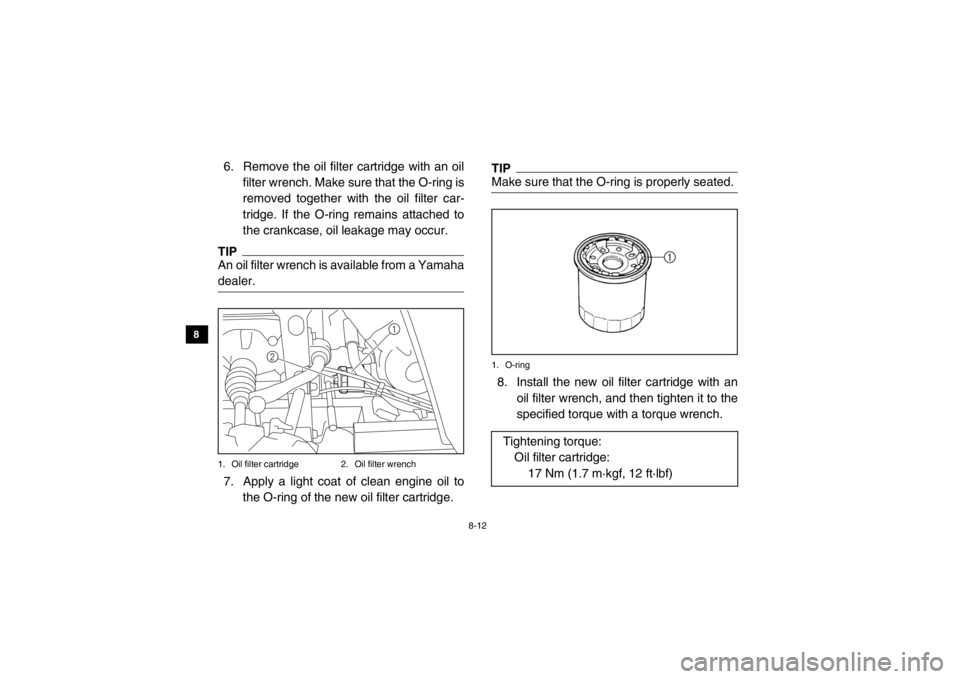
6. Remove the oil filter cartridge with an oil filter wrench. Make sure that the O-ring is
removed together with the oil filter car-
tridge. If the O-ring remains attached to
the crankcase, oil leakage may occur.TIPAn oil filter wrench is available from a Yamaha
dealer. 1. Oil filter cartridge 2. Oil filter wrench7. Apply a light coat of clean engine oil tothe O-ring of the new oil filter cartridge.
TIPMake sure that the O-ring is properly seated.1. O-ring8. Install the new oil filter cartridge with an oil filter wrench, and then tighten it to the
specified torque with a torque wrench.
2
1
Tightening torque:Oil filter cartridge: 17 Nm (1.7 m·kgf, 12 ft·lbf)
1XP7B_EE.book Page 12 Tuesday, February 4, 2014 3:40 PM
Page 123 of 180
8-13
1
2
3
4
5
6
78
9
10
11
12
13
14
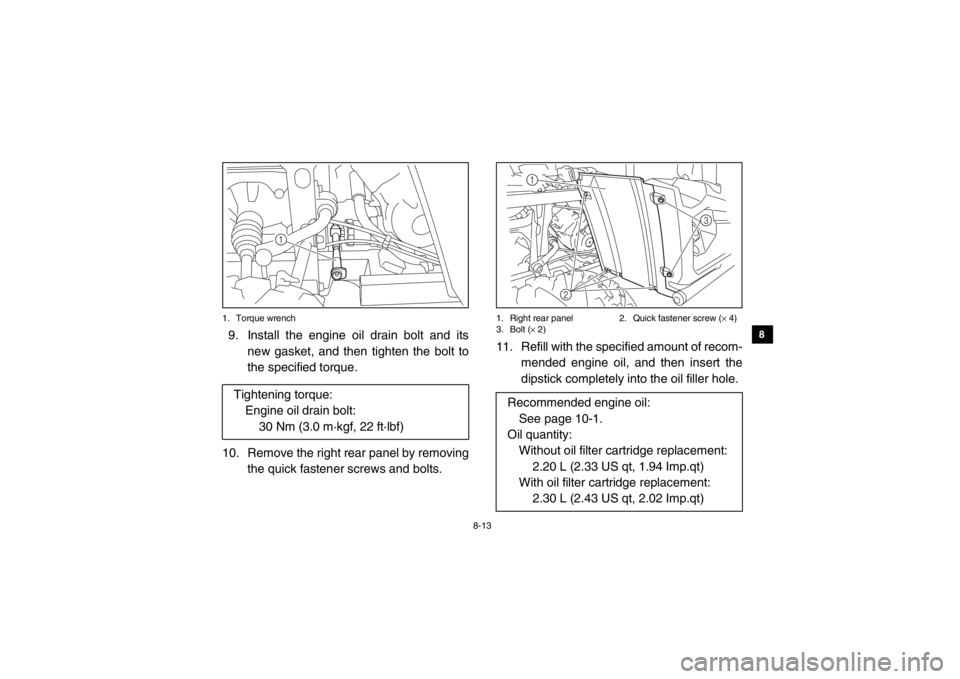
1. Torque wrench9. Install the engine oil drain bolt and itsnew gasket, and then tighten the bolt to
the specified torque.
10. Remove the right rear panel by removing the quick fastener screws and bolts.
1. Right rear panel 2. Quick fastener screw (× 4)
3. Bolt ( × 2)11. Refill with the specified amount of recom-
mended engine oil, and then insert the
dipstick completely into the oil filler hole.
Tightening torque: Engine oil drain bolt:
30 Nm (3.0 m·kgf, 22 ft·lbf)
1
Recommended engine oil:See page 10-1.
Oil quantity:
Without oil filter cartridge replacement: 2.20 L (2.33 US qt, 1.94 Imp.qt)
With oil filter cartridge replacement:
2.30 L (2.43 US qt, 2.02 Imp.qt)
1
2
3
1XP7B_EE.book Page 13 Tuesday, February 4, 2014 3:40 PM