fuel YAMAHA VIKING 2015 Owner's Manual
[x] Cancel search | Manufacturer: YAMAHA, Model Year: 2015, Model line: VIKING, Model: YAMAHA VIKING 2015Pages: 182, PDF Size: 3.82 MB
Page 167 of 182
8-57
1
2
3
4
5
6
78
9
10
11
12
13
14
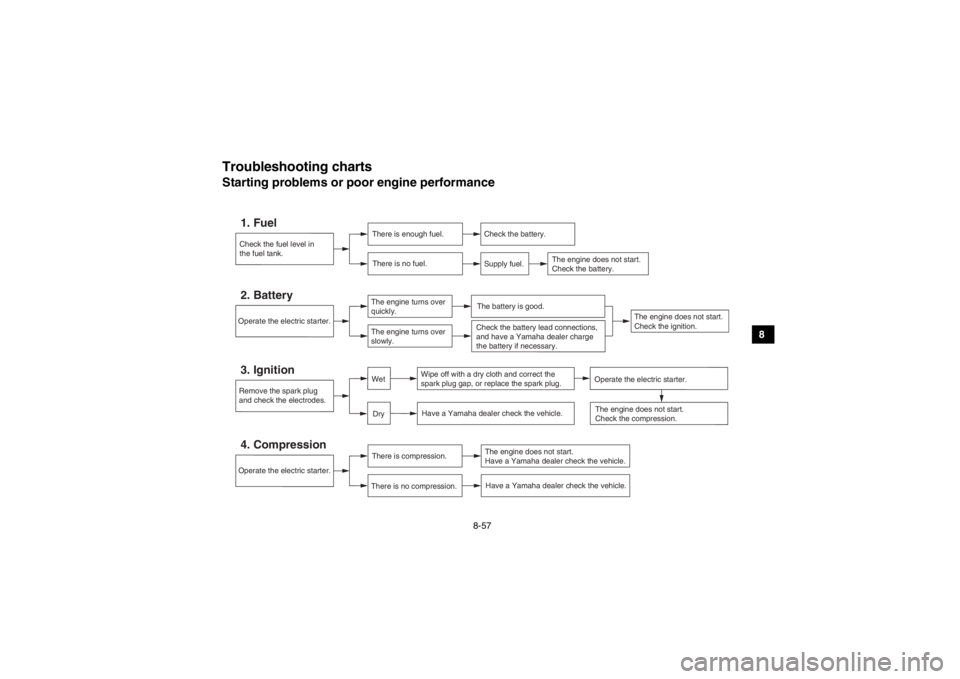
5B410024Troubleshooting chartsStarting problems or poor engine performance
Check the fuel level in
the fuel tank.1. Fuel
There is enough fuel.There is no fuel.
Check the battery.
Supply fuel.
The engine does not start.
Check the battery.
Operate the electric starter.4. Compression
There is compression.
There is no compression.
The engine does not start.
Have a Yamaha dealer check the vehicle.Have a Yamaha dealer check the vehicle.
Remove the spark plug
and check the electrodes.3. Ignition
Wipe off with a dry cloth and correct the
spark plug gap, or replace the spark plug. Have a Yamaha dealer check the vehicle.
The engine does not start.
Check the compression.
Operate the electric starter.2. Battery
The engine turns over
quickly.
The engine turns over
slowly.
The battery is good.
DryWet
Operate the electric starter.
Check the battery lead connections,
and have a Yamaha dealer charge
the battery if necessary.
The engine does not start.
Check the ignition.
1XP7C_EE.book Page 57 Monday, June 9, 2014 5:17 PM
Page 171 of 182

9-3
1
2
3
4
5
6
7
89
10
11
12
13
14
5B410025StorageLong term storage (60 days or more) of your
vehicle will require some preventive proce-
dures to guard against deterioration. Make
any necessary repairs before storing the vehi-
cle.
After thoroughly cleaning the vehicle, prepare
for storage as follows:1. Fill the fuel tank with fresh fuel and add
the specified amount of Yamaha Fuel
Stabilizer and Conditioner or equivalent
product. Operate the vehicle for at least
5 minutes to distribute treated fuel
through the fuel system. 2. Remove the spark plug, pour about one
tablespoon of SAE 10W-40 or 20W-50
motor oil in the spark plug hole and install
the spark plug. Ground the spark plug
wire and turn the engine over several
times to coat the cylinder wall with oil.
3. Lubricate all control cables.
4. Block up the frame to raise all wheels off the ground.
5. Tie a plastic bag over the exhaust pipe outlet to prevent moisture from entering.
6. If storing in a humid or salt-air atmo-
sphere, coat all exposed metal surfaces
with a light film of oil. Do not apply oil to
any rubber parts or the seat covers.
Specified amount:
1 oz of stabilizer to each gallon of fuel (or
7.5 ml of stabilizer to each liter of fuel)1XP7C_EE.book Page 3 Monday, June 9, 2014 5:17 PM
Page 172 of 182

9-4
9
10
11
12
13
14
7. Remove the battery and charge it. Store it in a dry place and recharge it once a
month. Do not store the battery in an ex-
cessively warm or cold place [less than
0 °C (30 °F) or more than 30 °C (90 °F)].
Use of fuel stabilizer and conditioner elimi-
nates the need to drain the fuel system. Con-
sult a Yamaha dealer if the fuel system needs
to be drained.1XP7C_EE.book Page 4 Monday, June 9, 2014 5:17 PM
Page 174 of 182
10-2
10
11
12
13
14 Engine oil:
Recommended brand:
YAMALUBE
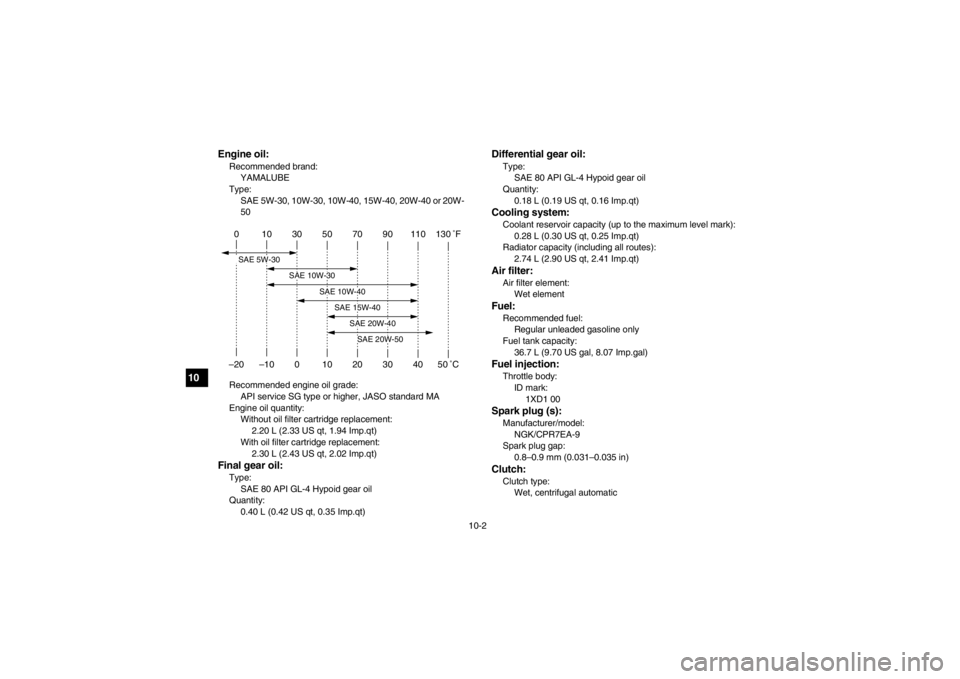
Type:
SAE 5W-30, 10W-30, 10W-40, 15W-40, 20W-40 or 20W-
50
Recommended engine oil grade: API service SG type or higher, JASO standard MA
Engine oil quantity: Without oil filter cartridge replacement:
2.20 L (2.33 US qt, 1.94 Imp.qt)
With oil filter cartridge replacement: 2.30 L (2.43 US qt, 2.02 Imp.qt)Final gear oil:Type:
SAE 80 API GL-4 Hypoid gear oil
Quantity: 0.40 L (0.42 US qt, 0.35 Imp.qt)
Differential gear oil:Type:SAE 80 API GL-4 Hypoid gear oil
Quantity:
0.18 L (0.19 US qt, 0.16 Imp.qt)Cooling system:Coolant reservoir capacity (up to the maximum level mark):0.28 L (0.30 US qt, 0.25 Imp.qt)
Radiator capacity (including all routes):
2.74 L (2.90 US qt, 2.41 Imp.qt)Air filter:Air filter element:Wet elementFuel:Recommended fuel:Regular unleaded gasoline only
Fuel tank capacity: 36.7 L (9.70 US gal, 8.07 Imp.gal)Fuel injection:Throttle body:ID mark:
1XD1 00Spark plug (s):Manufacturer/model: NGK/CPR7EA-9
Spark plug gap:
0.8–0.9 mm (0.031–0.035 in)Clutch:Clutch type:Wet, centrifugal automatic
0 10 30 50 70 90 110 130 ˚F
–20 –10 0 10 20 30 40 50 ˚CSAE 5W-30
SAE 10W-30
SAE 10W-40
SAE 15W-40
SAE 20W-40SAE 20W-50
1XP7C_EE.book Page 2 Monday, June 9, 2014 5:17 PM
Page 177 of 182

10-5
1
2
3
4
5
6
7
8
910
11
12
13
14
Bulb voltage, wattage
× quantity:
Headlight:
12 V, 35.0/35.0 W × 2
Tail/brake light:
12 V, 5.0/21.0 W × 2
Neutral indicator light: LED
Reverse indicator light: LED
Coolant temperature warning light:
LED
Engine trouble warning light: LED
Parking brake indicator light: LED
On-Command four-wheel-drive/differential gear lock indica-
tor: LCD
High-range indicator light:
LED
Low-range indicator light: LED
Differential gear lock indicator light: LED
EPS warning light:
LED
Helmet/Seat belt indicator light: 14 V, 0.85 W × 2Fuses:Main fuse:
40.0 A
Fuel injection system fuse: 10.0 A EPS fuse:
40.0 A
Headlight fuse: 15.0 A
Signaling system fuse:
10.0 A
Ignition fuse: 10.0 A
Auxiliary DC jack fuse: 10.0 A
Backup fuse:
10.0 A
Four-wheel-drive motor fuse: 10.0 A
Radiator fan motor fuse: 25.0 A
For Europe only
The figures quoted are emission levels and
are not necessarily safe working levels. Whilst
there is a correlation between the emission
and exposure levels, this cannot be used reli-
ably to determine whether or not further pre-
cautions are required.
Factors that influence the actual level of expo-
sure of work-force include the characteristics
of the work room, the other sources of noise,
etc. i.e. the number of machines and other ad-
1XP7C_EE.book Page 5 Monday, June 9, 2014 5:17 PM