wheel YAMAHA VIKING 2015 Owner's Guide
[x] Cancel search | Manufacturer: YAMAHA, Model Year: 2015, Model line: VIKING, Model: YAMAHA VIKING 2015Pages: 182, PDF Size: 3.82 MB
Page 142 of 182
8-32
8
9
10
11
12
13
14
BrakesReplacement of brake components requires
professional knowledge. Brake service should
be performed by a Yamaha dealer.
WARNING
Operating with improperly serviced or ad-
justed brakes could lead to a loss in brak-
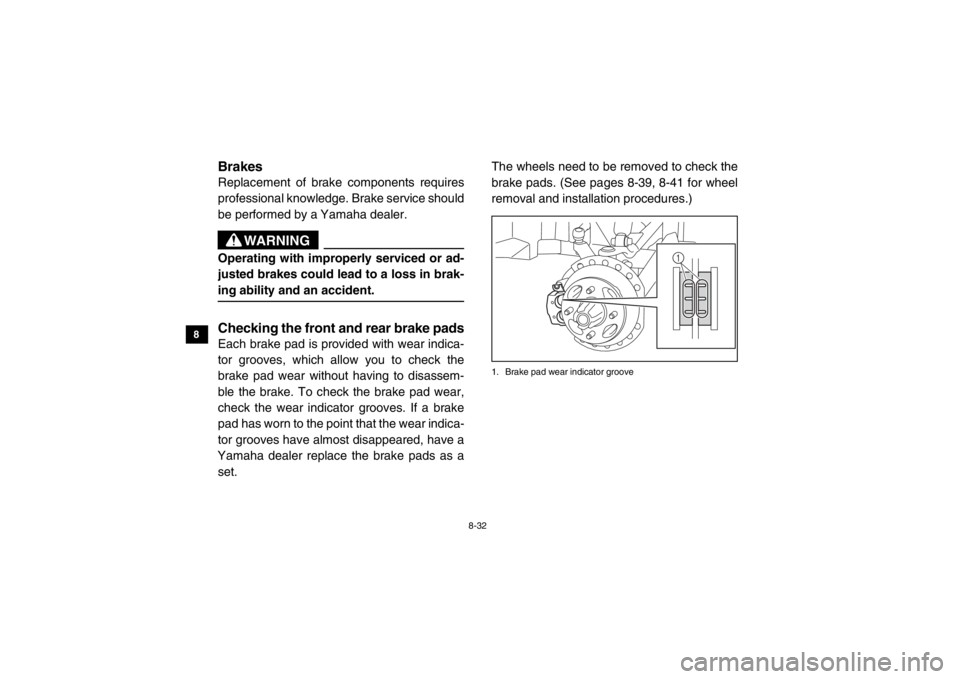
ing ability and an accident.5B410019Checking the front and rear brake padsEach brake pad is provided with wear indica-
tor grooves, which allow you to check the
brake pad wear without having to disassem-
ble the brake. To check the brake pad wear,
check the wear indicator grooves. If a brake
pad has worn to the point that the wear indica-
tor grooves have almost disappeared, have a
Yamaha dealer replace the brake pads as a
set. The wheels need to be removed to check the
brake pads. (See pages 8-39, 8-41 for wheel
removal and installation procedures.)
1. Brake pad wear indicator groove
1
1XP7C_EE.book Page 32 Monday, June 9, 2014 5:17 PM
Page 149 of 182
8-39
1
2
3
4
5
6
78
9
10
11
12
13
14
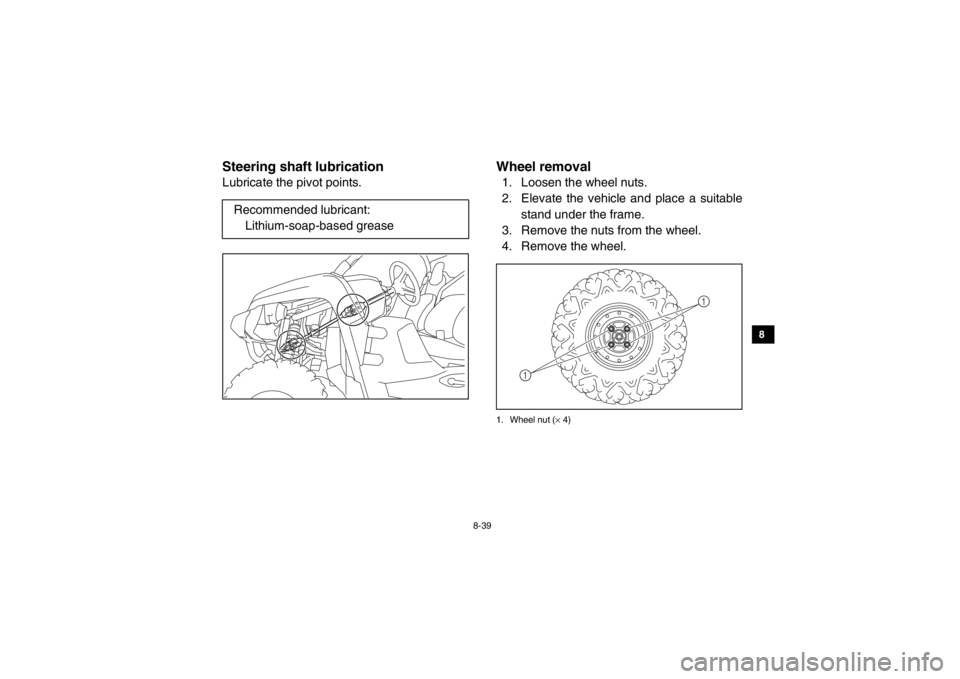
EVU00920Steering shaft lubricationLubricate the pivot points.
EVU00930Wheel removal1. Loosen the wheel nuts.
2. Elevate the vehicle and place a suitablestand under the frame.
3. Remove the nuts from the wheel.
4. Remove the wheel.1. Wheel nut ( × 4)
Recommended lubricant:
Lithium-soap-based grease
1
1
1XP7C_EE.book Page 39 Monday, June 9, 2014 5:17 PM
Page 151 of 182
8-41
1
2
3
4
5
6
78
9
10
11
12
13
14
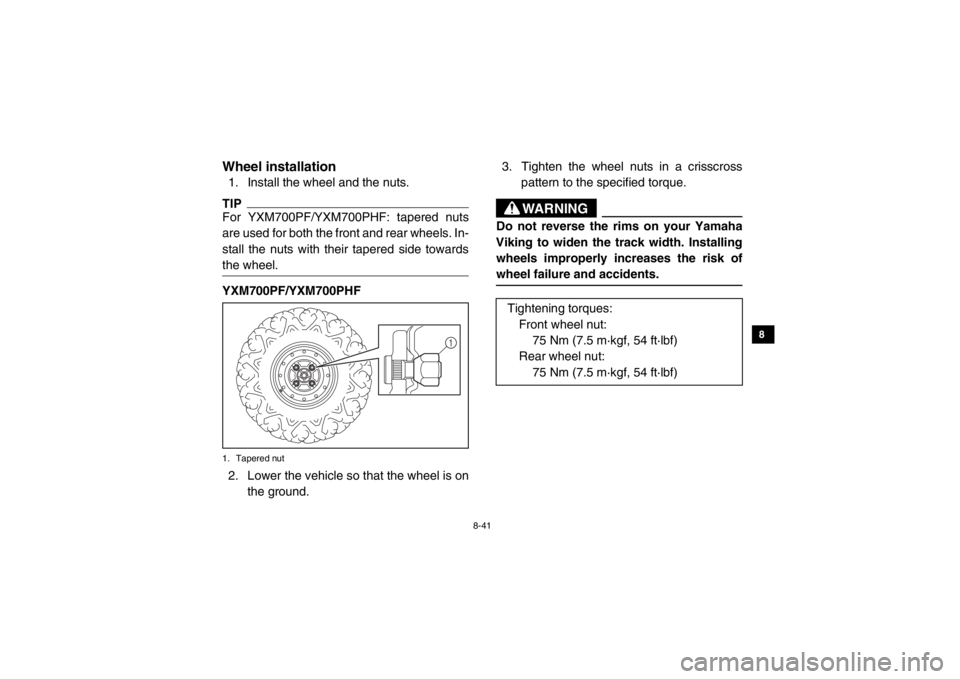
EVU00940Wheel installation1. Install the wheel and the nuts.TIPFor YXM700PF/YXM700PHF: tapered nuts
are used for both the front and rear wheels. In-
stall the nuts with their tapered side towards
the wheel.YXM700PF/YXM700PHF1. Tapered nut2. Lower the vehicle so that the wheel is onthe ground. 3. Tighten the wheel nuts in a crisscross
pattern to the specified torque.
WARNING
Do not reverse the rims on your Yamaha
Viking to widen the track width. Installing wheels improperly increases the risk of
wheel failure and accidents.
1
Tightening torques: Front wheel nut: 75 Nm (7.5 m·kgf, 54 ft·lbf)
Rear wheel nut:
75 Nm (7.5 m·kgf, 54 ft·lbf)
1XP7C_EE.book Page 41 Monday, June 9, 2014 5:17 PM
Page 158 of 182
8-48
8
9
10
11
12
13
14
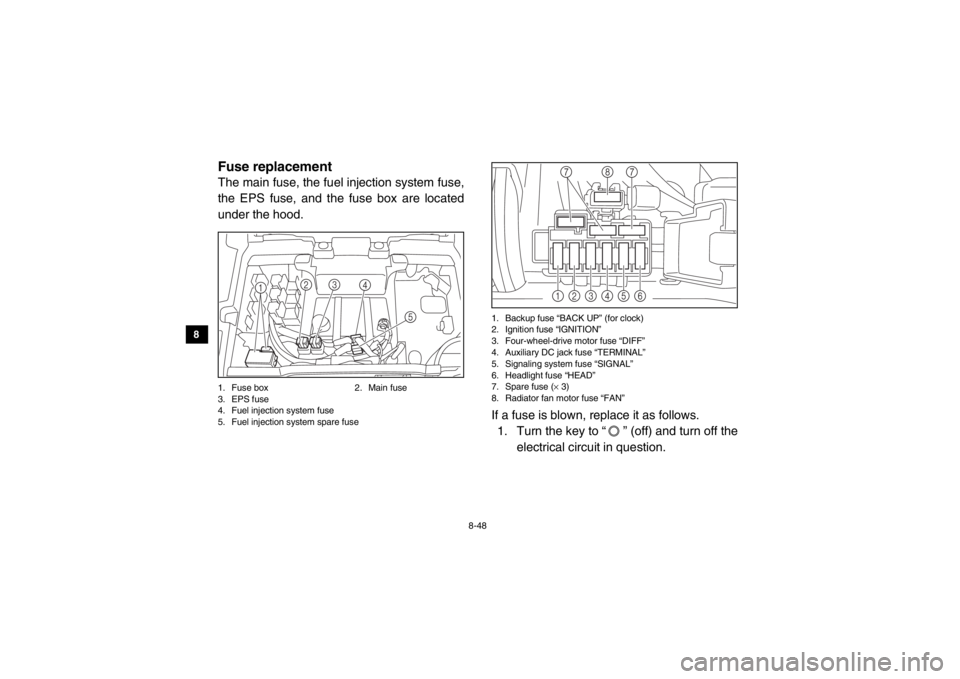
5B410023Fuse replacementThe main fuse, the fuel injection system fuse,
the EPS fuse, and the fuse box are located
under the hood.1. Fuse box 2. Main fuse
3. EPS fuse
4. Fuel injection system fuse
5. Fuel injection system spare fuse 1. Backup fuse “BACK UP” (for clock)
2. Ignition fuse “IGNITION”
3. Four-wheel-drive motor fuse “DIFF”
4. Auxiliary DC jack fuse “TERMINAL”
5. Signaling system fuse “SIGNAL”
6. Headlight fuse “HEAD”
7. Spare fuse (
× 3)
8. Radiator fan motor fuse “FAN”
If a fuse is blown, replace it as follows.
1. Turn the key to “ ” (off) and turn off the
electrical circuit in question.
1 3
2
4
5
1
2
3
4
5
6
8
7
7
1XP7C_EE.book Page 48 Monday, June 9, 2014 5:17 PM
Page 159 of 182
8-49
1
2
3
4
5
6
78
9
10
11
12
13
14
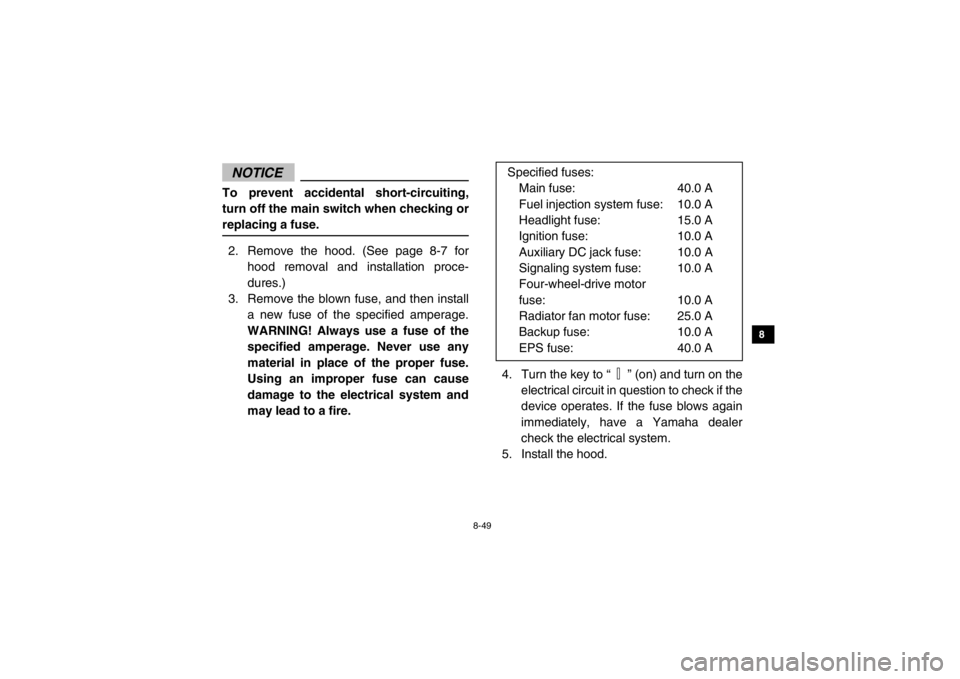
NOTICETo prevent accidental short-circuiting,
turn off the main switch when checking or
replacing a fuse.2. Remove the hood. (See page 8-7 forhood removal and installation proce-
dures.)
3. Remove the blown fuse, and then install a new fuse of the specified amperage.
WARNING! Always use a fuse of the specified amperage. Never use any
material in place of the proper fuse.
Using an improper fuse can cause
damage to the electrical system and
may lead to a fire. 4. Turn the key to “ ” (on) and turn on the
electrical circuit in question to check if the
device operates. If the fuse blows again
immediately, have a Yamaha dealer
check the electrical system.
5. Install the hood. Specified fuses:
Main fuse: 40.0 A
Fuel injection system fuse: 10.0 A
Headlight fuse: 15.0 A
Ignition fuse: 10.0 A
Auxiliary DC jack fuse: 10.0 A
Signaling system fuse: 10.0 A
Four-wheel-drive motor
fuse: 10.0 A
Radiator fan motor fuse: 25.0 A
Backup fuse: 10.0 A
EPS fuse: 40.0 A
1XP7C_EE.book Page 49 Monday, June 9, 2014 5:17 PM
Page 169 of 182

9-1
1
2
3
4
5
6
7
89
10
11
12
13
14
EVU01030
1-CLEANING AND STORAGE
CleaningFrequent, thorough cleaning of your vehicle
will not only enhance its appearance but will
improve its general performance and extend
the useful life of many components.1. Before cleaning the vehicle:
a. Block off the end of the exhaust pipeto prevent water entry. A plastic bag
and strong rubber band may be used.
b. Make sure the spark plug and all filler caps are properly installed.
2. If the engine case is excessively greasy,
apply degreaser with a paint brush. Do
not apply degreaser to the wheel axles. 3. Rinse the dirt and degreaser off with a
garden hose. Use only enough pressure
to do the job. WARNING! Test the
brakes after washing. Apply the
brakes several times at slow speeds
to let friction dry out the linings. Wet
brakes may have reduced stopping
ability, increasing the chance of an ac-
cident. NOTICE: Excessive water
pressure may cause water seepage
and deterioration of wheel bearings,
brakes, transmission seals and elec-
trical devices. Many expensive repair
bills have resulted from improper
high-pressure detergent applications,
such as those available in coin-oper-
ated car washers.1XP7C_EE.book Page 1 Monday, June 9, 2014 5:17 PM
Page 171 of 182

9-3
1
2
3
4
5
6
7
89
10
11
12
13
14
5B410025StorageLong term storage (60 days or more) of your
vehicle will require some preventive proce-
dures to guard against deterioration. Make
any necessary repairs before storing the vehi-
cle.
After thoroughly cleaning the vehicle, prepare
for storage as follows:1. Fill the fuel tank with fresh fuel and add
the specified amount of Yamaha Fuel
Stabilizer and Conditioner or equivalent
product. Operate the vehicle for at least
5 minutes to distribute treated fuel
through the fuel system. 2. Remove the spark plug, pour about one
tablespoon of SAE 10W-40 or 20W-50
motor oil in the spark plug hole and install
the spark plug. Ground the spark plug
wire and turn the engine over several
times to coat the cylinder wall with oil.
3. Lubricate all control cables.
4. Block up the frame to raise all wheels off the ground.
5. Tie a plastic bag over the exhaust pipe outlet to prevent moisture from entering.
6. If storing in a humid or salt-air atmo-
sphere, coat all exposed metal surfaces
with a light film of oil. Do not apply oil to
any rubber parts or the seat covers.
Specified amount:
1 oz of stabilizer to each gallon of fuel (or
7.5 ml of stabilizer to each liter of fuel)1XP7C_EE.book Page 3 Monday, June 9, 2014 5:17 PM
Page 173 of 182

10-1
1
2
3
4
5
6
7
8
910
11
12
13
14
EBU25960
1-SPECIFICATIONS
Dimensions:Overall length:3100 mm (122.0 in)
Overall width: YXM700PF 1570 mm (61.8 in)
YXM700PHF 1570 mm (61.8 in)
YXM700PSF 1625 mm (64.0 in)
Overall height: YXM700PF 1880 mm (74.0 in) (AUS)(NZL)
YXM700PF 1925 mm (75.8 in) (EUR)(FRA)(GBR)
YXM700PHF 1925 mm (75.8 in)
YXM700PSF 1925 mm (75.8 in)
Wheelbase: 2135 mm (84.1 in)
Ground clearance:
300 mm (11.8 in)
Minimum turning radius: 4500 mm (177 in)Weight:Curb weight:
YXM700PF 615 kg (1356 lb) (AUS)(NZL)
YXM700PF 623 kg (1373 lb) (EUR)(FRA)(GBR)
YXM700PHF 623 kg (1373 lb)
YXM700PSF 635 kg (1400 lb)Noise and vibration level:Noise level (77/311/EEC):83.0 dB(A) (EUR)(FRA)(GBR)
A-weighted sound power level:
93.0 dB(A) (EUR)(FRA)(GBR) Vibration on seat (EN1032, ISO5008):
Will not exceed 0.5 m/s² (EUR)(FRA)(GBR)
Vibration on handle (EN1032, ISO5008): Will not exceed 2.5 m/s² (EUR)(FRA)(GBR)
Engine:Engine type:
Liquid cooled 4-stroke, SOHC
Cylinder arrangement: Single cylinder
Displacement: 686 cm³
Bore × stroke:
102.0 × 84.0 mm (4.02 × 3.31 in)
Compression ratio: 10.0 : 1
Starting system: Electric starter
Lubrication system:
Wet sump
1XP7C_EE.book Page 1 Monday, June 9, 2014 5:17 PM
Page 176 of 182

10-4
10
11
12
13
14
Vehicle load: 300 kg – maximum (661 lb – maximum):
Front:70.0 kPa (0.700 kgf/cm
2, 10 psi)
Rear:
120.0 kPa (1.200 kgf/cm2, 17 psi)
Front wheel:Wheel type:YXM700PF Panel wheel
YXM700PHF Panel wheel
YXM700PSF Cast wheel
Rim size: 12 × 6.0ATRear wheel:Wheel type:
YXM700PF Panel wheel
YXM700PHF Panel wheel
YXM700PSF Cast wheel
Rim size: 12 × 7.5ATFront brake:Type:
Disc brake
Operation: Unified brake
Recommended fluid:
DOT 4Rear brake:Type:Disc brake
Operation:
Unified brake Recommended fluid:
DOT 4
Front suspension:Type:
Double wishbone
Spring/shock absorber type: Coil spring/gas-oil damper
Wheel travel: 205 mm (8.1 in)Rear suspension:Type:Double wishbone
Spring/shock absorber type: Coil spring/gas-oil damper
Wheel travel:
205 mm (8.1 in)Electrical system:Ignition system:TCI
Charging system:
AC magnetoBattery:Model:U1-H11L
Voltage, capacity:
12 V, 28.0 AhHeadlight:Bulb type:Halogen bulb
1XP7C_EE.book Page 4 Monday, June 9, 2014 5:17 PM
Page 177 of 182

10-5
1
2
3
4
5
6
7
8
910
11
12
13
14
Bulb voltage, wattage
× quantity:
Headlight:
12 V, 35.0/35.0 W × 2
Tail/brake light:
12 V, 5.0/21.0 W × 2
Neutral indicator light: LED
Reverse indicator light: LED
Coolant temperature warning light:
LED
Engine trouble warning light: LED
Parking brake indicator light: LED
On-Command four-wheel-drive/differential gear lock indica-
tor: LCD
High-range indicator light:
LED
Low-range indicator light: LED
Differential gear lock indicator light: LED
EPS warning light:
LED
Helmet/Seat belt indicator light: 14 V, 0.85 W × 2Fuses:Main fuse:
40.0 A
Fuel injection system fuse: 10.0 A EPS fuse:
40.0 A
Headlight fuse: 15.0 A
Signaling system fuse:
10.0 A
Ignition fuse: 10.0 A
Auxiliary DC jack fuse: 10.0 A
Backup fuse:
10.0 A
Four-wheel-drive motor fuse: 10.0 A
Radiator fan motor fuse: 25.0 A
For Europe only
The figures quoted are emission levels and
are not necessarily safe working levels. Whilst
there is a correlation between the emission
and exposure levels, this cannot be used reli-
ably to determine whether or not further pre-
cautions are required.
Factors that influence the actual level of expo-
sure of work-force include the characteristics
of the work room, the other sources of noise,
etc. i.e. the number of machines and other ad-
1XP7C_EE.book Page 5 Monday, June 9, 2014 5:17 PM