belt YAMAHA VIKING 2017 User Guide
[x] Cancel search | Manufacturer: YAMAHA, Model Year: 2017, Model line: VIKING, Model: YAMAHA VIKING 2017Pages: 172, PDF Size: 3.94 MB
Page 34 of 172
3-3
3
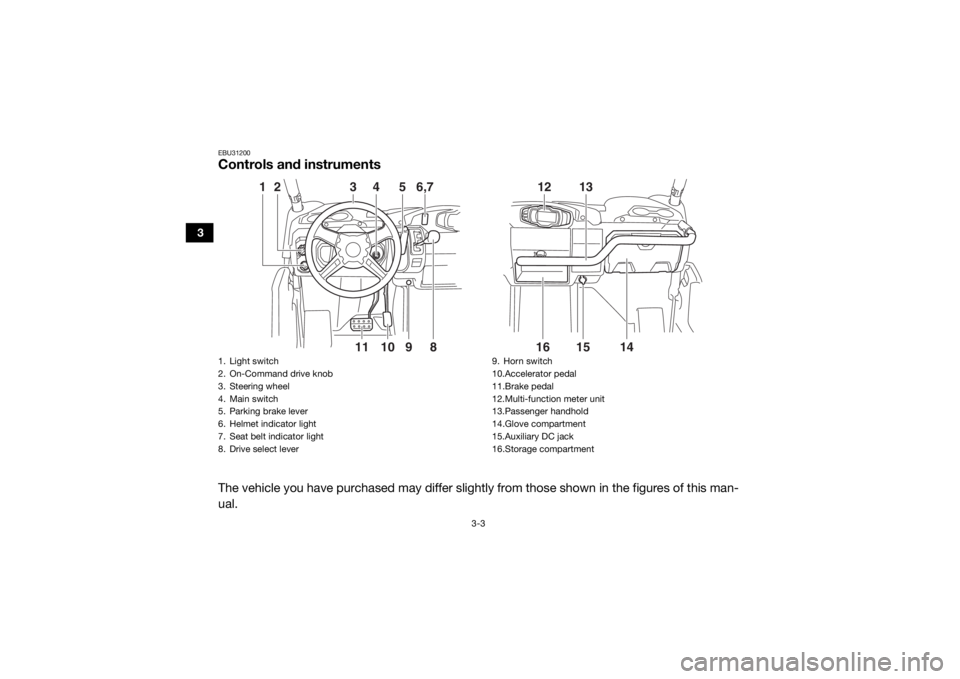
EBU31200Controls and instrumentsThe vehicle you have purchased may differ slightly from those shown in the figures of this man-
ual.
11
10
2
3
4
5
6,7
8
9
1
16
14
12
1315
1. Light switch
2. On-Command drive knob
3. Steering wheel
4. Main switch
5. Parking brake lever
6. Helmet indicator light
7. Seat belt indicator light
8. Drive select lever
9. Horn switch
10.Accelerator pedal
11.Brake pedal
12.Multi-function meter unit
13.Passenger handhold
14.Glove compartment
15.Auxiliary DC jack
16.Storage compartmentUB427BE0.book Page 3 Friday, February 5, 2016 2:14 PM
Page 36 of 172
4-2
4
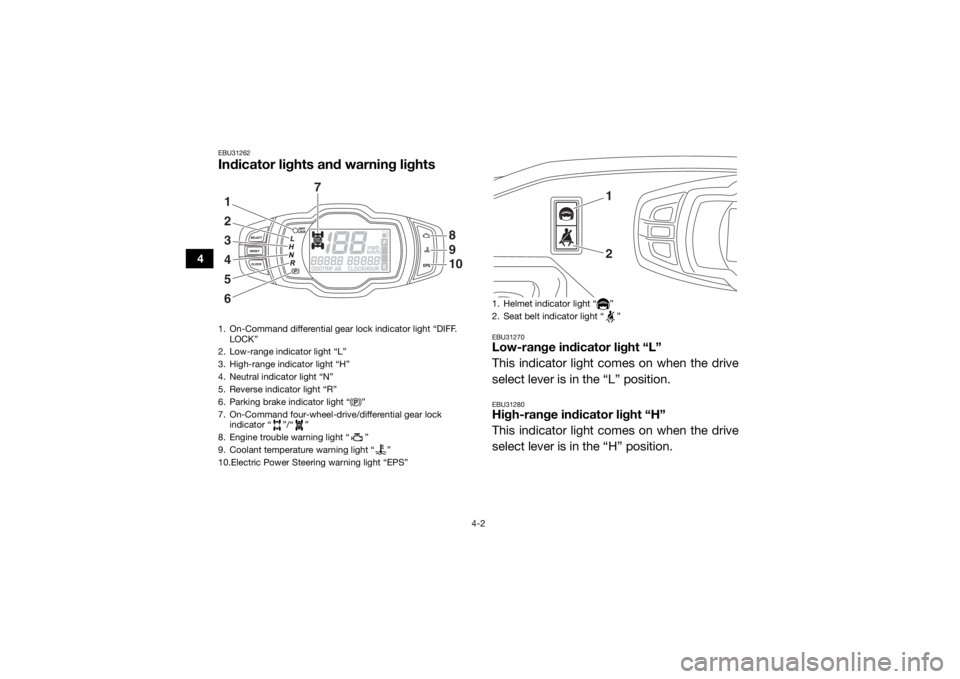
EBU31262Indicator lights and warning lights
EBU31270Low-range indicator light “L”
This indicator light comes on when the drive
select lever is in the “L” position.EBU31280High-range indicator light “H”
This indicator light comes on when the drive
select lever is in the “H” position.
1. On-Command differential gear lock indicator light “DIFF. LOCK”
2. Low-range indicator light “L”
3. High-range indicator light “H”
4. Neutral indicator light “N”
5. Reverse indicator light “R”
6. Parking brake indicator light “ ”
7. On-Command four-wheel-drive/differential gear lock indicator “ ”/“ ”
8. Engine trouble warning light “ ”
9. Coolant temperature warning light “ ”
10.Electric Power Steering warning light “EPS”356421
7
8109
1. Helmet indicator light “ ”
2. Seat belt indicator light “ ”
21
UB427BE0.book Page 2 Friday, February 5, 2016 2:14 PM
Page 39 of 172
4-5
4
EBU33041Electric Power Steering warning light
“EPS”
This warning light comes on when the key is
turned to “ ” (on), and then goes off once
the engine is started. If the warning light re-
mains on or comes on after the engine is
started, the EPS system may not be working
correctly. When this occurs, have a Yamaha
dealer check the EPS system.
The electrical circuit of the warning light can
be checked by turning the key to “ ” (on). If
the warning light does not come on, have a
Yamaha dealer check the electrical circuit.TIPIf the steering load is too heavy (e.g., exces-
sive steering use at slow speed or when op-
erating in deep mud, sand, or snow), the
power assist is reduced to protect the EPS
motor from overheating.
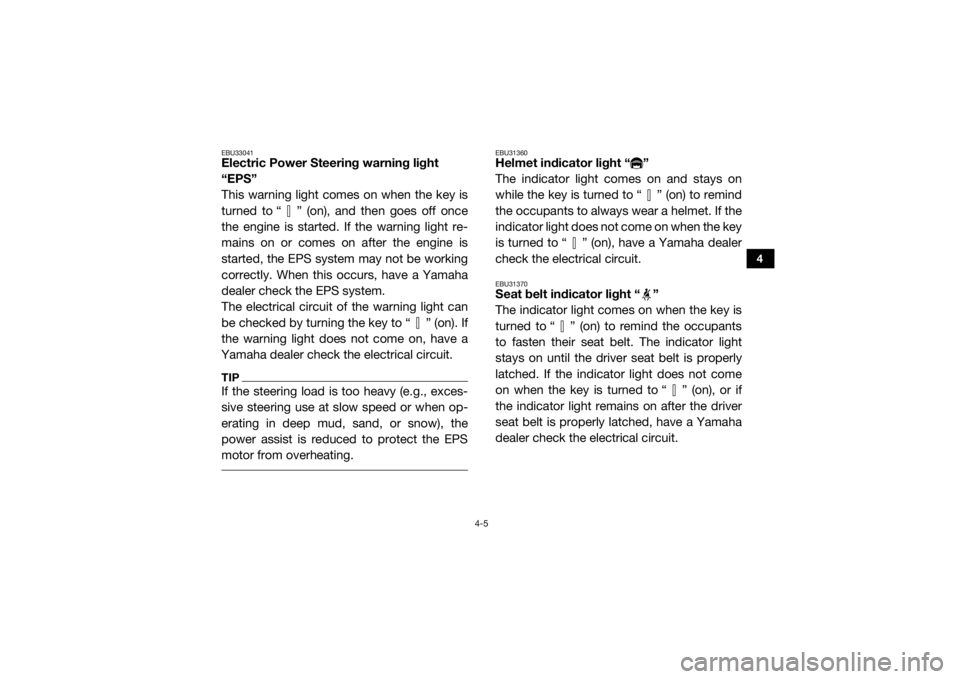
EBU31360Helmet indicator light “ ”
The indicator light comes on and stays on
while the key is turned to “ ” (on) to remind
the occupants to always wear a helmet. If the
indicator light does not come on when the key
is turned to “ ” (on), have a Yamaha dealer
check the electrical circuit.EBU31370Seat belt indicator light “ ”
The indicator light comes on when the key is
turned to “ ” (on) to remind the occupants
to fasten their seat belt. The indicator light
stays on until the driver seat belt is properly
latched. If the indicator light does not come
on when the key is turned to “ ” (on), or if
the indicator light remains on after the driver
seat belt is properly latched, have a Yamaha
dealer check the electrical circuit.
UB427BE0.book Page 5 Friday, February 5, 2016 2:14 PM
Page 51 of 172
4-17
4
4. Install the bolts, and then tighten the boltsto the specified torque.
5. Install the cushion.
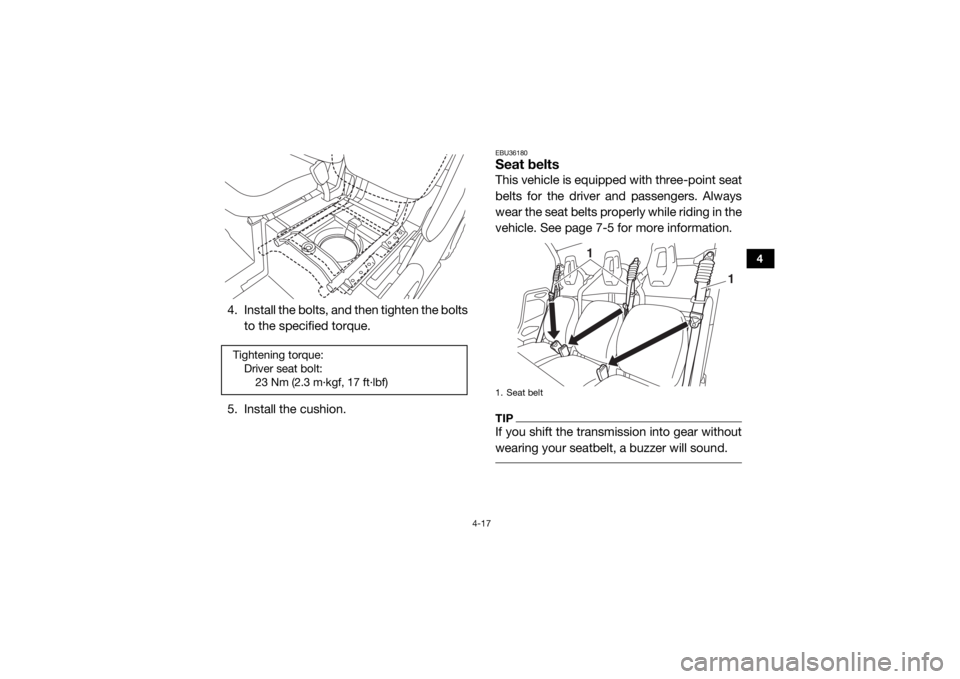
EBU36180Seat beltsThis vehicle is equipped with three-point seat
belts for the driver and passengers. Always
wear the seat belts properly while riding in the
vehicle. See page 7-5 for more information.TIPIf you shift the transmission into gear without
wearing your seatbelt, a buzzer will sound.
Tightening torque: Driver seat bolt:23 Nm (2.3 m·kgf, 17 ft·lbf)
1. Seat belt
1
1
UB427BE0.book Page 17 Friday, February 5, 2016 2:14 PM
Page 61 of 172

5-2
5
Coolant• Check coolant level in reservoir.
• Fill with coolant if necessary.
5-6, 8-21
Final gear oil/Differen-
tial gear oil • Check for leakage. 5-6, 5-6, 8-16, 8-19
Accelerator pedal • Check free play and for proper operation. 5-6
Seat belts • Check for proper operation and belt wear. 5-6
Passenger handhold • Check for stability and proper fastening. 5-7, 7-8
Steering • Check for proper operation. 5-7
Fittings and fasteners • Check all fittings and fasteners. 5-7
Instruments, lights and
switches • Check operation, and correct if necessary. 5-7, 8-50, 8-52, 8-53
Wheels and tires • Check tire pressure and for wear and damage. 5-8, 8-40, 8-42
Axle boots • Check for damage. 8-22
ITEM ROUTINE PAGE
UB427BE0.book Page 2 Friday, February 5, 2016 2:14 PM
Page 65 of 172
5-6
5
EBU31760CoolantCheck the coolant level in the coolant reser-
voir when the engine is cold (the coolant level
will vary with engine temperature).
The coolant level is satisfactory if it is be-
tween the minimum and maximum level
marks on the coolant reservoir. If the coolant
level is at or below the minimum level mark,
add additional coolant to bring the level up to
maximum level mark. If coolant is not avail-
able, add distilled water. Change the coolant
every two years. (See page 8-21.)NOTICEECB02120Hard water or salt water is harmful to the
engine. You may use soft water if you can-
not get distilled water.
EBU36020Final gearMake sure there is no oil leaking from the final
gear case.EBU36030Differential gearMake sure there is no oil leaking from the dif-
ferential gear case.EBU31790Accelerator pedalCheck to see that the accelerator pedal oper-
ates correctly. It must operate smoothly and
spring back to the idle position fully when re-
leased. Have a Yamaha dealer repair as nec-
essary for proper operation.EBU31800Seat beltsMake sure that the seat belts are not frayed,
torn, stretched, or damaged. The seat belts
must move smoothly when pulled out and re-
tract on its own when released. The seat belts
must also lock up when quickly pulled out.
Coolant reservoir capacity (up to the maxi-
mum level mark): 0.28 L (0.30 US qt, 0.25 Imp.qt)
UB427BE0.book Page 6 Friday, February 5, 2016 2:14 PM
Page 80 of 172
7-2
7
many features, including a protective struc-
ture and seat belts, to help protect occu-
pants, but the best way to avoid injuries is to
avoid accidents. There is a risk of injury or
death in any accident, even with these safety
features.
Driver requirements
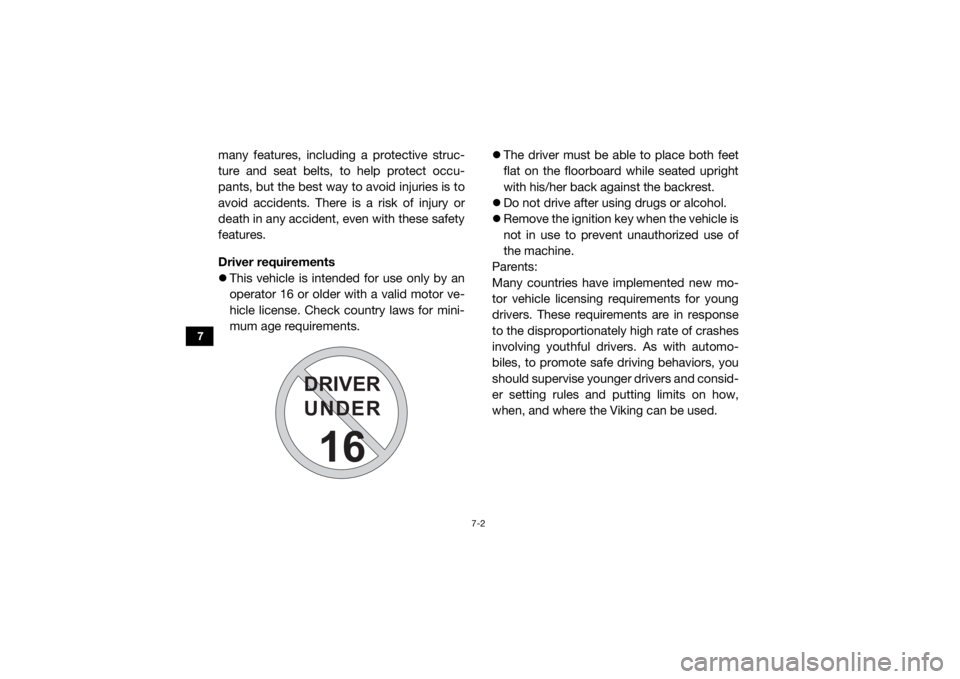
This vehicle is intended for use only by an
operator 16 or older with a valid motor ve-
hicle license. Check country laws for mini-
mum age requirements.
The driver must be able to place both feet
flat on the floorboard while seated upright
with his/her back against the backrest.
Do not drive after using drugs or alcohol.
Remove the ignition key when the vehicle is
not in use to prevent unauthorized use of
the machine.
Parents:
Many countries have implemented new mo-
tor vehicle licensing requirements for young
drivers. These requirements are in response
to the disproportionately high rate of crashes
involving youthful drivers. As with automo-
biles, to promote safe driving behaviors, you
should supervise younger drivers and consid-
er setting rules and putting limits on how,
when, and where the Viking can be used.
DRIVER
UNDER
16
UB427BE0.book Page 2 Friday, February 5, 2016 2:14 PM
Page 81 of 172
7-3
7
Passenger requirements
This vehicle is designed for the operator and
two passengers. Allowing passengers to ride
improperly can lead to serious injury or death.
As the operator, you are responsible for your
passengers.
Your passengers must be able to place
both feet on the fl oorboard while seated
upright with their backs against the back-
rests.
Your passengers must be able to reach and
hold the passenger handhold.
Allow only two passengers in the vehicle
and only in the designated passenger
seats. Do not carry any other passengers.
Do not carry passengers in the cargo bed.
Do not allow someone to ride as a passen-
ger who has been using drugs or alcohol.
Do not allow children who need child safety
seats or booster seats in the Viking. The
seat belt is not designed to restrain auto-
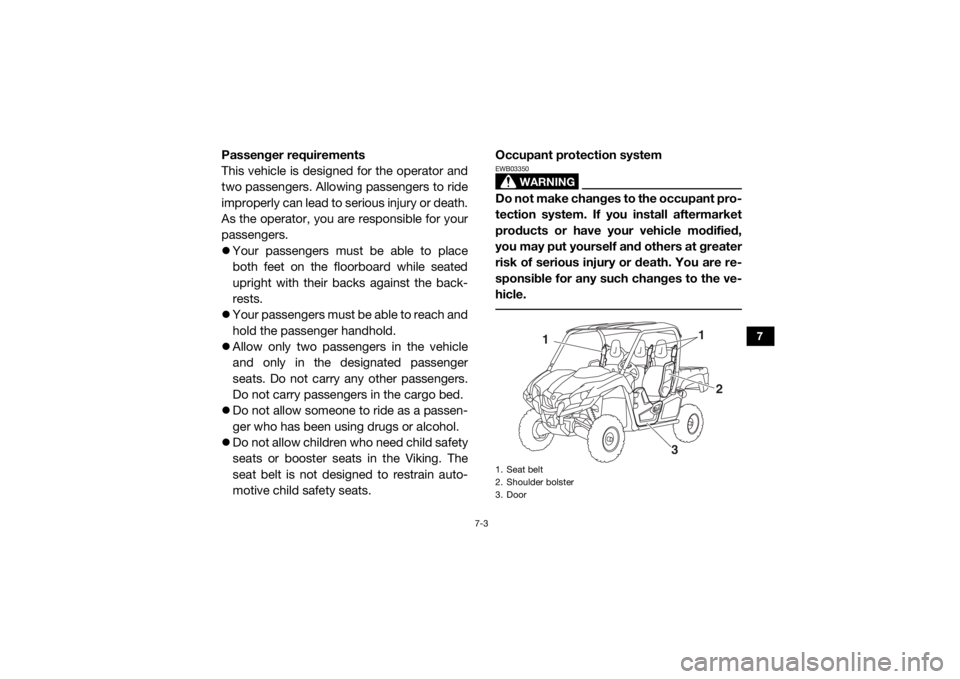
motive child safety seats. Occupant protection system
WARNING
EWB03350Do not make changes to the occupant pro-
tection system. If you install aftermarket
products or have your vehicle modified,
you may put yourself and others at greater
risk of serious injury or death. You are re-
sponsible for any such changes to the ve-
hicle. 1. Seat belt
2. Shoulder bolster
3. Door
2
3
1
1
UB427BE0.book Page 3 Friday, February 5, 2016 2:14 PM
Page 82 of 172
7-4
7
The Viking comes with a variety of features to
help reduce the risk of driver and passenger
injury. These features work together, and
when properly used, these features will help
protect the occupants in the event of an acci-
dent. If these features are not used properly,
they can cause injury.Protective structure
The vehicle cage/frame provides a protective
structure that helps limit intrusions by branch-
es or other objects and may reduce your risk
of injury in accidents. The protective structure
will not protect occupants in all rollovers or
accidents.
Body parts outside of vehicle can be struck
by passing objects or crushed during vehicle
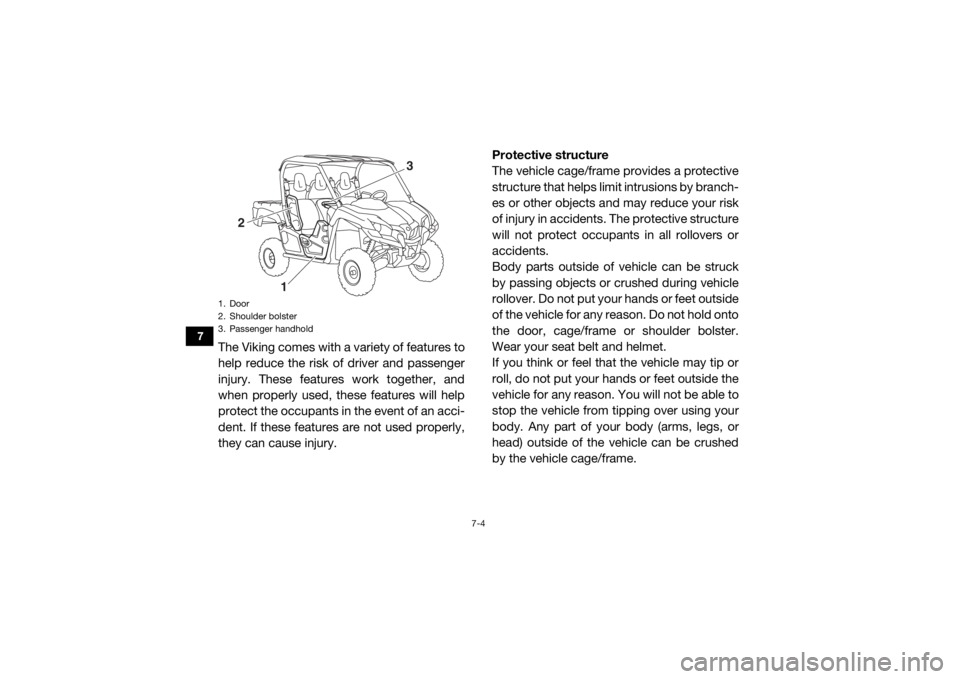
rollover. Do not put your hands or feet outside
of the vehicle for any reason. Do not hold onto
the door, cage/frame or shoulder bolster.
Wear your seat belt and helmet.
If you think or feel that the vehicle may tip or
roll, do not put your hands or feet outside the
vehicle for any reason. You will not be able to
stop the vehicle from tipping over using your
body. Any part of your body (arms, legs, or
head) outside of the vehicle can be crushed
by the vehicle cage/frame.1. Door
2. Shoulder bolster
3. Passenger handhold
2
1 3
UB427BE0.book Page 4 Friday, February 5, 2016 2:14 PM
Page 83 of 172
7-5
7
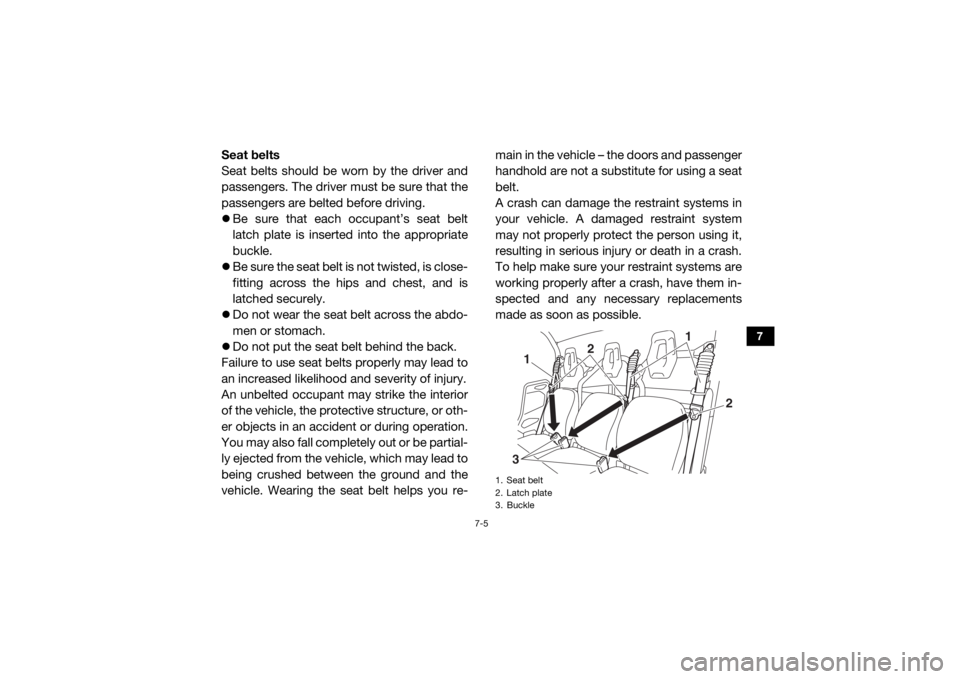
Seat belts
Seat belts should be worn by the driver and
passengers. The driver must be sure that the
passengers are belted before driving.
Be sure that each occupant’s seat belt
latch plate is inserted into the appropriate
buckle.
Be sure the seat belt is not twisted, is close-
fitting across the hips and chest, and is
latched securely.
Do not wear the seat belt across the abdo-
men or stomach.
Do not put the seat belt behind the back.
Failure to use seat belts properly may lead to
an increased likelihood and severity of injury.
An unbelted occupant may strike the interior
of the vehicle, the protective structure, or oth-
er objects in an accident or during operation.
You may also fall completely out or be partial-
ly ejected from the vehicle, which may lead to
being crushed between the ground and the
vehicle. Wearing the seat belt helps you re- main in the vehicle – the doors and passenger
handhold are not a substitute for using a seat
belt.
A crash can damage the restraint systems in
your vehicle. A damaged restraint system
may not properly protect the person using it,
resulting in serious injury or death in a crash.
To help make sure your restraint systems are
working properly after a crash, have them in-
spected and any necessary replacements
made as soon as possible.
1. Seat belt
2. Latch plate
3. Buckle
3
2
1
2
1
UB427BE0.book Page 5 Friday, February 5, 2016 2:14 PM