check engine YAMAHA VIKING 2017 User Guide
[x] Cancel search | Manufacturer: YAMAHA, Model Year: 2017, Model line: VIKING, Model: YAMAHA VIKING 2017Pages: 172, PDF Size: 3.94 MB
Page 96 of 172

7-18
7
side of a hill, which increases your risk of roll-
over. Practice first on gentle slopes before at-
tempting steeper hills. Always check the
terrain carefully before attempting any hill.
To climb a hill, you need traction, momentum,
and steady throttle. For more traction and
control for climbing steeper and/or rougher
slopes, shift into low gear and select “4WD”
or “DIFF LOCK”. Travel fast enough to main-
tain momentum, but not so fast that you can-
not react to changes in the terrain as you
climb.
Slow down when you reach the crest of the
hill if you cannot see clearly what is on the
other side – there could be another person, an
obstacle, or a sharp drop-off.
If you start to lose traction or momentum
when climbing, and decide you will be unable
to continue, use the brakes to stop. Do not at-
tempt to turn the vehicle around. With your
foot on the brake pedal, look behind you and
plan your descent. Shift the drive select lever
into reverse so you can use engine braking toslow your descent. Release the brake and be-
gin to coast down the hill. Use engine braking
as much as possible, gently applying the
brakes when necessary.
Downhill
Check the terrain carefully before going
downhill. When possible, choose a path that
lets you drive your vehicle straight downhill.
Choose your path carefully and drive slowly
enough to be able to react to obstacles that
you encounter.
For more traction and control, before going
down steeper and/or rougher slopes, shift
into low gear and select “4WD” or “DIFF
LOCK”. Engine braking will help you go
downhill slowly. Go as slowly as possible. If
you begin to go too fast, apply the brakes
gently. Avoid hard application of the brakes,
which could cause the vehicle to slide.UB427BE0.book Page 18 Friday, February 5, 2016 2:14 PM
Page 98 of 172

7-20
7
Wet brakes may have reduced effectiveness.
After leaving the water, test your brakes. If
necessary, apply the brakes several times to
let friction dry out the linings.NOTICEECB02170After driving your vehicle in water, be sure
to drain the trapped water by removing the
check hoses at the bottom of the air filter
case and air duct and the V-belt case drain
plug. Wash the vehicle in fresh water if it
has been operated in salt water or muddy
conditions. Loose terrain/slippery terrain
When driving on slippery terrain, including
wet, muddy, or icy conditions, as well as
loose gravel, be aware that you could begin
skidding or sliding. To avoid loss of control,
slow down and put the vehicle in four-wheel
drive before driving on a slippery surface and
plan your path to avoid making abrupt ma-
neuvers. If you feel the vehicle begin to slide sideways
or the back wheels slide during a turn, steer
into the direction of the slide if possible, to re-
gain directional control. For example, if you
feel the back of the vehicle start to slide to
your right, steer to the right.
Brush or wooded areas
When operating in areas with brush or trees,
watch carefully on both sides and above the
vehicle for obstacles such as branches that
the vehicle might hit, causing an accident.
Watch for brush that might enter the vehicle
as you pass and strike you or the passengers.
Never hold onto the cage/frame. The passen-
gers should always hold onto the passenger
handhold with both hands.
The muffler and other engine parts become
extremely hot during operation and remain
hot after the engine has stopped. To reduce
the risk of fire during operation or after leaving
the vehicle, do not let brush, grass and other
materials collect under the vehicle, near theUB427BE0.book Page 20 Friday, February 5, 2016 2:14 PM
Page 105 of 172

8-6
8
EBU32112General maintenance and lubrication chartNO. ITEMROUTINE INITIAL
EVERY
Whichev- er comes
first month 1 3 6 6 12
km
(mi) 320
(200) 1200
(750) 2400
(1500) 2400
(1500) 4800
(3000)
hours 20 75 150 150 300
1 *Cooling system • Check coolant leakage.
• Repair if necessary.
√√√√√
• Change coolant. Every 2 years
2 Air filter element •Clean.
• Replace if necessary. Every 20–40 hours (more often in
wet or dusty areas)
3Engine oil • Change (warm engine before draining). √√√√
4 Engine oil filter
cartridge • Replace.
√√√
5 Final gear oil/Dif-
ferential gear oil • Check oil level and for leakage.
√√√√√
• Change. √√
6 *Front brake • Check operation/brake pad wear/fluid leak-
age/see page 8-8.
• Correct if necessary. Replace pads if worn to the limit. √√√√√
7 *Rear brake • Check operation/brake pad wear/fluid leak-
age/see page 8-8.
• Correct if necessary. Replace pads if worn to the limit. √√√√√
UB427BE0.book Page 6 Friday, February 5, 2016 2:14 PM
Page 107 of 172

8-8
8
EBU32330TIPSome maintenance items need more frequent serv ice if you are riding in unusually wet, dusty,
sandy or muddy areas, or at full throttle.
Hydraulic brake service
• Regularly check and, if necessary, correct the brake fluid level.17 *Rear knuckle up-
per and lower piv-
ots • Lubricate with lithium-soap-based grease.
√√√
18 *Drive shaft uni-
versal joint • Lubricate with lithium-soap-based grease.
√√√
19 *Engine mount • Check for cracks or damage.
• Check bolt tightness. √√√
20 *Front and rear
axle boots • Check for cracks or other damage, and re-
place if necessary. √√
21 *Fittings and fas-
teners • Check all chassis fittings and fasteners.
• Correct if necessary.
√√√√√
NO. ITEM
ROUTINE INITIAL
EVERY
Whichev- er comes first month 1 3 6 6 12
km
(mi) 320
(200) 1200
(750) 2400
(1500) 2400
(1500) 4800
(3000)
hours 20 75 150 150 300UB427BE0.book Page 8 Friday, February 5, 2016 2:14 PM
Page 110 of 172
8-11
8
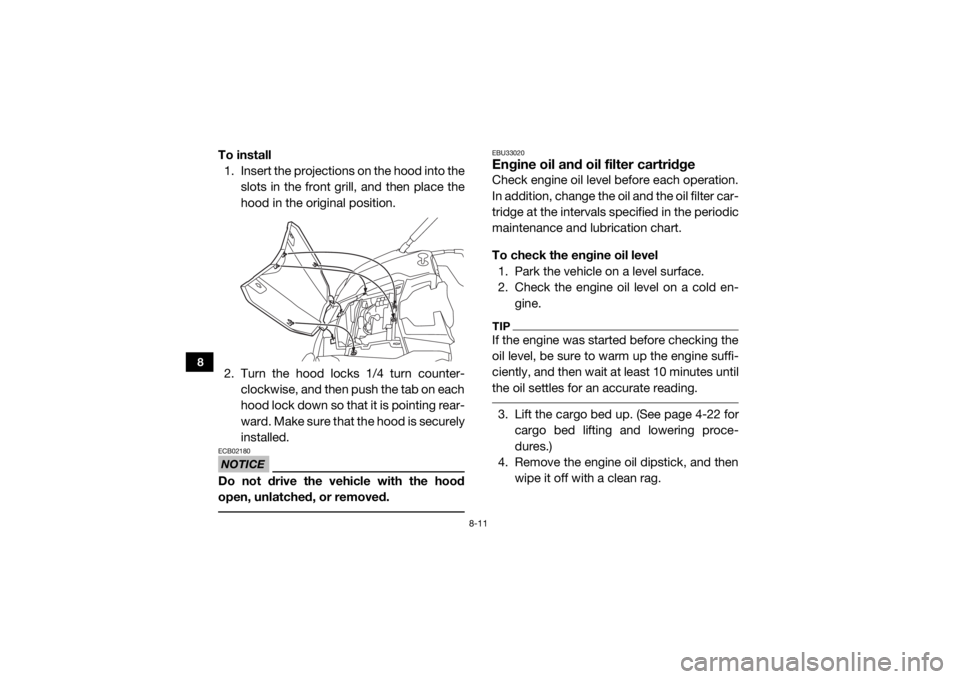
To install1. Insert the projections on the hood into the
slots in the front grill, and then place the
hood in the original position.
2. Turn the hood locks 1/4 turn counter- clockwise, and then push the tab on each
hood lock down so that it is pointing rear-
ward. Make sure that the hood is securely
installed.NOTICEECB02180Do not drive the vehicle with the hood
open, unlatched, or removed.
EBU33020Engine oil and oil filter cartridgeCheck engine oil level before each operation.
In addition, change the oil and the oil filter car-
tridge at the intervals specified in the periodic
maintenance and lubrication chart.
To check the engine oil level1. Park the vehicle on a level surface.
2. Check the engine oil level on a cold en- gine.TIPIf the engine was started before checking the
oil level, be sure to warm up the engine suffi-
ciently, and then wait at least 10 minutes until
the oil settles for an accurate reading. 3. Lift the cargo bed up. (See page 4-22 forcargo bed lifting and lowering proce-
dures.)
4. Remove the engine oil dipstick, and then
wipe it off with a clean rag.
UB427BE0.book Page 11 Friday, February 5, 2016 2:14 PM
Page 111 of 172
8-12
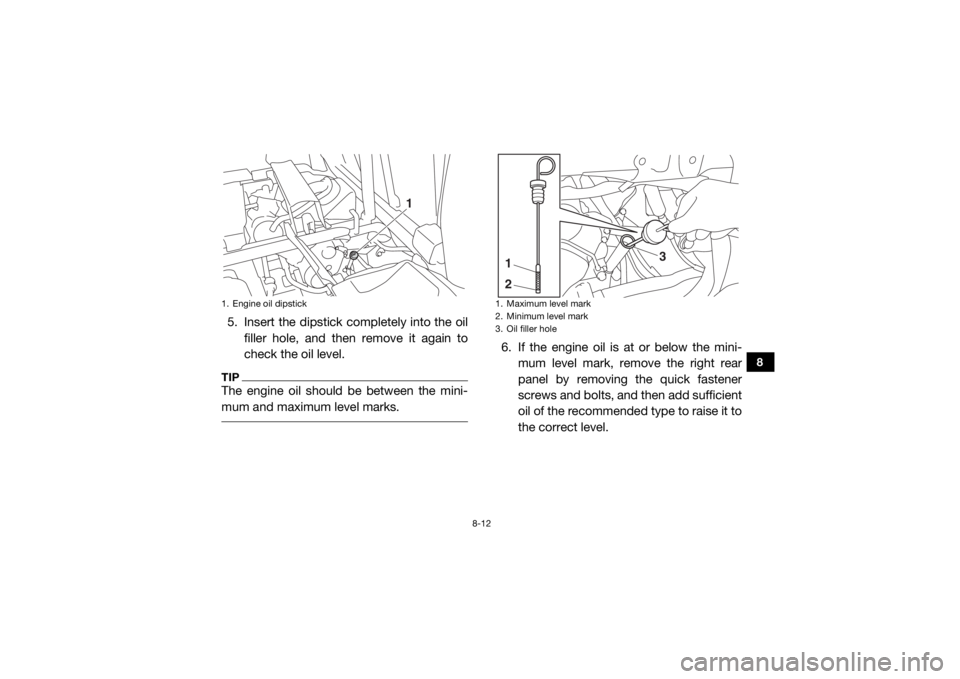
8
5. Insert the dipstick completely into the oilfiller hole, and then remove it again to
check the oil level.TIPThe engine oil should be between the mini-
mum and maximum level marks.
6. If the engine oil is at or below the mini-mum level mark, remove the right rear
panel by removing the quick fastener
screws and bolts, and then add sufficient
oil of the recommended type to raise it to
the correct level.
1. Engine oil dipstick
1
1. Maximum level mark
2. Minimum level mark
3. Oil filler hole1
2
3
UB427BE0.book Page 12 Friday, February 5, 2016 2:14 PM
Page 115 of 172
8-16
8
TIPBe sure to wipe off spilled oil on any parts af-
ter the engine and exhaust system have
cooled down. NOTICEECB00301In order to prevent clutch slippage (since
the engine oil also lubricates the clutch),
do not mix any chemical additives. Do
not use oils with a diesel specification of
“CD” or oils of a higher quality than
specified. In addition, do not use oils la-
beled “ENERGY CONSERVING II” or
higher.
Make sure that no foreign material en-
ters the crankcase.
12. Start the engine, and then let it idle for
several minutes while checking it for oil
leakage. If oil is leaking, immediately turn
the engine off and check for the cause.
13. Turn the engine off, wait at least 10 minu-
tes, and then check the oil level and cor-
rect it if necessary.
14. Install the right rear panel by installing the
bolts and the quick fastener screws.
15. Lower the cargo bed.EBU36050Final gear oilCheck the oil level and change the final gear
oil at the intervals specified in the general
maintenance and lubrication chart.
Checking the final gear oil level 1. Park the vehicle on a level surface.
Recommended engine oil: See page 10-1.
Oil quantity: Without oil filter cartridge replacement:2.20 L (2.33 US qt, 1.94 Imp.qt)
With oil filter cartridge replacement: 2.30 L (2.43 US qt, 2.02 Imp.qt)
UB427BE0.book Page 16 Friday, February 5, 2016 2:14 PM
Page 120 of 172
8-21
8
6. Check the oil filler bolt gasket for dam-age, and replace it if necessary.
7. Install the differential gear oil filler bolt and its gasket, and then tighten the bolt
to the specified torque.
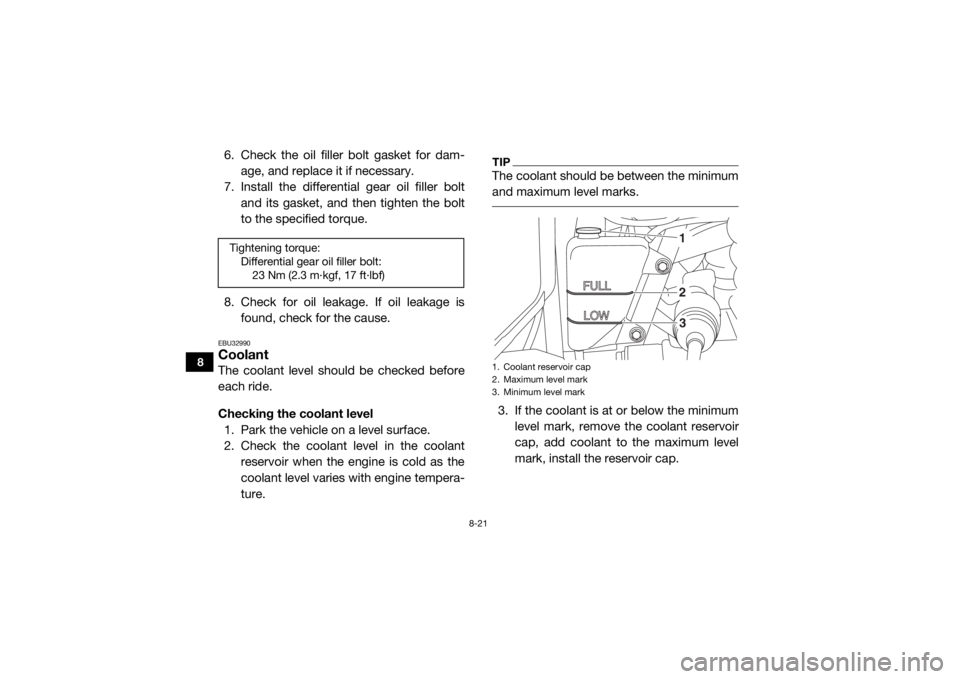
8. Check for oil leakage. If oil leakage is found, check for the cause.EBU32990CoolantThe coolant level should be checked before
each ride.
Checking the coolant level
1. Park the vehicle on a level surface.
2. Check the coolant level in the coolant reservoir when the engine is cold as the
coolant level varies with engine tempera-
ture.
TIPThe coolant should be between the minimum
and maximum level marks. 3. If the coolant is at or below the minimumlevel mark, remove the coolant reservoir
cap, add coolant to the maximum level
mark, install the reservoir cap.
Tightening torque:Differential gear oil filler bolt:23 Nm (2.3 m·kgf, 17 ft·lbf)
1. Coolant reservoir cap
2. Maximum level mark
3. Minimum level mark
123
UB427BE0.book Page 21 Friday, February 5, 2016 2:14 PM
Page 124 of 172
8-25
8
rect torque is one-quarter to one-half turn
past finger tight. Have the spark plug
tightened to the specified torque as soon
as possible.
3. Install the spark plug cap.
4. Lower the cargo bed.
EBU34811Cleaning the air filter elementThe air filter element should be cleaned every
20–40 hours. It should be cleaned and lubri-
cated more often if the vehicle is operated in
extremely dusty areas. Each time air filter ele-
ment maintenance is performed, check the air
inlet to the air filter case for obstructions. Check the air filter element rubber joint to the
throttle body and manifold fittings for an air-
tight seal. Tighten all fittings securely to avoid
the possibility of unfiltered air entering the en-
gine.
NOTICEECB02270Never operate the engine with the air filter
element removed. Doing so would allow
unfiltered air to enter, causing rapid en-
gine wear and possible engine damage.
Additionally, the fuel injection system
would be affected, resulting in poor engine
performance and possible overheating. 1. Remove the center passenger seat cush-
ion. (See page 4-15 for seat cushion re-
moval and installation procedures.)
2. Lift up the rubber damper, and then re- move the center passenger seat by re-
moving the bolts.
Tightening torque:Spark plug:13 Nm (1.3 m·kgf, 9.4 ft·lbf)
UB427BE0.book Page 25 Friday, February 5, 2016 2:14 PM
Page 130 of 172
8-31
8
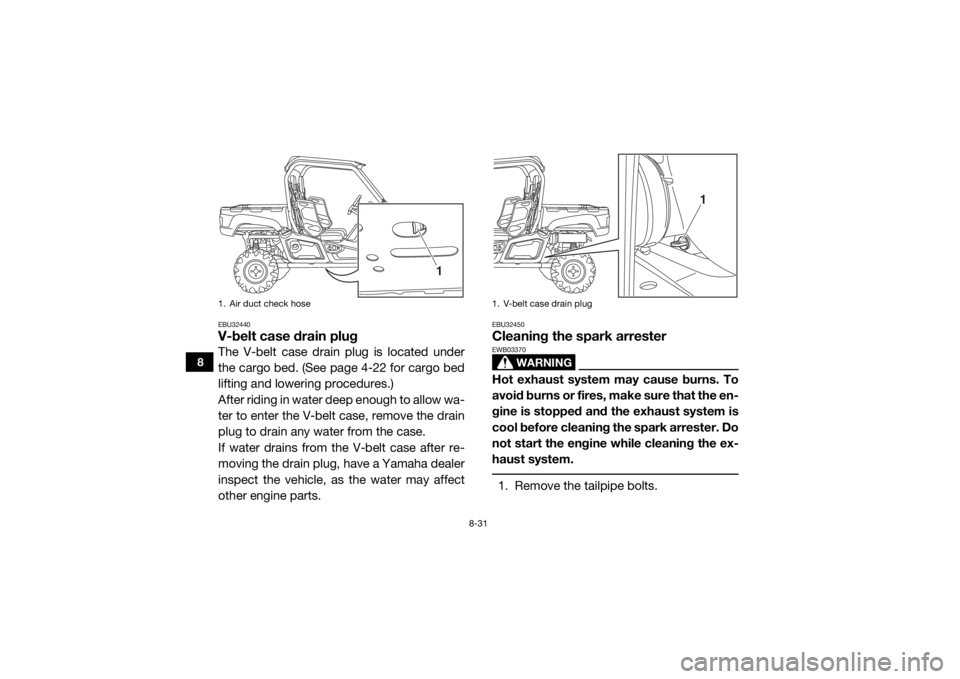
EBU32440V-belt case drain plugThe V-belt case drain plug is located under
the cargo bed. (See page 4-22 for cargo bed
lifting and lowering procedures.)
After riding in water deep enough to allow wa-
ter to enter the V-belt case, remove the drain
plug to drain any water from the case.
If water drains from the V-belt case after re-
moving the drain plug, have a Yamaha dealer
inspect the vehicle, as the water may affect
other engine parts.
EBU32450Cleaning the spark arrester
WARNING
EWB03370Hot exhaust system may cause burns. To
avoid burns or fires, make sure that the en-
gine is stopped and the exhaust system is
cool before cleaning the spark arrester. Do
not start the engine while cleaning the ex-
haust system. 1. Remove the tailpipe bolts.
1. Air duct check hose
1
1. V-belt case drain plug
1
UB427BE0.book Page 31 Friday, February 5, 2016 2:14 PM