parking brake YAMAHA VIKING 2017 User Guide
[x] Cancel search | Manufacturer: YAMAHA, Model Year: 2017, Model line: VIKING, Model: YAMAHA VIKING 2017Pages: 172, PDF Size: 3.94 MB
Page 76 of 172
6-7
6
EBU31930ParkingWhen parking, stop the engine and shift the
drive select lever into the neutral position. Ap-
ply the parking brake to help prevent the ve-
hicle from rolling. See page 7-16 for more
information on parking and parking on a
slope.EBU31940LoadingTake extra precautions when driving with a
load or trailer. Follow these instructions and
always use common sense and good judg-
ment when carrying cargo or towing a trailer.
Prepare your load or trailer
WARNING
EWB03310Improper loading or towing can increase
the risk of loss of control, an overturn, or
other accident:
Do not exceed the Maximum Loading
Limits for the vehicle (see “MAXIMUM
LOADING LIMIT” in this section and ve-
hicle labeling).
Keep weight in the cargo bed centered
side to side, and as low and as far for-
ward as possible. Top-heavy loads in-
crease the risk of overturn. Be sure
cargo is secured – a loose load could
change handling unexpectedly or strike
occupants.
Do not exceed the maximum tongue
weight.
Make sure the load does not interfere
with your control or ability to see where
you are going.
Tie down cargo in the trailer securely.
Make sure cargo in the trailer cannot
move around. A shifting load can cause
an accident.
Use the hooks equipped on the cargo bed to
tie down loads.
UB427BE0.book Page 7 Friday, February 5, 2016 2:14 PM
Page 92 of 172

7-14
7
Getting ready to ride
Perform the Pre-Operation Checks on page
5-1. Follow the instructions starting on page
6-2 to start the engine.
Turning
Use care in turns – turning the steering wheel
too far or too fast can result in loss of control
or a rollover. Slow down before entering
turns. When making tight turns from a stand-
still or at slow speeds, avoid sudden or hard
acceleration. Driving aggressively or making
abrupt maneuvers even on flat, open areas
can cause side rollovers. Avoid sideways slid-
ing, skidding, or back-wheel sliding, and nev-
er do donuts. If you feel the Viking begin to
slide sideways or the back wheels slide dur-
ing a turn, steer into the direction of the slide,
if possible, and gradually let off the accelera-
tor pedal to regain directional control and
avoid rollover. For example, if you feel the
back of the vehicle start to slide to your right,
steer to the right. If you think or feel that the vehicle may tip or
roll, keep your body completely inside the
protective structure of the vehicle:
Brace yourself by pressing your feet firmly
on the floorboard and keep a firm grip on
the steering wheel or passenger handhold.
Do not put your hands or feet outside of the
vehicle for any reason. Do not try to stop a
tipover using your arm or leg.
Accelerating
With the engine idling in neutral and your foot
on the brake, shift the drive select lever into
low or high. NOTICE: Do not shift from low
to high or vice versa without coming to a
complete stop and waiting for the engine
to return to normal idle speed – damage to
the engine or drive train may occur. Then
release the parking brake.
[ECB02160]
Press the
accelerator pedal slowly and smoothly. The
centrifugal clutch will engage and the vehicle
will begin to accelerate.
UB427BE0.book Page 14 Friday, February 5, 2016 2:14 PM
Page 93 of 172

7-15
7
Avoid higher speeds and sudden or hard ac-
celeration until you are thoroughly familiar
with the operation of your vehicle. Avoid sud-
den or hard acceleration in any turn.
Braking
When slowing down or stopping, take your
foot off the accelerator pedal and press the
brake pedal smoothly. Improper use of the
brakes can cause the tires to lose traction, re-
ducing control of the vehicle and increasing
the possibility of an accident.
Braking ability is affected by type of terrain. In
most cases, gradual application of the brakes
is more effective than abrupt braking, partic-
ularly on loose surfaces, such as gravel. Al-
ways allow for greater braking distance on
rough, loose, or slippery surfaces.
Engine braking
Engine compression braking is designed to
assist you when operating your Viking off-
road. With this feature, the engine helps slow the vehicle down after you take your foot off
the accelerator. Engine braking is more no-
ticeable in four-wheel drive. Application of ve-
hicle brakes provides additional stopping
power.
Leaving the vehicle
Do not get out of the vehicle while the engine
is running and the drive select lever is in any
gear. There is a risk of injury because:
Children or others may accidentally press
the accelerator pedal.
Objects tossed into the vehicle may strike
the accelerator pedal.
The parking brake may not keep the vehicle
from accelerating.
Unwanted vehicle movement can cause seri-
ous injury or death, and it may be dangerous
to try to stop the vehicle.UB427BE0.book Page 15 Friday, February 5, 2016 2:14 PM
Page 94 of 172

7-16
7
Parking on a flat area
When parking on a flat area, stop the engine
and shift the drive select lever into the neutral
position. Apply the parking brake to help pre-
vent the vehicle from rolling.
Parking on a slope
The parking brake acts only on the rear
wheels when in “2WD”. For the parking brake
to take effect on all four wheels, shift to “DIFF
LOCK” before stopping the engine.
If you park on a hill that is too steep the vehi-
cle may roll out of control. Never park on hills
that are so steep you cannot walk up them
easily. If you must park on an incline follow
these instructions:1. Bring the vehicle to a stop by applying the brake pedal.
2. Put the vehicle in “DIFF LOCK”.
3. Turn the key to “ ” (off).
4. With the brake pedal applied, set the parking brake. 5. Block the front and rear wheels with
rocks or other objects.
Loading
The total weight of operator, passengers, ac-
cessories, cargo, trailer tongue weight, and
the vehicle itself must not exceed 1080 kg
(2381 lb). Vehicle loading can affect handling.
See “Loading” on page 6-7.
EBU33360Operation on different surfaces and
terrainsGo slowly and proceed with caution when op-
erating on an unfamiliar surface or terrain.
This vehicle may handle differently in certain
types of terrains or on certain surfaces. You
may come upon hidden rocks, bumps, or
holes without enough time to react. To avoid
loss of control or rollover, always be alert to
changing surfaces or terrain when operating
the vehicle.
UB427BE0.book Page 16 Friday, February 5, 2016 2:14 PM
Page 99 of 172

7-21
7
muffler or exhaust pipe, or next to other hot
parts. Check under the vehicle after operating
in areas where combustible materials may
have collected. Do not idle or park the vehicle
in long dry grass or other dry ground cover.
Encountering obstacles
If you cannot go around an obstacle, such as
a fallen tree or a ditch, stop the vehicle where
it is safe to do so. Set the parking brake and
get out to inspect the area thoroughly. Look
from both your approach side and exit side. If
you believe you can continue safely, choose
the path that will allow you to get over the ob-
stacle and at as close to a right angle as pos-
sible to minimize vehicle tipping. Go only fast
enough to maintain your momentum but still
give yourself plenty of time to react to chang-
es in conditions.If there is any question about your ability to
maneuver safely over the obstacle, you
should turn around if the ground is flat and
you have the room or back up until you find a
less difficult path.UB427BE0.book Page 21 Friday, February 5, 2016 2:14 PM
Page 106 of 172

8-7
8
8*Parking brake • Check operation and free play/brake pad
wear.
• Correct if necessary. Replace pads if worn to the limit. √√√√√
9 *Brake fluid • Change. Every 2 years
10 *Accelerator pedal • Check operation and free play. √√√√√
11 *V-b e l t • Check operation.
• Check for wear, cracks, or damage. √√
√
12 *Wheels • Check balance/damage/runout.
• Repair if necessary. √ √√√
13 *Wheel bearings • Check bearing assemblies for loose-
ness/damage.
• Replace if damaged. √ √√√
14 *Front and rear
suspension • Check operation and for oil leakage.
• Correct if necessary.
√√
15 *Steering system • Check operation and for looseness. Replace
if damaged.
• Check toe-in. Adjust if necessary. √√√√√
16 *Stabilizer bushes • Check for cracks or other damage, and re-
place if necessary. √√√
NO. ITEM
ROUTINE INITIAL
EVERY
Whichev- er comes first month136612
km
(mi) 320
(200) 1200
(750) 2400
(1500) 2400
(1500) 4800
(3000)
hours 20 75 150 150 300UB427BE0.book Page 7 Friday, February 5, 2016 2:14 PM
Page 133 of 172
8-34
8
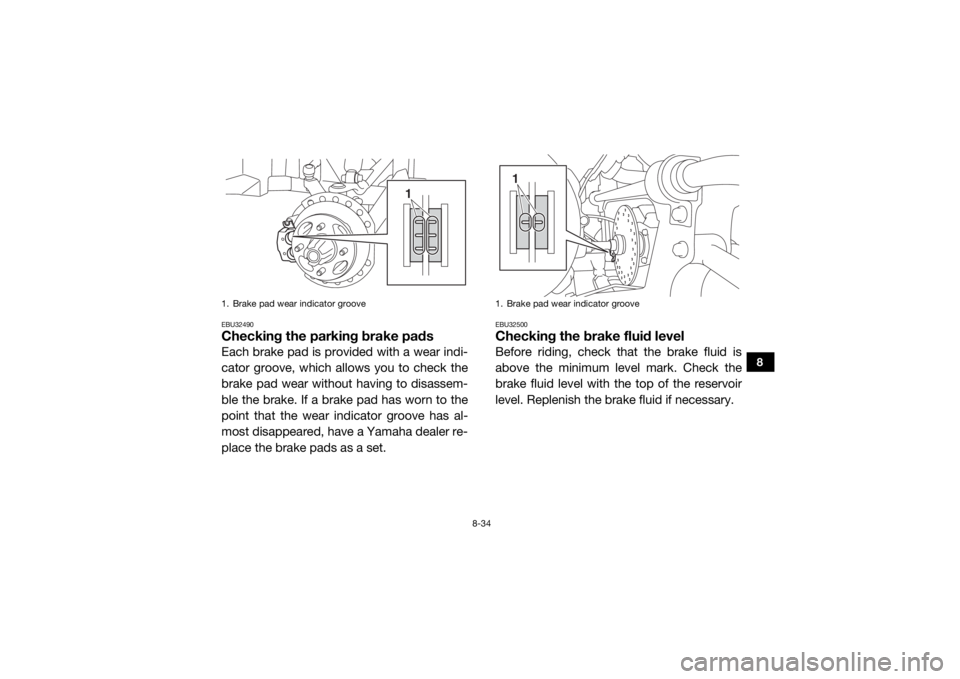
EBU32490Checking the parking brake padsEach brake pad is provided with a wear indi-
cator groove, which allows you to check the
brake pad wear without having to disassem-
ble the brake. If a brake pad has worn to the
point that the wear indicator groove has al-
most disappeared, have a Yamaha dealer re-
place the brake pads as a set.
EBU32500Checking the brake fluid levelBefore riding, check that the brake fluid is
above the minimum level mark. Check the
brake fluid level with the top of the reservoir
level. Replenish the brake fluid if necessary.
1. Brake pad wear indicator groove
1
1. Brake pad wear indicator groove
1
UB427BE0.book Page 34 Friday, February 5, 2016 2:14 PM
Page 135 of 172
8-36
8
As the brake pads wear, it is normal for the
brake fluid level to gradually go down. A low
brake fluid level may indicate worn brake
pads and/or brake system leakage; therefore,
be sure to check the brake pads for wear and
the brake system for leakage. If the brake fluid
level goes down suddenly, have a Yamaha
dealer check the cause before further riding.EBU32520Brake fluid replacementComplete fluid replacement should be done
only by trained Yamaha service personnel.
Have a Yamaha dealer replace the following
components during pe riodic maintenance or
when they are damaged or leaking.
Replace the oil seals every two years.
Replace the brake hoses every four years.EBU32530Checking the brake pedalHave a Yamaha dealer check the brakes at
the intervals specified in the periodic mainte-
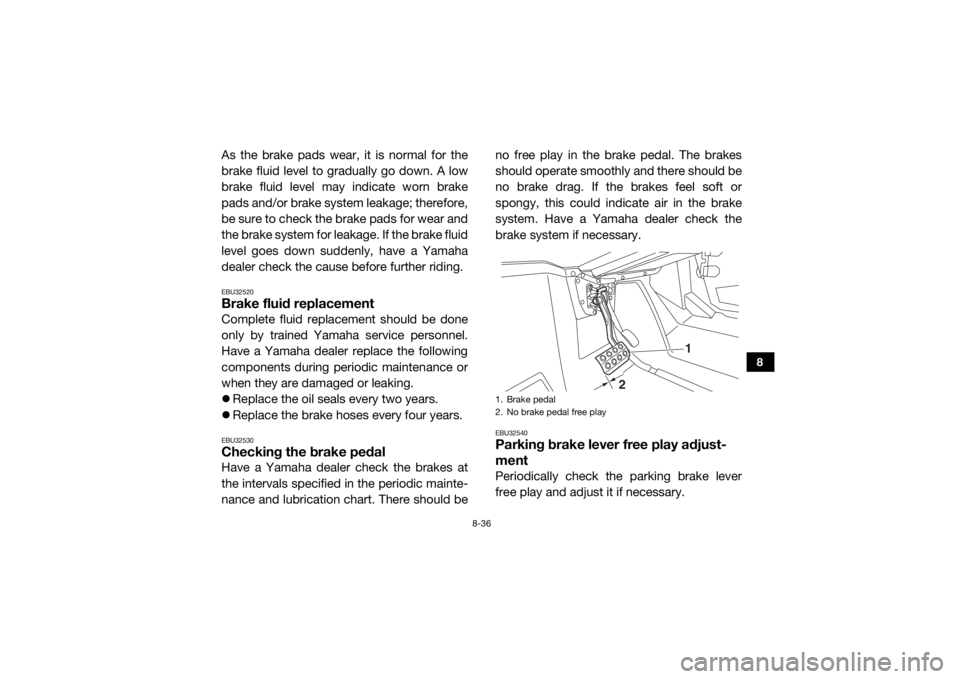
nance and lubrication chart. There should be no free play in the brake pedal. The brakes
should operate smoothly
and there should be
no brake drag. If the brakes feel soft or
spongy, this could indicate air in the brake
system. Have a Yamaha dealer check the
brake system if necessary.
EBU32540Parking brake lever free play adjust-
mentPeriodically check the parking brake lever
free play and adjust it if necessary.1. Brake pedal
2. No brake pedal free play
1
2
UB427BE0.book Page 36 Friday, February 5, 2016 2:14 PM
Page 136 of 172
8-37
8
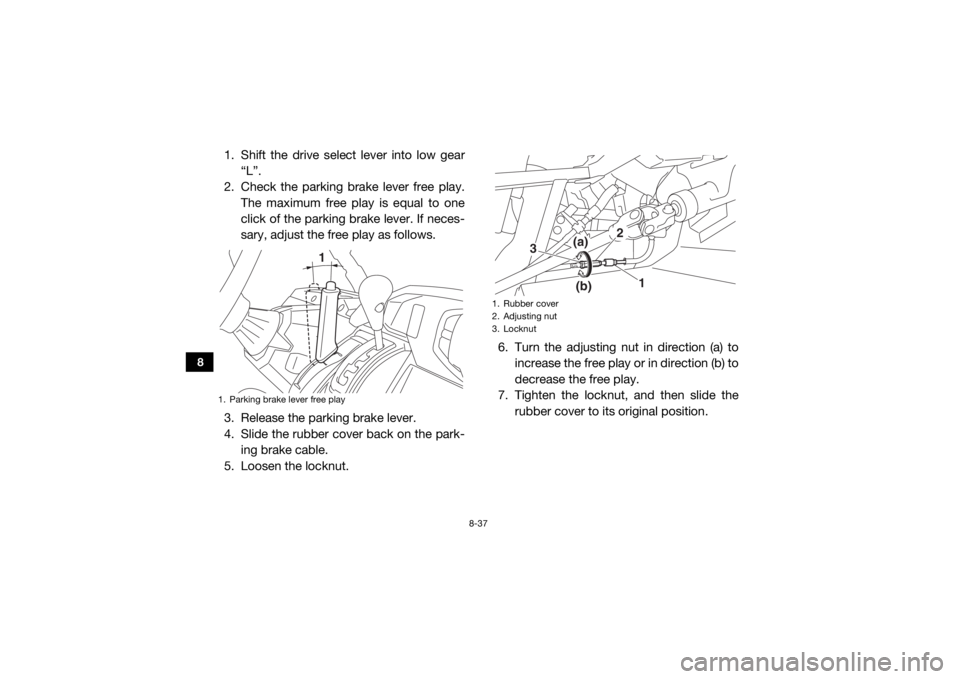
1. Shift the drive select lever into low gear“L”.
2. Check the parking brake lever free play. The maximum free play is equal to one
click of the parking brake lever. If neces-
sary, adjust the free play as follows.
3. Release the parking brake lever.
4. Slide the rubber cover back on the park- ing brake cable.
5. Loosen the locknut. 6. Turn the adjusting nut in direction (a) to
increase the free play or in direction (b) to
decrease the free play.
7. Tighten the locknut, and then slide the
rubber cover to its original position.1. Parking brake lever free play
1
1. Rubber cover
2. Adjusting nut
3. Locknut
1
(a)
(b)
2
3
UB427BE0.book Page 37 Friday, February 5, 2016 2:14 PM
Page 169 of 172

12-2
12
IIdentification number records ...................................... 11-1
Indicator lights and warning lights ................................. 4-2
Instruments, lights and switches, Pre-operation check ........................................................................... 5-7JJump-starting .............................................................. 8-46LLabel locations ............................................................... 1-1
Light switch .................................................................. 4-10
Loading .......................................................................... 6-7
Low-range indicator light ............................................... 4-2MMain switch .................................................................... 4-1
Maintenance and lubrication chart ................................ 8-6
Maintenance chart, emission control system ................ 8-4
Model label .................................................................. 11-1
Multi-function meter unit ............................................... 4-6NNeutral indicator light ..................................................... 4-3OOn-Command drive knob ............................................ 4-11
On-Command drive knob, operation ............................. 6-5
On-Command four-wheel-drive/differential gear lock indicator ....................................................................... 4-3
Owner’s manual and tool kit .......................................... 8-2PParking ........................................................................... 6-7
Parking brake indicator light .......................................... 4-3
Parking brake lever ...................................................... 4-13
Parking brake lever free play, adjusting ....................... 8-36 Parking brake pads, checking ..................................... 8-34
Passenger handhold, Pre-operation check ................... 5-7
RRear knuckle upper and lower pivot, lubrication ......... 8-39
Reverse indicator light ................................................... 4-3SSafety information .......................................................... 2-1
Seat belt indicator light .................................................. 4-5
Seat belts ..................................................................... 4-17
Seat belts, Pre-operation check .................................... 5-6
Seats ............................................................................ 4-15
Spark arrester, cleaning ............................................... 8-31
Spark plug, inspecting ................................................. 8-23
Specifications .............................................................. 10-1
Stabilizer bushes, checking ..........
............................... 8-39
Starting the engine ........................................................ 6-2
Steering, Pre-operation check ....................................... 5-7
Steering shaft, lubrication ............................................ 8-40
Storage .......................................................................... 9-2
Storage compartments ................................................ 4-18TTail/brake light bulb, replacing .................................... 8-53
Tire, replacing .............................................................. 8-41
Tires, Pre-operation check ............................................ 5-8
Trailer hitch bracket and receiver ................................ 4-23
Troubleshooting ........................................................... 8-54
Troubleshooting charts ................................................ 8-56VValve clearance ............................................................ 8-33
V-belt case drain plug .................................................. 8-31
Vehicle identification number ...................................... 11-1
UB427BE0.book Page 2 Friday, February 5, 2016 2:14 PM