ECU YAMAHA VIKING VI 2016 User Guide
[x] Cancel search | Manufacturer: YAMAHA, Model Year: 2016, Model line: VIKING VI, Model: YAMAHA VIKING VI 2016Pages: 184, PDF Size: 4.39 MB
Page 74 of 184

5-7
5
EBU31790Accelerator pedalCheck to see that the accelerator pedal oper-
ates correctly. It must operate smoothly and
spring back to the idle position fully when re-
leased. Have a Yamaha dealer repair as nec-
essary for proper operation.EBU31800Seat beltsMake sure that the seat belts are not frayed,
torn, stretched, or damaged. The seat belts
must move smoothly when pulled out and re-
tract on its own when released. The seat belts
must also lock up when quickly pulled out.
The latch plate should click securely into the
buckle and release when the release button is
pushed firmly. Wash off any dirt or mud that
could affect operation. Have a Yamaha dealer
repair as necessary for proper operation.
A crash can damage the restraint systems in
your vehicle. A damaged restraint system
may not properly protect the person using it,
resulting in serious injury or death in a crash. To help make sure your restraint systems are
working properly after a crash, have them in-
spected and any necessary replacements
made as soon as possible.
EBU31810Passenger handholdCheck that the handhold bar and its supports
are in good condition. Confirm that the lock-
ing pins are securely fastened, and then push
and pull on the handhold to make sure that it
is not loose.EBU31820SteeringPark on level ground. Turn the steering wheel
right and left. Check for excessive free play,
abnormal noises, or a rough feeling. Have a
Yamaha dealer repair as necessary for proper operation.
UB857AE0.book Page 7 Monday, August 24, 2015 8:59 AM
Page 84 of 184
6-7
6
EBU31930ParkingWhen parking, stop the engine and shift the
drive select lever into the neutral position. Ap-
ply the parking brake to help prevent the ve-
hicle from rolling. See page 7-17 for more
information on parking and parking on a
slope.EBU31940LoadingTake extra precautions when driving with a
load or trailer. Follow these instructions and
always use common sense and good judg-
ment when carrying cargo or towing a trailer.
Prepare your load or trailer
WARNING
EWB03310Improper loading or towing can increase
the risk of loss of control, an overturn, or
other accident:
Do not exceed the Maximum Loading
Limits for the vehicle (see “MAXIMUM
LOADING LIMIT” in this section and ve-
hicle labeling).
Keep weight in the cargo bed centered
side to side, and as low and as far for-
ward as possible. Top-heavy loads in-
crease the risk of overturn. Be sure
cargo is secured – a loose load could
change handling unexpectedly or strike
occupants.
Do not exceed the maximum tongue
weight.
Make sure the load does not interfere
with your control or ability to see where
you are going.
Tie down cargo in the trailer securely.
Make sure cargo in the trailer cannot
move around. A shifting load can cause
an accident.
Use the hooks equipped on the cargo bed to
tie down loads.
UB857AE0.book Page 7 Monday, August 24, 2015 8:59 AM
Page 91 of 184

7-5
7
of injury in accidents. The protective structure
will not protect occupants in all rollovers or
accidents.
Body parts outside of vehicle can be struck
by passing objects or crushed during vehicle
rollover. Do not put your hands or feet outside
of the vehicle for any reason. Do not hold onto
the door, cage/frame or shoulder bolster.
Wear your seat belt and helmet.
If you think or feel that the vehicle may tip or
roll, do not put your hands or feet outside the
vehicle for any reason. You will not be able to
stop the vehicle from tipping over using your
body. Any part of your body (arms, legs, or
head) outside of the vehicle can be crushed
by the vehicle cage/frame.
Seat belts
Seat belts should be worn by the driver and
passengers. The driver must be sure that the
passengers are belted before driving.
Be sure that each occupant’s seat belt
latch plate is inserted into the appropriate
buckle.
Be sure the seat belt is not twisted, is close-
fitting across the hips and chest, and is
latched securely.
Do not wear the seat belt across the abdo-
men or stomach.
Do not put the seat belt behind the back.
Failure to use seat belts properly may lead to
an increased likelihood and severity of injury.
An unbelted occupant may strike the interior
of the vehicle, the protective structure, or oth-
er objects in an accident or during operation.
You may also fall completely out or be partial-
ly ejected from the vehicle, which may lead to
being crushed between the ground and the
vehicle. Wearing the seat belt helps you re-
main in the vehicle – the doors and passenger
handhold are not a substitute for using a seat
belt.UB857AE0.book Page 5 Monday, August 24, 2015 8:59 AM
Page 93 of 184
7-7
7
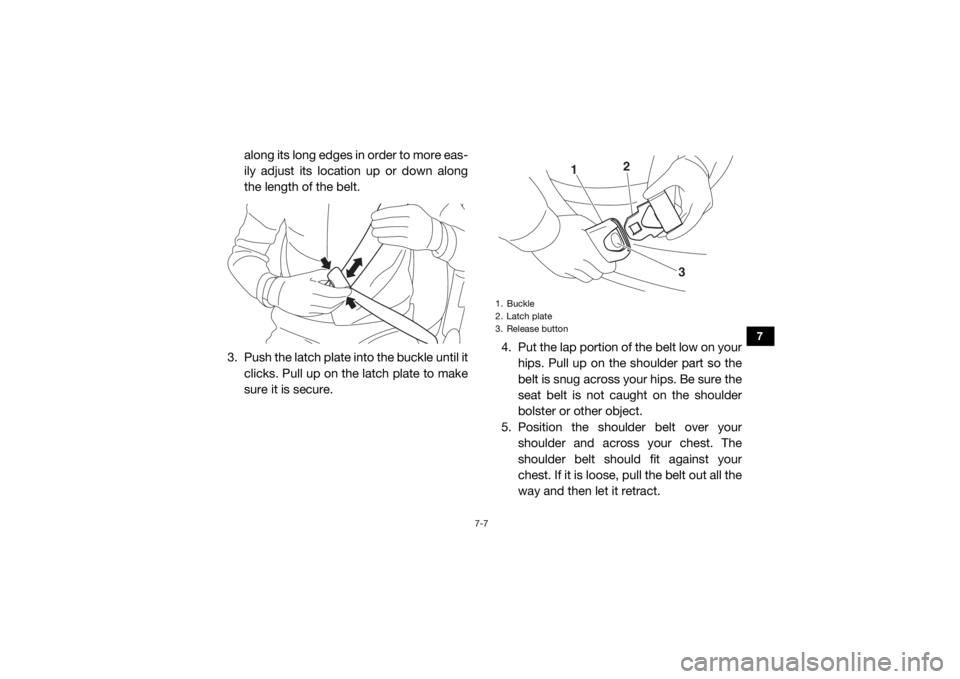
along its long edges in order to more eas-
ily adjust its location up or down along
the length of the belt.
3. Push the latch plate into the buckle until it clicks. Pull up on the latch plate to make
sure it is secure. 4. Put the lap portion of the belt low on your
hips. Pull up on the shoulder part so the
belt is snug across your hips. Be sure the
seat belt is not caught on the shoulder
bolster or other object.
5. Position the shoulder belt over your shoulder and across your chest. The
shoulder belt should fit against your
chest. If it is loose, pull the belt out all the
way and then let it retract.
1. Buckle
2. Latch plate
3. Release button
1
3
2
UB857AE0.book Page 7 Monday, August 24, 2015 8:59 AM
Page 94 of 184
7-8
7
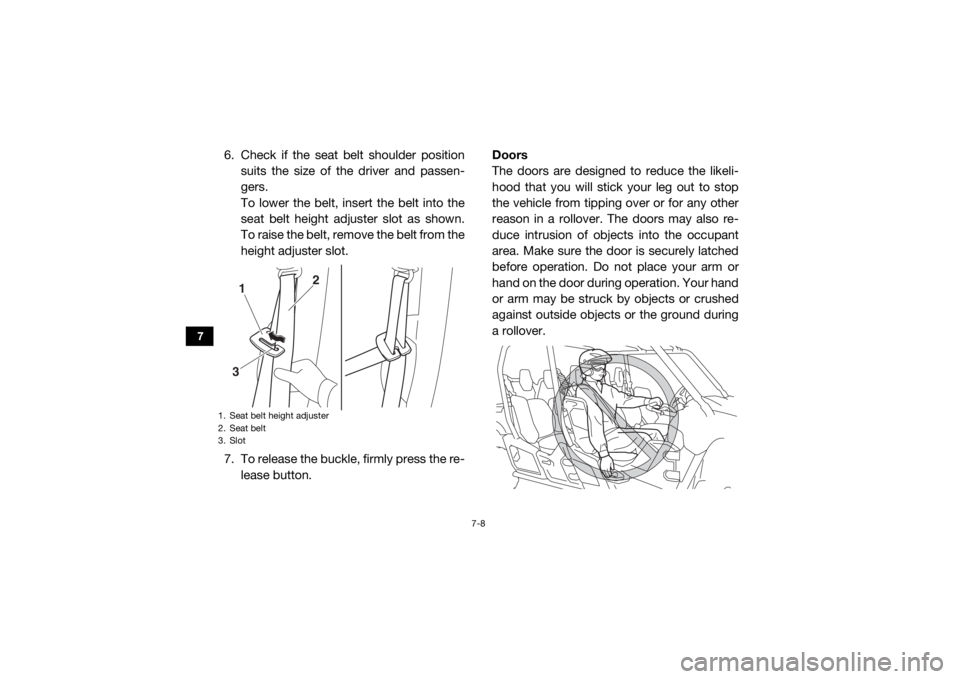
6. Check if the seat belt shoulder positionsuits the size of the driver and passen-
gers.
To lower the belt, insert the belt into the
seat belt height adjuster slot as shown.
To raise the belt, remove the belt from the
height adjuster slot.
7. To release the buckle, firmly press the re- lease button. Doors
The doors are designed to reduce the likeli-
hood that you will stick your leg out to stop
the vehicle from tipping over or for any other
reason in a rollover. The doors may also re-
duce intrusion of objects into the occupant
area. Make sure the door is securely latched
before operation. Do not place your arm or
hand on the door during operation. Your hand
or arm may be struck by objects or crushed
against outside objects or the ground during
a rollover.1. Seat belt height adjuster
2. Seat belt
3. Slot
1
2
3
UB857AE0.book Page 8 Monday, August 24, 2015 8:59 AM
Page 97 of 184
7-11
7
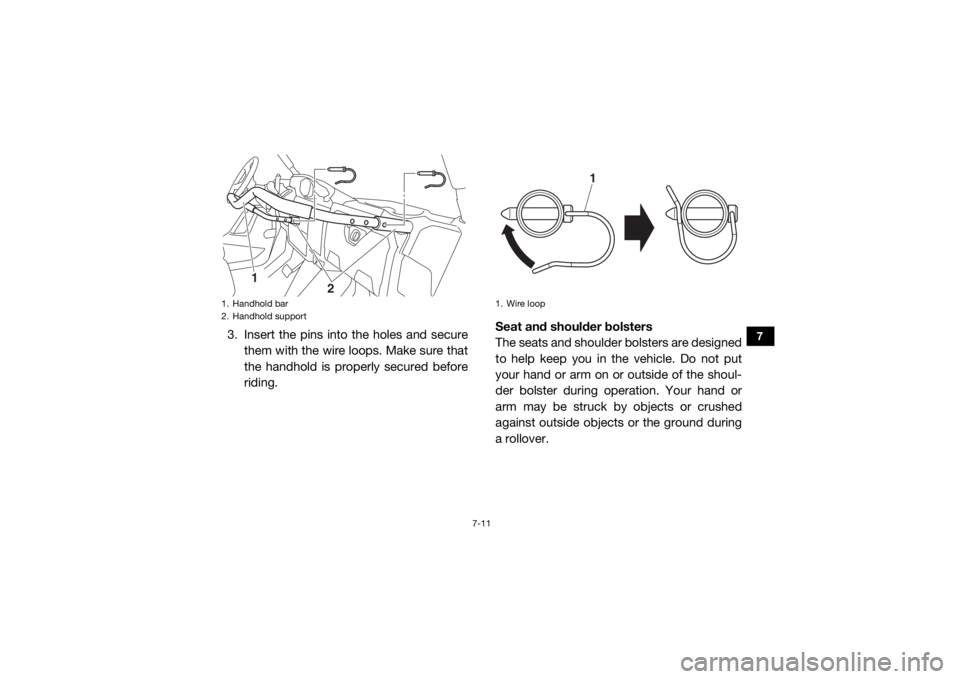
3. Insert the pins into the holes and securethem with the wire loops. Make sure that
the handhold is properly secured before
riding. Seat and shoulder bolsters
The seats and shoulder bolsters are designed
to help keep you in the vehicle. Do not put
your hand or arm on or outside of the shoul-
der bolster during operation. Your hand or
arm may be struck by objects or crushed
against outside objects or the ground during
a rollover.1. Handhold bar
2. Handhold support
2
1
1. Wire loop
1
UB857AE0.book Page 11 Monday, August 24, 2015 8:59 AM
Page 120 of 184
8-11
8
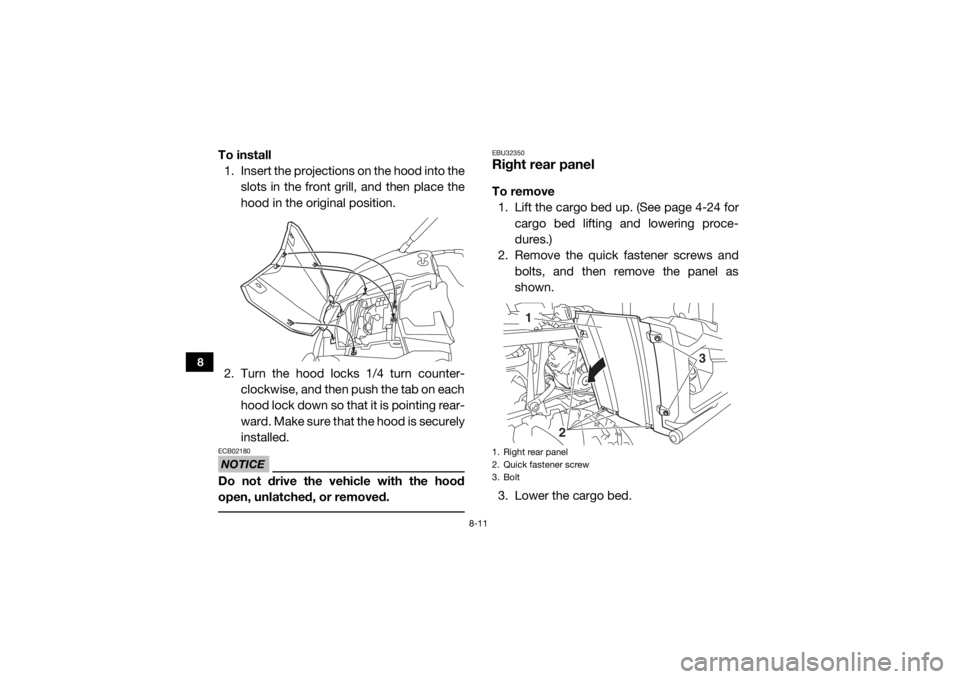
To install1. Insert the projections on the hood into the
slots in the front grill, and then place the
hood in the original position.
2. Turn the hood locks 1/4 turn counter- clockwise, and then push the tab on each
hood lock down so that it is pointing rear-
ward. Make sure that the hood is securely
installed.NOTICEECB02180Do not drive the vehicle with the hood
open, unlatched, or removed.
EBU32350Right rear panelTo remove1. Lift the cargo bed up. (See page 4-24 for cargo bed lifting and lowering proce-
dures.)
2. Remove the quick fastener screws and bolts, and then remove the panel as
shown.
3. Lower the cargo bed.1. Right rear panel
2. Quick fastener screw
3. Bolt
1
2
3
UB857AE0.book Page 11 Monday, August 24, 2015 8:59 AM
Page 137 of 184

8-28
8
Installation1. Clean the surface of the spark plug gas-
ket and its mating surface, and then wipe
off any grime from the spark plug
threads.
2. Install the spark plug and tighten it to the specified torque. If a torque wrench is not
available when you are installing the
spark plug, a good estimate of the cor-
rect torque is one-quarter to one-half turn
past finger tight. Have the spark plug
tightened to the specified torque as soon
as possible.
3. Install the spark plug cap.
4. Lower the cargo bed.
EBU34821Cleaning the air filter elementThe air filter element should be cleaned every
20–40 hours. It should be cleaned and lubri-
cated more often if the vehicle is operated in
extremely dusty areas. Each time air filter ele-
ment maintenance is performed, check the air
inlet to the air filter case for obstructions.
Check the air filter elem ent rubber joint to the
throttle body and manifold fittings for an air-
tight seal. Tighten all fittings securely to avoid
the possibility of unfiltered air entering the en-
gine.NOTICEECB02270Never operate the engine with the air filter
element removed. Doing so would allow
unfiltered air to enter, causing rapid en-
gine wear and possible engine damage.
Additionally, the fuel injection system
would be affected, re sulting in poor engine
performance and possible overheating.
Spark plug gap: 0.8–0.9 mm (0.031–0.035 in)
Tightening torque: Spark plug:13 Nm (1.3 m·kgf, 9.4 ft·lbf)
UB857AE0.book Page 28 Monday, August 24, 2015 8:59 AM
Page 163 of 184
8-54
8
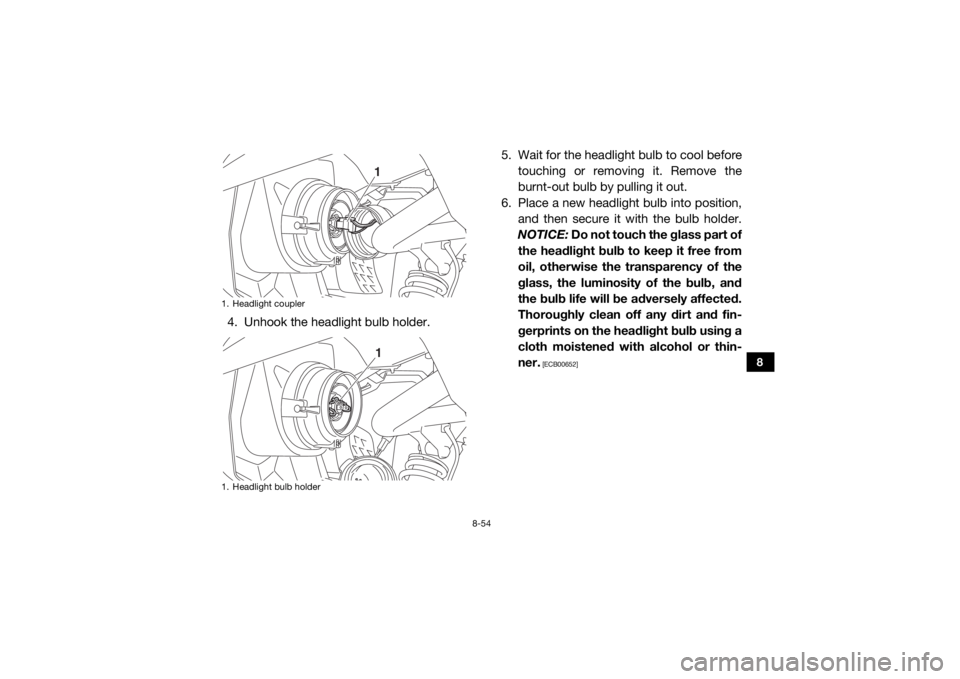
4. Unhook the headlight bulb holder.5. Wait for the headlight bulb to cool before
touching or removing it. Remove the
burnt-out bulb by pulling it out.
6. Place a new headlight bulb into position, and then secure it with the bulb holder.
NOTICE: Do not touch the glass part of
the headlight bulb to keep it free from
oil, otherwise the transparency of the
glass, the luminosity of the bulb, and
the bulb life will be adversely affected.
Thoroughly clean off any dirt and fin-
gerprints on the headlight bulb using a
cloth moistened with alcohol or thin-
ner.
[ECB00652]
1. Headlight coupler
1. Headlight bulb holder
11
UB857AE0.book Page 54 Monday, August 24, 2015 8:59 AM