lock YAMAHA VIKING VI 2016 Owner's Manual
[x] Cancel search | Manufacturer: YAMAHA, Model Year: 2016, Model line: VIKING VI, Model: YAMAHA VIKING VI 2016Pages: 184, PDF Size: 4.39 MB
Page 105 of 184

7-19
7
to see far enough ahead of you. Use common
sense and remember that some hills are too
steep for you to climb or descend. Use proper
driving techniques to avoid rearward, for-
ward, or sideways rollovers on hills and
slopes.
Drive straight up and down inclines, not
across them. If crossing a hill is unavoidable,
drive slowly. Turn downhill immediately if you
feel the vehicle may tip.
If you think or feel the vehicle may tip or
roll:
Brace yourself by pressing your feet firmly
on the floorboard and keep a firm grip on
the steering wheel or passenger handhold.
Do not put your hands or feet outside of the
vehicle for any reason.
Uphill
Do not attempt to climb hills until you have
mastered basic maneuv ers on flat ground.
Drive straight up hills, and avoid crossing the side of a hill, which increases your risk of roll-
over. Practice first on gentle slopes before at-
tempting steeper hills. Always check the
terrain carefully before attempting any hill.
To climb a hill, you need traction, momentum,
and steady throttle. For more traction and
control for climbing steeper and/or rougher
slopes, shift into low gear and select “4WD”
or “DIFF LOCK”. Travel fast enough to main-
tain momentum, but not so fast that you can-
not react to changes in the terrain as you
climb.
Slow down when you reach the crest of the
hill if you cannot see clearly what is on the
other side – there could be another person, an
obstacle, or a sharp drop-off.
If you start to lose traction or momentum
when climbing, and decide you will be unable
to continue, use the brakes to stop. Do not at-
tempt to turn the vehicle around. With your
foot on the brake pedal, look behind you and
plan your descent. Shift the drive select lever
into reverse so you can use engine braking toUB857AE0.book Page 19 Monday, August 24, 2015 8:59 AM
Page 106 of 184

7-20
7
slow your descent. Release the brake and be-
gin to coast down the hill. Use engine braking
as much as possible, gently applying the
brakes when necessary.
Downhill
Check the terrain carefully before going
downhill. When possible, choose a path that
lets you drive your vehicle straight downhill.
Choose your path carefully and drive slowly
enough to be able to react to obstacles that
you encounter.
For more traction and control, before going
down steeper and/or rougher slopes, shift
into low gear and select “4WD” or “DIFF
LOCK”. Engine braking will help you go
downhill slowly. Go as slowly as possible. If
you begin to go too fast, apply the brakes
gently. Avoid hard application of the brakes,
which could cause the vehicle to slide.If you are sliding or skidding, try to steer in the
direction the vehicle is sliding, to regain con-
trol. For example, if you feel the back of the
vehicle start to slide to your right, steer to the
right.
If you must turn on the hill to avoid an obsta-
cle, do so slowly and carefully. If the vehicle
starts to tip, immediately steer in the downhill
direction if there are no obstacles in your
path. As you regain proper balance, gradually
steer again in the direction you want to go.
Rough terrain
Operation over rough terrain should be done
with caution.
Look for and avoid obstacles that could
cause damage to the vehicle or could lead
to a rollover or accident.
Do not drive in a way that will get the vehicle
airborne, as injury, loss of control, and
damage to the vehicle could occur.UB857AE0.book Page 20 Monday, August 24, 2015 8:59 AM
Page 119 of 184
8-10
8
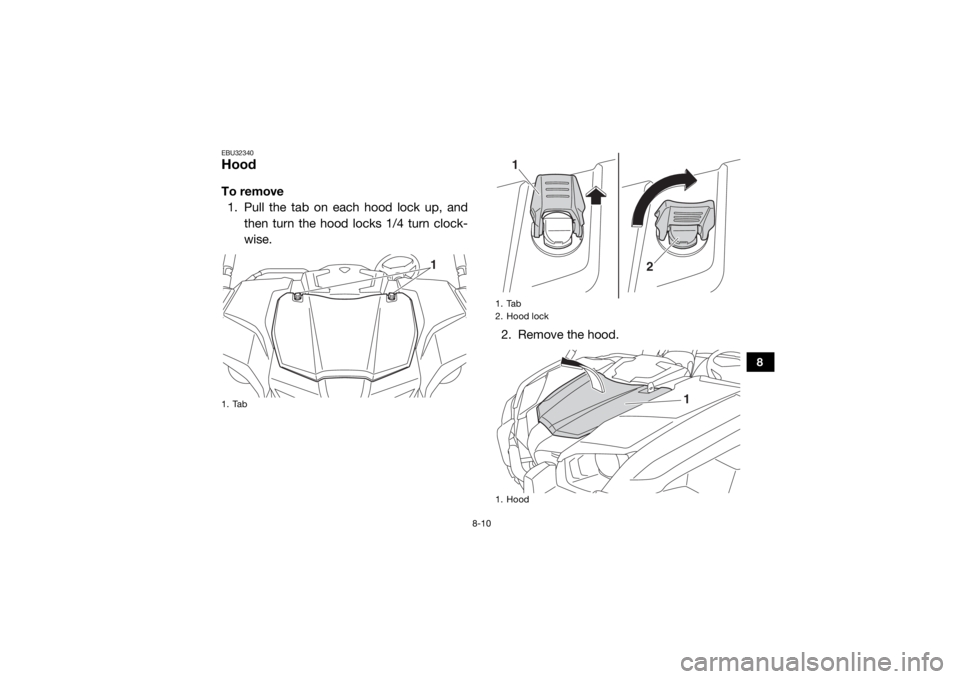
EBU32340HoodTo remove1. Pull the tab on each hood lock up, and then turn the hood locks 1/4 turn clock-
wise.
2. Remove the hood.1. Tab
1
1. Tab
2. Hood lock
1. Hood
1
2
1
UB857AE0.book Page 10 Monday, August 24, 2015 8:59 AM
Page 120 of 184
8-11
8
To install1. Insert the projections on the hood into the
slots in the front grill, and then place the
hood in the original position.
2. Turn the hood locks 1/4 turn counter- clockwise, and then push the tab on each
hood lock down so that it is pointing rear-
ward. Make sure that the hood is securely
installed.NOTICEECB02180Do not drive the vehicle with the hood
open, unlatched, or removed.
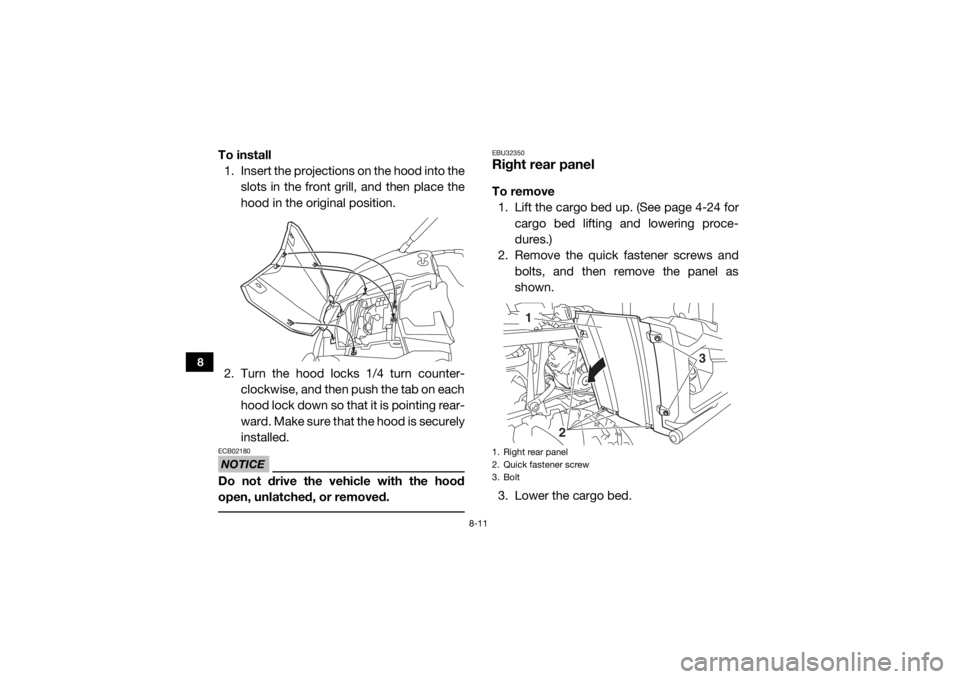
EBU32350Right rear panelTo remove1. Lift the cargo bed up. (See page 4-24 for cargo bed lifting and lowering proce-
dures.)
2. Remove the quick fastener screws and bolts, and then remove the panel as
shown.
3. Lower the cargo bed.1. Right rear panel
2. Quick fastener screw
3. Bolt
1
2
3
UB857AE0.book Page 11 Monday, August 24, 2015 8:59 AM
Page 147 of 184
8-38
8
WARNING
EWB02721Improper maintenance can result in loss of
braking ability. Observe these precau-
tions:
Insufficient brake fluid may allow air to
enter the brake system, reducing brak-
ing performance.
Clean the filler cap before removing. Use
only DOT 4 brake fluid from a sealed
container.
Use only the specified brake fluid; other-
wise, the rubber seal s may deteriorate,
causing leakage.
Refill with the same type of brake fluid.
Adding a brake fluid other than DOT 4
may result in a harmful chemical reac-
tion.
Be careful that water does not enter the
brake fluid reservoir when refilling. Wa-
ter will significantly lower the boiling
point of the fluid and may result in vapor
lock.
NOTICEECB01161Brake fluid may damage painted surfaces
or plastic parts. Always clean up spilled
fluid immediately.
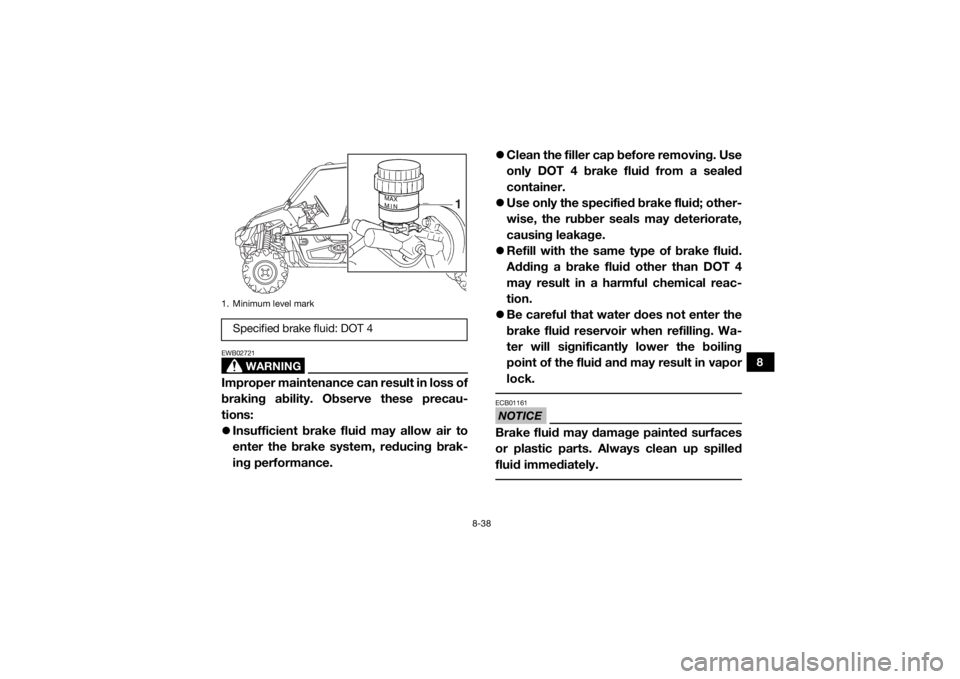
1. Minimum level markSpecified brake fluid: DOT 4
1
UB857AE0.book Page 38 Monday, August 24, 2015 8:59 AM
Page 149 of 184
8-40
8
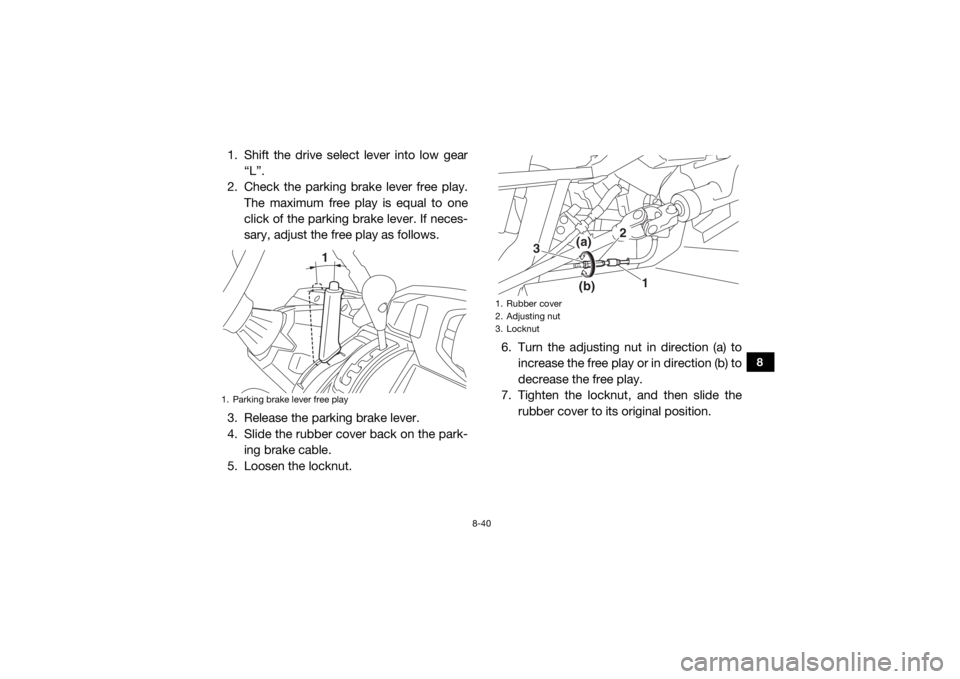
1. Shift the drive select lever into low gear“L”.
2. Check the parking brake lever free play. The maximum free play is equal to one
click of the parking brake lever. If neces-
sary, adjust the free play as follows.
3. Release the parking brake lever.
4. Slide the rubber cover back on the park- ing brake cable.
5. Loosen the locknut. 6. Turn the adjusting nut in direction (a) to
increase the free play or in direction (b) to
decrease the free play.
7. Tighten the locknut, and then slide the
rubber cover to its original position.1. Parking brake lever free play
1
1. Rubber cover
2. Adjusting nut
3. Locknut
1
(a)
(b)
2
3
UB857AE0.book Page 40 Monday, August 24, 2015 8:59 AM
Page 160 of 184
8-51
8
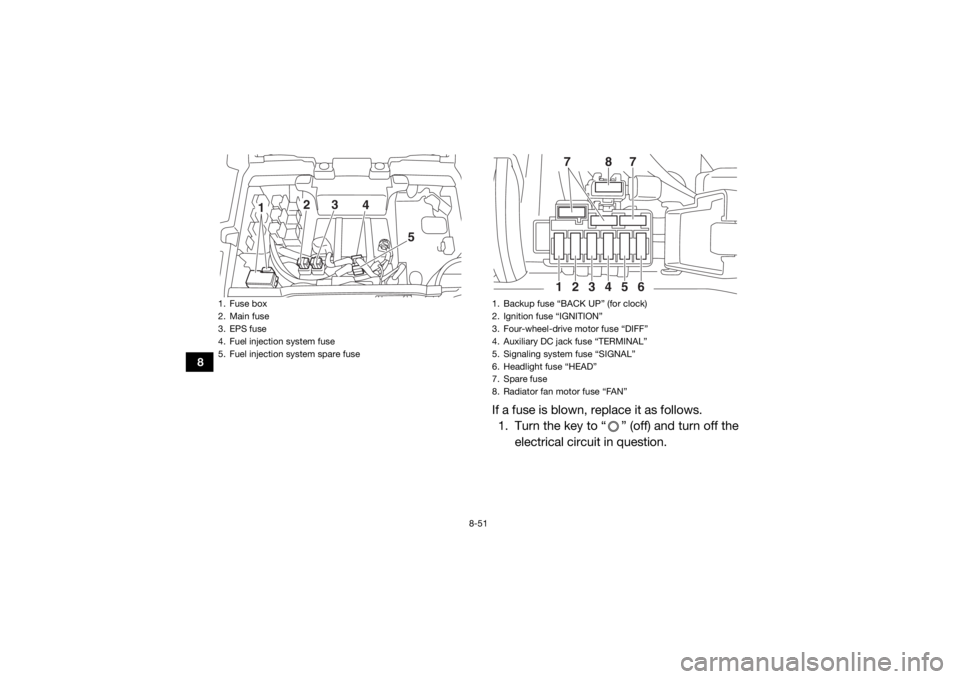
If a fuse is blown, replace it as follows.1. Turn the key to “ ” (off) and turn off the
electrical circuit in question.
1. Fuse box
2. Main fuse
3. EPS fuse
4. Fuel injection system fuse
5. Fuel injection system spare fuse
1 3
2
4
5
1. Backup fuse “BACK UP” (for clock)
2. Ignition fuse “IGNITION”
3. Four-wheel-drive motor fuse “DIFF”
4. Auxiliary DC jack fuse “TERMINAL”
5. Signaling system fuse “SIGNAL”
6. Headlight fuse “HEAD”
7. Spare fuse
8. Radiator fan motor fuse “FAN”
1
2
3
4
5
6
8
7
7
UB857AE0.book Page 51 Monday, August 24, 2015 8:59 AM
Page 166 of 184
8-57
8
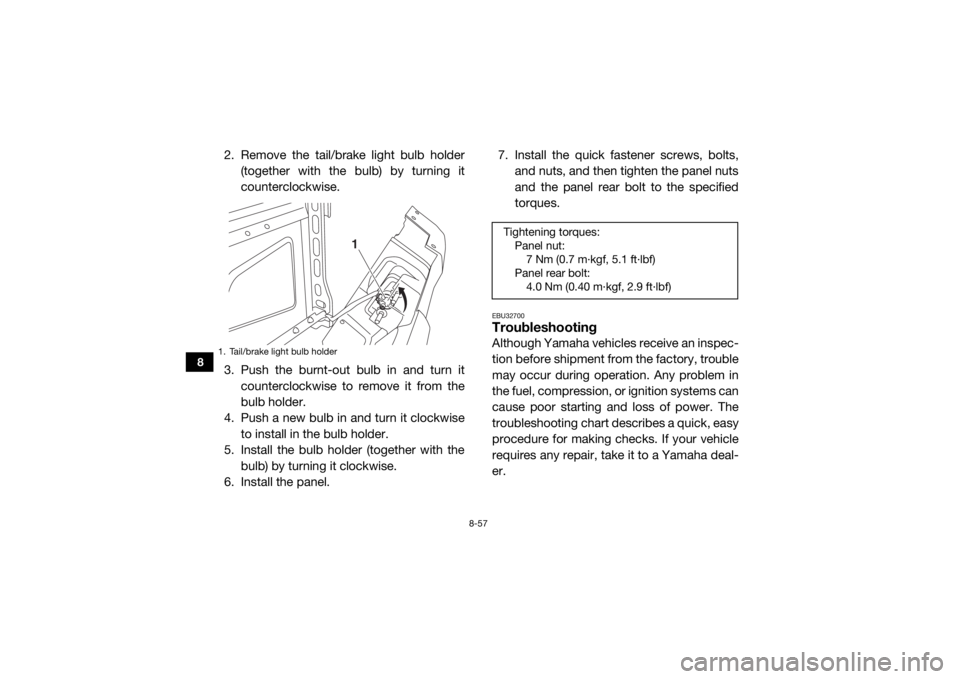
2. Remove the tail/brake light bulb holder(together with the bulb) by turning it
counterclockwise.
3. Push the burnt-out bulb in and turn it counterclockwise to remove it from the
bulb holder.
4. Push a new bulb in and turn it clockwise to install in the bulb holder.
5. Install the bulb holder (together with the
bulb) by turning it clockwise.
6. Install the panel. 7. Install the quick fastener screws, bolts,
and nuts, and then tighten the panel nuts
and the panel rear bolt to the specified
torques.
EBU32700TroubleshootingAlthough Yamaha vehicles receive an inspec-
tion before shipment from the factory, trouble
may occur during operation. Any problem in
the fuel, compression, or ignition systems can
cause poor starting and loss of power. The
troubleshooting chart describes a quick, easy
procedure for making checks. If your vehicle
requires any repair, take it to a Yamaha deal-
er.
1. Tail/brake light bulb holder
1
Tightening torques:Panel nut:7 Nm (0.7 m·kgf, 5.1 ft·lbf)
Panel rear bolt: 4.0 Nm (0.40 m·kgf, 2.9 ft·lbf)
UB857AE0.book Page 57 Monday, August 24, 2015 8:59 AM
Page 170 of 184

9-1
9
EBU32720
CLEANING AND STORAGE
EBU32730CleaningFrequent, thorough cleaning of your vehicle
will not only enhance its appearance but will
improve its general performance and extend
the useful life of many components.1. Before cleaning the vehicle: a. Block off the end of the exhaust pipe to prevent water entry. A plastic bag
and strong rubber band may be used.
b. Make sure the spark plug and all filler caps are properly installed.
2. If the engine case is excessively greasy, apply degreaser with a paint brush. Do
not apply degreaser to the wheel axles.
3. Rinse the dirt and degreaser off with a garden hose. Use only enough pressure
to do the job. WARNING! Test the
brakes after washing. Apply the
brakes several times at slow speeds to
let friction dry out the linings. Wet brakes may have reduced stopping
ability, increasing the chance of an ac-
cident.
[EWB03470]
NOTICE: Excessive wa-
ter pressure may cause water seepage
and deterioration of wheel bearings,
brakes, transmission seals and electri-
cal devices. Many expensive repair
bills have resulted from improper high-
pressure detergent applications such
as those available in coin-operated car
washers.
[ECB00712]
TIPThe tailgate can be removed to make it easier
to clean the cargo bed. To separate the tail-
gate from the cargo bed, unhook the latches,
lift the left side of the tailgate and pull the tail-
gate to the left. 4. Once the majority of the dirt has been hosed off, wash all surfaces with warm
water and mild, detergent-type soap. An
old toothbrush or bottle brush is handy
for hard-to-get-at places.
UB857AE0.book Page 1 Monday, August 24, 2015 8:59 AM
Page 171 of 184

9-2
9
5. Rinse the vehicle off immediately withclean water and dry all surfaces with a
clean chamois towel or soft, absorbent
cloth.
6. Clean the seats with a vinyl upholstery
cleaner to keep the covers pliable and
glossy.
7. Automotive-type wax may be applied to
all painted and chrome-plated surfaces.
Avoid combination cleaner-waxes. Many
contain abrasives which may scratch the
paint or protective finish. When finished,
start the engine and let it idle for several
minutes.EBU32740StorageLong term storage (60 days or more) of your
vehicle will require some preventive proce-
dures to guard against deterioration. Make
any necessary repairs before storing the vehi-
cle. After thoroughly cleaning the vehicle, prepare
for storage as follows:
1. Fill the fuel tank with fresh fuel and add the specified amount of Yamaha Fuel
Stabilizer and Conditioner or equivalent
product. Operate the vehicle for at least 5
minutes to distribute treated fuel through
the fuel system.
2. Remove the spark plug, pour about one tablespoon of SAE 10W-40 or 20W-50
motor oil in the spark plug hole and install
the spark plug. Ground the spark plug
wire and turn the engine over several
times to coat the cylinder wall with oil.
3. Lubricate all control cables.
4. Block up the frame to raise all wheels off the ground.
Specified amount:1 oz of stabilizer to each gallon of fuel (or
7.5 ml of stabilizer to each liter of fuel)
UB857AE0.book Page 2 Monday, August 24, 2015 8:59 AM