wheel YAMAHA VIKING VI 2016 Owner's Guide
[x] Cancel search | Manufacturer: YAMAHA, Model Year: 2016, Model line: VIKING VI, Model: YAMAHA VIKING VI 2016Pages: 184, PDF Size: 4.39 MB
Page 108 of 184

7-22
7
If you feel the vehicle begin to slide sideways
or the back wheels slide during a turn, steer
into the direction of the slide if possible, to re-
gain directional control. For example, if you
feel the back of the vehicle start to slide to
your right, steer to the right.
Brush or wooded areas
When operating in areas with brush or trees,
watch carefully on both sides and above the
vehicle for obstacles such as branches that
the vehicle might hit, causing an accident.
Watch for brush that might enter the vehicle
as you pass and strike you or the passengers.
Never hold onto the cage/frame. The passen-
gers should always hold onto the passenger
handhold with both hands.
The muffler and other engine parts become
extremely hot during operation and remain
hot after the engine has stopped. To reduce
the risk of fire during operation or after leaving
the vehicle, do not let brush, grass and other
materials collect under the vehicle, near the muffler or exhaust pipe, or next to other hot
parts. Check under the vehicle after operating
in areas where combustible materials may
have collected. Do not idle or park the vehicle
in long dry grass or other dry ground cover.
Encountering obstacles
If you cannot go around an obstacle, such as
a fallen tree or a ditch, stop the vehicle where
it is safe to do so. Set the parking brake and
get out to inspect the area thoroughly. Look
from both your approach side and exit side. If
you believe you can continue safely, choose
the path that will allow you to get over the ob-
stacle and at as close to a right angle as pos-
sible to minimize vehicle tipping. Go only fast
enough to maintain your momentum but still
give yourself plenty of time to react to chang-
es in conditions.UB857AE0.book Page 22 Monday, August 24, 2015 8:59 AM
Page 116 of 184

8-7
8
8*Parking brake • Check operation and free play/brake pad
wear.
• Correct if necessary. Replace pads if worn to the limit. √√√√√
9 *Brake fluid • Change. Every 2 years
10 *Accelerator pedal • Check operation and free play. √√√√√
11 *V-b e l t • Check operation.
• Check for wear, cracks, or damage. √√
√
12 *Wheels • Check balance/damage/runout.
• Repair if necessary. √ √√√
13 *Wheel bearings • Check bearing assemblies for loose-
ness/damage.
• Replace if damaged. √ √√√
14 *Front and rear
suspension • Check operation and for leakage.
• Correct if necessary.
√√
15 *Steering system • Check operation and for looseness. Replace
if damaged.
• Check toe-in. Adjust if necessary. √√√√√
16 *Stabilizer bushes • Check for cracks or other damage, and re-
place if necessary. √√√
NO. ITEM
ROUTINE INITIAL
EVERY
Whichev- er comes first month136612
km
(mi) 320
(200) 1200
(750) 2400
(1500) 2400
(1500) 4800
(3000)
hours 20 75 150 150 300UB857AE0.book Page 7 Monday, August 24, 2015 8:59 AM
Page 145 of 184
8-36
8
EBU32460Valve clearanceThe correct valve clearance changes with
use, resulting in improper fuel/air supply or
engine noise. To prevent this, the valve clear-
ance must be adjusted regularly. This adjust-
ment however, should be left to a
professional Yamaha service technician.EBU32470BrakesReplacement of brake components requires
professional knowledge. Brake service
should be performed by a Yamaha dealer.
WARNING
EWB02572Operating with improperly serviced or ad-
justed brakes could lead to a loss in brak-
ing ability and an accident.
EBU32480Checking the front and rear brake padsEach brake pad is prov ided with wear indica-
tor grooves, which allow you to check the
brake pad wear without having to disassem-
ble the brake. To check the brake pad wear,
check the wear indicator grooves. If a brake
pad has worn to the point that the wear indi-
cator grooves have almost disappeared, have
a Yamaha dealer replace the brake pads as a
set.
The wheels need to be removed to check the
brake pads. (See page s 8-43, 8-45 for wheel
removal and installation procedures.)
UB857AE0.book Page 36 Monday, August 24, 2015 8:59 AM
Page 152 of 184
8-43
8
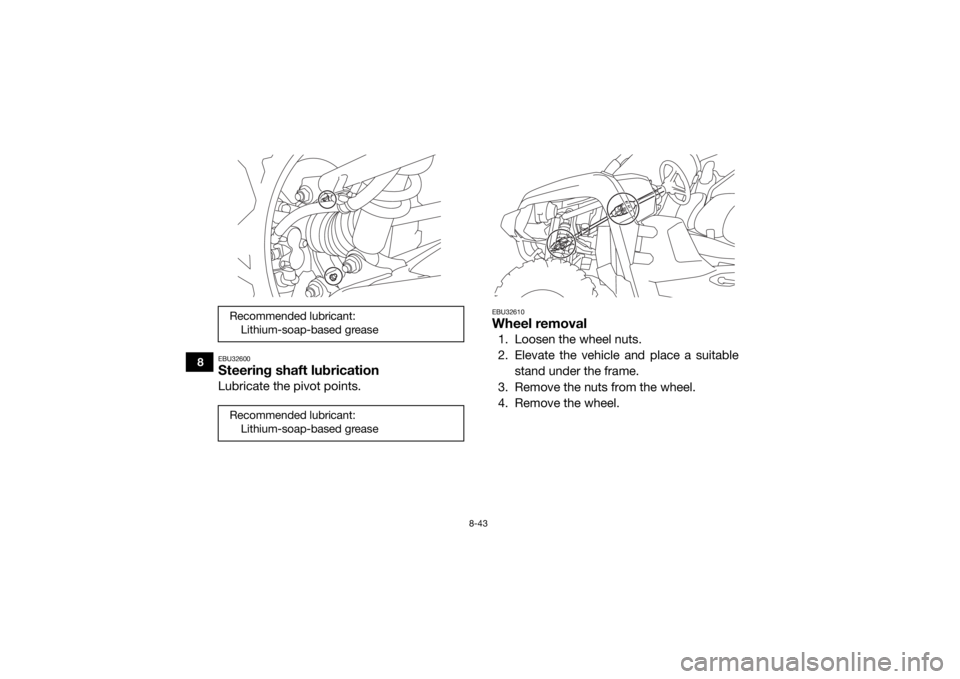
EBU32600Steering shaft lubricationLubricate the pivot points.
EBU32610Wheel removal1. Loosen the wheel nuts.
2. Elevate the vehicle and place a suitablestand under the frame.
3. Remove the nuts from the wheel.
4. Remove the wheel.
Recommended lubricant: Lithium-soap-based grease
Recommended lubricant: Lithium-soap-based grease
UB857AE0.book Page 43 Monday, August 24, 2015 8:59 AM
Page 153 of 184
8-44
8
EBU32620Tire replacementAlways use the same size and type of tires
recommended in this owner’s manual. The
tires that came with your Yamaha Viking VI
were designed to match the performance ca-
pabilities and to provide the best combination
of handling, braking, and comfort. It is best to
replace all four tires at the same time. If that is
not possible, you must replace the tires inpairs (front or rear) with tires of the same size
and type as the origin
als. Never replace just
one tire.
WARNING
EWB03390Installing improper tires on your Yamaha
Viking VI can affect handling and stability.
This can cause a loss of control. The tires listed below have been approved by
Yamaha Motor Manufacturing Corporation of
America for this model.
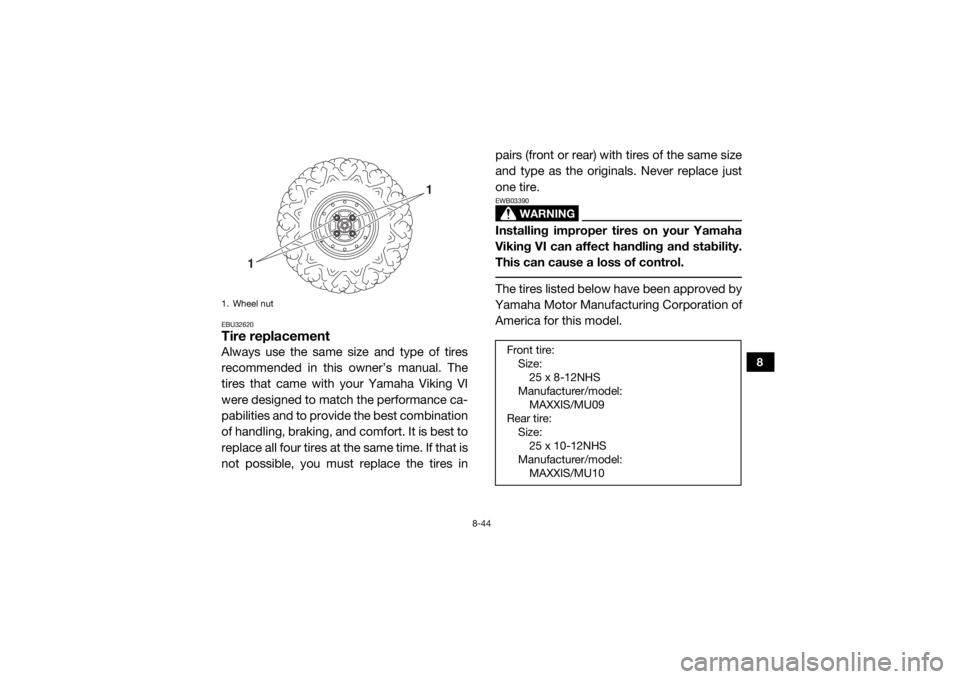
1. Wheel nut
1
1
Front tire: Size:25 x 8-12NHS
Manufacturer/model: MAXXIS/MU09
Rear tire: Size:25 x 10-12NHS
Manufacturer/model: MAXXIS/MU10
UB857AE0.book Page 44 Monday, August 24, 2015 8:59 AM
Page 154 of 184
8-45
8
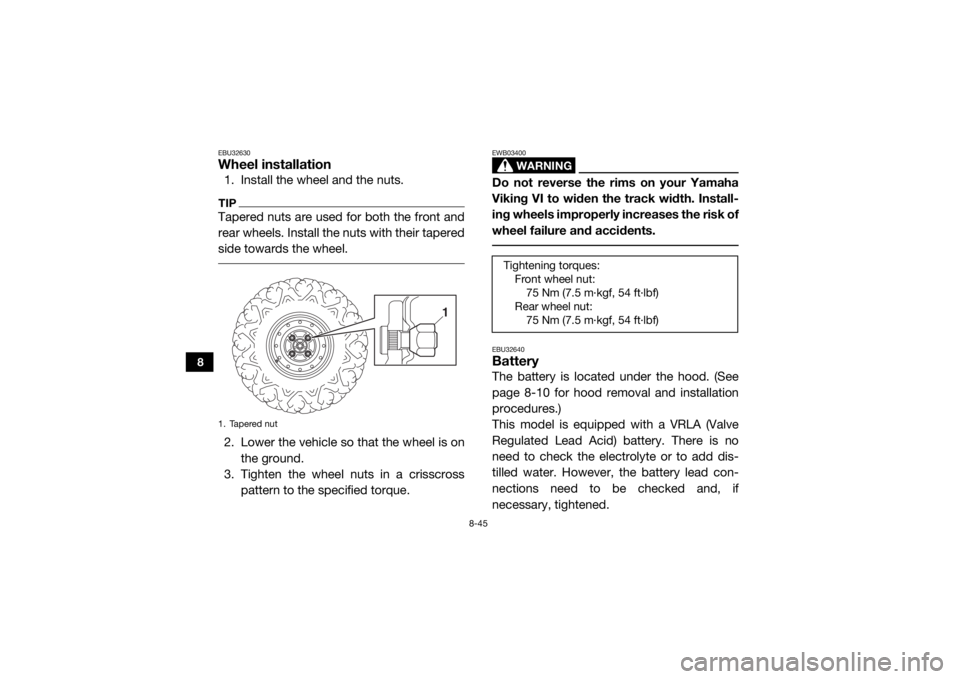
EBU32630Wheel installation1. Install the wheel and the nuts.TIPTapered nuts are used for both the front and
rear wheels. Install the nuts with their tapered
side towards the wheel. 2. Lower the vehicle so that the wheel is onthe ground.
3. Tighten the wheel nuts in a crisscross
pattern to the specified torque.
WARNING
EWB03400Do not reverse the rims on your Yamaha
Viking VI to widen the track width. Install-
ing wheels improperly increases the risk of
wheel failure and accidents. EBU32640BatteryThe battery is located under the hood. (See
page 8-10 for hood removal and installation
procedures.)
This model is equipped with a VRLA (Valve
Regulated Lead Acid) battery. There is no
need to check the electrolyte or to add dis-
tilled water. However, the battery lead con-
nections need to be checked and, if
necessary, tightened.
1. Tapered nut
1
Tightening torques:Front wheel nut:75 Nm (7.5 m·kgf, 54 ft·lbf)
Rear wheel nut: 75 Nm (7.5 m·kgf, 54 ft·lbf)
UB857AE0.book Page 45 Monday, August 24, 2015 8:59 AM
Page 160 of 184
8-51
8
If a fuse is blown, replace it as follows.1. Turn the key to “ ” (off) and turn off the
electrical circuit in question.
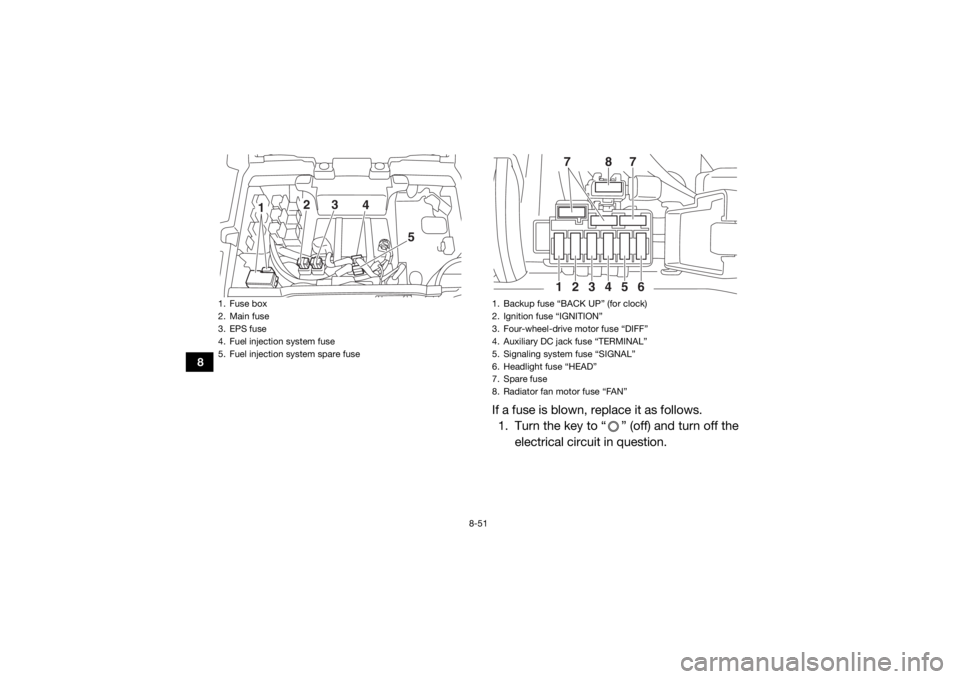
1. Fuse box
2. Main fuse
3. EPS fuse
4. Fuel injection system fuse
5. Fuel injection system spare fuse
1 3
2
4
5
1. Backup fuse “BACK UP” (for clock)
2. Ignition fuse “IGNITION”
3. Four-wheel-drive motor fuse “DIFF”
4. Auxiliary DC jack fuse “TERMINAL”
5. Signaling system fuse “SIGNAL”
6. Headlight fuse “HEAD”
7. Spare fuse
8. Radiator fan motor fuse “FAN”
1
2
3
4
5
6
8
7
7
UB857AE0.book Page 51 Monday, August 24, 2015 8:59 AM
Page 161 of 184
8-52
8
NOTICEECB00641To prevent accidental short-circuiting,
turn off the main switch when checking or
replacing a fuse. 2. Remove the hood. (See page 8-10 forhood removal and installation proce-
dures.)
3. Remove the blown fuse, and then install a new fuse of the specified amperage.
WARNING! Always use a fuse of the specified amperage. Never use any
material in place of the proper fuse.
Using an improper fuse can cause
damage to the electrical system and
may lead to a fire.
[EWB03440]
Specified fuses: Main fuse:40.0 A
Fuel injection system fuse: 10.0 A
Headlight fuse: 15.0 A
Ignition fuse: 10.0 A
Auxiliary DC jack fuse: 10.0 A
Signaling system fuse: 10.0 A
Four-wheel-drive motor fuse: 10.0 A
Radiator fan motor fuse: 25.0 A
Backup fuse: 10.0 A
EPS fuse: 40.0 A
UB857AE0.book Page 52 Monday, August 24, 2015 8:59 AM
Page 170 of 184
9-1
9
EBU32720
CLEANING AND STORAGE
EBU32730CleaningFrequent, thorough cleaning of your vehicle
will not only enhance its appearance but will
improve its general performance and extend
the useful life of many components.1. Before cleaning the vehicle: a. Block off the end of the exhaust pipe to prevent water entry. A plastic bag
and strong rubber band may be used.
b. Make sure the spark plug and all filler caps are properly installed.
2. If the engine case is excessively greasy, apply degreaser with a paint brush. Do
not apply degreaser to the wheel axles.
3. Rinse the dirt and degreaser off with a garden hose. Use only enough pressure
to do the job. WARNING! Test the
brakes after washing. Apply the
brakes several times at slow speeds to
let friction dry out the linings. Wet brakes may have reduced stopping
ability, increasing the chance of an ac-
cident.
[EWB03470]
NOTICE: Excessive wa-
ter pressure may cause water seepage
and deterioration of wheel bearings,
brakes, transmission seals and electri-
cal devices. Many expensive repair
bills have resulted from improper high-
pressure detergent applications such
as those available in coin-operated car
washers.
[ECB00712]
TIPThe tailgate can be removed to make it easier
to clean the cargo bed. To separate the tail-
gate from the cargo bed, unhook the latches,
lift the left side of the tailgate and pull the tail-
gate to the left. 4. Once the majority of the dirt has been hosed off, wash all surfaces with warm
water and mild, detergent-type soap. An
old toothbrush or bottle brush is handy
for hard-to-get-at places.
UB857AE0.book Page 1 Monday, August 24, 2015 8:59 AM
Page 171 of 184

9-2
9
5. Rinse the vehicle off immediately withclean water and dry all surfaces with a
clean chamois towel or soft, absorbent
cloth.
6. Clean the seats with a vinyl upholstery
cleaner to keep the covers pliable and
glossy.
7. Automotive-type wax may be applied to
all painted and chrome-plated surfaces.
Avoid combination cleaner-waxes. Many
contain abrasives which may scratch the
paint or protective finish. When finished,
start the engine and let it idle for several
minutes.EBU32740StorageLong term storage (60 days or more) of your
vehicle will require some preventive proce-
dures to guard against deterioration. Make
any necessary repairs before storing the vehi-
cle. After thoroughly cleaning the vehicle, prepare
for storage as follows:
1. Fill the fuel tank with fresh fuel and add the specified amount of Yamaha Fuel
Stabilizer and Conditioner or equivalent
product. Operate the vehicle for at least 5
minutes to distribute treated fuel through
the fuel system.
2. Remove the spark plug, pour about one tablespoon of SAE 10W-40 or 20W-50
motor oil in the spark plug hole and install
the spark plug. Ground the spark plug
wire and turn the engine over several
times to coat the cylinder wall with oil.
3. Lubricate all control cables.
4. Block up the frame to raise all wheels off the ground.
Specified amount:1 oz of stabilizer to each gallon of fuel (or
7.5 ml of stabilizer to each liter of fuel)
UB857AE0.book Page 2 Monday, August 24, 2015 8:59 AM