check oil YAMAHA VMAX 2001 User Guide
[x] Cancel search | Manufacturer: YAMAHA, Model Year: 2001, Model line: VMAX, Model: YAMAHA VMAX 2001Pages: 110, PDF Size: 11.88 MB
Page 56 of 110
PERIODIC MAINTENANCE AND MINOR REPAIR
6-13
6
EAU02975
Final gear oil The final gear case must be checked
for oil leakage before each ride. If any
leakage is found, have a Yamaha deal-
er check and repair the motorcycle. In
addition, the final gear oil must be
changed as follows at the intervals
specified in the periodic maintenance
and lubrication chart.
1. Place the motorcycle on the cen-
terstand.
2. Place an oil pan under the final
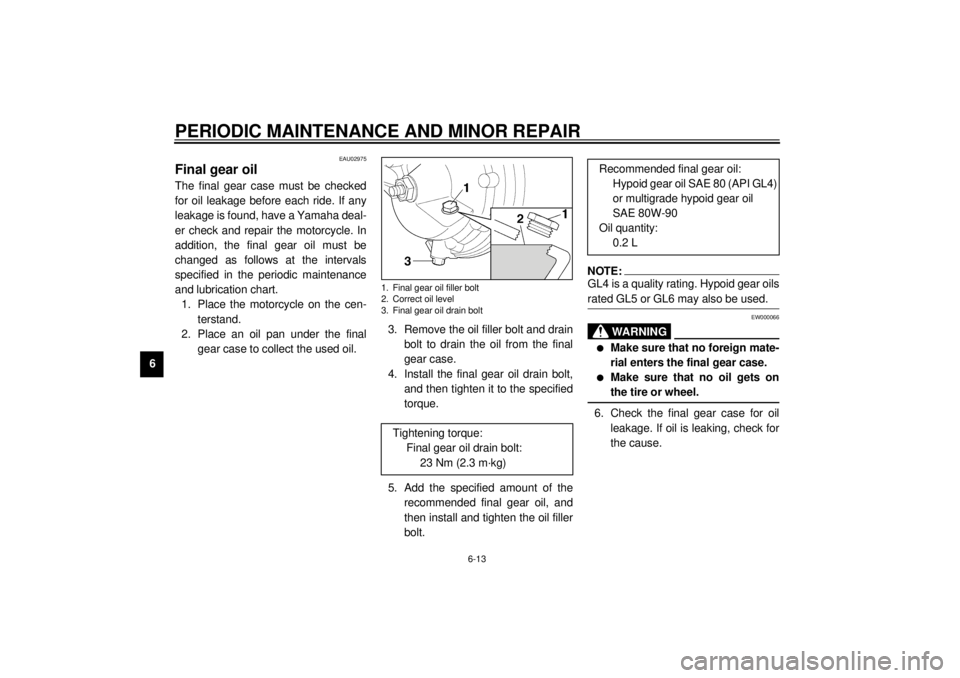
gear case to collect the used oil.3. Remove the oil filler bolt and drain
bolt to drain the oil from the final
gear case.
4. Install the final gear oil drain bolt,
and then tighten it to the specified
torque.
5. Add the specified amount of the
recommended final gear oil, and
then install and tighten the oil filler
bolt.
NOTE:@ GL4 is a quality rating. Hypoid gear oils
rated GL5 or GL6 may also be used. @
EW000066
WARNING
@ l
Make sure that no foreign mate-
rial enters the final gear case.
l
Make sure that no oil gets on
the tire or wheel.
@6. Check the final gear case for oil
leakage. If oil is leaking, check for
the cause.
1. Final gear oil filler bolt
2. Correct oil level
3. Final gear oil drain bolt
Tightening torque:
Final gear oil drain bolt:
23 Nm (2.3 m·kg)
Recommended final gear oil:
Hypoid gear oil SAE 80 (API GL4)
or multigrade hypoid gear oil
SAE 80W-90
Oil quantity:
0.2 L
E_3lr.book Page 13 Wednesday, November 22, 2000 4:10 PM
Page 70 of 110
PERIODIC MAINTENANCE AND MINOR REPAIR
6-27
6
EAU03418
Checking the brake fluid level Insufficient brake fluid may allow air to
enter the brake or clutch systems, pos-
sibly causing them to become ineffec-
tive.
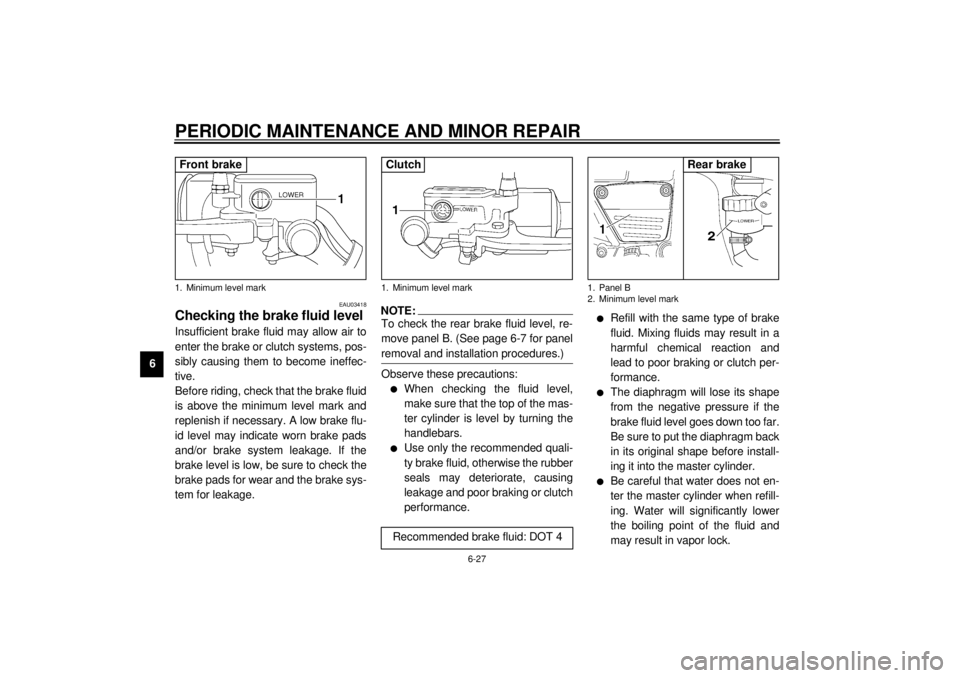
Before riding, check that the brake fluid
is above the minimum level mark and
replenish if necessary. A low brake flu-
id level may indicate worn brake pads
and/or brake system leakage. If the
brake level is low, be sure to check the
brake pads for wear and the brake sys-
tem for leakage.
NOTE:@ To check the rear brake fluid level, re-
move panel B. (See page 6-7 for panel
removal and installation procedures.) @Observe these precautions:l
When checking the fluid level,
make sure that the top of the mas-
ter cylinder is level by turning the
handlebars.
l
Use only the recommended quali-
ty brake fluid, otherwise the rubber
seals may deteriorate, causing
leakage and poor braking or clutch
performance.
l
Refill with the same type of brake
fluid. Mixing fluids may result in a
harmful chemical reaction and
lead to poor braking or clutch per-
formance.
l
The diaphragm will lose its shape
from the negative pressure if the
brake fluid level goes down too far.
Be sure to put the diaphragm back
in its original shape before install-
ing it into the master cylinder.
l
Be careful that water does not en-
ter the master cylinder when refill-
ing. Water will significantly lower
the boiling point of the fluid and
may result in vapor lock.
1. Minimum level markFront brake
1. Minimum level mark
Recommended brake fluid: DOT 4Clutch
1. Panel B
2. Minimum level mark
Rear brake
E_3lr.book Page 27 Wednesday, November 22, 2000 4:10 PM
Page 71 of 110
PERIODIC MAINTENANCE AND MINOR REPAIR
6-28
6
l
Brake fluid may deteriorate paint-
ed surfaces or plastic parts. Al-
ways clean up spilled fluid
immediately.
l
As the brake pads wear, it is nor-
mal for the brake fluid level to
gradually go down. However, if the
brake fluid level goes down sud-
denly, have a Yamaha dealer
check the cause.
EAU03238
Changing the brake fluid Have a Yamaha dealer change the
brake fluid at the intervals specified in
the periodic maintenance and lubrica-
tion chart. In addition, have the oil seals
of the brake master cylinder and caliper
as well as the brake hose replaced at
the intervals listed below or whenever
they are damaged or leaking.l
Oil seals: Replace every two
years.
l
Brake hose: Replace every four
years.
EAU02962
Checking and lubricating the
cables The operation of all control cables and
the condition of the cables should be
checked before each ride, and the ca-
bles and cable ends should be lubricat-
ed if necessary. If a cable is damaged
or does not move smoothly, have a
Yamaha dealer check or replace it.
EW000112
WARNING
@ Damage to the outer sheath may in-
terfere with proper cable operation
and will cause the inner cable to
rust. Replace a damaged cable as
soon as possible to prevent unsafe
conditions. @Recommended lubricant:
Engine oil
E_3lr.book Page 28 Wednesday, November 22, 2000 4:10 PM
Page 72 of 110
PERIODIC MAINTENANCE AND MINOR REPAIR
6-29
6
EAU03209
Checking and lubricating the
throttle grip and cable The operation of the throttle grip and
the condition of the throttle cable
should be checked before each ride,
and the cable should be lubricated or
replaced if necessary.NOTE:@ Since the throttle grip must be removed
to access the throttle cable end, the
throttle grip and the cable should al-
ways be lubricated at the same time. @1. Remove the throttle grip by remov-
ing the screws.
2. Disconnect the throttle cable, hold
it up, and then apply several drops
of oil to the cable end, allowing it to
trickle into the sheath.
3. Connect the throttle cable, and
then grease the inside of the throt-
tle grip housing.
4. Grease the metal-to-metal contact
surface of the throttle grip, and
then install the grip by installing
the screws.
EAU03370
Checking and lubricating the
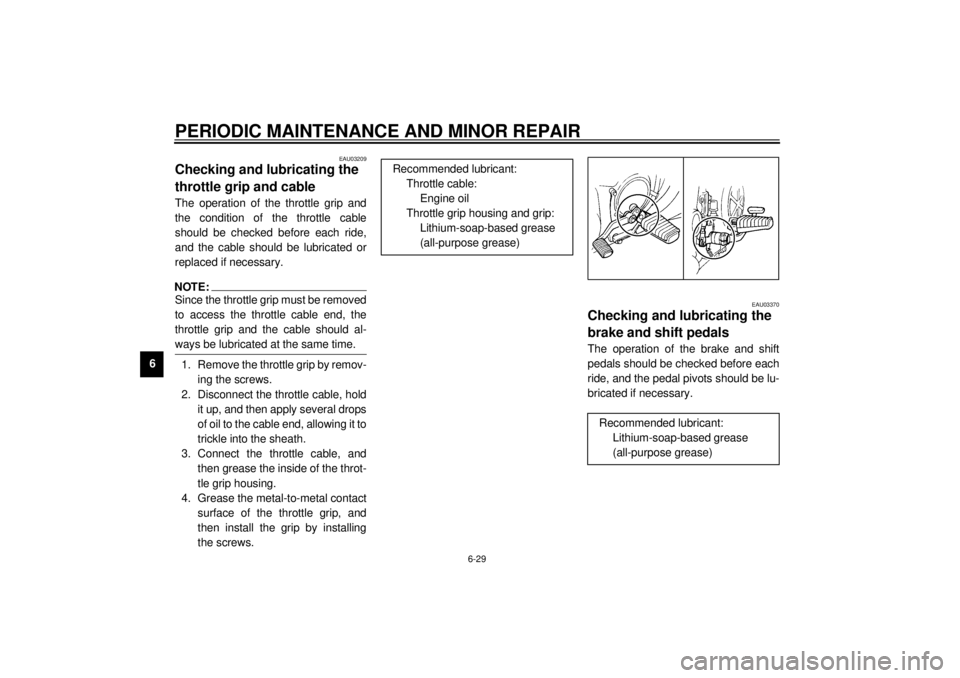
brake and shift pedals The operation of the brake and shift
pedals should be checked before each
ride, and the pedal pivots should be lu-
bricated if necessary. Recommended lubricant:
Throttle cable:
Engine oil
Throttle grip housing and grip:
Lithium-soap-based grease
(all-purpose grease)
Recommended lubricant:
Lithium-soap-based grease
(all-purpose grease)
E_3lr.book Page 29 Wednesday, November 22, 2000 4:10 PM
Page 74 of 110
PERIODIC MAINTENANCE AND MINOR REPAIR
6-31
6
EAU03166
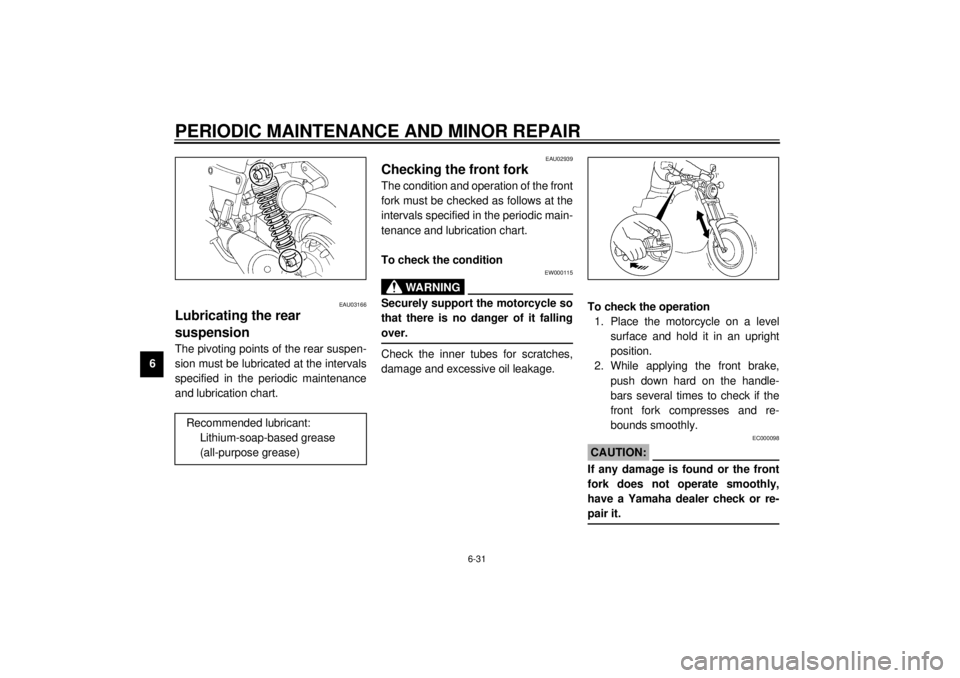
Lubricating the rear
suspension The pivoting points of the rear suspen-
sion must be lubricated at the intervals
specified in the periodic maintenance
and lubrication chart.
EAU02939
Checking the front fork The condition and operation of the front
fork must be checked as follows at the
intervals specified in the periodic main-
tenance and lubrication chart.
To check the condition
EW000115
WARNING
@ Securely support the motorcycle so
that there is no danger of it falling
over. @Check the inner tubes for scratches,
damage and excessive oil leakage.To check the operation
1. Place the motorcycle on a level
surface and hold it in an upright
position.
2. While applying the front brake,
push down hard on the handle-
bars several times to check if the
front fork compresses and re-
bounds smoothly.
EC000098
CAUTION:@ If any damage is found or the front
fork does not operate smoothly,
have a Yamaha dealer check or re-
pair it. @
Recommended lubricant:
Lithium-soap-based grease
(all-purpose grease)
E_3lr.book Page 31 Wednesday, November 22, 2000 4:10 PM
Page 78 of 110
PERIODIC MAINTENANCE AND MINOR REPAIR
6-35
6
EW000116
WARNING
@ l
Electrolyte is poisonous and
dangerous since it contains sul-
furic acid, which causes severe
burns. Avoid any contact with
skin, eyes or clothing and al-
ways shield your eyes when
working near batteries. In case
of contact, administer the fol-
lowing FIRST AID.
• EXTERNAL: Flush with plenty
of water.
• INTERNAL: Drink large quan-
tities of water or milk and im-
mediately call a physician.
• EYES: Flush with water for
15 minutes and seek prompt
medical attention.
l
Batteries produce explosive hy-
drogen gas. Therefore, keep
sparks, flames, cigarettes, etc.,
away from the battery and pro-
vide sufficient ventilation when
charging it in an enclosed
space.
l
KEEP THIS AND ALL BATTER-
IES OUT OF THE REACH OF
CHILDREN.
@
EC000100
CAUTION:@ Use only distilled water, as tap water
contains minerals that are harmful
to the battery. @
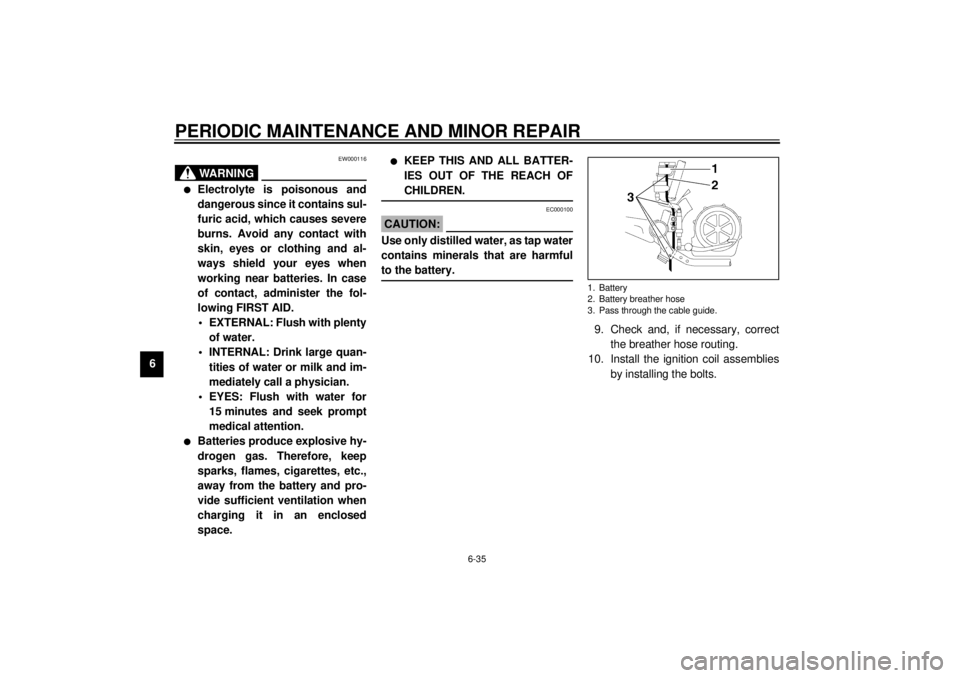
9. Check and, if necessary, correct
the breather hose routing.
10. Install the ignition coil assemblies
by installing the bolts.1. Battery
2. Battery breather hose
3. Pass through the cable guide.
E_3lr.book Page 35 Wednesday, November 22, 2000 4:10 PM
Page 79 of 110
PERIODIC MAINTENANCE AND MINOR REPAIR
6-36
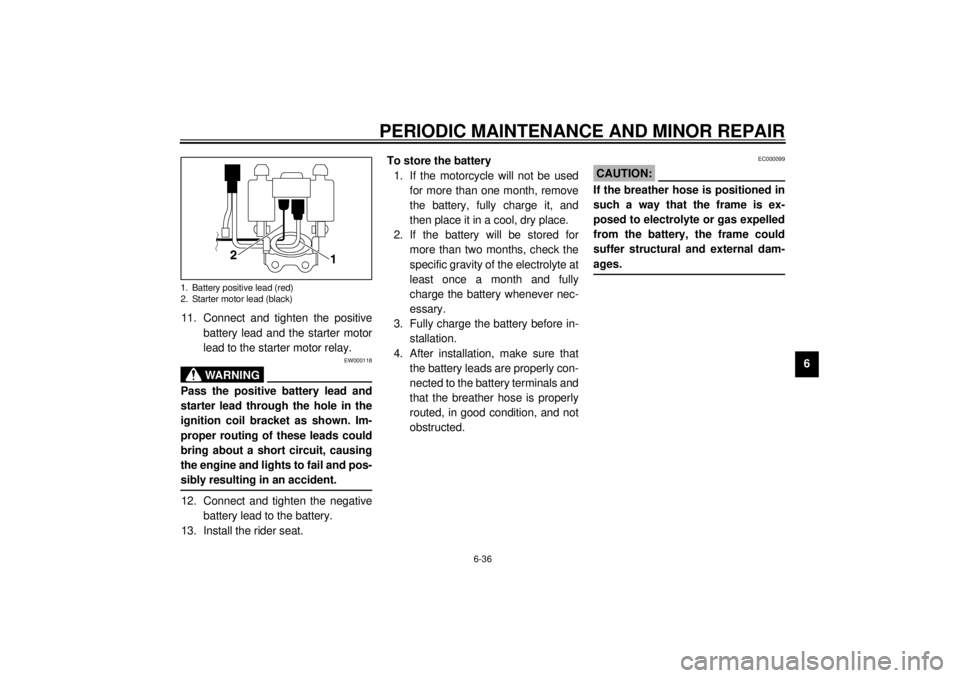
6 11. Connect and tighten the positive
battery lead and the starter motor
lead to the starter motor relay.
EW000118
WARNING
@ Pass the positive battery lead and
starter lead through the hole in the
ignition coil bracket as shown. Im-
proper routing of these leads could
bring about a short circuit, causing
the engine and lights to fail and pos-
sibly resulting in an accident. @12. Connect and tighten the negative
battery lead to the battery.
13. Install the rider seat.To store the battery
1. If the motorcycle will not be used
for more than one month, remove
the battery, fully charge it, and
then place it in a cool, dry place.
2. If the battery will be stored for
more than two months, check the
specific gravity of the electrolyte at
least once a month and fully
charge the battery whenever nec-
essary.
3. Fully charge the battery before in-
stallation.
4. After installation, make sure that
the battery leads are properly con-
nected to the battery terminals and
that the breather hose is properly
routed, in good condition, and not
obstructed.
EC000099
CAUTION:@ If the breather hose is positioned in
such a way that the frame is ex-
posed to electrolyte or gas expelled
from the battery, the frame could
suffer structural and external dam-
ages. @
1. Battery positive lead (red)
2. Starter motor lead (black)
E_3lr.book Page 36 Wednesday, November 22, 2000 4:10 PM
Page 106 of 110
10-INDEXAAir filter element, cleaning ...................... 6-19
Anti-theft alarm ........................................3-3BBattery ................................................... 6-33
Brake and clutch levers, checking and
lubricating ............................................ 6-30
Brake and shift pedals, checking and
lubricating ............................................ 6-29
Brake fluid, changing ............................. 6-28
Brake fluid level, checking...................... 6-27
Brake lever...............................................3-6
Brake lever free play, adjusting .............. 6-25
Brake light switch (rear), adjusting ......... 6-26
Brake pads, checking............................. 6-26
Brake pedal..............................................3-6
Brake pedal position, adjusting .............. 6-25CCables, checking and lubricating............ 6-28
Carburetors, adjusting............................ 6-20
Care.........................................................7-1
Centerstand and sidestand, checking
and lubricating ..................................... 6-30
Clutch lever ..............................................3-5
Clutch lever free play ............................. 6-24
Conversion table ......................................8-5
Coolant .................................................. 6-14
Changing .......................................... 6-15
Checking .......................................... 6-14
Coolant temperature gauge .....................3-3
Cowlings and panels, removing and
installing................................................ 6-6DDimmer switch ......................................... 3-4EEngine break-in ....................................... 5-4
Engine oil and oil filter cartridge ............... 6-9
Engine stop switch................................... 3-4FFinal gear oil .......................................... 6-13
Front fork, adjusting ............................... 3-11
Front fork, checking ............................... 6-31
Fuel ......................................................... 3-8
Fuel consumption, tips for reducing ......... 5-4
Fuel level warning light ............................ 3-2
Fuel reserve switch.................................. 3-5
Fuel tank cap ........................................... 3-7
Fuses, replacing .................................... 6-37HHandlebar switches ................................. 3-4
Headlight bulb, replacing ....................... 6-38
Helmet holder ........................................ 3-10
High beam indicator light ......................... 3-2
Horn switch ............................................. 3-4IIdentification numbers ............................. 9-1
Idling speed, adjusting ........................... 6-20
Ignition circuit cut-off system.................. 3-16
Indicator and warning lights ..................... 3-1
KKey identification number .........................9-1LLight switch ..............................................3-4MMain switch ..............................................3-1
Maintenance and lubrication, periodic ......6-3
Model label ..............................................9-2NNeutral indicator light ...............................3-1OOil level warning light ...............................3-2
Operation .................................................5-1PParking.....................................................5-5
Part locations ...........................................2-1
Pass switch ..............................................3-4
Pre-operation check list ............................4-1RRider seat ................................................3-9SSafety information ....................................1-1
Shifting .....................................................5-3
Shift pedal ................................................3-6
Shift points (for Switzerland only) .............5-4
Shock absorber assemblies, adjusting ...3-12
Sidestand ...............................................3-16
Spark plugs, checking ..............................6-7
Specifications ...........................................8-1
E_3lr.book Page 1 Wednesday, November 22, 2000 4:10 PM