fuel YAMAHA VX 2022 User Guide
[x] Cancel search | Manufacturer: YAMAHA, Model Year: 2022, Model line: VX, Model: YAMAHA VX 2022Pages: 122, PDF Size: 5.65 MB
Page 56 of 122
Instrument operation
47
TIP
The display units of the speedometer are
selected according to the display units of
the multifunction information center. (See
page 48 for information on switching the
display units.)
When operating the watercraft in reverse,
or when moving forward or in reverse at a
very low speed using the T.D.E., “0” will be
displayed on the speedometer.
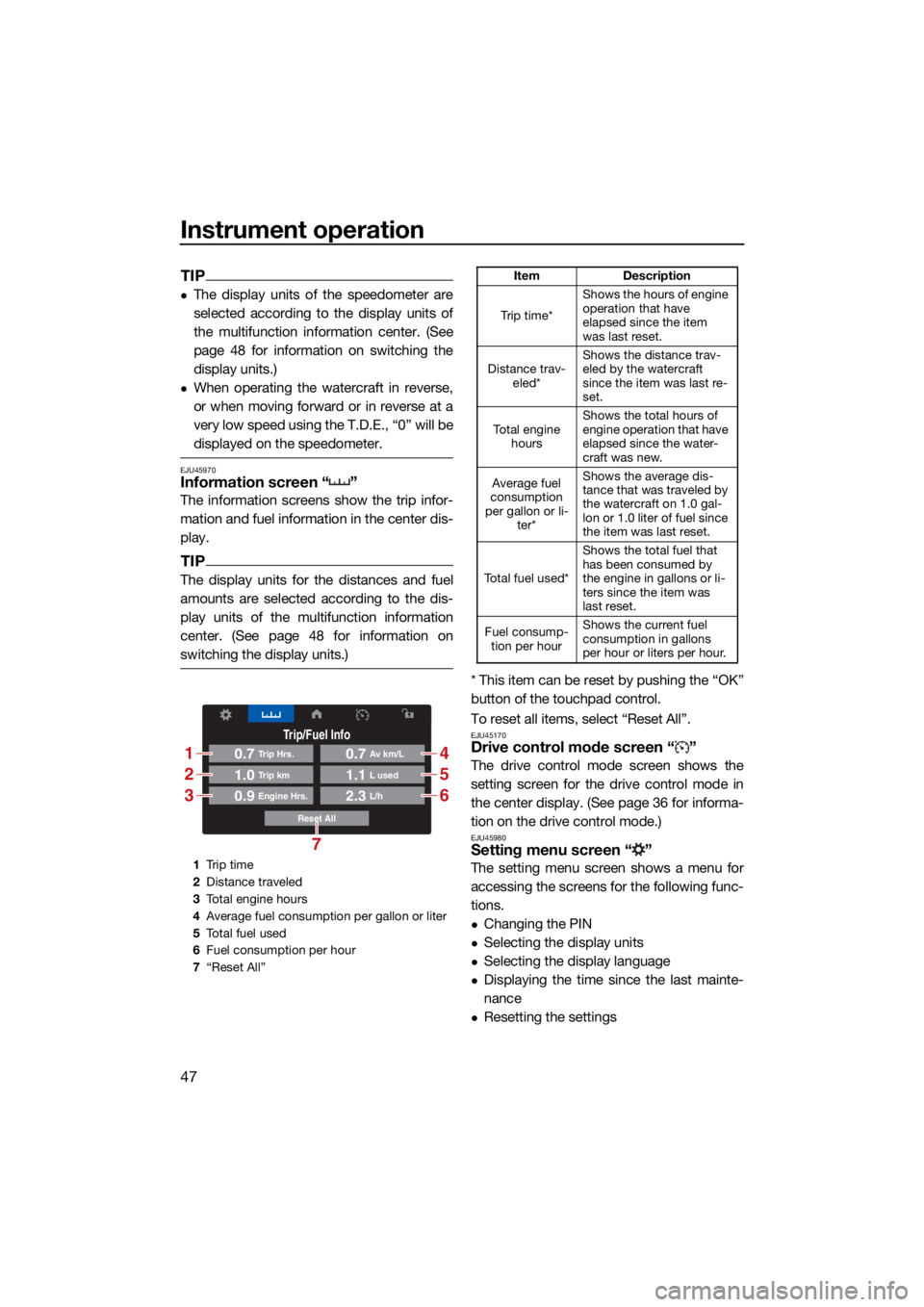
EJU45970Information screen “ ”
The information screens show the trip infor-
mation and fuel information in the center dis-
play.
TIP
The display units for the distances and fuel
amounts are selected according to the dis-
play units of the multifunction information
center. (See page 48 for information on
switching the display units.)
* This item can be reset by pushing the “OK”
button of the touchpad control.
To reset all items, select “Reset All”.
EJU45170Drive control mode screen “ ”
The drive control mode screen shows the
setting screen for the drive control mode in
the center display. (See page 36 for informa-
tion on the drive control mode.)
EJU45980Setting menu screen “ ”
The setting menu screen shows a menu for
accessing the screens for the following func-
tions.
Changing the PIN
Selecting the display units
Selecting the display language
Displaying the time since the last mainte-
nance
Resetting the settings
1Tr i p t i m e
2 Distance traveled
3 Total engine hours
4 Average fuel consumption per gallon or liter
5 To t a l f u e l u s e d
6 Fuel consumption per hour
7 “Reset All”
Trip/Fuel Info
Reset All
0.7Trip Hrs.
0.9Engine Hrs.
1.0Trip km
0.7Av km/L
2.3L/h
1.1L used
1
2
3
4
5
6
7
Item Description
Tr i p t i m e * Shows the hours of engine
operation that have
elapsed since the item
was last reset.
Distance trav- eled* Shows the distance trav-
eled by the watercraft
since the item was last re-
set.
To t a l e n g i n e hours Shows the total hours of
engine operation that have
elapsed since the water-
craft was new.
Average fuel
consumption
per gallon or li- ter* Shows the average dis-
tance that was traveled by
the watercraft on 1.0 gal-
lon or 1.0 liter of fuel since
the item was last reset.
Total fuel used* Shows the total fuel that
has been consumed by
the engine in gallons or li-
ters since the item was
last reset.
Fuel consump- tion per hour Shows the current fuel
consumption in gallons
per hour or liters per hour.
UF4N71E0.book Page 47 Thursday, August 5, 2021 11:58 AM
Page 57 of 122
Instrument operation
48
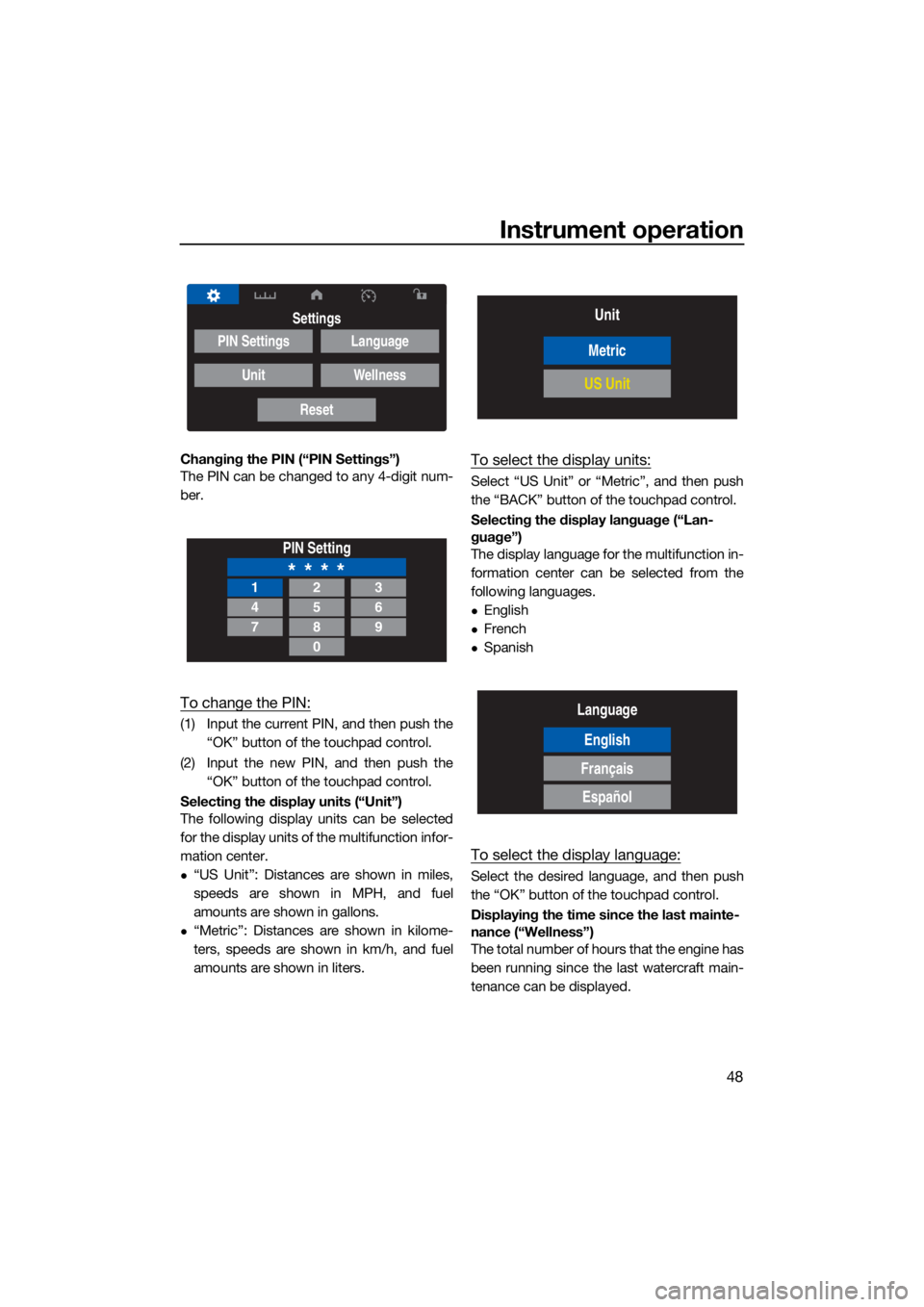
Changing the PIN (“PIN Settings”)
The PIN can be changed to any 4-digit num-
ber.
To change the PIN:
(1) Input the current PIN, and then push the“OK” button of the touchpad control.
(2) Input the new PIN, and then push the “OK” button of the touchpad control.
Selecting the display units (“Unit”)
The following display units can be selected
for the display units of the multifunction infor-
mation center.
“US Unit”: Distances are shown in miles,
speeds are shown in MPH, and fuel
amounts are shown in gallons.
“Metric”: Distances are shown in kilome-
ters, speeds are shown in km/h, and fuel
amounts are shown in liters.
To select the display units:
Select “US Unit” or “Metric”, and then push
the “BACK” button of the touchpad control.
Selecting the display language (“Lan-
guage”)
The display language for the multifunction in-
formation center can be selected from the
following languages.
English
French
Spanish
To select the display language:
Select the desired language, and then push
the “OK” button of the touchpad control.
Displaying the time since the last mainte-
nance (“Wellness”)
The total number of hours that the engine has
been running since the last watercraft main-
tenance can be displayed.
Settings
PIN Settings
Unit
Language
Wellness
Reset
PIN Setting
* * * *123
456
789
0
Unit
Metric
US Unit
Language
English
Français
Español
UF4N71E0.book Page 48 Thursday, August 5, 2021 11:58 AM
Page 58 of 122
Instrument operation
49
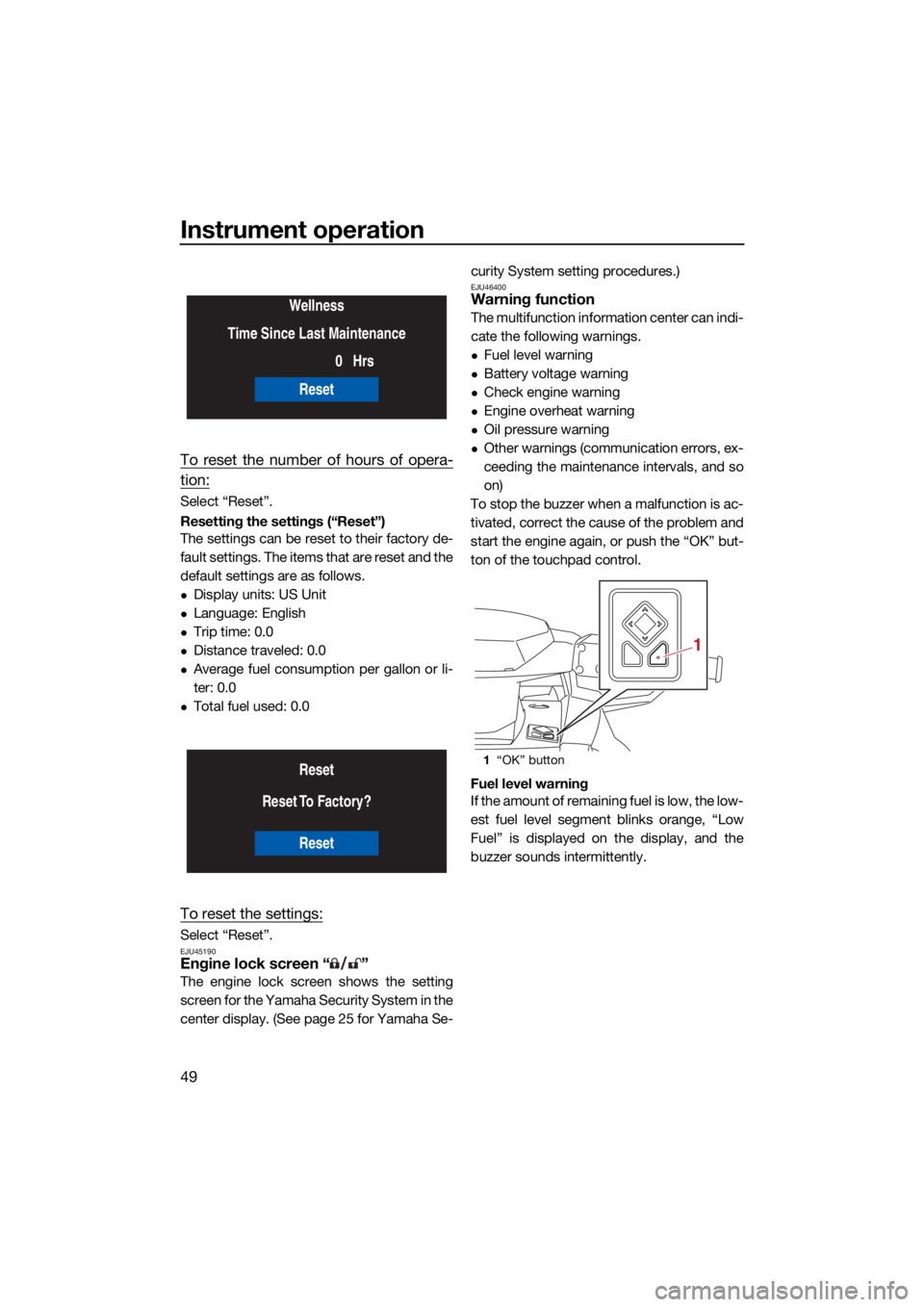
To reset the number of hours of opera-
tion:
Select “Reset”.
Resetting the settings (“Reset”)
The settings can be reset to their factory de-
fault settings. The items that are reset and the
default settings are as follows.
Display units: US Unit
Language: English
Trip time: 0.0
Distance traveled: 0.0
Average fuel consumption per gallon or li-
ter: 0.0
Total fuel used: 0.0
To reset the settings:
Select “Reset”.EJU45190Engine lock screen “ ”
The engine lock screen shows the setting
screen for the Yamaha Security System in the
center display. (See page 25 for Yamaha Se-curity System setting procedures.)
EJU46400Warning function
The multifunction information center can indi-
cate the following warnings.
Fuel level warning
Battery voltage warning
Check engine warning
Engine overheat warning
Oil pressure warning
Other warnings (communication errors, ex-
ceeding the maintenance intervals, and so
on)
To stop the buzzer when a malfunction is ac-
tivated, correct the cause of the problem and
start the engine again, or push the “OK” but-
ton of the touchpad control.
Fuel level warning
If the amount of remaining fuel is low, the low-
est fuel level segment blinks orange, “Low
Fuel” is displayed on the display, and the
buzzer sounds intermittently.
Wellness
Time Since Last Maintenance 0Hrs
Reset
Reset
Reset To Factory?
Reset
1 “OK” button
1
UF4N71E0.book Page 49 Thursday, August 5, 2021 11:58 AM
Page 59 of 122
Instrument operation
50
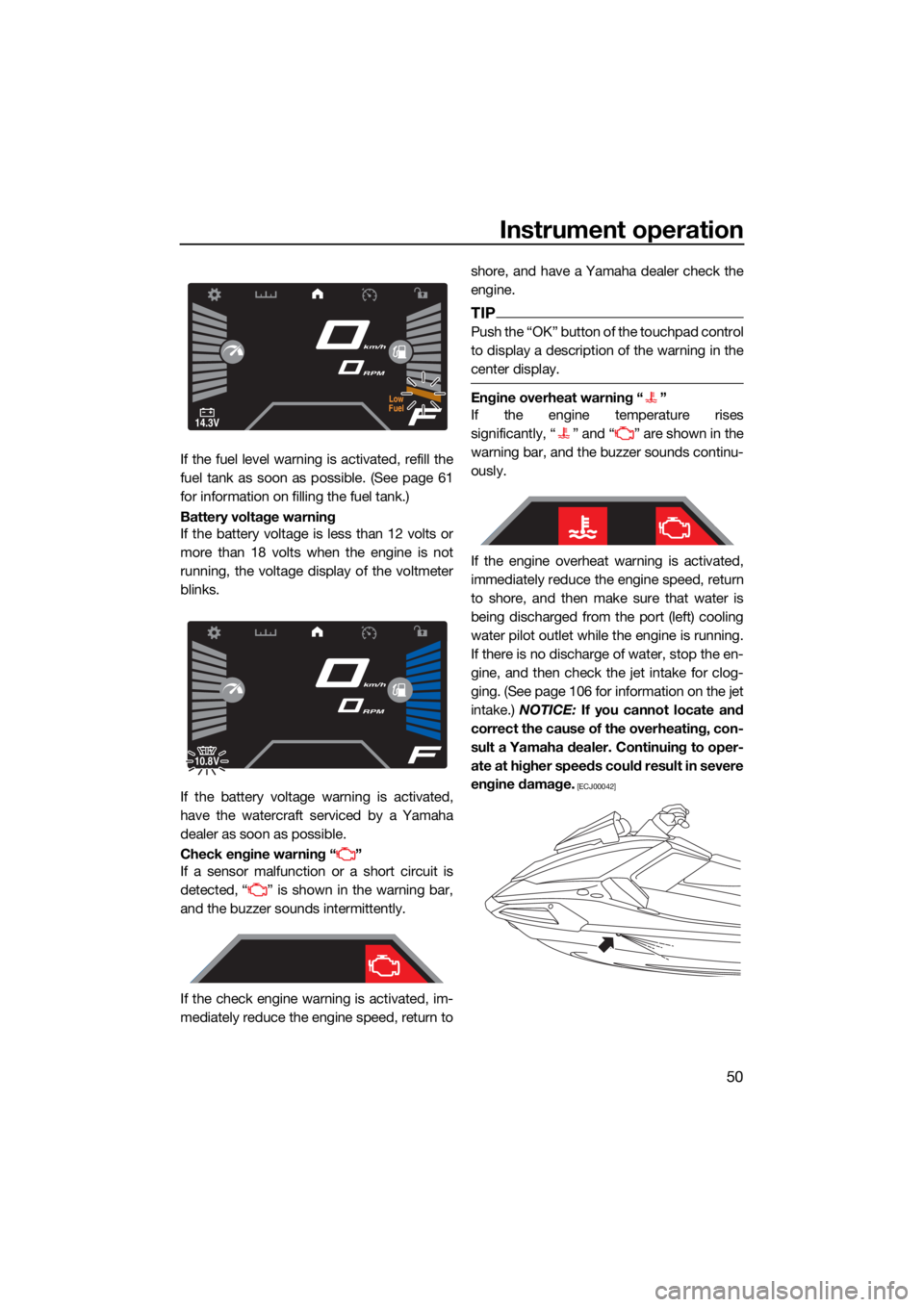
If the fuel level warning is activated, refill the
fuel tank as soon as possible. (See page 61
for information on filling the fuel tank.)
Battery voltage warning
If the battery voltage is less than 12 volts or
more than 18 volts when the engine is not
running, the voltage display of the voltmeter
blinks.
If the battery voltage warning is activated,
have the watercraft serviced by a Yamaha
dealer as soon as possible.
Check engine warning “ ”
If a sensor malfunction or a short circuit is
detected, “ ” is shown in the warning bar,
and the buzzer sounds intermittently.
If the check engine warning is activated, im-
mediately reduce the engine speed, return toshore, and have a Yamaha dealer check the
engine.
TIP
Push the “OK” button of the touchpad control
to display a description of the warning in the
center display.
Engine overheat warning “ ”
If the engine temperature rises
significantly, “ ” and “ ” are shown in the
warning bar, and the buzzer sounds continu-
ously.
If the engine overheat warning is activated,
immediately reduce the engine speed, return
to shore, and then make sure that water is
being discharged from the port (left) cooling
water pilot outlet while the engine is running.
If there is no discharge of water, stop the en-
gine, and then check the jet intake for clog-
ging. (See page 106 for information on the jet
intake.)
NOTICE: If you cannot locate and
correct the cause of the overheating, con-
sult a Yamaha dealer. Continuing to oper-
ate at higher speeds could result in severe
engine damage.
[ECJ00042]
14.3V
km/h
RPM
Low
Fuel
10.8V
km/h
RPM
UF4N71E0.book Page 50 Thursday, August 5, 2021 11:58 AM
Page 70 of 122
Operation and handling requirements
61
EJU31823
Fuel requirementsEJU45311FuelEWJ00283
Gasoline and gasoline vapors are ex-
tremely flammable. To avoid fires and
explosions and to reduce the risk of in-
jury when refueling, follow these in-
structions.
Gasoline is poisonous and can cause in-
jury or death. Handle gasoline with care.
Never siphon gasoline by mouth. If you
should swallow some gasoline, inhale a
lot of gasoline vapor, or get some gaso-
line in your eyes, see your doctor imme-
diately. If gasoline spills on your skin,
wash with soap and water. If gasoline
spills on your clothing, change your
clothes.
ECJ00322
Do not use leaded gasoline. Leaded
gasoline can seriously damage the en-
gine.
Avoid getting water and contaminants in
the fuel tank. Contaminated fuel can
cause poor performance and engine
damage. Use only fresh gasoline that
has been stored in clean containers.
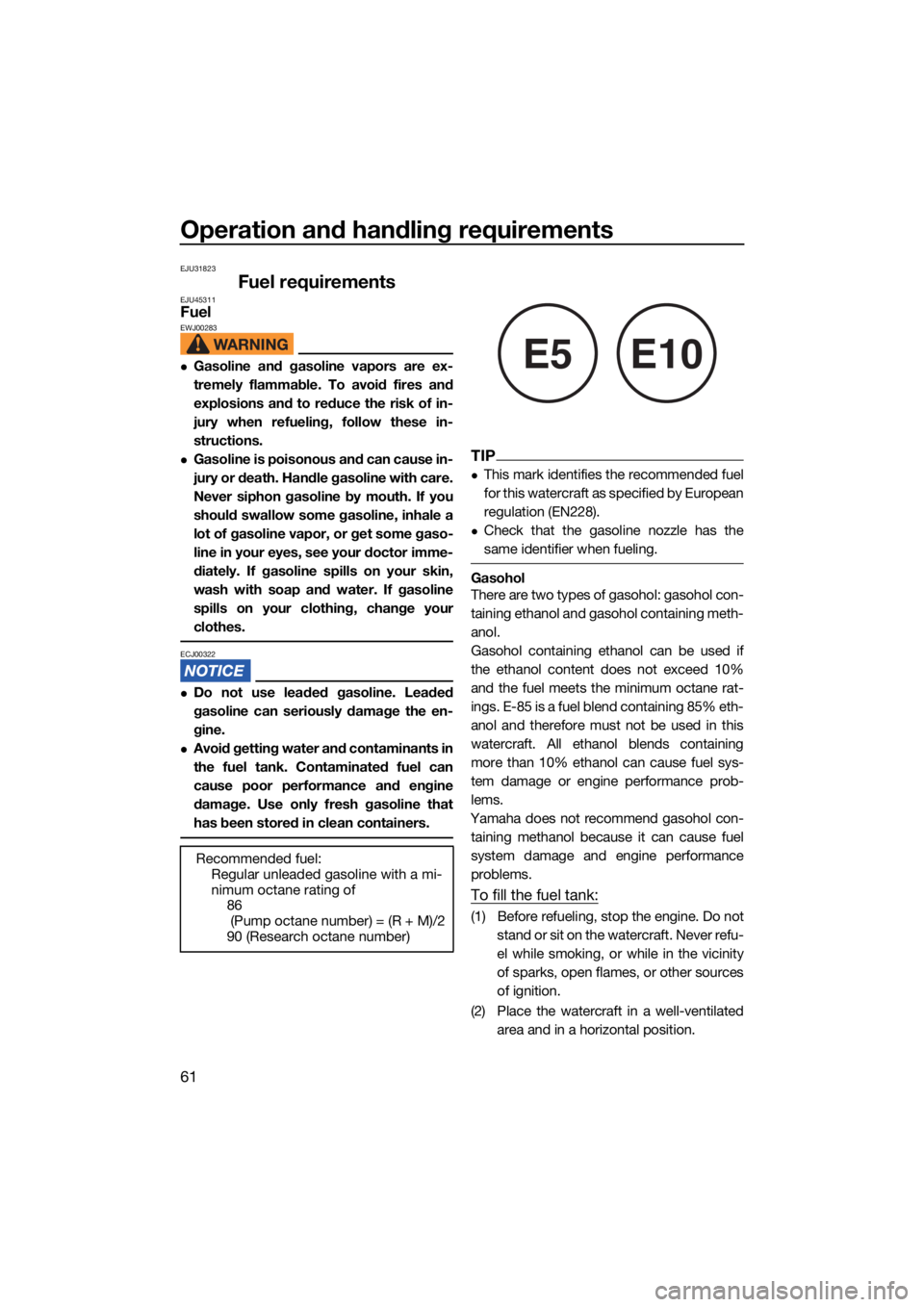
TIP
This mark identifies the recommended fuel
for this watercraft as specified by European
regulation (EN228).
Check that the gasoline nozzle has the
same identifier when fueling.
Gasohol
There are two types of gasohol: gasohol con-
taining ethanol and gasohol containing meth-
anol.
Gasohol containing ethanol can be used if
the ethanol content does not exceed 10%
and the fuel meets the minimum octane rat-
ings. E-85 is a fuel blend containing 85% eth-
anol and therefore must not be used in this
watercraft. All ethanol blends containing
more than 10% ethanol can cause fuel sys-
tem damage or engine performance prob-
lems.
Yamaha does not recommend gasohol con- taining methanol because it can cause fuel
system damage and engine performance
problems.
To fill the fuel tank:
(1) Before refueling, stop the engine. Do not stand or sit on the watercraft. Never refu-
el while smoking, or while in the vicinity
of sparks, open flames, or other sources
of ignition.
(2) Place the watercraft in a well-ventilated area and in a horizontal position.
Recommended fuel:
Regular unleaded gasoline with a mi-
nimum octane rating of86
(Pump octane number) = (R + M)/2
90 (Research octane number)
E5E10
UF4N71E0.book Page 61 Thursday, August 5, 2021 11:58 AM
Page 71 of 122
Operation and handling requirements
62
(3) Remove the seats, and then check thefuel level. (See page 54 for seat removal
and installation procedures.)
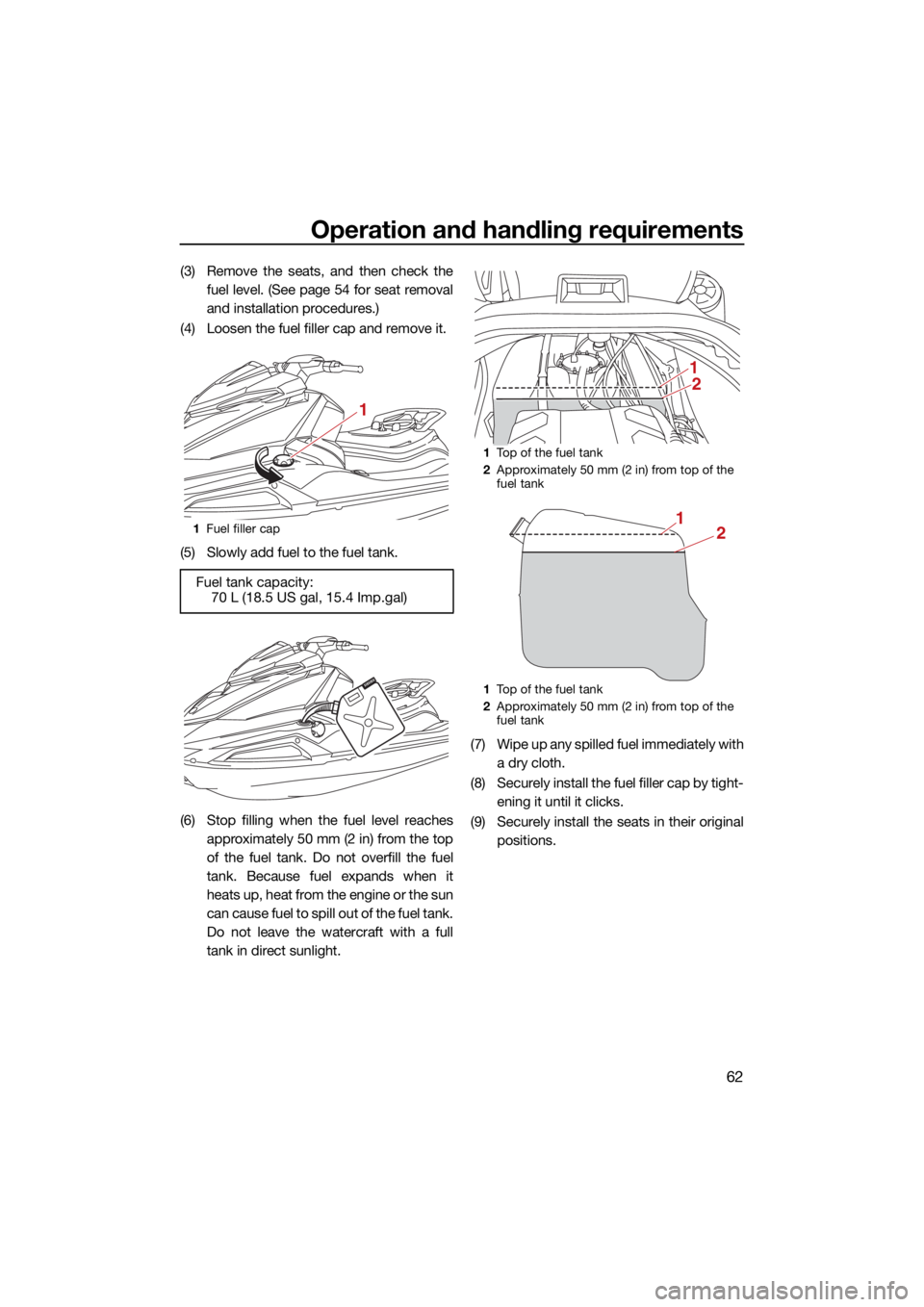
(4) Loosen the fuel filler cap and remove it.
(5) Slowly add fuel to the fuel tank.
(6) Stop filling when the fuel level reaches approximately 50 mm (2 in) from the top
of the fuel tank. Do not overfill the fuel
tank. Because fuel expands when it
heats up, heat from the engine or the sun
can cause fuel to spill out of the fuel tank.
Do not leave the watercraft with a full
tank in direct sunlight. (7) Wipe up any spilled fuel immediately with
a dry cloth.
(8) Securely install the fuel filler cap by tight- ening it until it clicks.
(9) Securely install the seats in their original positions.
1Fuel filler cap
Fuel tank capacity:
70 L (18.5 US gal, 15.4 Imp.gal)
1
1Top of the fuel tank
2 Approximately 50 mm (2 in) from top of the
fuel tank
1 Top of the fuel tank
2 Approximately 50 mm (2 in) from top of the
fuel tank
1
2
21
UF4N71E0.book Page 62 Thursday, August 5, 2021 11:58 AM
Page 77 of 122

Pre-operation checks
68
EJU31984
EWJ00413
Failure to inspect or maintain the watercraft properly increases the possibility of an ac-
cident or damage to the watercraft. Do not operate the watercraft if you find any prob-
lem. If a problem cannot be corrected by the procedures provided in this manual, have
the watercraft inspected by a Yamaha dealer.
EJU41237Pre-operation checklist
Before using this watercraft, be sure to perform the checks in the following checklist.
PRE-LAUNCH CHECKS
ITEM ROUTINEPAGE
Engine compartment Ventilate the engine compartment.
Check inside the engine compartment for damage.
70
Fuel system Check the fuel system for leakage.
Check the fuel level in the fuel tank.
70
Water separator Check the water separator for water. 70
Engine unit Check the exterior of the engine unit for damage. 71
Engine oil level Check the engine oil level. 71
Bilge water Check the engine compartment for bilge water. 71
Battery Check the battery connections. 71
Steering system Check the steering system for proper operation. 71
RiDE lever (VX /
VX DELUXE /
VX CRUISER / VX LIMITED) Check the RiDE lever for proper operation.
72
Throttle lever Check the throttle lever for proper operation. 72
Yamaha Security System
(VX DELUXE /
VX CRUISER / VX LIMITED) Check the Yamaha Security System for proper op-
eration.
72
Engine shut-off cord (lan-
yard) Check the engine shut-off cord (lanyard) for dam-
age.
72
Switches VX-C:
Check the start switch, engine stop switch, and en-
gine shut-off switch for proper operation.
VX / VX DELUXE / VX CRUISER / VX LIMITED:
Check the engine start/stop switch and engine
shut-off switch for proper operation.
73
Storage compartments Check the storage compartments for damage and
water.
74
Fire extinguisher holder,
cover, and band Check the fire extinguisher holder, cover, and band
for damage.
74
Fire extinguisher Check the condition of the fire extinguisher. 74
Safety equipment Check that safety equipment meeting the applica-
ble regulations is on board.
74
UF4N71E0.book Page 68 Thursday, August 5, 2021 11:58 AM
Page 79 of 122

Pre-operation checks
70
EJU32282
Pre-operation check pointsEJU40099Pre-launch checks
Perform the pre-launch checks in the pre-op-
eration checklist while the watercraft is on
land.
To perform the pre-launch checks:
(1) Remove the seats and seat storagecompartment. (See page 54 for seat re-
moval and installation procedures and
page 59 for information on the seat stor-
age compartment.)
(2) Perform the checks and make sure that there are no malfunctioning items or oth-
er problems.
(3) After completing these checks, securely install the seat storage compartment and
seats in their original positions.
EJU32334Engine compartment checkEWJ00462
Failure to ventilate the engine compart-
ment could result in a fire or explosion. Do
not start the engine if there is a fuel leak.
Ventilate the engine compartment. Leave the
engine compartment open for a few minutes
to allow any fuel vapors to escape.
Make sure that there is no damage inside the
engine compartment.
EJU34215Fuel system checksEWJ00382
Leaking fuel can result in fire or explosion.
Check for fuel leakage regularly.
If any fuel leakage is found, the fuel sys-
tem must be repaired by a qualified me-
chanic. Improper repairs can make the
watercraft unsafe to operate.
Make sure that there is no damage, leakage,
or other problem in the fuel system.
Check:
Fuel filler cap and seal for damage
Fuel tank for damage and leakage
Fuel hoses and joints for damage and leak-
age
Fuel tank breather hose for damage and
leakage
EJU36875Fuel level check
Check the fuel level in the fuel tank.
Add fuel if necessary. (See page 61 for infor-
mation on filling the fuel tank.)
EJU32424Water separator check
Make sure that no water has collected in the
water separator. If water has collected in the
water separator, drain it. (See page 29 for in-
formation on draining the water separator.)
1Water separator
1
UF4N71E0.book Page 70 Thursday, August 5, 2021 11:58 AM
Page 100 of 122
Care and storage
91
EJU37148
Post-operation careEWJ00332
Always place the watercraft upright in a
horizontal position when storing it, other-
wise fuel could leak out into the engine or
engine compartment, which could create
a fire hazard.
After using the watercraft, always take it out
of the water, clean it, and store it. Leaving the
watercraft in the water for extended periods
will accelerate the rate of normal deteriora-
tion of the jet pump and hull. Marine organ-
isms and corrosion are some of the
conditions that can shorten the life of many
watercraft components.
EJU46370Flushing the cooling water passagesECJ01311
Do not run the engine over 4000 r/min on
land. Also, do not run the engine for more
than 15 seconds without supplying water,
otherwise the engine could overheat.
Flush the cooling water passages to prevent
them from clogging with salt, sand, or dirt.
(1) Place the watercraft in a horizontal posi-tion.
(2) Remove the seats. (See page 54 for seat removal and installation procedures.)
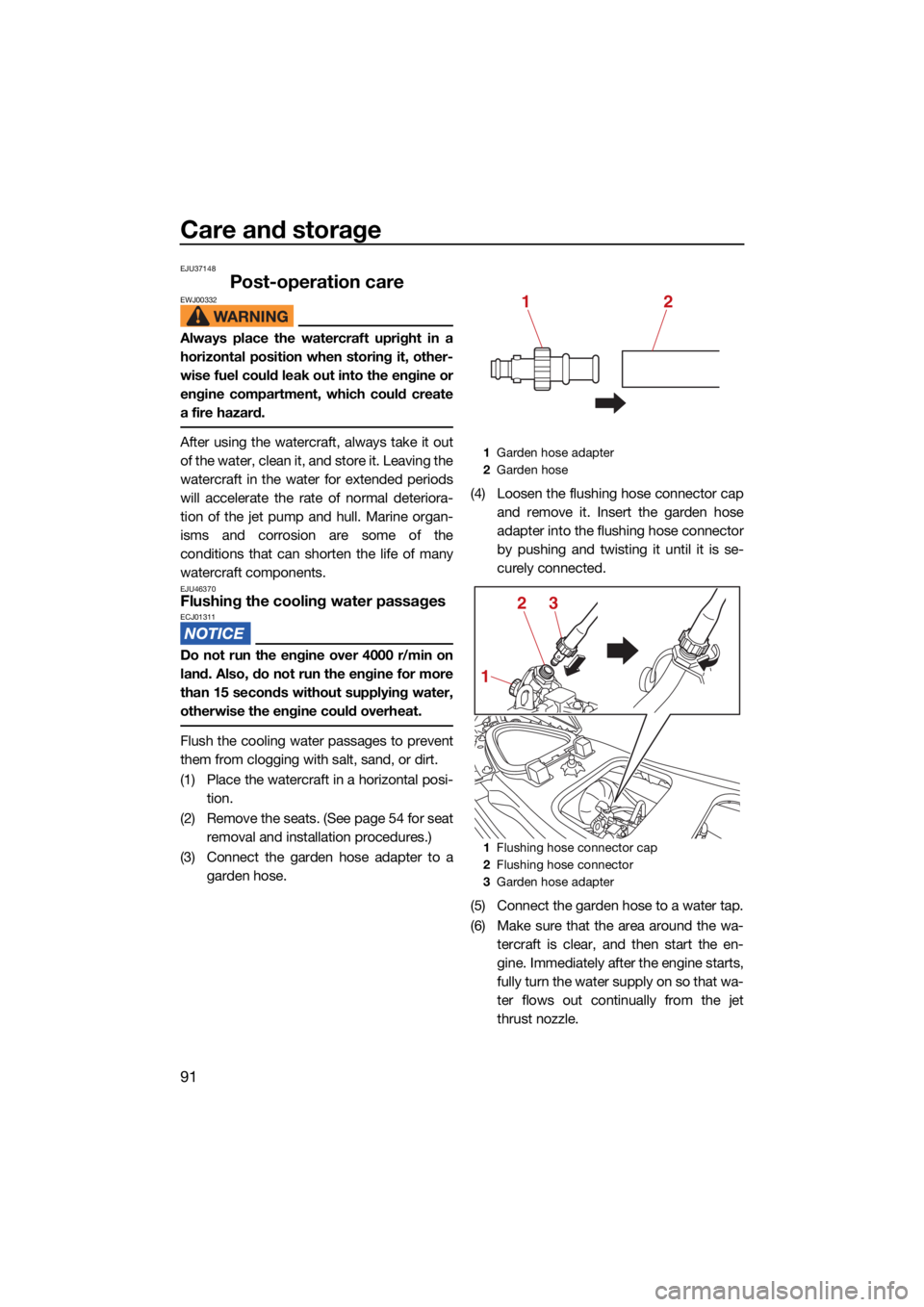
(3) Connect the garden hose adapter to a garden hose. (4) Loosen the flushing hose connector cap
and remove it. Insert the garden hose
adapter into the flushing hose connector
by pushing and twisting it until it is se-
curely connected.
(5) Connect the garden hose to a water tap.
(6) Make sure that the area around the wa- tercraft is clear, and then start the en-
gine. Immediately after the engine starts,
fully turn the water supply on so that wa-
ter flows out continually from the jet
thrust nozzle.
1Garden hose adapter
2 Garden hose
1 Flushing hose connector cap
2 Flushing hose connector
3 Garden hose adapter
12
32
1
UF4N71E0.book Page 91 Thursday, August 5, 2021 11:58 AM
Page 103 of 122
Care and storage
94
(4) Store the battery in a cool, dry place.NOTICE: Storing the battery in an un-
charged condition can cause perma-
nent battery damage. Check the
battery periodically.
[ECJ00103]
To install the battery:
(1) Place the battery in the battery compart- ment and hook the battery bands onto
the holders.
(2) Connect the positive (+) battery lead (red) to the positive (+) battery terminal.
NOTICE: Reversal of the battery leads
will damage the electrical parts.
[ECJ00262]
(3) Connect the negative (–) battery lead (black) to the negative (–) battery termi-
nal.
(4) Make sure that the battery is securely held in place.
EJU33495
Long-term storageEWJ00332
Always place the watercraft upright in a
horizontal position when storing it, other-
wise fuel could leak out into the engine or
engine compartment, which could create
a fire hazard.
Storage for long periods of time, such as win-
ter storage, requires preventive maintenance
to ensure against deterioration. It is advisable
to have the watercraft serviced by a Yamaha
dealer prior to storage.
However, the following procedures can be
performed easily by the owner.
EJU40763Cleaning
(1) Flush the cooling water passages. (Seepage 91 for information on flushing the
cooling water passages.)
TIP
If you will be storing the watercraft for a pro-
longed period, such as winter storage, top off
the fuel tank with fresh gasoline and add fuel
stabilizer and conditioner to the fuel tank ac-
cording to the manufacturer’s instruction be-
fore starting the engine.
(2) Clean the watercraft. (See page 92 for in-formation on cleaning the watercraft.)
Wax the hull with a non-abrasive wax.
EJU43663Lubrication
To keep moving parts sliding or rotating
smoothly, lubricate them with water-resistant
grease.
Steering cable (jet thrust nozzle end)
Recommended water-resistant grease:
YAMALUBE MARINE
GREASE/Yamaha Grease A
Recommended water-resistant grease:
YAMALUBE MARINE GREASE /
Ya m a h a G r e a s e A
UF4N71E0.book Page 94 Thursday, August 5, 2021 11:58 AM