display YAMAHA VX LIMITED 2017 User Guide
[x] Cancel search | Manufacturer: YAMAHA, Model Year: 2017, Model line: VX LIMITED, Model: YAMAHA VX LIMITED 2017Pages: 106, PDF Size: 3.53 MB
Page 45 of 106
Instrument operation
39
TIP:
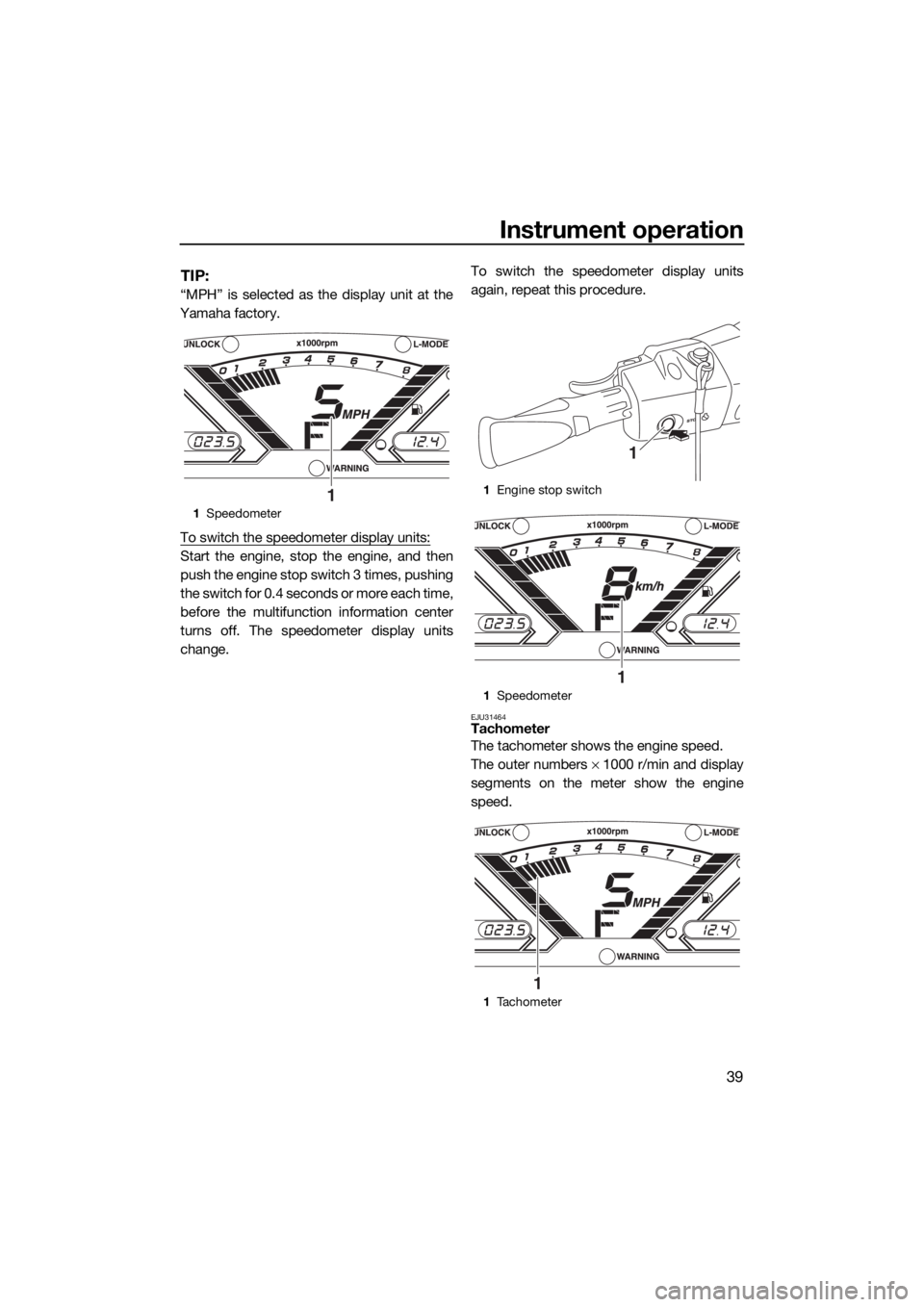
“MPH” is selected as the display unit at the
Yamaha factory.
To switch the speedometer display units:
Start the engine, stop the engine, and then
push the engine stop switch 3 times, pushing
the switch for 0.4 seconds or more each time,
before the multifunction information center
turns off. The speedometer display units
change.To switch the speedometer display units
again, repeat this procedure.
EJU31464Tachometer
The tachometer shows the engine speed.
The outer numbers × 1000 r/min and display
segments on the meter show the engine
speed.
1Speedometer
11Engine stop switch
1Speedometer
1Tachometer
1
1
1
UF4G71E0.book Page 39 Wednesday, July 27, 2016 9:32 AM
Page 46 of 106
Instrument operation
40
EJU43890Shift indicator
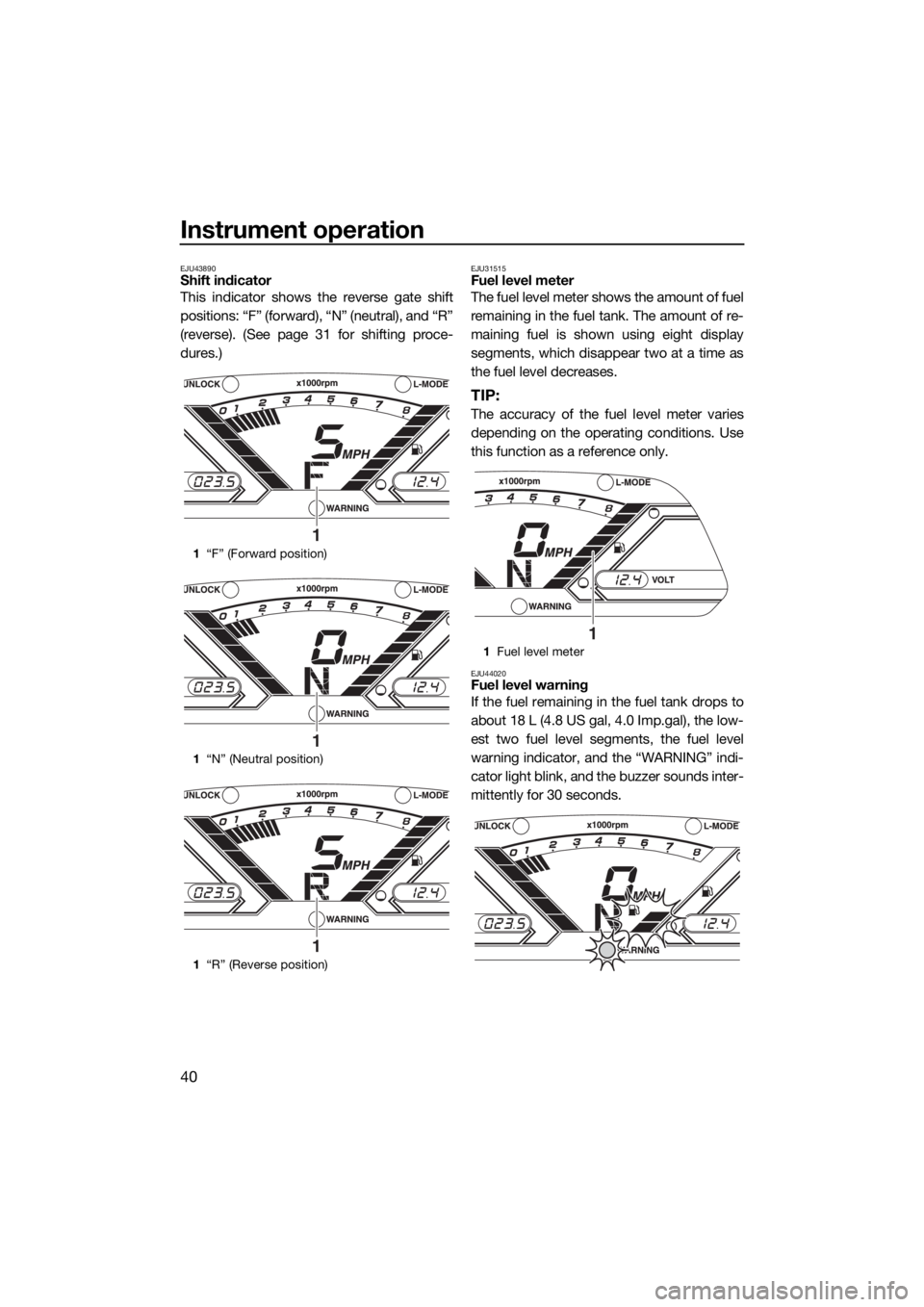
This indicator shows the reverse gate shift
positions: “F” (forward), “N” (neutral), and “R”
(reverse). (See page 31 for shifting proce-
dures.)EJU31515Fuel level meter
The fuel level meter shows the amount of fuel
remaining in the fuel tank. The amount of re-
maining fuel is shown using eight display
segments, which disappear two at a time as
the fuel level decreases.
TIP:
The accuracy of the fuel level meter varies
depending on the operating conditions. Use
this function as a reference only.
EJU44020Fuel level warning
If the fuel remaining in the fuel tank drops to
about 18 L (4.8 US gal, 4.0 Imp.gal), the low-
est two fuel level segments, the fuel level
warning indicator, and the “WARNING” indi-
cator light blink, and the buzzer sounds inter-
mittently for 30 seconds.
1“F” (Forward position)
1“N” (Neutral position)
1“R” (Reverse position)
1
1
1
1Fuel level meter
1
UF4G71E0.book Page 40 Wednesday, July 27, 2016 9:32 AM
Page 48 of 106

Instrument operation
42
If the engine is stopped after the check en-
gine warning is activated, the information dis-
play will indicate an error code.
If the check engine warning is activated, im-
mediately reduce the engine speed, return to
shore, and have a Yamaha dealer check the
engine.
EJU43740Hour meter
The hour meter shows the total number of
hours that the engine has been running since
the watercraft was new.
TIP:
The elapsed time will be kept even if the bat-
tery terminals have been disconnected.
EJU43751Voltmeter
The voltmeter shows the battery voltage.
When the battery voltage is normal, the volt-
meter displays approximately 12 volts.If the battery voltage has dropped significant-
ly, “Lo” is displayed on the voltmeter, and the
information display, hour meter, and indicator
lights turn off. If the battery voltage has risen
significantly, “HI” is displayed. If “Lo” or “HI”
is displayed, immediately return to shore and
have a Yamaha dealer service the watercraft.
1Hour meter
1
1Vo l t m et e r
1
UF4G71E0.book Page 42 Wednesday, July 27, 2016 9:32 AM
Page 71 of 106
Pre-operation checks
65
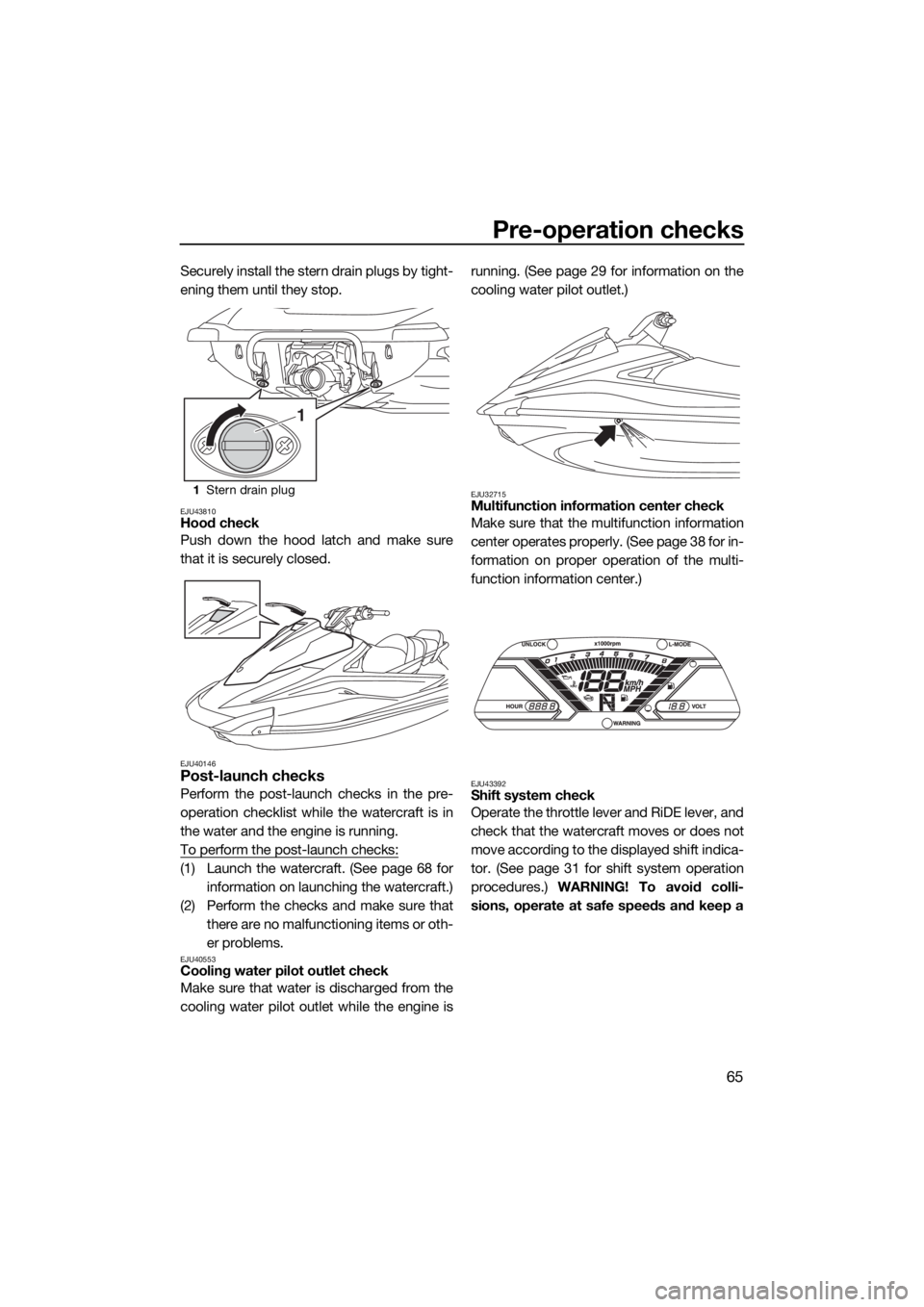
Securely install the stern drain plugs by tight-
ening them until they stop.
EJU43810Hood check
Push down the hood latch and make sure
that it is securely closed.
EJU40146Post-launch checks
Perform the post-launch checks in the pre-
operation checklist while the watercraft is in
the water and the engine is running.
To perform the post-launch checks:
(1) Launch the watercraft. (See page 68 for
information on launching the watercraft.)
(2) Perform the checks and make sure that
there are no malfunctioning items or oth-
er problems.
EJU40553Cooling water pilot outlet check
Make sure that water is discharged from the
cooling water pilot outlet while the engine isrunning. (See page 29 for information on the
cooling water pilot outlet.)
EJU32715Multifunction information center check
Make sure that the multifunction information
center operates properly. (See page 38 for in-
formation on proper operation of the multi-
function information center.)
EJU43392Shift system check
Operate the throttle lever and RiDE lever, and
check that the watercraft moves or does not
move according to the displayed shift indica-
tor. (See page 31 for shift system operation
procedures.) WARNING! To avoid colli-
sions, operate at safe speeds and keep a
1Stern drain plug
1
UF4G71E0.book Page 65 Wednesday, July 27, 2016 9:32 AM
Page 75 of 106

Operation
69
that the engine shut-off cord (lanyard)
is attached correctly. If the engine
shut-off cord (lanyard) is not attached
correctly, it may not pull free when the
operator falls off, allowing the water-
craft to continue to run and cause an
accident.
[EWJ00582]
(4) With the throttle lever released, push the
start switch (green button) to start the
engine. (See page 27 for information on
operating the start switch.)
EJU32863Stopping the engine
Release the throttle lever, and then push the
engine stop switch (red button) to stop the
engine. WARNING! You need throttle to
steer. Shutting the engine off can cause
you to hit an obstacle you are attemptingto avoid. A collision could result in severe
injury or death.
[EWJ00602]
EJU32873
Leaving the watercraft
If leaving the watercraft, remove the clip from
the engine shut-off switch to prevent acci-
dental starting or unauthorized operation by
children or others.
EJU43410Operating the watercraft
When the throttle lever is squeezed, the “F”
(forward) shift indicator will be displayed in
the multifunction display and the watercraft
will move forward. While the “F” (forward)
shift indicator is displayed, the watercraft will
move forward at trolling speed even if the
throttle lever is in the fully closed (idle) posi-
1Clip
2Engine shut-off switch
3Engine shut-off cord (lanyard)
12
3
UF4G71E0.book Page 69 Wednesday, July 27, 2016 9:32 AM
Page 78 of 106

Operation
72
proximately 100 m (330 ft) after the throttle le-
ver is released or the engine is stopped,
although this distance will vary depending on
many factors, including gross weight, water
surface conditions, and wind direction.
If the RiDE lever is squeezed to slow down,
the stopping distance is approximately 30%
shorter than when the RiDE lever is not used.
However, this distance will vary depending
on many factors, including gross weight, wa-
ter surface conditions, and wind direction.
WARNING
EWJ01791
Allow adequate stopping distance.
Take early action to avoid collisions. Re-
member, watercraft and other boats do
not have brakes.
Operate defensively at safe speeds and
keep a safe distance away from people,
objects, and other watercraft to give you
time to stop.
Do not shut the engine off when slowing
down in case you need engine power to
steer away from a boat or other obstacle
that comes into your path.
To avoid rear-end collisions while oper-
ating the watercraft, check behind you
before using the RiDE lever to slow
down or stop the watercraft.
EJU43442Operating the watercraft in reverse or
neutral
Operating in reverse
When the RiDE lever is squeezed, the “R” (re-
verse) shift indicator will be displayed in the
multifunction display and the watercraft will
move in reverse. (See page 31 for shift sys-
tem operation procedures.)
Make sure that there are no obstacles or peo-
ple behind you before shifting into reverse.
TIP:
This model is equipped with a function which
limits the engine speed in reverse.
Operating in neutral
When the RiDE lever is squeezed lightly and
released, the “N” (neutral) shift indicator will
be displayed in the multifunction display and
the watercraft will stop in its current location.
1“R” (Reverse position)
1
UF4G71E0.book Page 72 Wednesday, July 27, 2016 9:32 AM
Page 103 of 106

97
Index
A
After removing the watercraft from the
water ..................................................... 78
B
Battery care.............................................. 80
Battery checks ......................................... 60
Battery, jumping ....................................... 94
Beaching and docking the watercraft ...... 77
Bilge water check..................................... 60
Bilge water, draining ................................ 54
Bilge water, draining on land ................... 54
Bilge water, draining on water ................. 54
Boarding alone ......................................... 73
Boarding and starting off from a dock ..... 76
Boarding the watercraft ........................... 73
Boarding with passenger(s) ..................... 74
Bow eye ................................................... 45
Bow storage compartment ...................... 46
Builder’s plate ............................................ 2
C
Capsized watercraft ................................. 76
Check engine warning ............................. 41
Cleaning ................................................... 83
Cleaning the watercraft ............................ 80
Cleat ......................................................... 45
Cooling water pilot outlet ......................... 29
Cooling water pilot outlet check .............. 65
Craft Identification Number (CIN)............... 1
Cruise assist
(VX Deluxe / VX Cruiser / VX Limited) ... 36
Cruising limitations................................... 11
E
Emergency procedures ............................ 93
Engine break-in ........................................ 56
Engine compartment check ..................... 59
Engine idling speed check ....................... 66
Engine oil ................................................. 52
Engine oil and oil filter .............................. 88
Engine oil level check............................... 60
Engine oil requirements ........................... 52
Engine overheat warning ......................... 41
Engine serial number ................................. 1
Engine shut-off cord (lanyard) check ....... 62
Engine shut-off switch ............................. 27
Engine stop switch................................... 27Engine unit check ..................................... 60
Enjoy your watercraft responsibly ............ 19
Equipment ................................................ 43
F
Fire extinguisher check ............................ 64
Fire extinguisher holder and cover........... 48
Fire extinguisher holder, cover, and
band checks ......................................... 63
Flushing the cooling water passages....... 79
Fuel .......................................................... 50
Fuel level check........................................ 59
Fuel level meter ........................................ 40
Fuel level warning..................................... 40
Fuel requirements .................................... 50
Fuel system checks ................................. 59
G
Getting to know your watercraft .............. 67
Glossary, watercraft ................................. 20
Glove compartment ................................. 47
H
Handgrip .................................................. 44
Hazard information................................... 15
Hood check .............................................. 65
Hour meter ............................................... 42
Hull and deck check ................................ 64
I
Identification numbers ............................... 1
Information display................................... 38
J
Jet intake and impeller, cleaning.............. 93
Jet intake checks ..................................... 64
Jet thrust nozzle and reverse gate
check .................................................... 64
Jumper cables, connecting ...................... 94
L
Labels, important ....................................... 4
Labels, other .............................................. 8
Labels, warning .......................................... 5
Launching the watercraft ......................... 68
Learning to operate your watercraft......... 67
Leaving the watercraft.............................. 69
Limitations on who may operate the
watercraft .............................................. 10
Long-term storage ................................... 83
UF4G71E0.book Page 97 Wednesday, July 27, 2016 9:32 AM