oil YAMAHA VX SPORT 2014 User Guide
[x] Cancel search | Manufacturer: YAMAHA, Model Year: 2014, Model line: VX SPORT, Model: YAMAHA VX SPORT 2014Pages: 98, PDF Size: 4.01 MB
Page 56 of 98
Pre-operation checks
50
EJU31982
WARNING
EWJ00412
Failure to inspect or maintain the watercraft properly increases the possibility of an ac-
cident or damage to the watercraft. Do not operate the watercraft if you find any prob-
lem. If a problem cannot be corrected by the procedures provided in this manual, have
the watercraft inspected by a Yamaha dealer.
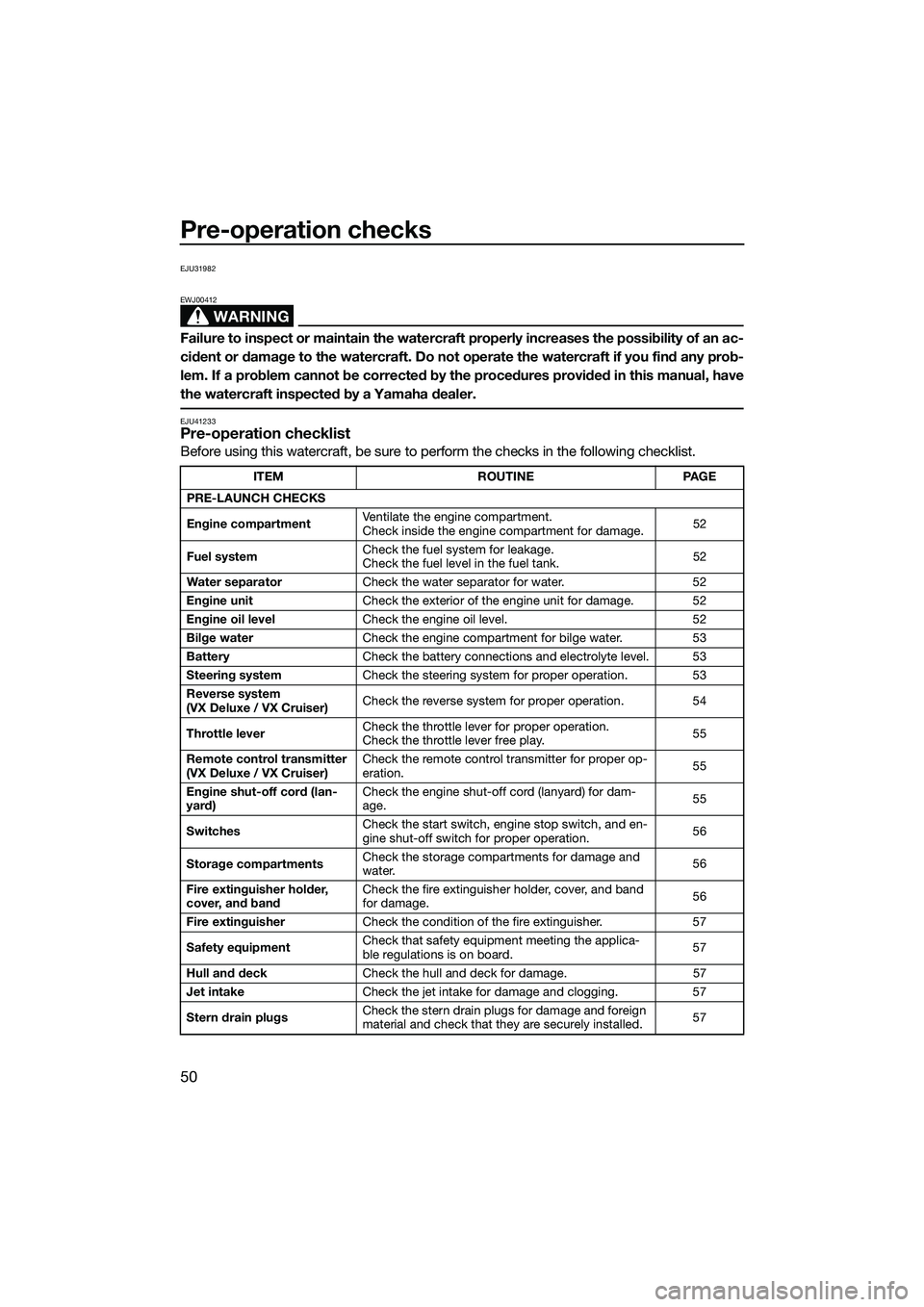
EJU41233Pre-operation checklist
Before using this watercraft, be sure to perform the checks in the following checklist.
ITEMROUTINEPAGE
PRE-LAUNCH CHECKS
Engine compartment Ventilate the engine compartment.
Check inside the engine compartment for damage.
52
Fuel system Check the fuel system for leakage.
Check the fuel level in the fuel tank.
52
Water separator Check the water separator for water. 52
Engine unit Check the exterior of the engine unit for damage. 52
Engine oil level Check the engine oil level. 52
Bilge water Check the engine compartment for bilge water. 53
Battery Check the battery connections and electrolyte level. 53
Steering system Check the steering system for proper operation. 53
Reverse system
(VX Deluxe / VX Cruiser) Check the reverse system for proper operation.
54
Throttle lever Check the throttle lever for proper operation.
Check the throttle lever free play.
55
Remote control transmitter
(VX Deluxe / VX Cruiser) Check the remote control transmitter for proper op-
eration.
55
Engine shut-off cord (lan-
yard) Check the engine shut-off cord (lanyard) for dam-
age.
55
Switches Check the start switch, engine stop switch, and en-
gine shut-off switch for proper operation.
56
Storage compartments Check the storage compartments for damage and
water.
56
Fire extinguisher holder,
cover, and band Check the fire extinguisher holder, cover, and band
for damage.
56
Fire extinguisher Check the condition of the fire extinguisher. 57
Safety equipment Check that safety equipment meeting the applica-
ble regulations is on board.
57
Hull and deck Check the hull and deck for damage. 57
Jet intake Check the jet intake for damage and clogging. 57
Stern drain plugs Check the stern drain plugs for damage and foreign
material and check that they are securely installed.
57
UF2P71E0.book Page 50 Wednesday, July 10, 2013 5:37 PM
Page 58 of 98
Pre-operation checks
52
EJU32282
Pre-operation check pointsEJU40546Pre-launch checks
Perform the pre-launch checks in the pre-op-
eration checklist while the watercraft is on
land.
To perform the pre-launch checks:
(1) Remove the seat. (See page 38 for seatremoval and installation procedures.)
(2) Perform the checks and make sure that there are no malfunctioning items or oth-
er problems.
(3) After completing these checks, securely install the seat in its original position.
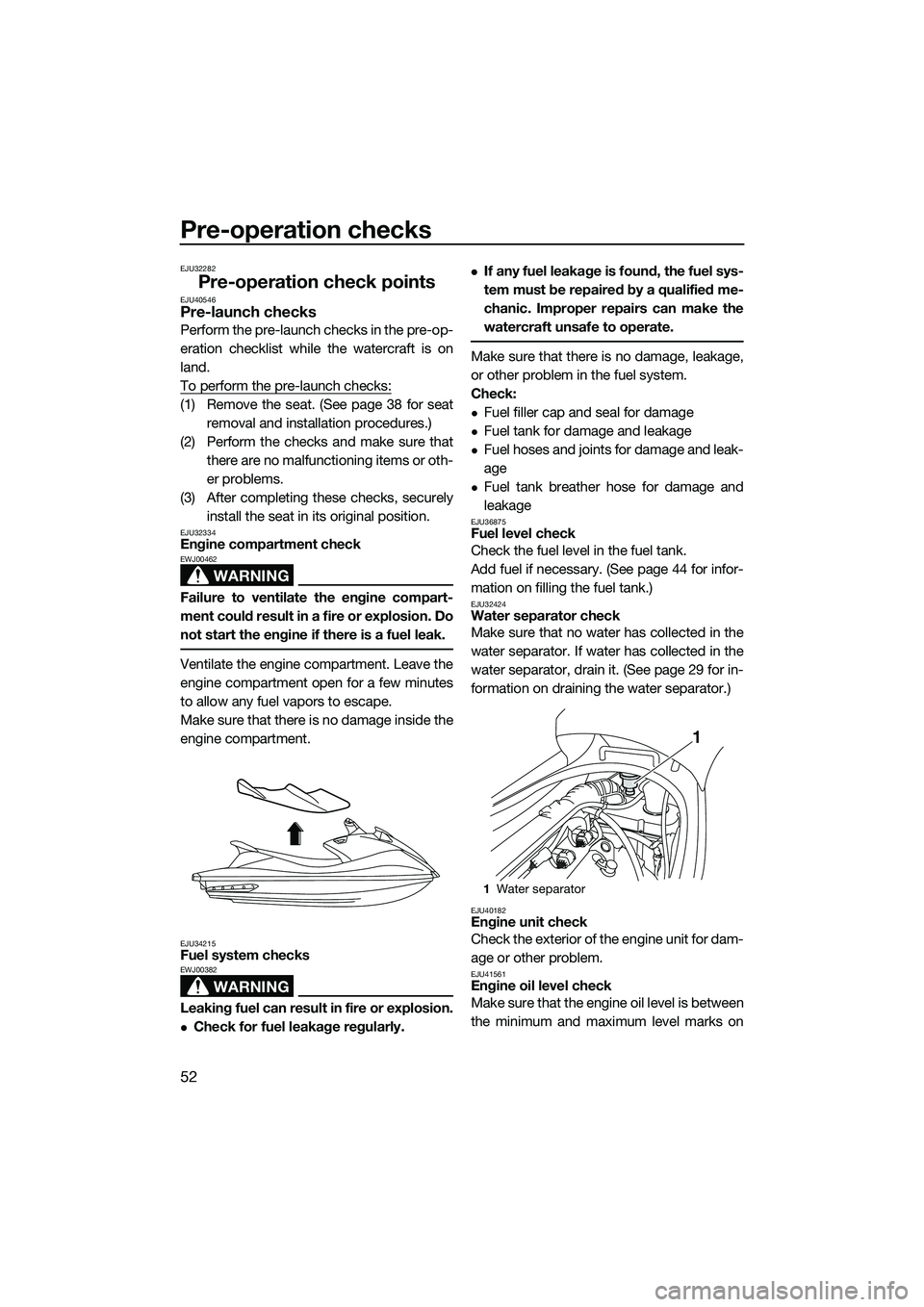
EJU32334Engine compartment check
WARNING
EWJ00462
Failure to ventilate the engine compart-
ment could result in a fire or explosion. Do
not start the engine if there is a fuel leak.
Ventilate the engine compartment. Leave the
engine compartment open for a few minutes
to allow any fuel vapors to escape.
Make sure that there is no damage inside the
engine compartment.
EJU34215Fuel system checks
WARNING
EWJ00382
Leaking fuel can result in fire or explosion.
Check for fuel leakage regularly.
If any fuel leakage is found, the fuel sys-
tem must be repaired by a qualified me-
chanic. Improper repairs can make the
watercraft unsafe to operate.
Make sure that there is no damage, leakage,
or other problem in the fuel system.
Check:
Fuel filler cap and seal for damage
Fuel tank for damage and leakage
Fuel hoses and joints for damage and leak-
age
Fuel tank breather hose for damage and
leakage
EJU36875Fuel level check
Check the fuel level in the fuel tank.
Add fuel if necessary. (See page 44 for infor-
mation on filling the fuel tank.)
EJU32424Water separator check
Make sure that no water has collected in the
water separator. If water has collected in the
water separator, drain it. (See page 29 for in-
formation on draining the water separator.)
EJU40182Engine unit check
Check the exterior of the engine unit for dam-
age or other problem.
EJU41561Engine oil level check
Make sure that the engine oil level is between
the minimum and maxi mum level marks on
1Water separator
1
UF2P71E0.book Page 52 Wednesday, July 10, 2013 5:37 PM
Page 59 of 98
Pre-operation checks
53
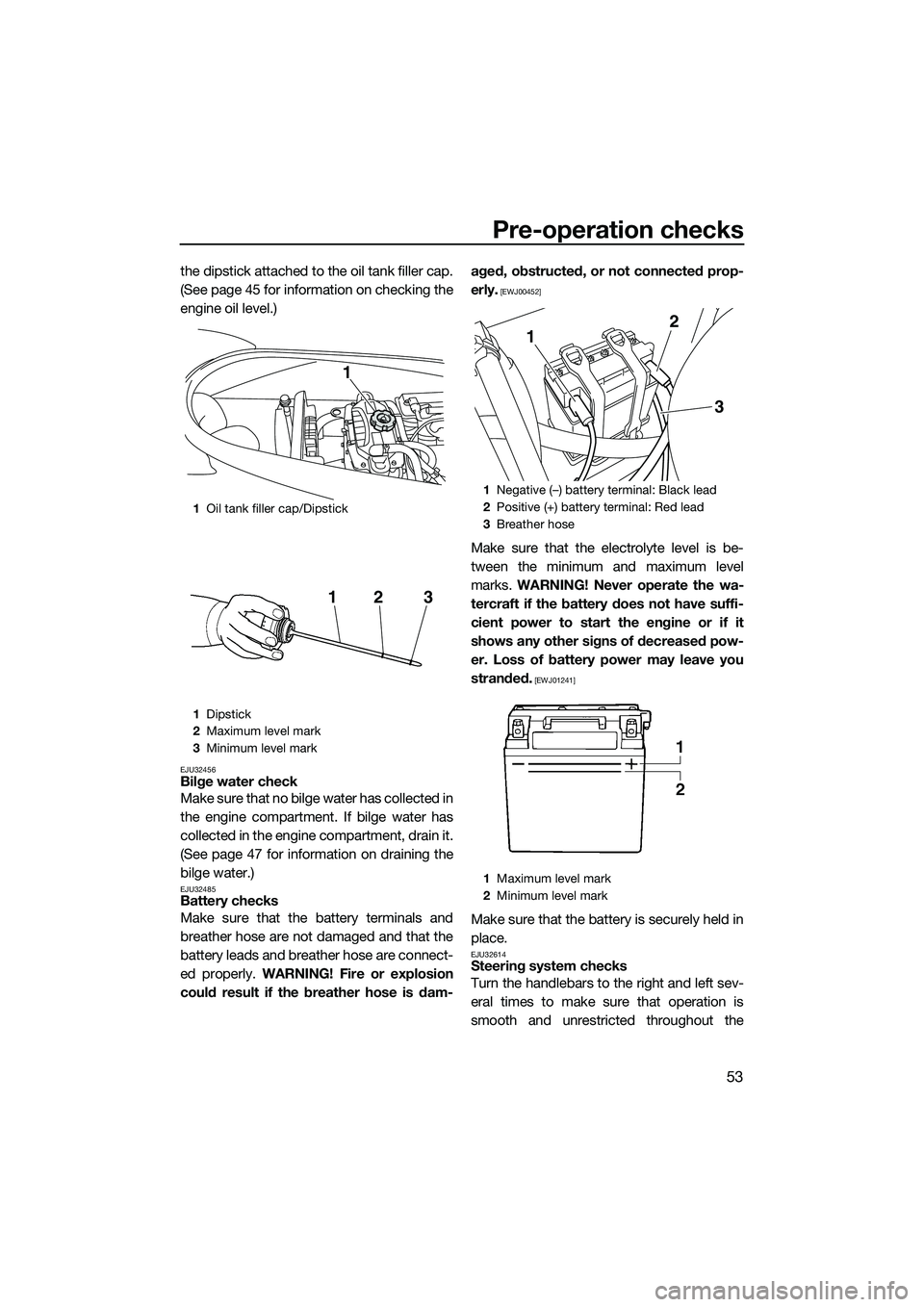
the dipstick attached to the oil tank filler cap.
(See page 45 for information on checking the
engine oil level.)
EJU32456Bilge water check
Make sure that no bilge water has collected in
the engine compartment. If bilge water has
collected in the engine compartment, drain it.
(See page 47 for information on draining the
bilge water.)
EJU32485Battery checks
Make sure that the battery terminals and
breather hose are not damaged and that the
battery leads and breather hose are connect-
ed properly. WARNING! Fire or explosion
could result if the breather hose is dam- aged, obstructed, or not connected prop-
erly.
[EWJ00452]
Make sure that the electrolyte level is be-
tween the minimum and maximum level
marks.
WARNING! Never operate the wa-
tercraft if the battery does not have suffi-
cient power to start the engine or if it
shows any other signs of decreased pow-
er. Loss of battery power may leave you
stranded.
[EWJ01241]
Make sure that the battery is securely held in
place.
EJU32614Steering system checks
Turn the handlebars to the right and left sev-
eral times to make sure that operation is
smooth and unrestricted throughout the
1 Oil tank filler cap/Dipstick
1 Dipstick
2 Maximum level mark
3 Minimum level mark
1
213
1Negative (–) battery terminal: Black lead
2 Positive (+) battery terminal: Red lead
3 Breather hose
1 Maximum level mark
2 Minimum level mark
1 2
3
UF2P71E0.book Page 53 Wednesday, July 10, 2013 5:37 PM
Page 80 of 98
Care and storage
74
Internal: Drink large quantities of water or
milk. Follow with milk of magnesia, beaten
egg, or vegetable oil. Call a physician im-
mediately.
Eyes: Flush with water for 15 minutes and
get prompt medical attention.
Batteries produce explosive gases. Keep
sparks, flames, cigarettes, etc., well away.
If using or charging the battery in an en-
closed space, make sure that it is well
ventilated. Always shield your eyes when
working near batteries.
Keep out of the reach of children.
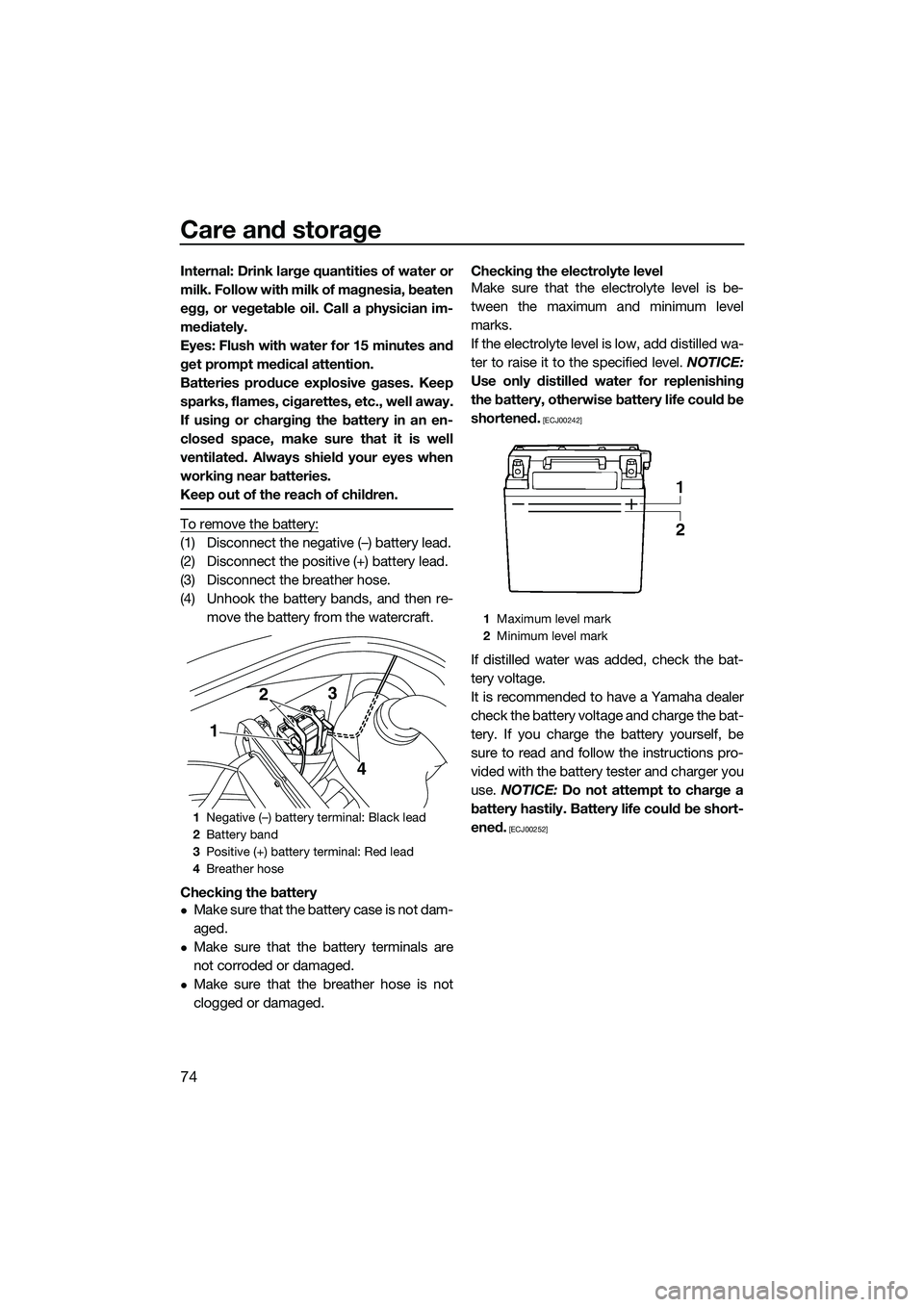
To remove the battery:
(1) Disconnect the negative (–) battery lead.
(2) Disconnect the positive (+) battery lead.
(3) Disconnect the breather hose.
(4) Unhook the battery bands, and then re-move the battery from the watercraft.
Checking the battery
Make sure that the battery case is not dam-
aged.
Make sure that the battery terminals are
not corroded or damaged.
Make sure that the breather hose is not
clogged or damaged. Checking the electrolyte level
Make sure that the electrolyte level is be-
tween the maximum and minimum level
marks.
If the electrolyte level is low, add distilled wa-
ter to raise it to the specified level.
NOTICE:
Use only distilled water for replenishing
the battery, otherwise battery life could be
shortened.
[ECJ00242]
If distilled water was added, check the bat-
tery voltage.
It is recommended to have a Yamaha dealer
check the battery voltage and charge the bat-
tery. If you charge the battery yourself, be
sure to read and follow the instructions pro-
vided with the battery tester and charger you
use. NOTICE: Do not attempt to charge a
battery hastily. Battery life could be short-
ened.
[ECJ00252]1 Negative (–) battery terminal: Black lead
2 Battery band
3 Positive (+) battery terminal: Red lead
4 Breather hose
1 2
3
4
1Maximum level mark
2 Minimum level mark
UF2P71E0.book Page 74 Wednesday, July 10, 2013 5:37 PM
Page 85 of 98
Maintenance
79
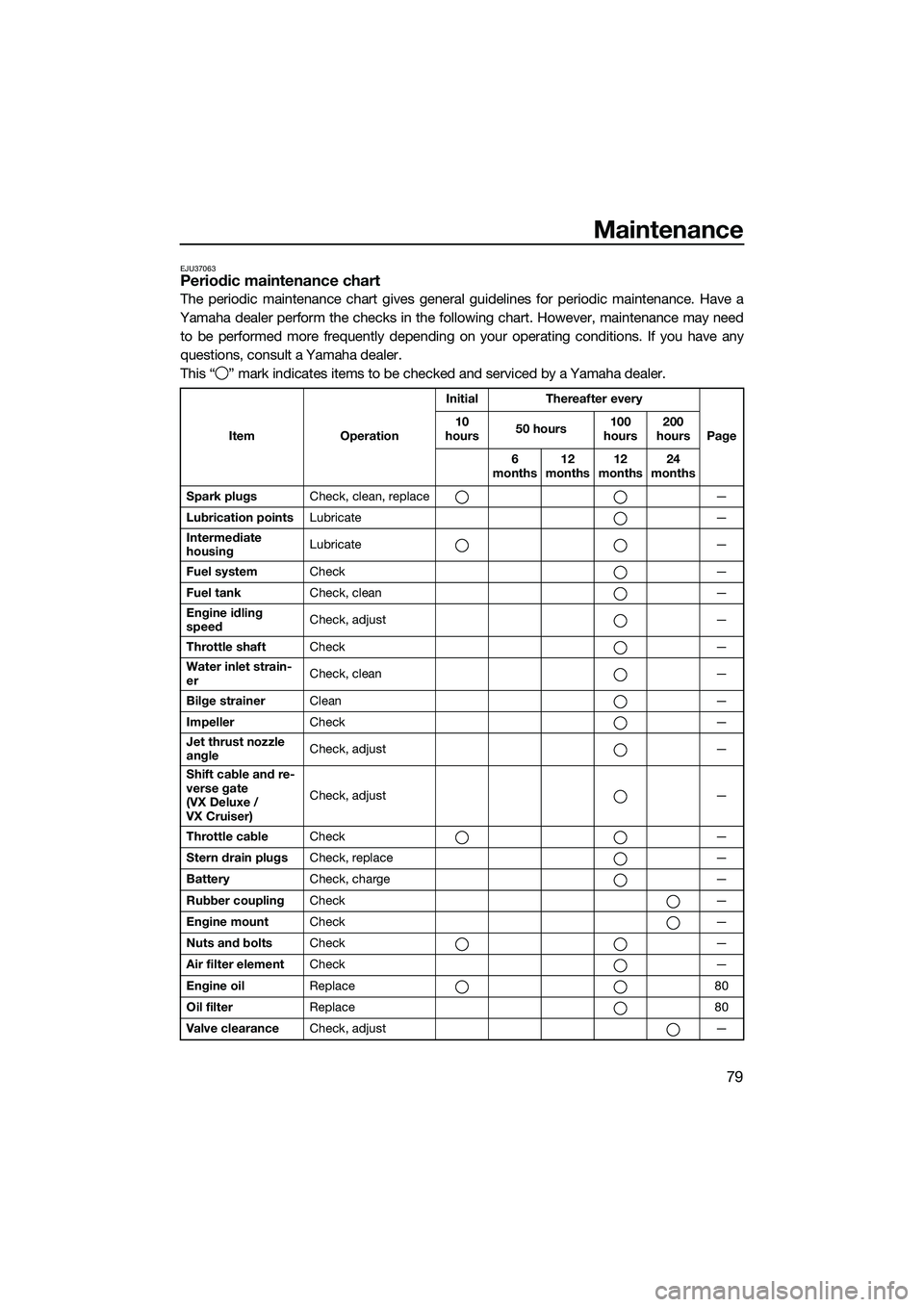
EJU37063Periodic maintenance chart
The periodic maintenance chart gives general guidelines for periodic maintenance. Have a
Yamaha dealer perform the checks in the following chart. However, maintenance may need to be performed more frequently depending on your operating conditions. If you have any
questions, consult a Yamaha dealer.
This “ ” mark indicates items to be checked and serviced by a Yamaha dealer.
Item OperationInitial
Thereafter every
Page
10
hours 50 hours
100
hours 200
hours
6
months 12
months 12
months 24
months
Spark plugs Check, clean, replace —
Lubrication points Lubricate —
Intermediate
housing Lubricate
—
Fuel system Check —
Fuel tank Check, clean —
Engine idling
speed Check, adjust
—
Throttle shaft Check —
Water inlet strain-
er Check, clean
—
Bilge strainer Clean —
Impeller Check —
Jet thrust nozzle
angle Check, adjust
—
Shift cable and re-
verse gate
(VX Deluxe /
VX Cruiser) Check, adjust
—
Throttle cable Check —
Stern drain plugs Check, replace —
Battery Check, charge —
Rubber coupling Check —
Engine mount Check —
Nuts and bolts Check —
Air filter element Check —
Engine oil Replace 80
Oil filter Replace 80
Valve clearance Check, adjust —
UF2P71E0.book Page 79 Wednesday, July 10, 2013 5:37 PM
Page 86 of 98
Maintenance
80
EJU36943Engine oil and oil filter
WARNING
EWJ00341
Engine oil is extremely hot immediately af-
ter the engine is turned off. Coming in con-
tact with or getting any engine oil on your
clothes could result in burns.
NOTICE
ECJ00992
Do not run the engine with too much or not
enough oil in the engine, otherwise the en-
gine could be damaged.
It is recommended to have a Yamaha dealer
change the engine oil and the engine oil filter.
However, if you choose to change the oil and
filter on your own, consult a Yamaha dealer.
UF2P71E0.book Page 80 Wednesday, July 10, 2013 5:37 PM
Page 87 of 98
Specifications
81
EJU34543
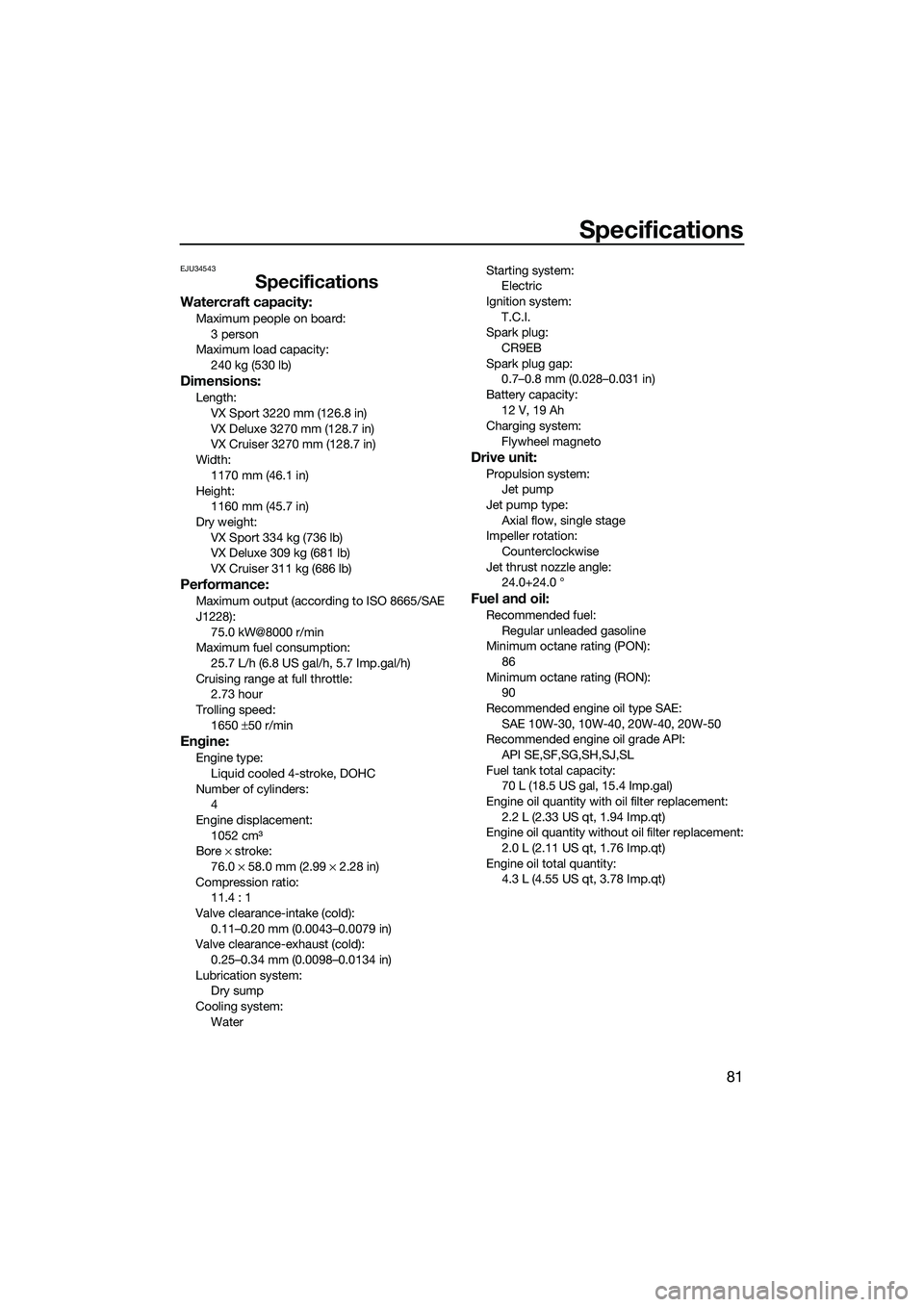
Specifications
Watercraft capacity:
Maximum people on board:3 person
Maximum load capacity: 240 kg (530 lb)
Dimensions:
Length:
VX Sport 3220 mm (126.8 in)
VX Deluxe 3270 mm (128.7 in)
VX Cruiser 3270 mm (128.7 in)
Width: 1170 mm (46.1 in)
Height: 1160 mm (45.7 in)
Dry weight:
VX Sport 334 kg (736 lb)
VX Deluxe 309 kg (681 lb)
VX Cruiser 311 kg (686 lb)
Performance:
Maximum output (according to ISO 8665/SAE
J1228):75.0 kW@8000 r/min
Maximum fuel consumption:
25.7 L/h (6.8 US gal/h, 5.7 Imp.gal/h)
Cruising range at full throttle: 2.73 hour
Trolling speed: 1650 ±50 r/min
Engine:
Engine type:
Liquid cooled 4-stroke, DOHC
Number of cylinders: 4
Engine displacement:
1052 cm³
Bore × stroke:
76.0 × 58.0 mm (2.99 × 2.28 in)
Compression ratio: 11.4 : 1
Valve clearance-intake (cold):
0.11–0.20 mm (0.0043–0.0079 in)
Valve clearance-exhaust (cold): 0.25–0.34 mm (0.0098–0.0134 in)
Lubrication system: Dry sump
Cooling system:
Water Starting system:
Electric
Ignition system: T.C.I.
Spark plug:
CR9EB
Spark plug gap: 0.7–0.8 mm (0.028–0.031 in)
Battery capacity: 12 V, 19 Ah
Charging system:
Flywheel magneto
Drive unit:
Propulsion system:Jet pump
Jet pump type: Axial flow, single stage
Impeller rotation:
Counterclockwise
Jet thrust nozzle angle: 24.0+24.0 °
Fuel and oil:
Recommended fuel:
Regular unleaded gasoline
Minimum octane rating (PON): 86
Minimum octane rating (RON): 90
Recommended engine oil type SAE:
SAE 10W-30, 10W-40, 20W-40, 20W-50
Recommended engine oil grade API: API SE,SF,SG,SH,SJ,SL
Fuel tank total capacity: 70 L (18.5 US gal, 15.4 Imp.gal)
Engine oil quantity with oil filter replacement:
2.2 L (2.33 US qt, 1.94 Imp.qt)
Engine oil quantity without oil filter replacement: 2.0 L (2.11 US qt, 1.76 Imp.qt)
Engine oil total quantity: 4.3 L (4.55 US qt, 3.78 Imp.qt)
UF2P71E0.book Page 81 Wednesday, July 10, 2013 5:37 PM
Page 89 of 98
Trouble recovery
83
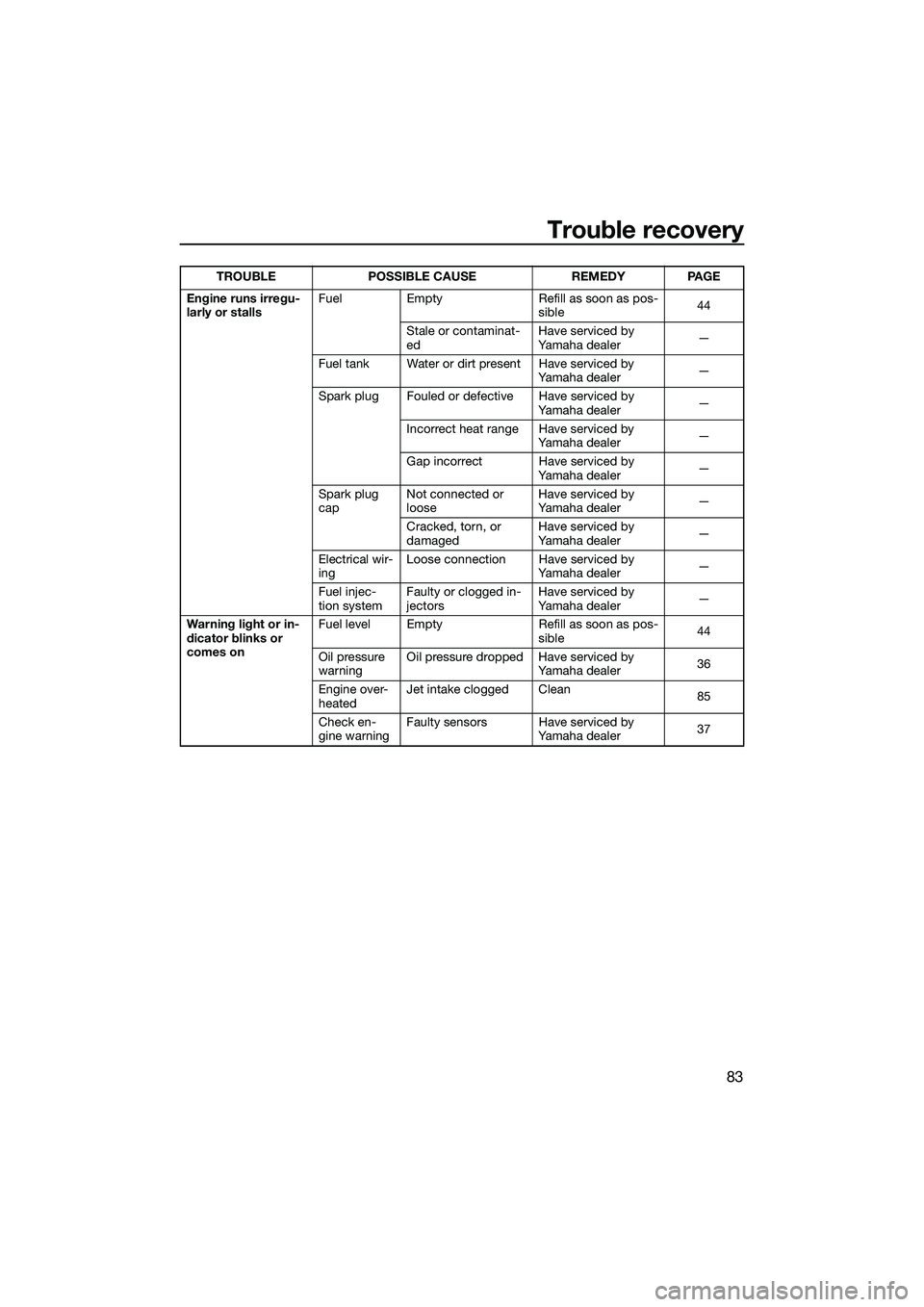
Engine runs irregu-
larly or stallsFuel Empty Refill as soon as pos-
sible44
Stale or contaminat-
ed Have serviced by
Yamaha dealer
—
Fuel tank Water or dirt present Have serviced by Yamaha dealer—
Spark plug Fouled or defective Have serviced by Yamaha dealer—
Incorrect heat range Have serviced by Yamaha dealer —
Gap incorrect Have serviced by Yamaha dealer —
Spark plug
cap Not connected or
loose Have serviced by
Yamaha dealer
—
Cracked, torn, or
damaged Have serviced by
Yamaha dealer
—
Electrical wir-
ing Loose connection Have serviced by
Yamaha dealer —
Fuel injec-
tion system Faulty or clogged in-
jectors Have serviced by
Yamaha dealer
—
Warning light or in-
dicator blinks or
comes on Fuel level Empty Refill as soon as pos-
sible44
Oil pressure
warning Oil pressure dropped Have serviced by
Yamaha dealer 36
Engine over-
heated Jet intake clogged Clean
85
Check en-
gine warning Faulty sensors Have serviced by
Yamaha dealer 37
TROUBLE POSSIBLE CAUSE REMEDY PAGE
UF2P71E0.book Page 83 Wednesday, July 10, 2013 5:37 PM
Page 90 of 98
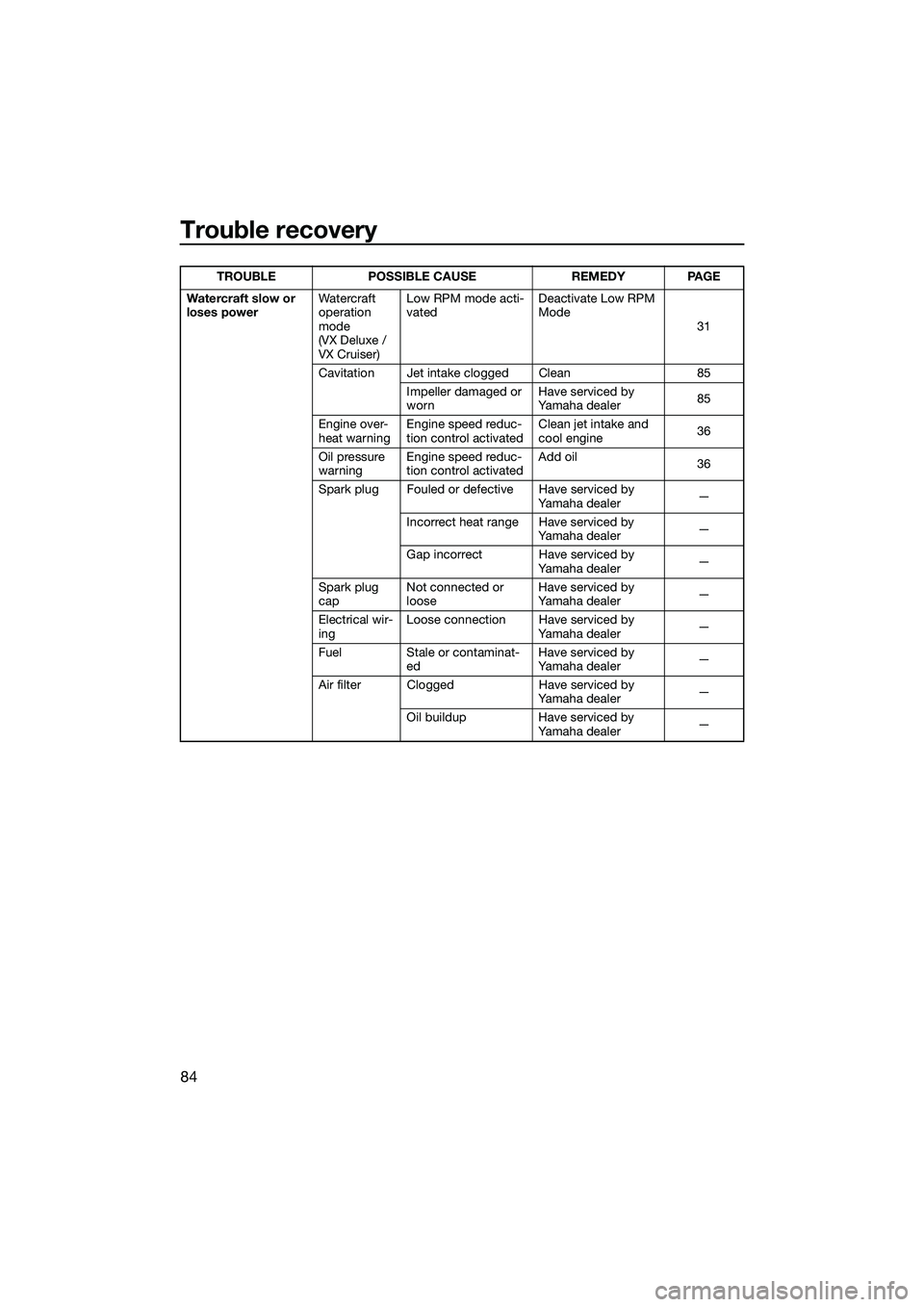
Trouble recovery
84
Watercraft slow or
loses powerWatercraft
operation
mode
(VX Deluxe /
VX Cruiser)Low RPM mode acti-
vated
Deactivate Low RPM
Mode
31
Cavitation Jet intake clogged Clean 85 Impeller damaged or
worn Have serviced by
Yamaha dealer
85
Engine over-
heat warning Engine speed reduc-
tion control activated Clean jet intake and
cool engine
36
Oil pressure
warning Engine speed reduc-
tion control activated Add oil
36
Spark plug Fouled or defective Have serviced by Yamaha dealer—
Incorrect heat range Have serviced by Yamaha dealer —
Gap incorrect Have serviced by Yamaha dealer —
Spark plug
cap Not connected or
loose Have serviced by
Yamaha dealer
—
Electrical wir-
ing Loose connection Have serviced by
Yamaha dealer —
Fuel Stale or contaminat- ed Have serviced by
Yamaha dealer
—
Air filter Clogged Have serviced by Yamaha dealer—
Oil buildup Have serviced by Yamaha dealer —
TROUBLE POSSIBLE CAUSE REMEDY PAGE
UF2P71E0.book Page 84 Wednesday, July 10, 2013 5:37 PM
Page 95 of 98
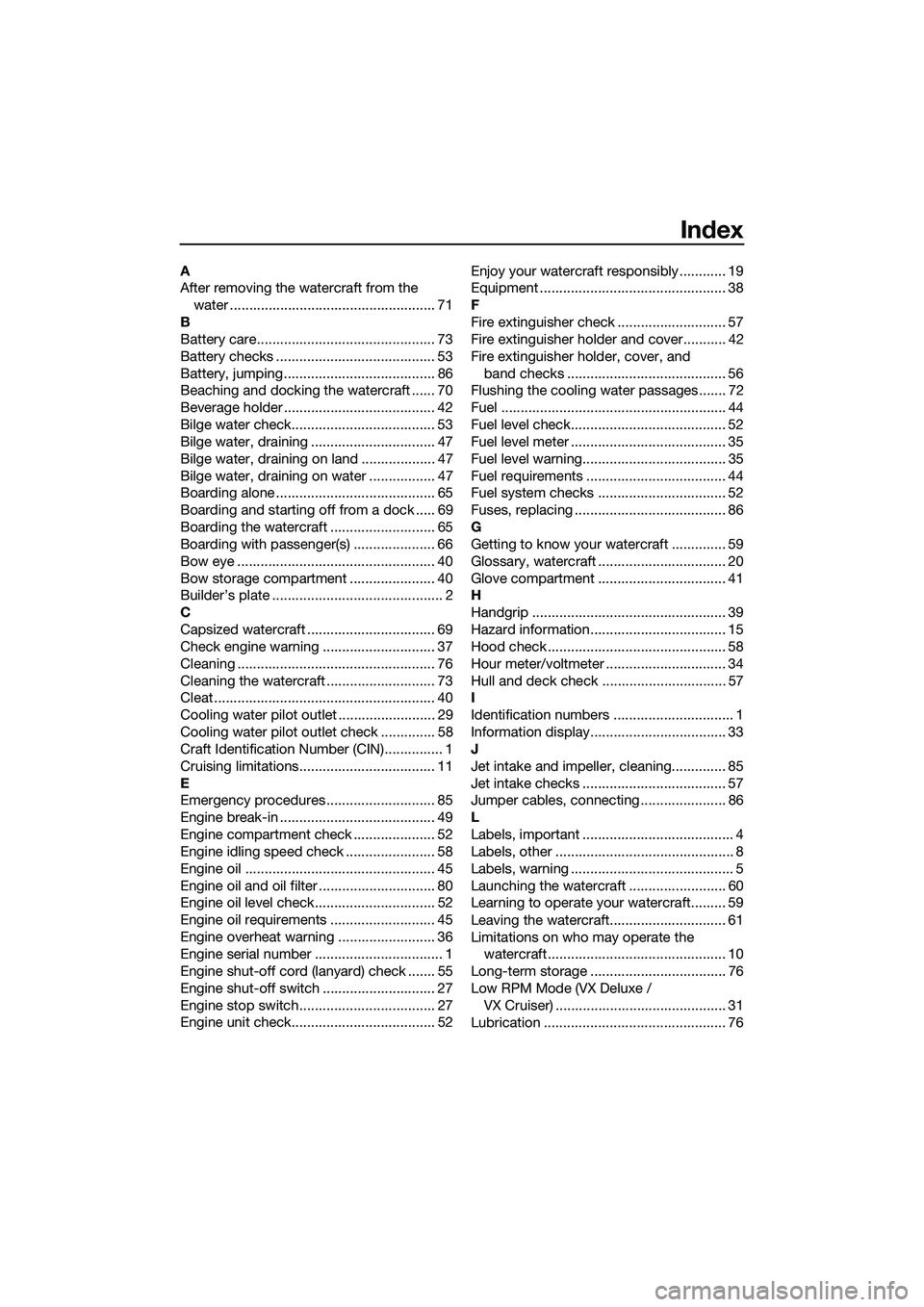
Index
A
After removing the watercraft from the water ..................................................... 71
B
Battery care.............................................. 73
Battery checks ......................................... 53
Battery, jumping ....................................... 86
Beaching and docking the watercraft ...... 70
Beverage holder ....................................... 42
Bilge water check..................................... 53
Bilge water, draining ................................ 47
Bilge water, draining on land ................... 47
Bilge water, draining on water ................. 47
Boarding alone ......................................... 65
Boarding and starting off from a dock ..... 69
Boarding the watercraft ........................... 65
Boarding with passenger(s) ..................... 66
Bow eye ................................................... 40
Bow storage compartment ...................... 40
Builder’s plate ............................................ 2
C
Capsized watercraft ................................. 69
Check engine warning ............................. 37
Cleaning ................................................... 76
Cleaning the watercraft ............................ 73
Cleat ......................................................... 40
Cooling water pilot outlet ......................... 29
Cooling water pilot outlet check .............. 58
Craft Identification Number (CIN)............... 1
Cruising limitations................................... 11
E
Emergency procedures ............................ 85
Engine break-in ........................................ 49
Engine compartment check ..................... 52
Engine idling speed check ....................... 58
Engine oil ................................................. 45
Engine oil and oil filter .............................. 80
Engine oil level check............................... 52
Engine oil requirements ........................... 45
Engine overheat warning ......................... 36
Engine serial number ................................. 1
Engine shut-off cord (lanyard) check ....... 55
Engine shut-off switch ............................. 27
Engine stop switch................................... 27
Engine unit check..................................... 52 Enjoy your watercraft responsibly ............ 19
Equipment ................................................ 38
F
Fire extinguisher check ............................ 57
Fire extinguisher holder and cover........... 42
Fire extinguisher holder, cover, and
band checks ......................................... 56
Flushing the cooling water passages....... 72
Fuel .......................................................... 44
Fuel level check........................................ 52
Fuel level meter ........................................ 35
Fuel level warning..................................... 35
Fuel requirements .................................... 44
Fuel system checks ................................. 52
Fuses, replacing ....................................... 86
G
Getting to know your watercraft .............. 59
Glossary, watercraft ................................. 20
Glove compartment ................................. 41
H
Handgrip .................................................. 39
Hazard information................................... 15
Hood check .............................................. 58
Hour meter/voltmeter ............................... 34
Hull and deck check ................................ 57
I
Identification numbers ............................... 1
Information display................................... 33
J
Jet intake and impeller, cleaning.............. 85
Jet intake checks ..................................... 57
Jumper cables, connecting ...................... 86
L
Labels, important ....................................... 4
Labels, other .............................................. 8
Labels, warning .......................................... 5
Launching the watercraft ......................... 60
Learning to operate your watercraft......... 59
Leaving the watercraft.............................. 61
Limitations on who may operate the watercraft .............................................. 10
Long-term storage ................................... 76
Low RPM Mode (VX Deluxe / VX Cruiser) ............................................ 31
Lubrication ............................................... 76
UF2P71E0.book Page 1 Wednesday, July 10, 2013 5:37 PM