high YAMAHA VXR 2013 Owners Manual
[x] Cancel search | Manufacturer: YAMAHA, Model Year: 2013, Model line: VXR, Model: YAMAHA VXR 2013Pages: 98, PDF Size: 3.89 MB
Page 9 of 98
General and important labels
3
TIP:
The significant wave height is the mean
height of the highest one-third of the waves,
which approximately corresponds to the wave
height estimated by an experienced observer.
However, some waves will be double this
height.
UF2M72E0.book Page 3 Thursday, July 12, 2012 5:05 PM
Page 17 of 98

Safety information
11
EJU30761
Cruising limitations
●Scan constantly for people, objects, and
other watercraft. Be alert for conditions that
limit your visibility or block your vision of
others.
●Operate defensively at safe speeds and
keep a safe distance away from people, ob-
jects, and other watercraft.
●Do not follow directly behind watercraft or
other boats.
●Do not go near others to spray or splash
them with water.
●Avoid sharp turns or other maneuvers that
make it hard for others to avoid you or un-
derstand where you are going.
●Avoid areas with submerged objects or
shallow water.
●Take early action to avoid collisions. Re-
member, watercraft and other boats do not
have brakes.
●Do not release the throttle lever when trying
to steer away from objects—you need throt-
tle to steer. Always check throttle and steer-
ing controls before starting the watercraft.
●Ride within your limits and avoid aggressive
maneuvers to reduce the risk of loss of con-
trol, ejection, and collision.
●This is a high performance boat—not a toy.
Sharp turns or jumping wakes or waves can
increase the risk of back/spinal injury (pa-
ralysis), facial injuries, and broken legs, an-kles, and other bones. Do not jump wakes
or waves.
●Do not operate the watercraft in rough wa-
ter, bad weather, or when visibility is poor;
this may lead to an accident causing injury
or death. Be alert to the possibility of ad-
verse weather. Take note of weather fore-
casts and the prevailing weather conditions
before setting out on your watercraft.
●As with any water sport, you should not op-
erate your watercraft without someone else
nearby. If you operate further than swim-
ming distance from shore, you should be
accompanied by another boat or watercraft,
but make sure you stay a safe distance
away. It’s good, common sense.
●Never operate in water that is less than 60
cm (2 ft) deep from the bottom of the water-
craft, otherwise you increase your chance
of hitting a submerged object, which could
result in injury.
●This watercraft is not equipped with lighting
required for night operation. Do not operate
the watercraft after sunset or before dawn,
otherwise you increase the risk of colliding
60 cm (2 ft)
UF2M72E0.book Page 11 Thursday, July 12, 2012 5:05 PM
Page 31 of 98
Control function operation
25
EJU31024
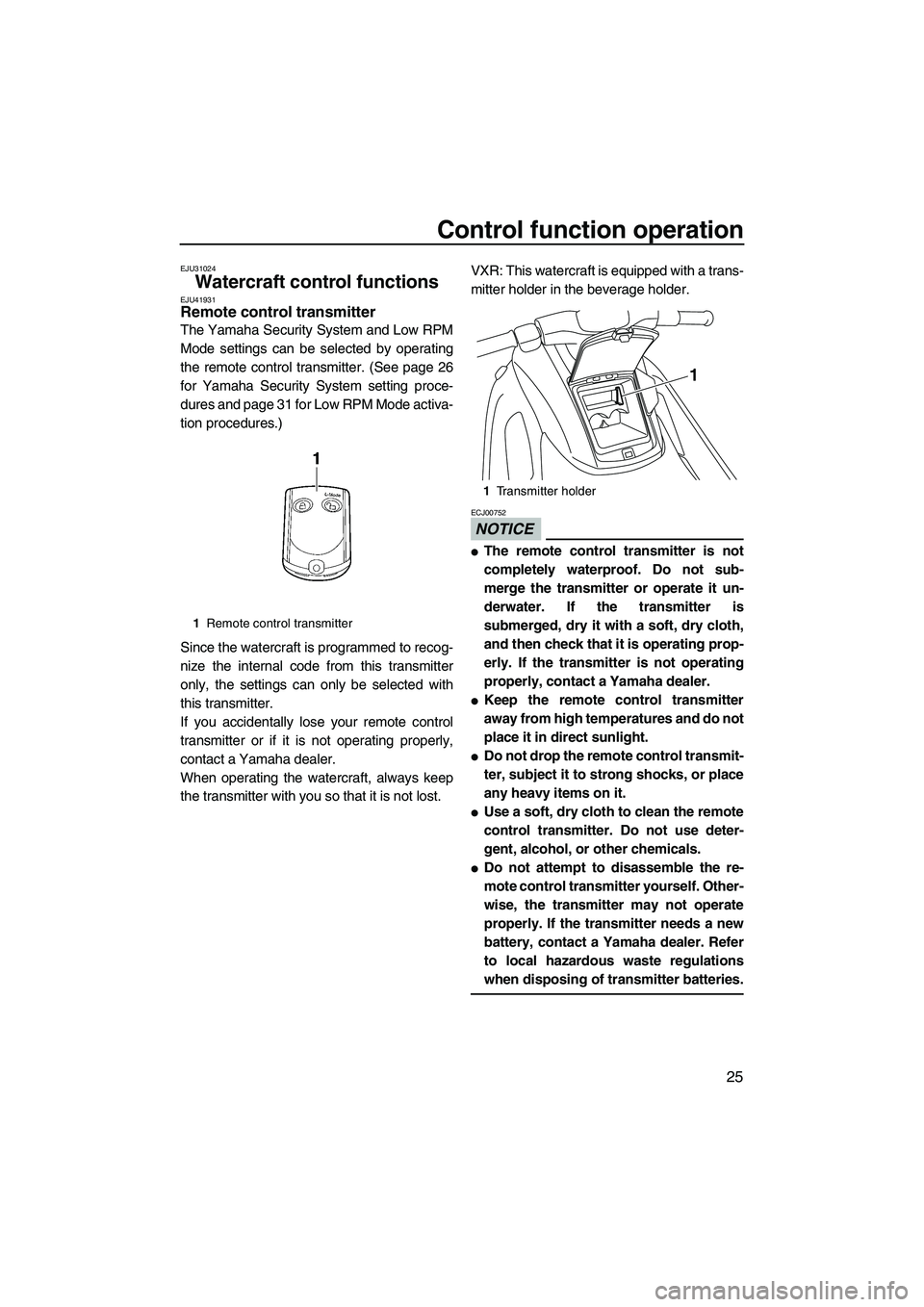
Watercraft control functions EJU41931Remote control transmitter
The Yamaha Security System and Low RPM
Mode settings can be selected by operating
the remote control transmitter. (See page 26
for Yamaha Security System setting proce-
dures and page 31 for Low RPM Mode activa-
tion procedures.)
Since the watercraft is programmed to recog-
nize the internal code from this transmitter
only, the settings can only be selected with
this transmitter.
If you accidentally lose your remote control
transmitter or if it is not operating properly,
contact a Yamaha dealer.
When operating the watercraft, always keep
the transmitter with you so that it is not lost. VXR: This watercraft is equipped with a trans-
mitter holder in the beverage holder.
NOTICE
ECJ00752
●The remote control transmitter is not
completely waterproof. Do not sub-
merge the transmitter or operate it un-
derwater. If the transmitter is
submerged, dry it with a soft, dry cloth,
and then check that it is operating prop-
erly. If the transmitter is not operating
properly, contact a Yamaha dealer.
●Keep the remote control transmitter
away from high temperatures and do not
place it in direct sunlight.
●Do not drop the remote control transmit-
ter, subject it to strong shocks, or place
any heavy items on it.
●Use a soft, dry cloth to clean the remote
control transmitter. Do not use deter-
gent, alcohol, or other chemicals.
●Do not attempt to disassemble the re-
mote control transmitter yourself. Other-
wise, the transmitter may not operate
properly. If the transmitter needs a new
battery, contact a Yamaha dealer. Refer
to local hazardous waste regulations
when disposing of transmitter batteries.
1
Remote control transmitter
1Transmitter holder
1
UF2M72E0.book Page 25 Thursday, July 12, 2012 5:05 PM
Page 42 of 98
Instrument operation
36
TIP:
Push the select button on the multifunction in-
formation center to stop the buzzer.
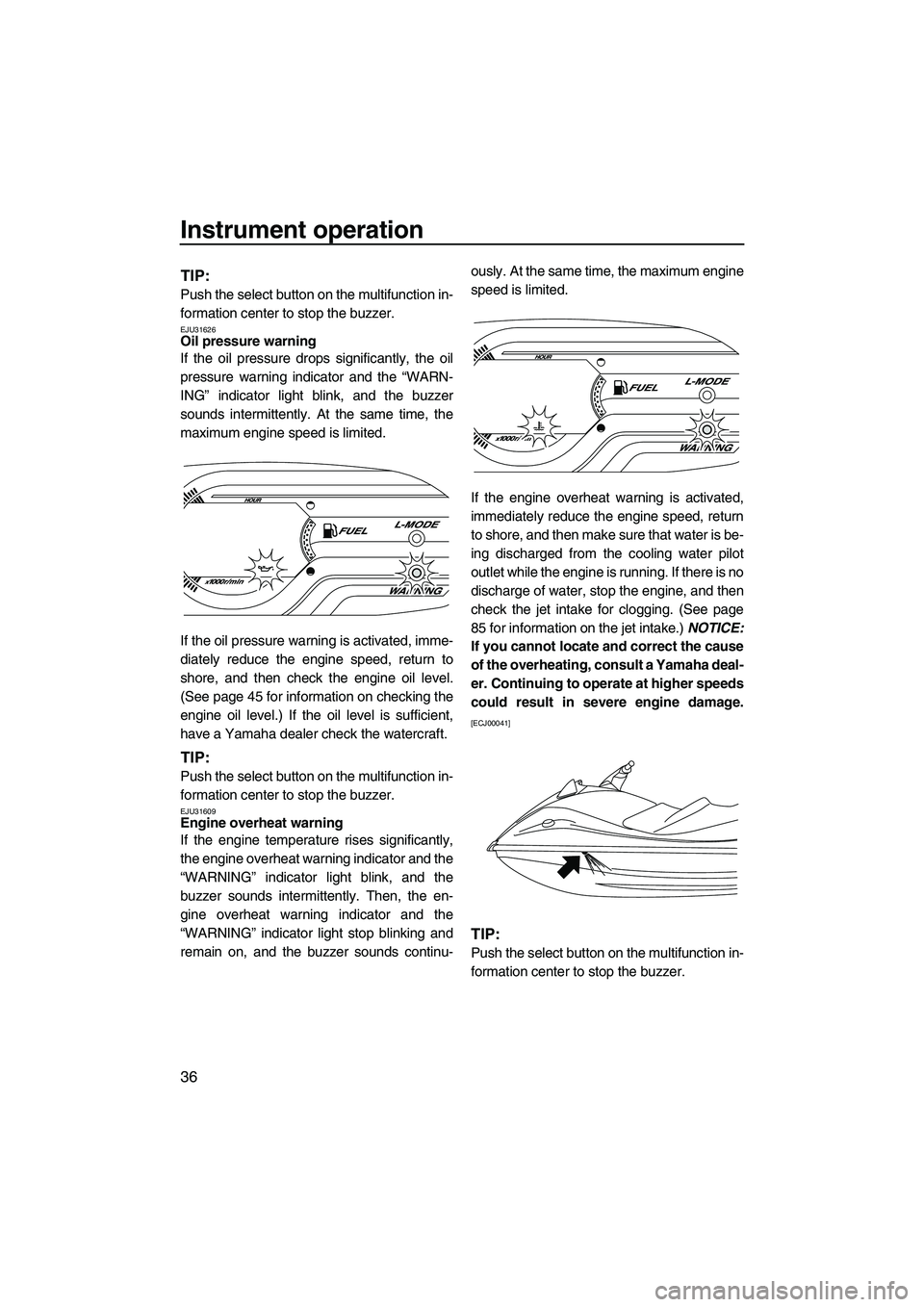
EJU31626Oil pressure warning
If the oil pressure drops significantly, the oil
pressure warning indicator and the “WARN-
ING” indicator light blink, and the buzzer
sounds intermittently. At the same time, the
maximum engine speed is limited.
If the oil pressure warning is activated, imme-
diately reduce the engine speed, return to
shore, and then check the engine oil level.
(See page 45 for information on checking the
engine oil level.) If the oil level is sufficient,
have a Yamaha dealer check the watercraft.
TIP:
Push the select button on the multifunction in-
formation center to stop the buzzer.
EJU31609Engine overheat warning
If the engine temperature rises significantly,
the engine overheat warning indicator and the
“WARNING” indicator light blink, and the
buzzer sounds intermittently. Then, the en-
gine overheat warning indicator and the
“WARNING” indicator light stop blinking and
remain on, and the buzzer sounds continu-ously. At the same time, the maximum engine
speed is limited.
If the engine overheat warning is activated,
immediately reduce the engine speed, return
to shore, and then make sure that water is be-
ing discharged from the cooling water pilot
outlet while the engine is running. If there is no
discharge of water, stop the engine, and then
check the jet intake for clogging. (See page
85 for information on the jet intake.)
NOTICE:
If you cannot locate and correct the cause
of the overheating, consult a Yamaha deal-
er. Continuing to operate at higher speeds
could result in severe engine damage.
[ECJ00041]
TIP:
Push the select button on the multifunction in-
formation center to stop the buzzer.
UF2M72E0.book Page 36 Thursday, July 12, 2012 5:05 PM
Page 68 of 98

Operation
62
is in the fully closed (idle) position. (See page
30 for information on operating the shift lever.)
EJU33254Turning the watercraft
WARNING
EWJ00771
●Do not release the throttle lever when
trying to steer away from objects—you
need throttle to steer. A collision could
result in severe injury or death.
●When operating at higher speeds, make
gradual turns or slow down before turn-
ing. Sharp high-speed turns may cause
the watercraft to slide sideways or spin,
throwing the operator and passenger(s)
overboard, which could cause an injury.
Steering control depends on the combination
of handlebar position and the amount of throt-
tle.Water sucked in through the intake grate is
pressurized by the impeller in the jet pump. As
the pressurized water is expelled from the
pump through the jet thrust nozzle, it creates
thrust to move and steer the watercraft. The
higher the engine speed, the more thrust pro-
duced.
The amount of jet thrust, in addition to the po-
sition of the handlebars, determines how
sharply you turn.
A. More throttle produces higher thrust, so
the watercraft will turn more sharply.
B. Less throttle produces lower thrust, so the watercraft will turn more gradually.
C. Releasing the throttle lever completely produces only minimum thrust. If you are
traveling at speeds above trolling, you will
have rapidly decreasing ability to steer
without throttle. You may still have some
turning ability immediately after releasing
the throttle lever, but once the engine
1Shift lever
2 Forward position
1
2
UF2M72E0.book Page 62 Thursday, July 12, 2012 5:05 PM
Page 78 of 98
Care and storage
72
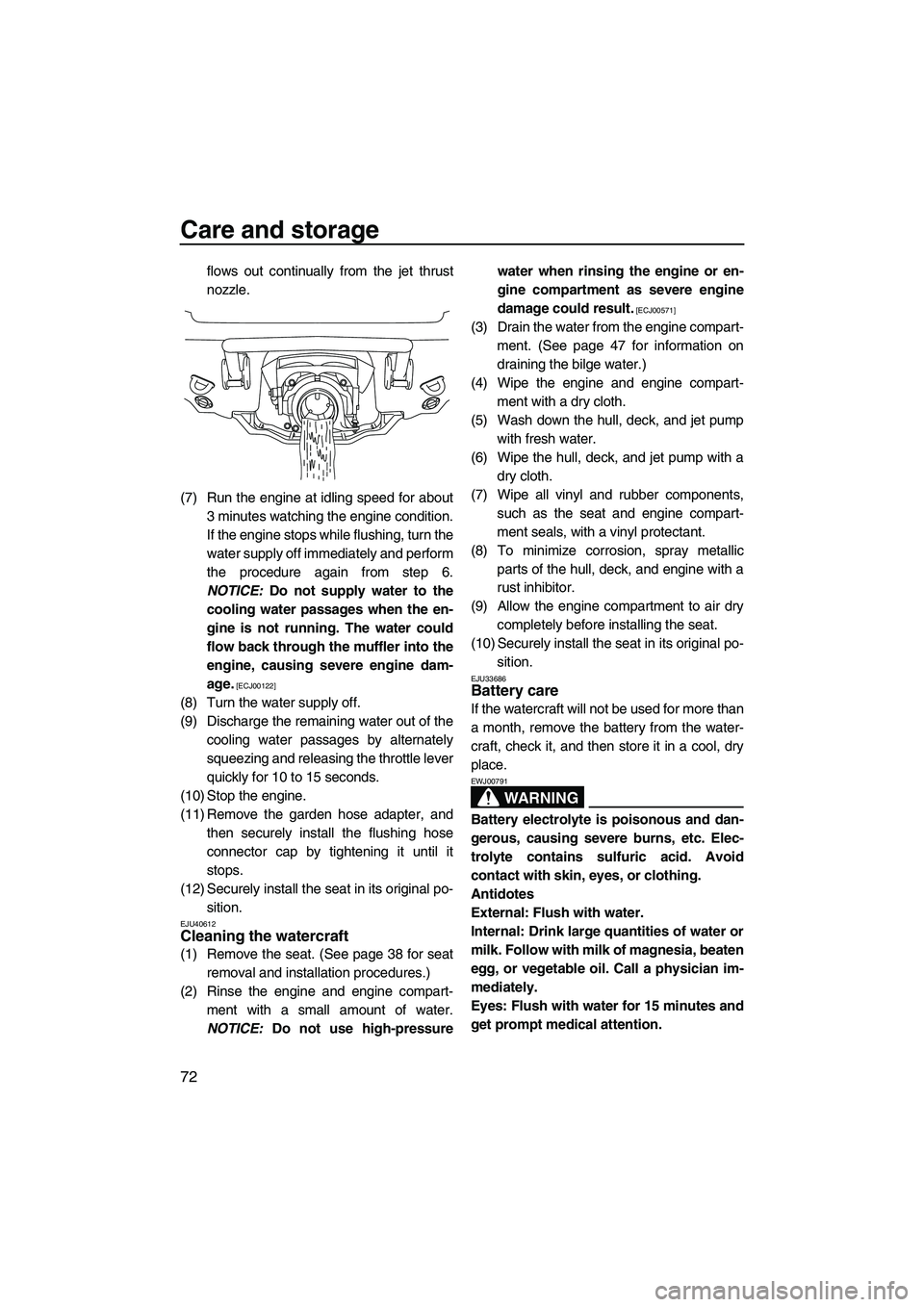
flows out continually from the jet thrust
nozzle.
(7) Run the engine at idling speed for about 3 minutes watching the engine condition.
If the engine stops while flushing, turn the
water supply off immediately and perform
the procedure again from step 6.
NOTICE: Do not supply water to the
cooling water passages when the en-
gine is not running. The water could
flow back through the muffler into the
engine, causing severe engine dam-
age.
[ECJ00122]
(8) Turn the water supply off.
(9) Discharge the remaining water out of the cooling water passages by alternately
squeezing and releasing the throttle lever
quickly for 10 to 15 seconds.
(10) Stop the engine.
(11) Remove the garden hose adapter, and then securely install the flushing hose
connector cap by tightening it until it
stops.
(12) Securely install the seat in its original po- sition.
EJU40612Cleaning the watercraft
(1) Remove the seat. (See page 38 for seatremoval and installation procedures.)
(2) Rinse the engine and engine compart- ment with a small amount of water.
NOTICE: Do not use high-pressure water when rinsing the engine or en-
gine compartment as severe engine
damage could result.
[ECJ00571]
(3) Drain the water from the engine compart-
ment. (See page 47 for information on
draining the bilge water.)
(4) Wipe the engine and engine compart- ment with a dry cloth.
(5) Wash down the hull, deck, and jet pump with fresh water.
(6) Wipe the hull, deck, and jet pump with a dry cloth.
(7) Wipe all vinyl and rubber components, such as the seat and engine compart-
ment seals, with a vinyl protectant.
(8) To minimize corrosion, spray metallic parts of the hull, deck, and engine with a
rust inhibitor.
(9) Allow the engine compartment to air dry completely before installing the seat.
(10) Securely install the seat in its original po- sition.
EJU33686Battery care
If the watercraft will not be used for more than
a month, remove the battery from the water-
craft, check it, and then store it in a cool, dry
place.
WARNING
EWJ00791
Battery electrolyte is poisonous and dan-
gerous, causing severe burns, etc. Elec-
trolyte contains sulfuric acid. Avoid
contact with skin, eyes, or clothing.
Antidotes
External: Flush with water.
Internal: Drink large quantities of water or
milk. Follow with milk of magnesia, beaten
egg, or vegetable oil. Call a physician im-
mediately.
Eyes: Flush with water for 15 minutes and
get prompt medical attention.
UF2M72E0.book Page 72 Thursday, July 12, 2012 5:05 PM