light YAMAHA WARRIOR 350 2001 User Guide
[x] Cancel search | Manufacturer: YAMAHA, Model Year: 2001, Model line: WARRIOR 350, Model: YAMAHA WARRIOR 350 2001Pages: 370, PDF Size: 20.56 MB
Page 116 of 370

5-17
Yuki_Data:Yuki_data:Yuki:Yuki_1:ATV:HM00B067_YFM350X-60:YFM350-5.frame
EL
EBU00151
Throttle lever
Check to see that the throttle lever operates
correctly. It must open smoothly and spring
back to idle position when released. Repair as
necessary for proper operation.
EBU00152
Fittings and Fasteners
Always check the tightness of chassis fittings
and fasteners before a ride. Take the machine
to a Yamaha dealer or refer to the Service Man-
ual for correct tightening torque.
EBU00153
Lights
Check the headlight and taillight to make sure
they are in working condition. Repair as neces-
sary for proper operation.
EBU00155
Switches
Check the operation of the headlight switch,
engine stop switch and any other switches. Re-
pair as necessary for proper operation.
Page 130 of 370
6-5
Yuki_Data:Yuki_data:Yuki:Yuki_1:ATV:HM00B067_YFM350X-60:YFM350-6.frame
EL
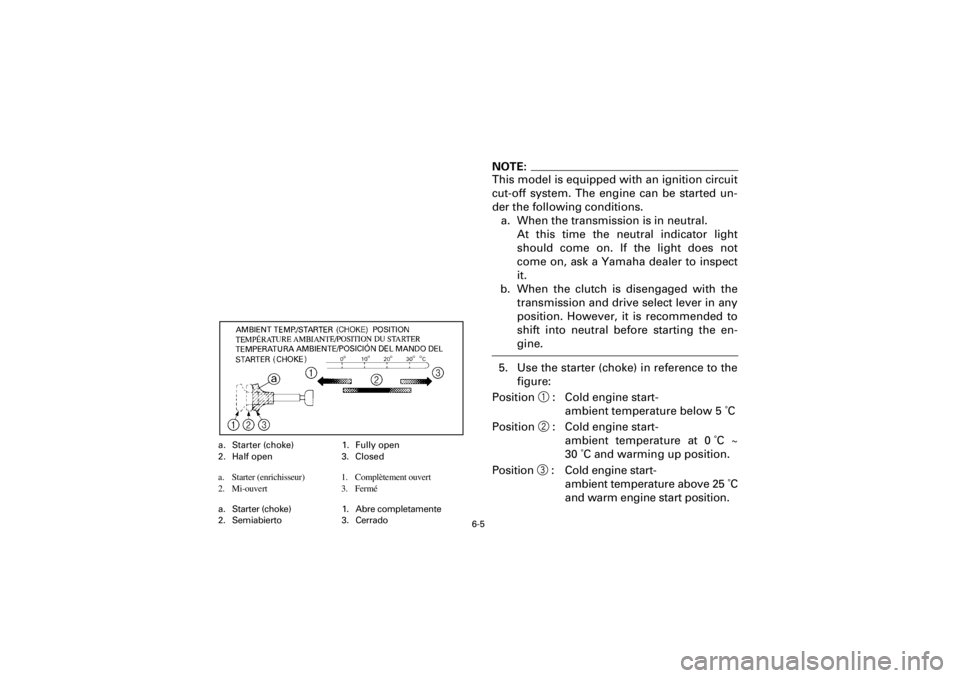
a. Starter (choke) 1. Fully open
2. Half open 3. Closed
a. Starter (enrichisseur) 1. Complètement ouvert
2. Mi-ouvert 3. Fermé
a. Starter (choke) 1. Abre completamente
2. Semiabierto 3. Cerrado
NOTE:
This model is equipped with an ignition circuit
cut-off system. The engine can be started un-
der the following conditions.
a. When the transmission is in neutral.
At this time the neutral indicator light
should come on. If the light does not
come on, ask a Yamaha dealer to inspect
it.
b. When the clutch is disengaged with the
transmission and drive select lever in any
position. However, it is recommended to
shift into neutral before starting the en-
gine.
5. Use the starter (choke) in reference to the
figure:
Position
1
: Cold engine start-
ambient temperature below 5 ˚C
Position
2
: Cold engine start-
ambient temperature at 0 ˚C ~
30 ˚C and warming up position.
Position
3
: Cold engine start-
ambient temperature above 25 ˚C
and warm engine start position.
Page 134 of 370
6-9
Yuki_Data:Yuki_data:Yuki:Yuki_1:ATV:HM00B067_YFM350X-60:YFM350-6.frame
EL
EBU00180
Starting a warm engine
To start a warm engine, refer to the “Starting a
cold engine” section. The starter (choke)
should not be used. The throttle should be
opened slightly.
EBU00538
Warming up
To get maximum engine life, always warm up
the engine before starting off. Never accelerate
hard with a cold engine! To see whether or not
the engine is warm, check if it responds to the
throttle normally with the starter (choke)
turned off.NOTE:
When the parking brake is used, engine speed
is limited to 2,300 r/min. Be sure the parking
brake is released before moving the throttle le-
ver. Otherwise, the engine will misfire, pre-
venting normal operation.
Page 136 of 370
6-11
Yuki_Data:Yuki_data:Yuki:Yuki_1:ATV:HM00B067_YFM350X-60:YFM350-6.frame
EL
EBU00188
Drive select lever operation and reverse driv-
ing
CAUTION:
Before shifting, stop the machine and return
the throttle lever to its closed position. Other-
wise the transmission may be damaged.
NOTE:
When shifting into reverse, the clutch must be
disengaged.
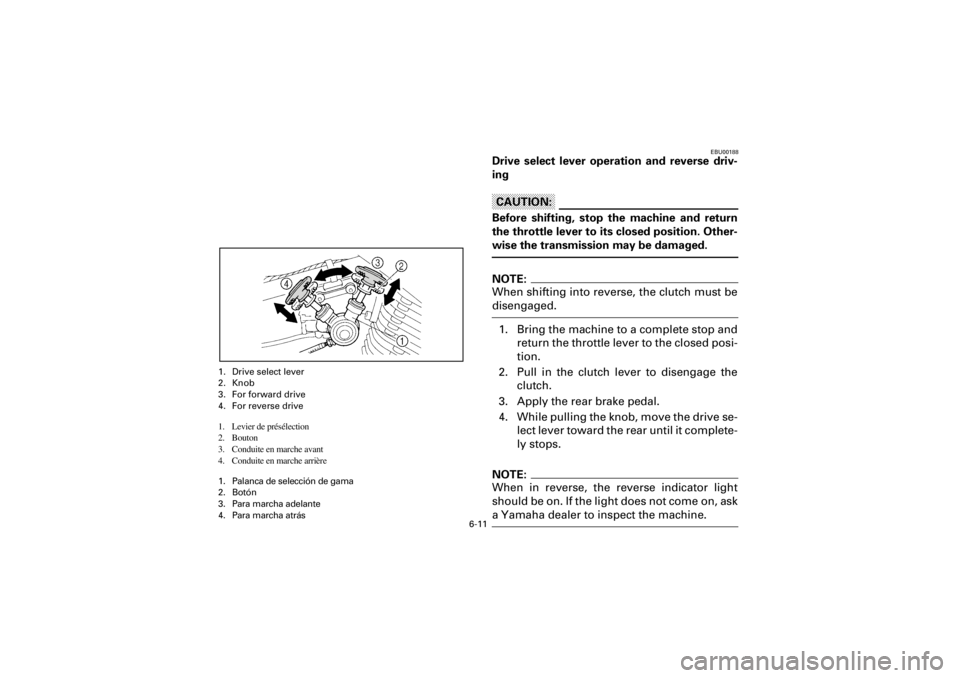
1. Bring the machine to a complete stop and
return the throttle lever to the closed posi-
tion.
2. Pull in the clutch lever to disengage the
clutch.
3. Apply the rear brake pedal.
4. While pulling the knob, move the drive se-
lect lever toward the rear until it complete-
ly stops.
NOTE:
When in reverse, the reverse indicator light
should be on. If the light does not come on, ask
a Yamaha dealer to inspect the machine.
1. Drive select lever
2. Knob
3. For forward drive
4. For reverse drive
1. Levier de présélection
2. Bouton
3. Conduite en marche avant
4. Conduite en marche arrière
1. Palanca de selección de gama
2. Botón
3. Para marcha adelante
4. Para marcha atrás
Page 140 of 370
6-15
Yuki_Data:Yuki_data:Yuki:Yuki_1:ATV:HM00B067_YFM350X-60:YFM350-6.frame
EL
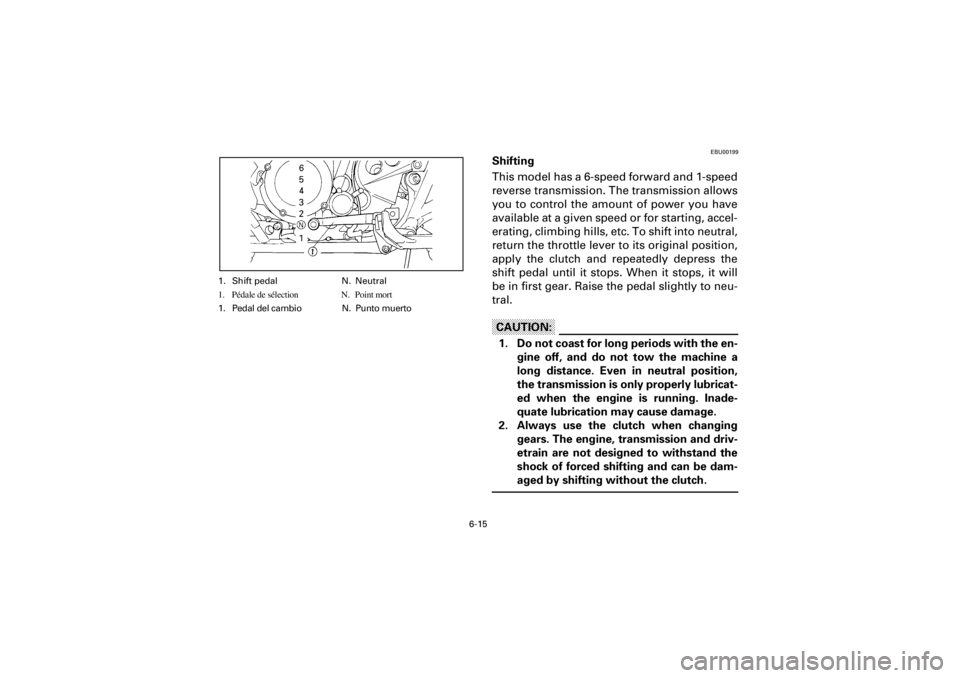
1. Shift pedal N. Neutral
1. Pédale de sélection N. Point mort
1. Pedal del cambio N. Punto muerto
EBU00199
Shifting
This model has a 6-speed forward and 1-speed
reverse transmission. The transmission allows
you to control the amount of power you have
available at a given speed or for starting, accel-
erating, climbing hills, etc. To shift into neutral,
return the throttle lever to its original position,
apply the clutch and repeatedly depress the
shift pedal until it stops. When it stops, it will
be in first gear. Raise the pedal slightly to neu-
tral.
CAUTION:
1. Do not coast for long periods with the en-
gine off, and do not tow the machine a
long distance. Even in neutral position,
the transmission is only properly lubricat-
ed when the engine is running. Inade-
quate lubrication may cause damage.
2. Always use the clutch when changing
gears. The engine, transmission and driv-
etrain are not designed to withstand the
shock of forced shifting and can be dam-
aged by shifting without the clutch.
Page 204 of 370
7-41
Yuki_Data:Yuki_data:Yuki:Yuki_1:ATV:HM00B067_YFM350X-60:YFM350-7.frame
EL
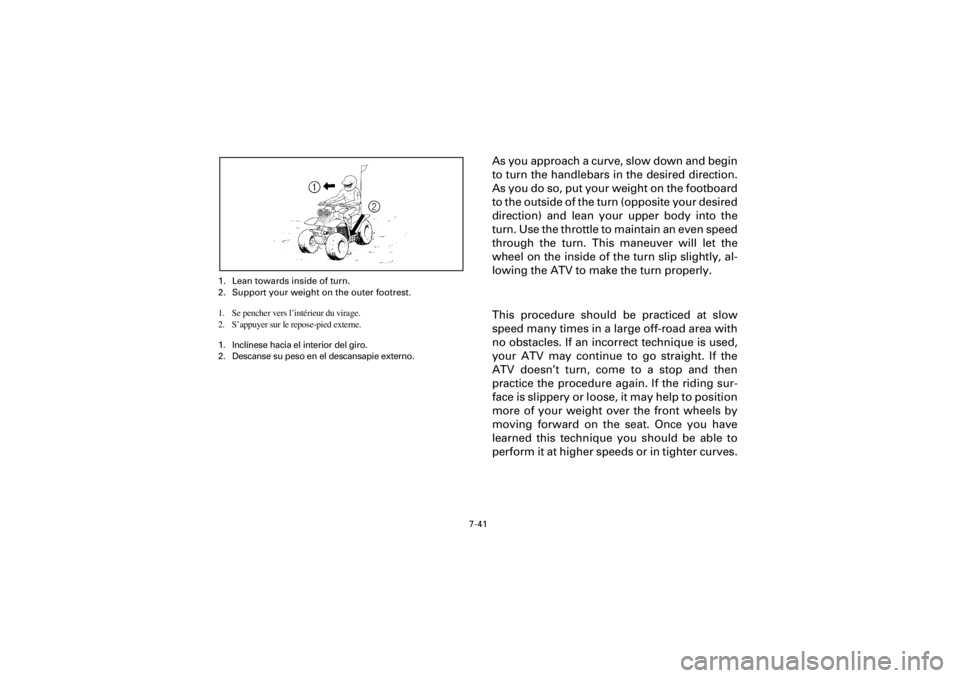
As you approach a curve, slow down and begin
to turn the handlebars in the desired direction.
As you do so, put your weight on the footboard
to the outside of the turn (opposite your desired
direction) and lean your upper body into the
turn. Use the throttle to maintain an even speed
through the turn. This maneuver will let the
wheel on the inside of the turn slip slightly, al-
lowing the ATV to make the turn properly.
This procedure should be practiced at slow
speed many times in a large off-road area with
no obstacles. If an incorrect technique is used,
your ATV may continue to go straight. If the
ATV doesn’t turn, come to a stop and then
practice the procedure again. If the riding sur-
face is slippery or loose, it may help to position
more of your weight over the front wheels by
moving forward on the seat. Once you have
learned this technique you should be able to
perform it at higher speeds or in tighter curves.
1. Lean towards inside of turn.
2. Support your weight on the outer footrest.
1. Se pencher vers l’intérieur du virage.
2. S’appuyer sur le repose-pied externe.
1. Inclínese hacia el interior del giro.
2. Descanse su peso en el descansapie externo.
Page 222 of 370

7-59
Yuki_Data:Yuki_data:Yuki:Yuki_1:ATV:HM00B067_YFM350X-60:YFM350-7.frame
EL
CROSSING A SLOPE
Traversing a sloping surface on your ATV re-
quires you to properly position your weight to
maintain proper balance. Be sure that you
have learned the basic riding skills on flat
ground before attempting to cross a sloping
surface. Avoid slopes with slippery surfaces or
rough terrain that may upset your balance.
As you travel across a slope, lean your body in
the uphill direction. It may be necessary to cor-
rect the steering when riding on loose surfaces
by pointing the front wheels slightly uphill.
When riding on slopes be sure not to make
sharp turns either up or down hill.
Page 264 of 370
8-23
Yuki_Data:Yuki_data:Yuki:Yuki_1:ATV:HM00B067_YFM350X-60:YFM350-8.frame
EL
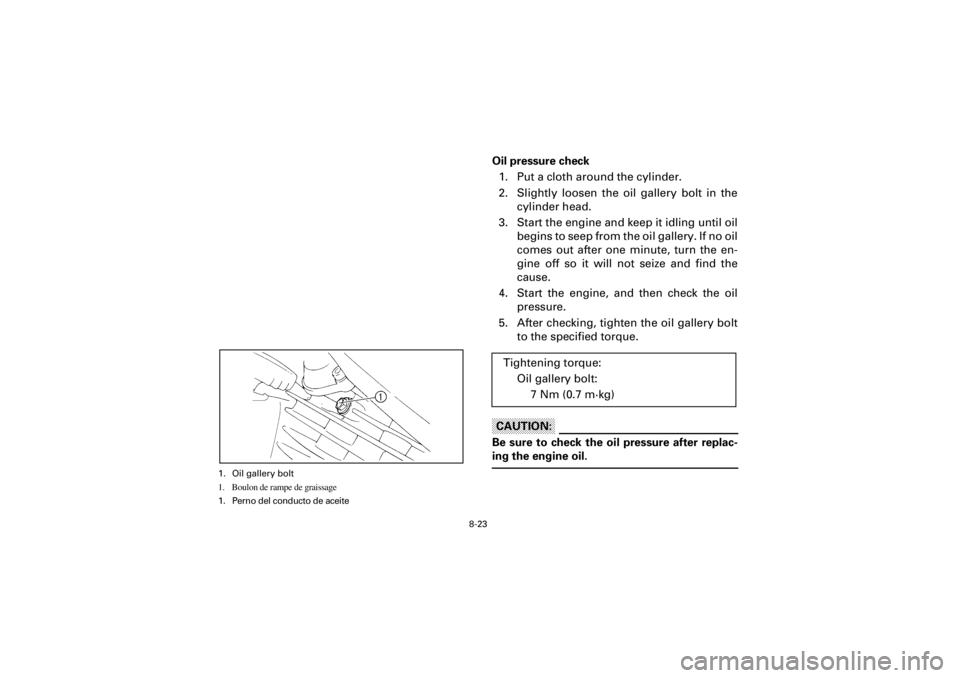
Oil pressure check
1. Put a cloth around the cylinder.
2. Slightly loosen the oil gallery bolt in the
cylinder head.
3. Start the engine and keep it idling until oil
begins to seep from the oil gallery. If no oil
comes out after one minute, turn the en-
gine off so it will not seize and find the
cause.
4. Start the engine, and then check the oil
pressure.
5. After checking, tighten the oil gallery bolt
to the specified torque.CAUTION:Be sure to check the oil pressure after replac-ing the engine oil. Tightening torque:
Oil gallery bolt:
7 Nm (0.7 m·kg)
1. Oil gallery bolt
1. Boulon de rampe de graissage
1. Perno del conducto de aceite
Page 324 of 370
8-83
Yuki_Data:Yuki_data:Yuki:Yuki_1:ATV:HM00B067_YFM350X-60:YFM350-8.frame
EL
EBU00599
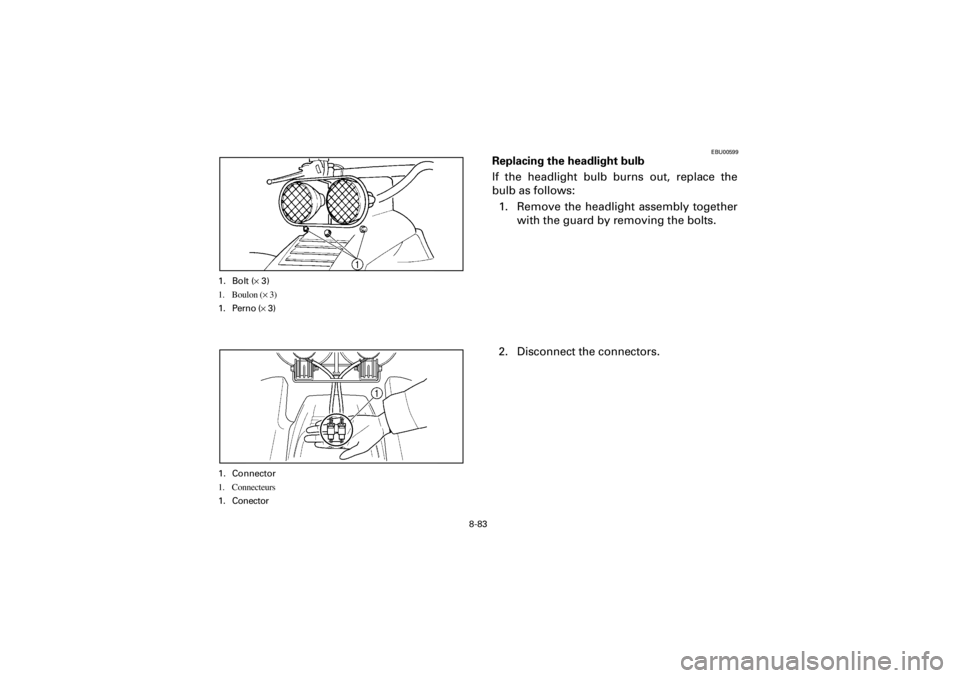
Replacing the headlight bulb
If the headlight bulb burns out, replace the
bulb as follows:
1. Remove the headlight assembly together
with the guard by removing the bolts.
2. Disconnect the connectors.
1. Bolt (´ 3)
1. Boulon (´ 3)
1. Perno (´ 3)1. Connector
1. Connecteurs
1. Conector
Page 326 of 370
8-85
Yuki_Data:Yuki_data:Yuki:Yuki_1:ATV:HM00B067_YFM350X-60:YFM350-8.frame
EL
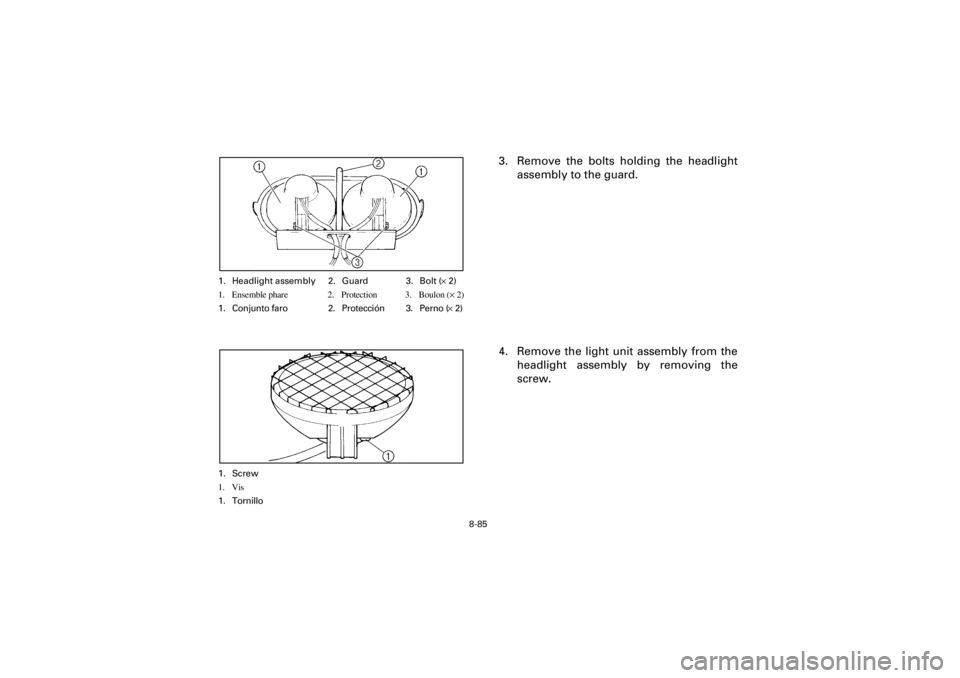
3. Remove the bolts holding the headlight
assembly to the guard.
4. Remove the light unit assembly from the
headlight assembly by removing the
screw.
1. Headlight assembly 2. Guard 3. Bolt (´ 2)
1. Ensemble phare 2. Protection 3. Boulon (´ 2)
1. Conjunto faro 2. Protección 3. Perno (´ 2)1. Screw
1. Vis
1. Tornillo