wheel YAMAHA WARRIOR 350 2001 User Guide
[x] Cancel search | Manufacturer: YAMAHA, Model Year: 2001, Model line: WARRIOR 350, Model: YAMAHA WARRIOR 350 2001Pages: 370, PDF Size: 20.56 MB
Page 202 of 370

7-39
Yuki_Data:Yuki_data:Yuki:Yuki_1:ATV:HM00B067_YFM350X-60:YFM350-7.frame
EL
TURNING YOUR ATV
To achieve maximum traction while riding off-
road, the two rear wheels are mounted solidly
on one axle and turn together at the same
speed. Therefore, unless the wheel on the in-
side of the turn is allowed to slip or lose some
traction, the ATV will resist turning. A special
turning technique must be used to allow the
ATV to make turns quickly and easily. It is es-
sential that this skill be learned first at low
speed.
WARNING
Always follow proper procedures for turning
as described in this Owner’s Manual.
Practice turning at low speeds before attempt-
ing to turn at faster speeds. Do not turn at
speeds too fast for your skills or the condi-tions.
Page 204 of 370
7-41
Yuki_Data:Yuki_data:Yuki:Yuki_1:ATV:HM00B067_YFM350X-60:YFM350-7.frame
EL
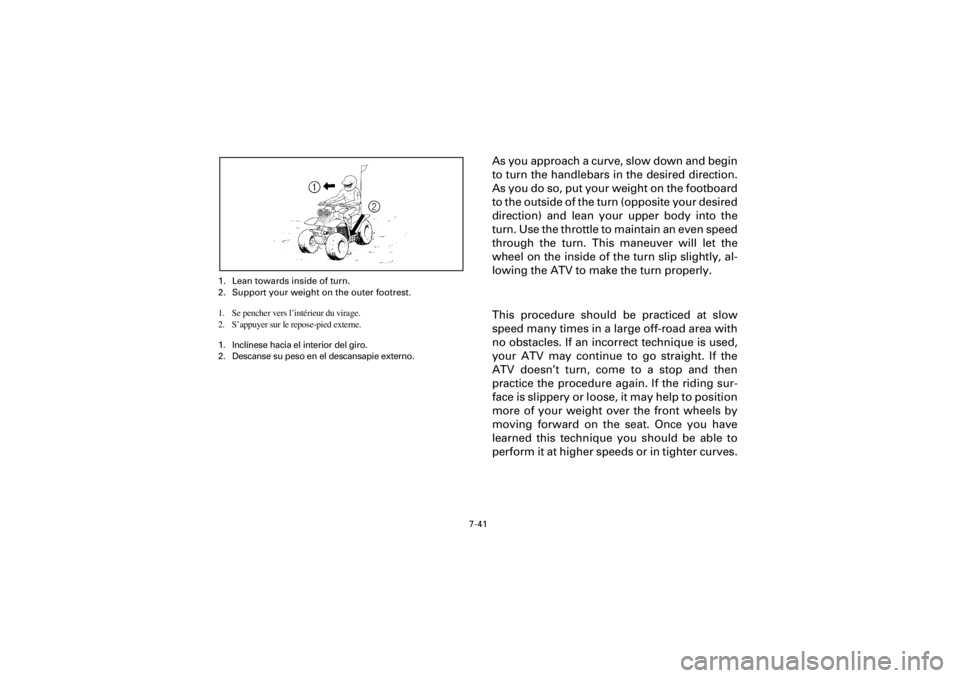
As you approach a curve, slow down and begin
to turn the handlebars in the desired direction.
As you do so, put your weight on the footboard
to the outside of the turn (opposite your desired
direction) and lean your upper body into the
turn. Use the throttle to maintain an even speed
through the turn. This maneuver will let the
wheel on the inside of the turn slip slightly, al-
lowing the ATV to make the turn properly.
This procedure should be practiced at slow
speed many times in a large off-road area with
no obstacles. If an incorrect technique is used,
your ATV may continue to go straight. If the
ATV doesn’t turn, come to a stop and then
practice the procedure again. If the riding sur-
face is slippery or loose, it may help to position
more of your weight over the front wheels by
moving forward on the seat. Once you have
learned this technique you should be able to
perform it at higher speeds or in tighter curves.
1. Lean towards inside of turn.
2. Support your weight on the outer footrest.
1. Se pencher vers l’intérieur du virage.
2. S’appuyer sur le repose-pied externe.
1. Inclínese hacia el interior del giro.
2. Descanse su peso en el descansapie externo.
Page 214 of 370

7-51
Yuki_Data:Yuki_data:Yuki:Yuki_1:ATV:HM00B067_YFM350X-60:YFM350-7.frame
EL
If your ATV has stalled or stopped and you be-
lieve you can continue up the hill, restart care-
fully to make sure you do not lift the front
wheels which could cause you to lose control.
If you are unable to continue up the hill, dis-
mount the ATV on the uphill side. Physically
turn the ATV around and then descend the hill.
If you start to roll backwards, DO NOT use the
rear brake to stop or try to put the ATV in gear.
The ATV could easily tip over backwards. In-
stead, dismount the ATV immediately on the
uphill side.
Page 222 of 370

7-59
Yuki_Data:Yuki_data:Yuki:Yuki_1:ATV:HM00B067_YFM350X-60:YFM350-7.frame
EL
CROSSING A SLOPE
Traversing a sloping surface on your ATV re-
quires you to properly position your weight to
maintain proper balance. Be sure that you
have learned the basic riding skills on flat
ground before attempting to cross a sloping
surface. Avoid slopes with slippery surfaces or
rough terrain that may upset your balance.
As you travel across a slope, lean your body in
the uphill direction. It may be necessary to cor-
rect the steering when riding on loose surfaces
by pointing the front wheels slightly uphill.
When riding on slopes be sure not to make
sharp turns either up or down hill.
Page 232 of 370
7-69
Yuki_Data:Yuki_data:Yuki:Yuki_1:ATV:HM00B067_YFM350X-60:YFM350-7.frame
EL
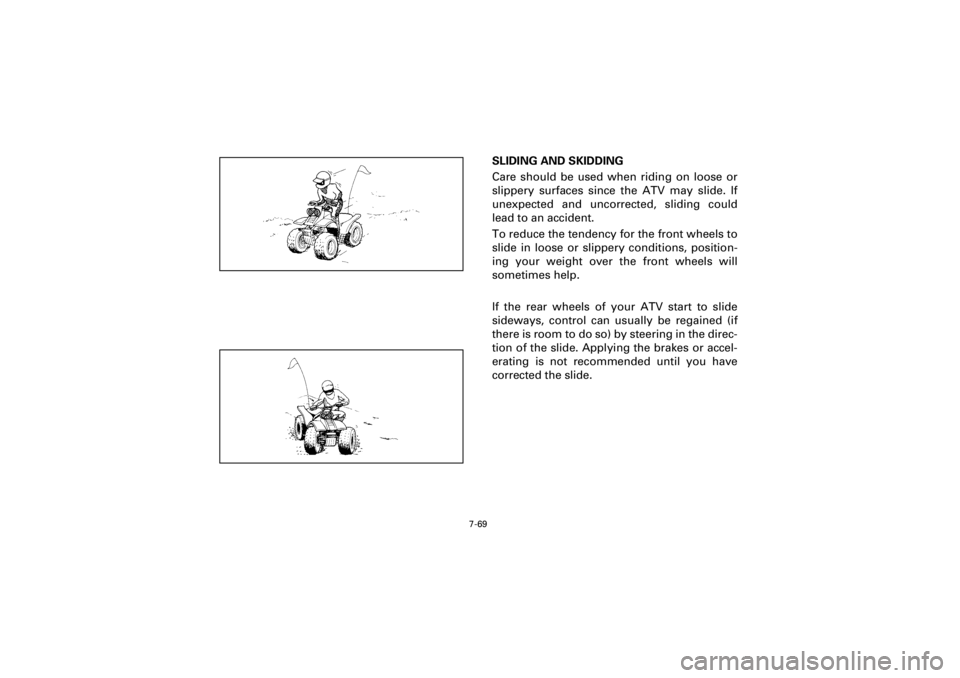
SLIDING AND SKIDDING
Care should be used when riding on loose or
slippery surfaces since the ATV may slide. If
unexpected and uncorrected, sliding could
lead to an accident.
To reduce the tendency for the front wheels to
slide in loose or slippery conditions, position-
ing your weight over the front wheels will
sometimes help.
If the rear wheels of your ATV start to slide
sideways, control can usually be regained (if
there is room to do so) by steering in the direc-
tion of the slide. Applying the brakes or accel-
erating is not recommended until you have
corrected the slide.
Page 236 of 370

7-73
Yuki_Data:Yuki_data:Yuki:Yuki_1:ATV:HM00B067_YFM350X-60:YFM350-7.frame
EL
WHAT TO DO IF...
This section is designed to be a reference
guide only. Be sure to read each section on
riding techniques completely.
WHAT TO DO...l
If your ATV doesn’t turn when you want it
to:
Bring the ATV to a stop and practice the
turning maneuvers again. Be sure you are
putting your weight on the footboard to the
outside of the turn. Position your weight
over the front wheels for better control.
(See pages 7-39 ~ 7-43.)
l
If your ATV begins to tip while turning:
Lean more into the turn to regain balance. If
necessary, gradually let off the throttle
and/or steer to the outside of the turn. (See
pages 7-39 ~ 7-43.)
l
If your ATV starts to slide sideways:
Steer in the direction of the slide if you have
the room.
Applying the brakes or accelerating is not
recommended until you have corrected the
slide. (See pages 7-69 ~ 7-71.)
Page 248 of 370
8-7
Yuki_Data:Yuki_data:Yuki:Yuki_1:ATV:HM00B067_YFM350X-60:YFM350-8.frame
EL
EBU00262
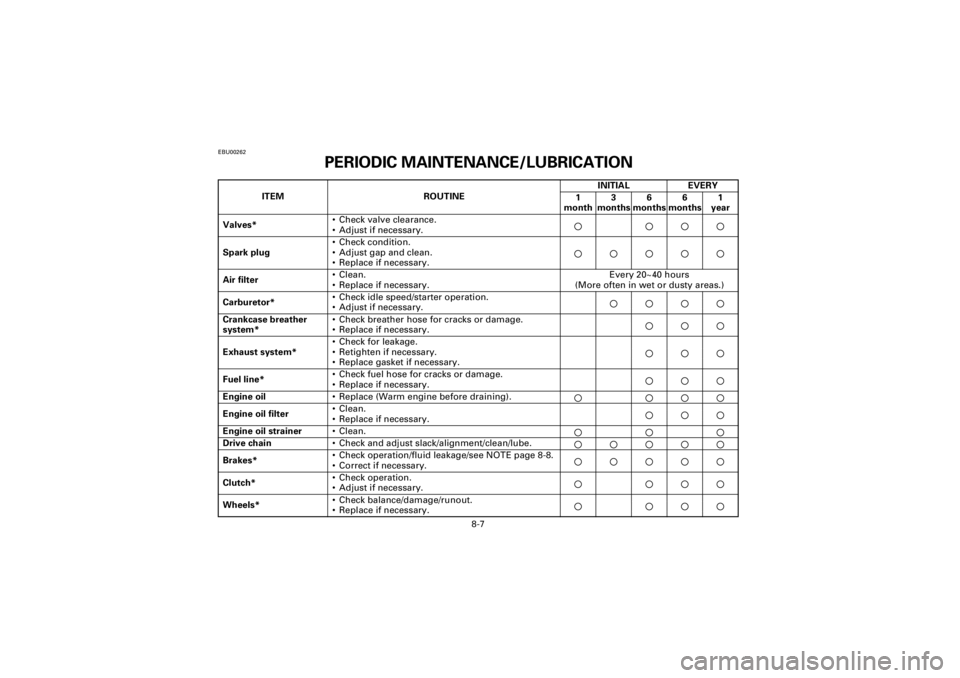
PERIODIC MAINTENANCE/LUBRICATION
ITEM ROUTINEINITIAL EVERY
1
month3
months6
months6
months1
year
Valves*
• Check valve clearance.
• Adjust if necessary.
Spark plug
• Check condition.
• Adjust gap and clean.
• Replace if necessary.
Air filter
• Clean.
• Replace if necessary.Every 20~40 hours
(More often in wet or dusty areas.)
Carburetor*
• Check idle speed/starter operation.
• Adjust if necessary.
Crankcase breather
system*
• Check breather hose for cracks or damage.
• Replace if necessary.
Exhaust system*
• Check for leakage.
• Retighten if necessary.
• Replace gasket if necessary.
Fuel line*
• Check fuel hose for cracks or damage.
• Replace if necessary.
Engine oil
• Replace (Warm engine before draining).
Engine oil filter
• Clean.
• Replace if necessary.
Engine oil strainer
• Clean.
Drive chain
• Check and adjust slack/alignment/clean/lube.
Brakes*
• Check operation/fluid leakage/see NOTE page 8-8.
• Correct if necessary.
Clutch*
• Check operation.
• Adjust if necessary.
Wheels*
• Check balance/damage/runout.
• Replace if necessary.
Page 249 of 370
8-8
Yuki_Data:Yuki_data:Yuki:Yuki_1:ATV:HM00B067_YFM350X-60:YFM350-8.frame
ER
* It is recommended that these items be serviced by a Yamaha dealer.
** Lithium-soap-based grease
NOTE:
Brake fluid replacement:
1. When disassembling the master cylinder or caliper cylinder, replace the brake fluid. Normally
check the brake fluid level and add fluid as required.
2. On the inner parts of the master cylinder and caliper cylinder, replace the oil seals every two
years.
3. Replace the brake hoses every four years, or if cracked or damaged.
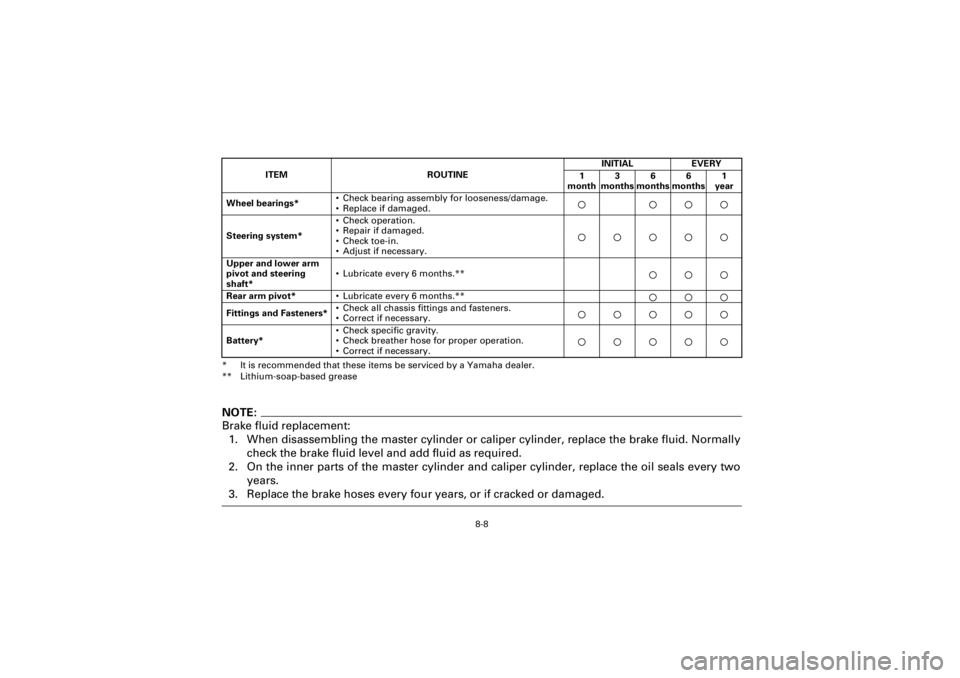
Wheel bearings*
• Check bearing assembly for looseness/damage.
• Replace if damaged.
Steering system*
• Check operation.
• Repair if damaged.
• Check toe-in.
• Adjust if necessary.
Upper and lower arm
pivot and steering
shaft*
• Lubricate every 6 months.**
Rear arm pivot*
• Lubricate every 6 months.**
Fittings and Fasteners*
• Check all chassis fittings and fasteners.
• Correct if necessary.
Battery*
• Check specific gravity.
• Check breather hose for proper operation.
• Correct if necessary.
ITEM ROUTINEINITIAL EVERY
1
month3
months6
months6
months1
year
Page 294 of 370
8-53
Yuki_Data:Yuki_data:Yuki:Yuki_1:ATV:HM00B067_YFM350X-60:YFM350-8.frame
EL
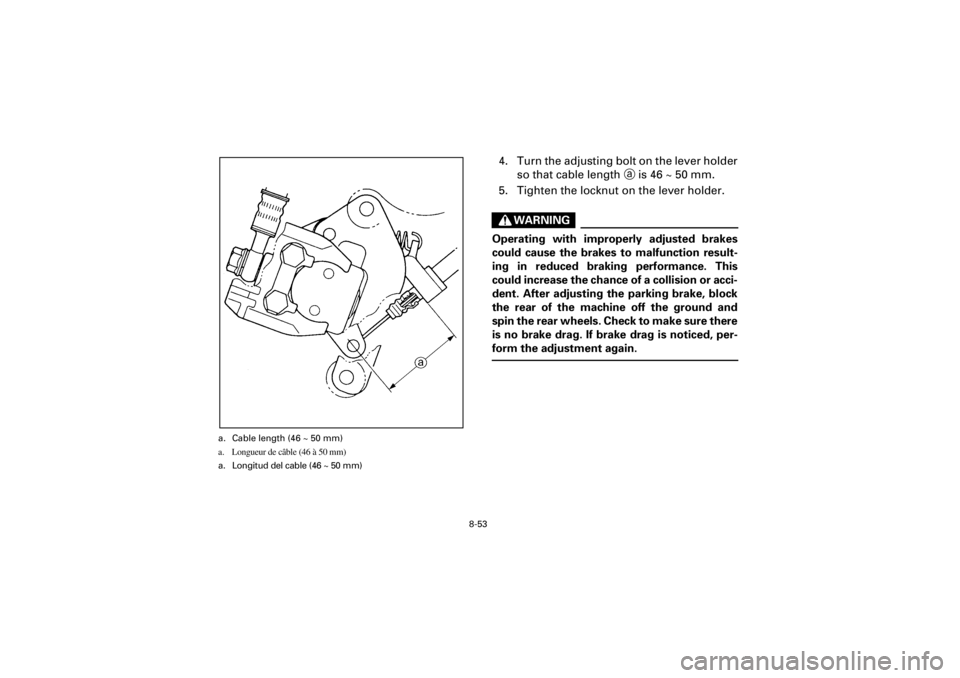
a. Cable length (46 ~ 50 mm)
a. Longueur de câble (46 à 50 mm)
a. Longitud del cable (46 ~ 50 mm)
4. Turn the adjusting bolt on the lever holder
so that cable length a is 46 ~ 50 mm.
5. Tighten the locknut on the lever holder.
WARNING
Operating with improperly adjusted brakes
could cause the brakes to malfunction result-
ing in reduced braking performance. This
could increase the chance of a collision or acci-
dent. After adjusting the parking brake, block
the rear of the machine off the ground and
spin the rear wheels. Check to make sure there
is no brake drag. If brake drag is noticed, per-form the adjustment again.
Page 300 of 370
8-59
Yuki_Data:Yuki_data:Yuki:Yuki_1:ATV:HM00B067_YFM350X-60:YFM350-8.frame
EL
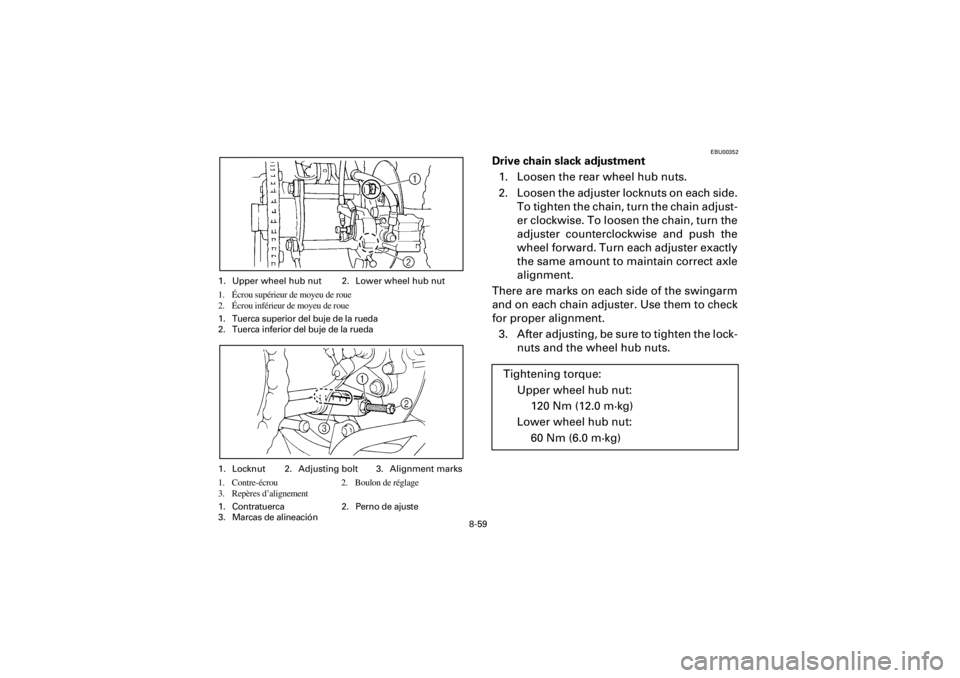
1. Upper wheel hub nut 2. Lower wheel hub nut
1. Écrou supérieur de moyeu de roue
2. Écrou inférieur de moyeu de roue
1. Tuerca superior del buje de la rueda
2. Tuerca inferior del buje de la rueda
EBU00352
Drive chain slack adjustment
1. Loosen the rear wheel hub nuts.
2. Loosen the adjuster locknuts on each side.
To tighten the chain, turn the chain adjust-
er clockwise. To loosen the chain, turn the
adjuster counterclockwise and push the
wheel forward. Turn each adjuster exactly
the same amount to maintain correct axle
alignment.
There are marks on each side of the swingarm
and on each chain adjuster. Use them to check
for proper alignment.
3. After adjusting, be sure to tighten the lock-
nuts and the wheel hub nuts.
Tightening torque:
Upper wheel hub nut:
120 Nm (12.0 m·kg)
Lower wheel hub nut:
60 Nm (6.0 m·kg)
1. Locknut 2. Adjusting bolt 3. Alignment marks
1. Contre-écrou 2. Boulon de réglage
3. Repères d’alignement
1. Contratuerca 2. Perno de ajuste
3. Marcas de alineación