belt YAMAHA WOLVERINE 2015 Owner's Manual
[x] Cancel search | Manufacturer: YAMAHA, Model Year: 2015, Model line: WOLVERINE, Model: YAMAHA WOLVERINE 2015Pages: 186, PDF Size: 4.22 MB
Page 97 of 186
7-7
7
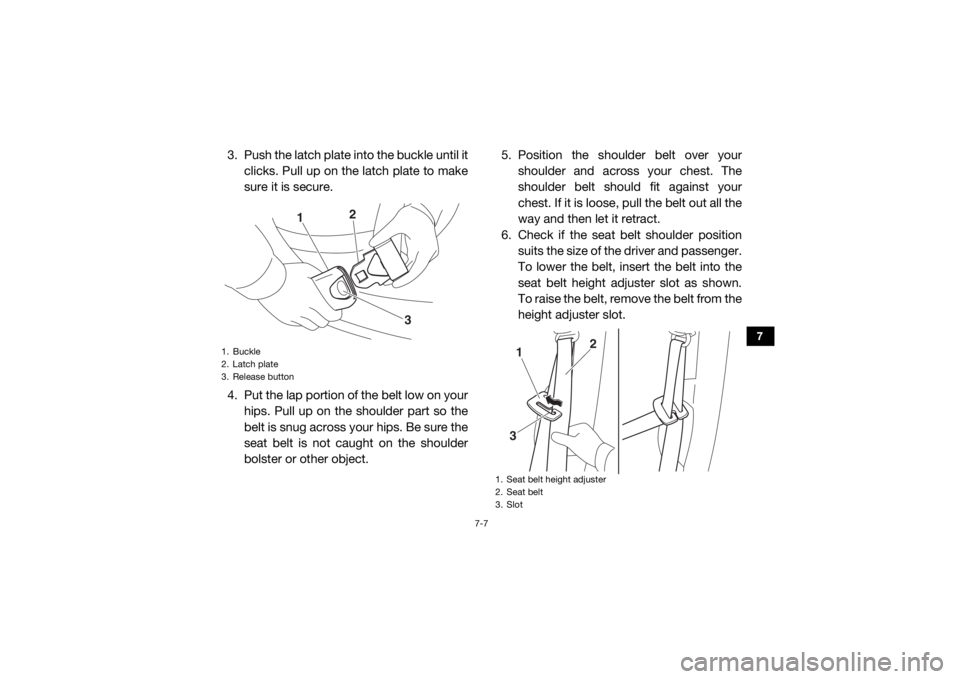
3. Push the latch plate into the buckle until itclicks. Pull up on the latch plate to make
sure it is secure.
4. Put the lap portion of the belt low on your hips. Pull up on the shoulder part so the
belt is snug across your hips. Be sure the
seat belt is not caught on the shoulder
bolster or other object. 5. Position the shoulder belt over your
shoulder and across your chest. The
shoulder belt should fit against your
chest. If it is loose, pull the belt out all the
way and then let it retract.
6. Check if the seat belt shoulder position suits the size of the driver and passenger.
To lower the belt, insert the belt into the
seat belt height adjuster slot as shown.
To raise the belt, remove the belt from the
height adjuster slot.1. Buckle
2. Latch plate
3. Release button
1
3
2
1. Seat belt height adjuster
2. Seat belt
3. Slot
1
2
3
U2MB7AE0.book Page 7 Thursday, January 29, 2015 3:42 PM
Page 110 of 186
7-20
7
Pavement
This vehicle is designed for off-road use only.
Avoid paved surfaces. Turn gradually and go
slowly if you must drive on pavement.
Water
If you must cross shallow, slow-moving water
up to the depth of the vehicle’s floorboard,
choose your path carefully to avoid sharp
drop-offs, large rocks, or slippery surfaces
that could cause the vehicle to overturn. Nev-
er operate through water deeper than 37 cm
(15 in) or fast-flowing water. Choose a path
where both your entrance into and exit point
from the water is a gradual incline. Determine
the water depth and currents before crossing.
Operating this vehicle through deep or fast-
flowing water can lead to loss of control or
overturn. To reduce your risk of drowning or
other injuries, use care when crossing
through water.Wet brakes may have reduced effectiveness.
After leaving the water, test your brakes. If
necessary, apply the brakes several times to
let friction dry out the linings.
NOTICEECB02170After driving your vehicle in water, be sure
to drain the trapped water by removing the
check hoses at the bottom of the air filter
case and air duct and the V-belt case drain
plug. Wash the vehicle in fresh water if it
has been operated in salt water or muddy
conditions. Loose terrain/slippery terrain
When driving on slippery terrain, including
wet, muddy, or icy conditions, as well as
loose gravel, be aware that you could begin
skidding or sliding. To avoid loss of control,
slow down and put the vehicle in four-wheel
drive before driving on a slippery surface and
plan your path to avoid making abrupt ma-
neuvers.
U2MB7AE0.book Page 20 Thursday, January 29, 2015 3:42 PM
Page 148 of 186
8-36
8
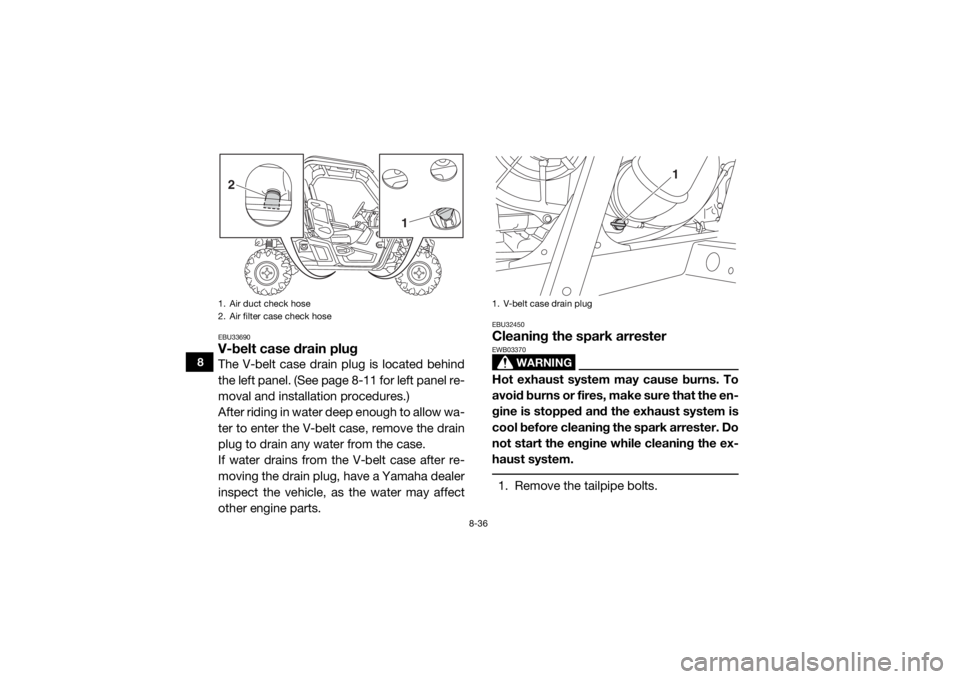
EBU33690V-belt case drain plugThe V-belt case drain plug is located behind
the left panel. (See page 8-11 for left panel re-
moval and installation procedures.)
After riding in water deep enough to allow wa-
ter to enter the V-belt case, remove the drain
plug to drain any water from the case.
If water drains from the V-belt case after re-
moving the drain plug, have a Yamaha dealer
inspect the vehicle, as the water may affect
other engine parts.
EBU32450Cleaning the spark arrester
WARNING
EWB03370Hot exhaust system may cause burns. To
avoid burns or fires, make sure that the en-
gine is stopped and the exhaust system is
cool before cleaning the spark arrester. Do
not start the engine while cleaning the ex-
haust system. 1. Remove the tailpipe bolts.
1. Air duct check hose
2. Air filter case check hose2
1
1. V-belt case drain plug
1
U2MB7AE0.book Page 36 Thursday, January 29, 2015 3:42 PM
Page 178 of 186

10-3
10
Secondary reduction ratio:43/21 × 17/12 × 33/9 (10.636)
Transmission type: V-belt automatic
Operation:
Right hand operation
Reverse gear: 23/14 × 28/23 (2.000)
Low range: 31/16 (1.938)
High range:
30/22 (1.364)Chassis:Frame type:Steel tube frame
Caster angle:
3.7 °
Trail: 19.0 mm (0.75 in)Front tire:Type:
Tubeless
Size: 26 x 8-12NHS
Manufacturer/model: MAXXIS/MU09Rear tire:Type:Tubeless
Size: 26 x 10-12NHS Manufacturer/model:
MAXXIS/MU10
Loading:Maximum loading limit:
327.0 kg (721 lb)
(Total weight of operator, passengers, cargo, accessories,
and tongue)Tire air pressure (measured on cold tires):Recommended:
Vehicle load: 0 - maximum
Front:
75.0 kPa (0.750 kgf/cm², 11 psi)
Rear: 75.0 kPa (0.750 kgf/cm², 11 psi)
Minimum: Vehicle load: 0 - maximum
Front: 70.0 kPa (0.700 kgf/cm², 10 psi)
Rear:
70.0 kPa (0.700 kgf/cm², 10 psi)Front wheel:Wheel type:Panel wheel
Rim size:
12 x 6.0ATRear wheel:Wheel type:Panel wheel
U2MB7AE0.book Page 3 Thursday, January 29, 2015 3:42 PM
Page 180 of 186

10-5
10
High-range indicator light:LED
Low-range indicator light: LED
Differential gear lock indicator light:
LED
EPS warning light: LED (YXE70WPHG, YXE70WPXG)
Helmet/Seat belt indicator light: 14 V, 0.85 W × 2Fuses:Main fuse:
40.0 A
Fuel injection system fuse: 10.0 A
EPS fuse:
40.0 A (YXE70WPHG, YXE70WPXG)
Headlight fuse: 15.0 A
Signaling system fuse: 10.0 A
Ignition fuse:
10.0 A
Auxiliary DC jack fuse: 10.0 A
Backup fuse: 10.0 A
Four-wheel-drive motor fuse:
10.0 A
Radiator fan motor fuse: 25.0 A
EBU33220For Europe only
The figures quoted are emission levels and
are not necessarily safe working levels. Whilst
there is a correlation between the emission
and exposure levels, this cannot be used reli-
ably to determine whether or not further pre-
cautions are required. Factors that influence
the actual level of exposure of work-force in-
clude the characteristics of the work room,
the other sources of noise, etc. i.e. the num-
ber of machines and other adjacent process-
es, and the length of time for which an
operator is exposed to the noise. Also the
permissible exposure level can vary from
country. This information, however, will en-
able the user of the machine to make a better
evaluation of the hazard and risk.
U2MB7AE0.book Page 5 Thursday, January 29, 2015 3:42 PM
Page 184 of 186

12-2
12
Indicator lights and warning lights ................................. 4-2
Instruments, lights and switches, Pre-operation check ........................................................................... 5-8JJump-starting ............................................................... 8-50LLabel locations ............................................................... 1-1
Light switch .................................................................. 4-10
Loading ..........................................................................6-7
Low-range indicator light ............................................... 4-2MMain switch .................................................................... 4-1
Maintenance and lubrication chart ................................8-6
Maintenance chart, emission control system ................ 8-4
Model label ................................................................... 11-1
Multi-function meter unit ................................................ 4-6NNeutral indicator light .....................................................4-3OOn-Command drive knob ............................................ 4-11
On-Command drive knob, operation ............................. 6-5
On-Command four-wheel-drive /differential gear lock
indicator ....................................................................... 4-3
Owner’s manual and tool kit .......................................... 8-2PPanels .......................................................................... 8-11
Parking ........................................................................... 6-7
Parking brake ............................................................... 8-41
Parking brake indicator light .......................................... 4-3
Parking brake lever ...................................................... 4-13
Passenger handhold, Pre-operation check ................... 5-7
RRear knuckle upper and lower pivot, lubrication ......... 8-43
Reverse indicator light ................................................... 4-3SSafety information .......................................................... 2-1
Seat belt indicator light .................................................. 4-5
Seat belts ..................................................................... 4-17
Seat belts, Pre-operation check .................................... 5-7
Seats ............................................................................ 4-15
Shock absorber assemblies, adjusting the front ......... 4-22
Shock absorber assemblies, adjusting the rear ........... 4-27
Spark arrester, cleaning ............................................... 8-36
Spark plug, inspecting ................................................. 8-30
Specifications .............................................................. 10-1
Stabilizer bushes, checking ......................................... 8-43
Starting the engine ......................................................... 6-2
Steering, Pre-operation check ....................................... 5-7
Steering shaft, lubrication ............................................ 8-44
Storage .......................................................................... 9-2
Storage compartments ................................................ 4-18TTail/brake light bulb, replacing ..................................... 8-57
Tire, replacing .............................................................. 8-45
Tires, Pre-operation check ............................................. 5-8
Trailer hitch bracket and receiver ................................ 4-32
Troubleshooting ........................................................... 8-57
Troubleshooting charts ................................................ 8-59VValve clearance ............................................................ 8-38
V-belt case drain plug .................................................. 8-36
Vehicle identification number ....................................... 11-1
U2MB7AE0.book Page 2 Thursday, January 29, 2015 3:42 PM