lock YAMAHA WOLVERINE 2015 Owner's Manual
[x] Cancel search | Manufacturer: YAMAHA, Model Year: 2015, Model line: WOLVERINE, Model: YAMAHA WOLVERINE 2015Pages: 186, PDF Size: 4.22 MB
Page 104 of 186
7-14
7
Become familiar with the way the vehicle feels
in low and high ranges, first in two-wheel
drive “2WD” and then in four-wheel drive
“4WD” and four-wheel drive with the differen-
tial locked “DIFF LOCK”. Steering may take
more effort in four-wheel drive with the differ-
ential locked “DIFF LOCK”. Also practice
driving in reverse.
Take the time to learn basic operation of the
vehicle before attempting more difficult ma-
neuvers. Getting ready to ride
Perform the Pre-Operation Checks on page
5-1. Follow the instructions starting on page
6-2 to start the engine.
Turning
Use care in turns – turning the steering wheel
too far or too fast can result in loss of control
or a rollover. Slow down before entering
turns. When making tight turns from a stand-
still or at slow speeds, avoid sudden or hard
acceleration. Driving aggressively or making
abrupt maneuvers even on flat, open areas
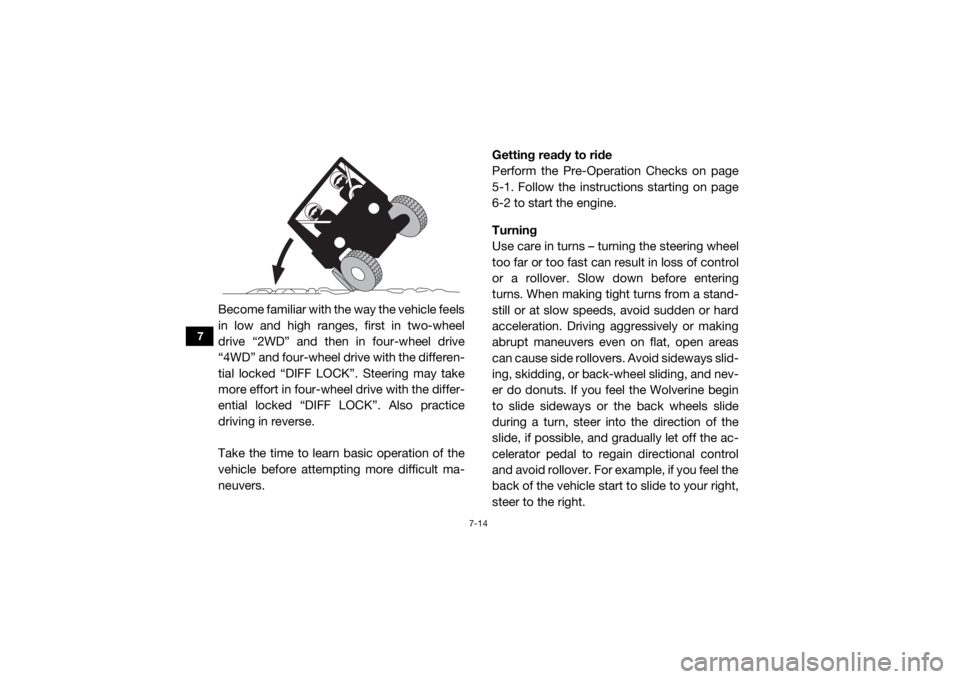
can cause side rollovers. Avoid sideways slid-
ing, skidding, or back-wheel sliding, and nev-
er do donuts. If you feel the Wolverine begin
to slide sideways or the back wheels slide
during a turn, steer into the direction of the
slide, if possible, and gradually let off the ac-
celerator pedal to regain directional control
and avoid rollover. For example, if you feel the
back of the vehicle start
to slide to your right,
steer to the right.U2MB7AE0.book Page 14 Thursday, January 29, 2015 3:42 PM
Page 106 of 186

7-16
7
the vehicle down after you take your foot off
the accelerator. Engine braking is more no-
ticeable in four-wheel drive. Application of ve-
hicle brakes provides additional stopping
power.
Leaving the vehicle
Do not get out of the vehicle while the engine
is running and the drive select lever is in any
gear. There is a risk of injury because:
Children or others may accidentally press
the accelerator pedal.
Objects tossed into the vehicle may strike
the accelerator pedal.
The parking brake may not keep the vehicle
from accelerating.
Unwanted vehicle movement can cause seri-
ous injury or death, and it may be dangerous
to try to stop the vehicle. Parking on a flat area
When parking on a flat area, stop the engine
and shift the drive select lever into the neutral
position. Apply the parking brake to help pre-
vent the vehicle from rolling.
Parking on a slope
The parking brake acts only on the rear
wheels when in “2WD”. For the parking brake
to take effect on all four wheels, shift to “DIFF
LOCK” before stopping the engine.
If you park on a hill that is too steep, the vehi-
cle may roll out of control. Never park on hills
that are so steep you cannot walk up them
easily. If you must park on an incline, follow
these instructions:
1. Bring the vehicle to a stop by applying the brake pedal.
2. Put the vehicle in “DIFF LOCK”.
3. Turn the key to “ ” (off).
4. With the brake pedal applied, set the parking brake.U2MB7AE0.book Page 16 Thursday, January 29, 2015 3:42 PM
Page 107 of 186
7-17
7
5. Block the front and rear wheels withrocks or other objects.
Loading
The total weight of operator, passenger, ac-
cessories, cargo, trailer tongue weight, and
the vehicle itself must not exceed 975 kg
(2150 lb). Vehicle loading can affect handling.
See “Loading” on page 6-7.EBU33730Operation on different surfaces and
terrainsGo slowly and proceed with caution when op-
erating on an unfamiliar surface or terrain.
This vehicle may handle differently in certain
types of terrains or on certain surfaces. You
may come upon hidden rocks, bumps, or
holes without enough time to react. To avoid
loss of control or rollover, always be alert to
changing surfaces or terrain when operating
the vehicle. Your Yamaha Wolverine has higher ground
clearance and other features to handle rug-
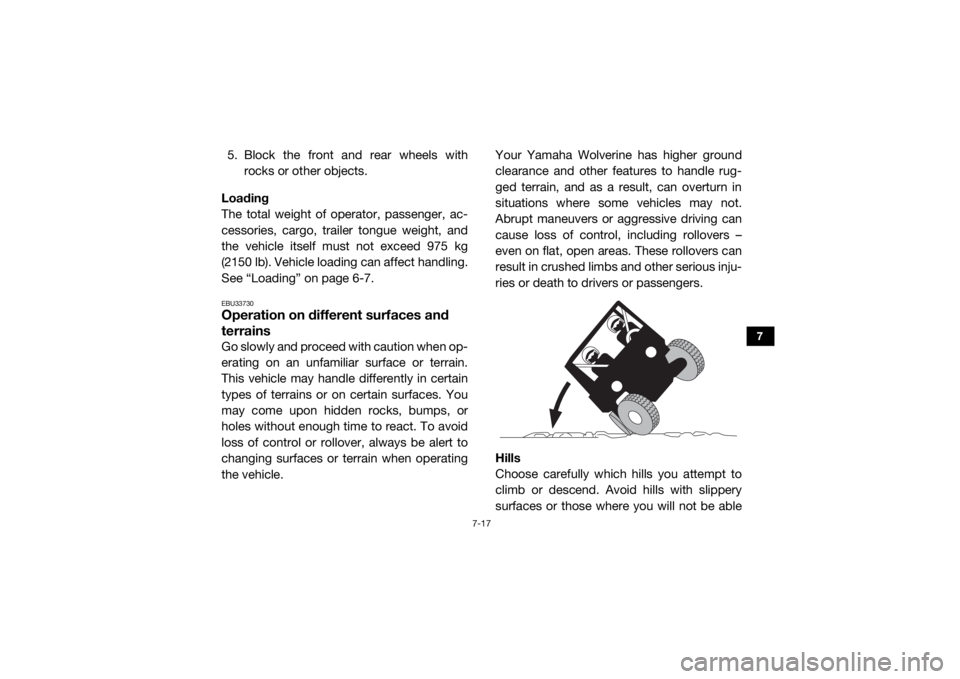
ged terrain, and as a result, can overturn in
situations where some vehicles may not.
Abrupt maneuvers or aggressive driving can
cause loss of control, including rollovers –
even on flat, open area
s. These rollovers can
result in crushed limbs and other serious inju-
ries or death to drivers or passengers.
Hills
Choose carefully which hills you attempt to
climb or descend. Avoid hills with slippery
surfaces or those where you will not be ableU2MB7AE0.book Page 17 Thursday, January 29, 2015 3:42 PM
Page 108 of 186

7-18
7
to see far enough ahead of you. Use common
sense and remember that some hills are too
steep for you to climb or descend. Use proper
driving techniques to avoid rearward, for-
ward, or sideways rollovers on hills and
slopes.
Drive straight up and down inclines, not
across them. If crossing a hill is unavoidable,
drive slowly. Turn downhill immediately if you
feel the vehicle may tip.
If you think or feel the vehicle may tip or
roll:
Brace yourself by pressing your feet firmly
on the floorboard and keep a firm grip on
the steering wheel or passenger handhold.
Do not put your hands or feet outside of the
vehicle for any reason.
Uphill
Do not attempt to climb hills until you have
mastered basic maneuvers on flat ground.
Drive straight up hills, and avoid crossing the side of a hill, which increases your risk of roll-
over. Practice first on gentle slopes before at-
tempting steeper hills. Always check the
terrain carefully before attempting any hill.
To climb a hill, you need traction, momentum,
and steady throttle. For more traction and
control for climbing steeper and/or rougher
slopes, shift into low gear and select “4WD”
or “DIFF LOCK”. Travel fast enough to main-
tain momentum, but not so fast that you can-
not react to changes in the terrain as you
climb.
Slow down when you reach the crest of the
hill if you cannot see clearly what is on the
other side – there could be another person, an
obstacle, or a sharp drop-off.
If you start to lose traction or momentum
when climbing, and decide you will be unable
to continue, use the brakes to stop. Do not at-
tempt to turn the vehicle around. With your
foot on the brake pedal, look behind you and
plan your descent. Shift the drive select lever
into reverse so you can use engine braking toU2MB7AE0.book Page 18 Thursday, January 29, 2015 3:42 PM
Page 109 of 186

7-19
7
slow your descent. Release the brake and be-
gin to coast down the hill. Use engine braking
as much as possible, gently applying the
brakes when necessary.
Downhill
Check the terrain carefully before going
downhill. When possible, choose a path that
lets you drive your vehicle straight downhill.
Choose your path carefully and drive slowly
enough to be able to react to obstacles that
you encounter.
For more traction and control, before going
down steeper and/or rougher slopes, shift
into low gear and select “4WD” or “DIFF
LOCK”. Engine braking will help you go
downhill slowly. Go as slowly as possible. If
you begin to go too fast, apply the brakes
gently. Avoid hard application of the brakes,
which could cause the vehicle to slide. If you are sliding or skidding, try to steer in the
direction the vehicle is sliding, to regain con-
trol. For example, if you feel the back of the
vehicle start to slide to your right, steer to the
right.
If you must turn on the hill to avoid an obsta-
cle, do so slowly and carefully. If the vehicle
starts to tip, immediately steer in the downhill
direction if there are no obstacles in your
path. As you regain proper balance, gradually
steer again in the direction you want to go.
Rough terrain
Operation over rough terrain should be done
with caution.
Look for and avoid obstacles that could
cause damage to the vehicle or could lead
to a rollover or accident.
Do not drive in a way that will get the vehicle
airborne, as injury, loss of control, and
damage to the vehicle could occur.U2MB7AE0.book Page 19 Thursday, January 29, 2015 3:42 PM
Page 122 of 186
8-10
8
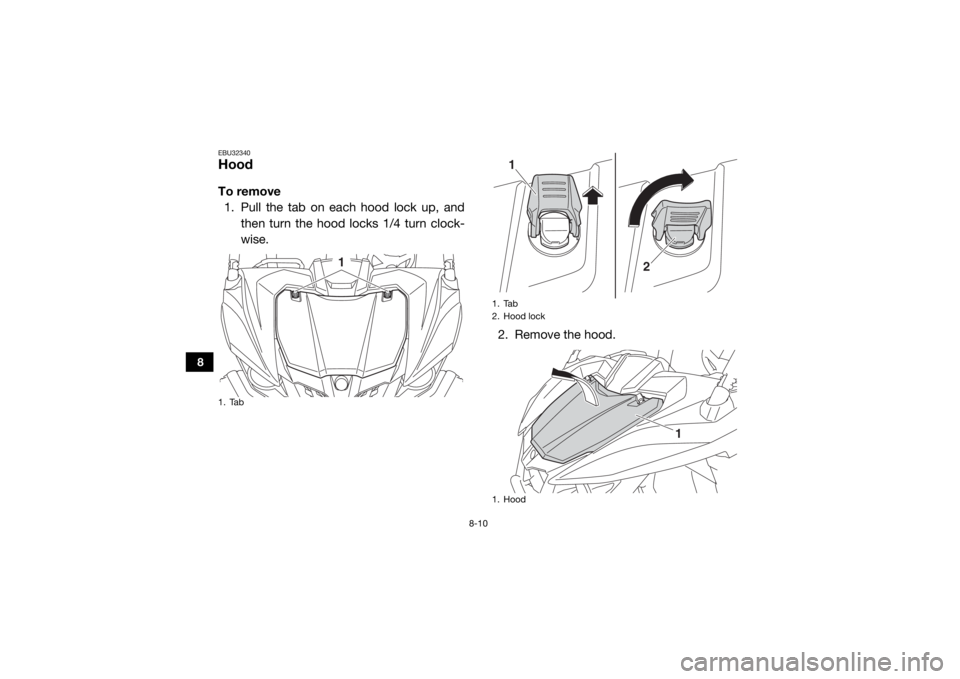
EBU32340HoodTo remove1. Pull the tab on each hood lock up, and then turn the hood locks 1/4 turn clock-
wise.
2. Remove the hood.1. Tab
1
1. Tab
2. Hood lock
1. Hood
1
2
1
U2MB7AE0.book Page 10 Thursday, January 29, 2015 3:42 PM
Page 123 of 186
8-11
8
To install1. Insert the projections on the hood into the
slots in the front grill, and then place the
hood in the original position.
2. Turn the hood locks 1/4 turn counter- clockwise, and then push the tab on each
hood lock down so that it is pointing rear-
ward. Make sure that the hood is securely
installed.NOTICEECB02180Do not drive the vehicle with the hood
open, unlatched, or removed.
EBU33601PanelsLeft panel
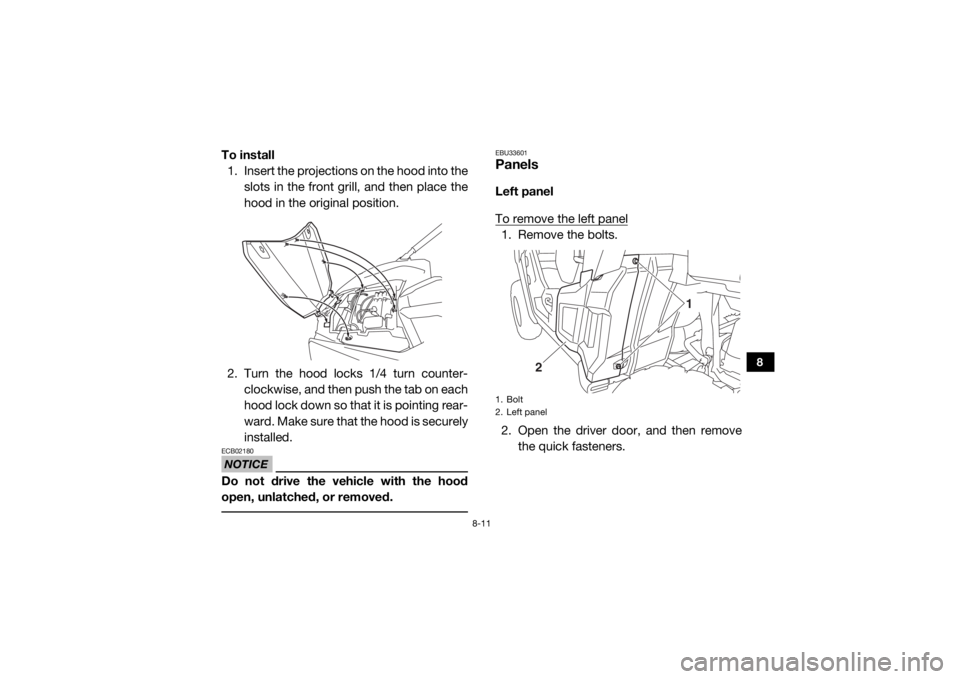
To remove the left panel1. Remove the bolts.
2. Open the driver door, and then removethe quick fasteners.1. Bolt
2. Left panel
1
2
U2MB7AE0.book Page 11 Thursday, January 29, 2015 3:42 PM
Page 152 of 186

8-40
8
Clean the filler cap before removing. Use
only DOT 4 brake fluid from a sealed
container.
Use only the specified brake fluid; other-
wise, the rubber seals may deteriorate,
causing leakage.
Refill with the same type of brake fluid.
Adding a brake fluid other than DOT 4
may result in a harmful chemical reac-
tion.
Be careful that water does not enter the
brake fluid reservoir when refilling. Wa-
ter will significantly lower the boiling
point of the fluid and may result in vapor
lock. NOTICEECB01161Brake fluid may damage painted surfaces
or plastic parts. Always clean up spilled
fluid immediately.
As the brake pads wear, it is normal for the
brake fluid level to gradually go down. A low
brake fluid level may indicate worn brake
pads and/or brake system leakage; therefore,
be sure to check the brake pads for wear and
the brake system for leakage. If the brake fluid
level goes down suddenly, have a Yamaha
dealer check the cause before further riding.EBU32520Brake fluid replacementComplete fluid replacement should be done
only by trained Yamaha service personnel.
Have a Yamaha dealer replace the following
components during periodic maintenance or
when they are damaged or leaking.
Replace the oil seals every two years.
Replace the brake hoses every four years.EBU32530Checking the brake pedalHave a Yamaha dealer check the brakes at
the intervals specified in the periodic mainte-
nance and lubrication chart. There should be
U2MB7AE0.book Page 40 Thursday, January 29, 2015 3:42 PM
Page 164 of 186
8-52
8
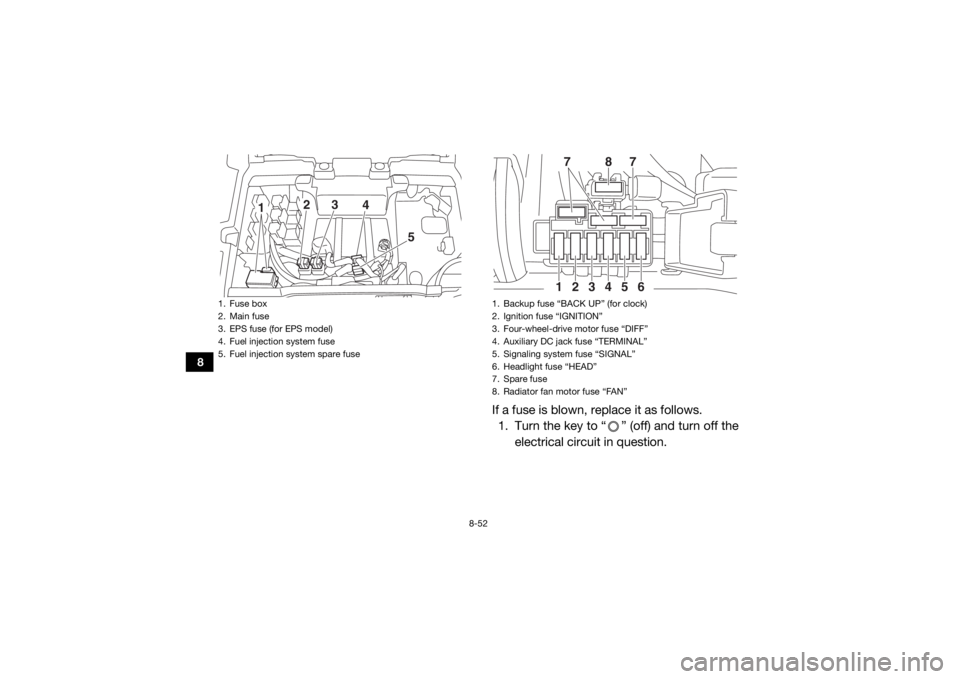
If a fuse is blown, replace it as follows.1. Turn the key to “ ” (off) and turn off the
electrical circuit in question.
1. Fuse box
2. Main fuse
3. EPS fuse (for EPS model)
4. Fuel injection system fuse
5. Fuel injection system spare fuse
1 3
2
4
5
1. Backup fuse “BACK UP” (for clock)
2. Ignition fuse “IGNITION”
3. Four-wheel-drive motor fuse “DIFF”
4. Auxiliary DC jack fuse “TERMINAL”
5. Signaling system fuse “SIGNAL”
6. Headlight fuse “HEAD”
7. Spare fuse
8. Radiator fan motor fuse “FAN”
1
2
3
4
5
6
8
7
7
U2MB7AE0.book Page 52 Thursday, January 29, 2015 3:42 PM
Page 169 of 186
8-57
8
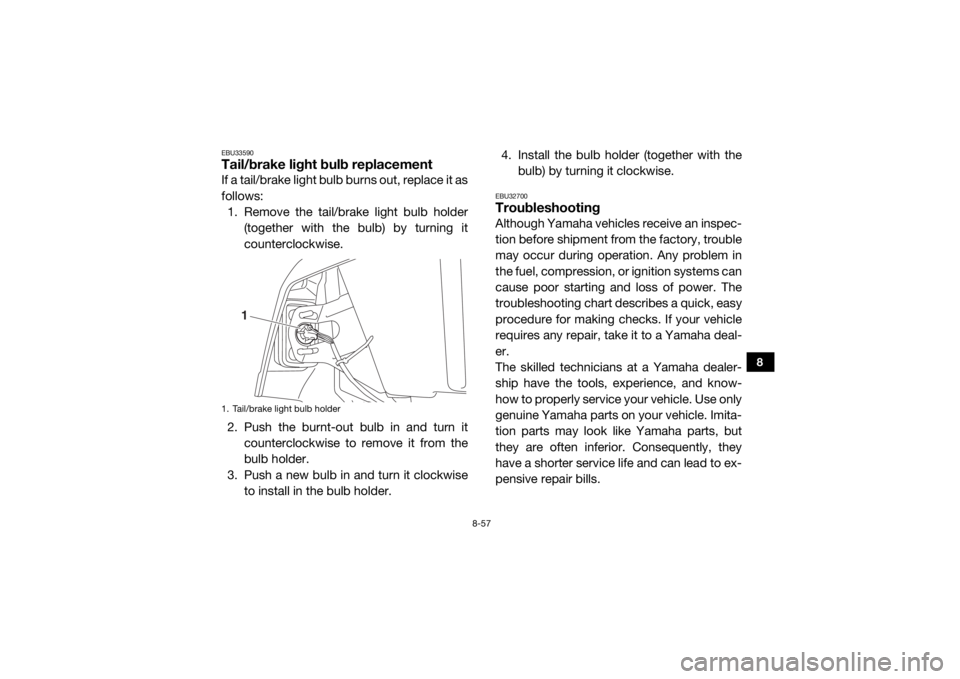
EBU33590Tail/brake light bulb replacementIf a tail/brake light bulb burns out, replace it as
follows:1. Remove the tail/brake light bulb holder
(together with the bulb) by turning it
counterclockwise.
2. Push the burnt-out bulb in and turn it counterclockwise to remove it from the
bulb holder.
3. Push a new bulb in and turn it clockwise to install in the bulb holder. 4. Install the bulb holder (together with the
bulb) by turning it clockwise.
EBU32700TroubleshootingAlthough Yamaha vehicles receive an inspec-
tion before shipment from the factory, trouble
may occur during operation. Any problem in
the fuel, compression, or ignition systems can
cause poor starting and loss of power. The
troubleshooting chart describes a quick, easy
procedure for making checks. If your vehicle
requires any repair, take it to a Yamaha deal-
er.
The skilled technicians at a Yamaha dealer-
ship have the tools, experience, and know-
how to properly service your vehicle. Use only
genuine Yamaha parts on your vehicle. Imita-
tion parts may look like Yamaha parts, but
they are often inferior. Consequently, they
have a shorter service life and can lead to ex-
pensive repair bills.
1. Tail/brake light bulb holder
1
U2MB7AE0.book Page 57 Thursday, January 29, 2015 3:42 PM