steering wheel YAMAHA WOLVERINE 2016 User Guide
[x] Cancel search | Manufacturer: YAMAHA, Model Year: 2016, Model line: WOLVERINE, Model: YAMAHA WOLVERINE 2016Pages: 192, PDF Size: 4.38 MB
Page 34 of 192

2-5
2
If you think or feel that the vehicle may tip or ro ll, keep your body completely inside the protec-
tive structure of the vehicle:
• Brace yourself by pressing your feet firmly on the floorboard and keep a firm grip on the
steering wheel or passenger handhold.
• Do not put your hands or feet outside of the vehicle for any reason. Your arm or leg could be
crushed.
• Do not try to stop a vehicle tipover using your arm or leg.
Do not operate this vehicle on any public street, road, or highway, even if dirt or gravel.
Do not operate the vehicle in fast-flowing water or water deeper than 37 cm (15 in). If you must
cross shallow, slow-moving water, choose your path carefully to avoid sharp drop-offs, large
rocks, or slippery surfaces. Operating this vehi cle through deep or fast-flowing water can lead
to loss of control or overturn. To reduce your risk of drowning or other injuries, use care when
crossing through water.
When loaded with cargo or towing a trailer:
• Reduce speed, operate in low gear only, and allow more room to stop.
• Avoid hills and rough terrain. Use extreme caution when towing or carrying a load on inclines.
• Load trailer properly and use extra care when towing or pulling.
Do not tow or pull objects from any part of the vehicle other than the trailer hitch bracket or
winch (if installed).
Avoid carbon monoxide poisoning
All engine exhaust contains carbon monoxide, a deadly gas. Breathing carbon monoxide can
cause headaches, dizziness, drowsiness, nausea, confusion, and eventually death.UBN57AE0.book Page 5 Tuesday, November 24, 2015 1:42 PM
Page 39 of 192
3-3
3
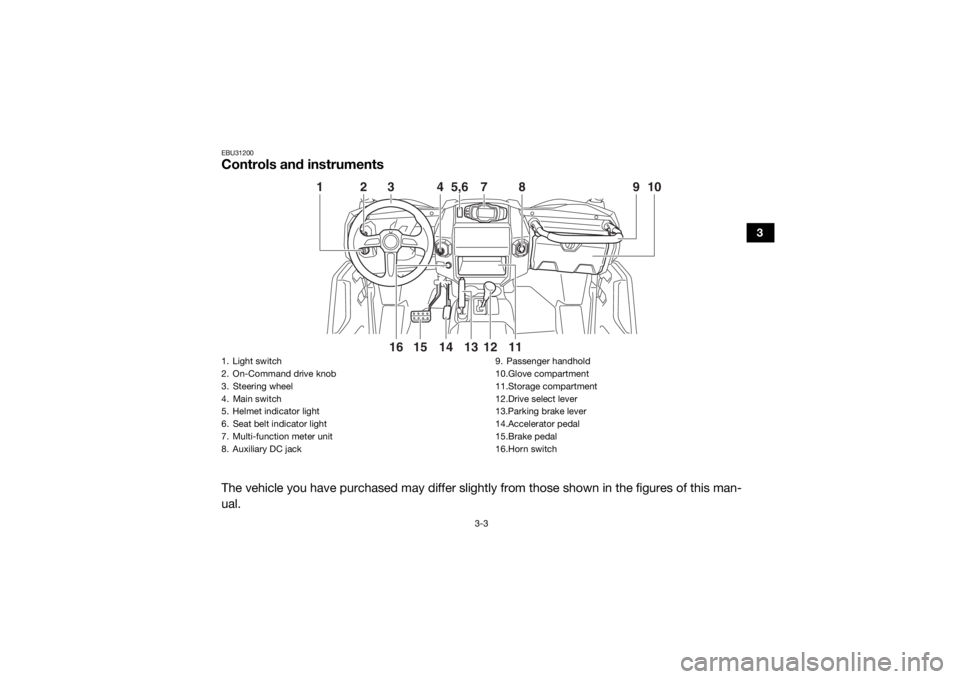
EBU31200Controls and instrumentsThe vehicle you have purchased may differ slightly from those shown in the figures of this man-
ual.
15
14
3
4
5,6
7
2
13
11
16
12
8
1
10
9
1. Light switch
2. On-Command drive knob
3. Steering wheel
4. Main switch
5. Helmet indicator light
6. Seat belt indicator light
7. Multi-function meter unit
8. Auxiliary DC jack 9. Passenger handhold
10.Glove compartment
11.Storage compartment
12.Drive select lever
13.Parking brake lever
14.Accelerator pedal
15.Brake pedal
16.Horn switchUBN57AE0.book Page 3 Tuesday, November 24, 2015 1:42 PM
Page 41 of 192
4-2
4
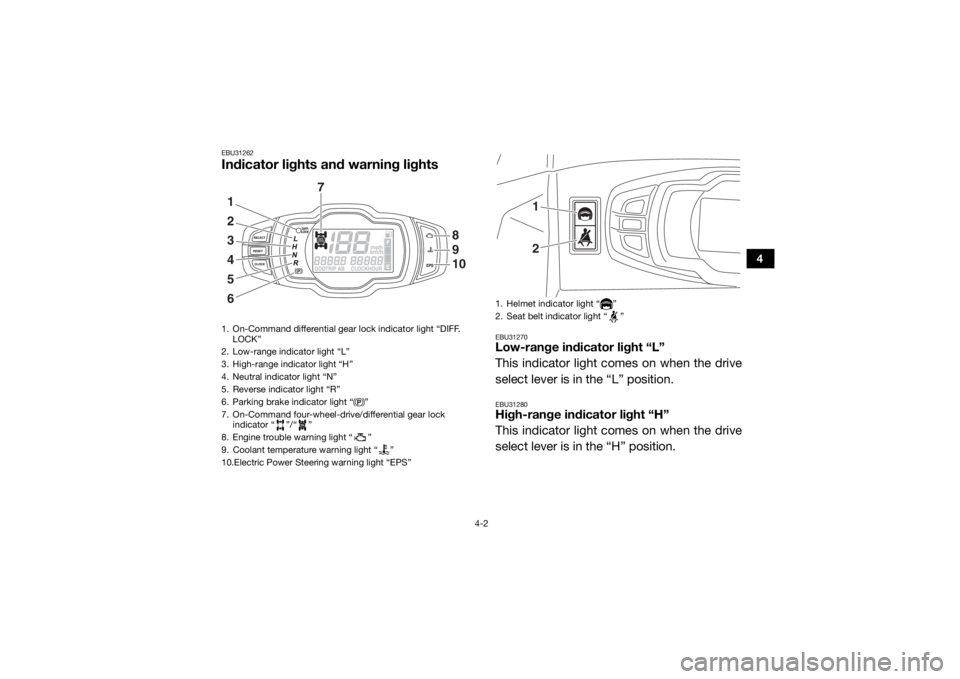
EBU31262Indicator lights and warning lights
EBU31270Low-range indicator light “L”
This indicator light comes on when the drive
select lever is in the “L” position.EBU31280High-range indicator light “H”
This indicator light co mes on when the drive
select lever is in the “H” position.
1. On-Command differential gear lock indicator light “DIFF.
LOCK”
2. Low-range indicator light “L”
3. High-range indicator light “H”
4. Neutral indicator light “N”
5. Reverse indicator light “R”
6. Parking brake indicator light “ ”
7. On-Command four-wheel-drive/differential gear lock indicator “ ”/“ ”
8. Engine trouble warning light “ ”
9. Coolant temperature warning light “ ”
10.Electric Power Steering warning light “EPS”356421
7
8109
1. Helmet indicator light “ ”
2. Seat belt indicator light “ ”
21
UBN57AE0.book Page 2 Tuesday, November 24, 2015 1:42 PM
Page 76 of 192

5-2
5
Coolant• Check coolant level in reservoir.
• Fill with coolant if necessary.
5-6, 8-25
Final gear oil/Differen-
tial gear oil • Check for leakage. 5-6, 5-6, 8-20, 8-22
Accelerator pedal • Check free play and for proper operation. 5-7
Seat belts • Check for proper operation and belt wear. 5-7
Passenger handhold • Check for stability and proper fastening. 5-7, 7-8
Steering • Check for proper operation. 5-7
Fittings and fasteners • Check all fittings and fasteners. 5-8
Instruments, lights and
switches • Check operation, and correct if necessary. 5-8, 8-57, 8-59, 8-60
Wheels and tires • Check tire pressure and for wear and damage. 5-8, 8-47, 8-49
Axle boots • Check for damage. 8-31
ITEM ROUTINE PAGEUBN57AE0.book Page 2 Tuesday, November 24, 2015 1:42 PM
Page 81 of 192

5-7
5
EBU31790Accelerator pedalCheck to see that the accelerator pedal oper-
ates correctly. It must operate smoothly and
spring back to the idle position fully when re-
leased. Have a Yamaha dealer repair as nec-
essary for proper operation.EBU31800Seat beltsMake sure that the seat belts are not frayed,
torn, stretched, or damaged. The seat belts
must move smoothly when pulled out and re-
tract on its own when released. The seat belts
must also lock up when quickly pulled out.
The latch plate should click securely into the
buckle and release when the release button is
pushed firmly. Wash off any dirt or mud that
could affect operation. Have a Yamaha dealer
repair as necessary for proper operation.
A crash can damage the restraint systems in
your vehicle. A damaged restraint system
may not properly protect the person using it,
resulting in serious injury or death in a crash.To help make sure your restraint systems are
working properly after a crash, have them in-
spected and any necessary replacements
made as soon as possible.
EBU31810Passenger handholdCheck that the handhold bar and its supports
are in good condition. Confirm that the lock-
ing pins are securely fastened, and then push
and pull on the handhold to make sure that it
is not loose.EBU31820SteeringPark on level ground. Turn the steering wheel
right and left. Check for excessive free play,
abnormal noises, or a rough feeling. Have a
Yamaha dealer repair as necessary for proper operation.
UBN57AE0.book Page 7 Tuesday, November 24, 2015 1:42 PM
Page 90 of 192

6-6
6
TIPWhen the knob is set to “DIFF LOCK” or “4WD”, the differential gear lock indicator and indica-
tor light will flash until the differential gear is completely locked or unlocked.
When the indicator and indicator light are flas hing, turning the steering wheel back and forth
will help the differential gear lock to engage or disengage.
Riding before the differential gear is properly engaged or disengaged (e.g., when the indicator
and indicator light are flashing) will cause the vehicle speed to be limited until the differential
gear is completely engaged or disengaged. UBN57AE0.book Page 6 Tuesday, November 24, 2015 1:42 PM
Page 104 of 192
7-11
7
Floorboard
The floorboard allows you to brace your feet,
which helps you keep your body in the vehicle
in the event of an accident or rollover. Keep
your feet on the floorboard during operation.
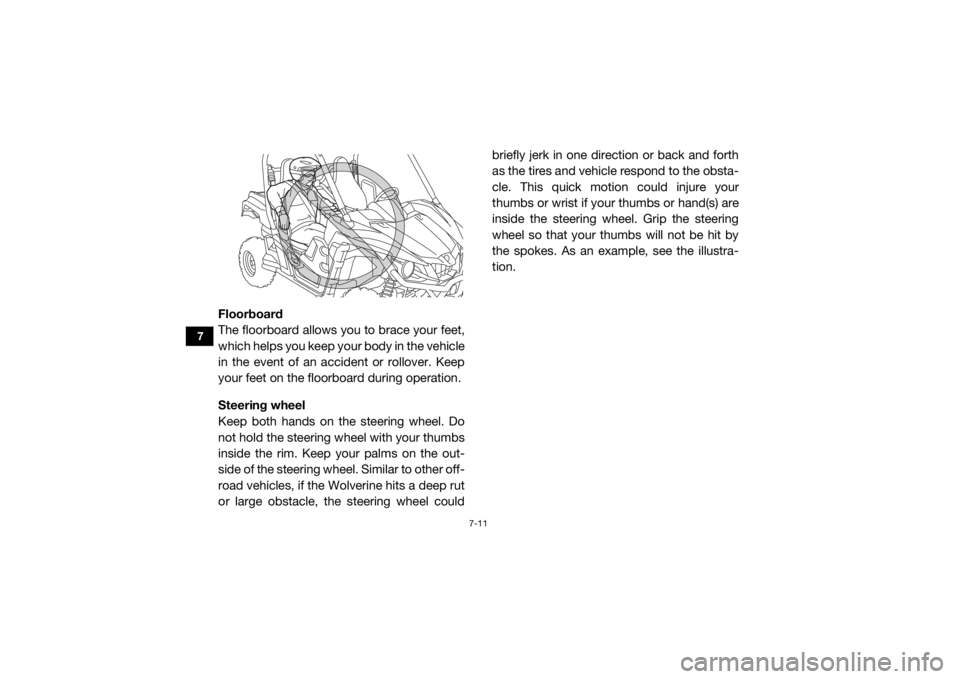
Steering wheel
Keep both hands on the steering wheel. Do
not hold the steering wheel with your thumbs
inside the rim. Keep your palms on the out-
side of the steering wheel. Similar to other off-
road vehicles, if the Wolverine hits a deep rut
or large obstacle, the steering wheel couldbriefly jerk in one direction or back and forth
as the tires and vehicle respond to the obsta-
cle. This quick motion could injure your
thumbs or wrist if your thumbs or hand(s) are
inside the steering wheel. Grip the steering
wheel so that your thum
bs will not be hit by
the spokes. As an exam ple, see the illustra-
tion.UBN57AE0.book Page 11 Tuesday, November 24, 2015 1:42 PM
Page 107 of 192
7-14
7
Become familiar with the way the vehicle feels
in low and high ranges, first in two-wheel
drive “2WD” and then in four-wheel drive
“4WD” and four-wheel drive with the differen-
tial locked “DIFF LOCK”. Steering may take
more effort in four-wheel drive with the differ-
ential locked “DIFF LOCK”. Also practice
driving in reverse.
Take the time to learn basic operation of the
vehicle before attempting more difficult ma-
neuvers.Getting ready to ride
Perform the Pre-Operation Checks on page
5-1. Follow the instructions starting on page
6-2 to start the engine.
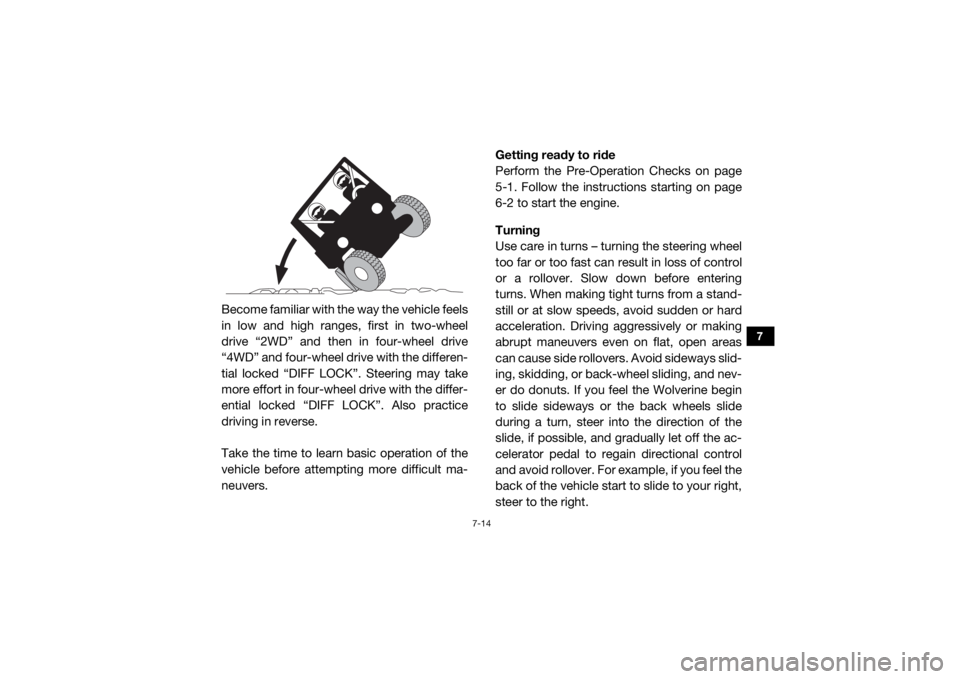
Turning
Use care in turns – tu
rning the steering wheel
too far or too fast can result in loss of control
or a rollover. Slow down before entering
turns. When making tight turns from a stand-
still or at slow speeds, avoid sudden or hard
acceleration. Driving aggressively or making
abrupt maneuvers even on flat, open areas
can cause side rollovers. Avoid sideways slid-
ing, skidding, or back-wheel sliding, and nev-
er do donuts. If you feel the Wolverine begin
to slide sideways or the back wheels slide
during a turn, steer into the direction of the
slide, if possible, and gradually let off the ac-
celerator pedal to regain directional control
and avoid rollover. For example, if you feel the
back of the vehicle start to slide to your right,
steer to the right.UBN57AE0.book Page 14 Tuesday, November 24, 2015 1:42 PM
Page 108 of 192

7-15
7
If you think or feel that the vehicle may tip or
roll, keep your body completely inside the
protective structure of the vehicle:
Brace yourself by pressing your feet firmly
on the floorboard and keep a firm grip on
the steering wheel or passenger handhold.
Do not put your hands or feet outside of the
vehicle for any reason. Do not try to stop a
tipover using your arm or leg.
Accelerating
With the engine idling in neutral and your foot
on the brake, shift the drive select lever into
low or high. NOTICE: Do not shift from low
to high or vice versa without coming to a
complete stop and waiting for the engine
to return to normal idle speed – damage to
the engine or drive train may occur. Then
release the parking brake.
[ECB02160]
Press the
accelerator pedal slowly and smoothly. The
centrifugal clutch will engage and the vehicle
will begin to accelerate. Avoid higher speeds and sudden or hard ac-
celeration until you are thoroughly familiar
with the operation of your vehicle. Avoid sud-
den or hard acceleration in any turn.
Braking
When slowing down or stopping, take your
foot off the accelerator pedal and press the
brake pedal smoothly. Improper use of the
brakes can cause the tires to lose traction, re-
ducing control of the vehicle and increasing
the possibility of an accident.
Braking ability is affected by type of terrain. In
most cases, gradual application of the brakes
is more effective than abrupt braking, partic-
ularly on loose surfaces
, such as gravel. Al-
ways allow for greater braking distance on
rough, loose, or slippery surfaces.
Engine braking
Engine compression braking is designed to
assist you when operating your Wolverine off-
road. With this feature, the engine helps slow
UBN57AE0.book Page 15 Tuesday, November 24, 2015 1:42 PM
Page 111 of 192

7-18
7
to see far enough ahead of you. Use common
sense and remember that some hills are too
steep for you to climb or descend. Use proper
driving techniques to avoid rearward, for-
ward, or sideways rollovers on hills and
slopes.
Drive straight up and down inclines, not
across them. If crossing a hill is unavoidable,
drive slowly. Turn downhill immediately if you
feel the vehicle may tip.
If you think or feel the vehicle may tip or
roll:
Brace yourself by pressing your feet firmly
on the floorboard and keep a firm grip on
the steering wheel or passenger handhold.
Do not put your hands or feet outside of the
vehicle for any reason.
Uphill
Do not attempt to climb hills until you have
mastered basic maneuv ers on flat ground.
Drive straight up hills, and avoid crossing the side of a hill, which increases your risk of roll-
over. Practice first on gentle slopes before at-
tempting steeper hills. Always check the
terrain carefully before attempting any hill.
To climb a hill, you need traction, momentum,
and steady throttle. For more traction and
control for climbing steeper and/or rougher
slopes, shift into low gear and select “4WD”
or “DIFF LOCK”. Travel fast enough to main-
tain momentum, but not so fast that you can-
not react to changes in the terrain as you
climb.
Slow down when you reach the crest of the
hill if you cannot see clearly what is on the
other side – there could be another person, an
obstacle, or a sharp drop-off.
If you start to lose traction or momentum
when climbing, and decide you will be unable
to continue, use the brakes to stop. Do not at-
tempt to turn the vehicle around. With your
foot on the brake pedal, look behind you and
plan your descent. Shift the drive select lever
into reverse so you can use engine braking toUBN57AE0.book Page 18 Tuesday, November 24, 2015 1:42 PM