lock YAMAHA WOLVERINE 2016 Owner's Manual
[x] Cancel search | Manufacturer: YAMAHA, Model Year: 2016, Model line: WOLVERINE, Model: YAMAHA WOLVERINE 2016Pages: 192, PDF Size: 4.38 MB
Page 81 of 192

5-7
5
EBU31790Accelerator pedalCheck to see that the accelerator pedal oper-
ates correctly. It must operate smoothly and
spring back to the idle position fully when re-
leased. Have a Yamaha dealer repair as nec-
essary for proper operation.EBU31800Seat beltsMake sure that the seat belts are not frayed,
torn, stretched, or damaged. The seat belts
must move smoothly when pulled out and re-
tract on its own when released. The seat belts
must also lock up when quickly pulled out.
The latch plate should click securely into the
buckle and release when the release button is
pushed firmly. Wash off any dirt or mud that
could affect operation. Have a Yamaha dealer
repair as necessary for proper operation.
A crash can damage the restraint systems in
your vehicle. A damaged restraint system
may not properly protect the person using it,
resulting in serious injury or death in a crash.To help make sure your restraint systems are
working properly after a crash, have them in-
spected and any necessary replacements
made as soon as possible.
EBU31810Passenger handholdCheck that the handhold bar and its supports
are in good condition. Confirm that the lock-
ing pins are securely fastened, and then push
and pull on the handhold to make sure that it
is not loose.EBU31820SteeringPark on level ground. Turn the steering wheel
right and left. Check for excessive free play,
abnormal noises, or a rough feeling. Have a
Yamaha dealer repair as necessary for proper operation.
UBN57AE0.book Page 7 Tuesday, November 24, 2015 1:42 PM
Page 89 of 192
6-5
6
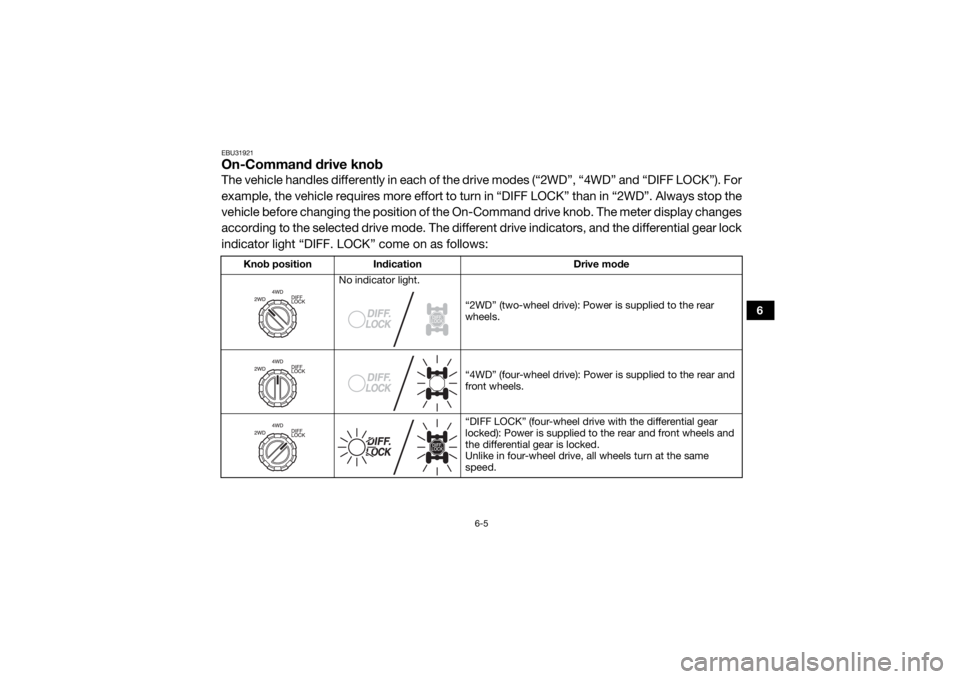
EBU31921On-Command drive knobThe vehicle handles differently in each of the drive modes (“2WD”, “4WD” and “DIFF LOCK”). For
example, the vehicle requires more effort to turn in “DIFF LOCK” than in “2WD”. Always stop the
vehicle before changing the position of the On -Command drive knob. The meter display changes
according to the selected drive mode. The different drive indicators, and the differential gear lock
indicator light “DIFF. LOCK” come on as follows:
Knob position Indication Drive mode
No indicator light.
“2WD” (two-wheel drive): Power is supplied to the rear
wheels.
“4WD” (four-wheel drive): Power is supplied to the rear and
front wheels.
“DIFF LOCK” (four-wheel drive with the differential gear
locked): Power is supplied to the rear and front wheels and
the differential gear is locked.
Unlike in four-wheel drive, all wheels turn at the same
speed.
UBN57AE0.book Page 5 Tuesday, November 24, 2015 1:42 PM
Page 90 of 192

6-6
6
TIPWhen the knob is set to “DIFF LOCK” or “4WD”, the differential gear lock indicator and indica-
tor light will flash until the differential gear is completely locked or unlocked.
When the indicator and indicator light are flas hing, turning the steering wheel back and forth
will help the differential gear lock to engage or disengage.
Riding before the differential gear is properly engaged or disengaged (e.g., when the indicator
and indicator light are flashing) will cause the vehicle speed to be limited until the differential
gear is completely engaged or disengaged. UBN57AE0.book Page 6 Tuesday, November 24, 2015 1:42 PM
Page 102 of 192
7-9
7
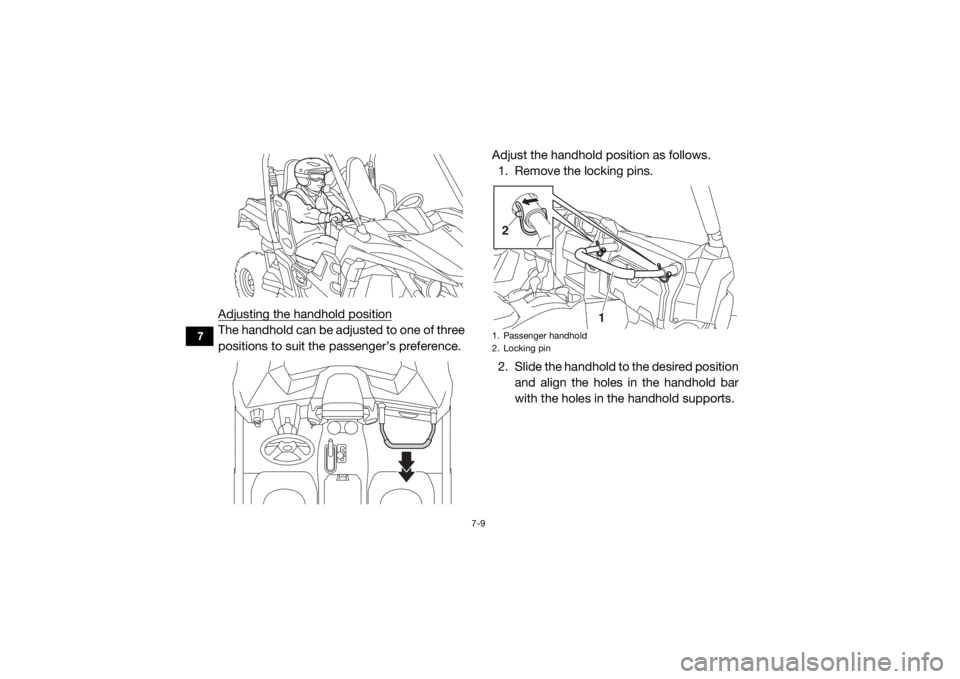
Adjusting the handhold positionThe handhold can be adjusted to one of three
positions to suit the passenger’s preference.Adjust the handhold position as follows.
1. Remove the locking pins.
2. Slide the handhold to the desired position
and align the holes in the handhold bar
with the holes in the handhold supports.
1. Passenger handhold
2. Locking pin2
1
UBN57AE0.book Page 9 Tuesday, November 24, 2015 1:42 PM
Page 107 of 192
7-14
7
Become familiar with the way the vehicle feels
in low and high ranges, first in two-wheel
drive “2WD” and then in four-wheel drive
“4WD” and four-wheel drive with the differen-
tial locked “DIFF LOCK”. Steering may take
more effort in four-wheel drive with the differ-
ential locked “DIFF LOCK”. Also practice
driving in reverse.
Take the time to learn basic operation of the
vehicle before attempting more difficult ma-
neuvers.Getting ready to ride
Perform the Pre-Operation Checks on page
5-1. Follow the instructions starting on page
6-2 to start the engine.
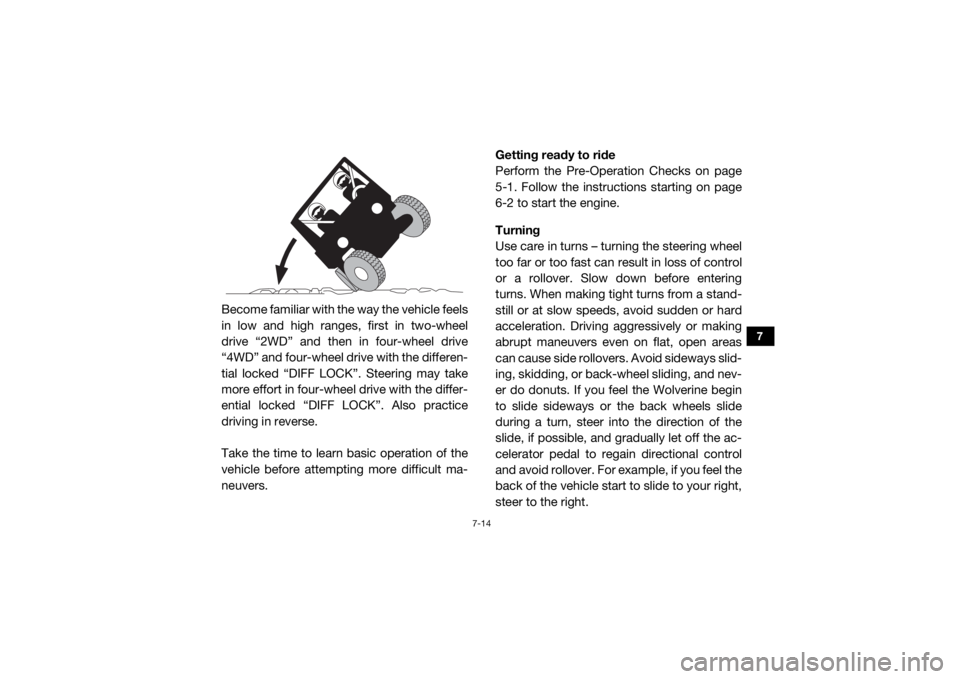
Turning
Use care in turns – tu
rning the steering wheel
too far or too fast can result in loss of control
or a rollover. Slow down before entering
turns. When making tight turns from a stand-
still or at slow speeds, avoid sudden or hard
acceleration. Driving aggressively or making
abrupt maneuvers even on flat, open areas
can cause side rollovers. Avoid sideways slid-
ing, skidding, or back-wheel sliding, and nev-
er do donuts. If you feel the Wolverine begin
to slide sideways or the back wheels slide
during a turn, steer into the direction of the
slide, if possible, and gradually let off the ac-
celerator pedal to regain directional control
and avoid rollover. For example, if you feel the
back of the vehicle start to slide to your right,
steer to the right.UBN57AE0.book Page 14 Tuesday, November 24, 2015 1:42 PM
Page 109 of 192

7-16
7
the vehicle down after you take your foot off
the accelerator. Engine braking is more no-
ticeable in four-wheel drive. Application of ve-
hicle brakes provides additional stopping
power.
Leaving the vehicle
Do not get out of the vehicle while the engine
is running and the drive select lever is in any
gear. There is a risk of injury because:
Children or others may accidentally press
the accelerator pedal.
Objects tossed into the vehicle may strike
the accelerator pedal.
The parking brake may not keep the vehicle
from accelerating.
Unwanted vehicle movement can cause seri-
ous injury or death, and it may be dangerous
to try to stop the vehicle. Parking on a flat area
When parking on a flat area, stop the engine
and shift the drive select lever into the neutral
position. Apply the parking brake to help pre-
vent the vehicle from rolling.
Parking on a slope
The parking brake acts only on the rear
wheels when in “2WD”. For the parking brake
to take effect on all four wheels, shift to “DIFF
LOCK” before stopping the engine.
If you park on a hill that is too steep, the vehi-
cle may roll out of control. Never park on hills
that are so steep you cannot walk up them
easily. If you must park
on an incline, follow
these instructions:
1. Bring the vehicle to a stop by applying the brake pedal.
2. Put the vehicle in “DIFF LOCK”.
3. Turn the key to “ ” (off).
4. With the brake pedal applied, set the parking brake.UBN57AE0.book Page 16 Tuesday, November 24, 2015 1:42 PM
Page 110 of 192
7-17
7
5. Block the front and rear wheels withrocks or other objects.
Loading
The total weight of operator, passenger, ac-
cessories, cargo, trailer tongue weight, and
the vehicle itself must not exceed 975 kg
(2150 lb). Vehicle loading can affect handling.
See “Loading” on page 6-7.EBU33730Operation on different surfaces and
terrainsGo slowly and proceed with caution when op-
erating on an unfamiliar surface or terrain.
This vehicle may handle differently in certain
types of terrains or on certain surfaces. You
may come upon hidden rocks, bumps, or
holes without enough time to react. To avoid
loss of control or rollover, always be alert to
changing surfaces or terrain when operating
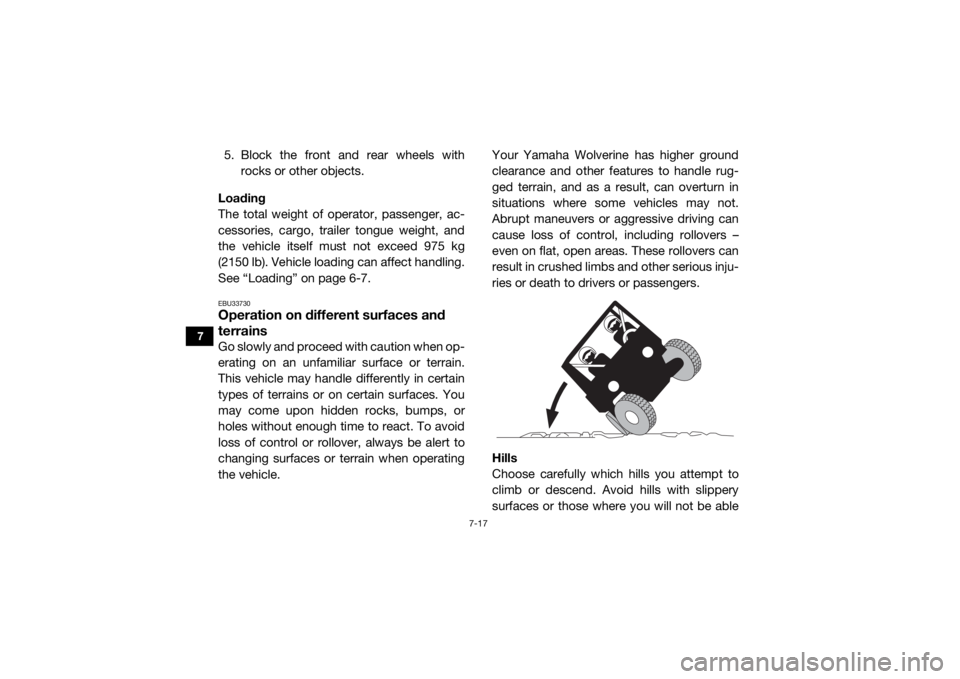
the vehicle. Your Yamaha Wolverine has higher ground
clearance and other features to handle rug-
ged terrain, and as a result, can overturn in
situations where some vehicles may not.
Abrupt maneuvers or aggressive driving can
cause loss of control, including rollovers –
even on flat, open areas. These rollovers can
result in crushed limbs and other serious inju-
ries or death to drivers or passengers.
Hills
Choose carefully which hills you attempt to
climb or descend. Avoid hills with slippery
surfaces or those where you will not be ableUBN57AE0.book Page 17 Tuesday, November 24, 2015 1:42 PM
Page 111 of 192

7-18
7
to see far enough ahead of you. Use common
sense and remember that some hills are too
steep for you to climb or descend. Use proper
driving techniques to avoid rearward, for-
ward, or sideways rollovers on hills and
slopes.
Drive straight up and down inclines, not
across them. If crossing a hill is unavoidable,
drive slowly. Turn downhill immediately if you
feel the vehicle may tip.
If you think or feel the vehicle may tip or
roll:
Brace yourself by pressing your feet firmly
on the floorboard and keep a firm grip on
the steering wheel or passenger handhold.
Do not put your hands or feet outside of the
vehicle for any reason.
Uphill
Do not attempt to climb hills until you have
mastered basic maneuv ers on flat ground.
Drive straight up hills, and avoid crossing the side of a hill, which increases your risk of roll-
over. Practice first on gentle slopes before at-
tempting steeper hills. Always check the
terrain carefully before attempting any hill.
To climb a hill, you need traction, momentum,
and steady throttle. For more traction and
control for climbing steeper and/or rougher
slopes, shift into low gear and select “4WD”
or “DIFF LOCK”. Travel fast enough to main-
tain momentum, but not so fast that you can-
not react to changes in the terrain as you
climb.
Slow down when you reach the crest of the
hill if you cannot see clearly what is on the
other side – there could be another person, an
obstacle, or a sharp drop-off.
If you start to lose traction or momentum
when climbing, and decide you will be unable
to continue, use the brakes to stop. Do not at-
tempt to turn the vehicle around. With your
foot on the brake pedal, look behind you and
plan your descent. Shift the drive select lever
into reverse so you can use engine braking toUBN57AE0.book Page 18 Tuesday, November 24, 2015 1:42 PM
Page 112 of 192

7-19
7
slow your descent. Release the brake and be-
gin to coast down the hill. Use engine braking
as much as possible, gently applying the
brakes when necessary.
Downhill
Check the terrain carefully before going
downhill. When possible, choose a path that
lets you drive your vehicle straight downhill.
Choose your path carefully and drive slowly
enough to be able to react to obstacles that
you encounter.
For more traction and control, before going
down steeper and/or rougher slopes, shift
into low gear and select “4WD” or “DIFF
LOCK”. Engine braking will help you go
downhill slowly. Go as slowly as possible. If
you begin to go too fast, apply the brakes
gently. Avoid hard application of the brakes,
which could cause the vehicle to slide.If you are sliding or skidding, try to steer in the
direction the vehicle is sliding, to regain con-
trol. For example, if you feel the back of the
vehicle start to slide to your right, steer to the
right.
If you must turn on the hill to avoid an obsta-
cle, do so slowly and carefully. If the vehicle
starts to tip, immediately steer in the downhill
direction if there are no obstacles in your
path. As you regain proper balance, gradually
steer again in the direction you want to go.
Rough terrain
Operation over rough terrain should be done
with caution.
Look for and avoid obstacles that could
cause damage to the vehicle or could lead
to a rollover or accident.
Do not drive in a way that will get the vehicle
airborne, as injury, loss of control, and
damage to the vehicle could occur.UBN57AE0.book Page 19 Tuesday, November 24, 2015 1:42 PM
Page 122 of 192

8-7
8
8*Parking brake • Check operation and adjust if necessary. √√√√√
9 *Brake fluid • Change. Every 2 years
10 *Accelerator pedal • Check operation and free play. √√√√√
11 *V-b e l t • Check operation.
• Check for wear, cracks, or damage. √√√
12 *Wheels • Check balance, runout, and for damage.
• Balance wheel if necessary.
• Replace wheel if damaged or if runout is
over specified limits. √ √√√
• Check and tighten the bead lock (for equipped models). Every 500 km (300 mi)
13 *Wheel bearings • Check bearing assemblies for loose-
ness/damage.
• Replace if damaged. √ √√√
14 *Front and rear
suspension • Check operation and for oil leakage.
• Correct if necessary.
√√
15 *Steering system • Check operation and for looseness. Replace
if damaged.
• Check toe-in. Adjust if necessary. √√√√√
NO. ITEM
ROUTINE INITIAL
EVERY
Whichev- er comes first month136612
km
(mi) 320
(200) 1200
(750) 2400
(1500) 2400
(1500) 4800
(3000)
hours 20 75 150 150 300UBN57AE0.book Page 7 Tuesday, November 24, 2015 1:42 PM