seat YAMAHA WOLVERINE 2016 Owner's Manual
[x] Cancel search | Manufacturer: YAMAHA, Model Year: 2016, Model line: WOLVERINE, Model: YAMAHA WOLVERINE 2016Pages: 192, PDF Size: 4.38 MB
Page 95 of 192
7-2
7
As the owner/operator, it is your responsibility
to protect yourself and your passenger from
accidents, including rollovers. The Wolverine
has many features, including a protective
structure and seat belts, to help protect occu-
pants, but the best way to avoid injuries is to
avoid accidents. There is a risk of injury or
death in any accident, even with these safety
features.
Driver requirements
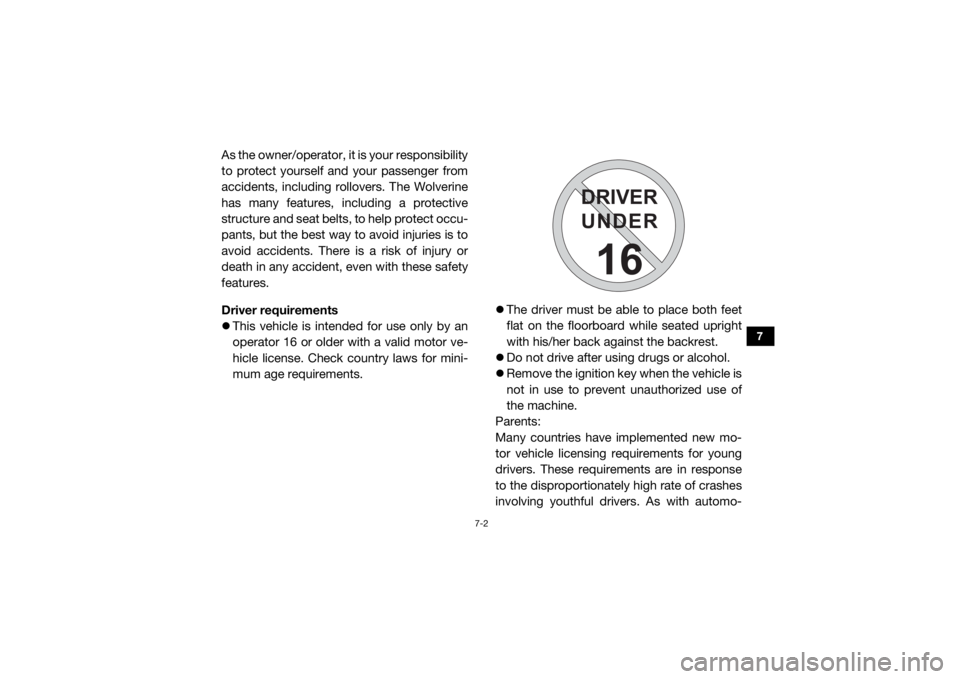
This vehicle is intended for use only by an
operator 16 or older with a valid motor ve-
hicle license. Check country laws for mini-
mum age requirements.
The driver must be able to place both feet
flat on the floorboard while seated upright
with his/her back against the backrest.
Do not drive after using drugs or alcohol.
Remove the ignition key when the vehicle is
not in use to prevent unauthorized use of
the machine.
Parents:
Many countries have implemented new mo-
tor vehicle licensing requirements for young
drivers. These requirements are in response
to the disproportionately high rate of crashes
involving youthful drivers. As with automo-
DRIVER
UNDER
16
UBN57AE0.book Page 2 Tuesday, November 24, 2015 1:42 PM
Page 96 of 192
7-3
7
biles, to promote safe driving behaviors, you
should supervise younger drivers and consid-
er setting rules and putting limits on how,
when, and where the Wolverine can be used.
Passenger requirements
This vehicle is designed for the operator and
one passenger. Allowing passengers to ride
improperly can lead to serious injury or death.
As the operator, you are responsible for your
passenger.
Your passenger must be able to place both
feet on the floorboard while seated upright
with his/her back against the backrest.
Your passenger must be able to reach and
hold the passenger handhold.
Allow only one passenger in the vehicle and
only in the designated passenger seat. Do
not carry any other passengers. Do not car-
ry passengers in the cargo bed.
Do not allow someone to ride as a passen-
ger who has been using drugs or alcohol.
Do not allow children who need child safety
seats or booster seats in the Wolverine. The
seat belt is not designed to restrain auto-
motive child safety seats.
Occupant protection system
WARNING
EWB03350Do not make changes to the occupant pro-
tection system. If you install aftermarket
products or have your vehicle modified,
you may put yourself and others at greater
risk of serious injury or death. You are re-
sponsible for any such changes to the ve-
hicle.
UBN57AE0.book Page 3 Tuesday, November 24, 2015 1:42 PM
Page 97 of 192
7-4
7
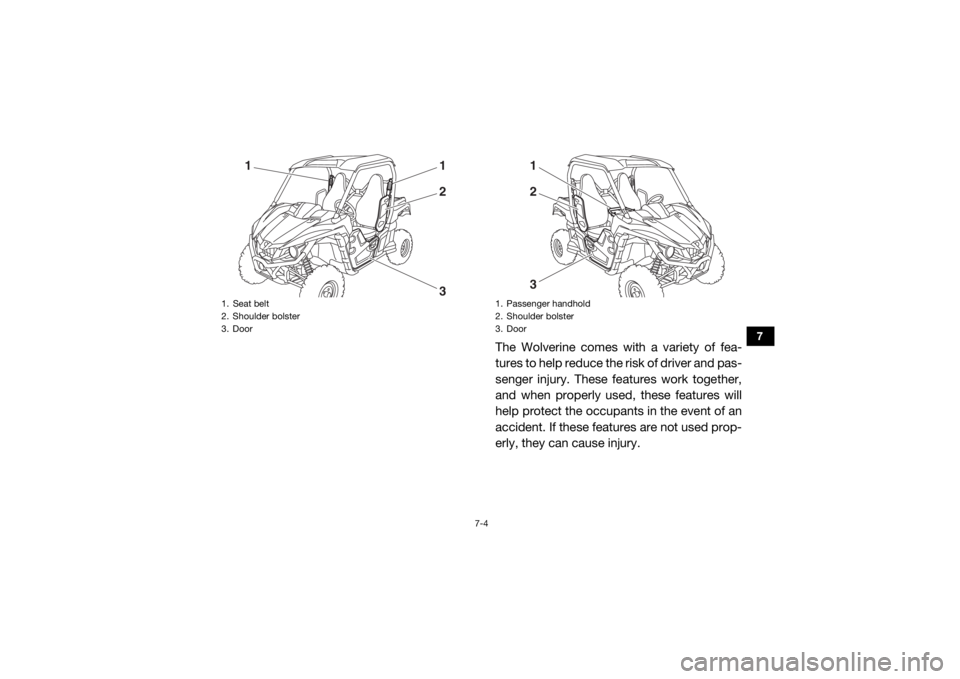
The Wolverine comes with a variety of fea-
tures to help reduce the risk of driver and pas-
senger injury. These features work together,
and when properly used, these features will
help protect the occupants in the event of an
accident. If these features are not used prop-
erly, they can cause injury.
1. Seat belt
2. Shoulder bolster
3. Door
123
1
1. Passenger handhold
2. Shoulder bolster
3. Door
123
UBN57AE0.book Page 4 Tuesday, November 24, 2015 1:42 PM
Page 98 of 192

7-5
7
Protective structure
The vehicle cage/frame provides a protective
structure that helps limit intrusions by branch-
es or other objects and may reduce your risk
of injury in accidents. The protective structure
will not protect occupants in all rollovers or
accidents.
Body parts outside of vehicle can be struck
by passing objects or crushed during vehicle
rollover. Do not put your hands or feet outside
of the vehicle for any reason. Do not hold onto
the door, cage/frame or shoulder bolster.
Wear your seat belt and helmet.
If you think or feel that the vehicle may tip or
roll, do not put your hands or feet outside the
vehicle for any reason. You will not be able to
stop the vehicle from tipping over using your
body. Any part of your body (arms, legs, or
head) outside of the vehicle can be crushed
by the vehicle cage/frame. Seat belts
Seat belts should be worn by the driver and
passenger. The driver must be sure that the
passenger is belted before driving.
Be sure the seat belt is not twisted, is close-
fitting across the hips and chest, and is
latched securely.
Do not wear the seat belt across the abdo-
men or stomach.
Do not put the seat belt behind the back.
Failure to use seat belts properly may lead to
an increased likelihood and severity of injury.
An unbelted occupant may strike the interior
of the vehicle, the protective structure, or oth-
er objects in an accident or during operation.
You may also fall completely out or be partial-
ly ejected from the vehicle, which may lead to
being crushed between the ground and the
vehicle. Wearing the seat belt helps you re-
main in the vehicle – the doors and passenger
handhold are not a substitute for using a seat
belt.UBN57AE0.book Page 5 Tuesday, November 24, 2015 1:42 PM
Page 99 of 192
7-6
7
A crash can damage the restraint systems in
your vehicle. A damaged restraint system
may not properly protect the person using it,
resulting in serious injury or death in a crash.
To help make sure your restraint systems are
working properly after a crash, have them in-
spected and any necessary replacements
made as soon as possible.
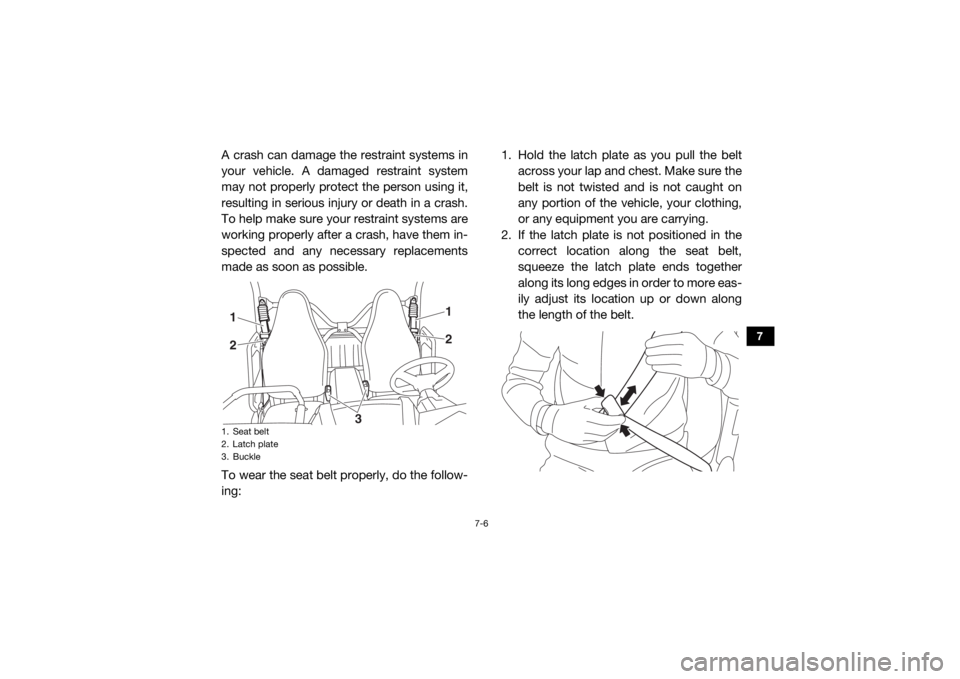
To wear the seat belt properly, do the follow-
ing:1. Hold the latch plate as you pull the belt
across your lap and chest. Make sure the
belt is not twisted and is not caught on
any portion of the vehi cle, your clothing,
or any equipment you are carrying.
2. If the latch plate is not positioned in the correct location along the seat belt,
squeeze the latch plate ends together
along its long edges in order to more eas-
ily adjust its location up or down along
the length of the belt.1. Seat belt
2. Latch plate
3. Buckle12
12
3
UBN57AE0.book Page 6 Tuesday, November 24, 2015 1:42 PM
Page 100 of 192
7-7
7
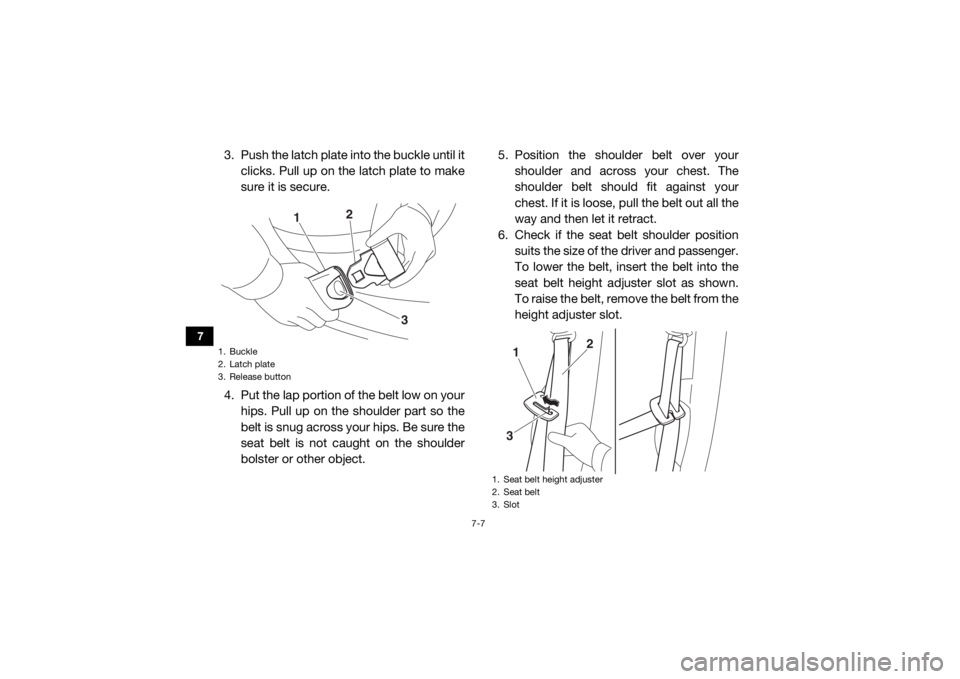
3. Push the latch plate into the buckle until itclicks. Pull up on the latch plate to make
sure it is secure.
4. Put the lap portion of the belt low on your hips. Pull up on the shoulder part so the
belt is snug across your hips. Be sure the
seat belt is not caught on the shoulder
bolster or other object. 5. Position the shoulder belt over your
shoulder and across your chest. The
shoulder belt should fit against your
chest. If it is loose, pull the belt out all the
way and then let it retract.
6. Check if the seat belt shoulder position suits the size of the driver and passenger.
To lower the belt, insert the belt into the
seat belt height adjuster slot as shown.
To raise the belt, remove the belt from the
height adjuster slot.1. Buckle
2. Latch plate
3. Release button
1
3
2
1. Seat belt height adjuster
2. Seat belt
3. Slot
1
2
3
UBN57AE0.book Page 7 Tuesday, November 24, 2015 1:42 PM
Page 103 of 192
7-10
7
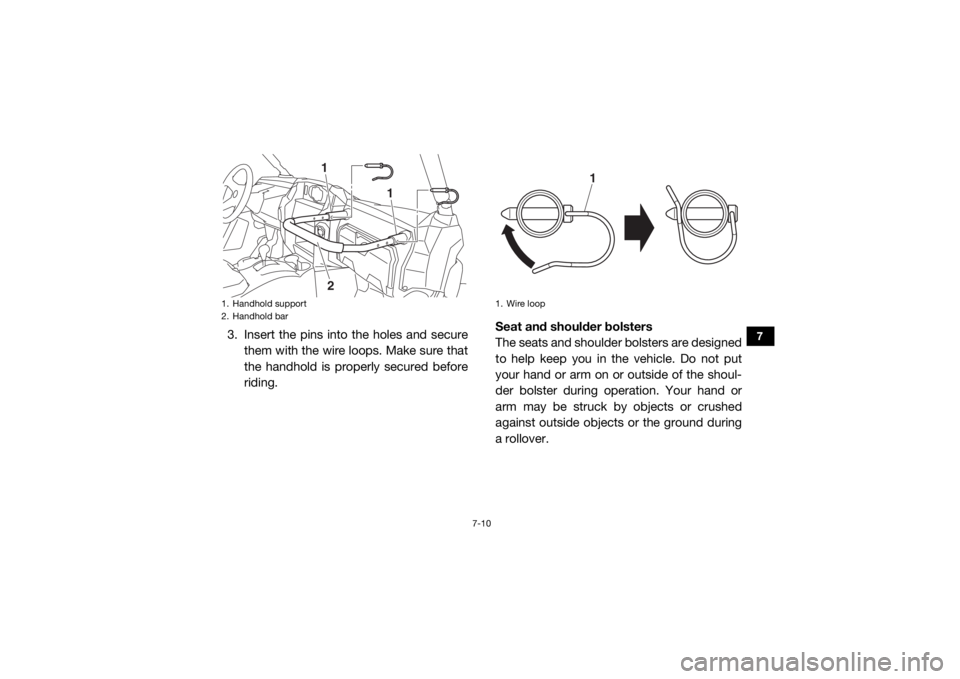
3. Insert the pins into the holes and securethem with the wire loops. Make sure that
the handhold is properly secured before
riding. Seat and shoulder bolsters
The seats and shoulder bolsters are designed
to help keep you in the vehicle. Do not put
your hand or arm on or outside of the shoul-
der bolster during operation. Your hand or
arm may be struck by objects or crushed
against outside objects or the ground during
a rollover.1. Handhold support
2. Handhold bar
2
1
1
1. Wire loop
1
UBN57AE0.book Page 10 Tuesday, November 24, 2015 1:42 PM
Page 117 of 192
8-2
8
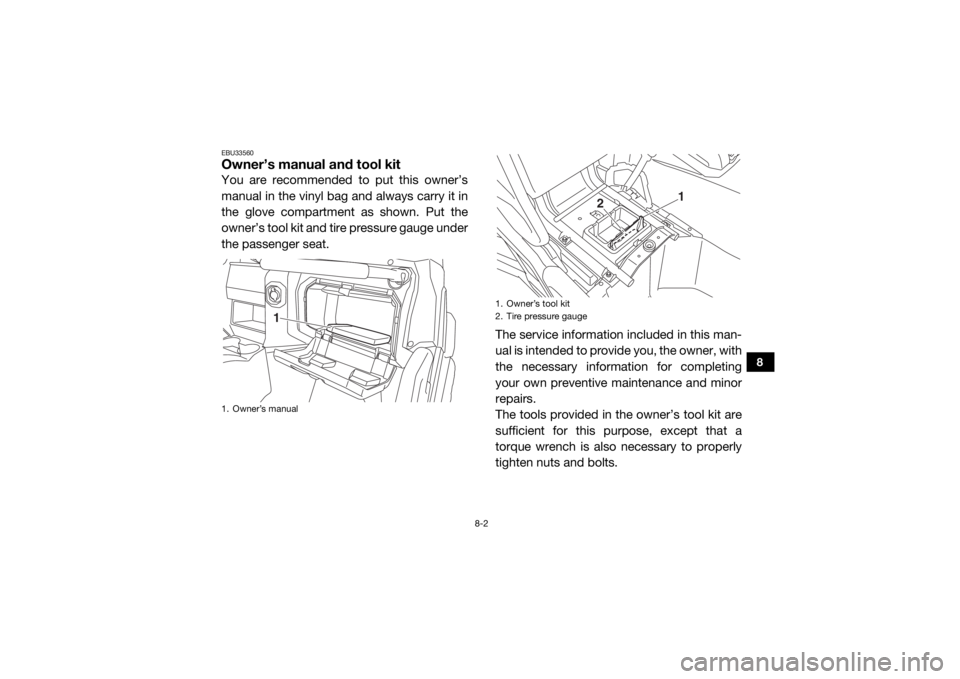
EBU33560Owner’s manual and tool kitYou are recommended to put this owner’s
manual in the vinyl bag and always carry it in
the glove compartment as shown. Put the
owner’s tool kit and tire pressure gauge under
the passenger seat.The service information included in this man-
ual is intended to provide you, the owner, with
the necessary information for completing
your own preventive maintenance and minor
repairs.
The tools provided in the owner’s tool kit are
sufficient for this purpose, except that a
torque wrench is also necessary to properly
tighten nuts and bolts.1. Owner’s manual
1
1. Owner’s tool kit
2. Tire pressure gauge
1
2
UBN57AE0.book Page 2 Tuesday, November 24, 2015 1:42 PM
Page 129 of 192
8-14
8
EBU33702Engine oil and oil filter cartridgeCheck engine oil level before each operation.
In addition, change the oil and the oil filter car-
tridge at the intervals specified in the periodic
maintenance and lubrication chart.
To check the engine oil level
1. Park the vehicle on a level surface.
2. Check the engine oil level on a cold en- gine.TIPIf the engine was started before checking the
oil level, be sure to warm up the engine suffi-
ciently, and then wait at least 10 minutes until
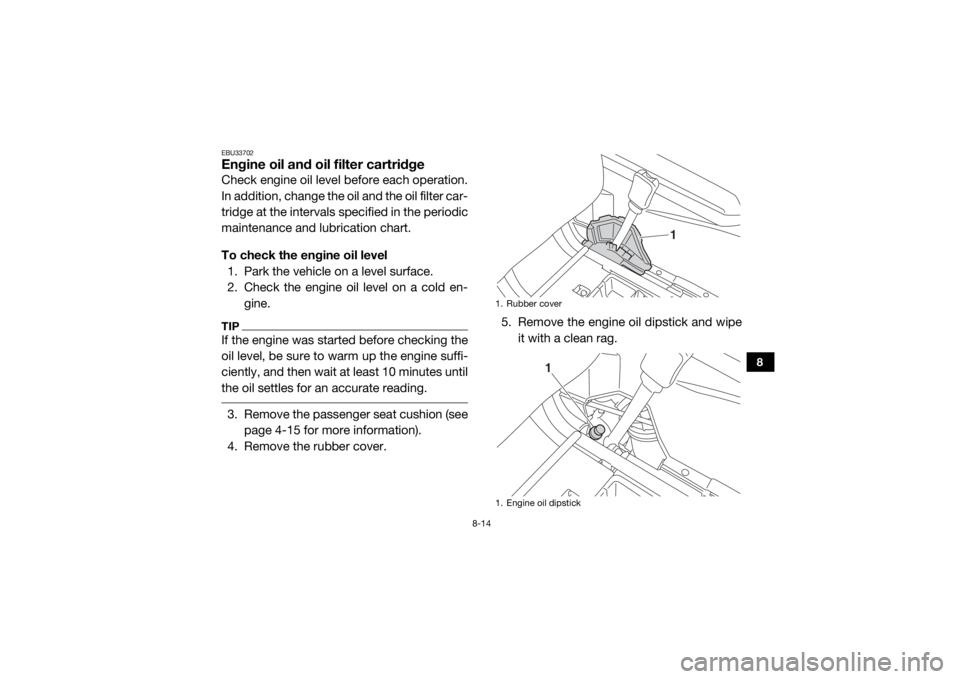
the oil settles for an accurate reading. 3. Remove the passenger seat cushion (seepage 4-15 for more information).
4. Remove the rubber cover. 5. Remove the engine oil dipstick and wipe
it with a clean rag.
1. Rubber cover
1. Engine oil dipstick
1
1
UBN57AE0.book Page 14 Tuesday, November 24, 2015 1:42 PM
Page 131 of 192
8-16
8
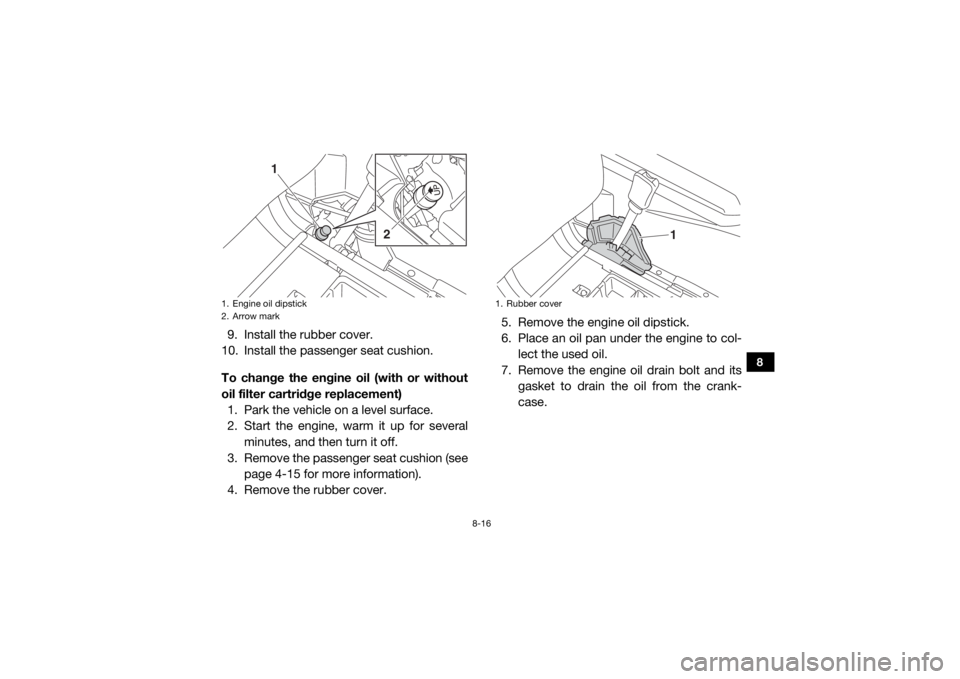
9. Install the rubber cover.
10. Install the passenger seat cushion.
To change the engine oil (with or without
oil filter cartridge replacement)
1. Park the vehicle on a level surface.
2. Start the engine, warm it up for several minutes, and then turn it off.
3. Remove the passenger seat cushion (see page 4-15 for more information).
4. Remove the rubber cover. 5. Remove the engine oil dipstick.
6. Place an oil pan under the engine to col-
lect the used oil.
7. Remove the engine oil drain bolt and its gasket to drain the oil from the crank-
case.1. Engine oil dipstick
2. Arrow mark
1
2
1. Rubber cover
1
UBN57AE0.book Page 16 Tuesday, November 24, 2015 1:42 PM