trailer YAMAHA WOLVERINE 2018 User Guide
[x] Cancel search | Manufacturer: YAMAHA, Model Year: 2018, Model line: WOLVERINE, Model: YAMAHA WOLVERINE 2018Pages: 188, PDF Size: 5.4 MB
Page 71 of 188
4-33
4
This vehicle is equipped with a trailer hitch
bracket and a 2" (5 cm) receiver for a stan-
dard trailer hitch. Trailer towing equipment
can be obtained at a Yamaha dealer. See
page 6-7 for loading information.EBU32952Auxiliary DC jack
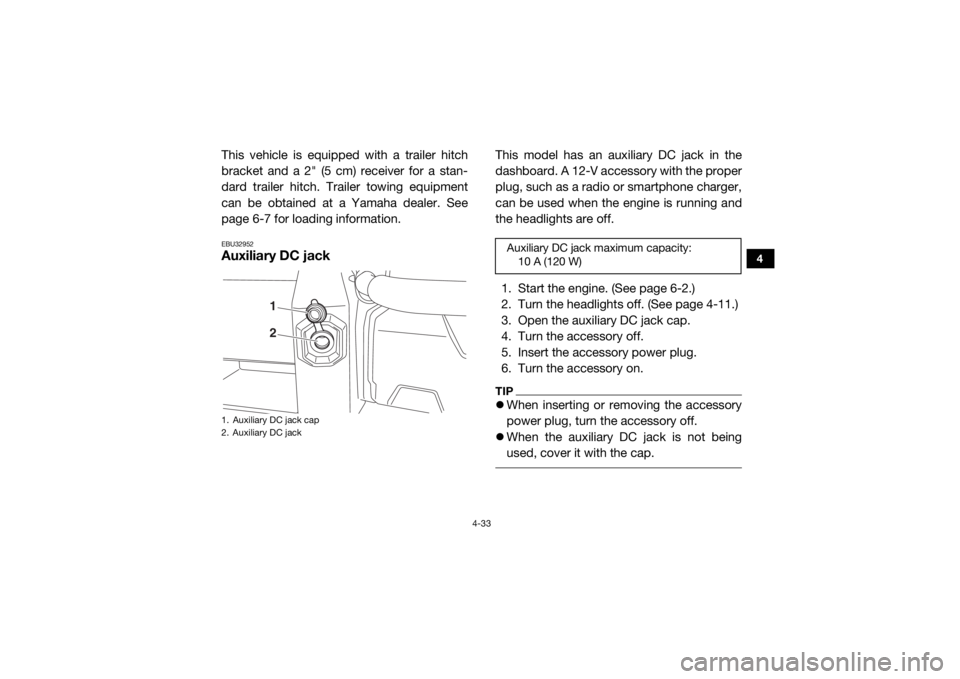
This model has an auxiliary DC jack in the
dashboard. A 12-V accessory with the proper
plug, such as a radio or smartphone charger,
can be used when the engine is running and
the headlights are off.
1. Start the engine. (See page 6-2.)
2. Turn the headlights off. (See page 4-11.)
3. Open the auxiliary DC jack cap.
4. Turn the accessory off.
5. Insert the accessory power plug.
6. Turn the accessory on.TIP When inserting or removing the accessory
power plug, turn the accessory off.
When the auxiliary DC jack is not being
used, cover it with the cap.
1. Auxiliary DC jack cap
2. Auxiliary DC jack
21
Auxiliary DC jack maximum capacity:
10 A (120 W)
UB3D7AE0.book Page 33 Tuesday, November 7, 2017 9:38 AM
Page 81 of 188
5-9
5
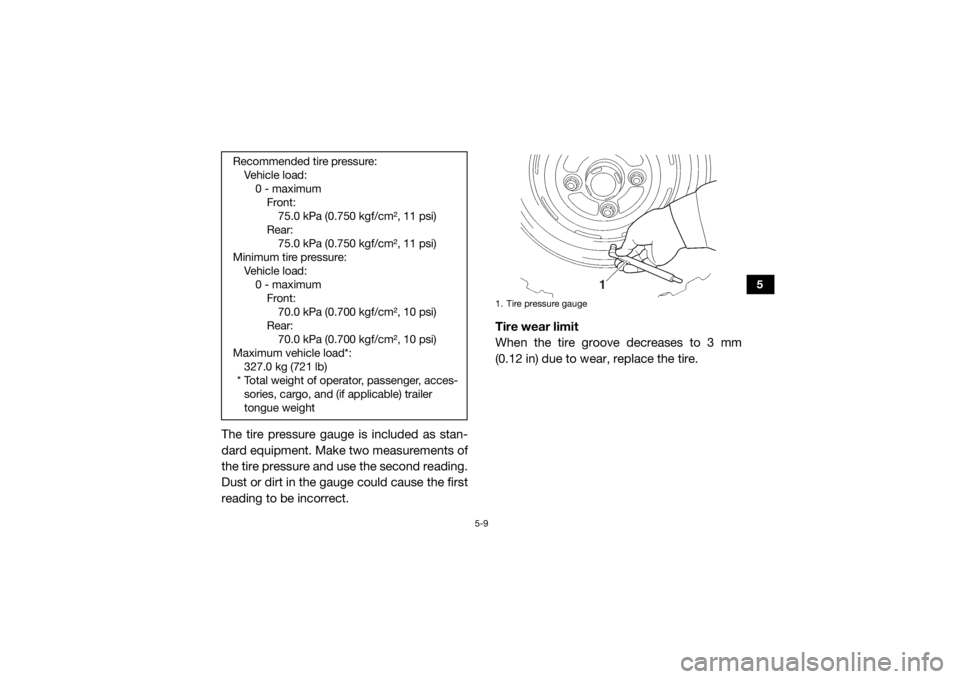
The tire pressure gauge is included as stan-
dard equipment. Make two measurements of
the tire pressure and use the second reading.
Dust or dirt in the gauge could cause the first
reading to be incorrect.Tire wear limit
When the tire groove decreases to 3 mm
(0.12 in) due to wear, replace the tire.Recommended tire pressure:
Vehicle load:0 - maximum Front:75.0 kPa (0.750 kgf/cm², 11 psi)
Rear: 75.0 kPa (0.750 kgf/cm², 11 psi)
Minimum tire pressure: Vehicle load:0 - maximum Front:70.0 kPa (0.700 kgf/cm², 10 psi)
Rear: 70.0 kPa (0.700 kgf/cm², 10 psi)
Maximum vehicle load*: 327.0 kg (721 lb)
* Total weight of operator, passenger, acces- sories, cargo, and (if applicable) trailer
tongue weight
1. Tire pressure gauge
1
UB3D7AE0.book Page 9 Tuesday, November 7, 2017 9:38 AM
Page 89 of 188

6-7
6
EBU31930ParkingWhen parking, stop the engine and shift the
drive select lever into the neutral position. Ap-
ply the parking brake to help prevent the ve-
hicle from rolling. See page 7-16 for more
information on parking and parking on a
slope.EBU31941LoadingTake extra precautions when driving with a
load or trailer. Follow these instructions and
always use common sense and good judg-
ment when carrying cargo or towing a trailer.
Prepare your load or trailer
Use the hooks equipped on the cargo bed to
tie down loads. (See page 4-20.)
Choose a trailer hitch drawbar designed for
use with a 2" (5 cm) receiver. (See page 4-32.)
WARNING
EWB04260Improper loading or towing can increase
the risk of loss of control, an overturn, or
other accident:
Keep weight in the cargo bed centered
side to side, and as low and as far for-
ward as possible. Top-heavy loads in-
crease the risk of overturn. Be sure
cargo is secured — a loose load could
change handling unexpectedly or strike
occupants.
Be sure to tie down cargo in the trailer
securely — a shifting load can cause an
accident.
Make sure the load does not interfere
with your control or ability to see where
you are going.
Do not exceed the Maximum Load Limits
for each section of the vehicle or the
Maximum Vehicle Load.
UB3D7AE0.book Page 7 Tuesday, November 7, 2017 9:38 AM
Page 90 of 188
6-8
6
TIPYou can measure tongue weight with a bath-
room scale. Put the tongue of the loaded trail-
er on the scale with the tongue at hitch height.
Adjust the load in the trailer, if necessary, to
reduce the weight on hitch. If you are carrying
cargo and towing a trailer, include the tongue
weight in the maximum vehicle load limit.
Operating when loaded with cargo or tow-
ing a trailer
Drive more slowly than you would without a
load. The more weight you carry, the slower
you should go. Although conditions vary, it is
good practice to keep the vehicle in low gear
whenever you are carrying heavier loads or
when towing a trailer.
WARNING
EWB03320Carrying loads or towing a trailer can in-
crease the risk of loss of control, an over-
turn, or other accident. To reduce the risk
of an accident:
Reduce speed, operate in low gear only,
and allow more room to stop. A heavier
vehicle takes longer to stop.
Avoid hills and rough terrain. Choose
terrain carefully. Use extreme caution
when towing or carrying a load on in-
clines.
Turn gradually and go slowly.
MAXIMUM LOAD LIMITS
Cargo bed:136.0 kg (300 lb)
Pulling load (gross trailer weight): 6664 N (680 kgf, 1500 lbf)
Tongue weight (vertical load on hitch): 490 N (50 kgf, 110 lbf)
Vehicle maximum load (all occupants, ac-
cessories, cargo, and tongue weight): 327.0 kg (721 lb)
UB3D7AE0.book Page 8 Tuesday, November 7, 2017 9:38 AM
Page 91 of 188

6-9
6
Pulling something other than a trailer
Yamaha recommends that loads be trans-
ported in the bed or in a trailer. If you need to
move an object a short distance use a winch
and follow the winch manufacturer’s instruc-
tions.
If you choose to use something other than a
winch use extreme caution, follow the manu-
facturer’s instructions for that product, and
only attach to the hitch or hitch bracket of the
Wolverine. WARNING! Improperly pulling
can cause serious injury or death. Never
exceed the pulling load limit of the
Wolverine. Avoid pulling on inclines.
[EWB03330]
Pulling objects on the ground can be more
hazardous than pulling a trailer. It may be dif-
ficult to predict how the load will affect vehicle
operation. That effect could also change de-
pending upon terrain or what obstacles might
be in the object’s path.UB3D7AE0.book Page 9 Tuesday, November 7, 2017 9:38 AM
Page 108 of 188
7-17
7
5. Block the front and rear wheels withrocks or other objects.
Loading
The total weight of operator, passenger, ac-
cessories, cargo, trailer tongue weight, and
the vehicle itself must not exceed 975 kg
(2150 lb). Vehicle loading can affect handling.
(See page 6-7.)EBU33551Operation on different surfaces and
terrainsGo slowly and proceed with caution when op-
erating on an unfamiliar surface or terrain.
This vehicle may handle differently in certain
types of terrains or on certain surfaces. You
may come upon hidden rocks, bumps, or
holes without enough time to react. To avoid
loss of control or rollover, always be alert to
changing surfaces or terrain when operating
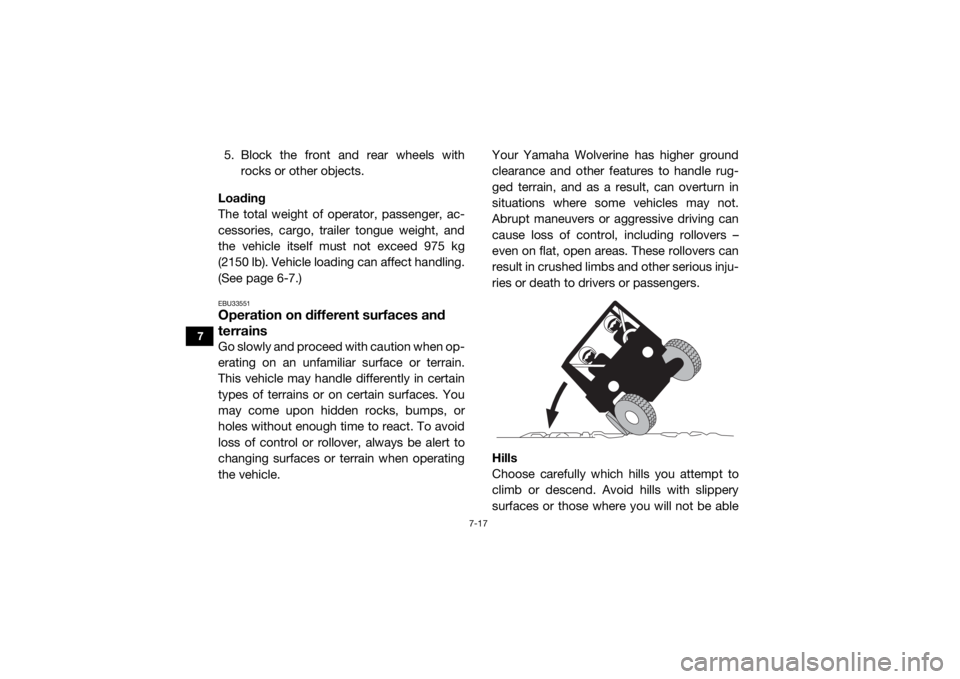
the vehicle. Your Yamaha Wolverine has higher ground
clearance and other features to handle rug-
ged terrain, and as a result, can overturn in
situations where some vehicles may not.
Abrupt maneuvers or aggressive driving can
cause loss of control, including rollovers –
even on flat, open areas. These rollovers can
result in crushed limbs and other serious inju-
ries or death to drivers or passengers.
Hills
Choose carefully which hills you attempt to
climb or descend. Avoid hills with slippery
surfaces or those where you will not be ableUB3D7AE0.book Page 17 Tuesday, November 7, 2017 9:38 AM
Page 185 of 188

12-2
12
Horn switch .................................................................. 4-12IIdentification number records ...................................... 11-1
Indicator lights and warning lights ................................. 4-2
Instruments, lights and switches, Pre-operation check ........................................................................... 5-8JJump-starting .............................................................. 8-51LLabel locations ............................................................... 1-1
Light switch .................................................................. 4-11
Loading .......................................................................... 6-7
Low-range indicator light ............................................... 4-2MMain switch .................................................................... 4-1
Maintenance charts ....................................................... 8-4
Model label .................................................................. 11-1
Multi-function meter unit ............................................... 4-6NNeutral indicator light ..................................................... 4-3OOn-Command drive knob, operation ............................. 6-5
Owner’s Manual and tool kit .......................................... 8-2PPanels .......................................................................... 8-11
Parking ........................................................................... 6-7
Parking brake ............................................................... 8-42
Parking brake indicator light .......................................... 4-3
Parking brake lever ...................................................... 4-13
Passenger handhold, Pre-operation check ................... 5-7
RRear knuckle upper and lower pivot, lubrication ......... 8-45
Reverse indicator light ................................................... 4-3SSafety information .......................................................... 2-1
Seat belt indicator light .................................................. 4-5
Seat belts ..................................................................... 4-17
Seat belts, Pre-operation check .................................... 5-7
Seats ............................................................................ 4-15
Shock absorbers, front ................................................ 4-22
Shock absorbers, rear ................................................. 4-27
Spark arrester, cleaning ............................................... 8-37
Spark plug, inspecting ................................................. 8-30
Specifications .............................................................. 10-1
Stabilizer bushes, checking .......... ............................... 8-44
Starting the engine ........................................................ 6-2
Steering, Pre-operation check ....................................... 5-7
Steering shaft, lubrication ............................................ 8-45
Storage .......................................................................... 9-2
Storage compartments ................................................ 4-18TTail/brake light bulb, replacing .................................... 8-57
Tire, replacing .............................................................. 8-46
Tires, Pre-operation check ............................................ 5-8
Trailer hitch bracket and receiver ................................ 4-32
Troubleshooting ........................................................... 8-57
Troubleshooting charts ................................................ 8-59VValve clearance ............................................................ 8-39
V-belt case drain plug .................................................. 8-37
Vehicle identification number ...................................... 11-1
UB3D7AE0.book Page 2 Tuesday, November 7, 2017 9:38 AM