vin YAMAHA WOLVERINE 2018 Owner's Manual
[x] Cancel search | Manufacturer: YAMAHA, Model Year: 2018, Model line: WOLVERINE, Model: YAMAHA WOLVERINE 2018Pages: 188, PDF Size: 5.4 MB
Page 96 of 188

7-5
7
Protective structure
The vehicle cage/frame provides a protective
structure that helps limit intrusions by branch-
es or other objects and may reduce your risk
of injury in accidents. The protective structure
will not protect occupants in all rollovers or
accidents.
Body parts outside of vehicle can be struck
by passing objects or crushed during vehicle
rollover. Do not put your hands or feet outside
of the vehicle for any reason. Do not hold onto
the door, cage/frame or shoulder bolster.
Wear your seat belt and helmet.
If you think or feel that the vehicle may tip or
roll, do not put your hands or feet outside the
vehicle for any reason. You will not be able to
stop the vehicle from tipping over using your
body. Any part of your body (arms, legs, or
head) outside of the vehicle can be crushed
by the vehicle cage/frame. Seat belts
Seat belts should be worn by the driver and
passenger. The driver must be sure that the
passenger is belted before driving.
Be sure the seat belt is not twisted, is close-
fitting across the hips and chest, and is
latched securely.
Do not wear the seat belt across the abdo-
men or stomach.
Do not put the seat belt behind the back.
Failure to use seat belts properly may lead to
an increased likelihood and severity of injury.
An unbelted occupant may strike the interior
of the vehicle, the protective structure, or oth-
er objects in an accident or during operation.
You may also fall completely out or be partial-
ly ejected from the vehicle, which may lead to
being crushed between the ground and the
vehicle. Wearing the seat belt helps you re-
main in the vehicle – the doors and passenger
handhold are not a substitute for using a seat
belt.UB3D7AE0.book Page 5 Tuesday, November 7, 2017 9:38 AM
Page 104 of 188

7-13
7
Eye protection (goggles, helmet face shield,
or protective eyewear)
Over-the-ankle boots, gloves, long-sleeved
shirt or jacket, and long pants
An approved helmet and other personal pro-
tective equipment can help in a variety of
ways, including:
Reduce the severity of injuries if any part of
you is outside the vehicle cage/frame pro-
tective structure during a rollover.
Help protect you if outside objects intrude
inside the vehicle during operation.
Help protect you in the event of vehicle im-
pact with an obstacle.
Wear eye protection when operating or riding
in the vehicle to reduce the risk of a serious
accident or injury. Eye protection, such as a
face shield or goggles, may reduce the risk of
foreign material getting in your eyes and help
prevent loss of vision. Practice for new Yamaha Wolverine users
You should become familiar with the perfor-
mance characteristics of the vehicle in a lar-
ge, flat area that is free of obstacles and other
vehicles. Practice controlling the accelerator
pedal, brakes, steering, and drive select lever.
Drive at slow speeds with gradual accelera-
tion and turning. Practice smooth throttle ap-
plication. Practice slowing down before
turning. Practice maintaining a steady throttle
through the turn. Avoid higher speeds until
you are thoroughly familiar with the operation
of your vehicle. Remember, driving aggres-
sively or making abrupt maneuvers even on
flat, open areas can cause side rollovers.UB3D7AE0.book Page 13 Tuesday, November 7, 2017 9:38 AM
Page 105 of 188
7-14
7
Become familiar with the way the vehicle feels
in low and high ranges, first in two-wheel
drive “2WD” and then in four-wheel drive
“4WD” and four-wheel drive with the differen-
tial locked “DIFF LOCK”. Steering may take
more effort in four-wheel drive with the differ-
ential locked “DIFF LOCK”. Also practice
driving in reverse.
Take the time to learn basic operation of the
vehicle before attempting more difficult ma-
neuvers.Getting ready to ride
Perform the Pre-Operation Checks on page
5-1. Follow the instructions starting on page
6-2 to start the engine.
Turning
Use care in turns – tu
rning the steering wheel
too far or too fast can result in loss of control
or a rollover. Slow down before entering
turns. When making tight turns from a stand-
still or at slow speeds, avoid sudden or hard
acceleration. Driving aggressively or making
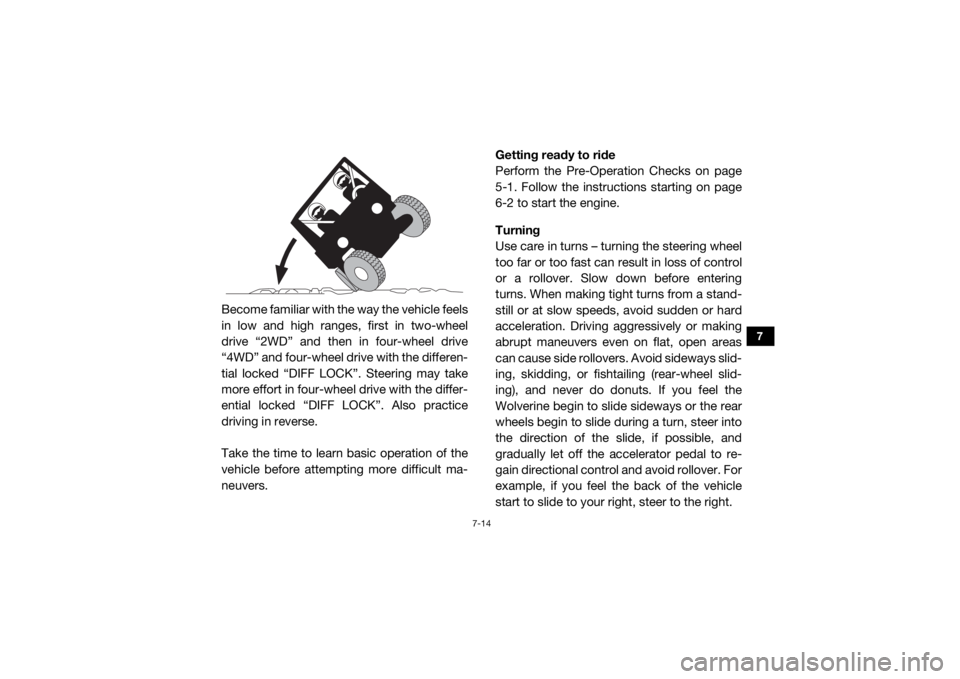
abrupt maneuvers even on flat, open areas
can cause side rollovers. Avoid sideways slid-
ing, skidding, or fishtailing (rear-wheel slid-
ing), and never do donuts. If you feel the
Wolverine begin to slide sideways or the rear
wheels begin to slide during a turn, steer into
the direction of the slide, if possible, and
gradually let off the accelerator pedal to re-
gain directional control and avoid rollover. For
example, if you feel the back of the vehicle
start to slide to your right, steer to the right.UB3D7AE0.book Page 14 Tuesday, November 7, 2017 9:38 AM
Page 107 of 188

7-16
7
the vehicle down after you take your foot off
the accelerator. Engine braking is more no-
ticeable in four-wheel drive. Application of ve-
hicle brakes provides additional stopping
power.
Leaving the vehicle
Do not get out of the vehicle while the engine
is running and the drive select lever is in any
gear. There is a risk of injury because:
Children or others may accidentally press
the accelerator pedal.
Objects tossed into the vehicle may strike
the accelerator pedal.
The parking brake may not keep the vehicle
from accelerating.
Unwanted vehicle movement can cause seri-
ous injury or death, and it may be dangerous
to try to stop the vehicle. Parking on a flat area
When parking on a flat area, stop the engine
and shift the drive select lever into the neutral
position. Apply the parking brake to help pre-
vent the vehicle from rolling.
Parking on a slope
The parking brake acts only on the rear
wheels when in “2WD”. For the parking brake
to take effect on all four wheels, shift to “DIFF
LOCK” before stopping the engine.
If you park on a hill that is too steep, the vehi-
cle may roll out of control. Never park on hills
that are so steep you cannot walk up them
easily. If you must park
on an incline, follow
these instructions:
1. Bring the vehicle to a stop by applying the brake pedal.
2. Put the vehicle in “DIFF LOCK”.
3. Turn the key to “ ” (off).
4. With the brake pedal applied, set the parking brake.UB3D7AE0.book Page 16 Tuesday, November 7, 2017 9:38 AM
Page 108 of 188
7-17
7
5. Block the front and rear wheels withrocks or other objects.
Loading
The total weight of operator, passenger, ac-
cessories, cargo, trailer tongue weight, and
the vehicle itself must not exceed 975 kg
(2150 lb). Vehicle loading can affect handling.
(See page 6-7.)EBU33551Operation on different surfaces and
terrainsGo slowly and proceed with caution when op-
erating on an unfamiliar surface or terrain.
This vehicle may handle differently in certain
types of terrains or on certain surfaces. You
may come upon hidden rocks, bumps, or
holes without enough time to react. To avoid
loss of control or rollover, always be alert to
changing surfaces or terrain when operating
the vehicle. Your Yamaha Wolverine has higher ground
clearance and other features to handle rug-
ged terrain, and as a result, can overturn in
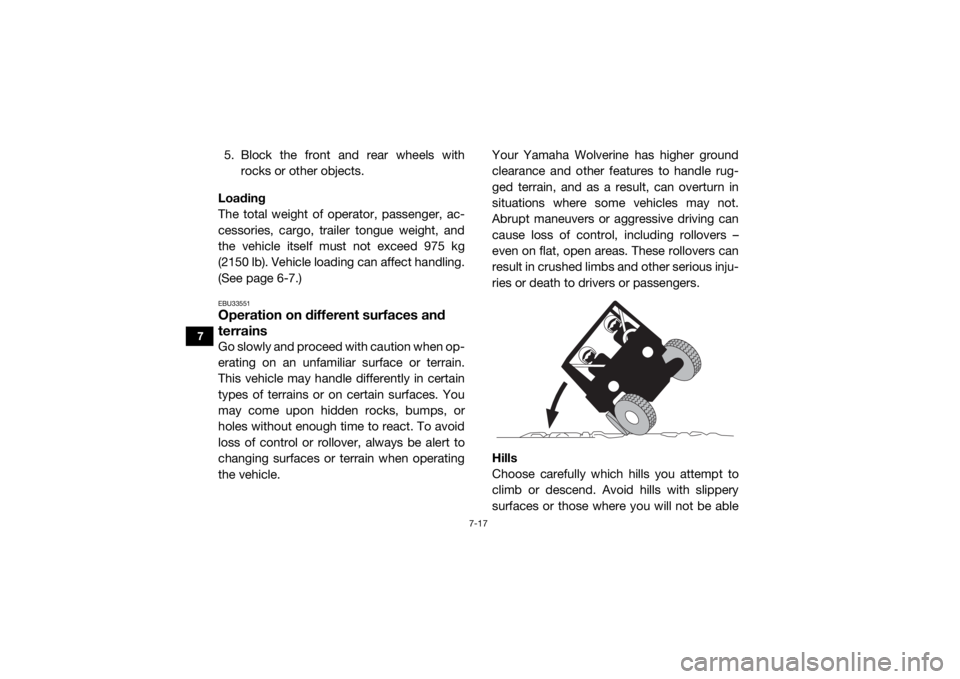
situations where some vehicles may not.
Abrupt maneuvers or aggressive driving can
cause loss of control, including rollovers –
even on flat, open areas. These rollovers can
result in crushed limbs and other serious inju-
ries or death to drivers or passengers.
Hills
Choose carefully which hills you attempt to
climb or descend. Avoid hills with slippery
surfaces or those where you will not be ableUB3D7AE0.book Page 17 Tuesday, November 7, 2017 9:38 AM
Page 109 of 188

7-18
7
to see far enough ahead of you. Use common
sense and remember that some hills are too
steep for you to climb or descend. Use proper
driving techniques to avoid rearward, for-
ward, or sideways rollovers on hills and
slopes.
Drive straight up and down inclines, not
across them. If crossing a hill is unavoidable,
drive slowly. Turn downhill immediately if you
feel the vehicle may tip.
If you think or feel the vehicle may tip or
roll:
Brace yourself by pressing your feet firmly
on the floorboard and keep a firm grip on
the steering wheel or passenger handhold.
Do not put your hands or feet outside of the
vehicle for any reason.
Uphill
Do not attempt to climb hills until you have
mastered basic maneuv ers on flat ground.
Drive straight up hills, and avoid crossing the side of a hill, which increases your risk of roll-
over. Practice first on gentle slopes before at-
tempting steeper hills. Always check the
terrain carefully before attempting any hill.
To climb a hill, you need traction, momentum,
and steady throttle. For more traction and
control for climbing steeper and/or rougher
slopes, shift into low gear and select “4WD”
or “DIFF LOCK”. Travel fast enough to main-
tain momentum, but not so fast that you can-
not react to changes in the terrain as you
climb.
Slow down when you reach the crest of the
hill if you cannot see clearly what is on the
other side – there could be another person, an
obstacle, or a sharp drop-off.
If you start to lose traction or momentum
when climbing, and decide you will be unable
to continue, use the brakes to stop. Do not at-
tempt to turn the vehicle around. With your
foot on the brake pedal, look behind you and
plan your descent. Shift the drive select lever
into reverse so you can use engine braking toUB3D7AE0.book Page 18 Tuesday, November 7, 2017 9:38 AM
Page 111 of 188

7-20
7
Pavement
This vehicle is designed for off-road use only.
Avoid paved surfaces. Turn gradually and go
slowly if you must drive on pavement.
Water
If you must cross shallow, slow-moving water
up to the depth of the vehicle’s floorboard,
choose your path carefully to avoid sharp
drop-offs, large rocks, or slippery surfaces
that could cause the vehicle to overturn. Nev-
er operate through water deeper than 37 cm
(15 in) or fast-flowing water. Choose a path
where both your entrance into and exit point
from the water is a gradual incline. Determine
the water depth and currents before crossing.
Operating this vehicle through deep or fast-
flowing water can lead to loss of control or
overturn. To reduce your risk of drowning or
other injuries, use care when crossing
through water.Wet brakes may have reduced effectiveness.
After leaving the water, test the brakes. If nec-
essary, apply the brakes several times to let
friction dry them out.
NOTICEECB02170After driving your vehicle in water, be sure
to drain the trapped water by removing the
check hoses at the bottom of the air filter
case and air duct and the V-belt case drain
plug. Wash the vehicle in fresh water if it
has been operated in salt water or muddy
conditions. Loose terrain/slippery terrain
When driving on slippery terrain, including
wet, muddy, or icy conditions, as well as
loose gravel, be aware that you could begin
skidding or sliding. To avoid loss of control,
slow down and put the vehicle in four-wheel
drive before driving on a slippery surface and
plan your path to avoid making abrupt ma-
neuvers.
UB3D7AE0.book Page 20 Tuesday, November 7, 2017 9:38 AM
Page 112 of 188

7-21
7
If you feel the vehicle begin to slide sideways
or fishtail (rear-wheel sliding), steer into the di-
rection of the slide if possible, to regain direc-
tional control. For example, if you feel the
back of the vehicle start to slide to your right,
steer to the right.
Brush or wooded areas
When operating in areas with brush or trees,
watch carefully on both sides and above the
vehicle for obstacles such as branches that
the vehicle might hit, causing an accident.
Watch for brush that might enter the vehicle
as you pass and strike you or the passenger.
Never hold onto the cage/frame. The passen-
ger should always hold onto the passenger
handhold with both hands.
The muffler and other engine parts become
extremely hot during operation and remain
hot after the engine has stopped. To reduce
the risk of fire during operation or after leaving
the vehicle, do not let brush, grass and other
materials collect under the vehicle, near the muffler or exhaust pipe, or next to other hot
parts. Check under the vehicle after operating
in areas where combustible materials may
have collected. Do not idle or park the vehicle
in long dry grass or other dry ground cover.
Encountering obstacles
If you cannot go around an obstacle, such as
a fallen tree or a ditch, stop the vehicle where
it is safe to do so. Set the parking brake and
get out to inspect the area thoroughly. Look
from both your approach side and exit side. If
you believe you can continue safely, choose
the path that will allow you to get over the ob-
stacle and at as close to a right angle as pos-
sible to minimize vehicle tipping. Go only fast
enough to maintain your momentum but still
give yourself plenty of time to react to chang-
es in conditions.UB3D7AE0.book Page 21 Tuesday, November 7, 2017 9:38 AM
Page 114 of 188
8-1
8
EBU32005PERIODIC MAINTENANCE AND ADJUSTMENTEBU32010Periodic inspection, adjustment, and lubrica-
tion will keep your vehicle in the safest and
most efficient condition possible. Safety is an
obligation of the vehicle owner/operator. The
most important points of vehicle inspection,
adjustment, and lubrication are explained on
the following pages.
WARNING
EWB01842Failure to properly maintain the vehicle or
performing maintenance activities incor-
rectly may increase your risk of injury or
death during service or while using the ve-
hicle. If you are not familiar with vehicle
service, have a Yamaha dealer perform the
service.
WARNING
EWB02563Turn off the engine when performing main-
tenance unless otherwise specified.
A running engine has moving parts that
can catch on body parts or clothing and
electrical parts that can cause shocks or
fires.
Running the engine while servicing can
lead to eye injury, burns, fire, or carbon
monoxide poisoning - possibly leading
to death. See page 2-5 for more informa-
tion about carbon monoxide.
WARNING
EWB02691Brake discs, calipers, drums, and linings
can become very hot during use. To avoid
possible burns, let brake components cool
before touching them.
UB3D7AE0.book Page 1 Tuesday, November 7, 2017 9:38 AM
Page 115 of 188
8-2
8
EBU33561Owner’s Manual and tool kitYou are recommended to put this manual in
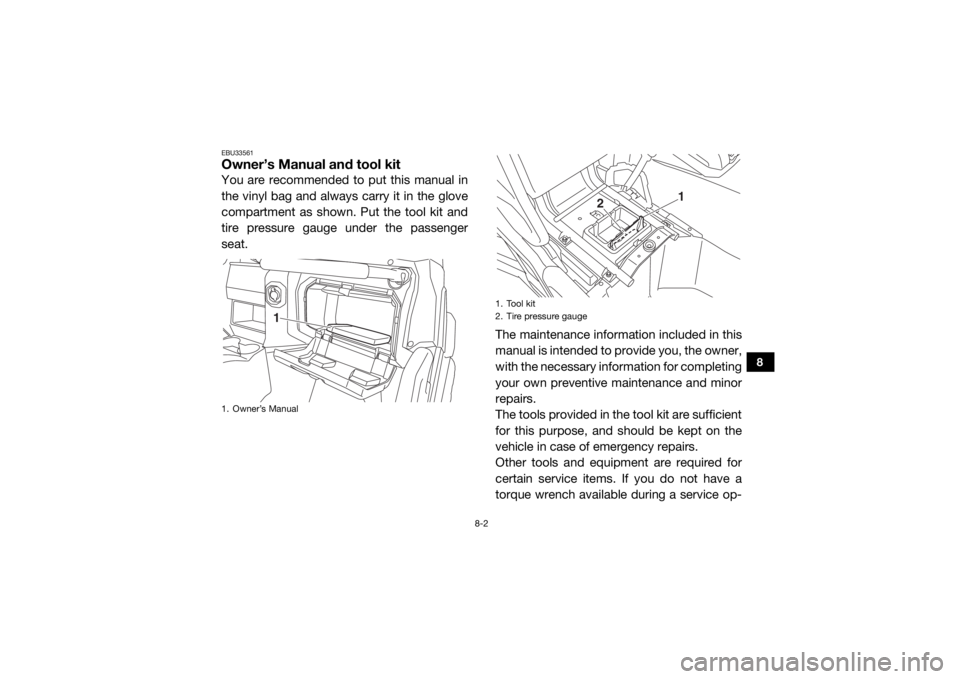
the vinyl bag and always carry it in the glove
compartment as shown. Put the tool kit and
tire pressure gauge under the passenger
seat.The maintenance information included in this
manual is intended to provide you, the owner,
with the necessary information for completing
your own preventive maintenance and minor
repairs.
The tools provided in the tool kit are sufficient
for this purpose, and should be kept on the
vehicle in case of emergency repairs.
Other tools and equipment are required for
certain service items. If you do not have a
torque wrench available during a service op-1. Owner’s Manual
1
1. Tool kit
2. Tire pressure gauge
1
2
UB3D7AE0.book Page 2 Tuesday, November 7, 2017 9:38 AM