maintenance YAMAHA WR 250F 2003 Owner's Manual
[x] Cancel search | Manufacturer: YAMAHA, Model Year: 2003, Model line: WR 250F, Model: YAMAHA WR 250F 2003Pages: 860, PDF Size: 35.16 MB
Page 192 of 860

3 - 1
INSP
ADJ
MAINTENANCE INTERVALS
EC300000
REGULAR INSPECTION AND ADJUSTMENTS
MAINTENANCE INTERVALS
The following schedule is intended as a general guide to maintenance and lubrication. Bear in mind that such factors as
weather, terrain, geographical location, and individual usage will alter the required maintenance and lubrication intervals. If
you are a doubt as to what intervals to follow in maintaining and lubricating your machine, consult your Yamaha dealer.
ItemAfter
break-inEvery
race
Every third
(or
500 km)Every fifth
(or
1,000 km)As
requiredRemarks
ENGINE OIL
Replace
Inspect
VALVES
Check the valve clearances The engine must be cold.
Check the valve seats and
valve stems for wear. Inspect
Replace
VALVE SPRINGS
InspectCheck the free length and
the tilt.
Replace
VALVE LIFTERS
InspectCheck for scratches and
wear.
Replace
CAMSHAFTSInspect the camshaft
surface.
Inspect the decompression
system. Inspect
Replace
TIMING CHAIN SPROCKETS, TIMING
CHAIN
InspectCheck for wear on the teeth
and for damage.
Replace
PISTON
InspectInspect crack
Inspect carbon deposits and
eliminate them. Clean
Replace
PISTON RING
InspectCheck ring end gap
Replace
PISTON PIN
Inspect
Replace
CYLINDER HEADInspect carbon deposits and
eliminate them.
Change gasket Inspect and clean
CYLINDER
Inspect and clean Inspect score marks
Inspect wear
Replace
CLUTCH
Inspect and adjust Inspect housing, friction
plate, clutch plate and spring
Replace
TRANSMISSION
Inspect
Replace bearing
SHIFT FORK, SHIFT CAM, GUIDE BAR
InspectInspect wear
Page 193 of 860
3 - 2
INSP
ADJ
MAINTENANCE INTERVALS
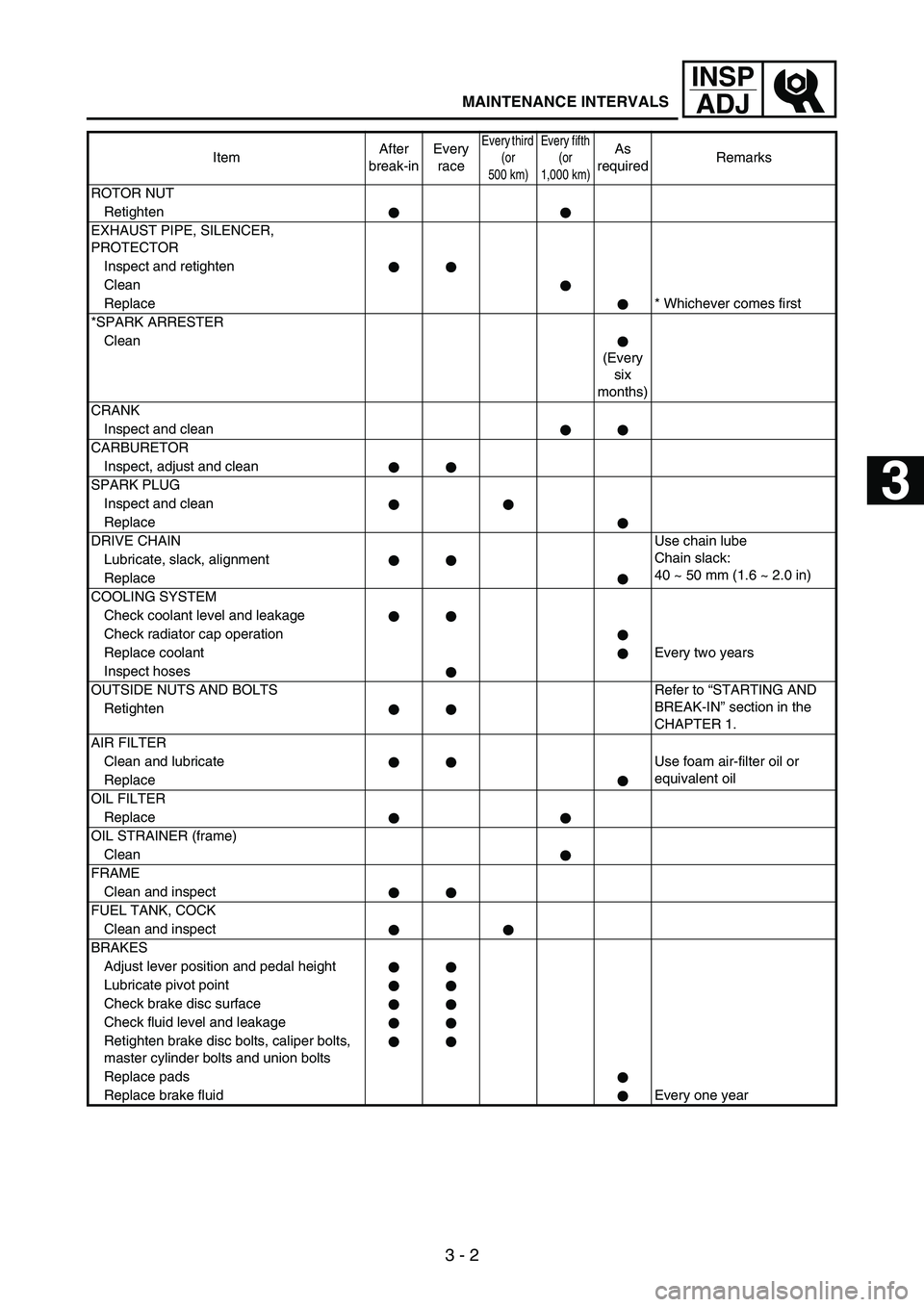
ROTOR NUT
Retighten
EXHAUST PIPE, SILENCER,
PROTECTOR
Inspect and retighten
Clean
Replace* Whichever comes first
*SPARK ARRESTER
Clean
(Every
six
months)
CRANK
Inspect and clean
CARBURETOR
Inspect, adjust and clean
SPARK PLUG
Inspect and clean
Replace
DRIVE CHAINUse chain lube
Chain slack:
40 ~ 50 mm (1.6 ~ 2.0 in) Lubricate, slack, alignment
Replace
COOLING SYSTEM
Check coolant level and leakage
Check radiator cap operation
Replace coolantEvery two years
Inspect hoses
OUTSIDE NUTS AND BOLTS Refer to “STARTING AND
BREAK-IN” section in the
CHAPTER 1. Retighten
AIR FILTER
Clean and lubricate Use foam air-filter oil or
equivalent oil
Replace
OIL FILTER
Replace
OIL STRAINER (frame)
Clean
FRAME
Clean and inspect
FUEL TANK, COCK
Clean and inspect
BRAKES
Adjust lever position and pedal height
Lubricate pivot point
Check brake disc surface
Check fluid level and leakage
Retighten brake disc bolts, caliper bolts,
master cylinder bolts and union bolts
Replace pads
Replace brake fluid Every one yearItemAfter
break-inEvery
race
Every third
(or
500 km)Every fifth
(or
1,000 km)As
requiredRemarks
1
2
3
4
5
6
7
Page 194 of 860
3 - 3
INSP
ADJ
MAINTENANCE INTERVALS
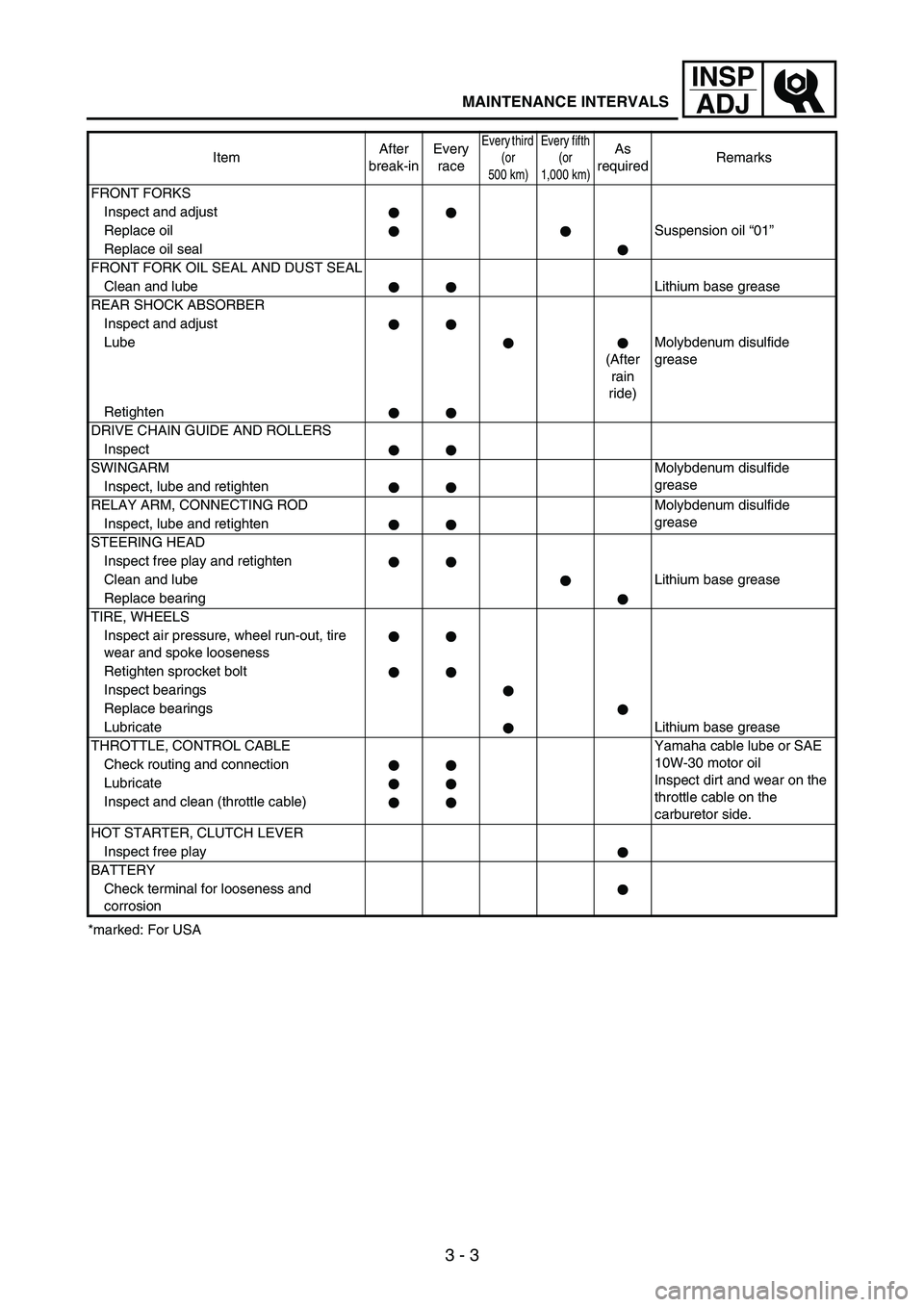
*marked: For USAFRONT FORKS
Inspect and adjust
Replace oilSuspension oil “01”
Replace oil seal
FRONT FORK OIL SEAL AND DUST SEAL
Clean and lubeLithium base grease
REAR SHOCK ABSORBER
Inspect and adjust
Lube
(After
rain
ride)Molybdenum disulfide
grease
Retighten
DRIVE CHAIN GUIDE AND ROLLERS
Inspect
SWINGARMMolybdenum disulfide
grease
Inspect, lube and retighten
RELAY ARM, CONNECTING ROD Molybdenum disulfide
grease
Inspect, lube and retighten
STEERING HEAD
Inspect free play and retighten
Clean and lubeLithium base grease
Replace bearing
TIRE, WHEELS
Inspect air pressure, wheel run-out, tire
wear and spoke looseness
Retighten sprocket bolt
Inspect bearings
Replace bearings
LubricateLithium base grease
THROTTLE, CONTROL CABLE Yamaha cable lube or SAE
10W-30 motor oil
Inspect dirt and wear on the
throttle cable on the
carburetor side. Check routing and connection
Lubricate
Inspect and clean (throttle cable)
HOT STARTER, CLUTCH LEVER
Inspect free play
BATTERY
Check terminal for looseness and
corrosionItemAfter
break-inEvery
race
Every third
(or
500 km)Every fifth
(or
1,000 km)As
requiredRemarks
Page 207 of 860
3 - 16
INSP
ADJ
PRE-OPERATION INSPECTION AND MAINTENANCE
EC320000
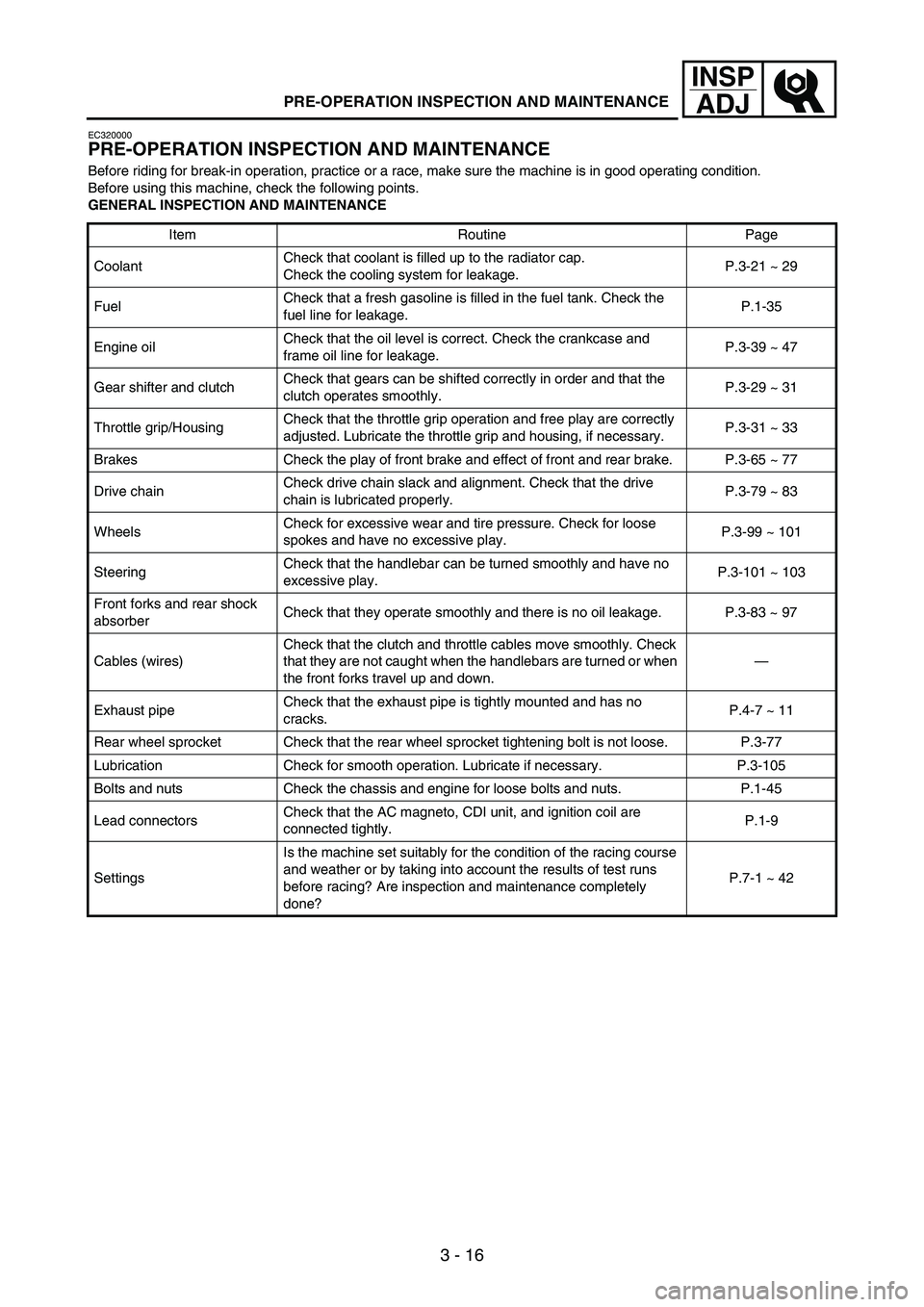
PRE-OPERATION INSPECTION AND MAINTENANCE
Before riding for break-in operation, practice or a race, make sure the machine is in good operating condition.
Before using this machine, check the following points.
GENERAL INSPECTION AND MAINTENANCE
Item Routine Page
CoolantCheck that coolant is filled up to the radiator cap.
Check the cooling system for leakage.P.3-21 ~ 29
FuelCheck that a fresh gasoline is filled in the fuel tank. Check the
fuel line for leakage.P.1-35
Engine oilCheck that the oil level is correct. Check the crankcase and
frame oil line for leakage.P.3-39 ~ 47
Gear shifter and clutchCheck that gears can be shifted correctly in order and that the
clutch operates smoothly.P.3-29 ~ 31
Throttle grip/HousingCheck that the throttle grip operation and free play are correctly
adjusted. Lubricate the throttle grip and housing, if necessary.P.3-31 ~ 33
Brakes Check the play of front brake and effect of front and rear brake. P.3-65 ~ 77
Drive chainCheck drive chain slack and alignment. Check that the drive
chain is lubricated properly.P.3-79 ~ 83
WheelsCheck for excessive wear and tire pressure. Check for loose
spokes and have no excessive play.P.3-99 ~ 101
SteeringCheck that the handlebar can be turned smoothly and have no
excessive play.P.3-101 ~ 103
Front forks and rear shock
absorberCheck that they operate smoothly and there is no oil leakage. P.3-83 ~ 97
Cables (wires)Check that the clutch and throttle cables move smoothly. Check
that they are not caught when the handlebars are turned or when
the front forks travel up and down.—
Exhaust pipeCheck that the exhaust pipe is tightly mounted and has no
cracks.P.4-7 ~ 11
Rear wheel sprocket Check that the rear wheel sprocket tightening bolt is not loose. P.3-77
Lubrication Check for smooth operation. Lubricate if necessary. P.3-105
Bolts and nuts Check the chassis and engine for loose bolts and nuts. P.1-45
Lead connectorsCheck that the AC magneto, CDI unit, and ignition coil are
connected tightly.P.1-9
SettingsIs the machine set suitably for the condition of the racing course
and weather or by taking into account the results of test runs
before racing? Are inspection and maintenance completely
done?P.7-1 ~ 42
Page 226 of 860

3 - 35
INSP
ADJ
AIR FILTER CLEANING
NOTE:Proper air filter maintenance is the
biggest key to preventing premature
engine wear and damage.
CAUTION:
Never run the engine without the
air filter element in place; this
would allow dirt and dust to enter
the engine and cause rapid wear
and possible engine damage.
1. Remove:
Air filter case cover
1
NOTE:Loosen the quick screw
2 and draw
the air filter case cover to remove it
because its claws
a are inserted in
the side cover as shown.
2. Unhook:
Binder
1
3. Remove:
Air filter element
1
Filter guide
2
4. Clean:
Air filter element
Clean them with solvent.
NOTE:After cleaning, remove the remaining
solvent by squeezing the element.
CAUTION:
Do not twist the element when
squeezing the element.
Leaving too much of solvent in
the element may result in poor
starting.
NETTOYAGE DU FILTRE A AIR
N.B.:
Un entretien convenable du filtre à air
est la clé pour éviter l’usure prématurée
et l’endommagement du moteur.
ATTENTION:
Ne jamais faire tourner le moteur
lorsque l’élément du filtre à air n’est
pas en place; ceci permettrait la péné-
tration de poussière dans le moteur et
causerait son usure rapide et son
endommagement.
1. Déposer:
Le couvercle du boîtier du filtre à
air 1
N.B.:
Desserrer la vis rapide 2 et tirer le cou-
vercle du boîtier de filtre à air pour
l’enlever comme indiqué car les griffes
a sont insérées dans le capot latéral.
2. Décrocher:
Ressort 1
3. Déposer:
Elément du filtre à air 1
Guide de filtre 2
4. Nettoyer:
Elément du filtre à air
Les nettoyer avec du dissolvant.
N.B.:
Une fois l’entretien terminé, éliminer ce
qui reste de solvant en serrant l’élément.
ATTENTION:
Ne pas tordre l’élément en l’esso-
rant.
Un excès de dissolvant sur l’élément
risque de rendre la mise en marche
du moteur plus difficile.
ENGINE
MOTEUR
Page 704 of 860
5 - 127
CHASSWINGARM
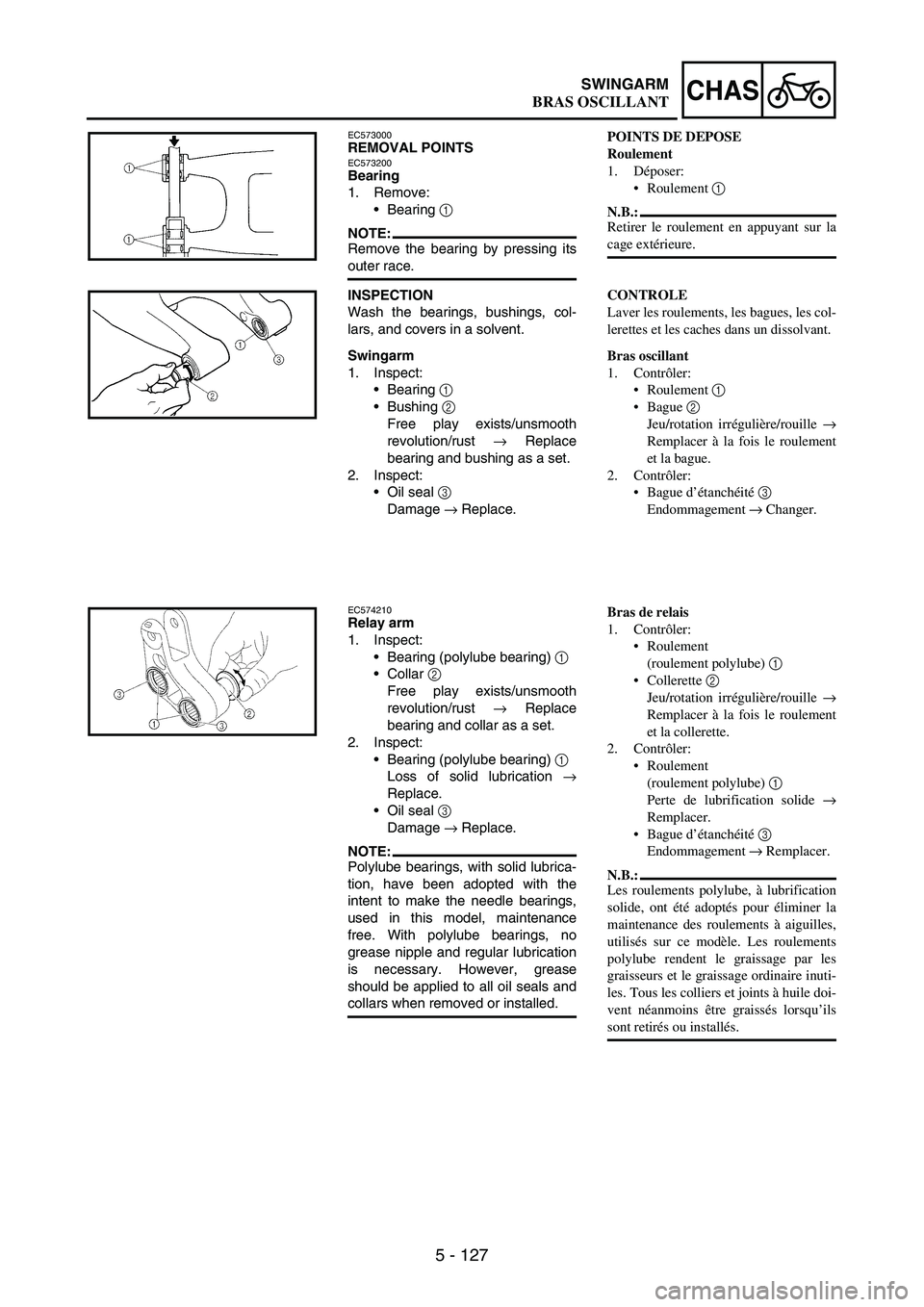
EC573000REMOVAL POINTSEC573200Bearing
1. Remove:
Bearing
1
NOTE:Remove the bearing by pressing its
outer race.
INSPECTION
Wash the bearings, bushings, col-
lars, and covers in a solvent.
Swingarm
1. Inspect:
Bearing
1
Bushing
2
Free play exists/unsmooth
revolution/rust
→ Replace
bearing and bushing as a set.
2. Inspect:
Oil seal
3
Damage
→ Replace.
EC574210Relay arm
1. Inspect:
Bearing (polylube bearing)
1
Collar
2
Free play exists/unsmooth
revolution/rust
→ Replace
bearing and collar as a set.
2. Inspect:
Bearing (polylube bearing)
1
Loss of solid lubrication
→
Replace.
Oil seal
3
Damage
→ Replace.
NOTE:Polylube bearings, with solid lubrica-
tion, have been adopted with the
intent to make the needle bearings,
used in this model, maintenance
free. With polylube bearings, no
grease nipple and regular lubrication
is necessary. However, grease
should be applied to all oil seals and
collars when removed or installed.
POINTS DE DEPOSE
Roulement
1. Déposer:
Roulement 1
N.B.:
Retirer le roulement en appuyant sur la
cage extérieure.
CONTROLE
Laver les roulements, les bagues, les col-
lerettes et les caches dans un dissolvant.
Bras oscillant
1. Contrôler:
Roulement 1
Bague 2
Jeu/rotation irrégulière/rouille →
Remplacer à la fois le roulement
et la bague.
2. Contrôler:
Bague d’étanchéité 3
Endommagement → Changer.
Bras de relais
1. Contrôler:
Roulement
(roulement polylube) 1
Collerette 2
Jeu/rotation irrégulière/rouille →
Remplacer à la fois le roulement
et la collerette.
2. Contrôler:
Roulement
(roulement polylube) 1
Perte de lubrification solide →
Remplacer.
Bague d’étanchéité 3
Endommagement → Remplacer.
N.B.:
Les roulements polylube, à lubrification
solide, ont été adoptés pour éliminer la
maintenance des roulements à aiguilles,
utilisés sur ce modèle. Les roulements
polylube rendent le graissage par les
graisseurs et le graissage ordinaire inuti-
les. Tous les colliers et joints à huile doi-
vent néanmoins être graissés lorsqu’ils
sont retirés ou installés.
BRAS OSCILLANT
Page 706 of 860
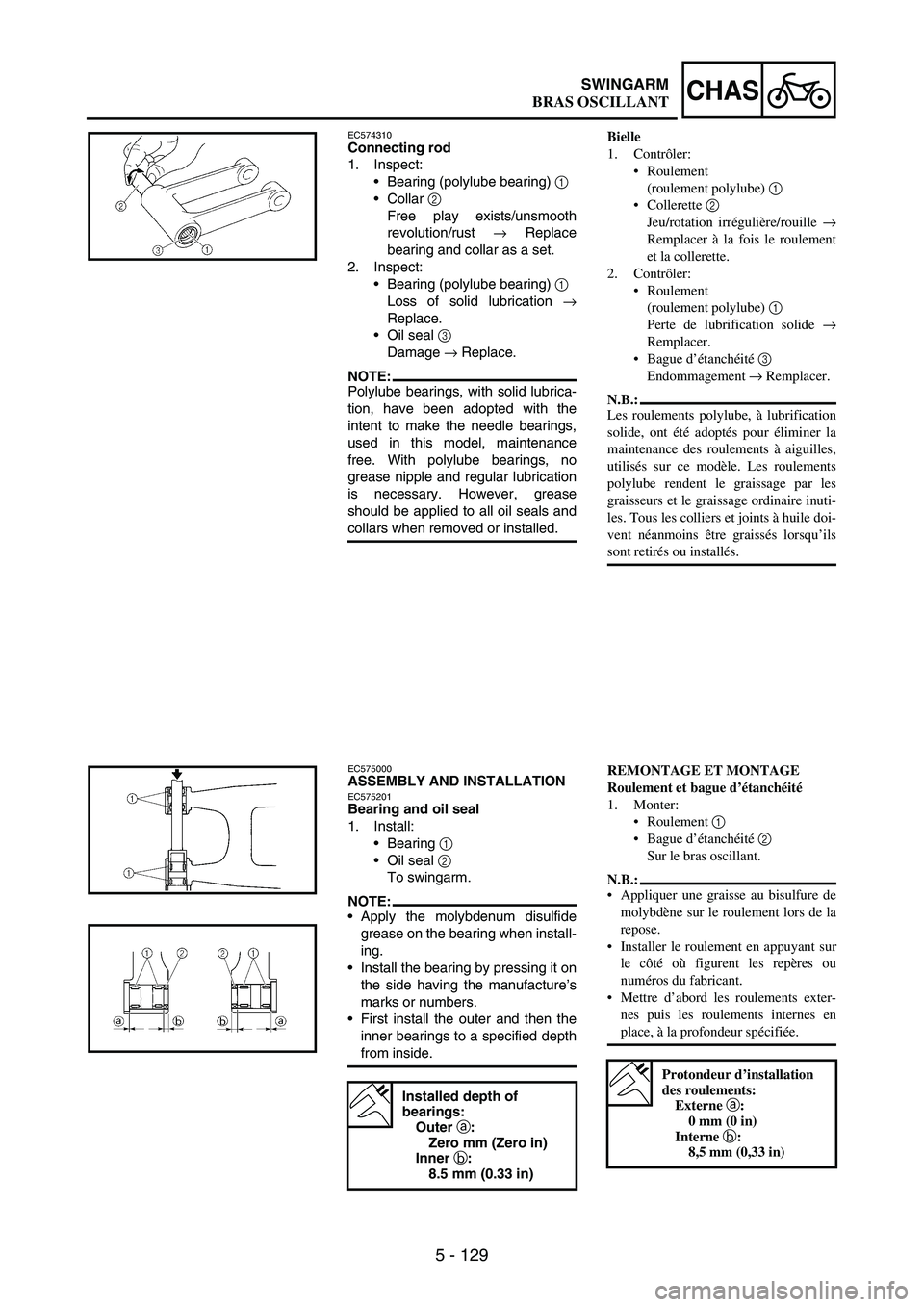
5 - 129
CHASSWINGARM
EC574310Connecting rod
1. Inspect:
Bearing (polylube bearing)
1
Collar
2
Free play exists/unsmooth
revolution/rust
→ Replace
bearing and collar as a set.
2. Inspect:
Bearing (polylube bearing)
1
Loss of solid lubrication
→
Replace.
Oil seal
3
Damage
→ Replace.
NOTE:Polylube bearings, with solid lubrica-
tion, have been adopted with the
intent to make the needle bearings,
used in this model, maintenance
free. With polylube bearings, no
grease nipple and regular lubrication
is necessary. However, grease
should be applied to all oil seals and
collars when removed or installed.
EC575000ASSEMBLY AND INSTALLATIONEC575201Bearing and oil seal
1. Install:
Bearing
1
Oil seal
2
To swingarm.
NOTE:Apply the molybdenum disulfide
grease on the bearing when install-
ing.
Install the bearing by pressing it on
the side having the manufacture’s
marks or numbers.
First install the outer and then the
inner bearings to a specified depth
from inside.
Installed depth of
bearings:
Outer a
:
Zero mm (Zero in)
Inner b
:
8.5 mm (0.33 in)
Bielle
1. Contrôler:
Roulement
(roulement polylube) 1
Collerette 2
Jeu/rotation irrégulière/rouille →
Remplacer à la fois le roulement
et la collerette.
2. Contrôler:
Roulement
(roulement polylube) 1
Perte de lubrification solide →
Remplacer.
Bague d’étanchéité 3
Endommagement → Remplacer.
N.B.:
Les roulements polylube, à lubrification
solide, ont été adoptés pour éliminer la
maintenance des roulements à aiguilles,
utilisés sur ce modèle. Les roulements
polylube rendent le graissage par les
graisseurs et le graissage ordinaire inuti-
les. Tous les colliers et joints à huile doi-
vent néanmoins être graissés lorsqu’ils
sont retirés ou installés.
REMONTAGE ET MONTAGE
Roulement et bague d’étanchéité
1. Monter:
Roulement 1
Bague d’étanchéité 2
Sur le bras oscillant.
N.B.:
Appliquer une graisse au bisulfure de
molybdène sur le roulement lors de la
repose.
Installer le roulement en appuyant sur
le côté où figurent les repères ou
numéros du fabricant.
Mettre d’abord les roulements exter-
nes puis les roulements internes en
place, à la profondeur spécifiée.
Protondeur d’installation
des roulements:
Externe a:
0 mm (0 in)
Interne b:
8,5 mm (0,33 in)
BRAS OSCILLANT