light YAMAHA WR 250F 2004 User Guide
[x] Cancel search | Manufacturer: YAMAHA, Model Year: 2004, Model line: WR 250F, Model: YAMAHA WR 250F 2004Pages: 864, PDF Size: 22.07 MB
Page 96 of 864
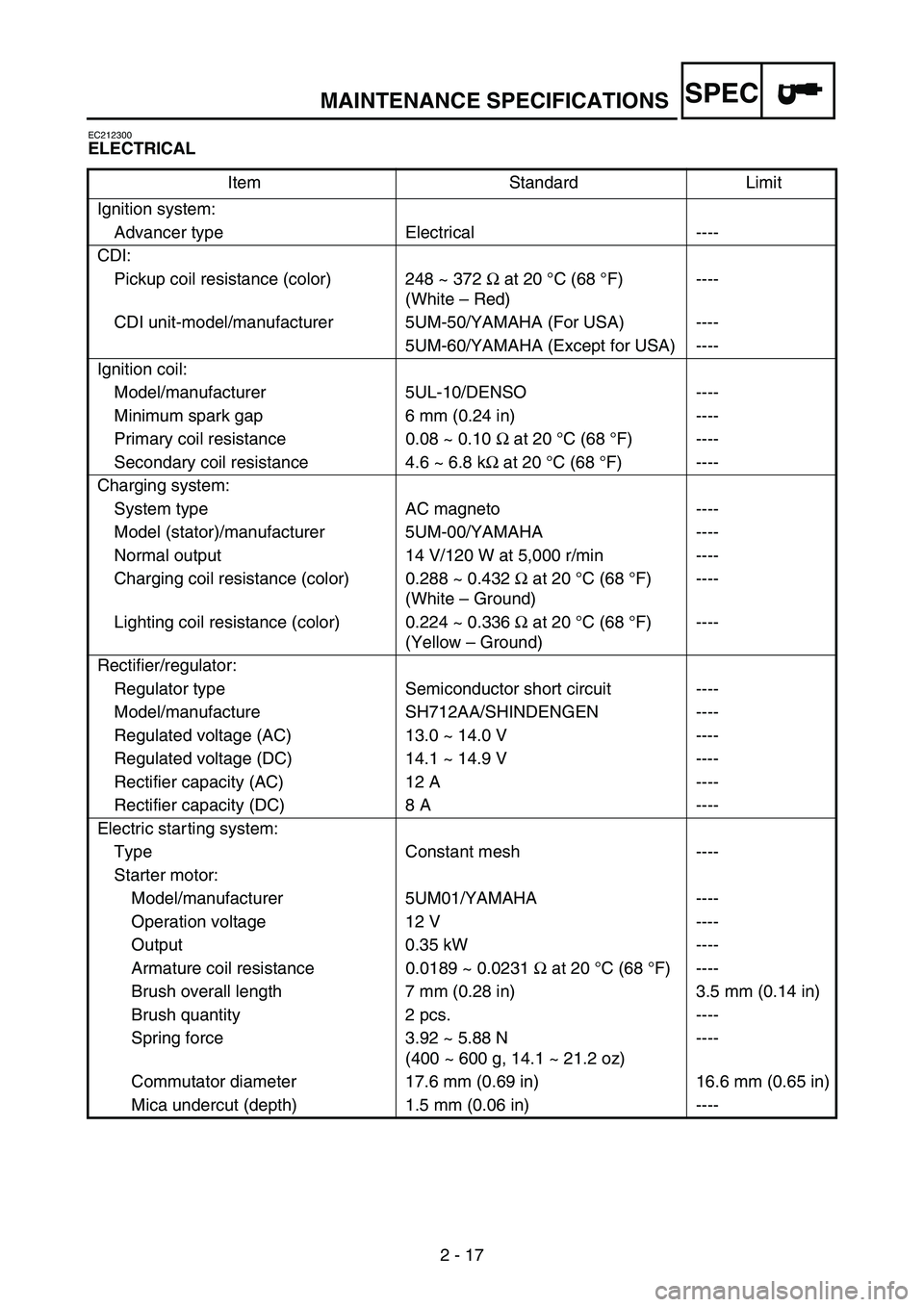
MAINTENANCE SPECIFICATIONS
2 - 17
SPEC
EC212300
ELECTRICAL
Item Standard Limit
Ignition system:
Advancer type Electrical ----
CDI:
Pickup coil resistance (color) 248 ~ 372 Ω at 20°C (68 °F)
(White – Red)----
CDI unit-model/manufacturer 5UM-50/YAMAHA (For USA) ----
5UM-60/YAMAHA (Except for USA) ----
Ignition coil:
Model/manufacturer 5UL-10/DENSO ----
Minimum spark gap 6 mm (0.24 in) ----
Primary coil resistance 0.08 ~ 0.10 Ω at 20 °C (68 °F) ----
Secondary coil resistance 4.6 ~ 6.8 kΩ at 20 °C (68 °F) ----
Charging system:
System type AC magneto ----
Model (stator)/manufacturer 5UM-00/YAMAHA ----
Normal output 14 V/120 W at 5,000 r/min ----
Charging coil resistance (color) 0.288 ~ 0.432 Ω at 20 °C (68 °F)
(White – Ground)----
Lighting coil resistance (color) 0.224 ~ 0.336 Ω at 20 °C (68 °F)
(Yellow – Ground)----
Rectifier/regulator:
Regulator type Semiconductor short circuit ----
Model/manufacture SH712AA/SHINDENGEN ----
Regulated voltage (AC) 13.0 ~ 14.0 V ----
Regulated voltage (DC) 14.1 ~ 14.9 V ----
Rectifier capacity (AC) 12 A ----
Rectifier capacity (DC) 8 A ----
Electric starting system:
Type Constant mesh ----
Starter motor:
Model/manufacturer 5UM01/YAMAHA ----
Operation voltage 12 V ----
Output 0.35 kW ----
Armature coil resistance 0.0189 ~ 0.0231 Ω at 20 °C (68 °F) ----
Brush overall length 7 mm (0.28 in) 3.5 mm (0.14 in)
Brush quantity 2 pcs. ----
Spring force 3.92 ~ 5.88 N
(400 ~ 600 g, 14.1 ~ 21.2 oz)----
Commutator diameter 17.6 mm (0.69 in) 16.6 mm (0.65 in)
Mica undercut (depth) 1.5 mm (0.06 in) ----
Page 186 of 864
SPEC
2 - 107
CABLE ROUTING DIAGRAM
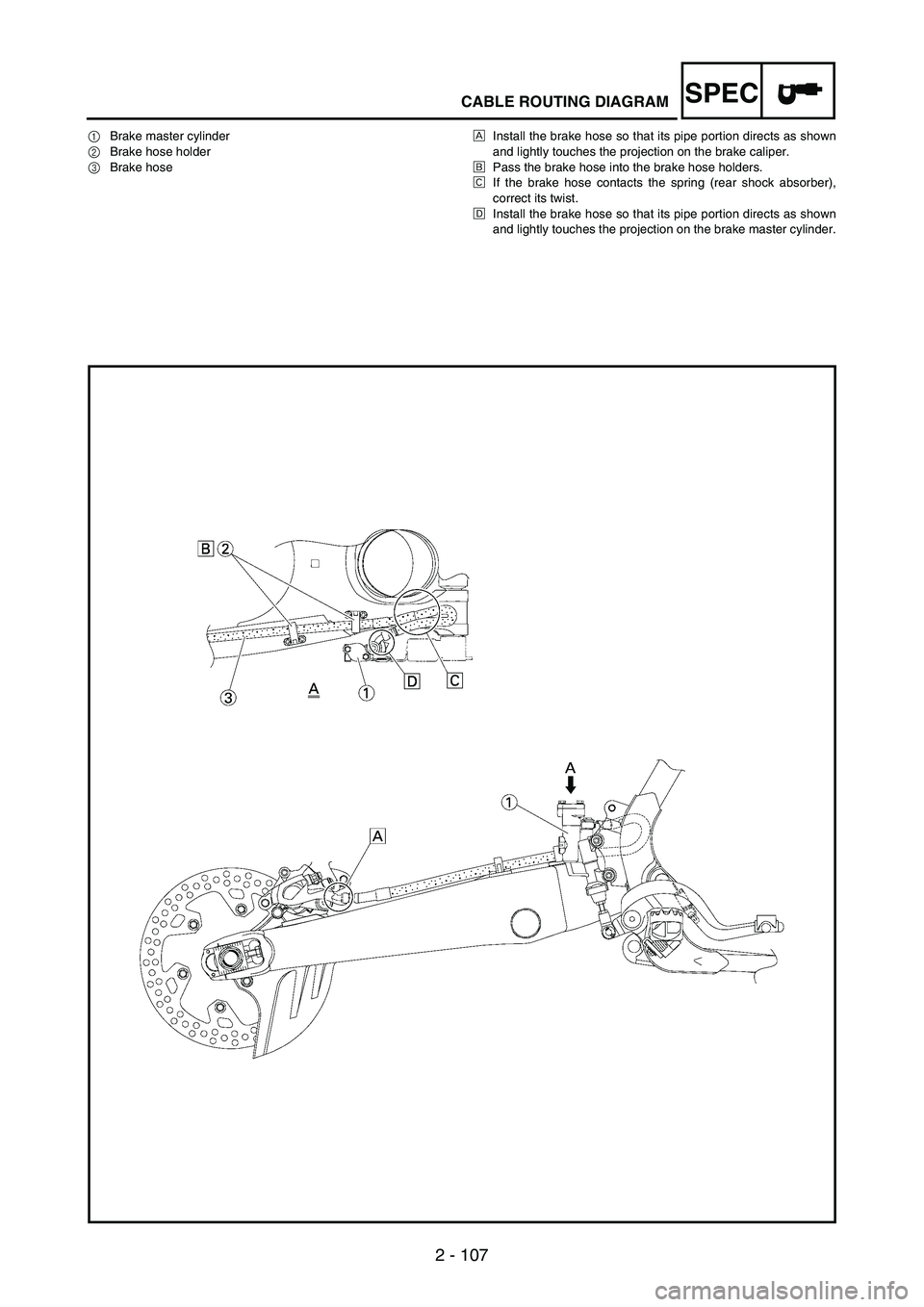
1Brake master cylinder
2Brake hose holder
3Brake hoseÈInstall the brake hose so that its pipe portion directs as shown
and lightly touches the projection on the brake caliper.
ÉPass the brake hose into the brake hose holders.
ÊIf the brake hose contacts the spring (rear shock absorber),
correct its twist.
ËInstall the brake hose so that its pipe portion directs as shown
and lightly touches the projection on the brake master cylinder.
Page 188 of 864
SPEC
2 - 109
CABLE ROUTING DIAGRAM
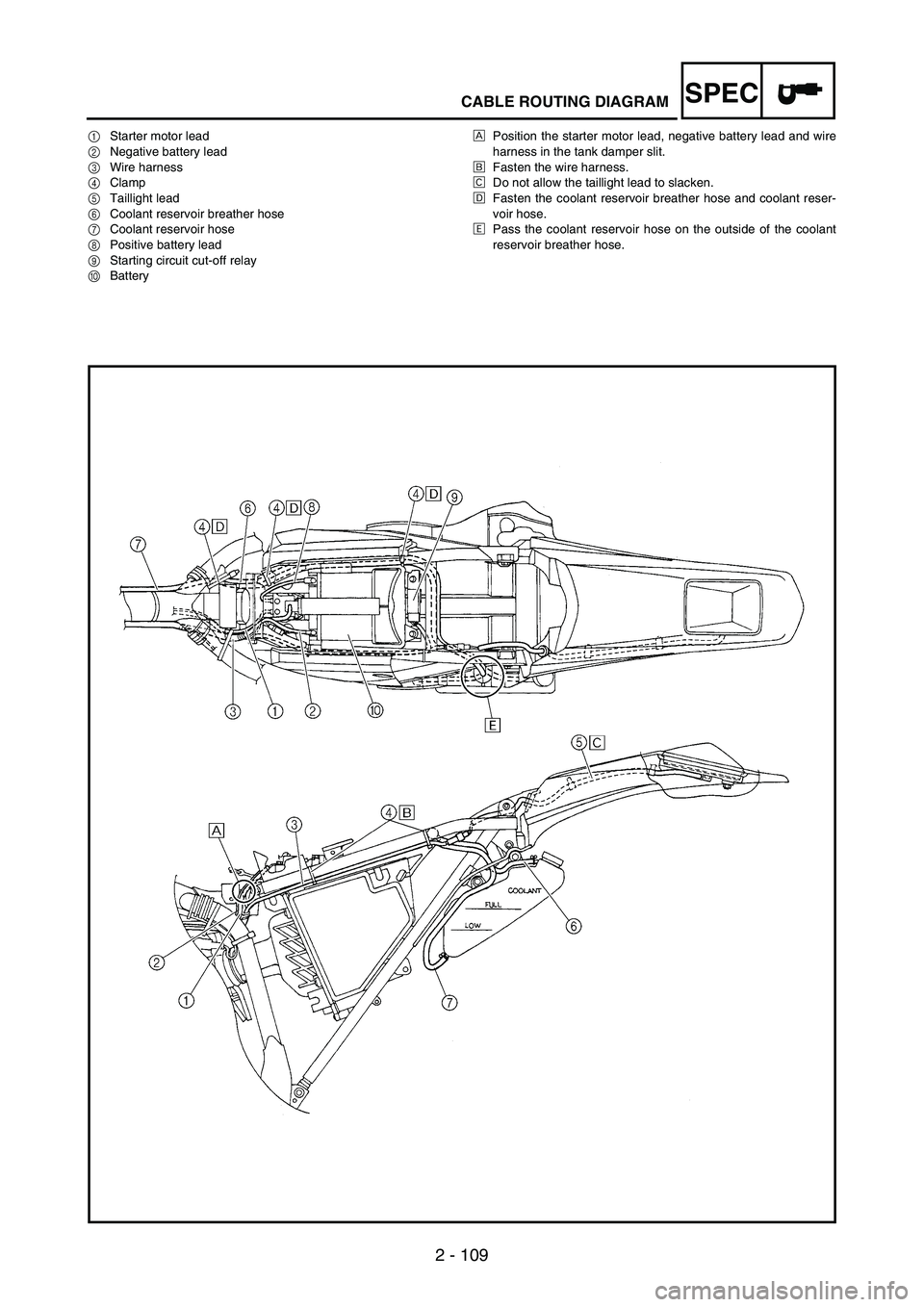
1Starter motor lead
2Negative battery lead
3Wire harness
4Clamp
5Taillight lead
6Coolant reservoir breather hose
7Coolant reservoir hose
8Positive battery lead
9Starting circuit cut-off relay
0BatteryÈPosition the starter motor lead, negative battery lead and wire
harness in the tank damper slit.
ÉFasten the wire harness.
ÊDo not allow the taillight lead to slacken.
ËFasten the coolant reservoir breather hose and coolant reser-
voir hose.
ÌPass the coolant reservoir hose on the outside of the coolant
reservoir breather hose.
Page 230 of 864

3 - 39
INSP
ADJ
ENGINE OIL LEVEL INSPECTION
1. Start the engine, warm it up for
several minutes, and then turn
off the engine and wait for five
minutes.
2. Place the machine on a level
place and hold it up on upright
position by placing the suitable
stand under the engine.
3. Remove:
Oil tank cap
1
1
4. Inspect:
Oil level
Oil level should be between
maximum
a and minimum b
marks.
Oil level is low → Add oil to
proper level.
NOTE:When inspecting the oil level, do not
screw the oil tank cap into the oil
tank. Insert the gauge lightly.
(For USA and CDN)
CAUTION:
Do not add any chemical addi-
tives. Engine oil also lubricates
the clutch and additives could
cause clutch slippage.
Do not allow foreign material to
enter the crankcase.
Recommended oil:
At 5 °C (40 °F) or
higher È Yamalube 4
(20W-40) or SAE 20W-
40 type SG motor oil
(Non-Friction
modified)
At 15 °C (60 °F) or
lower É Yamalube 4
(10W-30) or SAE 10W-
30 type SG motor oil
(Non-Friction modified)
and/or
Yamalube 4-R (15W-50)
(Non-Friction modified)
a
b
CONTROLE DU NIVEAU D’HUILE
MOTEUR
1. Mettre le moteur en marche, le faire
chauffer pendant quelques minutes,
puis le couper et attendre cinq
minutes.
2. Placer le véhicule sur un plan hori-
zontal et le dresser à la verticale en
plaçant un support adéquat sous le
moteur.
3. Déposer:
Bouchon du réservoir d’huile 1
4. Contrôler:
Niveau d’huile
Le niveau d’huile doit se trouver
entre les repères maximum a et
minimum b.
Bas niveau d’huile → Ajouter de
l’huile jusqu’au niveau requis.
N.B.:
Pour mesurer le niveau d’huile, intro-
duire la jauge dans le réservoir en
veillant à ne pas la visser.
(USA et CDN)
ATTENTION:
Ne pas ajouter d’additifs chimiques.
L’huile moteur lubrifie également
l’embrayage et des additifs risquent
de provoquer le patinage de
l’embrayage.
Empêcher toute pénétration de
crasses ou d’objets dans le carter.
Huile recommandée:
Min. 5 °C (40 °F) È:
Yamalube 4 (20W40) ou
SAE 20W-40 de type SG
(Sans additifs anti-
friction)
Max. 15 °C (60 °F) É:
Yamalube 4 (10W-30) ou
SAE 10W-30 de type SG
(Sans additifs anti-
friction)
et/ou
Yamalube 4-R (15W-50)
(Sans additifs anti-
friction)
ENGINE
MOTEUR
Page 238 of 864
3 - 47
INSP
ADJ
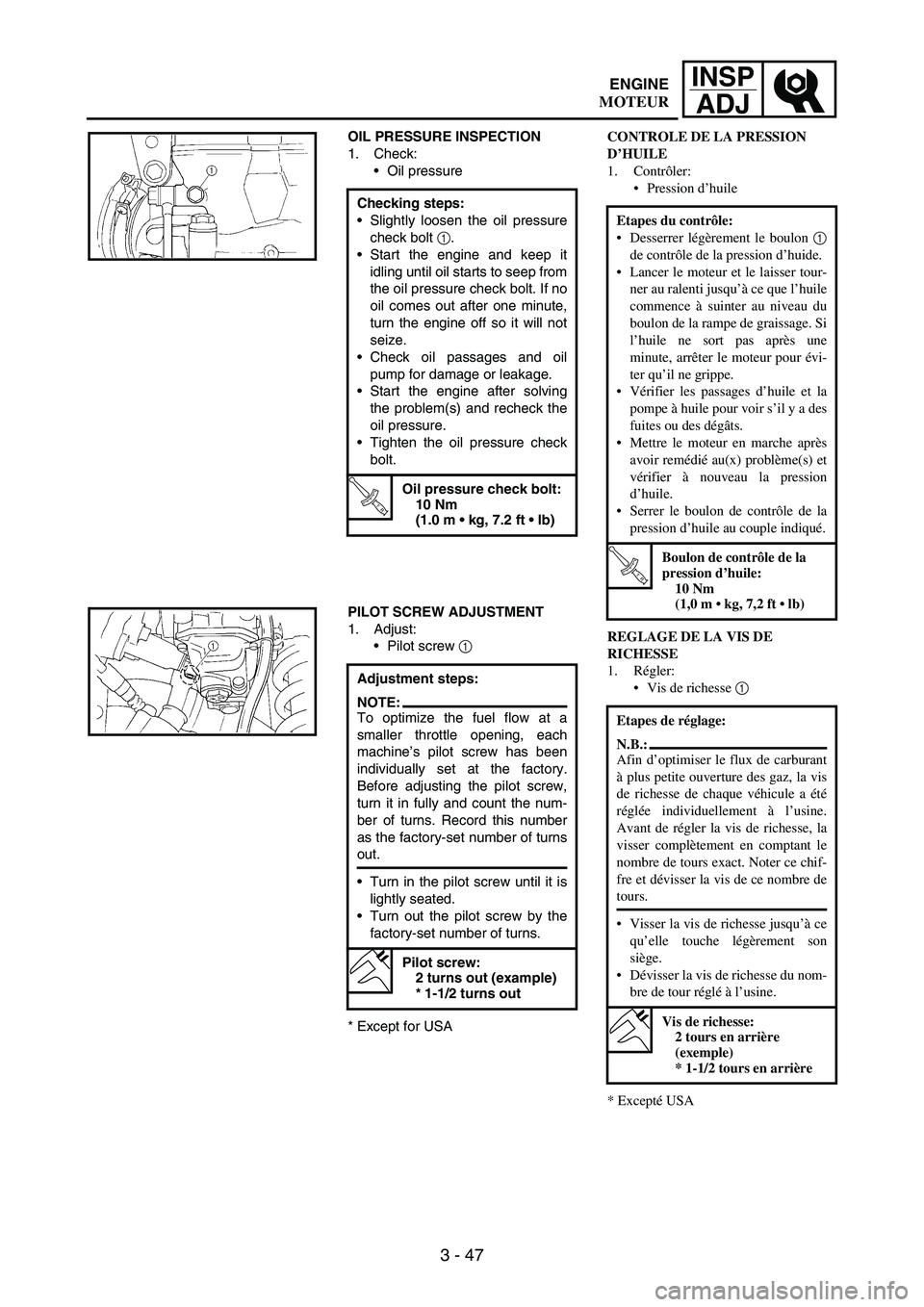
OIL PRESSURE INSPECTION
1. Check:
Oil pressure
Checking steps:
Slightly loosen the oil pressure
check bolt
1.
Start the engine and keep it
idling until oil starts to seep from
the oil pressure check bolt. If no
oil comes out after one minute,
turn the engine off so it will not
seize.
Check oil passages and oil
pump for damage or leakage.
Start the engine after solving
the problem(s) and recheck the
oil pressure.
Tighten the oil pressure check
bolt.
T R..
Oil pressure check bolt:
10 Nm
(1.0 m kg, 7.2 ft lb)
PILOT SCREW ADJUSTMENT
1. Adjust:
Pilot screw
1
* Except for USAAdjustment steps:
NOTE:To optimize the fuel flow at a
smaller throttle opening, each
machine’s pilot screw has been
individually set at the factory.
Before adjusting the pilot screw,
turn it in fully and count the num-
ber of turns. Record this number
as the factory-set number of turns
out.
Turn in the pilot screw until it is
lightly seated.
Turn out the pilot screw by the
factory-set number of turns.
Pilot screw:
2 turns out (example)
* 1-1/2 turns out
CONTROLE DE LA PRESSION
D’HUILE
1. Contrôler:
Pression d’huile
REGLAGE DE LA VIS DE
RICHESSE
1. Régler:
Vis de richesse 1
* Excepté USA Etapes du contrôle:
Desserrer légèrement le boulon 1
de contrôle de la pression d’huide.
Lancer le moteur et le laisser tour-
ner au ralenti jusqu’à ce que l’huile
commence à suinter au niveau du
boulon de la rampe de graissage. Si
l’huile ne sort pas après une
minute, arrêter le moteur pour évi-
ter qu’il ne grippe.
Vérifier les passages d’huile et la
pompe à huile pour voir s’il y a des
fuites ou des dégâts.
Mettre le moteur en marche après
avoir remédié au(x) problème(s) et
vérifier à nouveau la pression
d’huile.
Serrer le boulon de contrôle de la
pression d’huile au couple indiqué.
T R..
Boulon de contrôle de la
pression d’huile:
10 Nm
(1,0 m kg, 7,2 ft lb)
Etapes de réglage:
N.B.:
Afin d’optimiser le flux de carburant
à plus petite ouverture des gaz, la vis
de richesse de chaque véhicule a été
réglée individuellement à l’usine.
Avant de régler la vis de richesse, la
visser complètement en comptant le
nombre de tours exact. Noter ce chif-
fre et dévisser la vis de ce nombre de
tours.
Visser la vis de richesse jusqu’à ce
qu’elle touche légèrement son
siège.
Dévisser la vis de richesse du nom-
bre de tour réglé à l’usine.
Vis de richesse:
2 tours en arrière
(exemple)
* 1-1/2 tours en arrière
ENGINE
MOTEUR
Page 254 of 864
3 - 63
INSP
ADJ
SPARK ARRESTER CLEANING
(For USA)
WARNING
Be sure the exhaust pipe and
muffler are cool before cleaning
the spark arrester.
Do not start the engine when
cleaning the exhaust system.
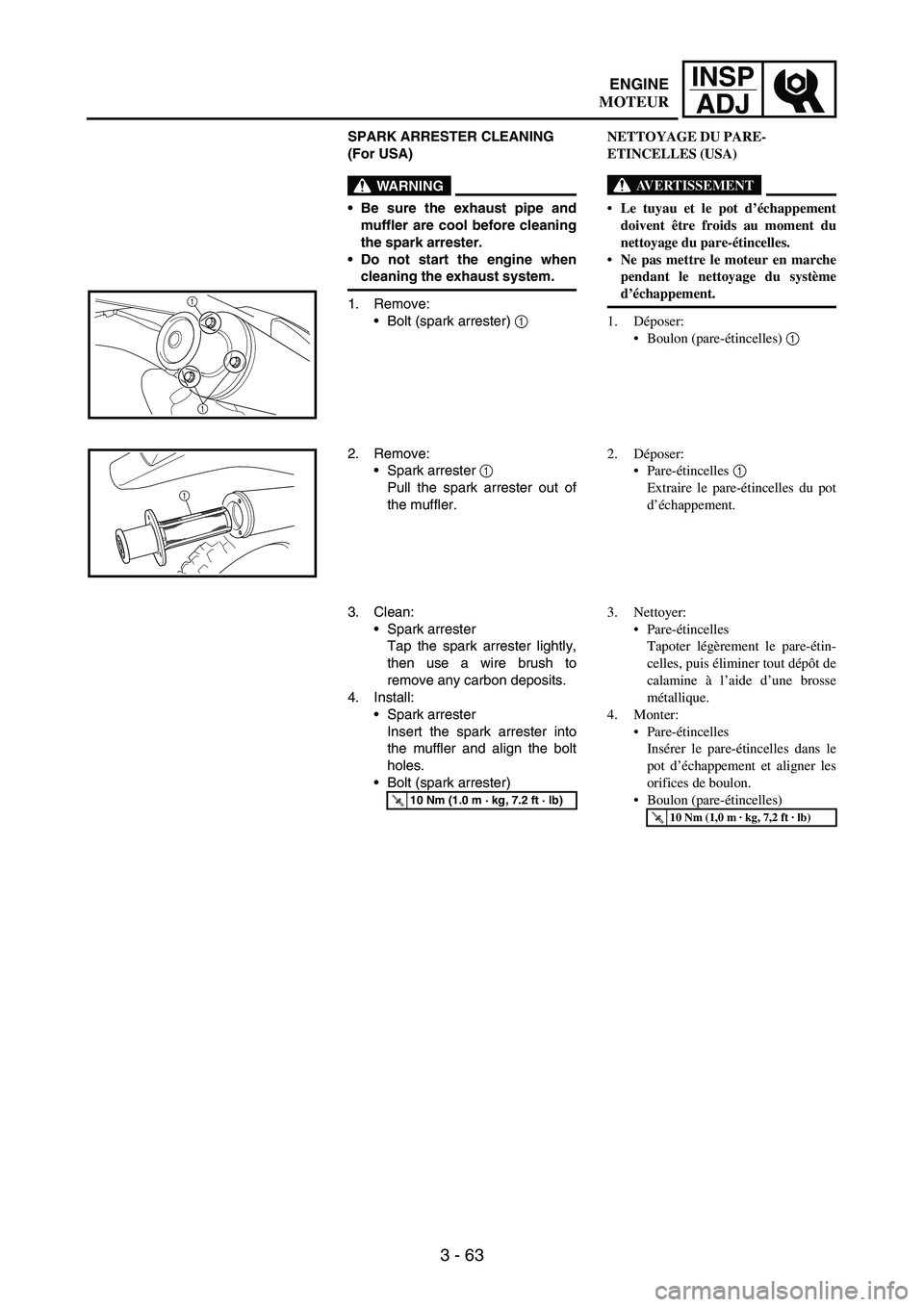
1. Remove:
Bolt (spark arrester)
1
1
1
2. Remove:
Spark arrester
1
Pull the spark arrester out of
the muffler.
1
3. Clean:
Spark arrester
Tap the spark arrester lightly,
then use a wire brush to
remove any carbon deposits.
4. Install:
Spark arrester
Insert the spark arrester into
the muffler and align the bolt
holes.
Bolt (spark arrester)
T R..10 Nm (1.0 m · kg, 7.2 ft · lb)
NETTOYAGE DU PARE-
ETINCELLES (USA)
AVERTISSEMENT
Le tuyau et le pot d’échappement
doivent être froids au moment du
nettoyage du pare-étincelles.
Ne pas mettre le moteur en marche
pendant le nettoyage du système
d’échappement.
1. Déposer:
Boulon (pare-étincelles) 1
2. Déposer:
Pare-étincelles 1
Extraire le pare-étincelles du pot
d’échappement.
3. Nettoyer:
Pare-étincelles
Tapoter légèrement le pare-étin-
celles, puis éliminer tout dépôt de
calamine à l’aide d’une brosse
métallique.
4. Monter:
Pare-étincelles
Insérer le pare-étincelles dans le
pot d’échappement et aligner les
orifices de boulon.
Boulon (pare-étincelles)
T R..10 Nm (1,0 m · kg, 7,2 ft · lb)
ENGINE
MOTEUR
Page 292 of 864
3 - 101
INSP
ADJ
2. Inspect:
Bearing free play
Exist play
→ Replace.
EC36U013STEERING HEAD INSPECTION
AND ADJUSTMENT
1. Elevate the front wheel by plac-
ing a suitable stand under the
engine.
2. Check:
Steering stem
Grasp the bottom of the forks
and gently rock the fork
assembly back and forth.
Free play
→ Adjust steering
head.
3. Check:
Steering smooth action
Turn the handlebar lock to
lock.
Unsmooth action
→ Adjust
steering ring nut.
4. Adjust:
Steering ring nut
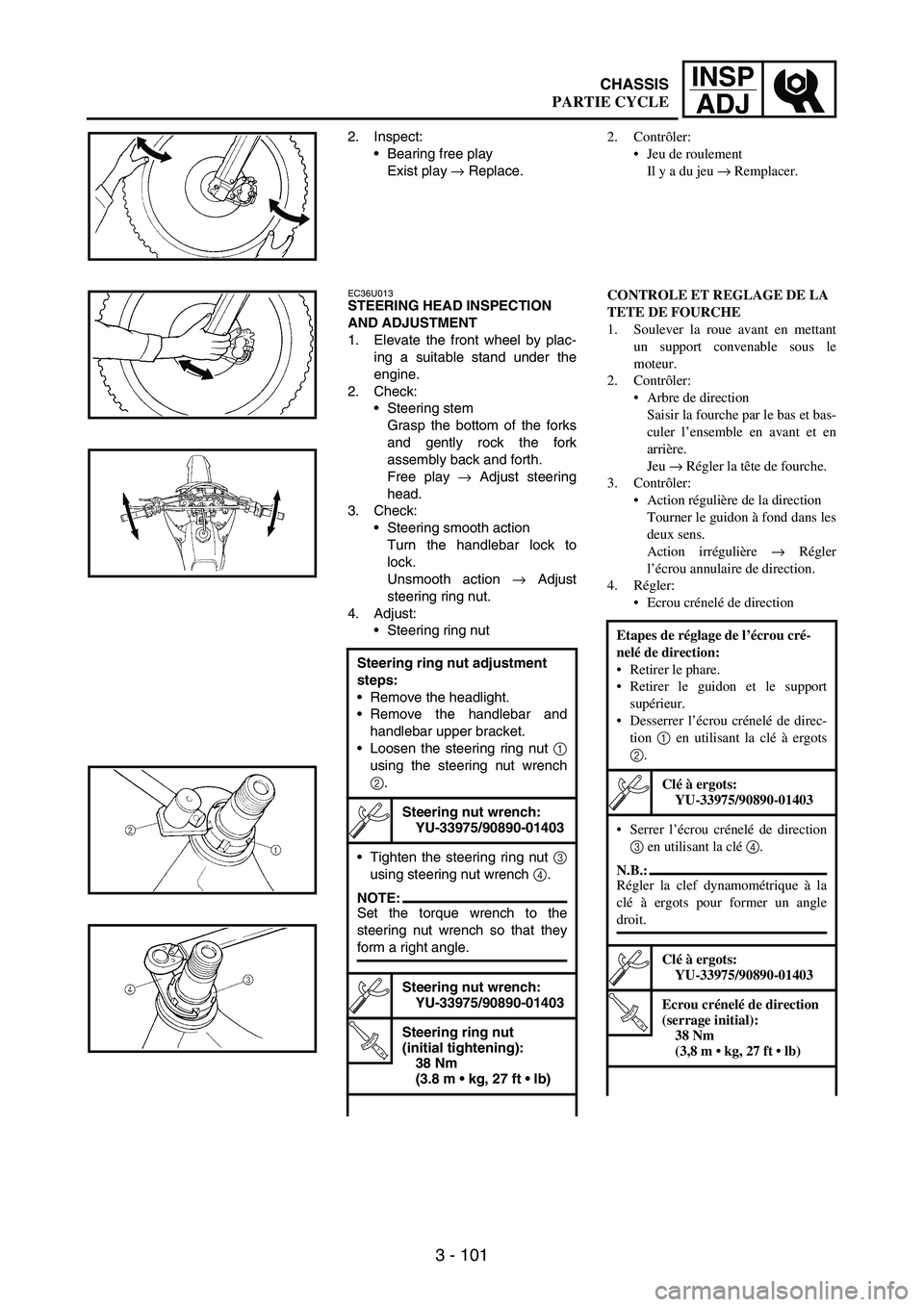
Steering ring nut adjustment
steps:
Remove the headlight.
Remove the handlebar and
handlebar upper bracket.
Loosen the steering ring nut
1
using the steering nut wrench
2.
Steering nut wrench:
YU-33975/90890-01403
Tighten the steering ring nut
3
using steering nut wrench
4.
NOTE:Set the torque wrench to the
steering nut wrench so that they
form a right angle.
Steering nut wrench:
YU-33975/90890-01403
T R..
Steering ring nut
(initial tightening):
38 Nm
(3.8 m kg, 27 ft lb)
2. Contrôler:
Jeu de roulement
Il y a du jeu → Remplacer.
CONTROLE ET REGLAGE DE LA
TETE DE FOURCHE
1. Soulever la roue avant en mettant
un support convenable sous le
moteur.
2. Contrôler:
Arbre de direction
Saisir la fourche par le bas et bas-
culer l’ensemble en avant et en
arrière.
Jeu → Régler la tête de fourche.
3. Contrôler:
Action régulière de la direction
Tourner le guidon à fond dans les
deux sens.
Action irrégulière → Régler
l’écrou annulaire de direction.
4. Régler:
Ecrou crénelé de direction
Etapes de réglage de l’écrou cré-
nelé de direction:
Retirer le phare.
Retirer le guidon et le support
supérieur.
Desserrer l’écrou crénelé de direc-
tion 1 en utilisant la clé à ergots
2.
Clé à ergots:
YU-33975/90890-01403
Serrer l’écrou crénelé de direction
3 en utilisant la clé 4.
N.B.:
Régler la clef dynamométrique à la
clé à ergots pour former un angle
droit.
Clé à ergots:
YU-33975/90890-01403
T R..
Ecrou crénelé de direction
(serrage initial):
38 Nm
(3,8 m kg, 27 ft lb)
CHASSIS
PARTIE CYCLE
Page 294 of 864
3 - 103
INSP
ADJ
Loosen the steering ring nut
one turn.
Retighten the steering ring nut
using the steering nut wrench.
WARNING
Avoid over-tightening.
T R..
Steering ring nut
(final tightening):
7 Nm
(0.7 m kg, 5.1 ft lb)
Check the steering stem by
turning it lock to lock. If there is
any binding, remove the steer-
ing stem assembly and inspect
the steering bearings.
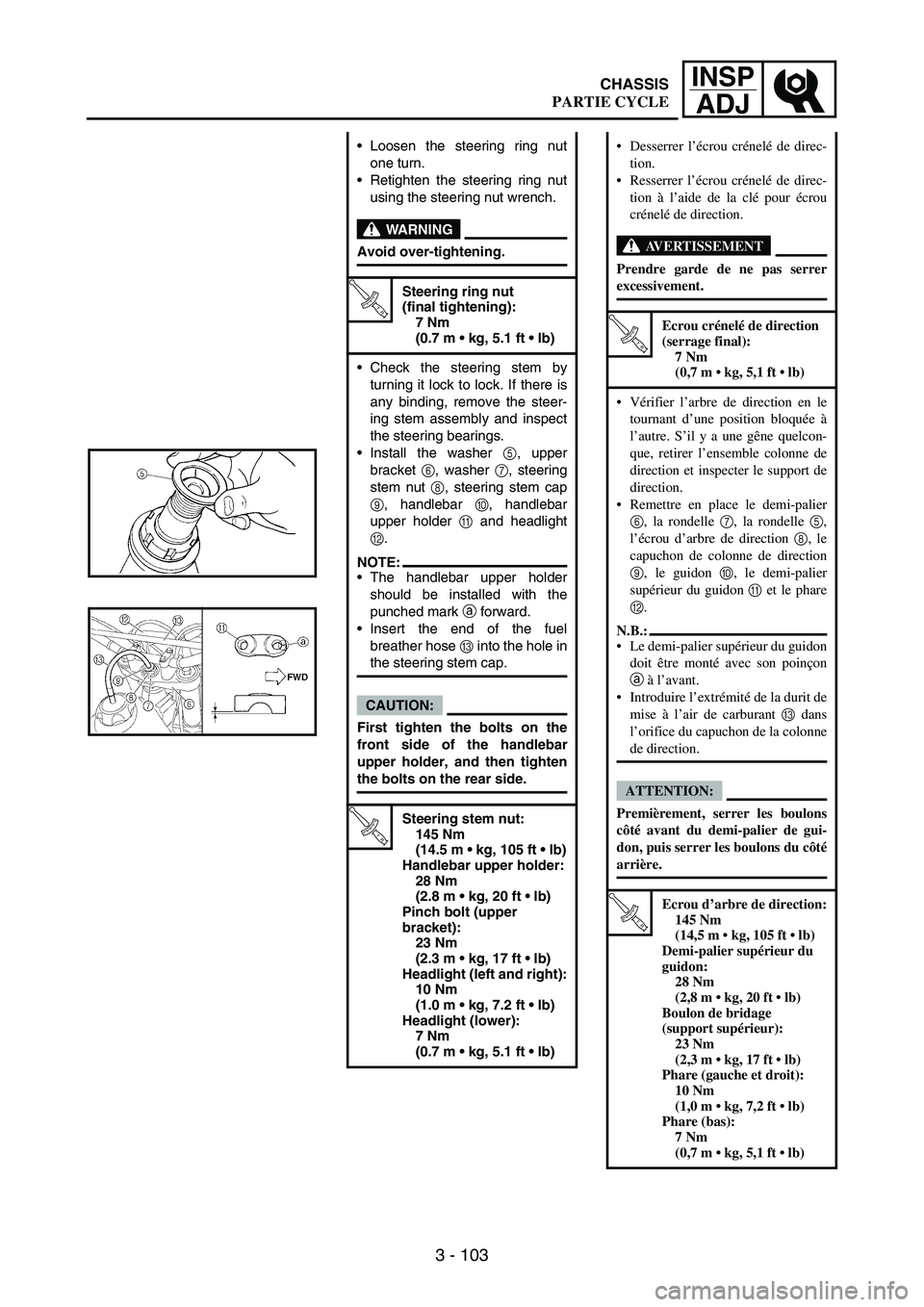
Install the washer
5, upper
bracket
6, washer
7, steering
stem nut
8, steering stem cap
9, handlebar
0, handlebar
upper holder
A and headlight
B.
NOTE:The handlebar upper holder
should be installed with the
punched mark
a forward.
Insert the end of the fuel
breather hose
C into the hole in
the steering stem cap.
CAUTION:
First tighten the bolts on the
front side of the handlebar
upper holder, and then tighten
the bolts on the rear side.
T R..
Steering stem nut:
145 Nm
(14.5 m kg, 105 ft lb)
Handlebar upper holder:
28 Nm
(2.8 m kg, 20 ft lb)
Pinch bolt (upper
bracket):
23 Nm
(2.3 m kg, 17 ft lb)
Headlight (left and right):
10 Nm
(1.0 m kg, 7.2 ft lb)
Headlight (lower):
7 Nm
(0.7 m kg, 5.1 ft lb)
Desserrer l’écrou crénelé de direc-
tion.
Resserrer l’écrou crénelé de direc-
tion à l’aide de la clé pour écrou
crénelé de direction.
AVERTISSEMENT
Prendre garde de ne pas serrer
excessivement.
T R..
Ecrou crénelé de direction
(serrage final):
7 Nm
(0,7 m kg, 5,1 ft lb)
Vérifier l’arbre de direction en le
tournant d’une position bloquée à
l’autre. S’il y a une gêne quelcon-
que, retirer l’ensemble colonne de
direction et inspecter le support de
direction.
Remettre en place le demi-palier
6, la rondelle 7, la rondelle 5,
l’écrou d’arbre de direction 8, le
capuchon de colonne de direction
9, le guidon 0, le demi-palier
supérieur du guidon A et le phare
B.
N.B.:
Le demi-palier supérieur du guidon
doit être monté avec son poinçon
a à l’avant.
Introduire l’extrémité de la durit de
mise à l’air de carburant C dans
l’orifice du capuchon de la colonne
de direction.
ATTENTION:
Premièrement, serrer les boulons
côté avant du demi-palier de gui-
don, puis serrer les boulons du côté
arrière.
T R..
Ecrou d’arbre de direction:
145 Nm
(14,5 m kg, 105 ft lb)
Demi-palier supérieur du
guidon:
28 Nm
(2,8 m kg, 20 ft lb)
Boulon de bridage
(support supérieur):
23 Nm
(2,3 m kg, 17 ft lb)
Phare (gauche et droit):
10 Nm
(1,0 m kg, 7,2 ft lb)
Phare (bas):
7 Nm
(0,7 m kg, 5,1 ft lb)
CHASSIS
PARTIE CYCLE
Page 296 of 864
3 - 105
INSP
ADJ
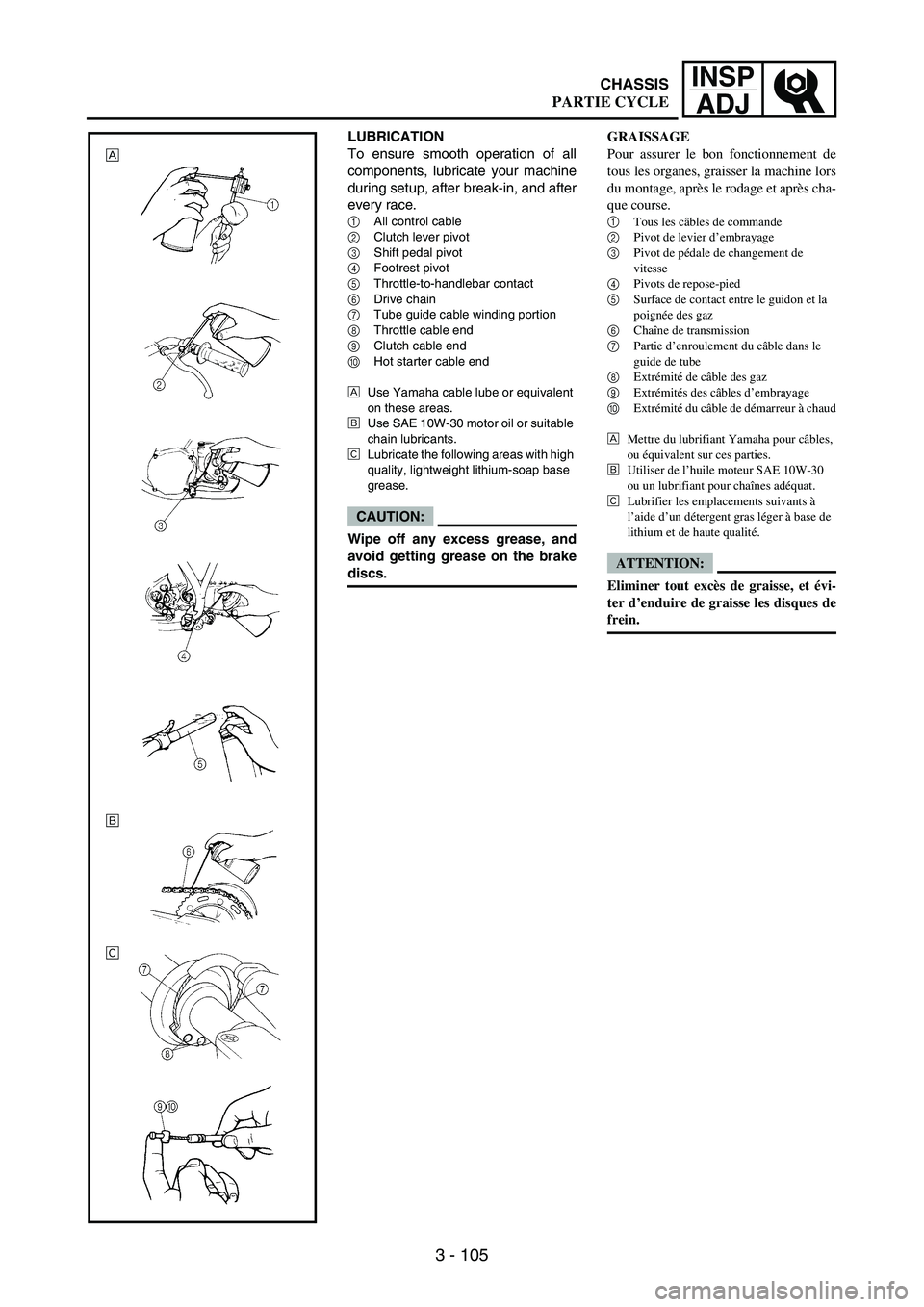
GRAISSAGE
Pour assurer le bon fonctionnement de
tous les organes, graisser la machine lors
du montage, après le rodage et après cha-
que course.
1
Tous les câbles de commande
2
Pivot de levier d’embrayage
3
Pivot de pédale de changement de
vitesse
4
Pivots de repose-pied
5
Surface de contact entre le guidon et la
poignée des gaz
6
Chaîne de transmission
7
Partie d’enroulement du câble dans le
guide de tube
8
Extrémité de câble des gaz
9
Extrémités des câbles d’embrayage
0
Extrémité du câble de démarreur à chaud
È
Mettre du lubrifiant Yamaha pour câbles,
ou équivalent sur ces parties.
É
Utiliser de l’huile moteur SAE 10W-30
ou un lubrifiant pour chaînes adéquat.
Ê
Lubrifier les emplacements suivants à
l’aide d’un détergent gras léger à base de
lithium et de haute qualité.
ATTENTION:
Eliminer tout excès de graisse, et évi-
ter d’enduire de graisse les disques de
frein.
CHASSIS
PARTIE CYCLE
LUBRICATION
To ensure smooth operation of all
components, lubricate your machine
during setup, after break-in, and after
every race.
1All control cable
2Clutch lever pivot
3Shift pedal pivot
4Footrest pivot
5Throttle-to-handlebar contact
6Drive chain
7Tube guide cable winding portion
8Throttle cable end
9Clutch cable end
0Hot starter cable end
ÈUse Yamaha cable lube or equivalent
on these areas.
ÉUse SAE 10W-30 motor oil or suitable
chain lubricants.
ÊLubricate the following areas with high
quality, lightweight lithium-soap base
grease.
CAUTION:
Wipe off any excess grease, and
avoid getting grease on the brake
discs.
È
É
Ê
Page 298 of 864
3 - 107
INSP
ADJ
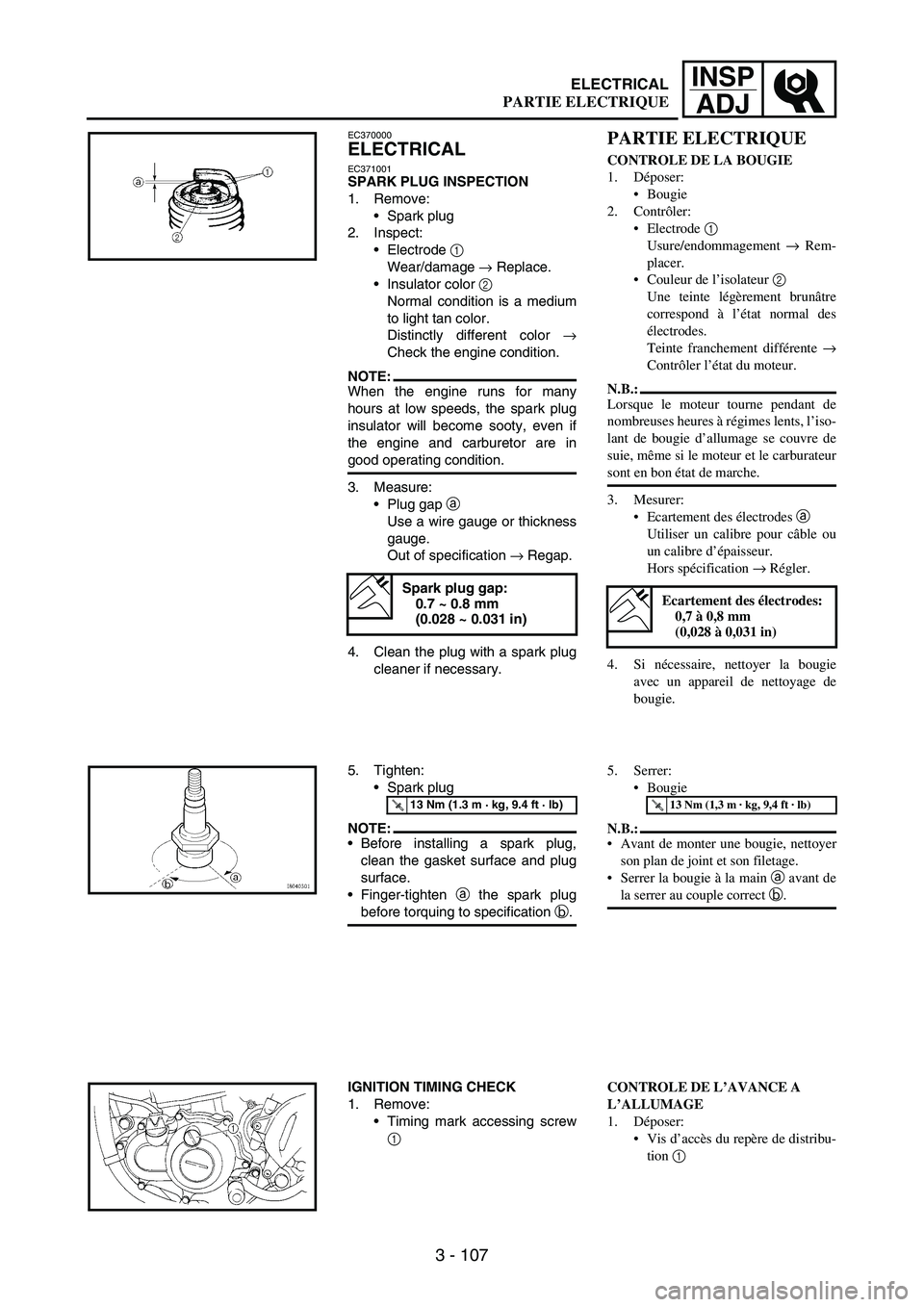
EC370000
ELECTRICAL
EC371001SPARK PLUG INSPECTION
1. Remove:
Spark plug
2. Inspect:
Electrode
1
Wear/damage
→ Replace.
Insulator color
2
Normal condition is a medium
to light tan color.
Distinctly different color
→
Check the engine condition.
NOTE:When the engine runs for many
hours at low speeds, the spark plug
insulator will become sooty, even if
the engine and carburetor are in
good operating condition.
3. Measure:
Plug gap
a
Use a wire gauge or thickness
gauge.
Out of specification
→ Regap.
4. Clean the plug with a spark plug
cleaner if necessary.
Spark plug gap:
0.7 ~ 0.8 mm
(0.028 ~ 0.031 in)
5. Tighten:
Spark plug
NOTE:Before installing a spark plug,
clean the gasket surface and plug
surface.
Finger-tighten
a the spark plug
before torquing to specification
b.
T R..13 Nm (1.3 m · kg, 9.4 ft · lb)
IGNITION TIMING CHECK
1. Remove:
Timing mark accessing screw
1
PARTIE ELECTRIQUE
CONTROLE DE LA BOUGIE
1. Déposer:
Bougie
2. Contrôler:
Electrode 1
Usure/endommagement → Rem-
placer.
Couleur de l’isolateur 2
Une teinte légèrement brunâtre
correspond à l’état normal des
électrodes.
Teinte franchement différente →
Contrôler l’état du moteur.
N.B.:
Lorsque le moteur tourne pendant de
nombreuses heures à régimes lents, l’iso-
lant de bougie d’allumage se couvre de
suie, même si le moteur et le carburateur
sont en bon état de marche.
3. Mesurer:
Ecartement des électrodes a
Utiliser un calibre pour câble ou
un calibre d’épaisseur.
Hors spécification → Régler.
4. Si nécessaire, nettoyer la bougie
avec un appareil de nettoyage de
bougie.
Ecartement des électrodes:
0,7 à 0,8 mm
(0,028 à 0,031 in)
5. Serrer:
Bougie
N.B.:
Avant de monter une bougie, nettoyer
son plan de joint et son filetage.
Serrer la bougie à la main a avant de
la serrer au couple correct b.
T R..13 Nm (1,3 m · kg, 9,4 ft · lb)
CONTROLE DE L’AVANCE A
L’ALLUMAGE
1. Déposer:
Vis d’accès du repère de distribu-
tion 1
ELECTRICAL
PARTIE ELECTRIQUE